
Market Overview
| Study Period | 2020 - 2031 |
|---|---|
| Forecast Data Period | 2026 - 2031 |
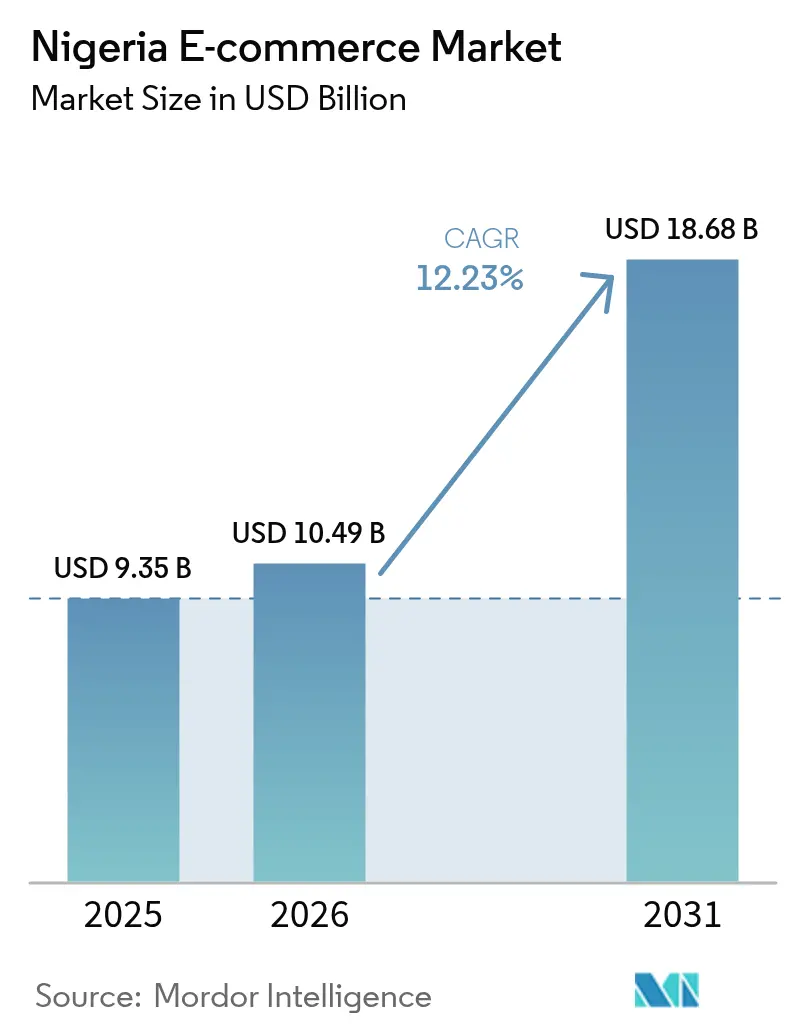
| Base Year Market Size (2025) | USD 9.35 Billion |
| Market Size (2026) | USD 10.49 Billion |
| Market Size (2031) | USD 18.68 Billion |
| Growth Rate (2026 - 2031) | 12.23 % |
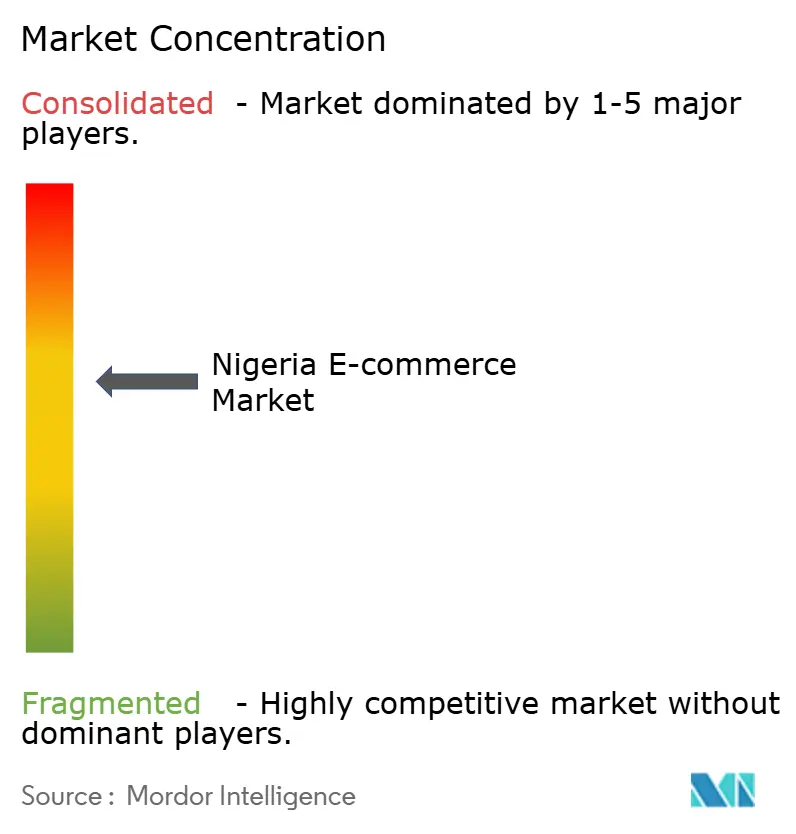
| Market Concentration | Medium |
Major Players *Disclaimer: Major Players sorted in no particular order Image © Mordor Intelligence. Reuse requires attribution under CC BY 4.0. | |
Nigeria E-commerce Market Analysis by Mordor Intelligence
The Nigeria e-commerce market size is expected to grow from USD 9.35 billion in 2025 to USD 10.49 billion in 2026 and is forecast to reach USD 18.68 billion by 2031 at 12.23% CAGR over 2026-2031. Rapid smartphone adoption, stronger payment rails and a wider logistics footprint continue to expand digital retail penetration in both urban and semi-urban centres. Mobile commerce now accounts for more than four-fifths of online orders, while social platforms have become critical discovery and checkout venues. Intensifying competition among local and foreign platforms is encouraging investments in same-day fulfilment, embedded finance and richer SKU depth. At the same time, margin management remains a central theme because of Naira volatility, higher last-mile costs and an evolving tax regime for non-resident digital sellers. Market participants that secure dependable logistics partners, diversify currency exposure and leverage data-driven merchandising are best positioned to capture upside within the Nigeria e-commerce market.[1]
Key Report Takeaways
- By business model, the B2C segment held 86.40% Nigeria e-commerce market share in 2025, while B2B is set to expand at an 18.14% CAGR through 2031.
- By device, smartphones captured 82.30% of transactions in 2025; desktop-led purchases are forecast to grow at a modest 4.08% CAGR to 2031.
- By payment method, credit/debit cards contributed 32.40% of transaction value in 2025, whereas BNPL solutions are projected to rise at a 28.4% CAGR between 2026 and 2031.
- By B2C product category, consumer electronics commanded 27.60% of revenue in 2025; beauty and personal care is advancing at a 16.46% CAGR to 2031.
Note: Market size and forecast figures in this report are generated using Mordor Intelligence’s proprietary estimation framework, updated with the latest available data and insights as of 2026.
Market Trends and Insights
Drivers Impact Analysis of Nigeria E-commerce Market*
| Driver | (~) % Impact on CAGR Forecast | Geographic Relevance | Impact Timeline |
|---|---|---|---|
| Surge in Social Commerce Adoption via WhatsApp & Instagram | +1.9% | National, with higher impact in Lagos, Abuja, and Port Harcourt | Short term (≤ 2 years) |
| Rapid Expansion of Mobile-Money Agent Network for Pay-on-Delivery Conversion | +1.5% | National, with emphasis on semi-urban and rural areas | Medium term (2-4 years) |
| Government National Broadband Plan Targeting 70% Coverage by 2025 | +2.2% | National, with initial focus on urban centers | Medium term (2-4 years) |
| Logistics Tech Start-ups Enabling Same-Day Fulfilment in Lagos & Abuja | +1.7% | Lagos and Abuja, with gradual expansion to secondary cities | Short term (≤ 2 years) |
| Cross-border Marketplace Integrations Boosting SKU Depth | +1.4% | National, with higher impact in urban centers | Medium term (2-4 years) |
| Rising Adoption of Buy-Now-Pay-Later Increasing Average Basket Size | +2.1% | National, with concentration in middle-income urban areas | Short term (≤ 2 years) |
| Source: Mordor Intelligence | |||
Surge in Social Commerce Adoption via WhatsApp & Instagram
Social shopping has shifted from a supplementary marketing tool into a priority sales engine for merchants in the Nigeria e-commerce market. Roughly 36.8 million social users dedicate close to four hours daily to platforms that now embed frictionless checkout. Businesses exploit these high-engagement venues to shorten conversion paths, increase order frequency and reduce reliance on formal storefronts. Real-time messaging builds consumer trust by enabling product verification before purchase. As a result, social commerce transaction value is projected to nearly double from USD 2.04 billion in 2025 to USD 3.96 billion in 2030, outpacing overall market growth. Platforms are also opening monetisation avenues for content creators, adding a community-led influence layer that supports cross-selling.
Rapid Expansion of Mobile-Money Agent Network for Pay-on-Delivery Conversion
Agent banking has evolved into an essential last-mile enabler for online retail, especially beyond tier-one cities. National initiatives targeting an eight-fold increase in female agents are widening consumer touchpoints for digital transactions. Agents convert cash-on-delivery orders into electronic settlements, lowering fraud risk and accelerating cash cycles for merchants. Larger corporates are introducing “agent-as-a-service” models, providing e-commerce platforms with on-demand distribution capacity. With cash still representing 55% of point-of-sale value, these networks help migrate shoppers into formal digital rails, ultimately enlarging addressable demand for the Nigeria e-commerce market.[3]
Government National Broadband Plan Targeting 70% Coverage by 2025
The broadband roadmap mandates download speeds of 25 Mbps in cities and 10 Mbps in rural zones, aiming to connect at least 90% of the population.[2] Every 10-point rise in broadband penetration is linked to up to 3.8% incremental GDP, reinforcing political commitment to infrastructure roll-outs. While a USD 461 million funding gap risks delay, public-private co-investment and a recently announced US-Nigeria technology dialogue are catalysing fibre deployment. Greater capacity unlocks richer media experiences, faster page loads and secure payment flows, broadening the customer base and supporting higher-value categories within the Nigeria e-commerce market.
Logistics Tech Start-ups Enabling Same-Day Fulfilment in Lagos & Abuja
More than 370 logistics tech ventures now operate in Nigeria, with funded players introducing AI-based route optimisation, real-time parcel visibility and micro-hub models. Same-day delivery, once aspirational, is becoming viable across key districts, elevating customer satisfaction and repeat orders. Asset-light orchestration platforms aggregate third-party vehicles and riders, cutting fixed costs while scaling capacity for peak events. As logistics reliability improves, retailers can confidently list perishable or fragile items, adding SKU diversity that deepens the Nigeria e-commerce market.
Restraints Impact Analysis of Nigeria E-commerce Market*
| Restraint | (~) % Impact on CAGR Forecast | Geographic Relevance | Impact Timeline |
|---|---|---|---|
| Urban Congestion & Poor Address Systems Inflate Last-Mile Costs | -1.1% | Major urban centers, particularly Lagos and Abuja | Medium term (2-4 years) |
| High Card-Not-Present Fraud & Charge-backs Escalate Merchant Costs | -1.0% | National, with higher impact in urban areas | Short term (≤ 2 years) |
| Naira Volatility Compressing Import-Heavy Category Margins | -1.4% | National | Medium term (2-4 years) |
| Uncertain Digital Services Tax Framework for Foreign Sellers | -0.9% | National, with higher impact on international platforms | Medium term (2-4 years) |
| Source: Mordor Intelligence | |||
Urban Congestion & Poor Address Systems Inflate Last-Mile Costs
Traffic bottlenecks lengthen delivery windows by several hours and raise fulfilment charges by up to 30% versus structured markets. Informal addressing leads to failed drops and costly re-routes. Operators are piloting address validation APIs, geo-tagged pick-up lockers and community delivery agents to cut mis-delivery. Micro-fulfilment centres closer to demand clusters reduce travel distance but push up fixed overheads, limiting adoption by smaller vendors. Collaboration between state authorities and postal services aims to standardise addressing, which would materially unlock efficiency across the Nigeria e-commerce market.
High Card-Not-Present Fraud & Charge-backs Escalate Merchant Costs
Fraudulent transactions erode merchant profitability and damage consumer trust. Multi-factor authentication, one-time passwords and tokenisation have lowered attack vectors, yet fraud rates remain above global averages. Payment gateways are investing in behavioural analytics to flag anomalies in real time. Cost-sharing arrangements between issuers and acquirers help absorb charge-back exposure, but smaller sellers still face processing fee penalties that discourage card acceptance.
*Our forecasts treat driver/restraint impacts as directional, not additive. The impact forecasts reflect baseline growth, mix effects, and variable interactions.
Nigeria E-commerce Market Segment Analysis
By Business Model:
B2B Platforms Unlock Supply-Chain EfficiencyThe B2C arm dominates current value flows, holding 86.40% Nigeria e-commerce market share in 2025. Even so, the B2B channel is scaling at an 18.14% CAGR as wholesalers and informal retailers digitise procurement. Leading start-ups process hundreds of millions of USD in annual transactions, leveraging embedded credit to improve stock rotation for corner shops that still drive most consumer purchases. Service expansion into inventory analytics, demand forecasting and supplier financing makes these platforms integral to the fast-moving consumer goods chain.
Digitalisation compresses procurement costs by roughly one-fifth and cuts delivery lead times from days to hours. As mobile penetration deepens, rural shop owners increasingly use voice-enabled ordering interfaces offered in local languages. Financial-service partners underwrite inventory loans based on real-time sales data, reducing default risk. Over the forecast horizon, scale economics, coupled with deeper monetisation of data, should sustain double-digit growth and progressively rebalance overall revenue composition within the Nigeria e-commerce market.


By Device Type:
Mobile Prevails, Multiscreen MaturesSmartphones generated 82.30% of orders in 2025 and are projected to grow at a 12.95% CAGR. The Nigeria e-commerce market size for mobile reached USD 7.66 billion in 2025 and is set to exceed USD 15.9 billion by 2031. High-speed 4G and impending 5G roll-outs further reinforce mobile’s primacy. Desktop traffic, while shrinking as a share, remains important for research-intensive or high-value purchases such as appliances.
Short-form video, live commerce and in-app messaging are optimised for handheld devices, obliging merchants to prioritise responsive design, compressed imagery and concise copy. Voice search and vernacular chat-bots improve accessibility for first-time shoppers. Concurrently, connected-TV commerce and smart-speaker ordering are emerging in affluent homes, indicating a gradual pivot toward omnichannel engagement. Platforms that maintain design parity across screens are positioned to capture incremental wallet share as device ecosystems proliferate.
By Payment Method:
BNPL Widens Affordability SpectrumCards led value throughput with 32.40% share in 2025, yet BNPL volume is climbing rapidly. The Nigeria e-commerce market size for BNPL solutions is expected to surpass USD 1.78 billion in 2026, reflecting mounting preference among millennials seeking frictionless credit. Pay-in-four instalments spread discretionary spending without incurring traditional loan interest, driving up conversion rates for electronics and fashion.
Digital wallets are on track to capture 22% of transaction value by 2027. Telecommunications operators anchor this trend by bundling wallets with data plans and loyalty rewards. Payment orchestration platforms route transactions dynamically to optimise approval rates and lower fees. Cash-on-delivery still appeals in trust-deficit clusters, but its share will erode as agent networks and regulatory safeguards improve perception of digital channels in the Nigeria e-commerce market.

By B2C Product Category:
Beauty and Personal Care Outpaces Core ElectronicsConsumer electronics retained the revenue crown with 27.60% of sales in 2025, buoyed by demand for smartphones, accessories and home entertainment. However, beauty and personal care generated the fastest trajectory with a 16.46% CAGR outlook. Rising disposable income and social-media-driven aesthetics fuel online discovery of skincare, haircare and cosmetics. Local indie brands leverage home-grown ingredients and inclusive shades to differentiate.
Average basket values in beauty remain lower than electronics but frequency is higher, promoting recurring revenue. Subscription models for essential items and influencer-led bundles encourage loyalty. Meanwhile, fashion, grocery and home goods continue to expand as logistics and cold-chain capacity strengthen. Augmented-reality try-on tools for furniture and apparel reduce return rates, enhancing profitability across verticals in the Nigeria e-commerce market.
Geography Analysis
Greater Lagos accounted for nearly 39.30% of online orders in 2025, supported by 60% broadband penetration and a dense courier network. Abuja and Port Harcourt complete the top urban triad, contributing a further 25.40% of trade. Collectively, these hubs dominate basket sizes and host the highest concentration of same-day fulfilment services. Smart lockers and bike couriers offset traffic congestion, yet address verification remains a work in progress.
Expansion to secondary cities such as Ibadan, Kano and Enugu is accelerating. Telecom roll-outs, affordable smartphones and agent-enabled cash digitisation lower entry barriers for first-time shoppers. The Nigeria e-commerce market size attributable to northern states is projected to record a 15.02% CAGR to 2031, aided by government and donor programmes that promote female agent participation and vernacular literacy tools. Regional platform variants with lighter apps and USSD ordering further bridge digital divides.
Cross-border commerce layers another dimension on geography. Import-dependent segments rely on coastal ports and Lagos airport logistics hubs to feed inventory. The African Continental Free Trade Area promises smoother customs corridors, potentially expanding addressable demand to diaspora markets and neighbouring economies. However, currency risks and nascent digital tax enforcement make cross-border volume sensitive to macro shifts. Operators that hedge currency exposure and adopt compliant invoicing stand to capture incremental share within the Nigeria e-commerce market.
Regulatory Landscape
Nigeria's e-commerce operating environment is shaped by overlapping digital economy, consumer protection, and data privacy requirements. In 2026, the Federal Ministry of Communications, Innovation and Digital Economy directed a harmonised approach to regulating internet platforms and online intermediaries, establishing a Joint Technical Coordination Committee and maintaining a regulatory status quo while inter-agency alignment is pursued across relevant authorities.
For consumer-facing conduct, the Federal Competition and Consumer Protection Commission (FCCPC) issued the Federal Competition and Consumer Protection (Consumer Protection) Regulations, 2026 as exposure drafts in April 2026, including clearer disclosure requirements on digital platforms such as transparent pricing in Nigerian currency and strengthened consumer information obligations for e-commerce websites and mobile apps. On the governance side, NITDA continues to publish and maintain key digital governance instruments, while the Nigeria Data Protection Commission enforces privacy requirements under the current data protection regime. This keeps pricing transparency, terms, and data handling readiness central for marketplace operators and merchants.
Value Chain Analysis
Nigeria's e-commerce value chain begins with merchants and brand owners, including cross-border sellers, and extends through marketplace enablers such as storefronts, catalog and content tools, and seller onboarding and KYC. Payment acceptance then runs through banks, fintech gateways, and open banking-enabled integrations, followed by fulfillment operations that blend in-house networks with third-party logistics.
In B2B commerce, platforms such as OmniRetail and TradeDepot act as upstream digitisation nodes for informal retail by combining ordering, inventory visibility, and embedded finance to move stock from manufacturers and distributors to kiosks and corner shops. Midstream and downstream performance is still constrained by infrastructure and operational frictions, including fragmented courier capacity, congestion-driven variability in last-mile delivery, unreliable power affecting warehousing operations, and import logistics exposure for electronics and other import-heavy categories. Specialized logistics and fulfillment providers, including Movnn and Peng Logistics, support warehousing and nationwide delivery coverage for online sellers, while port and customs inefficiencies remain key lead-time and cost variables for cross-border inventory into Lagos gateways. The chain increasingly leans on orchestration, pickup points, agent-enabled cash digitisation, and data-driven routing to improve delivery reliability and reduce failed-delivery rates in dense urban clusters.
Competitive Landscape
Nigeria’s digital retail arena remains moderately concentrated. Jumia leads on brand awareness, logistics reach and vendor onboarding, processing 21.3 million orders in 2023. Konga defends share through private-label electronics and marketplace diversification. Temu’s late-2024 entry injected aggressive price competition backed by global sourcing efficiencies. The trio commanded an estimated 54% of gross merchandise value in 2024.
Competitive advantage now hinges on control of fulfilment nodes and payment rails. Jumia invests in proprietary delivery vehicles and pick-up stations, while Temu partners with international couriers to compress lead times for imports. BNPL alliances with fintechs such as CredPal deepen consumer stickiness, whereas embedded wallet ecosystems from telcos create closed-loop funnels for repeat purchase. Data analytics, AI-driven recommendations and real-time inventory sync differentiate user experience and lift conversion across the Nigeria e-commerce market.
Niche challengers carve defensible positions in grocery, pharmaceuticals and B2B trade. OmniRetail leverages embedded credit to lock in informal shopkeepers, whereas GoLemon deploys dark stores for perishable goods. Logistics startups like Shipbubble and Kobo360 monetise route intelligence through software-as-a-service. Strategic partnerships, selective M&A and targeted geographic focus are the dominant manoeuvres as firms pursue scale without overextending capital.
Nigeria E-commerce Industry Leaders
-
Chrisvicmall
-
Zikel Cosmetics International Limited
-
Soso Games Limited
-
BonAmour Nigeria Limited
-
Ajebomarket Limited
- *Disclaimer: Major Players sorted in no particular order
Nigeria E-commerce Market Companies Covered in this Report
- Jumia Technologies AG
- Konga Online Shopping Limited
- SLOT Systems Limited
- Omniretail Technologies Limited
- Jiji Africa B.V.
- Amazon.com Inc.
- AliExpress – Alibaba Group Holding Limited
- PayPorte Global Systems Limited
- Chrisvicmall
- Ajebomarket Limited
- Obeezi Ecommerce Limited
- Seunman Ventures Limited
- Soso Games Limited
- BonAmour Nigeria Limited
- Zikel Cosmetics International Limited
- Vendease Africa Limited
- Mall for Africa Inc.
- Kara Nigeria Online Limited
- OList Nigeria Marketplace
Market Opportunities and Future Outlook
A near-term opportunity is simplifying compliance and trust-building at checkout as Nigeria moves toward clearer digital economy governance. The Federal Ministry of Communications, Innovation and Digital Economy's 2026 directive to harmonise regulation of internet platforms, alongside the ongoing National Digital Economy and E-Governance Bill process, creates room for platforms and merchants that formalize consumer-facing disclosures, complaint handling, and privacy-by-design workflows early. This is particularly timely as the FCCPC's April 2026 exposure drafts for the Consumer Protection Regulations emphasize clearer price presentation in Nigerian currency and stronger consumer information standards across apps and websites.
Payments and affordability tools are also widening the addressable base as rails modernize and merchant credit products deepen. Nigeria Inter-Bank Settlement System introduced the National Payment Stack (NPS) in November 2025 as an ISO 20022-based multi-rail instant payments infrastructure, while the Central Bank of Nigeria launched Payments System Vision (PSV) 2028 in June 2026 with an inclusion and cross-border payments agenda. Together, these initiatives support broader use cases for marketplace payouts, refunds, and multi-rail payment orchestration. On the commercial side, platforms are expanding flexible payment options, including Konga's July 2026 upgrade of its digital shopping experience and its BNPL partnership with Klump. Major operators such as Jumia also highlighted Nigeria as its most active market in 2026 disclosures, reinforcing ongoing investment in assortment, sourcing, and fulfillment execution within the country.
Recent Industry Developments in Nigeria E-commerce Market
- July 2026: Konga rolled out an upgraded mobile app and website and announced a partnership with BNPL provider Klump to enable monthly installment payments for qualified purchases. The rollout broadens affordability for higher-ticket categories and strengthens conversion in a market where flexible payments are increasingly used to offset household budget constraints.
- June 2026: The Central Bank of Nigeria launched Payments System Vision (PSV) 2028, outlining priorities including deeper financial inclusion and stronger cross-border payment capabilities. This policy direction supports faster, more interoperable payment experiences for e-commerce checkout, refunds, and merchant settlements as platforms integrate multi-rail payment options.
- May 2025: OmniRetail secured USD 20 million in Series A funding to deepen coverage across West Africa and scale its B2B commerce model serving informal retailers. The capital supports expansion of logistics and embedded finance capabilities that improve product availability and procurement efficiency for merchants that also feed downstream consumer demand.
Nigeria E-commerce Market Report Scope and Research Methodology
Market Definition and Coverage
This market covers the value of goods and services purchased through online channels in Nigeria, where the order is placed digitally and the transaction is completed for delivery or fulfillment.
Scope exclusions: We exclude informal social selling where there is no online checkout, plus offline purchases that are only influenced by digital ads.
Segments Covered in This Report
- By Business Model
- B2C
- B2B
- By Device Type
- Smartphone / Mobile
- Desktop and Laptop
- Other Device Types
- By Payment Method
- Credit / Debit Cards
- Digital Wallets
- BNPL
- Other Payment Method
- By B2C Product Category
- Beauty and Personal Care
- Consumer Electronics
- Fashion and Apparel
- Food and Beverages
- Furniture and Home
- Toys, DIY and Media
- Other Product Categories
Data Sources, Market Sizing, and Validation
Desk Research
Desk research starts with public data that helps anchor the demand pool and the ability to serve it. For Nigeria, we use sources such as the Nigerian Communications Commission for broadband and subscriber trends, the National Bureau of Statistics for household consumption signals, and the Central Bank of Nigeria for payment system indicators and currency context.
To make the online commerce layer more measurable, we also review sources such as the World Bank and ITU for digital access benchmarks. For delivery constraints and coverage, we include Nigeria Postal Service data plus trade and logistics publications. These signals are then complemented with company filings, investor decks, trusted press releases, and news archives. In a smaller set of cases, we use select paid subscriptions for company financials, shipment-level trade checks, and patent lookups when they clarify platform capability and addressability. The sources listed here are illustrative, and many other references were used to collect data, validate assumptions, and clarify open questions.
Primary Interviews and Surveys
Interviews and surveys with marketplace, retail, payment, logistics, and brand-side participants in Nigeria clarify merchant activity, order frequency, average basket value, cash usage, and delivery friction. We compare respondent input with secondary indicators to identify gaps and adjust the final model, particularly where payment activity does not map directly to retail orders.
Distribution of primary research fieldwork respondents
| Company type | Respondent position |
|---|---|
| Top tier: 28% | CXOs: 20% |
| Mid tier: 47% | Functional/Unit leaders: 30% |
| Smaller Players: 25% | Managers: 50% |
Market-Sizing & Forecasting
Sizing is built by first reconstructing the digital buying pool from Nigeria-specific online access and payments readiness, then applying adoption and spending intensity assumptions that were checked in interviews. Where the market can be tracked through supply signals, we cross-check results using selective bottom-up approximations such as sampled order volumes and average order values by category, then adjust when gaps show up.
A few practical inputs that steer the model include internet and smartphone penetration, share of retail that shifts online, share of orders paid with cash versus electronic methods, delivery reach and failed-delivery rates, and category mix that changes average basket sizes. When a data series is missing for a period, the gap is filled using proxy indicators that move with commerce activity, such as payments rails usage and logistics throughput. These proxy-based fills are reviewed with respondents before the totals are finalized.
For forecasting, we mainly rely on scenario analysis tied to macro and execution drivers that matter in Nigeria, such as disposable income direction, inflation pressure on basket sizes, improvements in delivery coverage, and payment acceptance growth. The scenario weights are tuned using expert expectations so the final curve does not jump unrealistically between years.
Data Validation & Update Cycle
Validation happens through repeated checks between the model output and independent signals such as digital payments growth, telecom access trends, and observable shifts in delivery capacity. If a category or business model shows an abnormal swing, we revisit inputs, re-check currency conversions and timing, and re-contact a small set of experts to understand what changed.
Before sign-off, the work goes through multi-step analyst review so assumptions, math, and logic remain consistent across years. Reports are refreshed annually, and interim updates are made when major market events change demand or transaction behavior, followed by a final pre-delivery review to reflect the latest information.
Mordor Intelligence's Nigeria Ecommerce Market Size Compared Against Other Published Estimates
Published numbers for Nigeria e-commerce often differ because they are not always measuring the same thing, even when they use similar wording. Common causes include mixing GMV with revenue-like value, counting only B2C versus including B2B, and using different currency timing for conversion.
The biggest gap drivers in this market are whether cross-border orders are counted at full merchandise value or at platform value capture, and whether informal social commerce is treated as e-commerce even without checkout. Another source of spread is refresh cadence, where older assumptions on payment mix and delivery success rates can overstate completed value in cash-heavy categories.
Benchmark comparison
| Source | Market Size | Gaps in Research Methodology |
|---|---|---|
| Mordor Intelligence | USD 9.35 B (2025) | |
| Regional Consultancy A | USD 9.54 B (2025) | Uses a GMV-style construct, which can count gross merchandise value without consistently adjusting for cancellations, returns, or delivery failures, thereby lifting totals in cash-heavy categories. |
| Payments Industry Brief B | USD 33.00 B (2026) | Reported as B2C sales and often discussed as transaction value, which can reflect a broader merchandise flow and a different year, rather than a completed-value construct anchored to delivery and payment completion. |
The table shows that the spread is mostly explained by metric choice, year alignment, and how completed transactions are treated. Keeping adjustments tied to cancellation rates, payment mix, and delivery success checks reduces avoidable inflation in the totals, a discipline applied by Mordor Intelligence.
Key Questions Answered in the Report
What is the current value of the Nigeria e-commerce market?
The Nigeria e-commerce market size reached USD 10.49 billion in 2026 and is forecast to rise to USD 18.68 billion by 2031.
Which business model is growing fastest within Nigerian e-commerce?
The B2B segment is expanding at an 18.14% CAGR as digital platforms streamline wholesale procurement for informal retailers.
How important is mobile commerce in Nigeria?
Smartphones contributed 82.30% of online orders in 2025, reflecting Nigeria’s mobile-first shopping behaviour.
Why is BNPL gaining traction among Nigerian consumers?
BNPL boosts affordability by splitting payments into instalments, raising average order values by up to 40% and supporting a projected 28.4% CAGR between 2026 and 2031.
What challenges affect last-mile delivery in Nigeria?
Urban congestion, informal addressing and traffic delays inflate delivery costs by up to 30%, prompting investment in address verification and micro-fulfilment hubs.
Who are the leading e-commerce players in Nigeria?
Jumia, Konga and Temu lead in terms of gross merchandise value, jointly accounting for about 54% of the market in 2024.