
Neuromorphic Vision Sensors For Industrial Automation Market Size and Share
Market Overview
| Study Period | 2020 - 2031 |
|---|---|
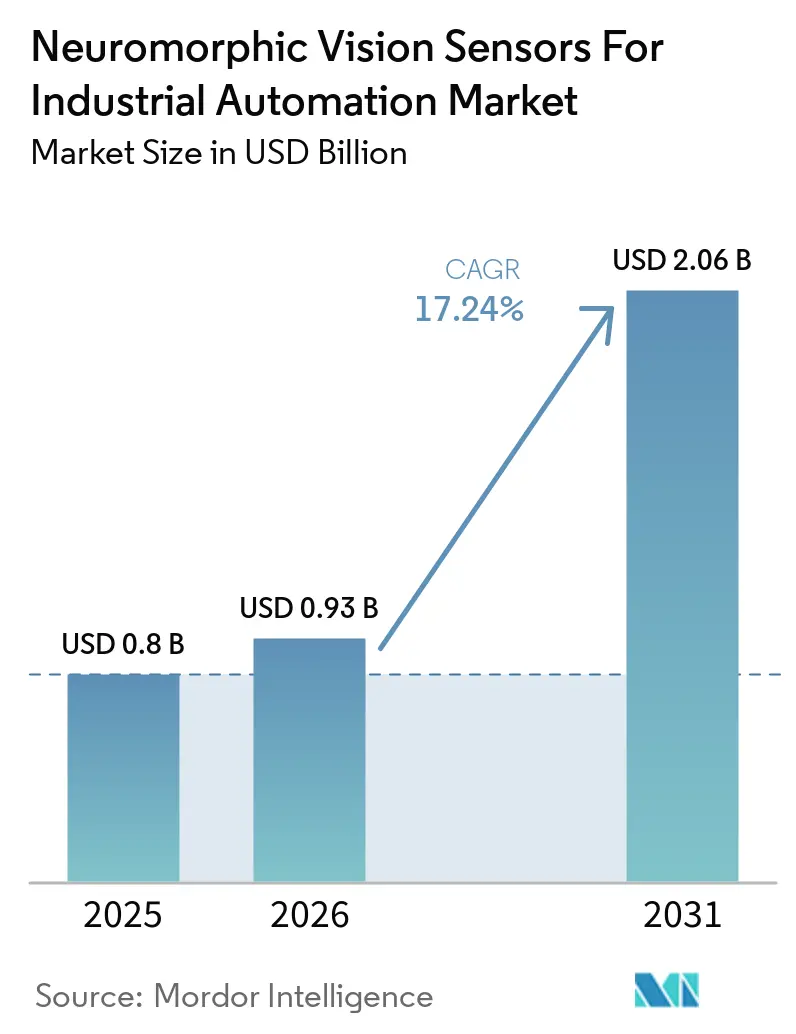
| Market Size (2026) | USD 0.93 Billion |
| Market Size (2031) | USD 2.06 Billion |
| Growth Rate (2026 - 2031) | 17.24 % |
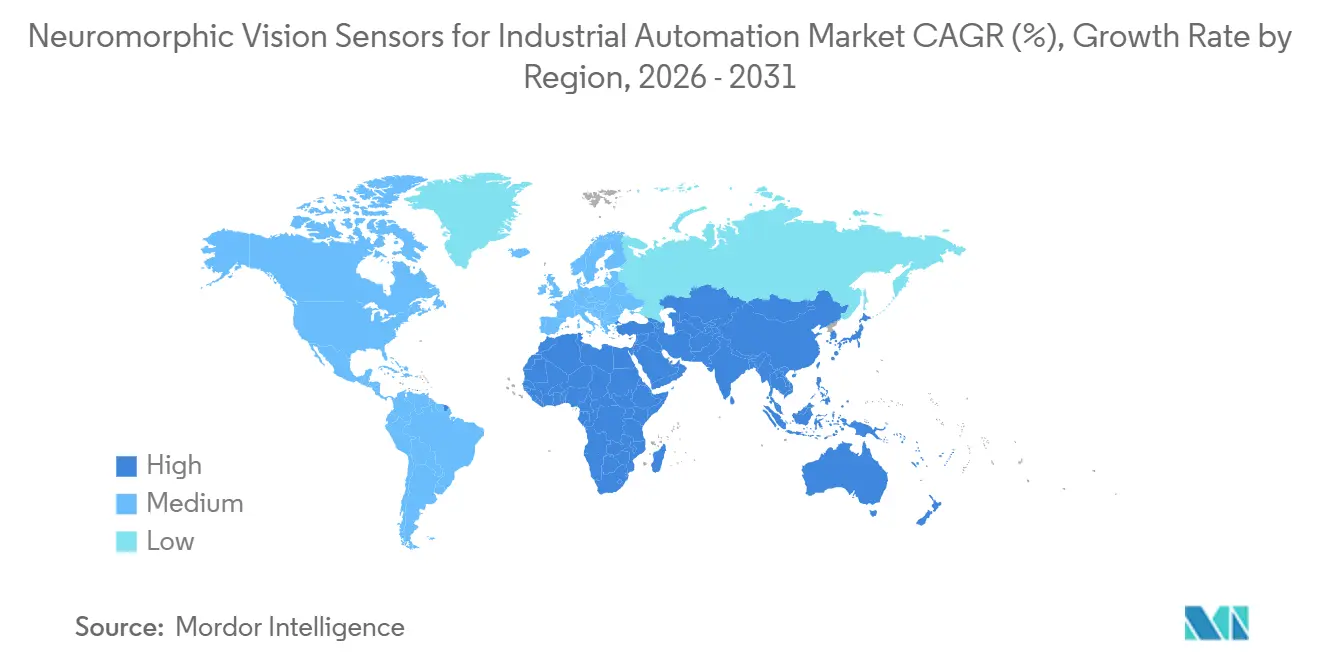
| Fastest Growing Market | Middle East and Africa |
| Largest Market | Asia-Pacific |
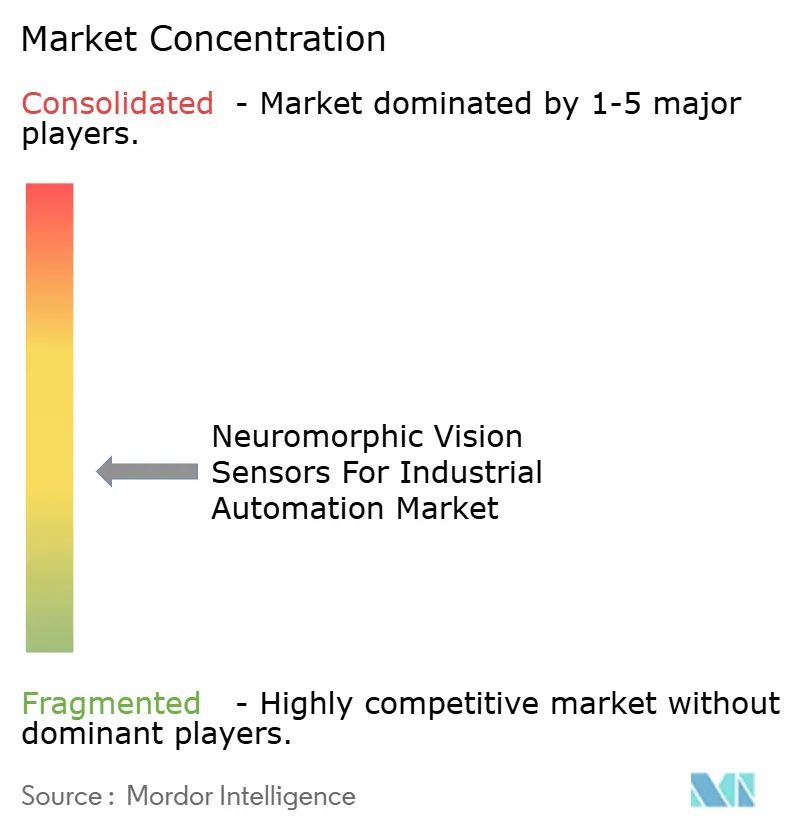
| Market Concentration | Medium |
Major Players *Disclaimer: Major Players sorted in no particular order Image © Mordor Intelligence. Reuse requires attribution under CC BY 4.0. | |
Neuromorphic Vision Sensors For Industrial Automation Market Analysis by Mordor Intelligence
The Neuromorphic Vision Sensors for Industrial Automation Market size is projected to expand from USD 0.80 billion in 2025 to USD 0.93 billion in 2026, and to USD 2.06 billion by 2031, registering a CAGR of 17.24% between 2026 and 2031. Event-based sensors capture pixel-level luminance changes asynchronously, which can reduce the volume of data processed compared with frame-based cameras. This capability supports fast decisions at the edge, where blur, data transfer, and processing delay limit conventional cameras. Semiconductor inspection, automotive assembly, and battery electrode production offer clear early use cases because production lines operate at high speeds. Suppliers are moving from stand-alone hardware toward combined sensor, software, and industrial-interface offerings. The strongest opportunity remains in systems that lower deployment effort for factories while meeting high-speed inspection requirements.
Key Report Takeaways
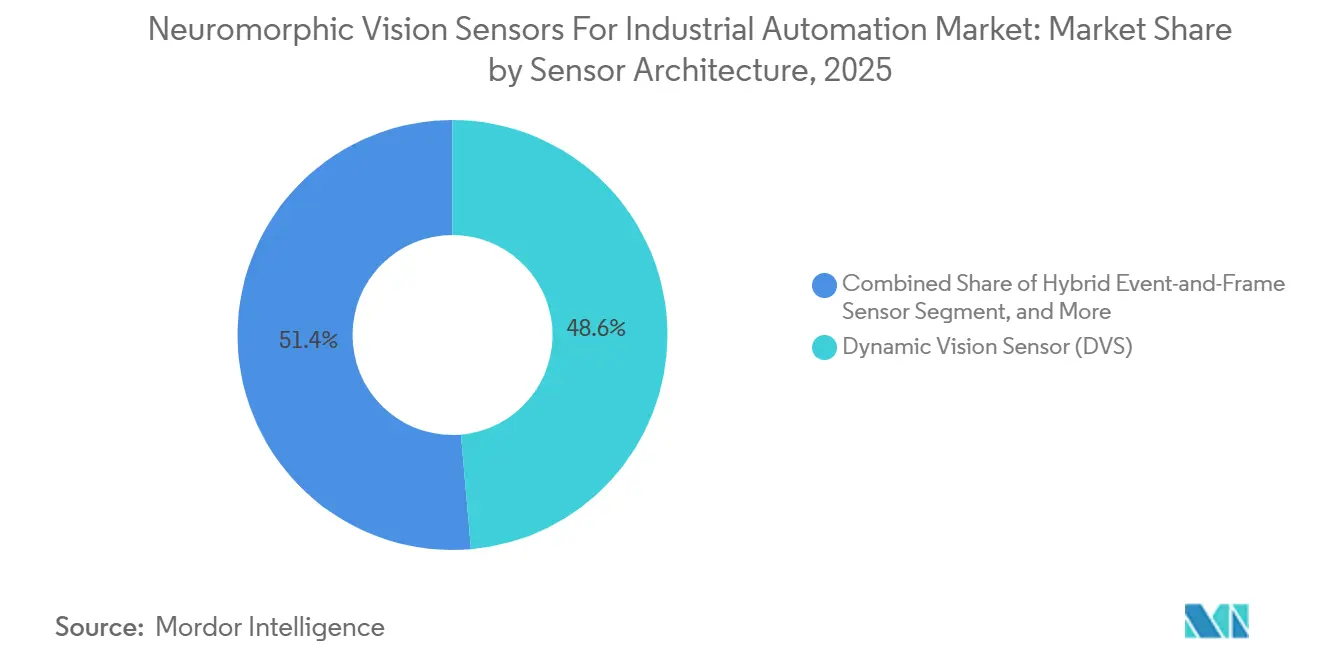
- By sensor architecture, the Dynamic Vision Sensor held 48.63% of the Neuromorphic Vision Sensors for Industrial Automation Market share in 2025, while Hybrid Event-and-Frame Sensors are projected to expand at a 22.87% CAGR through 2031.
- By resolution, VGA-to-HD accounted for 54.72% of revenue in 2025, while Above HD sensors are expected to expand at a 22.69% CAGR through 2031.
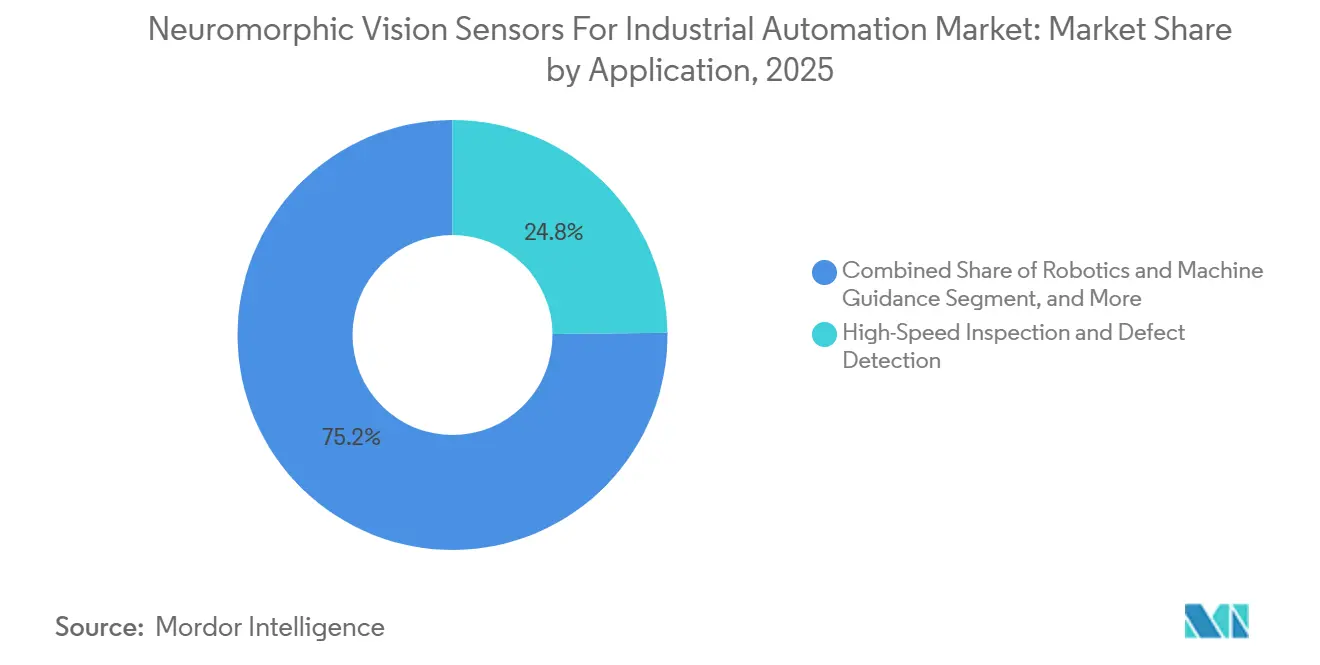
- By application, High-Speed Inspection and Defect Detection held 24.83% of revenue in 2025, while Robotics and Machine Guidance is projected to expand at a 21.93% CAGR through 2031 within the Neuromorphic Vision Sensors for Industrial Automation Market.
- By end-user industry, Automotive and Electric Vehicles held 22.76% of revenue in 2025, while Batteries and Energy Storage are projected to expand at a 22.14% CAGR through 2031.
- By geography, Asia-Pacific accounted for 38.94% of revenue in 2025, while the Middle East and Africa are projected to expand at a 22.47% CAGR through 2031 in the Neuromorphic Vision Sensors for Industrial Automation Market.
Note: Market size and forecast figures in this report are generated using Mordor Intelligence’s proprietary estimation framework, updated with the latest available data and insights as of January 2026.
Global Neuromorphic Vision Sensors For Industrial Automation Market Trends and Insights
Drivers Impact Analysis*
| Driver | (~) % Impact on CAGR Forecast | Geographic Relevance | Impact Timeline |
|---|---|---|---|
| High-Speed Automated Inspection Adoption | +4.2% | Global, led by Asia-Pacific including China, South Korea, and Taiwan | Short term (≤ 2 years) |
| Vision-Guided Robotics and Autonomous Mobile Robots | +3.6% | Global, with North America and Asia-Pacific as core regions | Medium term (2-4 years) |
| Edge Artificial Intelligence and Neuromorphic Processing Integration | +3.1% | Global | Medium term (2-4 years) |
| Low-Power, High-Dynamic-Range Sensing Demand | +2.6% | Global | Medium term (2-4 years) |
| Semiconductor, Electronics, and Battery Manufacturing Expansion | +2.0% | Asia-Pacific, with spillover to Middle East and Africa | Medium term (2-4 years) |
| Privacy-Preserving Worker and Process Monitoring | +1.4% | Europe and North America | Medium term (2-4 years) |
| Source: Mordor Intelligence | |||
Adoption of High-Speed Automated Inspection
High-speed inspection is increasing demand for Neuromorphic Vision Sensors in the Industrial Automation Market because many production lines run faster than frame cameras can reliably assess. At several meters per second, standard 60 fps cameras can introduce motion blur that weakens defect detection. A Khalifa University project reported a tactile roller sensor that scanned at 0.5 m/s with a mean absolute error below 100 µm, 11 times faster than comparable continuous tactile sensing.[1] A 2025 study reported neuromorphic imaging across a 300-fold range of motion speeds and dynamic ranges above 10,000-fold. The performance suits wafer, OLED panel, and battery production inspection, where event data can flag changes without creating a complete frame at every interval. Camera suppliers are sourcing specialist sensors for industrial housings and familiar interfaces, helping integrators add capability without replacing wider factory controls.
Expansion of Vision-Guided Robotics and Autonomous Mobile Robots
Vision-guided robots and autonomous mobile robots are driving applications for Neuromorphic Vision Sensors in the Industrial Automation Market. Industrial robot installations exceeded 590,000 units in 2024, and annual installations are expected to exceed 900,000 by 2027.[2] Electronics assembly, warehouses, and automotive plants need mobile systems that quickly identify obstacles and provide reliable proximity detection. Event-based sensing responds with sub-millisecond latency, supporting grasping and conveyor handling while objects remain in motion. The technology also works in cluttered, low-contrast settings where frame cameras may saturate or lose detail. Dynamic Vision Sensor devices produce sparse data from changes in pixels, favoring suppliers that offer validated motion detection and control software.
Integration With Edge Artificial Intelligence and Neuromorphic Processing
Edge processing is changing the value proposition of Neuromorphic Vision Sensors in the Industrial Automation Market by reducing network and computing constraints. SynSense’s Speck chip combines a Dynamic Vision Sensor and an asynchronous neural network processor on a single die. The source material reports idle power consumption below 1 mW while processing high-speed event streams in real time.[3] This arrangement can make mobile inspection platforms, autonomous mobile robots, and drones more practical. AMD and Prophesee linked the Metavision HD sensor with the AMD Kria KV260 Vision AI Starter Kit for FPGA-based edge development. Combining sensing and inference can reduce dependence on Ethernet, lower system complexity, and shorten the path from capture to industrial action.
Demand for Low-Power, High-Dynamic-Range Sensing
Factories combine bright inspection lighting and shaded areas, which challenge standard CMOS cameras. The source material gives standard CMOS a practical dynamic-range ceiling of 80 dB, while event cameras can provide 120 dB or more. This allows a wider luminance range to be assessed on a single production line. The Neuromorphic Vision Sensors for Industrial Automation Market can therefore support work in which rapid changes and uneven lighting occur simultaneously.[4] A 2026 Nature Communications paper described an amphibian-inspired system with microsecond-scale responses and ultraviolet-to-visible photosensitivity. Low-power operation may also limit clean-room cooling demand in battery facilities, where many inspection points run continuously.
Restraints Impact Analysis*
| Restraint | (~) % Impact on CAGR Forecast | Geographic Relevance | Impact Timeline |
|---|---|---|---|
| High Sensor and System Cost at Low Production Volumes | -3.4% | Global | Short term (≤ 2 years) |
| Limited Event-Data Engineering and Spiking-Neural-Network Skills | -2.2% | Global, with greater pressure in emerging economies | Medium term (2-4 years) |
| Immature Interoperability and Industrial Communication Standards | -1.8% | Global | Medium term (2-4 years) |
| Lower Static-Scene and Absolute-Intensity Performance Than Frame Cameras | -1.4% | Global | Short term (≤ 2 years) |
| Source: Mordor Intelligence | |||
High Sensor and System Cost at Low Production Volumes
High component and integration costs limit wider adoption of Neuromorphic Vision Sensors in the Industrial Automation Market. Event-based sensors can cost several thousand USD per unit in low-volume procurement, which can be an order of magnitude higher than equivalent-resolution CMOS cameras. Specialized pixel arrays have not reached the production volumes needed for cost parity. Buyers, therefore, focus on high-value lines, including pharmaceutical blister packs and automotive airbag-sensor production, where missed defects carry high costs. Dedicated software and incompatible event-stream formats can further increase total system cost. A high-performing sensor can still face qualification delays when its software environment is not mature for full-line validation.
Limited Event-Data Engineering and Spiking-Neural-Network Skills
Limited specialist skills are a persistent restraint for the Neuromorphic Vision Sensors for Industrial Automation Market. Spiking neural network training requires knowledge of asynchronous pipelines, spike timing, and event-frame fusion, with limited overlap with conventional deep learning. Industrial pilots can extend beyond 18 months while internal teams develop this capability. EventCV, released in 2026, provides OpenCV-style Python bindings that may lower the barrier to entry. SynSense’s 2025 testing proposal passed the IEC New Work Item vote and can support comparable data and practices. Vendors with pre-trained inspection models can reduce the engineering burden for end users.
*Our forecasts treat driver/restraint impacts as directional, not additive. The impact forecasts reflect baseline growth, mix effects, and variable interactions.
Segment Analysis
By Sensor Architecture: DVS Leads While Hybrid Sensors Scale
The Dynamic Vision Sensor architecture accounted for 48.63% of revenue in 2025, reflecting its long commercial history and Sony-Prophesee IMX636 and IMX637 products. Dynamic Vision Sensor designs work well in vibration monitoring, particle counting, and fast defect flagging because these tasks depend on binary motion information. IDS Imaging Development Systems GmbH and LUCID Vision Labs Inc. have used these sensors in industrial camera lines, giving integrators a practical deployment route. Dynamic and Active Pixel Vision Sensor designs combine event data and grayscale frames where texture context is needed. The DAVIS 240C from SynSense Innovation maintained reliable operation for more than 2.5 years in low Earth orbit, according to a 2025 study.
Hybrid Event-and-Frame Sensors are projected to expand at a 22.87% CAGR through 2031 because factories increasingly use fusion algorithms. A 2024 Nature study found that a 20 fps RGB and event-sensor system could match the perceptual latency of a 5,000 fps camera while retaining 45 fps bandwidth. The combination provides time-sensitive data and richer scene context without a fully high-speed frame stream. Other event-based designs, including spiking retinal imagers and ferroelectric-pixel systems, remain i commercialization. Their patent activity points to further differentiation beyond current core architectures.

By Resolution: HD Is the Current Baseline and Above HD Gains Ground
VGA-to-HD devices accounted for 54.72% of the Neuromorphic Vision Sensors for Industrial Automation Market size in 2025, making HD the practical baseline for many installations. This range balances spatial detail and event-rate throughput for vibration monitoring, motion analysis, and automotive inspection. It can operate with mid-tier edge processors without custom FPGA hardware for data reduction. HD resolution supports many production tasks while limiting system computing requirements. It is therefore suited to buyers who need established performance at a manageable processing load.
Above HD sensors are expected to expand at a 22.69% CAGR through 2031 as semiconductor inspection needs denser imaging. Wafer-edge review, bonding-wire alignment, and mask alignment need higher pixel density to identify small features at line speed. A 2025 Journal of Semiconductors article reported a 128×128 hybrid sensor with a maximum rate of 960 million events per second and a grayscale frame rate of 117,100 fps at 60.1 mW. QVGA and lower-resolution devices remain relevant for compact navigation, worker safety, and battery-powered equipment. Battery electrode coating lines also support the shift toward higher resolution, as very small coating voids are difficult to detect at speed.
By Application: Inspection Holds the Largest Position and Robotics Advances
High-Speed Inspection and Defect Detection held 24.83% of the Neuromorphic Vision Sensors for Industrial Automation Market size in 2025. Semiconductor and electronics producers use the systems to support strict defect-control requirements on fast lines. Event sensing captures brief surface changes that may be missed in a conventional frame stream. The tactile roller project was scanned at 0.5 m/s, with a mean absolute error below 100 µm, demonstrating the technical demands of the application. Code reading, optical character recognition, counting, gauging, sorting, tracking, and predictive maintenance use the same time-stamped pixel information.
Robotics and Machine Guidance is projected to expand at a 21.93% CAGR through 2031. Event cameras can provide robotic grippers with feedback in less than 10 ms when objects remain in motion. This supports conveyor handling without pausing for a frame capture. Worker Safety and Privacy-Preserving Vision is also emerging because sparse geometric data can reduce reliance on photographic imagery. Process, particle, and fluid monitoring has a longer path to wider adoption but is attracting pilots where optical observation windows are brief.
By End-User Industry: Automotive Leads While Battery Production Accelerates
Automotive and Electric Vehicles held 22.76% of revenue in 2025. Stamped body-part checks, weld-seam verification, and airbag-sensor validation occur at speeds that challenge frame cameras. Microsecond temporal resolution can limit reliance on strobe-lighting workarounds. Prophesee and DTS from Xperi Corporation developed a driver-monitoring system for automotive-grade hardware. Electronics and Semiconductors form the second-largest end-user area because advanced production requires strict defect control.
Batteries and Energy Storage is projected to expand at a 22.14% CAGR through 2031. Electrode coating, separator inspection, and cell assembly require continuous visual monitoring at high throughput. Event cameras can limit data transfer and power requirements compared with many frame-camera arrays. Food, Beverage, and Packaging, Pharmaceuticals and Medical Devices, Metals, Machinery, and Heavy Industry, Logistics and Warehousing, and Research, Testing, and Scientific Instrumentation widen the demand base. Logistics is gaining attention because autonomous mobile robots need rapid obstacle detection between storage racks.
Geography Analysis
Asia-Pacific held 38.94% of revenue in 2025. China, South Korea, Japan, and Taiwan have large concentrations of electronics, semiconductor, and battery manufacturing. The region is both a production center and a source of sensor development. Sony Semiconductor Solutions Corporation manufactures the Sony-Prophesee IMX636 and IMX637 families in Japan for industrial camera makers. India offers pilot opportunities in printed circuit board and semiconductor-packaging inspection as electronics investment increases.
North America and Europe represent the second- and third-largest revenue pools in the Neuromorphic Vision Sensors for Industrial Automation Market. North America benefits from a growing semiconductor equipment base, including planned capacity in Arizona, particularly in Phoenix. Advanced-node production requires inspection tools that can assess fast processes with great detail. Germany is central to Europe because of its automotive original equipment manufacturers and Tier 1 supplier network. In March 2026, IDS Imaging Development Systems GmbH and Prophesee signed a Letter of Intent at Embedded World in Nuremberg to expand industrial-vision work.
France has a concentrated neuromorphic intellectual property cluster around Prophesee, while the United Kingdom and the Netherlands support logistics and port automation integration. The Middle East and Africa are projected to expand at a 22.47% CAGR through 2031. Saudi Arabia and the UAE are developing greenfield advanced-manufacturing sites that can specify event sensing from the initial design stage. South Africa and Nigeria have smaller manufacturing bases but are evaluating mining and agricultural processing, while South America is smaller, with Brazil leading activity in electronics and automotive production.
Competitive Landscape
The Neuromorphic Vision Sensors for Industrial Automation Market remains moderately fragmented at the technology layer. Prophesee and the SynSense-innovation Group are leading intellectual-property specialists in event-based pixel architecture and algorithms. A broader group of camera original equipment manufacturers and systems integrators integrates these sensors into industrial housings and communication systems. Prophesee holds 100 patents in event-based vision, according to company material. Its platform combines sensors, software development kits, and algorithm libraries to support customer retention as deployments scale.
SynSense is pursuing both standards and products. Its Dynamic Vision Sensor testing proposal passed the IEC New Work Item vote in 2025 and covers 18 parameters, including noise, dynamic response, and sensitivity. Common testing can make product evaluation easier, while favoring suppliers with established test data. SynSense acquired 100% of Inivasion AG shares, creating a combined portfolio of sensors, computing chips, vision modules, and software. This integrated offer can appeal to buyers seeking one technical supplier in the Neuromorphic Vision Sensors for Industrial Automation Market.
Other suppliers are entering the market with a focus on specific applications rather than covering every use case. AlpsenTek Inc. and Oculi Inc. are developing pixel architectures for optical flow and low-latency manufacturing detection. CelePixel Technology Co., Ltd., now part of OmniVision, and DVSense Technology Co., Ltd. use domestic wafer-fab relationships to target cost-sensitive buyers. A 2026 Nature Communications paper described the NEOSTI sensor, which integrates a binary neural network on a chip.
Neuromorphic Vision Sensors For Industrial Automation Industry Leaders
-
PROPHESEE S.A.
-
iniVation AG
-
CelePixel Technology Co., Ltd.
-
Sony Semiconductor Solutions Corporation
-
Samsung Electronics Co., Ltd.
- *Disclaimer: Major Players sorted in no particular order
Recent Industry Developments
- June 2026: PROPHESEE S.A. launched Mantara®, the first fully integrated event-based drone detection and tracking system, along with the Hearth® software platform as a successor to its open-source OpenEB and standalone Metavision SDK. The launch included a EUR 20 million (USD 21.6 million) capital raise led by Critical Path Ventures with participation from existing shareholders. The proceeds were allocated to Mantara commercial scale-up, embedded sensor intelligence, and Hearth developer ecosystem build-out.
- June 2026: PROPHESEE S.A. and Exosens signed a memorandum of understanding to explore a long-term partnership combining Prophesee's event-based Metavision sensors with Exosens's night-vision and full-spectrum imaging technologies. The combination targets defense, industrial, and critical-infrastructure applications requiring high-speed event detection beyond the visible spectrum.
- March 2026: IDS Imaging Development Systems GmbH and PROPHESEE S.A. signed a Letter of Intent at Embedded World 2026 in Nuremberg, Germany, to co-develop next-generation industrial vision systems integrating Prophesee's event-based Metavision® technology. The initiative targets automation, robotics, logistics, transportation, and intelligent-systems applications, building on the commercial success of the IDS uEye EVS camera line.
- November 2025: iniVation AG, part of SynSense Group, introduced the Axiro product family, a range of high-speed, high-dynamic-range frame-based vision solutions for industrial embodied artificial intelligence and automation. The launch expanded iniVation's portfolio beyond event-based cameras for integrators needing hybrid sensing architectures.
Global Neuromorphic Vision Sensors For Industrial Automation Market Report Scope
Neuromorphic Vision Sensors for Industrial Automation are bio-inspired imaging devices that asynchronously capture brightness changes at the pixel level, offering ultra-low latency, high temporal resolution, and reduced data bandwidth to enable real-time monitoring of high-speed motion and dynamic events in industrial environments.
The Neuromorphic Vision Sensors for Industrial Automation Market Report is Segmented by Sensor Architecture (Dynamic Vision Sensor (DVS), Dynamic and Active Pixel Vision Sensor (DAVIS), Hybrid Event-and-Frame Sensor, and Other Event-Based Architectures), Resolution (QVGA and Below, VGA to HD, and Above HD), Application (High-Speed Inspection and Defect Detection, Code Reading and OCR, Counting, Gauging, Sorting, and Tracking, Robotics and Machine Guidance, Motion, Velocity, and Vibration Monitoring, Process, Particle, and Fluid Monitoring, Worker Safety and Privacy-Preserving Vision, and Other Applications), End-User Industry (Automotive and Electric Vehicles, Electronics and Semiconductors, Batteries and Energy Storage, Food, Beverage, and Packaging, Pharmaceuticals and Medical Devices, Metals, Machinery, and Heavy Industry, Logistics and Warehousing, Research, Testing, and Scientific Instrumentation, and Other End-User Industries), and Geography (North America, South America, Europe, Asia-Pacific, Middle East and Africa). The Market Forecasts are Provided in Terms of Value (USD).
| Dynamic Vision Sensor (DVS) |
| Dynamic and Active Pixel Vision Sensor (DAVIS) |
| Hybrid Event-and-Frame Sensor |
| Other Event-Based Architectures |
| QVGA and Below |
| VGA to HD |
| Above HD |
| High-Speed Inspection and Defect Detection |
| Code Reading and OCR |
| Counting, Gauging, Sorting, and Tracking |
| Robotics and Machine Guidance |
| Motion, Velocity, and Vibration Monitoring |
| Process, Particle, and Fluid Monitoring |
| Worker Safety and Privacy-Preserving Vision |
| Other Applications |
| Automotive and Electric Vehicles |
| Electronics and Semiconductors |
| Batteries and Energy Storage |
| Food, Beverage, and Packaging |
| Pharmaceuticals and Medical Devices |
| Metals, Machinery, and Heavy Industry |
| Logistics and Warehousing |
| Research, Testing, and Scientific Instrumentation |
| Other End-User Industries |
| North America | United States | |
| Canada | ||
| Mexico | ||
| South America | Brazil | |
| Argentina | ||
| Rest of South America | ||
| Europe | Germany | |
| United Kingdom | ||
| France | ||
| Italy | ||
| Spain | ||
| Rest of Europe | ||
| Asia-Pacific | China | |
| Japan | ||
| India | ||
| South Korea | ||
| Rest of Asia-Pacific | ||
| Middle East and Africa | Middle East | Saudi Arabia |
| United Arab Emirates | ||
| Turkey | ||
| Rest of the Middle East | ||
| Africa | South Africa | |
| Nigeria | ||
| Rest of Africa | ||
| By Sensor Architecture | Dynamic Vision Sensor (DVS) | ||
| Dynamic and Active Pixel Vision Sensor (DAVIS) | |||
| Hybrid Event-and-Frame Sensor | |||
| Other Event-Based Architectures | |||
| By Resolution | QVGA and Below | ||
| VGA to HD | |||
| Above HD | |||
| By Application | High-Speed Inspection and Defect Detection | ||
| Code Reading and OCR | |||
| Counting, Gauging, Sorting, and Tracking | |||
| Robotics and Machine Guidance | |||
| Motion, Velocity, and Vibration Monitoring | |||
| Process, Particle, and Fluid Monitoring | |||
| Worker Safety and Privacy-Preserving Vision | |||
| Other Applications | |||
| By End-User Industry | Automotive and Electric Vehicles | ||
| Electronics and Semiconductors | |||
| Batteries and Energy Storage | |||
| Food, Beverage, and Packaging | |||
| Pharmaceuticals and Medical Devices | |||
| Metals, Machinery, and Heavy Industry | |||
| Logistics and Warehousing | |||
| Research, Testing, and Scientific Instrumentation | |||
| Other End-User Industries | |||
| By Geography | North America | United States | |
| Canada | |||
| Mexico | |||
| South America | Brazil | ||
| Argentina | |||
| Rest of South America | |||
| Europe | Germany | ||
| United Kingdom | |||
| France | |||
| Italy | |||
| Spain | |||
| Rest of Europe | |||
| Asia-Pacific | China | ||
| Japan | |||
| India | |||
| South Korea | |||
| Rest of Asia-Pacific | |||
| Middle East and Africa | Middle East | Saudi Arabia | |
| United Arab Emirates | |||
| Turkey | |||
| Rest of the Middle East | |||
| Africa | South Africa | ||
| Nigeria | |||
| Rest of Africa | |||
Key Questions Answered in the Report
What is the Neuromorphic Vision Sensors for Industrial Automation Market size?
The Neuromorphic Vision Sensors for Industrial Automation Market was USD 0.93 billion in 2026 and is forecast to reach USD 2.06 billion by 2031 at a 17.24% CAGR.
Which sensor architecture leads industrial adoption?
Dynamic Vision Sensor architecture led with 48.63% of revenue in 2025, supported by its use in fast motion detection, vibration monitoring, and defect flagging.
Which application has the highest projected expansion rate?
Robotics and Machine Guidance is projected to expand at a 21.93% CAGR through 2031 as autonomous mobile robots and collaborative systems need rapid sensing.
Which end-user segment is projected to expand fastest?
Batteries and Energy Storage is projected to expand at a 22.14% CAGR through 2031 due to inspection needs across electrode coating, separator inspection, and cell assembly.
Which region leads demand for industrial neuromorphic vision sensors?
Asia-Pacific led with 38.94% of revenue in 2025 because of its concentration of electronics, semiconductor, automotive, and battery manufacturing.
What limits wider adoption of event-based sensors in factories?
High low-volume system costs, limited specialist engineering skills, and immature interoperability standards can extend qualification and deployment work.