
Neuromorphic Industrial Vision Market Size and Share
Market Overview
| Study Period | 2020 - 2031 |
|---|---|
| Market Size (2026) | USD 0.67 Billion |
| Market Size (2031) | USD 1.61 Billion |
| Growth Rate (2026 - 2031) | 19.17 % |
| Fastest Growing Market | Asia-Pacific |
| Largest Market | Asia-Pacific |
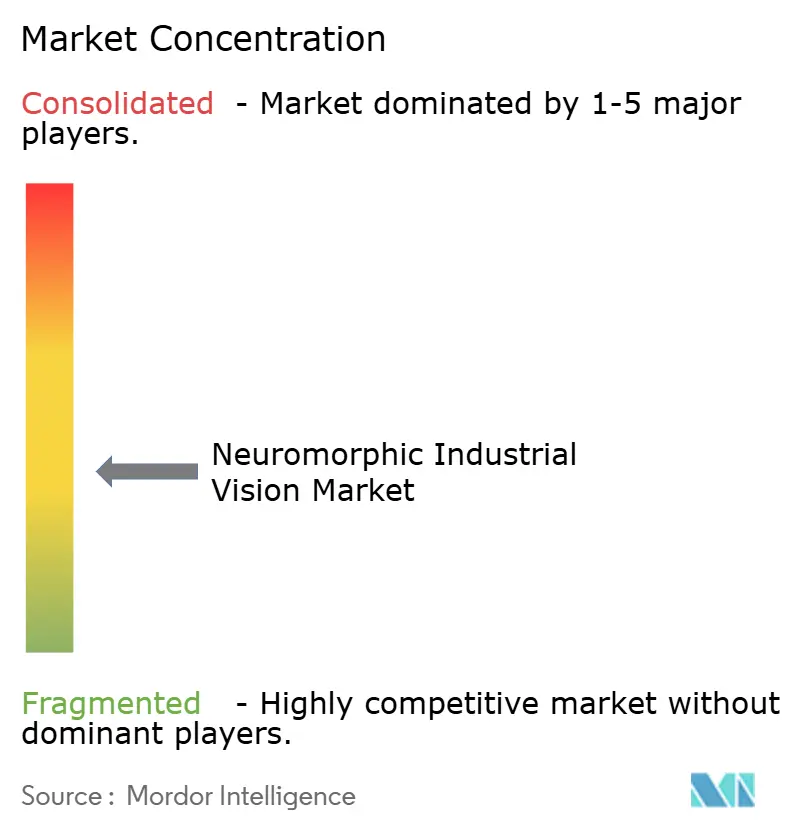
| Market Concentration | Medium |
Major Players *Disclaimer: Major Players sorted in no particular order Image © Mordor Intelligence. Reuse requires attribution under CC BY 4.0. | |
Neuromorphic Industrial Vision Market Analysis by Mordor Intelligence
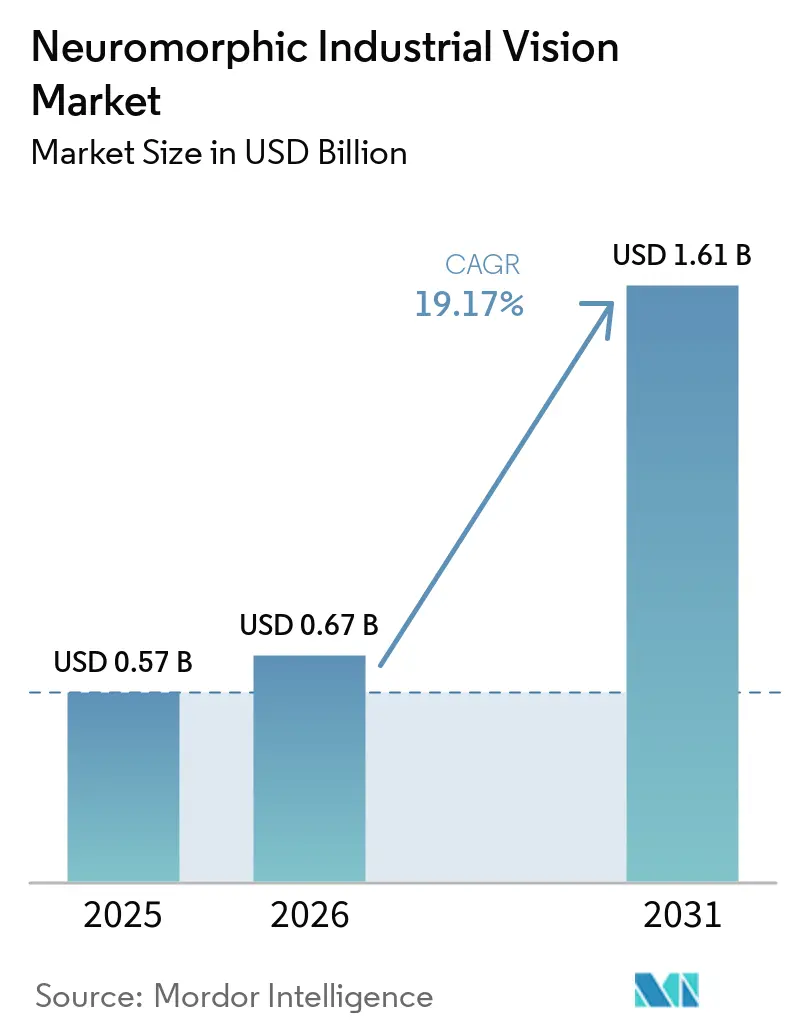
The Neuromorphic industrial vision market size is projected to expand from USD 0.57 billion in 2025 to USD 0.67 billion in 2026, and to USD 1.61 billion by 2031, registering a CAGR of 19.17% from 2026 to 2031. The Neuromorphic industrial vision market growth centers on factory settings where conventional cameras cannot capture brief changes quickly enough or work reliably within strict power limits. Event-based sensors record pixel-level changes rather than full frames, reducing data volume by 10 to 100 times and enabling rapid edge decisions. The Neuromorphic industrial vision market is well-suited to defect detection, robotic handling, and inspection, where movement, reflections, or changing lighting can degrade conventional imaging. Competition is moving beyond sensors toward software that converts event streams into usable quality and control signals, as manufacturers require practical tools for deployment, training, and connection with existing factory equipment. Adoption remains limited to high-value and motion-rich work because integration costs, scarce specialist skills, and weak static-scene performance still complicate deployment, which makes a clear operational benefit essential before manufacturers replace proven frame-based equipment.
Key Report Takeaways
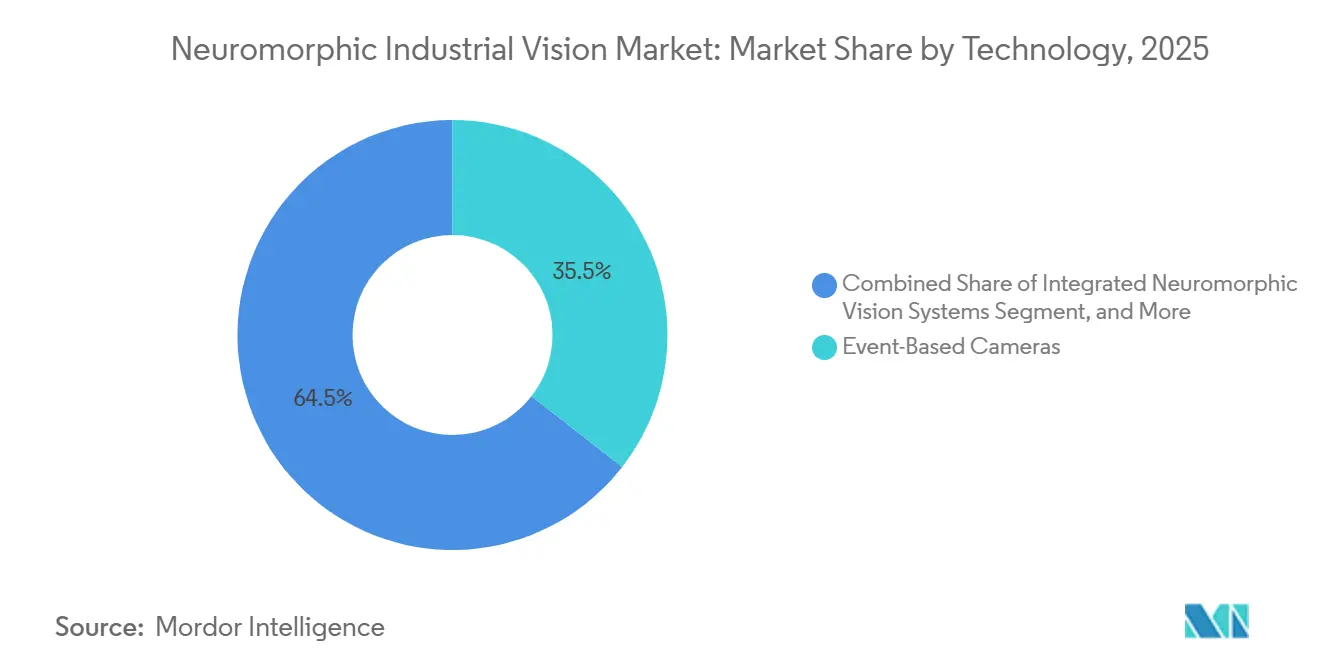
- By technology, Event-Based Cameras held 35.51% of the Neuromorphic Industrial Vision Market share in 2025, while Neuromorphic Vision Software and Algorithms are projected to expand at a 21.67% CAGR through 2031.
- By application, High-Speed Inspection and Defect Detection held 25.56% share in 2025, while Robotics and Robotic Guidance are expected to expand at a 22.13% CAGR through 2031.
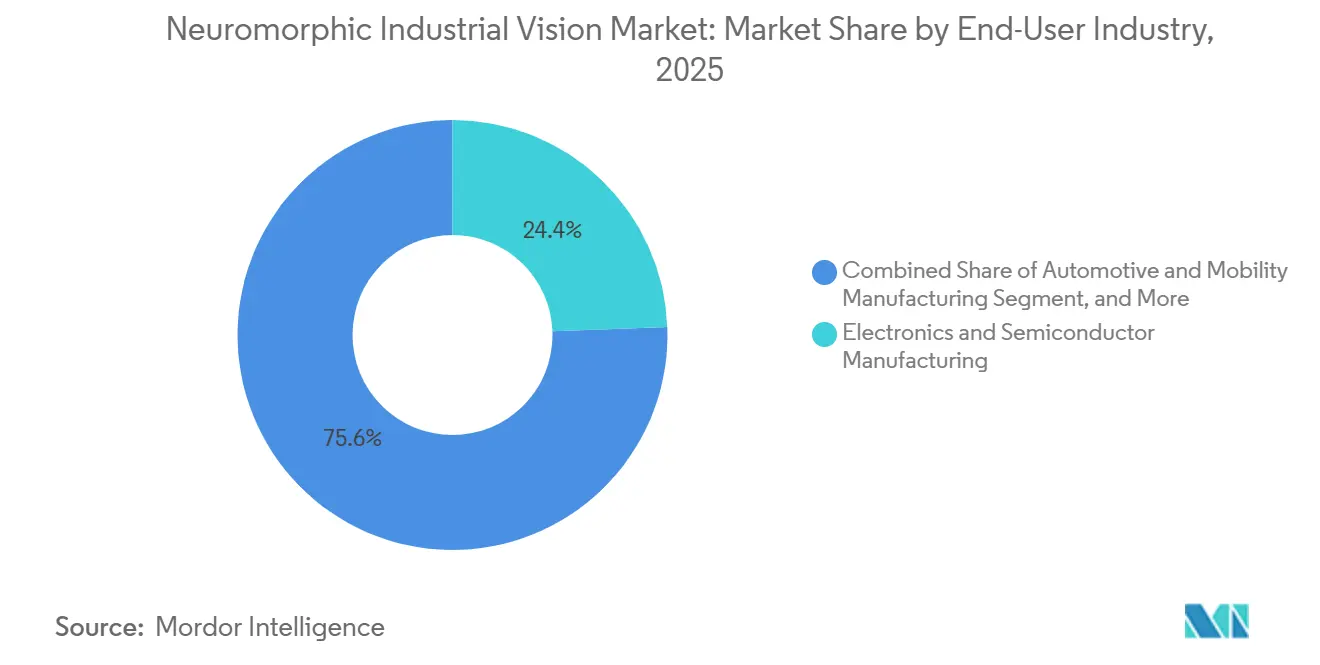
- By end-user industry, Electronics and Semiconductor Manufacturing held 24.41% share in 2025, while Logistics and Warehousing is projected to expand at a 21.78% CAGR through 2031.
- By deployment, Fixed/Stationary Vision Systems held 52.31% share in 2025, while Robotic-Mounted Vision Systems are expected to expand at a 20.55% CAGR through 2031.
- By geography, Asia-Pacific accounted for 37.77% of regional demand in 2025 and is projected to grow at a 20.71% CAGR through 2031.
Note: Market size and forecast figures in this report are generated using Mordor Intelligence’s proprietary estimation framework, updated with the latest available data and insights as of January 2026.
Global Neuromorphic Industrial Vision Market Trends and Insights
Drivers Impact Analysis*
| Driver | (~) % Impact on CAGR Forecast | Geographic Relevance | Impact Timeline |
|---|---|---|---|
| Demand for Microsecond-Latency Industrial Inspection | +4.5% | Global, with highest intensity in Asia-Pacific and Europe | Short term (≤ 2 years) |
| Expansion of Edge AI and Low-Power Machine Vision | +3.8% | Global, led by Asia-Pacific and North America | Medium term (2-4 years) |
| Growth of High-Speed Robotics and Factory Automation | +3.2% | Asia-Pacific core, spillover to Europe and North America | Medium term (2-4 years) |
| Increasing Use of Vision Systems in Difficult Lighting Conditions | +2.1% | Global | Short term (≤ 2 years) |
| Event-Stream Data Advantage in Bandwidth-Constrained Factories | +1.7% | Global, with early gains in brownfield facilities in Asia-Pacific and Europe | Medium term (2-4 years) |
| Growing Availability of Integrated Sensor, Processor, and Software Platforms | +1.4% | Global | Long term (≥ 4 years) |
| Source: Mordor Intelligence | |||
Demand for Microsecond-Latency Industrial Inspection
Conventional cameras operate at fixed frame rates, typically ranging from 30 to 10,000 frames per second. Their synchronization steps introduce several milliseconds of latency, which can cause transient faults to be missed on high-speed lines, where a defect may appear and pass through the inspection area before the next full image is available. In the Neuromorphic industrial vision market, event-based sensors detect brightness changes in under 100 microseconds. Sony's IMX636 HD and Prophesee’s IMX636 HD specify pixel latency below 100 microseconds at 1,000 lux and a dynamic range above 120 dB. A 2025 Advanced Science study found that computational neuromorphic imaging delivered 300-fold sampling flexibility during fast motion. Semiconductor and electronics facilities have strict defect tolerances, which gives this capability a practical role in high-speed inspection.
Expansion of Edge AI and Low-Power Machine Vision
Within the Neuromorphic industrial vision market, factory edge AI is moving from server-based processing to processors located near sensors. Neuromorphic hardware can scale energy use with scene activity instead of running continuously at a fixed load. A 2025 study by the Australian Institute for Machine Learning and Intel Labs found that a spiking neural network used 15% as much energy as comparable CPU pipelines for geometric model fitting. BrainChip began commercial shipments of the AKD1500 in June 2026, and the processor operates at below 300 milliwatts in PCIe mode and below 200 milliwatts in serial mode. STMicroelectronics launched its STM32V8 in November 2025, stating a nearly 60% performance gain over its predecessor and operation up to 140°C. Combining low-power sensing with local inference supports wider use of event-triggered perception nodes across large factory floors.
Growth of High-Speed Robotics and Factory Automation
For the Neuromorphic industrial vision market, global industrial robot installations reached 542,000 units in 2024. The International Federation of Robotics projected 575,000 installations in 2025 and more than 700,000 by 2028. Production systems also need faster and more precise visual feedback as cycle times decline. Event cameras generate signals as a scene changes, rather than waiting for the next frame. Their precise event timestamps can support trajectory prediction for objects moving through a robot’s gripper path. A 2026 journal study reported that a vision, planning, and control pipeline on Intel Loihi 2 ran in the milliwatt range with latencies competitive with GPU-based approaches. China installed 295,000 industrial robots in 2024, or 54% of the global total, providing a large potential base for robotics-grade vision.
Increasing Use of Vision Systems in Difficult Lighting Conditions
In the Neuromorphic industrial vision market, factory floors often have reflections, sharp shadows, ultraviolet curing areas, and inconsistent ambient light. Such conditions can reduce the reliability of frame-based cameras. Event-based sensors respond to relative brightness changes, which makes them less dependent on absolute luminance. The IMX636 HD specifies more than 120 dB of dynamic range across illumination from 80 millilux to 100 kilolux. This can reduce the need for dedicated lighting equipment for suitable inspection tasks, although performance still depends on the surface material, movement pattern, and the specific production environment. Logistics, pharmaceutical, and food and beverage operations are relevant users because their long lines often contain several competing light sources.
Restraints Impact Analysis*
| Restraint | (~) % Impact on CAGR Forecast | Geographic Relevance | Impact Timeline |
|---|---|---|---|
| High Development and Integration Costs | -2.6% | Global, most acute in South America, Africa, and Middle East | Short term (≤ 2 years) |
| Shortage of Event-Based Vision and Spiking Neural Network Expertise | -2.1% | Global, most severe in South America, Africa, Middle East, and Southeast Asia | Medium term (2-4 years) |
| Limited Interoperability and Immature Industry Standards | -1.5% | Global | Medium term (2-4 years) |
| Reduced Performance in Static-Scene and Color-Intensive Inspection | -0.8% | Global | Long term (≥ 4 years) |
| Source: Mordor Intelligence | |||
High Development and Integration Costs
The cost of a system in the Neuromorphic industrial vision market extends beyond the sensor. Integrators must build or license event-stream software, train models on application data, and adapt industrial communications for asynchronous inputs. They may also need new evaluation tools and production validation processes. A single event-based camera development kit was priced between USD 1,800 and USD 3,000 in India. Full pilot deployments can exceed USD 100,000 after software, labor, validation, communication adaptation, and application-specific model work are included, particularly where a manufacturer is building its first production pilot. Compliance with ISO 13849 and IEC 62061 can further increase qualification costs in safety-rated robotic cells.
Shortage of Event-Based Vision and Spiking Neural Network Expertise
The Neuromorphic industrial vision market requires expertise in spiking neural networks, event-stream preprocessing, temporal coding, and asynchronous hardware design. These capabilities do not directly overlap with conventional deep learning or FPGA engineering. Relevant academic programs are concentrated in France, Switzerland, Germany, the United States, and Australia, making local engineering support harder for manufacturers in South Asia, Southeast Asia, South America, and Africa to access. A 2026 ICRA workshop paper noted that the lack of standardized datasets and evaluation benchmarks slows the transfer of research into industrial use. SynSense’s 2024 acquisition of iniVation combined event-based sensing with spiking-processor development under a single organization. This acquisition-led response indicates that the broader skills shortage is likely to persist in the medium term.
*Our forecasts treat driver/restraint impacts as directional, not additive. The impact forecasts reflect baseline growth, mix effects, and variable interactions.
Segment Analysis
By Technology: Software Stacks and Sensors Co-Define the Value Proposition
Event-Based Cameras held 35.51% of the Neuromorphic industrial vision market share in 2025. In the Neuromorphic industrial vision market, their position reflects the availability of production-ready modules that can be fitted into industrial systems without requiring manufacturers to redesign the broader inspection architecture. Sony and Prophesee’s IMX636 HD combines stacked CMOS technology with event-based pixels. It provides 1,280-by-720 resolution, sub-100-microsecond pixel latency, and more than 120 dB dynamic range. IDS Imaging Development Systems built its uEye EVS camera line around this sensor. The cameras use conventional industrial housings and support GigE Vision interfaces. This familiar format can lower adoption barriers for manufacturers using frame-based cameras by preserving common camera housings and interfaces during an otherwise demanding technology transition. Standalone sensors and neuromorphic processors make up the remaining technology mix. Integrated systems command higher prices because they combine sensing, processing, and local inference in a validated enclosure, reducing the integration work that individual manufacturers would otherwise need to complete themselves.
Neuromorphic Vision Software and Algorithms is projected to expand at a 21.67% CAGR from 2026 to 2031. The Neuromorphic industrial vision market size for this technology is shaped by the shift from sensor selection toward software capability. Manufacturers need sparse convolutional, graph neural network, and spiking neural network tools to interpret event streams, distinguish relevant changes from background activity, and turn sensor outputs into operational quality signals. Prophesee’s Metavision Intelligence Suite includes 95 algorithms, 67 code samples, and 11 ready-to-use applications. A 2026 Sensors paper reported that event-driven preprocessing reduced computation for human detection from 5.8 giga-FLOP to 81 mega-FLOP. It also reduced runtime from 172 milliseconds to 15 milliseconds. Open-source libraries could reduce proprietary sensor pricing advantages over time by giving integrators a wider set of reusable tools for prototyping, testing, and adapting algorithms to application-specific data. This may create space for suppliers focused on models and algorithms rather than hardware.



By Application: Inspection Drives Volume, Robotics Drives Growth
High-Speed Inspection and Defect Detection accounted for 25.56% of the Neuromorphic industrial vision market size in 2025. Across the Neuromorphic industrial vision market, semiconductor and electronics manufacturers use these systems to identify transient surface faults, micro-cracks, and solder-joint failures that may occur too quickly for conventional cameras to record consistently at line speed. Their production speeds can exceed the capture limits of conventional imaging. China’s Beijing Industrial Intelligence Association issued T/BIIA 081-2026 in July 2026. The specification covers deep learning-based defect detection in semiconductor, automotive, textile, food processing, and metal processing settings. Object detection, tracking, counting, quality control, and process monitoring also support demand. Event cameras can detect small vibrations in rotating equipment at microsecond temporal resolution, supporting predictive maintenance without the need to install a dedicated vibration sensor on each monitored asset. Identification, OCR, and barcode reading benefit where conveyor speeds create motion blur for conventional readers.
Robotics and Robotic Guidance are projected to expand at a 22.13% CAGR from 2026 to 2031. In the Neuromorphic industrial vision market, rising robot density and shorter cycle times in automotive and logistics facilities are central factors. A 2026 research paper described an event-driven vision system combined with adaptive model predictive control for autonomous logistics robots. The paper reported 11,281-fold energy savings and nearly half the latency of a GPU baseline on neuromorphic hardware. This result supports the use of event-based perception in autonomous mobile robots with watt-level power budgets, where battery life, onboard heat, and response time directly affect operating practicality. Motion analysis and metrology remain important supporting applications. Aerospace component inspection and medical device assembly also provide early demand outside traditional factory environments. These settings value high temporal resolution where process movement can affect quality results, particularly when a brief change in position or surface condition can affect inspection accuracy.
By End-User Industry: Semiconductor Electronics Leads, Logistics Accelerates
Electronics and Semiconductor Manufacturing accounted for 24.41% of the total in 2025. This share of end-user demand reflects continued investment in advanced semiconductor capacity. BrainChip and Orama.AOI partnered in August 2026 to retrain Akida models for automated optical inspection. Orama.AOI had deployments in tire production and semiconductor packaging inspection. Automotive and mobility manufacturing is the second-largest vertical, where visual checks cover body panels, weld quality, and drivetrain components with reflective metal surfaces that can complicate strobe-based imaging. It requires inspection of body panels, welds, and drivetrain parts. Pharmaceuticals, medical devices, metals processing, and food and beverage manufacturing contribute through high-speed inspection uses. Machinery, industrial equipment, packaging, and printing use event cameras for print registration and component inspection.
Logistics and warehousing are expected to expand at a 21.78% CAGR from 2026 to 2031. High-velocity fulfillment centers must manage changing light, fast conveyor movement, and partial occlusions, all of which can weaken conventional frame-based perception and interrupt consistent automated handling. A 2026 SPIE Proceedings paper found that an asynchronous event-vision pipeline with LiDAR and RFID reduced decision latency by 35% and raised throughput by 27% against synchronous perception systems.[1]Yi Li, “Event-Based Machine Vision for Edge AI Computing,” Sensors, mdpi.com Event cameras can operate under these conditions without additional lighting equipment in suitable settings. Major e-commerce and third-party logistics operators are adopting multi-tier fulfillment designs that increase the number of automated handoffs, conveyor decisions, and mobile robot movements that need dependable visual feedback. These designs increase demand for vision that supports autonomous mobile robots and conveyor operations. Robotic-Mounted Vision Systems and logistics growth reinforce each other because logistics is a major driver of AMR adoption. The Neuromorphic industrial vision industry is therefore increasingly linked to warehouse automation requirements.
By Deployment: Fixed Systems Lead, Robotic-Mounted Systems Accelerate
Fixed/Stationary Vision Systems held 52.31% share in 2025. This deployment is common in electronics, semiconductor, and automotive plants. Cameras are mounted over conveyors, printing stations, and assembly test fixtures. For the Neuromorphic industrial vision market, the established supply chain for fixed configurations supports its position, as these arrangements match the layouts of many high-volume production lines and established inspection stations. GigE Vision and USB3 compatibility in IDS uEye EVS cameras also helps users integrate event-based sensing into existing equipment. Mobile/Autonomous Vision Systems are the smallest deployment group. They receive research funding for outdoor inspections of photovoltaic arrays and infrastructure assets, as well as for mobile robots that must operate in unstructured environments without fixed camera positions. They can also support mobile collaborative robots in settings where a fixed camera is impractical.
Robotic-Mounted Vision Systems is projected to expand at a 20.55% CAGR from 2026 to 2031. A 2026 study found that a full neuromorphic vision-and-control pipeline for robotic peg-in-hole assembly achieved latency competitive with GPU-based systems. The system ran entirely on Intel’s Loihi 2 chip in the milliwatt range, indicating that wrist-mounted event cameras can be used without placing the same power and thermal burden on a robot as larger processing systems do. Mounting a camera on a robot arm can avoid parallax errors caused by fixed overhead cameras. It also avoids static calibration assumptions in workcells where fixtures change frequently. The approach is relevant when the inspection point moves with the end effector, especially in workcells where changing fixtures make a single fixed viewpoint less reliable over time. Collaborative robot makers may increasingly integrate event-based perception into native platforms. This would allow robotic-mounted systems to narrow the gap with fixed installations through the forecast period.
Geography Analysis
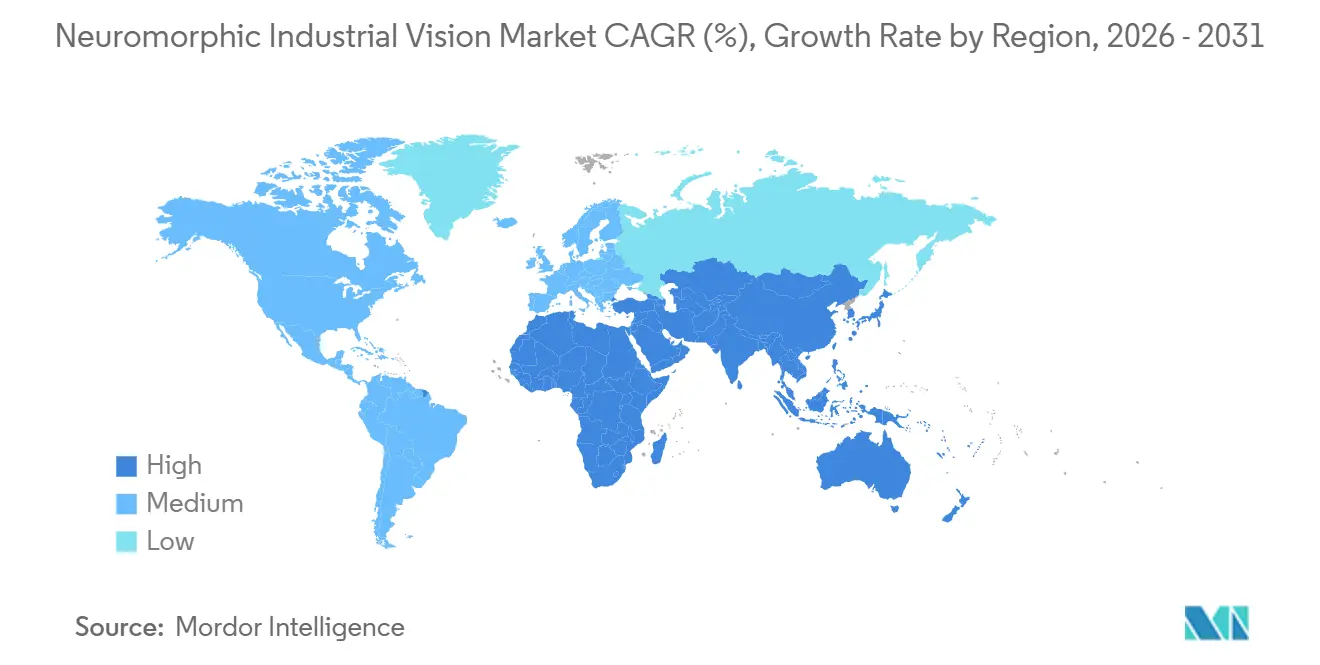
Asia-Pacific held 37.77% of the Neuromorphic industrial vision market share in 2025 and is projected to grow at a 20.71% CAGR through 2031. The region combines semiconductor fabrication, electronics assembly, a broad supplier base, deeper automation networks, and a growing installed base of robots. China installed 295,000 industrial robots in 2024, accounting for 54% of global installations. South Korea, Japan, India, and Australia also sustain investment in automation, which broadens the regional base for advanced vision. Japan selected IBM Japan in 2026 to develop a 2-nanometer neuromorphic AI accelerator through NEDO, while TDK and Tohoku University are advancing spin-memristor devices targeting a 100-fold reduction in AI inference power consumption.[2]TDK Corporation, “AIの消費電力を100分の1へ。脳型AIデバイス「ニューロモルフィックデバイス」とは,” TDK Featured Stories, tdk.com Chinese neuromorphic vision patent filings grew at 68% annually in 2024 and 2025 and represented 31.6% of global cumulative patent families by mid-2026.
For the Neuromorphic industrial vision market, North America and Europe are secondary demand centers, each with distinct industrial strengths. North American demand is linked to automotive manufacturing, semiconductor packaging, EV battery cell production, advanced packaging fabs, and wire-bond verification, where inspection requirements rise with production scale. U.S. semiconductor investment supports demand at advanced production nodes, while Europe’s activity is concentrated in Germany, Italy, and France across automotive suppliers, packaging machinery makers, and industrial equipment manufacturers. IDS has commercialized Prophesee Metavision technology in standard GigE industrial camera housings, showing how European integrators are adapting the technology for familiar industrial formats. The Horizon 2020 ANDANTE consortium also produced FeFET-based spiking accelerator intellectual property that STMicroelectronics and GlobalFoundries are translating into 2026 process-node products.
The Middle East, and Africa remain early-stage areas for the Neuromorphic industrial vision market. Brazil accounts for much of South American activity through automotive and food and beverage clusters, but camera kits costing USD 1,800 to USD 3,000 before integration remain difficult for many smaller manufacturers to justify. Saudi Arabia and the UAE can specify the technology in greenfield smart manufacturing facilities, which can be more practical than retrofitting legacy systems. South Africa and Egypt are at an earlier stage of advanced automation adoption, and larger global production volumes and Asian ODM capacity could support wider adoption from 2028 to 2031.

Competitive Landscape
The Neuromorphic industrial vision market is moderately fragmented, with specialized event-based vision companies holding sensor intellectual property and algorithmic capabilities, alongside diversified semiconductor companies offering neuromorphic functions within broader industrial and edge-computing portfolios. Specialized suppliers can update sensor designs and spiking neural network tools quickly, while companies such as Sony, Intel, Qualcomm, and STMicroelectronics have greater manufacturing scale and customer access. Prophesee and IDS signed a letter of intent in March 2026 to develop event-based industrial vision systems.[3]Prophesee SA, “IDS and Prophesee Advance Event-Based Industrial Vision Collaboration,” Prophesee, prophesee.ai The arrangement combines Prophesee sensing and software with IDS camera integration, manufacturing, and distribution. This partnership model can help specialist technologies reach established industrial users by combining a focused technology supplier’s development speed with an integrator’s existing product formats, manufacturing capacity, and customer relationships.
The software and integration layer remains a key competitive opening in the Neuromorphic industrial vision market because the evidence provided indicates that no supplier offers a complete turnkey package for calibration, spiking model training, industrial communications, and predictive maintenance analytics. BrainChip’s August 2026 partnership with Orama.AOI illustrates an incremental approach, with Orama.AOI is retraining its inspection models for BrainChip’s Akida architecture in semiconductor packaging inspection. Prophesee raised EUR 20 million (USD 22 million), in June 2026 and launched Mantara while identifying industrial automation as a priority vertical. SynSense combined event-based sensing and processor design through its 2024 iniVation acquisition. These actions reflect different routes to broader systems capability in the Neuromorphic industrial vision market.
The Neuromorphic industrial vision market also needs networked factory deployments to meet to meet industrial cybersecurity expectations, and IEC 62443 compliance is becoming a qualification factor for connected vision systems. Established semiconductor vendors may have an advantage because they maintain dedicated security engineering resources. There were 4,312 published neuromorphic vision patent families globally since 2023 through mid-2026, with U.S. and EU applicants holding 47.6% and Chinese applicants increasing new applications at 68% annually. The Neuromorphic industrial vision industry therefore includes established chip suppliers and focused companies seeking positions in sensing, software, and system integration.
Neuromorphic Industrial Vision Industry Leaders
Prophesee SA
SynSense AG
IDS Imaging Development Systems GmbH
LUCID Vision Labs, Inc.
Samsung Electronics Co., Ltd.
- *Disclaimer: Major Players sorted in no particular order

Recent Industry Developments
- August 2026: BrainChip Holdings Ltd announced a partnership with Orama.AOI, an automated optical inspection solution provider with validated deployments in tire production and semiconductor packaging inspection. Orama.AOI retrained and optimized BrainChip's Akida neuromorphic models on its proprietary industrial inspection datasets, validating the Akida AKD1500 platform as a production-ready edge AI co-processor for defect detection applications at scale.
- June 2026: Prophesee SA announced a EUR 20 million (USD 22 million) capital raise led by Critical Path Ventures, with participation from 360 Capital Group and Bosch Ventures. The company simultaneously launched Mantara, its first fully integrated event-based drone detection and tracking system, built on the Hearth software platform, and sharpened its commercial focus on industrial automation, aerospace and defense, and security as near-term priority verticals.
- June 2026: BrainChip Holdings Ltd announced commercial availability and initial production shipments of the Akida AKD1500 neuromorphic processor, manufactured in GlobalFoundries' 22nm FD-SOI (22FDX) process. Operating below 300 milliwatts in PCIe mode and below 200 milliwatts in serial mode, the AKD1500 targets industrial IoT, automotive, aerospace, and defense edge inference, with industrial and military environmental qualification underway covering severe shock, vibration, and temperature extremes.
- March 2026: BrainChip Holdings Ltd announced Neuromorphyx, a Croatian deep-tech hardware and embedded software company, as a strategic customer and go-to-market partner for the AKD1500. Neuromorphyx integrates the AKD1500 into its Vision NeuroNode edge-AI device alongside event-based vision (DVS/EVS), FPGA preprocessing, and a fleet orchestration platform targeting industrial and defense robotics.


Global Neuromorphic Industrial Vision Market Report Scope
The neuromorphic industrial vision market comprises hardware, software, and systems that use neuromorphic computing principles to enable industrial vision applications. These solutions process visual data in ways that mimic the human brain, enabling faster, energy-efficient, real-time image recognition, inspection, monitoring, and automation across industrial environments.
The Neuromorphic Industrial Vision Market Report is Segmented by Technology (Event-Based Vision Sensors, Event-Based Cameras, Neuromorphic Vision Processors, Neuromorphic Vision Software and Algorithms, and Integrated Neuromorphic Vision Systems), Application (High-Speed Inspection and Defect Detection, Object Detection, Tracking and Counting, Robotics and Robotic Guidance, Motion Analysis and Metrology, Quality Control and Process Monitoring, Surface and Vibration Monitoring, Identification, OCR and Barcode Reading, and Other Applications), End-User Industry (Automotive and Mobility Manufacturing, Electronics and Semiconductor Manufacturing, Machinery and Industrial Equipment, Food and Beverage Manufacturing, Pharmaceuticals and Medical Devices, Metals and Material Processing, Logistics and Warehousing, Packaging and Printing, and Other End-User Industries), Deployment (Fixed/Stationary Vision Systems, Robotic-Mounted Vision Systems, and Mobile/Autonomous Vision Systems), and Geography (North America, South America, Europe, Asia-Pacific, Middle East, and Africa). The Market Forecasts are Provided in Terms of Value (USD).
| Event-Based Vision Sensors |
| Event-Based Cameras |
| Neuromorphic Vision Processors |
| Neuromorphic Vision Software and Algorithms |
| Integrated Neuromorphic Vision Systems |
| High-Speed Inspection and Defect Detection |
| Object Detection, Tracking and Counting |
| Robotics and Robotic Guidance |
| Motion Analysis and Metrology |
| Quality Control and Process Monitoring |
| Surface and Vibration Monitoring |
| Identification, OCR and Barcode Reading |
| Other Applications |
| Automotive and Mobility Manufacturing |
| Electronics and Semiconductor Manufacturing |
| Machinery and Industrial Equipment |
| Food and Beverage Manufacturing |
| Pharmaceuticals and Medical Devices |
| Metals and Material Processing |
| Logistics and Warehousing |
| Packaging and Printing |
| Other End-User Industries |
| Fixed/Stationary Vision Systems |
| Robotic-Mounted Vision Systems |
| Mobile/Autonomous Vision Systems |
| North America | United States |
| Canada | |
| Mexico | |
| South America | Brazil |
| Argentina | |
| Chile | |
| Rest of South America | |
| Europe | Germany |
| United Kingdom | |
| France | |
| Italy | |
| Spain | |
| Rest of Europe | |
| Asia-Pacific | China |
| Japan | |
| India | |
| South Korea | |
| Australia | |
| Rest of Asia-Pacific | |
| Middle East | United Arab Emirates |
| Saudi Arabia | |
| Qatar | |
| Rest of Middle East | |
| Africa | South Africa |
| Egypt | |
| Nigeria | |
| Rest of Africa |
| By Technology | Event-Based Vision Sensors | |
| Event-Based Cameras | ||
| Neuromorphic Vision Processors | ||
| Neuromorphic Vision Software and Algorithms | ||
| Integrated Neuromorphic Vision Systems | ||
| By Application | High-Speed Inspection and Defect Detection | |
| Object Detection, Tracking and Counting | ||
| Robotics and Robotic Guidance | ||
| Motion Analysis and Metrology | ||
| Quality Control and Process Monitoring | ||
| Surface and Vibration Monitoring | ||
| Identification, OCR and Barcode Reading | ||
| Other Applications | ||
| By End-User Industry | Automotive and Mobility Manufacturing | |
| Electronics and Semiconductor Manufacturing | ||
| Machinery and Industrial Equipment | ||
| Food and Beverage Manufacturing | ||
| Pharmaceuticals and Medical Devices | ||
| Metals and Material Processing | ||
| Logistics and Warehousing | ||
| Packaging and Printing | ||
| Other End-User Industries | ||
| By Deployment | Fixed/Stationary Vision Systems | |
| Robotic-Mounted Vision Systems | ||
| Mobile/Autonomous Vision Systems | ||
| By Geography | North America | United States |
| Canada | ||
| Mexico | ||
| South America | Brazil | |
| Argentina | ||
| Chile | ||
| Rest of South America | ||
| Europe | Germany | |
| United Kingdom | ||
| France | ||
| Italy | ||
| Spain | ||
| Rest of Europe | ||
| Asia-Pacific | China | |
| Japan | ||
| India | ||
| South Korea | ||
| Australia | ||
| Rest of Asia-Pacific | ||
| Middle East | United Arab Emirates | |
| Saudi Arabia | ||
| Qatar | ||
| Rest of Middle East | ||
| Africa | South Africa | |
| Egypt | ||
| Nigeria | ||
| Rest of Africa | ||


Key Questions Answered in the Report
What is the size of the Neuromorphic industrial vision market?
The market was valued at USD 0.57 billion in 2025, is USD 0.67 billion in 2026, and is projected to reach USD 1.61 billion by 2031 at a 19.17% CAGR.
What is driving adoption of neuromorphic industrial vision?
High-speed inspection, low-power edge AI, robotics, and difficult lighting conditions are the principal adoption factors.
Which technology leads neuromorphic industrial vision adoption?
Event-Based Cameras led with 35.51% share in 2025, while software and algorithms are projected to grow at a 21.67% CAGR through 2031.
Which application is growing fastest?
Robotics and Robotic Guidance is expected to grow at a 22.13% CAGR from 2026 to 2031.
Which end-user sector is expanding fastest?
Logistics and Warehousing is projected to expand at a 21.78% CAGR through 2031, supported by high-velocity fulfillment operations.
Which region leads demand?
Asia-Pacific held 37.77% share in 2025 and is projected to grow at a 20.71% CAGR through 2031.
Page last updated on:





