
Market Overview
| Study Period | 2021 - 2031 |
|---|---|
| Forecast Data Period | 2026 - 2031 |
| Base Year Market Size (2025) | 149.88 Million liters |
| Market Volume (2026) | 156.30 Million liters |
| Market Volume (2031) | 192.87 Million liters |
| Growth Rate (2026 - 2031) | 4.29 % |
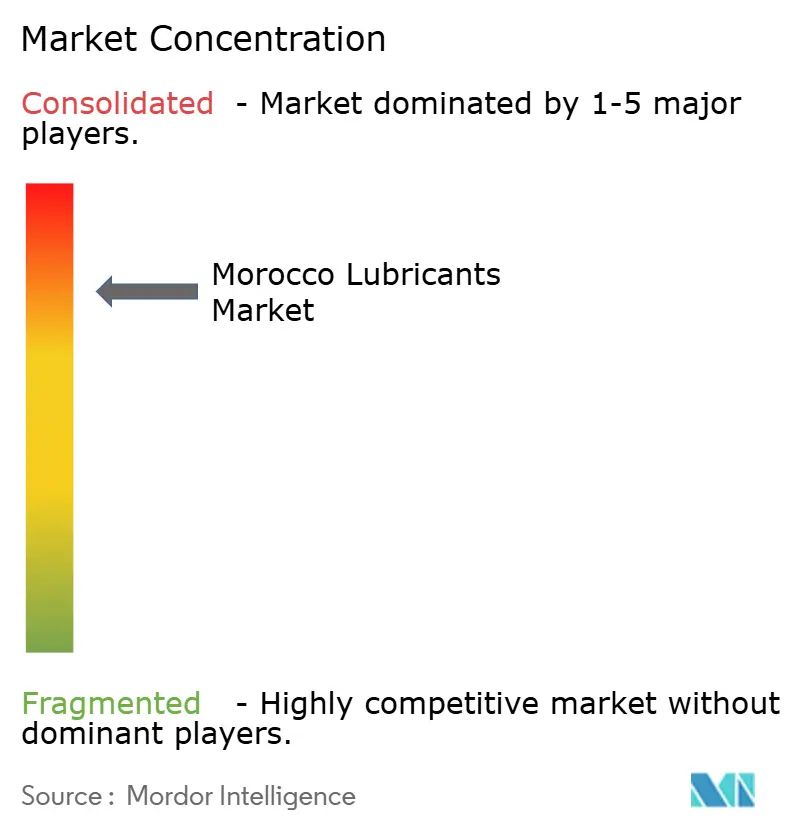
| Market Concentration | High |
Major Players *Disclaimer: Major Players sorted in no particular order Image © Mordor Intelligence. Reuse requires attribution under CC BY 4.0. | |
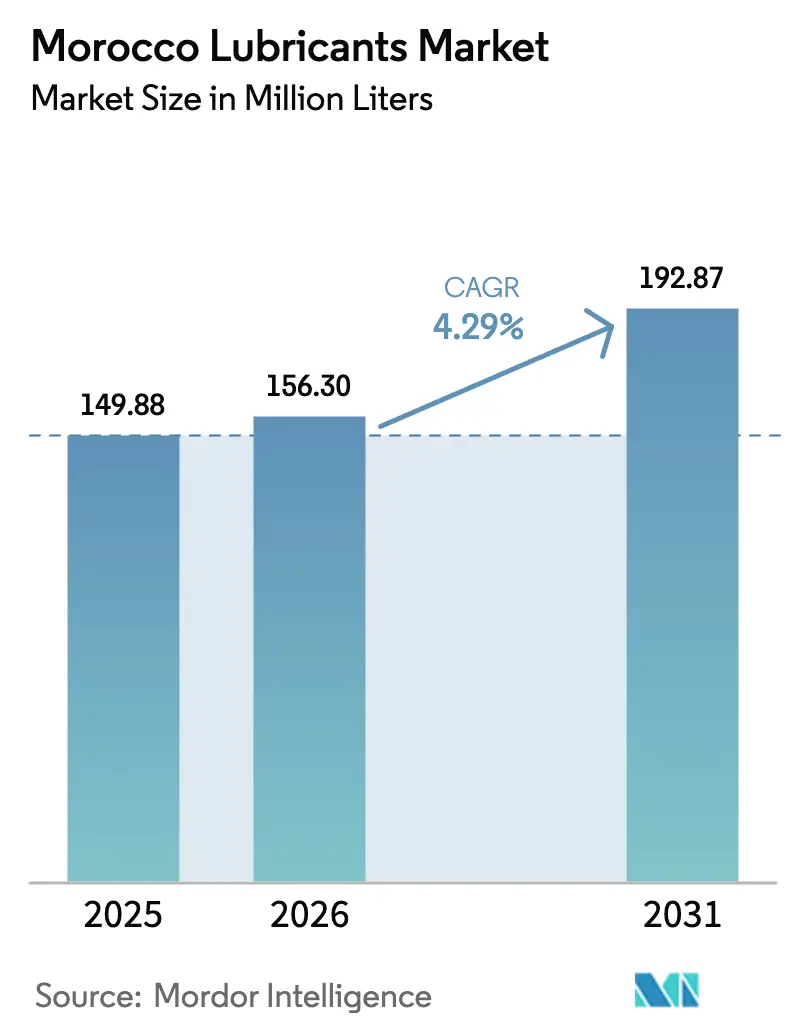
Morocco Lubricants Market Analysis by Mordor Intelligence
The Morocco Lubricants Market size is projected to be 149.88 Million liters in 2025, 156.30 Million liters in 2026, and reach 192.87 Million liters by 2031, growing at a CAGR of 4.29% from 2026 to 2031. The steady ascent is linked to the scale-up of local automotive output, the roll-out of Euro 6/VI fuel standards, and multibillion-dollar green-energy investments that expand specialty-fluid demand. Factory-fill volumes climb as Stellantis and Renault lift installed capacity, while low-SAPS synthetics gain ground in both the factory and aftermarket because ultra-low-sulfur diesel now dominates retail pumps. Parallel spending on 5 GW of renewable power, a 1 GW green-hydrogen complex, and a 1,500 km high-speed-rail build-out anchors long-cycle demand for turbine oils, hydraulic fluids, and biodegradable greases. Market concentration remains high: the three largest suppliers jointly hold just under half of the Morocco lubricants market and differentiate through blending scale, OEM tie-ups, and digital service tools.
Key Report Takeaways
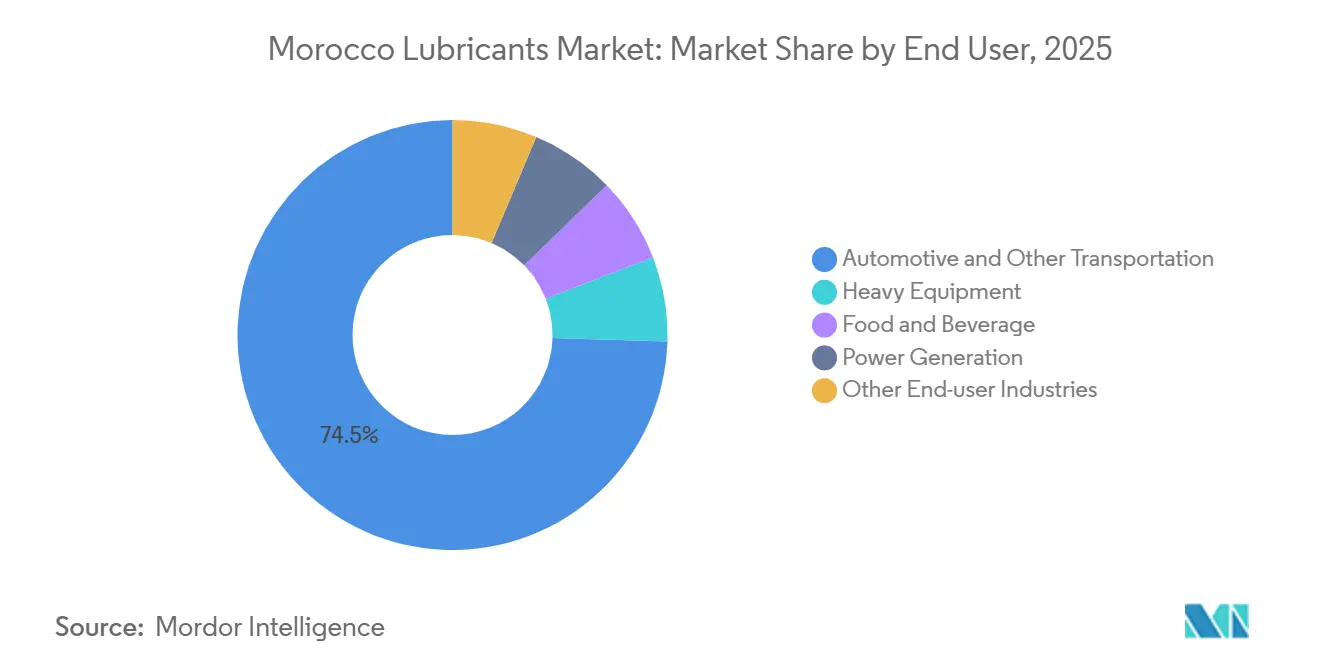
- By end user, automotive and other transportation led with 74.51% of the Morocco lubricants market share in 2025 and is expanding at a 6.10% CAGR through 2031.
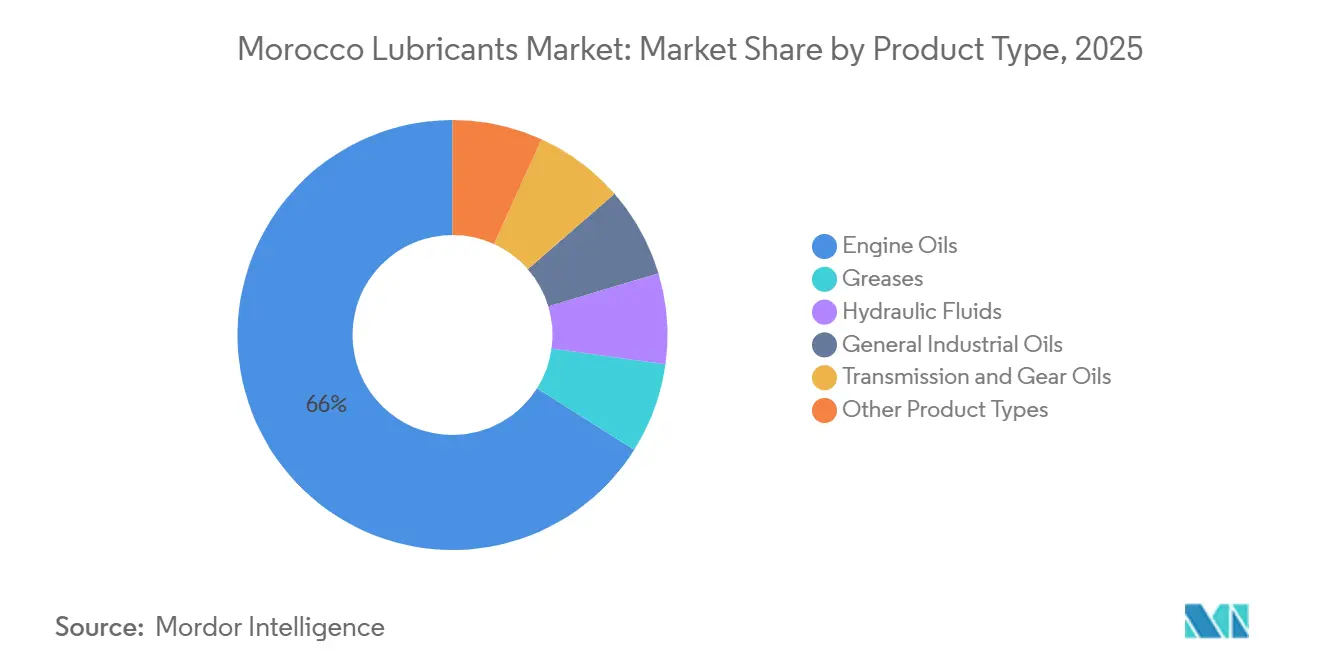
- By product type, greases are projected to post the fastest 5.38% CAGR, although engine oils continue to command 66.04% of the Morocco lubricants market size in 2025
Note: Market size and forecast figures in this report are generated using Mordor Intelligence’s proprietary estimation framework, updated with the latest available data and insights as of January 2026.
Morocco Lubricants Market Trends and Insights
Drivers Impact Analysis*
| Drivers | (~) % Impact on CAGR Forecast | Geographic Relevance | Impact Timeline |
|---|---|---|---|
| Rapid expansion of Morocco's OEM automotive production hubs | +0.8% | National, concentrated in Tanger-Tétouan-Al Hoceima and Casablanca-Settat | Medium term (2–4 years) |
| Continued infrastructure and mining investments driving heavy-equipment lubricant demand | +1.2% | National, with highest intensity in Khouribga-Jorf Lasfar, Gantour-Meskala-Safi, Tarfaya-Boucraa-Laayoune, and Al Boraq rail corridor | Long term (≥4 years) |
| Growing shift toward premium synthetics as vehicle parc modernises | +0.9% | National, early gains in Casablanca, Rabat, Marrakech urban centers | Medium term (2–4 years) |
| Government fuel-quality upgrades mandating low-sulfur, higher-spec lubricants | +0.7% | National | Short term (≤2 years) |
| Planned green-hydrogen megaprojects creating demand for specialty fluids | +0.5% | Regional, concentrated in coastal zones (Chbika, Dakhla) and OCP industrial complexes | Long term (≥4 years) |
| Source: Mordor Intelligence | |||
Rapid Expansion of Morocco's OEM Automotive Production Hubs
In 2024, Morocco produced vehicles, with ongoing plant expansions set to increase capacity significantly. This surge in production directly boosts the demand for factory-fill engine oils, transmission fluids, and assembly greases. Notably, Stellantis's upgrade is set to increase its engine output. Meanwhile, Renault is ramping up its hybrid initiatives, highlighted by the launch of a new engineering center. Each additional line incorporates high-precision stamping presses, machining centers, and paint booths that consume hydraulic oils, cutting fluids, and heat-transfer media. EV and hybrid output also introduces niche requirements such as ester-based dielectric coolants and ultra-low-friction wheel-bearing greases. Collectively, these factors keep the Morocco lubricants market on a firm upward trajectory despite efficiency gains.
Continued Infrastructure and Mining Investments Driving Heavy-Equipment Lubricant Demand
OCP is channeling significant investments into its Green Investment Program, aiming to ramp up fertilizer production by 2027[1]OCP Group, “OCP Green Investment Program,” ocpgroup.ma. This initiative also sees the installation of renewable energy across three major mining corridors. As a result, there's a secured long-term demand for hydraulic and gear oils, essential for excavators, haul trucks, and conveyors. In tandem, a rail strategy is broadening the Al Boraq network, while the Dakhla Atlantic Port is now under construction. Every step, from concrete pouring and rail welding to dredging, is dependent on biodegradable hydraulics and extreme-pressure greases that meet ISO 15380 standards. Additionally, wind and Concentrated Solar Power (CSP) plants in Ouarzazate are introducing turbine oils and synthetic heat-transfer fluids, expanding Morocco's lubricants market reach beyond just passenger vehicles.
Growing Shift Toward Premium Synthetics as Vehicle Parc Modernizes
With the introduction of Euro 6 vehicles and the use of 10 ppm diesel fuel, longer drain intervals are now achievable. This advancement is driving a notable shift towards fully synthetic, low-SAPS formulations. TotalEnergies’ Quartz 9000 range, now validated to ACEA C3, delivers improved fuel economy over its predecessor[2]TotalEnergies, “Quartz Product Range,” totalenergies.ma . Shell, in collaboration with Vivo Energy, has launched the Helix Ultra, boasting API SP and a host of OEM approvals. Meanwhile, Afriquia is scaling local blending runs, targeting West Africa's export markets with its Chevron-sourced Delo and Havoline lines. As synthetic formulations gain traction, they elevate the average unit value in Morocco's lubricants market, despite a slight dip in per-vehicle volumes.
Government Fuel-Quality Upgrades Mandating Low-Sulfur, Higher-Spec Lubricants
Order 1948-21 lowered national diesel sulfur starting January 2023, paving the way for particulate filters and selective catalytic reduction on new trucks. Lubricant blenders must therefore formulate ACEA C2/C3 oils with reduced sulfated ash to prevent after-treatment fouling. IMANOR certification and spot inspections, aided by a Climate and Clean Air Coalition technical-assistance grant, tighten compliance across retail channels. The new regime accelerates the substitution of legacy mineral grades, expanding the value share of synthetics within the Morocco lubricants market.
Restraints Impact Analysis*
| Restraints | (~) % Impact on CAGR Forecast | Geographic Relevance | Impact Timeline |
|---|---|---|---|
| Persistent counterfeit/sub-standard lubricant trade | -0.5% | National, with higher incidence in informal retail channels | Short term (≤2 years) |
| Accelerating EV and hybrid penetration in urban centres | -0.6% | Urban centers: Casablanca, Rabat, Marrakech, Tangier | Medium term (2–4 years) |
| Tightening waste-oil disposal rules raising compliance costs | -0.4% | National, with stricter enforcement in industrial zones (Casablanca-Settat, Tanger Med) | Medium term (2–4 years) |
| Source: Mordor Intelligence | |||
Persistent Counterfeit/Sub-Standard Lubricant Trade
OECD research flags Morocco as a provenance economy for counterfeit goods entering the EU, and similar informal networks distribute non-spec oils domestically, undercutting reputable brands. Sub-standard blends shorten engine life, erode consumer trust, and compress legitimate distributors’ margins. While Afriquia rebranded stations and introduced loyalty programs to signal authenticity, rural channels still escape routine lab testing. Enhanced border inspections and stiffer penalties are essential to safeguard the Morocco lubricants market’s premium tier.
Accelerating EV and Hybrid Penetration in Urban Centers
In 2024, Morocco registered a small EV fleet. However, this number is set to grow significantly in the coming years, supported by the establishment of a battery gigafactory. Pure electric vehicles (EVs) have eliminated the demand for engine oil, leading to a substantial reduction in total fluid consumption per vehicle. Meanwhile, hybrid vehicles have managed to cut annual oil changes. While there's a rise in specialized dielectric and thermal-management fluids, their volumes remain limited. This is expected to continue until EV penetration in the market surpasses a significant threshold—a milestone not anticipated before the late 2020s. This delay poses a medium-term challenge for Morocco's lubricants market.
*Our forecasts treat driver/restraint impacts as directional, not additive. The impact forecasts reflect baseline growth, mix effects, and variable interactions.
Segment Analysis
By End User: Automotive Dominance Masks Emerging Industrial Complexity
Automotive and other transportation represented 74.51% of the Morocco lubricants market share in 2025, and the segment is on track for a 6.10% CAGR to 2031, buoyed by record vehicle exports and rising fleet maintenance needs. Factory-fill requirements expand in tandem with OEM capacity, while aftermarket demand benefits from a passenger-car parc. Yet a deeper reading shows heavy equipment, though smaller, outpaces headline growth as OCP ramps conveyor installations and the rail-port build refreshes demand for hydraulic and gear oils.
Second-order effects widen the industrial user base. Power producers purchase turbine and transformer oils as renewable capacity climbs, and food processors convert to NSF H1-certified greases for export compliance. Collectively, these shifts lift the Morocco lubricants market size for non-automotive consumers, even as per-vehicle usage shows a gradual decline.



By Product Type: Engine Oils Lead, Greases Accelerate on Mining and EV Demand
Engine oils retained 66.04% of the Morocco lubricants market size in 2025, but their CAGR lags the overall market because electrification and extended oil-drain intervals erode volume per asset. Greases, in contrast, post a 5.38% CAGR through 2031, fueled by high-load conveyors in phosphate mines and by wind-turbine main bearings that require calcium-sulfonate complexes rated NLGI 2.
Hydraulic fluids capitalize on sustained capex in open-pit mines and civil-works machinery, whereas specialty oils such as heat-transfer fluids record double-digit growth inside CSP plants and battery-cell coating lines. This nuanced mix signals a pivot from high-volume, lower-margin SKUs to targeted, higher-value chemistries inside the broader Morocco lubricants market.
Geography Analysis
Casablanca-Settat captured a significant share of lubricant demand thanks to its dense cluster of automotive assembly, chemical fabrication, and offshore finance that concentrates vehicle parc and industrial activity. The corridor hosts Afriquia’s primary blending site and TotalEnergies’ lube plant, facilitating just-in-time deliveries to OEMs and fleets.
Tanger-Tétouan-Al Hoceima, home to Renault’s Tangier plant and Africa’s largest container port, is a key region by growth rate. The free-zone logistics chain pulls in marine lubricants for ship-to-shore cranes and biodegradable hydraulic oils for port reach-stackers. Hybrid and EV assembly lines under the 2025 Renault accord will further diversify lubricant needs, cementing the region as a fast-rising pole within the Morocco lubricants market.
Marrakech-Safi and the southern mining corridor contribute a smaller base yet register notable gains as OCP’s Green Investment Program unfolds. New high-speed rail links and the Dakhla Atlantic Port extend commercial reach, meaning specialty fluids for construction equipment and ammonia synthesis units will disperse beyond core coastal hubs. The geographic profile of the Morocco lubricants market is therefore evolving from a Casablanca-centric model to a multi-node network anchored by automotive, mining, logistics, and renewable-energy clusters.
Regulatory Landscape
Morocco is tightening oversight of lubricants under the Ministry of Energy Transition and Sustainable Development, which supervises hydrocarbon activities under Law No. 67-15/15-67. In January 2026, the Ministry introduced a draft regulatory framework to monitor the quality of lubricating oils, extending controls across import, manufacturing, filling, and retail sale, with compliance anchored to Moroccan standard NM 03.8.010 and laboratory sampling and analysis requirements.
Standards and certification are handled through IMANOR (Institut Marocain de Normalisation), which manages Moroccan standards and NM labeling. On the trade side, lubricants imported into Morocco follow HTSMOROCCO classification and can face duties that vary by line (with cited ranges spanning 2.5% to 35%) plus a 25% parafiscal tax unless covered by exemptions or trade agreement concessions, including under the U.S.-Morocco FTA and related tariff schedule circular updates referenced in 2025.
Value Chain Analysis
The value chain starts with base oils and additive packages that are largely imported (commonly from Europe and the United States), then blended and packed domestically by leading players with local infrastructure. Morocco also has local blending and storage footprints, including Société Afriquia Lubrifiants (Akwa Group) with storage and blending infrastructure around Jorf Lasfar and Mohammedia, alongside a Casablanca-Settat cluster that supports just-in-time supply to OEMs, fleets, and industrial customers.
Distribution relies on branded fuel retail networks, fleet and industrial direct sales, and coastal logistics nodes, with bulk terminals and ports supporting inbound raw materials and outbound shipments. As the January 2026 quality-monitoring framework rolls out, the chain becomes more compliance-intensive, with higher expectations for batch control, accredited lab testing, and documented traceability. This raises the barrier for informal and non-compliant supply. Local blending partnerships are also becoming more visible, including OLA Energy Maroc and ExxonMobil Petroleum and Chemical BV announcing in May 2024 the initiation of local blending of Mobil-branded lubricants at the Les Roches Noires facility in Casablanca.
Competitive Landscape
The Morocco Lubricants Market is consolidated. Afriquia draws on Chevron’s Delo and Havoline technology and exports to 14 African states, leveraging ISO 9001 blending lines in Jorf Lasfar. Mid-tier entrants compete on niche chemistries or regional distribution, often importing finished goods rather than blending locally. Digitalization is a secondary battleground. Vivo’s predictive LubeAnalyst reduces unscheduled downtime for mining fleets, while TotalEnergies’ QR-code traceability counters counterfeit infiltration. These tech advances, combined with widening synthetic portfolios, allow leading suppliers to protect their share even as the Morocco lubricants market fragments under e-commerce and cross-border import pressure.
Morocco Lubricants Industry Leaders
TotalEnergies
Afriquia
Shell Plc
OLA Energy
FUCHS
- *Disclaimer: Major Players sorted in no particular order

Market Opportunities and Future Outlook
Quality enforcement creates room for branded suppliers and compliant blenders to shift demand away from informal channels by pairing NM 03.8.010-aligned products with traceability and documented batch control, as the Ministry of Energy Transition and Sustainable Development moved in January 2026 to formalize lubricant quality monitoring. The same shift also supports service-led opportunities, including used-oil collection and compliant disposal models, as tighter waste-oil rules increase the value of verifiable circular practices in industrial zones and along logistics corridors.
Industrial investment at Jorf Lasfar supports higher-value demand for industrial oils, hydraulic fluids, greases, and specialty process fluids sold through long-cycle contracts rather than spot retail. Recent indicators include Pakistan Maroc Phosphore (OCP and Fauji Group) inaugurating a fifth phosphoric acid concentration line at the Jorf Lasfar platform on 2 April 2026 (adding 400 tonnes per day), and OCP advancing industrial deployment of cadmium-removal technology at Jorf Lasfar in June 2026, both of which add installed base for rotating equipment and process units that depend on reliable lubrication regimes. Competitive dynamics add another angle: Stonepeak agreeing in April 2026 to acquire a 65% controlling stake in BP’s Castrol business signals potential changes in route-to-market priorities, distribution alignment, and supplier terms for Morocco and adjacent export lanes.
Recent Industry Developments
- July 2026: OCP and Koch announced a partnership around a 1.2 million mt phosphate facility in Morocco under the Jorf Fertilizers Company I banner. The project reinforces Jorf Lasfar as a growing industrial hub, expanding the installed base for industrial lubricants used in pumps, gearboxes, compressors, and materials-handling systems.
- June 2025: BP Plc initiated a sale process for its Castrol division, flagged at a valuation of up to USD 10 billion. The move introduced uncertainty and optionality around Castrol’s ownership and route-to-market strategy, with potential knock-on effects for distributor agreements and supply priorities in Morocco.
- May 2024: OLA Energy Maroc announced a strategic partnership with ExxonMobil Petroleum and Chemical BV to initiate local blending of Mobil-branded lubricants at the Les Roches Noires facility in Casablanca. Expanding local blending capability shortens lead times versus finished-goods imports and improves the ability to tailor specifications for Moroccan automotive fleets and industrial users.


Research Methodology Framework and Report Scope
Market Definition and Coverage
For this methodology, the Morocco lubricants market covers finished lubricants sold and consumed within Morocco across automotive, transport, heavy equipment, industrial, and power uses. The market is sized in volume terms, where demand is linked to in-use equipment, drain intervals, and industrial operating intensity.
Scope exclusions: We exclude fuels, base oils as a traded commodity, and most process oils that are not used primarily for lubrication.
Segmentation Overview
- By End User
- Automotive and Other Transportation
- Heavy Equipment
- Food and Beverage
- Power Generation
- Other End-user Industries
- By Product Type
- Engine Oils
- Greases
- Hydraulic Fluids
- General Industrial Oils
- Transmission and Gear Oils
- Other Product Types
Data Sources, Market Sizing, and Validation
Desk Research
Desk research was used to build the starting structure of demand and to keep assumptions grounded in Morocco specific operating conditions. We referred to public and official sources such as the International Energy Agency for energy and generation indicators, UN Comtrade for import and export directions, the World Bank for macro and industrial signals, and the International Organization of Motor Vehicle Manufacturers for vehicle production context.
On top of these, we also reviewed items such as regulator and standards body publications, importer and distributor announcements, company filings and investor presentations, and reputable press coverage that points to capacity changes or policy shifts. For cross-checking volumes and trade flows, we also used select paid databases that cover import and export shipment records and lubricants specific market information, which helped us validate whether implied supply was consistent with the demand build. The desk sources listed here are illustrative, and many other references were used to collect data, validate inputs, and clarify open questions during the research.
Primary Interviews and Surveys
Interviews and surveys in Morocco cover lubricant distributors, service outlets, fleet operators, industrial users, and maintenance managers. Respondent input is used to clarify fleet usage, drain intervals, product mix, purchase prices, channel margins, and changes in demand. These findings are then compared with secondary data and used to review the final assumptions.
Distribution of primary research fieldwork respondents
| Company type | Respondent position |
|---|---|
| Top tier: 28% | CXOs: 18% |
| Mid tier: 47% | Functional/Unit leaders: 30% |
| Smaller Players: 25% | Managers: 52% |
Market-Sizing & Forecasting
The core model used a top-down demand pool approach, where the installed base of vehicles and equipment and the operating intensity of key industries are translated into lubricant consumption using realistic drain intervals and typical fill volumes. Those totals were checked against selective bottom-up approximations, mainly by sampling lubricant pricing and packaging mixes by channel and using supply side sense checks to adjust totals when the first pass looked overstated or understated.
Inputs were chosen because they move lubricant consumption in a visible way and can be validated without relying on overly detailed private datasets. For Morocco, we leaned on indicators such as vehicle parc and utilization patterns, commercial fleet maintenance practices, construction and heavy equipment activity, manufacturing output trends, and power generation operations that influence turbine and hydraulic oil use. Pricing and value logic were handled through average selling price ranges by product family and pack size, followed by a weighted mix that reflects the aftermarket versus industrial buying behavior.
Forecasting used scenario analysis around the few variables that most often shift year to year, including industrial activity, transport intensity, and drain interval evolution as higher performance oils are adopted. Where bottom-up checks had gaps, we used conservative interpolation based on adjacent product families and confirmed the implied mix with interview feedback before locking the final series.
Data Validation & Update Cycle
Validation was done through several layers of cross-checks so the final numbers stay consistent with what is observable in the country. We compared model outputs with independent signals such as trade flow direction, macro and industrial trend lines, and what distributors and maintenance teams described as normal buying cycles, and then investigated and corrected any large variances.
Before sign-off, the work goes through internal reviews where assumptions are stress-tested and recalculated to see whether small changes create unrealistic swings. When a data point looks inconsistent, respondents are re-contacted to confirm whether it is a real market shift or a timing effect. Reports are refreshed annually, with interim updates when material events occur, and a final pre-delivery pass is completed so clients receive the latest view.
Mordor Intelligence's Morocco Lubricants Market Market Size Measured Against Other Published Estimates
Published market values can differ even when the same country is discussed, because research teams may not line up on the unit of measure, the product boundary, and what gets treated as end-use lubricants versus adjacent fluids. Differences also show up when older pricing is carried forward, or when currency timing is not aligned to the same base year.
In lubricants, the spread is often driven by whether the estimate is built from volume first and then converted to value using a pack mix and product family price bands, or whether it starts with broad revenue proxies that can accidentally include base oils or non-lubricant industrial fluids. Exchange rate timing also matters in Morocco because imported product pricing can move faster than volumes, and a tighter refresh cycle reduces the risk that ASP assumptions lag real market changes, which is the approach applied by Mordor Intelligence.
Benchmark comparison
| Source | Market Size | Gaps in Research Methodology |
|---|---|---|
| Mordor Intelligence | USD 149.88 M (2025) | |
| Trade Journal A | USD 156.30 M (2026) | This figure is stated for 2026 and is shared mainly as a volume-level milestone, so converting it into USD can depend heavily on the assumed pack mix and the exchange rate month used, which can shift the value without any real volume change. |
| Industry Publication B | USD 146.39 M (2025) | This estimate focuses on automotive lubricants and is presented in value terms, which can undercount non-automotive industrial demand, and it may also apply a single blended ASP that does not fully reflect the industrial versus consumer mix. |
Overall, the table shows that the biggest gaps come from unit conversion choices, the boundary between automotive-only and total lubricants, and how pricing is refreshed and weighted by mix. By keeping the demand pool logic traceable to equipment activity and then applying transparent ASP and currency timing checks, the sizing stays easier to reconcile with real market signals and easier to update when conditions change.


Key Questions Answered in the Report
How big is the Morocco lubricants market?
It reached 156.30 million liters in 2026 and is forecast to climb to 192.87 million liters by 2031.
What CAGR is projected for Morocco’s lubricant demand through 2031?
The market is expected to register a 4.29% CAGR from 2026 to 2031, led by automotive factory-fill and mining equipment needs.
Which end-user group consumes the most lubricants?
Automotive and other transportation account for 74.51% of total volume and are still growing at 6.10% per year.
Why are synthetic lubricants gaining share?
Euro 6 fuel standards, longer drain intervals, and OEM approvals are pushing buyers toward low-SAPS, fully synthetic oils.
How is electrification affecting lubricant suppliers?
EVs cut traditional engine-oil volumes, but they open smaller niches in dielectric coolants and thermal-management fluids, prompting suppliers to diversify.
Page last updated on:




