
Market Overview
| Study Period | 2021 - 2031 |
|---|---|
| Forecast Data Period | 2026 - 2031 |
| Historical Data Period | 2021 - 2024 |
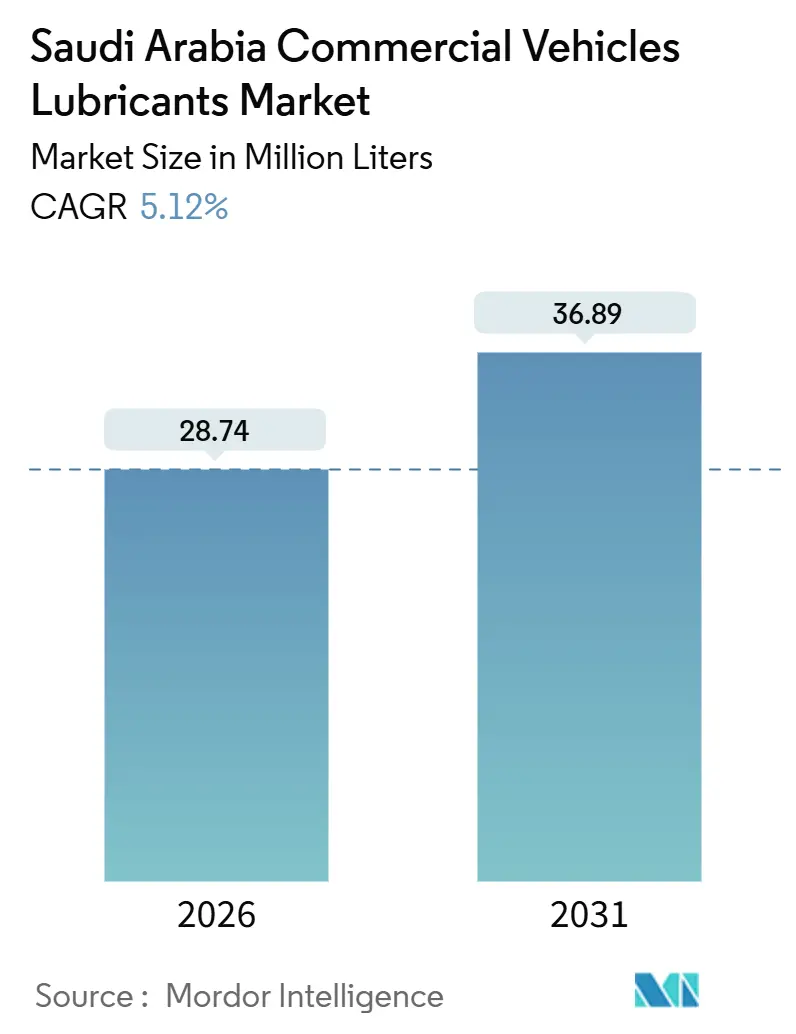
| Market Volume (2026) | 28.74 Million liters |
| Market Volume (2031) | 36.89 Million liters |
| Growth Rate (2026 - 2031) | 5.12 % |
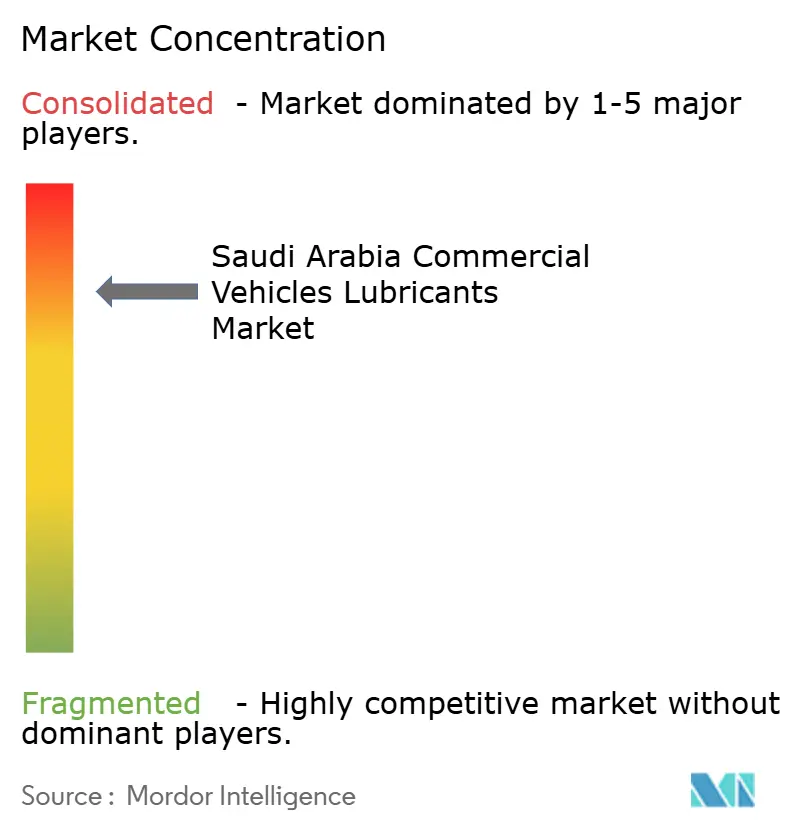
| Market Concentration | High |
Major Players *Disclaimer: Major Players sorted in no particular order Image © Mordor Intelligence. Reuse requires attribution under CC BY 4.0. | |
Saudi Arabia Commercial Vehicles Lubricants Market Analysis by Mordor Intelligence
The Saudi Arabia Commercial Vehicles Lubricants Market size is estimated at 28.74 million liters in 2026, and is expected to reach 36.89 million liters by 2031, at a CAGR of 5.12% during the forecast period (2026-2031). Record infrastructure awards support growth under Vision 2030, logistics densification that keeps heavy-duty vehicles moving year-round, and a steady shift toward synthetic formulations engineered for desert operating temperatures above 50 °C. Seasonal pilgrimage peaks, the rise of predictive-maintenance contracts that lock in premium multi-year volumes, and Aramco’s downstream push after the Valvoline acquisition have intensified competition, widened service expectations, and reduced supplier lead times. At the same time, electrification of last-mile fleets and public buses is starting to flatten long-run engine oil volumes, forcing suppliers to diversify into driveline fluids, battery coolants, and greases.
Key Report Takeaways
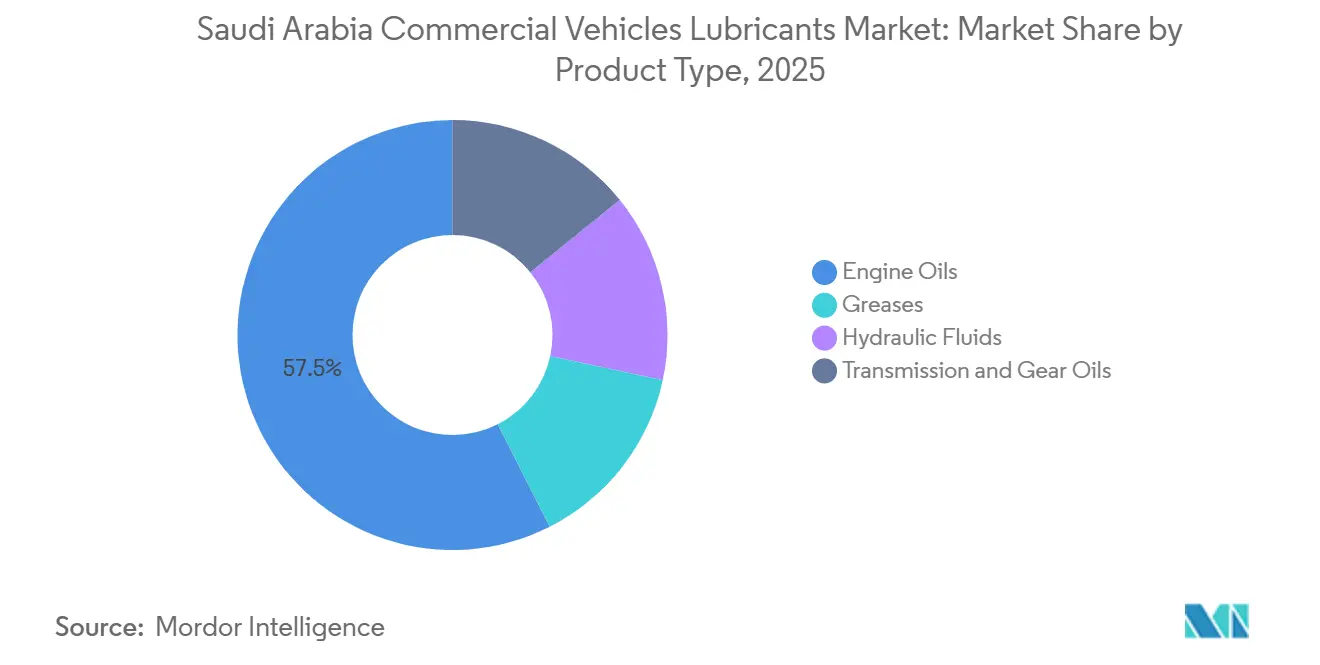
- By product type, engine oils held 57.46% of the Saudi Arabian commercial vehicles lubricants market share in 2025, while transmission and gear oils are forecast to expand at a 6.18% CAGR through 2031.
Note: Market size and forecast figures in this report are generated using Mordor Intelligence’s proprietary estimation framework, updated with the latest available data and insights as of January 2026.
Saudi Arabia Commercial Vehicles Lubricants Market Trends and Insights
Drivers Impact Analysis*
| Drivers | (~) % Impact on CAGR Forecast | Geographic Relevance | Impact Timeline |
|---|---|---|---|
| Infrastructure megaprojects under Vision 2030 fueling construction and fleet lubricant demand | +1.2% | National, with concentration in Riyadh, NEOM, Jeddah, and Eastern Province industrial zones | Medium term (2-4 years) |
| Booming logistics/e-commerce miles increasing lubricant consumption intensity | +0.9% | National, with urban density in Riyadh, Jeddah, Dammam driving last-mile delivery growth | Short term (≤ 2 years) |
| Shift toward synthetic HDDEO for extended drain intervals in extreme desert climate | +0.7% | National, particularly high-temperature regions (Rub' al Khali, Northern Border Province) | Long term (≥ 4 years) |
| Seasonal Hajj-Umrah pilgrimage peaks creating predictable bus-fleet maintenance cycles | +0.5% | Western Province (Mecca, Medina, Jeddah), with spillover to national coach operators | Short term (≤ 2 years) |
| Digital predictive-maintenance adoption driving premium bundled lubricant contracts | +0.6% | National, with early adoption by large logistics fleets (DHL, Aramex, FedEx) and public-transport operators | Medium term (2-4 years) |
| Source: Mordor Intelligence | |||
Infrastructure Megaprojects Under Vision 2030 Fueling Construction and Fleet Lubricant Demand
Saudi Arabia’s construction pipeline between 2023 and 2030 is mobilizing thousands of haul trucks, excavators, and concrete mixers that collectively consume large volumes of engine oils, hydraulic fluids, and greases each year[1]. NEOM’s 170-kilometer linear city, the Amiral petrochemical complex at Jubail, and the Samref VFA expansion at Yanbu each deploy equipment that operates almost continuously in ambient temperatures exceeding 45 °C, shortening drain intervals and demanding oxidation-stable synthetics. The planned logistics centers designed to lift non-oil GDP further amplify truck density and extend operating hours for forklifts and yard tractors. Local blenders that secure Group II/III base-oil supply through Luberef’s new Yanbu train have begun shortening customer lead times from weeks to days, capturing fleet renewals tied to civil-works contracts. Together, these projects cement a multi-year uplift in Saudi Arabia's commercial vehicles lubricants market demand, especially for heavy-duty diesel engine oils and shock-load hydraulic fluids.
Booming Logistics and E-Commerce Miles Increasing Lubricant Consumption Intensity
The national freight and logistics sector is set to grow, driven by rising expectations for same-day deliveries and enhanced cross-border ties with Gulf ports. Major players like Aramex, Ajex (backed by DHL), and FedEx are broadening their hub-and-spoke networks, boasting a combined fleet of vehicles. Notably, many of these vehicles still depend on diesel engines for their long-haul journeys. Every additional mile driven by these fleets translates directly to lubricant consumption. Telematics data reveals a shift: urban vans now cover greater distances daily. While pilot initiatives, like Aramex's electric Farizon 8-tonner, hint at a forthcoming shift, the pace of this transition remains slow. As a result, the Saudi Arabian market for commercial vehicle lubricants continues to be closely tied to traditional internal combustion cycles throughout the forecast period.
Shift Toward Synthetic HDDEO for Extended Drain Intervals in Extreme Desert Climate
Field tests in the Empty Quarter reveal that Group III-based 5W-40 synthetics outlast mineral 15W-40 by retaining viscosity and total base number longer[2]. This advancement enables fleets to extend oil drains without surpassing iron wear thresholds. Blenders are capitalizing on the new Yanbu base-oil train to produce premium HDDEO grades locally. This shift reduces reliance on imports from Singapore and South Korea, effectively curbing currency-related price fluctuations. While these premium oils carry a price markup over their mineral counterparts, a comprehensive total cost of ownership analysis reveals net savings when accounting for diminished downtime and fewer filter purchases. This economic advantage is propelling adoption among organized fleets that emphasize whole-life cost considerations.
Seasonal Hajj–Umrah Pilgrimage Peaks Creating Predictable Bus-Fleet Maintenance Cycles
During the 2025 Hajj season, a fleet of buses and taxis, bolstered by mobile workshops and tow trucks, operated over a concentrated four-week maintenance window. This effort consumed significant amounts of engine oil and transmission fluid. Hafil, servicing a large number of buses between Ramadan and Dhul-Hijjah, has led suppliers to strategically pre-position inventory in Jeddah and Medina. Although Mecca's newly introduced electric BRT fleet in late 2025 has diminished the demand for engine oil in urban shuttle routes, intercity coaches still rely on diesel. This ensures that the peaks of pilgrimage seasons continue to set a reliable volume floor for Saudi Arabia's commercial vehicle lubricants market.
Restraints Impact Analysis*
| Restraints | (~) % Impact on CAGR Forecast | Geographic Relevance | Impact Timeline |
|---|---|---|---|
| Crude-oil price volatility and intense price competition squeezing margins | -0.8% | National, with spillover effects from global Brent crude pricing and OPEC+ production decisions | Short term (≤ 2 years) |
| Counterfeit and low-quality products eroding brand share and trust | -0.5% | National, with higher incidence in secondary distribution channels and independent workshops | Medium term (2-4 years) |
| Riyadh's 30% EV public-transport target gradually capping long-term engine-oil demand | -0.4% | Urban centers (Riyadh, Jeddah, Dammam), with national spillover as EV adoption accelerates | Long term (≥ 4 years) |
| Source: Mordor Intelligence | |||
Crude-Oil Price Volatility and Intense Price Competition Squeezing Margins
Brent crude prices lingered at a stable level throughout 2025. This trend compressed base-oil spreads, compelling blenders to either absorb cost fluctuations or offer steep discounts in a market where brand loyalty frequently wavers. The arrival of a fully integrated Aramco–Valvoline entity has raised the stakes, as a state-backed supplier can underwrite promotions during soft quarters, pressuring independents to defend share with extended credit terms and bundled services rather than outright price cuts.
Counterfeit and Low-Quality Products Eroding Brand Share and Trust
In January 2024, the Ministry of Commerce confiscated counterfeit lubricant items. Despite this, smaller workshops along the Riyadh–Dammam corridor persist in stocking unverified oils, often undercutting branded prices. By the close of 2024, SASO’s Product Safety Program achieved compliance. However, with authentication labs facing capacity constraints, rogue distributors have found opportunities to exploit enforcement gaps. In response, genuine suppliers have introduced QR-coded packs, tamper-evident seals, and rigorous distributor audits. Yet, the challenge remains: rebuilding a tarnished brand equity is both costly and time-intensive.
*Our forecasts treat driver/restraint impacts as directional, not additive. The impact forecasts reflect baseline growth, mix effects, and variable interactions.
Segment Analysis
By Product Type: Engine Oils Anchor Volume, Transmission Fluids Lead Growth
Engine oils commanded 57.46% of the 2025 volume, driven by Saudi Arabia's fleet of trucks, buses, and vans. These vehicles operate in high-temperature, dusty conditions, leading to shorter drain intervals and busier service bays. The market for engine oils in Saudi Arabia's commercial vehicle lubricants sector is set to grow in the coming years, despite the encroaching influence of electrification. Fleet managers are increasingly opting for API CK-4 and OEM-licensed 5W-40 synthetics, not only to safeguard against warranty claims but also to benefit from longer service intervals, reducing downtime and filter purchases.
Transmission and gear oils, while accounting for a smaller absolute tonnage, are the fastest-growing line at a 6.18% CAGR. This growth is fueled by the rising adoption of automated manual and continuously variable transmissions in new long-haul tractors. Leading OEMs like Volvo, Daimler, and FAW are specifying API GL-5 and MT-1 fluids, known for their enhanced shear stability. In response, blenders are reformulating with synthetic base stocks to ensure gear protection at sump temperatures of 200 °C. Meanwhile, greases and hydraulic fluids are experiencing steady growth, largely driven by the need for construction equipment uptime. Suppliers are introducing advanced chemistries, such as calcium-sulfonate and polyurea thickeners, which not only enhance performance but also extend relubrication intervals. Collectively, these trends highlight a shift in the Saudi Arabian market, moving from traditional bulk engine oils to specialty driveline fluids that offer higher profit margins.

Geography Analysis
Riyadh is the country’s largest demand center, accounting for a significant share of Saudi Arabia's commercial vehicles lubricants market volume. The city’s metro expansion, ring-road widening, and airport logistics park projects generate thousands of daily trips by earthmovers, dump trucks, and ready-mix concrete mixers, each consuming lubricants at accelerated rates under stop-start conditions. Government tenders now stipulate WASL compliance, so vendors able to integrate drain alerts into the platform have secured multi-year contracts with municipal bus operators, refuse collectors, and construction fleets.
Western Province demand is dominated by Jeddah-Mecca pilgrimage flows that cause predictable spikes in June–July. The launch of the Mecca electric BRT corridor reduces diesel lubricant intensity within the urban core but leaves intercity coach routes untouched, so the overall Saudi Arabia commercial vehicles lubricants market share from the Western Province is expected to remain stable.
The Eastern Province supplies the bulk of Group II/III base oil via Luberef’s Yanbu site, giving local blenders a logistics advantage in serving petrochemical complexes at Jubail and Yanbu industrial cities, where equipment works continuously. Heavy-haul trucking that links these plants to Dammam’s King Abdulaziz Port remains diesel-dependent, sustaining robust engine oil and gear oil demand. NEOM in the northwest introduces a greenfield hotspot where sustainability mandates will eventually favor electric and hydrogen equipment; however, bulk earthworks through the coming years will still rely on diesel-fueled machinery, ensuring a transitional lubricant revenue stream for suppliers that establish on-site service hubs.
Regulatory Landscape
Commercial vehicle lubricants sold in Saudi Arabia are governed by SASO (Saudi Standards, Metrology and Quality Organization) Technical Regulation for Lubricating Oils, which defines product quality, labeling, and safety requirements for market access. A key update is GSO 1785-1:2024 (approved May 1, 2024), which revises specifications for internal combustion engine lubricants and aligns requirements with API performance classifications for both gasoline and diesel engines.
To place products on the market, importers and manufacturers need to complete conformity assessment via the SABER platform and secure Certificates of Conformity. With that documentation and test reporting, plus Arabic and English labeling, positioned as central compliance checkpoints, the regulation also references adjacent SASO/GSO standards that extend beyond engine oils to hydraulic oils, automotive greases, and gear lubricants. This broadens enforcement across the multi-product lubricant packages used by fleets and workshops.
Value Chain Analysis
The value chain begins with base oil supply, led domestically by Saudi Aramco Base Oil Company (Luberef). This provides the feedstock base for Group II/III inputs used in heavy-duty diesel engine oils and driveline fluids. In February 2026, the Saudi Ministry of Energy extended feedstock allocation for Luberef's Jeddah facility (24,500 barrels/day until 2030) and Yanbu facility (50,000 barrels/day until 2038), which supports longer-horizon planning for blenders and lowers disruption risk for fleet-service contracts tied to major project cycles.
On the formulation and blending side, international majors and local players convert base oils and additive packages into API- and OEM-aligned finished lubricants, then distribute them through authorized channels, including distributors, service stations, and independent workshops. Localization is concentrating around Yanbu, where the LubeHUB lubricants value park improves access to base oil supply logistics; in June 2026, Apar Industries Middle East Limited signed a base oil supply agreement with Luberef to manufacture specialty oils at LubeHUB. Downstream, large fleets and public-transport operators increasingly buy through bundled maintenance agreements, and compliance through SASO technical regulation and SABER-based conformity remains a gatekeeper across import, warehousing, and last-mile retail.
Competitive Landscape
The Saudi Arabia Commercial Vehicles Lubricants Market is consolidated. Aramco’s acquisition of Valvoline and its interest in BP’s Castrol unit reflect a strategic bid to internalize blending margins and leverage unmatched base-oil access, giving the state champion a cost position few can match. Service bundling is emerging as a moat. Digital natives such as Eagle-IoT insert themselves between fleet and lubricant supplier, monetizing data while directing volume to partners that pay referral fees. As electrification spreads, first movers with e-driveline fluids and battery coolant portfolios stand to capture early share.
Saudi Arabia Commercial Vehicles Lubricants Industry Leaders
-
Petromin Corporation
-
Shell plc
-
BP plc
-
ExxonMobil Corporation
-
FUCHS
- *Disclaimer: Major Players sorted in no particular order
Market Opportunities and Future Outlook
A noticeable opportunity is localizing critical lubricant inputs beyond base oils, especially additives that affect high-temperature oxidation control and extended drain performance for heavy-duty fleets. In February 2025, Farabi Downstream Petrochemical Company and Xinxiang Richful Lube Additive Co., Ltd signed an MoU to establish an integrated lubricant additive manufacturing plant in Yanbu, suggesting a pathway to domestic component sourcing that can reduce constraints on formulation flexibility and working-capital cycles for blenders serving organized fleets.
Supply-side capacity and feedstock security are also influencing where premium demand can be captured, particularly in premium synthetics and specialty driveline fluids. In January 2026, Luberef and Saudi Aramco signed an MoU to explore development of a base oil plant at the Jazan complex, and Luberef has guided its Yanbu base oils expansion toward completion in the second half of 2026, with maintenance shutdowns used to finalize the project. As domestic base oil availability and localized additive capability improve, suppliers can expand into higher-margin, high-stress products (HDDEO, transmission and gear oils, hydraulic fluids, greases) while progressing through SASO conformity via SABER for faster commercialization and more resilient distribution planning.
Recent Industry Developments
- June 2026: FUCHS and Aramco signed a Global Framework Agreement for Base Oils at FUCHS headquarters in Mannheim to deepen collaboration under Aramco's Base Oils Alliance. The agreement strengthens long-term base oil sourcing optionality for FUCHS and supports product continuity in high-temperature heavy-duty lubricant grades used across commercial fleets.
- February 2026: JOSLOC (Al Jomaih and Shell Lubricating Oil Company) signed a strategic lubricants supply agreement with Al Nakhlah National Company (NANCO) to supply premium lubricants for its fleet. The deal reflects growing use of structured fleet supply contracts that link lubricant selection to uptime and maintenance performance, favoring suppliers with technical service depth and assured availability.
- January 2024: Saudi Arabia's Ministry of Commerce confiscated counterfeit lubricant items as part of enforcement actions against non-compliant products. The crackdown elevated the importance of traceability, compliant labeling, and verified distribution channels for branded lubricant suppliers competing in workshop-led and secondary-market routes.
Research Methodology Framework and Report Scope
Market Definition and Coverage
This market covers lubricants consumed in Saudi Arabia for operating and maintaining commercial vehicles. We measure consumption across the full set of in-service lubricant fills and drain intervals over the year.
Scope exclusions: We exclude lubricants used in passenger cars, motorcycles, industrial equipment, marine, aviation, and power generation, along with base oil and additive trading that does not translate into finished lubricant demand.
Segmentation Overview
- By Product Type
- Engine Oils
- Greases
- Hydraulic Fluids
- Transmission and Gear Oils
Data Sources, Market Sizing, and Validation
Desk Research
Desk research was used to build a practical demand picture for commercial vehicle lubricants in Saudi Arabia before we took assumptions into interviews. We relied on public and official references such as Saudi General Authority for Statistics releases, customs and trade statistics, and standards and regulatory publications from SASO. For the macro context and energy-linked indicators, we also used publications from agencies such as OPEC and the World Bank.
To translate these signals into a lubricant consumption view, we reviewed technical literature and publicly available service guidance that shapes drain intervals. Where available, we also used association and fleet-related publications. Company annual reports, investor presentations, and reputable press were then used to track product mix shifts, for example higher synthetic penetration, and route-to-market changes. When needed, we supplemented with paid database subscriptions for company financials and intelligence, import-export shipment level checks, and patent database scans to keep product and formulation trends grounded. These sources are illustrative and not exhaustive, and additional references were used for data collection, validation, and clarification.
Primary Interviews and Surveys
Primary interviews and surveys were used to validate local demand drivers that desk sources cannot show clearly. This included fleet maintenance practices, oil drain interval discipline, and how procurement changes with project activity. Respondents included lubricant suppliers and blenders, distributors and workshops, and fleet-side maintenance stakeholders. The inputs were then reconciled to match Saudi-specific vehicle activity patterns and product usage behavior.
Distribution of primary research fieldwork respondents
| Company type | Respondent position |
|---|---|
| Top tier: 31% | CXOs: 12% |
| Mid tier: 54% | Functional/Unit leaders: 35% |
| Smaller Players: 15% | Managers: 53% |
Market-Sizing & Forecasting
Our sizing starts with a top-down build that links the addressable commercial vehicle parc and annual utilization to lubricant demand. We then convert that demand into category volumes using service-fill rates and drain intervals that fit Saudi operating conditions.
To keep totals realistic, we also run selective bottom-up checks, such as rolling up sampled channel volumes. We use a volume times average price sanity check based on interview inputs, then adjust for gaps where coverage is incomplete.
Key inputs that shaped the model include commercial vehicle parc growth, average kilometers traveled by vehicle class, oil drain interval patterns for heavy duty diesel engines, product mix split across engine oils, hydraulic fluids, greases, and transmission and gear oils, and the pace of shift toward synthetic and low-ash formulations. For forecasting, we used scenario analysis guided by experts, since project cycles, freight activity, and maintenance behavior can move faster than straight-line trends. When conflicting inputs appeared, we chose assumptions that could be traced back to at least two independent signals and that were repeatable for annual updates.
Data Validation & Update Cycle
Validation was done through a set of cross-checks, not a single step. Model outputs were compared against independent signals such as vehicle parc direction, import and supply movement indicators, and the implied liters per vehicle per year so abnormal spikes could be flagged early.
If a variance was large, we re-checked unit conversions and timing alignment. We also checked whether a respondent was describing retail sales versus actual consumption, and then triggered re-contact for clarification when needed. A second analyst review is completed before sign-off so assumptions and math are consistent across years and product types. Reports are refreshed annually, with interim updates when material events occur, and a final pre-delivery pass is done to ensure the latest available data is reflected.
Mordor Intelligence's Saudi Arabia Commercial Vehicles Lubricants Market Size Compared With Other Published Estimates
Published market sizes for Saudi Arabia commercial vehicle lubricants can vary because different studies do not always count the same lubricant types. Some also present value versus volume in different ways. Differences can also come from how each publisher treats drain intervals and fleet utilization, which changes liters consumed even if the vehicle parc is similar.
Import and local supply movement checks, along with implied liters-per-vehicle validation from fleet maintenance inputs, are the evidence used to keep Mordor Intelligence's estimate aligned to lubricant consumption in commercial vehicles, rather than broader automotive or industrial fluid demand. The largest gaps usually show up when a study folds in adjacent categories such as off-highway equipment fluids, uses aggressive assumptions for synthetic upgrading that inflate average prices, or applies exchange-rate timing that does not match the year being reported.
Benchmark comparison
| Source | Market Size | Gaps in Research Methodology |
|---|---|---|
| Mordor Intelligence | USD 28.74 M (2026) | |
| Industry Bulletin A | USD 34.10 M (2026) | Often expands scope beyond on-road commercial vehicles by adding mixed industrial and off-highway hydraulic demand, which lifts totals even if fleet activity is unchanged. |
| Regional Consultancy B | USD 24.90 M (2026) | Typically applies conservative utilization and longer drain intervals based on generalized service guidance, which lowers implied liters per vehicle for Saudi operating conditions. |
The table shows that most of the spread can be explained by scope boundaries and by how liters per vehicle are set using local duty cycles and service practices. By anchoring the model to observable supply signals and realistic maintenance behavior, the final value stays traceable to clear variables and can be updated year after year with the same steps.
Key Questions Answered in the Report
What is the projected volume for Saudi Arabia's commercial vehicles' lubricants by 2031?
What is the projected volume for Saudi Arabia's commercial vehicle lubricants by 2031?
Which product type is growing fastest?
Transmission and gear oils lead growth with a 6.18% CAGR through 2031.
How does Vision 2030 influence lubricant demand?
Construction megaprojects drive heavy-equipment hours, lifting consumption of engine oils, hydraulic fluids, and greases.
What impact will fleet electrification have?
Electrification will gradually cap engine-oil volumes but raise demand for e-axle fluids and battery coolants.