Monoclonal Antibodies In Veterinary Health Market Size and Share
Market Overview
| Study Period | 2020 - 2031 |
|---|---|
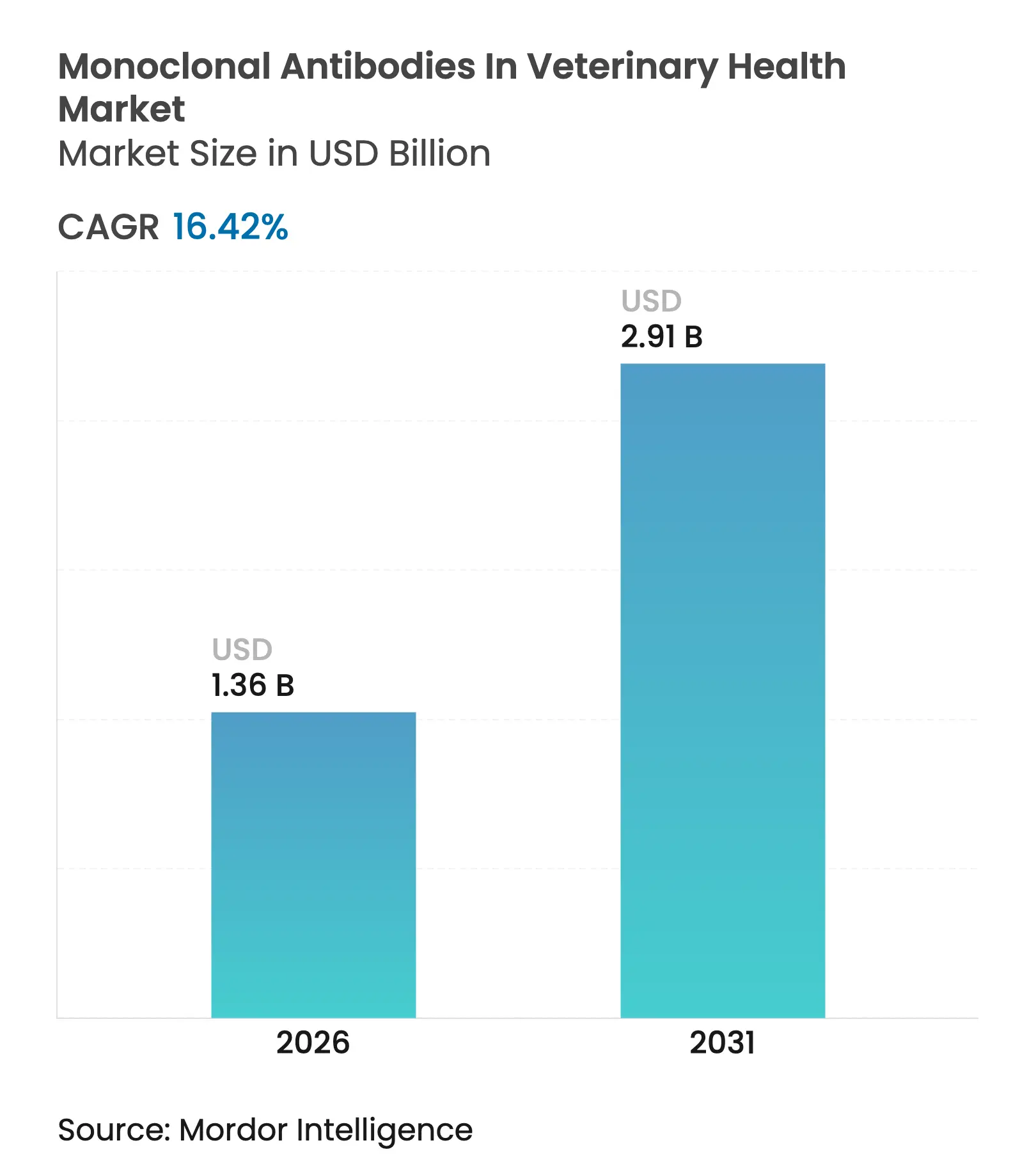
| Market Size (2026) | USD 1.36 Billion |
| Market Size (2031) | USD 2.91 Billion |
| Growth Rate (2026 - 2031) | 16.42 % CAGR |
| Fastest Growing Market | Asia Pacific |
| Largest Market | North America |
| Market Concentration | High |
Major Players *Disclaimer: Major Players sorted in no particular order. Image © Mordor Intelligence. Reuse requires attribution under CC BY 4.0. |

Monoclonal Antibodies In Veterinary Health Market Analysis by Mordor Intelligence
This powerful trajectory stems from chronic-disease prevalence in aging pets, a surge of first-in-class regulatory approvals, and the rapid build-out of purpose-built biomanufacturing capacity. Early commercial successes, such as bedinvetmab for canine osteoarthritis and frunevetmab for feline osteoarthritis, have demonstrated strong efficacy-to-safety ratios and inspired confidence among veterinarians, payers, and pet owners. Pipeline visibility has also improved as conditional and fast-track pathways shorten development timelines while contract development and manufacturing organizations (CDMOs) scale single-use bioreactor footprints to meet demand.
Key Report Takeaways
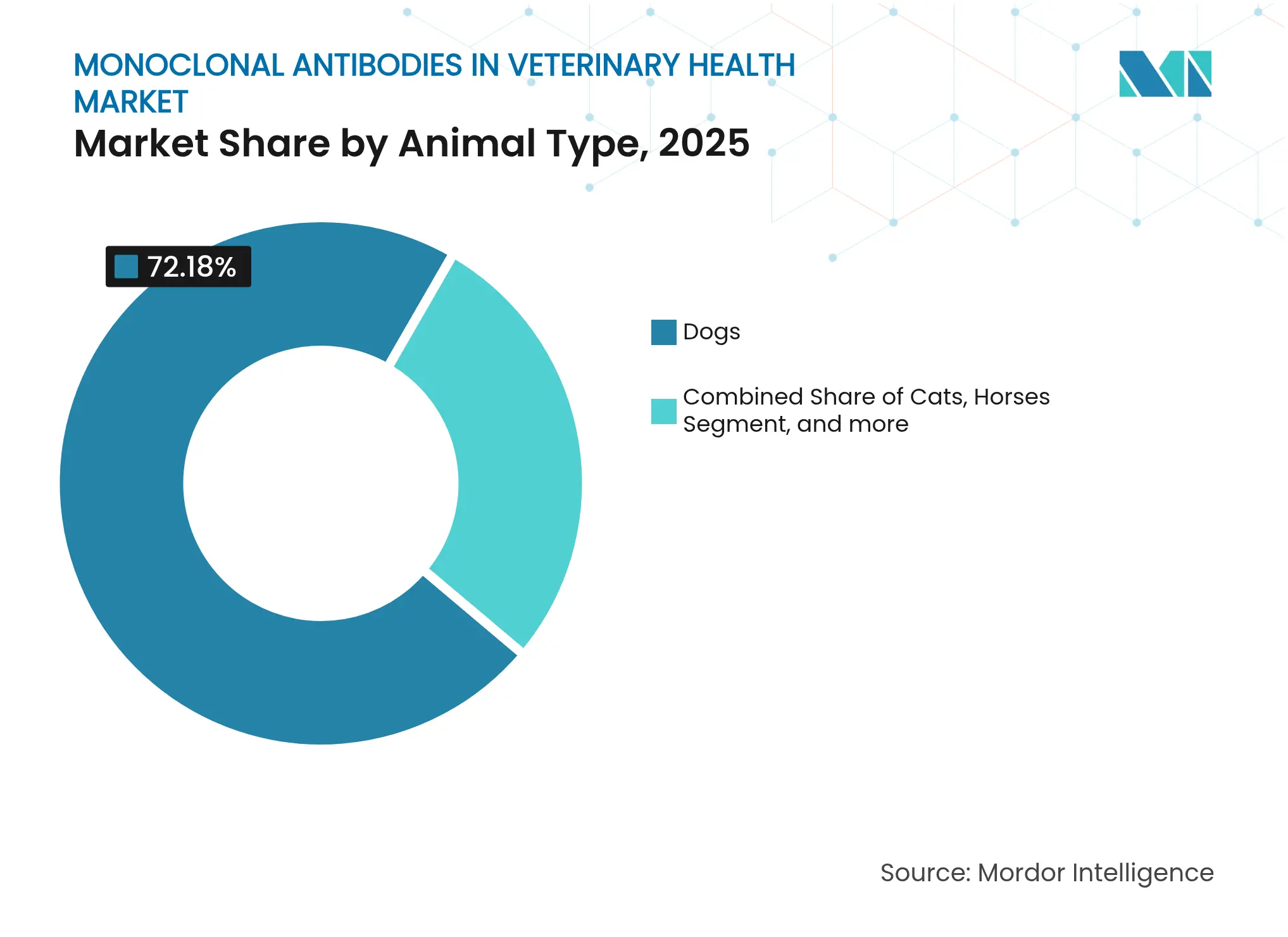
- By animal type, dogs held 72.18% of the monoclonal antibodies in veterinary health market share in 2025, while cats are forecast to post an 18.73% CAGR to 2031.
- By application, dermatology led with 58.75% revenue share in 2025; oncology is expected to expand at a 19.42% CAGR through 2031.
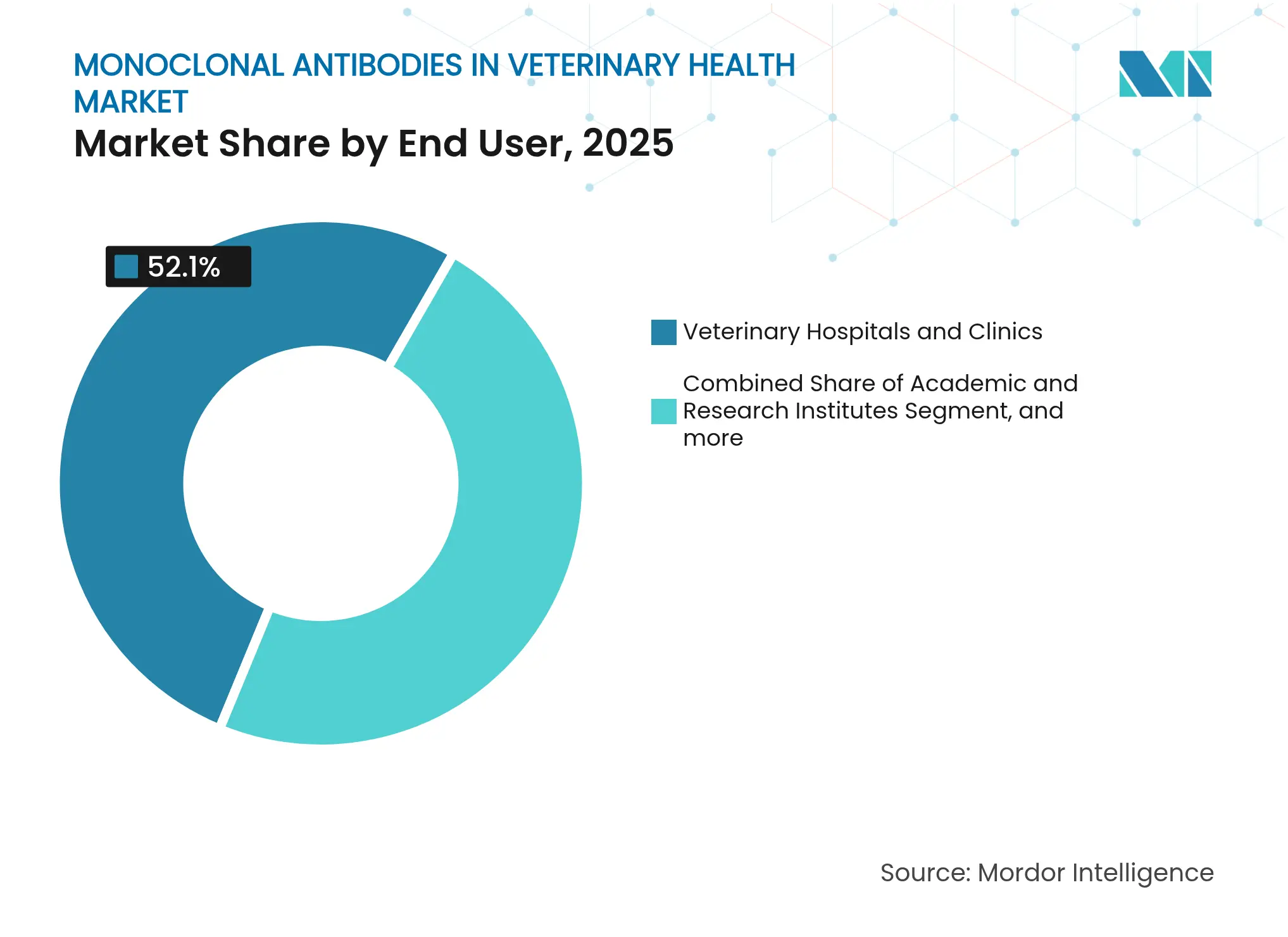
- By end user, veterinary hospitals and clinics accounted for 52.10% of the monoclonal antibodies in veterinary health market size in 2025; academic and research institutes show the highest projected CAGR at 23.25% to 2031.
- By geography, North America commanded 44.30% revenue share in 2025, whereas Asia-Pacific is projected to climb at a 21.90% CAGR through 2031.
Note: Market size and forecast figures in this report are generated using Mordor Intelligence's proprietary estimation framework, updated with the latest available data and insights as of 2026.
Global Monoclonal Antibodies In Veterinary Health Market Trends and Insights
Drivers Impact Analysis
| Driver | (~) % Impact on CAGR Forecast | Geographic Relevance | Impact Timeline |
|---|---|---|---|
Rising burden
of chronic disorders among companion animals
|
+3.2%
|
Global;
highest in North America & Europe
|
Long term (≥
4 years)
|
Increasing
pet ownership & expenditure on advanced care
| +2.8% | Global; fastest in Asia-Pacific | Medium term (2-4 years) |
Rapid
approval pipeline of novel veterinary mAbs
| +2.1% | North America & Europe; Asia-Pacific gaining | Short term (≤ 2 years) |
Favourable
USDA/EMA fast-track pathways for biologics
| +1.9% | North America & Europe | Short term (≤ 2 years) |
Expansion of
dedicated CDMO capacity for vet-mAbs
| +1.7% | Global; hubs in North America & Europe | Medium term (2-4 years) |
AI-driven
precision-dosing platforms boosting efficacy
| +1.4% | Initially North America & Europe; global later | Long term (≥ 4 years) |
| Source: Mordor Intelligence | |||
Rising Burden of Chronic Disorders Among Companion Animals
One in four dogs now develops osteoarthritis during its lifetime, creating persistent therapeutic demand that favors antibody-guided pain control over daily NSAIDs. Bedinvetmab’s targeted nerve-growth-factor blockade produced fewer adverse events than meloxicam in head-to-head trials, with only four adverse-event reports versus seventeen in the control arm.[1] Large post-marketing studies covering France, Germany, Italy, Spain, and the United Kingdom confirmed high veterinarian satisfaction, reinforcing the product-class halo.[2] Comparable disease loads exist for allergic dermatitis and certain cancers, expanding the clinical runway for additional species-specific monoclonal antibodies in veterinary health market therapies.
Increasing Pet Ownership & Expenditure on Advanced Care
Millennial and Generation Z owners treat pets as family and routinely purchase premium therapeutics despite macro-economic slowdowns, propelling companion-animal health spending to record levels in 2025.[3] The willingness to pay aligns with monthly injectable regimens that reduce pill fatigue. Zoetis disclosed double-digit revenue growth in canine and feline pain franchises in 2024, with monoclonal antibodies a principal contributor. Broader pet-insurance penetration further offsets out-of-pocket costs, lifting adoption across income tiers.
Rapid Approval Pipeline of Novel Veterinary mAbs
Regulatory momentum is robust: the USDA granted conditional approval for Elanco’s canine parvovirus monoclonal antibody, the first targeted antiviral with 100% survival in challenge studies. Boehringer Ingelheim’s acquisition of Saiba Animal Health expanded its checkpoint-inhibitor pipeline, signaling an industry pivot toward immune-oncology. Parallel investments, such as Elanco’s USD 130 million biologics expansion in Kansas, underscore growing confidence in the class.
Favourable USDA/EMA Fast-Track Pathways for Biologics
Conditional licensure and priority review designations now shave multiple years off development timelines and unlock earlier revenue streams. The FDA’s expanded conditional approval pathway, combined with the USDA’s priority zoonotic-drug framework, has already accelerated several first-in-class launches. VICH guideline harmonization facilitates multi-region submissions, reducing duplicative study requirements and smoothing international rollouts.
Restraints Impact Analysis
| Restraint | (~) % Impact on CAGR Forecast | Geographic Relevance | Impact Timeline |
|---|---|---|---|
High cost of
development & therapy
|
-2.3%
|
Global;
deeper in emerging markets
|
Long term (≥
4 years)
|
Complex
multi-jurisdictional regulatory compliance
| -1.8% | Global; toughest on SMEs | Medium term (2-4 years) |
Weak
cold-chain logistics in emerging markets
| -1.2% | Asia-Pacific, MEA, Latin America | Medium term (2-4 years) |
Competition
from long-acting small-molecule analgesics
| -1.1% | Global; usage varies by region | Short term (≤ 2 years) |
| Source: Mordor Intelligence | |||
High Cost of Development & Therapy
Species-specific antibody engineering, multi-arm field trials, and GMP-grade production can drive pre-commercial spend above USD 200 million, placing a ceiling on addressable volumes in price-sensitive regions. Developers such as PetMedix and Adivo have invested heavily in phage-display libraries that produce fully canine or feline sequences, yet these platforms also prolong time-to-proof-of-concept. Smaller firms often out-license assets early to balance risk, which can dilute future upside and restrain innovation velocity within the monoclonal antibodies in veterinary health market.
Complex Multi-Jurisdictional Regulatory Compliance
Dual oversight by the USDA and FDA in the United States, EMA in Europe, PMDA in Japan, and NMPA in China forces sponsors to tailor dossiers to divergent definitions of “biologic,” raising costs and extending lead times. New data-exclusivity rules in China and an online submission mandate in India add further procedural layers that can stall smaller entrants.
Segment Analysis
By Animal Type: Canine Strength and Accelerating Feline Uptake
Dogs generated 72.18% of the monoclonal antibodies in veterinary health market size in 2025 thanks to early-acting blockbusters like bedinvetmab and lokivetmab. Strong brand equity, a large installed base of canine patients, and straightforward weight-based dosing frameworks keep uptake resilient in the face of competing analgesics. Dermatology, orthopedic, and emerging oncology studies in breeds such as Labrador Retrievers and Golden Retrievers cement clinical relevance, while the breed-specific data also help refine AI-supported dosing algorithms. Stable reimbursement policies from leading pet insurance providers further bolster long-term renewal rates of canine biologics.
Cats, although historically underserved, now deliver the highest growth trajectory at an 18.73% CAGR as frunevetmab proves that feline-specific antibodies can match canine benchmarks in pain relief and owner adherence. Expanded research into feline stomatitis, chronic kidney disease, and lymphoma widens therapeutic horizons. Developers must navigate distinct feline immune-system architecture, yet AI-enabled epitope mapping is cutting discovery cycles in half, speeding time-to-clinic. Horses and other specialty species presently account for a small slice of revenue, mostly in performance-medicine contexts, but could gain if bio-similarity rules evolve to embrace larger-animal indications.
Note: Segment shares of all individual segments available upon report purchase
By Application: Dermatology Dominance with Oncology Rising
Dermatology contributed 58.75% of the monoclonal antibodies in veterinary health market size in 2025, anchored by lokivetmab’s robust global sales and multiple label expansions into chronic pruritus. Monthly injections have replaced corticosteroid cycles in many clinics, lowering adverse-event incidence and reinforcing positive adherence loops. Cross-discipline evidence showing shared inflammatory pathways between atopic dermatitis and osteoarthritis has encouraged off-label exploration, broadening end-user familiarity with antibody solutions.
Oncology is scaling rapidly at a 19.42% CAGR as checkpoint-inhibitor science migrates from human medicine to pets through programs such as Akston Biosciences’ anti-cPD-L1 for canine bladder cancer. Comparative-oncology grants from the National Cancer Institute support parallel trials, generating translational data that improves both human and veterinary outcomes. Infectious-disease antibodies like Elanco’s parvovirus candidate reinforce the modality’s versatility, while immune-mediated disorders such as pemphigus foliaceus present frontier indications likely to materialize late in the decade.
By End User: Hospital Lead and Academic Outperformance
Veterinary hospitals and clinics retained 52.10% of the monoclonal antibodies in the veterinary health market share in 2025, driven by routine wellness visits that align with monthly dosing schedules and in-house inventory management. Clinic networks employ board-certified specialists who champion early adoption and actively integrate AI-tailored dosing schemes into practice management software, tightening client retention. Emergency and specialty referral centers account for growing secondary demand as complex oncology and immune-mediated cases cluster.
Academic and research institutes, although smaller in revenue today, are expanding at a 23.25% CAGR through 2031 as universities leverage comparative oncology funding to run randomized controlled trials at scale. Grant-funded studies accelerate evidence generation and create educated cohorts of new veterinarians already fluent in biologic protocols, which cascades back into commercial practice. Diagnostic labs embedded within teaching hospitals also refine biomarker panels that feed AI-powered dosing engines, bolstering real-world efficacy data feedback loops.
Note: Segment shares of all individual segments available upon report purchase
Geography Analysis
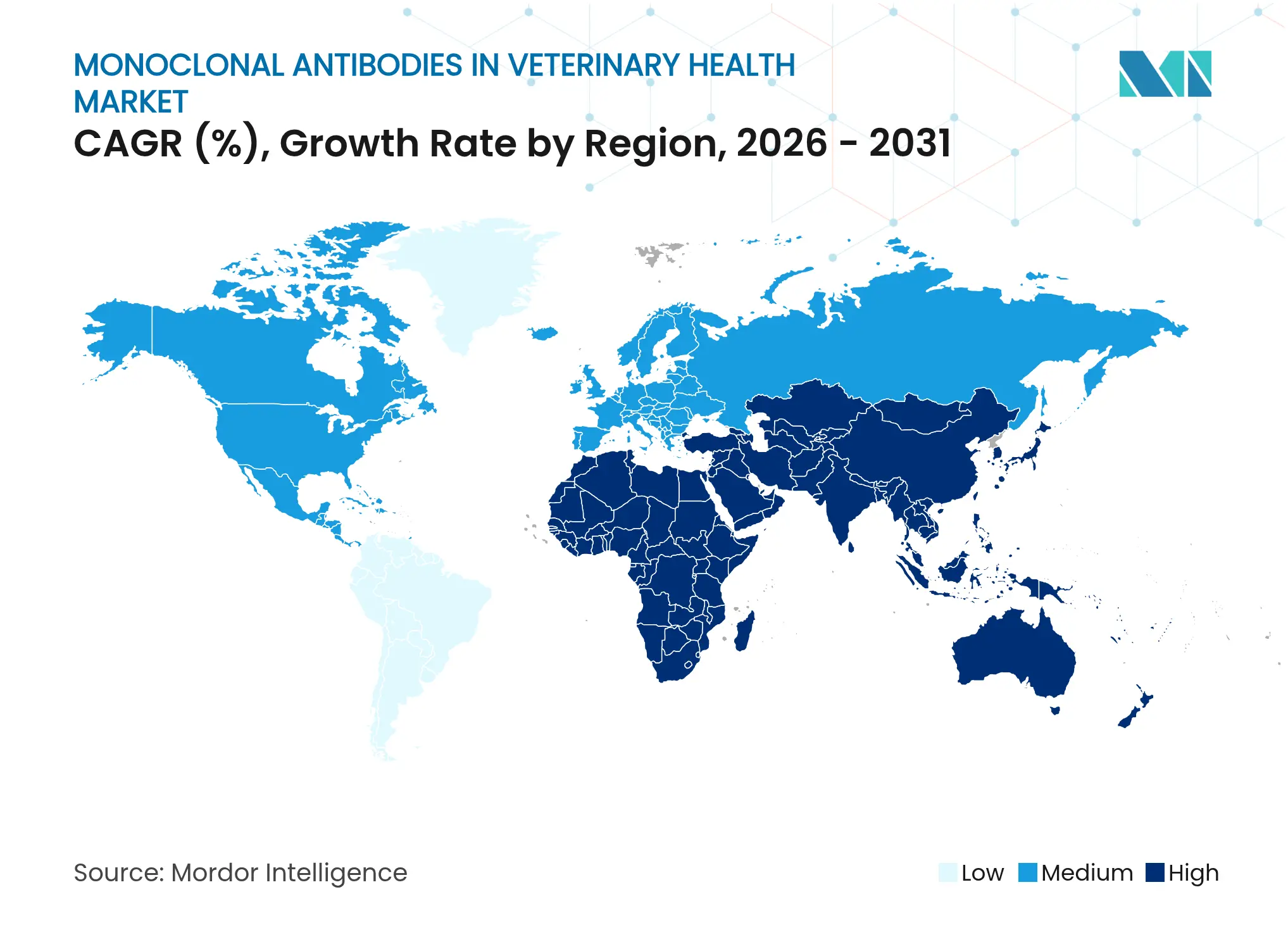
North America captured 44.30% of 2025 revenue within the monoclonal antibodies in veterinary health market, reflecting a mature reimbursement culture, deep pet-insurance penetration, and an accommodating FDA-USDA dual-pathway framework. Robust practice networks allow manufacturers to stage direct-to-veterinarian education campaigns that translate swiftly into prescription growth. Canada leverages similar product-registration rules, while Mexico’s expanding middle class supports premium pet care, albeit from a lower base.
Europe remains a high-value but more regulated arena. EMA centralized procedures standardize quality, safety, and efficacy criteria, fostering predictable launch timelines. Germany, France, and the United Kingdom anchor demand, yet Southern and Eastern European markets are catching up as disposable incomes rise. Strict antimicrobial-use reduction targets underscore the strategic importance of targeted biologics as alternatives to conventional drugs.
Asia-Pacific is the fastest climber with a 21.90% CAGR, propelled by China’s approval of 93 therapeutic biologics in 2024, including multiple monoclonal antibodies. Urbanization and single-child household dynamics boost pet adoption, and tier-one Chinese cities already mirror Western spending patterns. Japan blends rigorous PMDA scrutiny with an aging pet population, spawning steady antibody uptake. India adopts an online regulatory portal that signals future acceleration once cold-chain gaps narrow.
Latin America, the Middle East, and Africa collectively remain nascent but improving. Brazil and Saudi Arabia champion higher-end veterinary clinics that stock biologics, while South Africa leads Sub-Saharan adoption. Long-haul supply chains and intermittent power supply challenge cold-storage integrity, restricting near-term volume but prompting local fill-finish investments slated for completion after 2027.

Competitive Landscape
Market Concentration
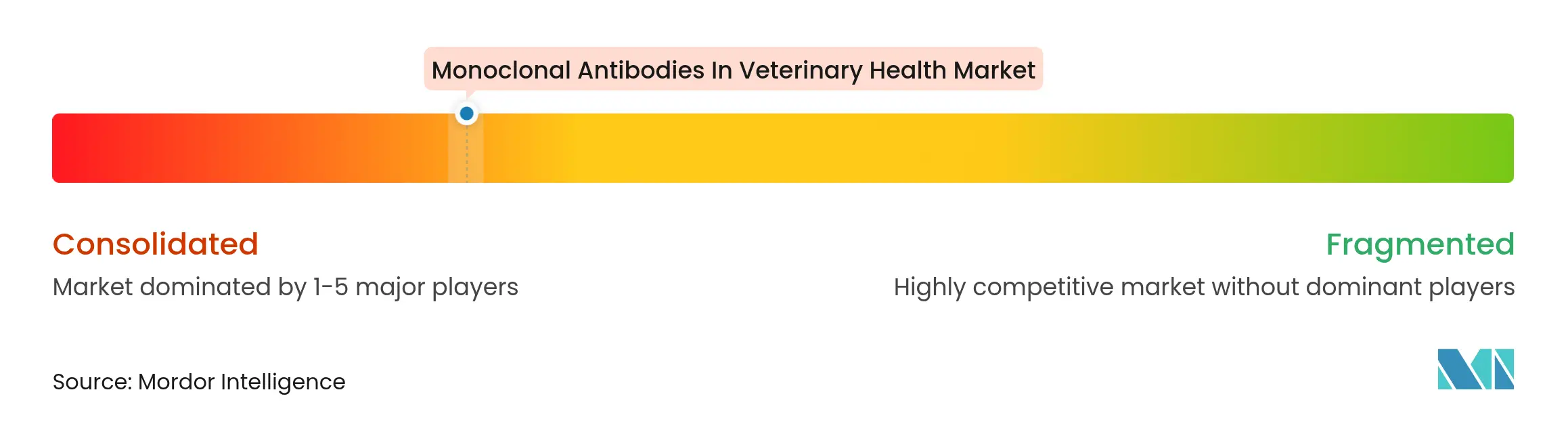
The market for monoclonal antibodies in veterinary health is highly consolidated due to the high competitiveness and limited number of players. The monoclonal antibodies in veterinary health market features an oligopolistic top tier and a vibrant cohort of platform biotechs. Zoetis dominates on the strength of Librela and Solensia, supported by a global diagnostic-lab network that feeds post-marketing surveillance and reinforces veterinary confidence. Merck Animal Health’s USD 895 million Kansas expansion underscores the capital intensity required to scale GMP suites for veterinary doses. Boehringer Ingelheim’s animal-health division leverages virus-like-particle know-how acquired through Saiba to enter immune-oncology faster.
Elanco is repositioning through a USD 130 million biologics campus designed to cut cycle times for canine and feline antibodies. Dechra’s acquisition of Invetx expands half-life-extension IP, giving the mid-cap player longer patent tails and fewer injections per treatment course. OmniAb licenses transgenic-animal platforms to more than 80 partners, generating a royalty stream while seeding the next wave of assets.
AI collaborations add another competitive dimension. Absci applies generative algorithms to de-risk affinity maturation while predicting manufacturability, letting partners advance candidates with built-in developability scores. CDMOs courting veterinary clients tout platform readiness levels now comparable to human programs, compressing time from cell-line development to engineering runs to under six months. Collectively, these moves elevate entry barriers and favor firms with integrated discovery-to-commercial capabilities.
Monoclonal Antibodies In Veterinary Health Industry Leaders

*Disclaimer: Major Players sorted in no particular order
Recent Industry Developments
- June 2025: Absci Corporation and Invetx announced a strategic partnership to develop a generative AI drug creation platform specifically for animal health applications, focusing on half-life extension technology for monoclonal antibodies targeting canines with potential expansion to other companion animals.
- May 2025: Merck Animal Health and the State of Kansas announced an USD 895 million investment in manufacturing and research & development facilities in De Soto, aimed at enhancing veterinary monoclonal antibody production capabilities and supporting future biologics development.
- August 2024: Elanco Animal Health Incorporated has revealed plans for a 25,000-sq. ft expansion of its biologics manufacturing site in Kansas, United States. This anticipated USD 130 million investment, set to be completed by 2026, aims to enhance the company's monoclonal antibody (mAb) platform for canine parvovirus monoclonal antibody (CPMA), leveraging the existing strong expertise at this facility.
- July 2024: Invetx Inc. introduced its agreement to be acquired by Dechra Pharmaceuticals Limited (Dechra) for up to USD 520 million on a cash-free and debt-free basis. This acquisition aims to enhance the portfolio of high-value monoclonal antibody therapeutics for companion animals.
Table of Contents for Monoclonal Antibodies In Veterinary Health Industry Report
1. Introduction
- 1.1 Study Assumptions & Market Definition
- 1.2 Scope of the Study
2. Research Methodology
3. Executive Summary
4. Market Landscape
- 4.1 Market Overview
- 4.2 Market Drivers
- 4.2.1 Rising Burden of Chronic Disorders Among Companion Animals
- 4.2.2 Increasing Pet Ownership & Expenditure on Advanced Care
- 4.2.3 Rapid Approval Pipeline of Novel Veterinary mAbs
- 4.2.4 Favourable USDA/EMA Fast-Track Pathways for Biologics
- 4.2.5 Expansion of Dedicated CDMO Capacity for Vet-mAbs
- 4.2.6 AI-Driven Precision-Dosing Platforms Boosting Efficacy
- 4.3 Market Restraints
- 4.3.1 High Cost of Development & Therapy
- 4.3.2 Complex Multi-Jurisdictional Regulatory Compliance
- 4.3.3 Weak Cold-Chain Logistics in Emerging Markets
- 4.3.4 Competition from Long-Acting Small-Molecule Analgesics
- 4.4 Regulatory Landscape
- 4.5 Porter’s Five Forces Analysis
- 4.5.1 Threat of New Entrants
- 4.5.2 Bargaining Power of Buyers
- 4.5.3 Bargaining Power of Suppliers
- 4.5.4 Threat of Substitutes
- 4.5.5 Competitive Rivalry
5. Market Size & Growth Forecasts (Value in USD)
- 5.1 By Animal Type
- 5.1.1 Dogs
- 5.1.2 Cats
- 5.1.3 Horses
- 5.1.4 Livestock
- 5.1.4.1 Cattle
- 5.1.4.2 Swine
- 5.1.4.3 Poultry
- 5.1.5 Others
- 5.2 By Application
- 5.2.1 Dermatology
- 5.2.2 Osteoarthritis & Pain Management
- 5.2.3 Oncology
- 5.2.4 Infectious Diseases
- 5.2.5 Immunological Disorders
- 5.2.6 Others
- 5.3 By End User
- 5.3.1 Veterinary Hospitals & Clinics
- 5.3.2 Academic & Research Institutes
- 5.3.3 Others
- 5.4 By Geography
- 5.4.1 North America
- 5.4.1.1 United States
- 5.4.1.2 Canada
- 5.4.1.3 Mexico
- 5.4.2 Europe
- 5.4.2.1 Germany
- 5.4.2.2 United Kingdom
- 5.4.2.3 France
- 5.4.2.4 Italy
- 5.4.2.5 Spain
- 5.4.2.6 Rest of Europe
- 5.4.3 Asia-Pacific
- 5.4.3.1 China
- 5.4.3.2 Japan
- 5.4.3.3 India
- 5.4.3.4 Australia
- 5.4.3.5 South Korea
- 5.4.3.6 Rest of Asia-Pacific
- 5.4.4 Middle East & Africa
- 5.4.4.1 GCC
- 5.4.4.2 South Africa
- 5.4.4.3 Rest of Middle East & Africa
- 5.4.5 South America
- 5.4.5.1 Brazil
- 5.4.5.2 Argentina
- 5.4.5.3 Rest of South America
6. Competitive Landscape
- 6.1 Market Concentration
- 6.2 Market Share Analysis
- 6.3 Company Profiles (includes Global level Overview, Market level overview, Core Segments, Financials as available, Strategic Information, Market Rank/Share for key companies, Products & Services, and Recent Developments)
- 6.3.1 Zoetis Inc.
- 6.3.2 Merck Animal Health
- 6.3.3 Elanco Animal Health Inc.
- 6.3.4 Boehringer Ingelheim Vetmedica GmbH
- 6.3.5 Virbac SA
- 6.3.6 Indian Immunologicals Ltd.
- 6.3.7 Ceva Santé Animale
- 6.3.8 Dechra Pharmaceuticals PLC
- 6.3.9 Nextmune AB
- 6.3.10 Kindred Biosciences, Inc.
- 6.3.11 Invetx, Inc.
- 6.3.12 Bayer Animal Health GmbH
- 6.3.13 PetMedix Ltd.
- 6.3.14 Aratana Therapeutics, Inc.
- 6.3.15 Torigen Pharmaceuticals, Inc.
- 6.3.16 AbCellera Biologics Inc.
- 6.3.17 Orion Corp. (Animal Health)
- 6.3.18 Northway Biotech CDMO
- 6.3.19 Bioatla LLC
- 6.3.20 Advio GmbH
7. Market Opportunities & Future Outlook
- 7.1 White-space & Unmet-Need Assessment
Scope and Methodology
According to the scope, monoclonal antibodies are the antibodies that are developed by the immune cells to mimic the immune responses caused by the pathogens in animal health. These antibodies are highly effective in preventing and treating cancer, autoimmune diseases, and chronic infections in animals; thus, they are highly adopted by veterinarians.
The monoclonal antibodies in veterinary health market is segmented by animal type, application, end user, and geography. By animal type, the market is segmented into dogs and other animal types. By application, the market is segmented into dermatology, pain, and other applications. By end user, the market is segmented into veterinary hospitals and other end users. By geography, the market is segmented into North America, Europe, Asia-Pacific, and Rest of the World. The market size is provided for each segment in terms of value (USD).
| By Animal Type | Dogs | |
| Cats | ||
| Horses | ||
| Livestock | Cattle | |
| Swine | ||
| Poultry | ||
| Others | ||
| By Application | Dermatology | |
| Osteoarthritis & Pain Management | ||
| Oncology | ||
| Infectious Diseases | ||
| Immunological Disorders | ||
| Others | ||
| By End User | Veterinary Hospitals & Clinics | |
| Academic & Research Institutes | ||
| Others | ||
| By Geography | North America | United States |
| Canada | ||
| Mexico | ||
| Europe | Germany | |
| United Kingdom | ||
| France | ||
| Italy | ||
| Spain | ||
| Rest of Europe | ||
| Asia-Pacific | China | |
| Japan | ||
| India | ||
| Australia | ||
| South Korea | ||
| Rest of Asia-Pacific | ||
| Middle East & Africa | GCC | |
| South Africa | ||
| Rest of Middle East & Africa | ||
| South America | Brazil | |
| Argentina | ||
| Rest of South America | ||

