Technology, Media and Telecom
5th MayAccelerating Additive Manufacturing Adoption in India
3 Min Read
The Moldova Facility Management Market Report is Segmented by Service Type (Hard Services, and Soft Services), Offering Type (In-House, and Outsourced), and End-User Industry (Commercial, Hospitality, Institutional and Public Infrastructure, Healthcare, Industrial and Process, and Other End-User Industries). The Market Forecasts are Provided in Terms of Value (USD).
Market Overview
| Study Period | 2020 - 2031 |
|---|---|
| Base Year For Estimation | 2025 |
| Forecast Data Period | 2026 - 2031 |
| Market Size (2026) | USD 576.82 Million |
| Market Size (2031) | USD 788.51 Million |
| Growth Rate (2026 - 2031) | 6.45 % CAGR |
| Market Concentration | Medium |
Major Players *Disclaimer: Major Players sorted in no particular order. Image © Mordor Intelligence. Reuse requires attribution under CC BY 4.0. |
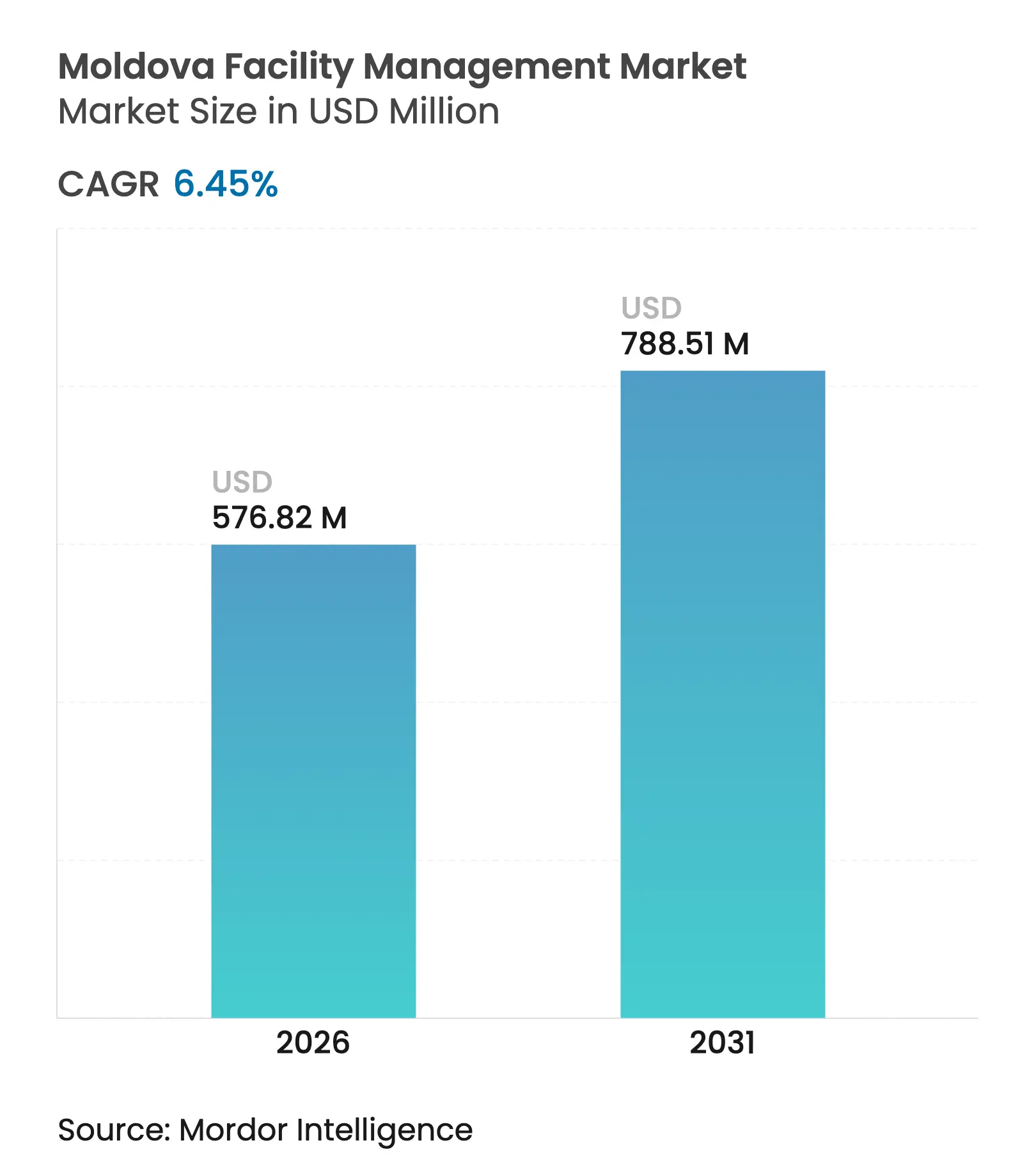

The Moldova facility management market size is expected to grow from USD 541.87 million in 2025 to USD 576.82 million in 2026 and is forecast to reach USD 788.51 million by 2031 at 6.45% CAGR over 2026-2031. The upward curve reflects rising infrastructure spending, urban population growth, and a steady pivot from in-house operations to outsourced integrated services.[1] Growing transport corridor projects, stricter ESG mandates, and rapid digitization intensify service sophistication while supporting long-term revenue visibility across the Moldova facility management market. Local providers capitalize on proximity and regulatory fluency, yet regional entrants equipped with IoT, digital twin, and performance-based models exert fresh competitive pressure. Cost optimization, energy savings, and risk-sharing contracts are becoming baseline expectations for public and private assets, encouraging bundled and integrated delivery. Intensifying skilled-labor shortages plus currency volatility add cost pressure, but modern procurement frameworks that reward verified efficiency gains soften the impact for technology-ready vendors within the Moldova facility management market.
Key Report Takeaways
Note: Market size and forecast figures in this report are generated using Mordor Intelligence's proprietary estimation framework, updated with the latest available data and insights as of 2026.
Drivers Impact Analysis
| Driver | (~) % Impact on CAGR Forecast | Geographic Relevance | Impact Timeline |
|---|---|---|---|
Current Occupancy Rates Driving Service Demand
|
+1.2%
|
National, concentrated in Chisinau and Balti
|
Short term (≤ 2 years)
|
Sector Investment Priorities in Moldova's Infrastructure
Pipeline
| +1.8% | National, with focus on transport corridors | Medium term (2-4 years) |
Urbanisation Accelerating Service Sophistication
| +0.9% | Urban centers, particularly Chisinau metropolitan area | Long term (≥ 4 years) |
Profitability Rates Reshaping Service Offerings
| +0.7% | National, with emphasis on commercial districts | Medium term (2-4 years) |
ESG Compliance Pressures Boosting Outsourcing
| +1.1% | National, aligned with EU integration requirements | Long term (≥ 4 years) |
Digitization and IoT Integration Enhancing FM Efficiency
| +1.3% | Urban centers with advanced infrastructure | Medium term (2-4 years) |
| Source: Mordor Intelligence | |||
Current Occupancy Rates Driving Service Demand
Office and retail occupancy in Chisinau keeps facility teams at capacity, contrasting with elevated vacancy in many European capitals.[2] Mall Moldova’s 110,000 m² complex, added in April 2025, intensifies work scopes that move beyond routine cleaning into energy performance and tenant-well-being accountability. Healthcare properties mirror this labor intensity, as Sanatoriul Preventoriu de Bază sustains 120 staff on MDL 14.03 million (USD 0.83 million) revenue, spotlighting high people-to-space ratios. Owners increasingly embed occupancy-based KPIs into contracts, motivating providers to link maintenance schedules to real-time usage metrics. This shift accelerates the Moldova facility management market transition toward outcome-oriented integrated agreements.
Infrastructure Investment Pipeline Accelerating Demand
The EUR 362 million (USD 380.1 million) national pipeline encompassing the Ungheni-Chisinau-Odessa highway, 446 km rail rehabilitation, and 400 kV Straseni-Gutinas line scales technical workload across transport and energy assets. Facility managers must cover multi-jurisdiction compliance, biodiversity audits, and high-voltage safety drills to secure long-term maintenance contracts, raising entry barriers while enlarging contract value. EIB’s EUR 200 million (USD 210 million) commitment adds green targets that reward carbon-footprint reduction competencies. Providers with regional hubs along the corridors capture logistical efficiencies, reinforcing the Moldova facility management market leadership for firms with distributed service networks.
ESG Compliance Pressures Boosting Outsourcing
Alignment with EU directives, notably the Corporate Sustainability Due Diligence Directive, pushes local firms to outsource to specialists who can navigate environmental impact assessments and social governance audits. The ESCO Moldova program illustrates this pathway, tying payments to verified CO₂ cuts in municipal buildings.[3] The climate adaptation plan citing 2.13% GDP annual loss potential elevates resilience measures as a strategic necessity, encouraging performance-based energy contracts that underpin recurring revenue. Firms offering integrated reporting dashboards and green-certification support gain an advantage across the Moldova facility management market.
Digitization & IoT Integration Enhancing Efficiency
IoT deployments demonstrate up to 86% peak-hour energy savings in comparable Eastern European case studies. Predictive maintenance cuts unplanned downtime costs by up to 40% and slashes preventive tasks by 8–12%. Moldcell’s nationwide 4G rollout supplies the connectivity backbone for remote monitoring, while AI-driven HVAC platforms achieve double-digit energy reductions. Early adopters secure margin expansion and contract renewals, establishing a technology moat within the Moldova facility management market.
Restraints Impact Analysis
| Restraint | (~) % Impact on CAGR Forecast | Geographic Relevance | Impact Timeline |
|---|---|---|---|
Regulatory Complexity Limiting Market Entry
|
-0.8%
|
National, with heightened impact in Chisinau
|
Short term (≤ 2 years)
|
Macroeconomic Volatility Constraining Investment
| -1.1% | National, with spillover effects from regional instability | Medium term (2-4 years) |
Skilled Labor Shortage Escalating Service Costs
| -0.9% | National, particularly acute in urban centers | Long term (≥ 4 years) |
Limited Client Awareness of Integrated FM Benefits
| -0.6% | Regional, concentrated in smaller municipalities | Medium term (2-4 years) |
| Source: Mordor Intelligence | |||
Regulatory Complexity Limiting Market Entry
Concurrent national laws and EU alignment raise compliance costs, favoring incumbents versed in environmental and strategic impact assessments effective since late 2023. Registration and licensing can stretch beyond the nominal five-day process due to sector-specific permits. Mandatory social and health contributions inflate payroll, challenging new entrants with thinner capital bases. Certifications for energy management or fire safety multiply administrative touchpoints, slowing scale-up. The result slows fresh competition and tempers short-term growth in the Moldova facility management market.
Macroeconomic Volatility Constraining Investment
FDI declined to USD 428 million in 2023 as regional instability weighed on investor sentiment. Suspension of the Israel labor accord in January 2024 exposed vulnerability to external shocks, cutting off 13,000 skilled workers key to construction and caretaking roles. Currency swings complicate multi-year service fee projections, particularly for contracts denominated in foreign currencies. Energy import dependence magnifies cost uncertainty for HVAC-intensive portfolios. Consequently, several clients postpone major retrofits, delaying contingent facility management revenues and capping upside for the Moldova facility management market.
By Service Type: Hard Services Lead Market Consolidation
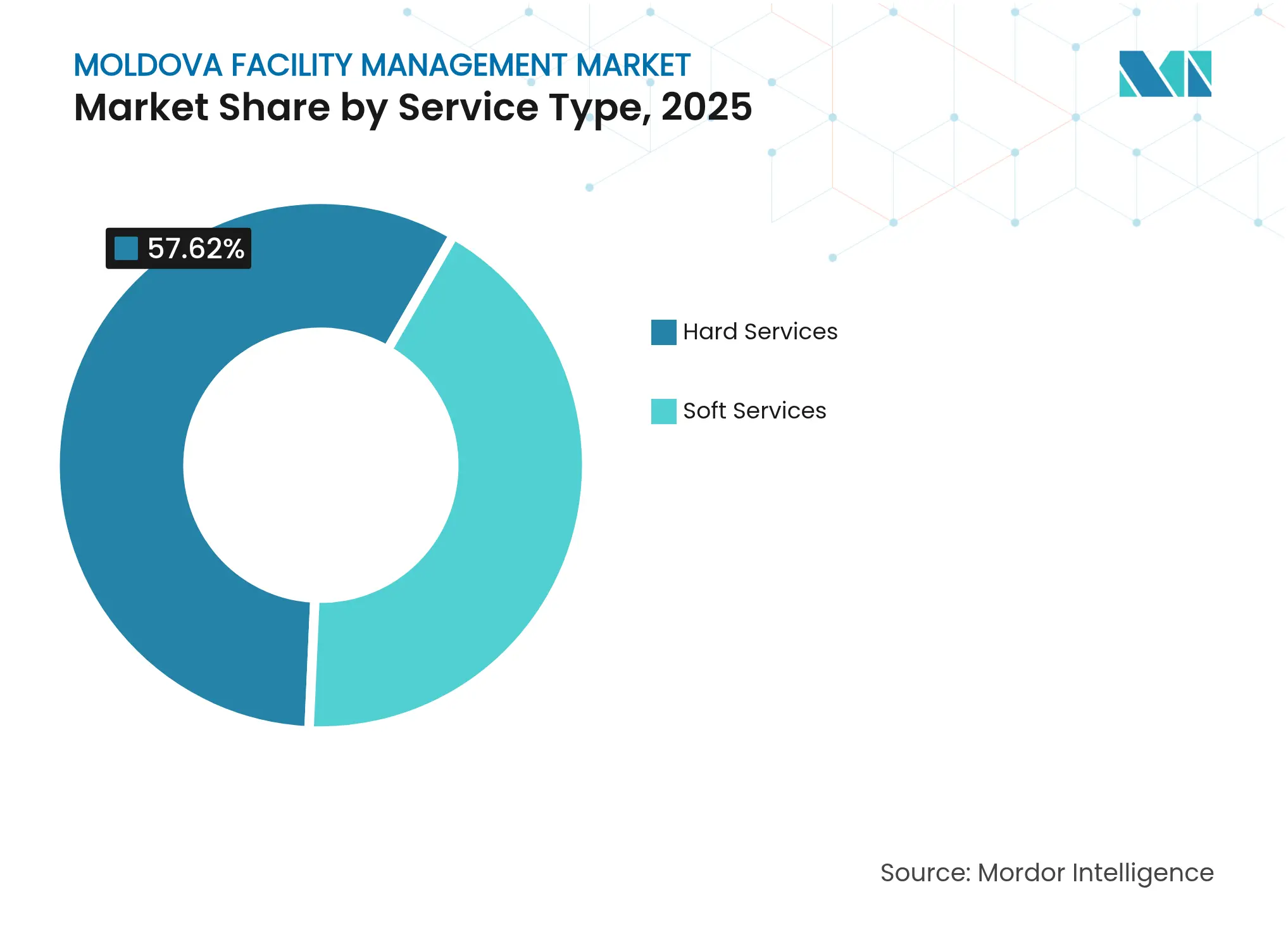
Hard services captured 57.62% of the Moldova facility management market size in 2025, anchored by the transport and energy projects that demand mechanical, electrical, and plumbing expertise. Over 60% of hospitals built before 1969 amplify asset life-cycle workload, driving stable revenue for structural maintenance, fire safety, and HVAC optimization. Digitally enabled MEP inspections using sensors and drones trim inspection time and strengthen compliance reliability, reinforcing client preference for specialized hard-service contractors in the Moldova facility management market.
Soft services grow faster at 6.95% CAGR as ESG screening extends expectations to cleaning chemicals, waste segregation, and secure front-of-house practices. Robotics-assisted cleaning and AI-based security analytics mitigate labor shortages and align with occupancy-based pricing. Integrated tenders now bundle janitorial, reception, and catering under performance warranties, nudging clients toward outcome-linked service level indicators. Providers adept at merging hospitality fluency with tech-infused reporting unlock cross-selling potential across the Moldova facility management industry.
Note: Segment shares of all individual segments available upon report purchase
By Offering Type: Outsourcing Accelerates Market Transformation
Outsourcing commanded 63.48% of the Moldova facility management market share in 2025 and remains the fastest-growing channel through 2031. Single-service contracts often mark the entry path, yet bundled and integrated FM are absorbing share as clients chase one-invoice simplicity and verified savings. The ESCO Moldova initiative illustrates integrated models that hinge payment on energy-efficiency proof points, expanding addressable wallet size per site.
In-house operations persist among large industrial firms and ministries citing security or legacy workforce agreements. Rising minimum wages and ongoing upskilling demands tilt cost-benefit math toward strategic outsourcing. Technology adoption accelerates the shift, as IoT analytics platforms deliver dashboards that internal crews find costly to replicate. Resulting demand fortifies vendor pipelines and pushes consolidation activity in the Moldova facility management market.
By End-User Industry: Commercial Sector Drives Market Leadership
Commercial facilities accounted for 38.25% of the Moldova facility management market size in 2025, propelled by IT hubs, 4G data centers, and newly opened retail destinations. Warehouse and logistics estates along EU trade routes heighten security, temperature-controlled storage, and multi-site coordination demands, anchoring contract lengths and cross-border scope. Predictive maintenance of telecommunications equipment limits downtime for Moldcell and peer operators, endorsing advanced FM engagements across the Moldova facility management market.
Institutional and public infrastructure tops the growth chart at 9.18% CAGR to 2031 as schools, police academies, and hydro-projects undergo EU-led modernization. Stringent safety codes and 24/7 operational mandates place a premium on certified vendors. Healthcare assets consume a sizable share of utilities, making energy-reduction performance contracts financially attractive and socially visible. Industrial, hospitality, and multi-housing niches round out demand, each requiring tailored compliance matrices and specialized expertise within the Moldova facility management industry.

Recognized by Experts. Trusted by Leaders.
A trusted intelligence partner to global decision-makers across 90+ countries.







Chisinau hosts the single largest concentration of demand, owing to one-third of the national population and the majority of commercial infrastructure. The city’s contract mix skews toward technology-enabled integrated packages covering energy dashboards, smart-access control, and onsite sustainability reporting requirements. Premium pricing prevails as high-rise offices and large retail complexes expect round-the-clock uptime supported by predictive analytics teams embedded within the Moldova facility management market.
Secondary growth nodes align with the Ungheni-Chisinau-Odessa highway and 446 km rail link, where project clusters necessitate mobile service crews and regional storage hubs for spare parts. Balti and Ungheni leverage strategic positions on these corridors, raising contract volumes for road lighting, station security, and track-side vegetation control. EU-border proximity accelerates regulatory stringency, prompting demand for vendors experienced in cross-border standards throughout the Moldova facility management market.
Rural municipalities lag on sophistication yet access fresh funding under UNDP programs aimed at climate resilience and public-service upgrades. Simplified scopes—basic cleaning, small-scale maintenance, and waste management—enter multi-year frameworks that facilitate vendor entry while securing essential services for underserved zones. As rural infrastructure upgrades advance, technology-ready firms gain first-mover edge by piloting low-cost IoT sensors to monitor energy use in schools and clinics.

Reports are available across multiple geographies.
Gain in-depth market insights across regions to support informed decisions.
Market Concentration
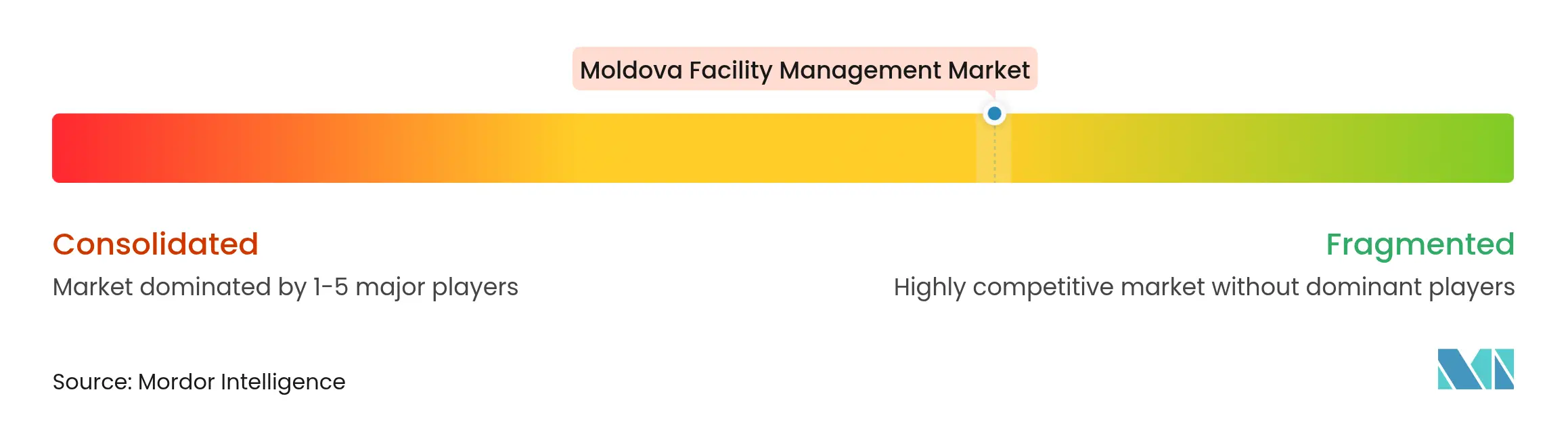
Local players such as Smartlinks S.R.L., Glemus, and Planet Group International dominate through established municipal ties and regulatory familiarity, keeping the market moderately fragmented. Regional entrants from Romania and Ukraine position around integrated and tech-heavy contracts, exploiting synergies with transport and energy projects tied to EU funding. M&A discussions revolve around scale economics, geographic reach, and proprietary IoT platforms that sharpen bid competitiveness within the Moldova facility management market.
Technology serves as the primary differentiator. Providers deploying digital twins and AI-driven HVAC optimization report 10–15% cost savings, winning outcome-based renewals that lock in multiyear revenue. Patent activity around smart-building control systems signals a pivot to intellectual-property-backed offerings, protecting margins against price-based competition. Firms able to combine hard-service depth with hospitality-grade soft services and real-time sustainability dashboards secure premium status in large public tenders.
White-space opportunities appear in healthcare, where 24/7 operations and infection-control standards demand specialized protocols. Outcome-based energy performance contracting also appears under-supplied despite ESCO Moldova’s proof of concept. Forward-looking strategies center on workforce upskilling, ESG advisory integration, and region-wide asset visibility to consolidate standing in the Moldova facility management market.

*Disclaimer: Major Players sorted in no particular order
1. INTRODUCTION
2. RESEARCH METHODOLOGY
3. EXECUTIVE SUMMARY
4. MARKET LANDSCAPE
5. MARKET SIZE AND GROWTH FORECASTS (VALUES)
6. COMPETITIVE LANDSCAPE
7. MARKET OPPORTUNITIES AND FUTURE OUTLOOK
Facility management (FM) is a profession that encompasses multiple disciplines to ensure functionality, comfort, safety, and efficiency of the built environment by integrating people, place, process, and technology.
The Moldova facility management market is segmented by service type (hard services [asset management, MEP and HVAC services, fire systems and safety, and other hard FM services] and soft services [office support and security, cleaning services, catering services, and other soft FM services]), offering type (in-house and outsourced [single FM, bundled FM, and integrated FM]), and by end-user (commercial, hospitality, institutional & public infrastructure, healthcare, industrial & process sector, and others). The market sizes and forecasts are provided in terms of value (USD) for all the above segments.
| By Service Type | Hard Services | Asset Management |
| MEP and HVAC Services | ||
| Fire Systems and Safety | ||
| Other Hard FM Services | ||
| Soft Services | Office Support and Security | |
| Cleaning Services | ||
| Catering Services | ||
| Other Soft FM Services | ||
| By Offering Type | In-house | |
| Outsourced | Single FM | |
| Bundled FM | ||
| Integrated FM | ||
| By End-user Industry | Commercial (IT and Telecom, Retail and Warehouses, etc.) | |
| Hospitality (Hotels, Eateries, Large-scale Restaurants) | ||
| Institutional and Public Infrastructure (Govt, Education, Transportation) | ||
| Healthcare (Public and Private Facilities) | ||
| Industrial and Process (Manufacturing, Energy, Mining) | ||
| Other End-user Industries (Multi-housing, Entertainment, Sports and Leisure) | ||
Accelerating Additive Manufacturing Adoption in India
3 Min Read
Pricing Strategy for Semiconductor Components
3 Min Read
When decisions matter, industry leaders turn to our analysts. Let’s talk.

