
Model Context Protocol Security Market Size and Share
Market Overview
| Study Period | 2020 - 2031 |
|---|---|
| Market Size (2026) | USD 169.73 Million |
| Market Size (2031) | USD 624.46 Million |
| Growth Rate (2026 - 2031) | 29.76 % |
| Fastest Growing Market | Asia-Pacific |
| Largest Market | North America |
| Market Concentration | Medium |
Major Players *Disclaimer: Major Players sorted in no particular order Image © Mordor Intelligence. Reuse requires attribution under CC BY 4.0. | |
Model Context Protocol Security Market Analysis by Mordor Intelligence
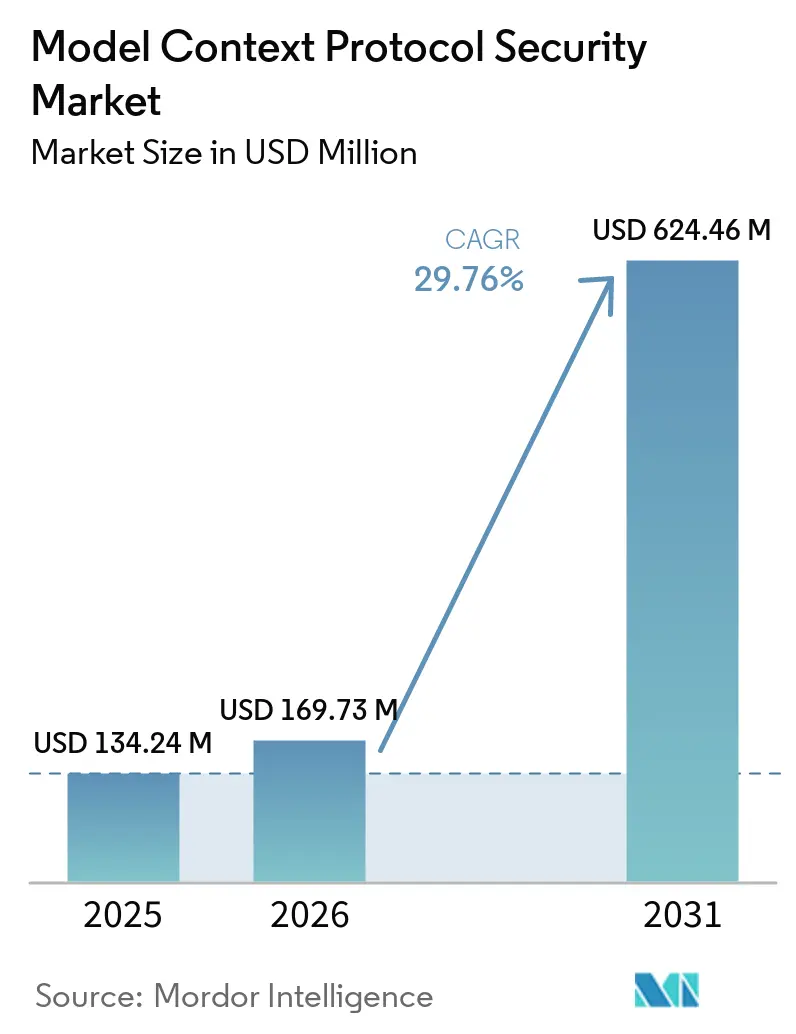
The model context protocol security market size was valued at USD 134.24 million in 2025 and estimated to grow from USD 169.73 million in 2026 to reach USD 624.46 million by 2031, at a CAGR of 29.76% during the forecast period (2026-2031). Adoption of Model Context Protocol, or MCP, is moving security from a secondary consideration into an operating requirement for enterprise AI agents. The protocol has expanded the number of connections among language models, agents, tools, and data systems, increasing the need for controls that work at the point of tool execution. Buyers are focusing on gateways, identity controls, monitoring, and context protection because conventional API controls do not address every MCP workflow. Larger platforms are extending existing cloud and API security portfolios, while specialized providers are developing controls for protocol-specific risks. This Model Context Protocol Security Market also offers opportunities for vendors that can combine discovery, policy enforcement, audit records, and managed security services for organizations with limited in-house expertise across global deployments.
Key Report Takeaways
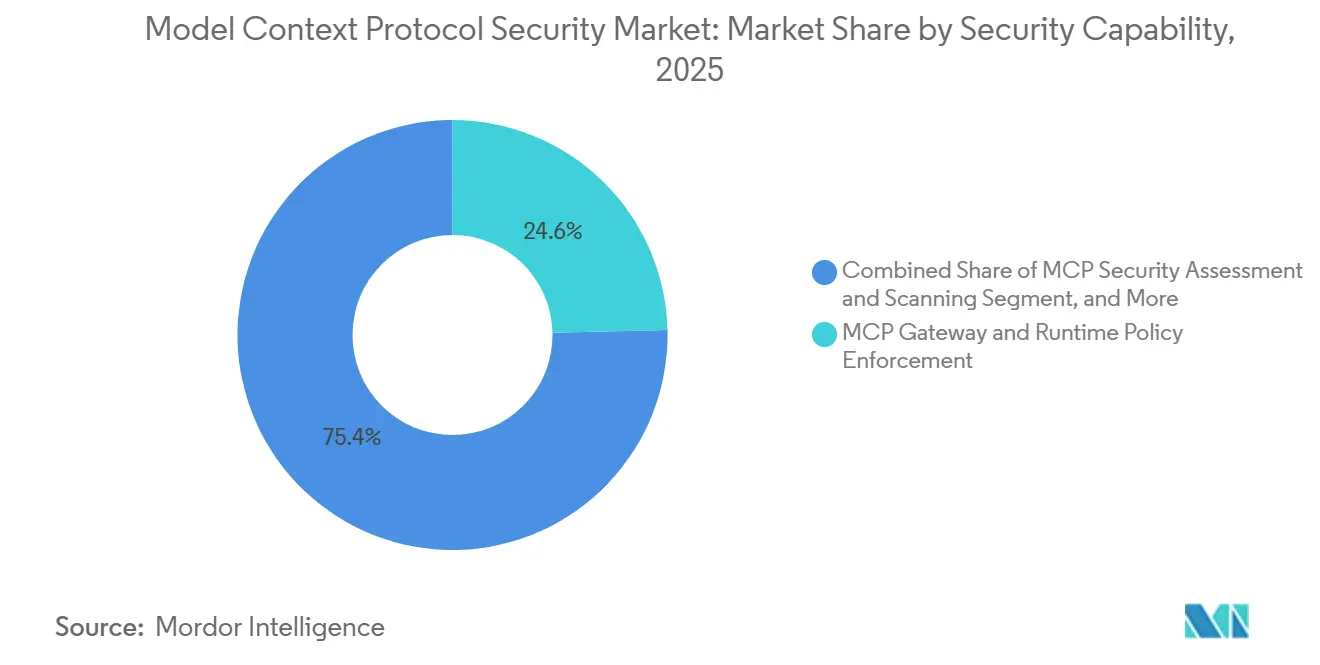
- By security capability, MCP gateway and runtime policy enforcement accounted for 24.63% of spending in the model context protocol security market in 2025, while MCP tool, prompt, and context security is projected to expand at a 32.18% CAGR through 2031.
- By deployment, cloud accounted for 59.81% of spending in the model context protocol security market in 2025, while hybrid deployment is expected to expand at a 31.57% CAGR through 2031.
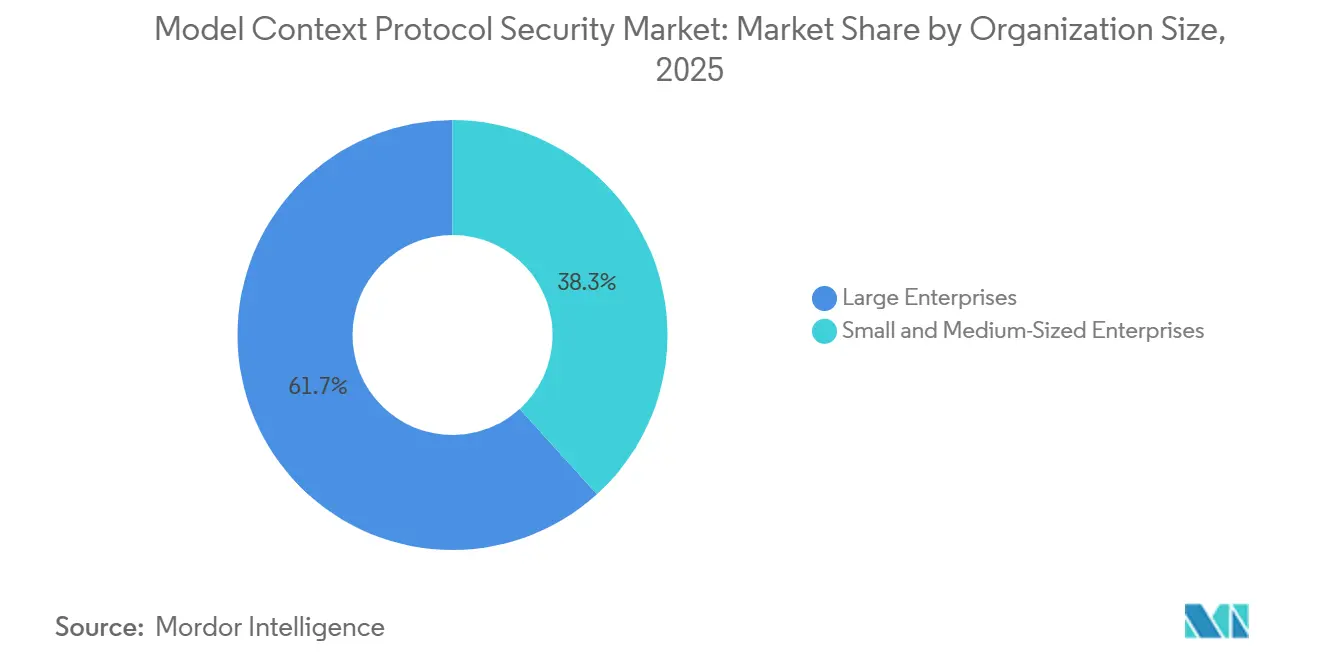
- By organization size, large enterprises held 61.73% of spending in 2025, while SMEs are projected to grow at a 33.29% CAGR through 2031.
- By end user, BFSI held 23.71% in the model context protocol security market in 2025, while the IT and Telecommunication industry is expected to advance at a 37.62% CAGR through 2031.
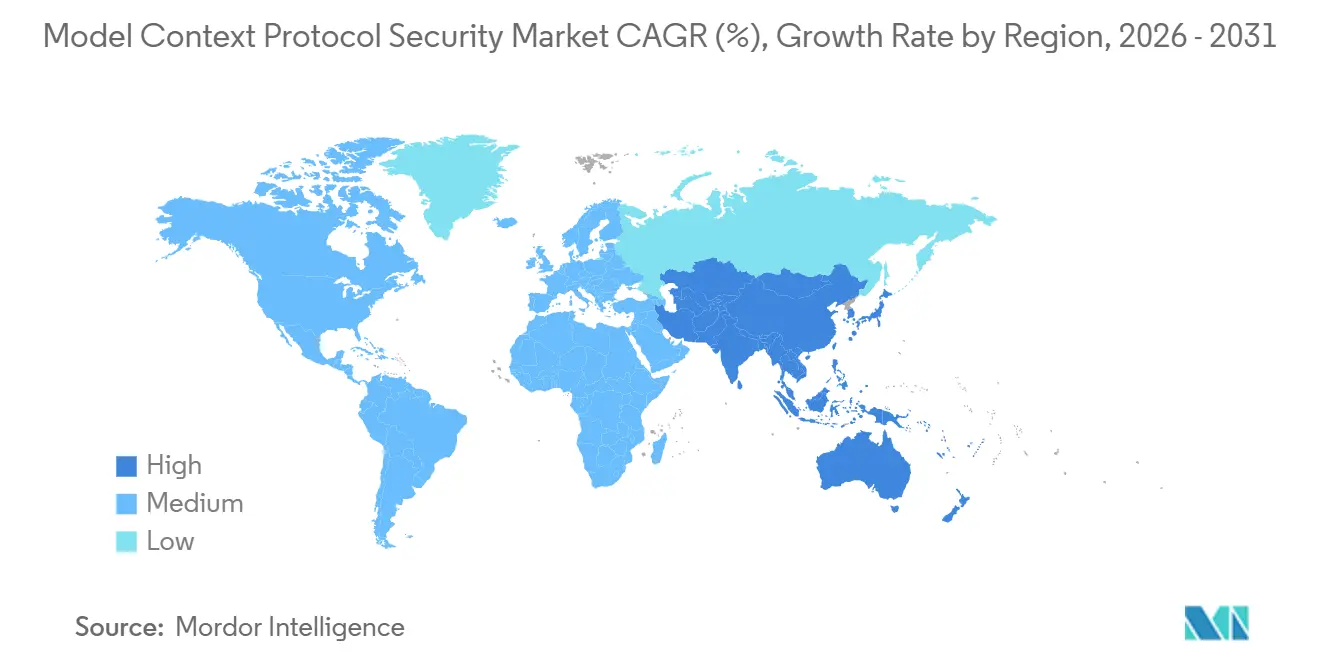
- By geography, North America accounted for 39.16% of the model context protocol security market in 2025, while Asia-Pacific is projected to grow at a 36.53% CAGR through 2031.
Note: Market size and forecast figures in this report are generated using Mordor Intelligence’s proprietary estimation framework, updated with the latest available data and insights as of January 2026.
Market Trends and Insights
Drivers Impact Analysis of Model Context Protocol Security Market*
| DRIVER | (~) % IMPACT ON CAGR FORECAST | GEOGRAPHIC RELEVANCE | IMPACT TIMELINE |
|---|---|---|---|
| Enterprise MCP Adoption Expands the Control Surface | +6.2% | Global | Short term (≤ 2 years) |
| Growth of Agentic Workflows and Tool Chaining | +5.5% | Global | Short term (≤ 2 years) |
| Mandatory OAuth 2.1 and Enterprise Authorization Requirements | +4.8% | Global, with early gains in North America and Europe | Short term (≤ 2 years) |
| Increasing MCP Server Supply-Chain Exposure | +4.1% | Global | Medium term (2-4 years) |
| Rising Shadow MCP Discovery and Governance Needs | +3.9% | North America and Europe | Medium term (2-4 years) |
| Regulatory Demand for Traceable AI Actions | +3.2% | Europe and Asia-Pacific | Medium term (2-4 years) |
| Source: Mordor Intelligence | |||
Enterprise MCP Adoption Expands the Control Surface
Enterprise MCP deployment is widening the range of systems that security teams must govern. Palo Alto Networks reported that 81% of enterprises were piloting or deploying AI agents when it announced its Portkey transaction in April 2026.[1]Palo Alto Networks, “Palo Alto Networks to Acquire Portkey to Secure the Rise of AI Agents,” Palo Alto Networks, paloaltonetworks.com Each connected MCP server can introduce opportunities for tool-call interception, credential loss, or prompt injection, and it can add a connection that security teams need to inventory. These risks can compound when several servers use the same client session and rely on common credentials or shared context. The U.S. National Security Agency identified insecure context serialization, missing access controls, and inadequate audit logs as design concerns in its June 2026 MCP guidance. Security teams that formerly reviewed a limited set of API connections can now face many MCP servers deployed by development groups without a consistent review process. The gap between MCP adoption and governance maturity supports continuing demand across the model context protocol security market.
Growth of Agentic Workflows and Tool Chaining
Multi-agent workflows create authorization questions that conventional enterprise controls do not always resolve. An orchestrator can delegate work to a subagent that then calls an MCP tool, making effective privilege difficult to determine and making accountability less direct. OWASP identifies the confused deputy problem and related authorization weaknesses in its MCP security guidance.[2]OWASP Foundation, “MCP09:2025 - Shadow MCP Servers,” OWASP MCP Top 10, owasp.org Tool chaining can also expand exposure through cross-server data movement and persistence after a session ends. Palo Alto Networks positioned Portkey as a centralized control plane for AI-agent transactions when it completed the acquisition in May 2026. This approach reflects the need to trace activity across agent, model, and tool interactions. Monitoring, analytics, audit, and incident-response offerings, therefore, have a larger role in the model context protocol security market as enterprises seek to detect behavior that static policies do not identify.
Mandatory OAuth 2.1 and Enterprise Authorization Requirements
MCP authorization requirements are making identity architecture a more central part of deployment decisions. The MCP specification requires OAuth 2.1 for remote servers, and its July 2026 release candidate described stronger issuer validation and a move away from Dynamic Client Registration toward Client ID Metadata Documents. These changes seek to reduce OAuth mix-up risks that earlier approaches did not fully address. Enterprises using centralized identity services must map established policies to MCP token-scoping requirements, including the limits that apply to specific resources. They also need to distinguish interactive users from automated non-user agents across varied credential patterns. This work creates demand for identity, authorization, and secrets controls in the model context protocol security market, even when it lengthens implementation planning.
Increasing MCP Server Supply-Chain Exposure
MCP server supply chains can introduce risk before a tool call reaches a production application. Server metadata may contain malicious instructions, while unmanaged servers can expose credentials or create a route into connected business systems. OWASP identifies shadow MCP servers as a distinct risk category, which reinforces the need to maintain an inventory of authorized connections. Salt Security launched MCP Finder in November 2025 to provide discovery across repositories, deployed infrastructure, and SaaS environments. Docker also describes curated servers, secret isolation, provenance checks, and containerized execution as ways to reduce supply-chain exposure. Organizations need discovery and inventory tools in the model context protocol security market before they can apply policy and monitoring consistently across their MCP footprint.
Restraints Impact Analysis of Model Context Protocol Security Market*
| RESTRAINT | (~) % IMPACT ON CAGR FORECAST | GEOGRAPHIC RELEVANCE | IMPACT TIMELINE |
|---|---|---|---|
| Immature Standards and Uneven Client Implementations | -3.5% | Global | Medium term (2-4 years) |
| Alert Fatigue and Approval Friction | -2.1% | Global | Short term (≤ 2 years) |
| Limited MCP-Specific Security Budgets | -1.8% | South America, Middle East and Africa | Long term (≥ 4 years) |
| Performance and Privacy Trade-offs in Inline Inspection | -1.4% | Europe and Asia-Pacific | Medium term (2-4 years) |
| Source: Mordor Intelligence | |||
Immature Standards and Uneven Client Implementations
Differences between protocol specifications and client behavior can slow adoption of MCP security controls. A May 2026 study of 7 commercial MCP clients found that 5 had no static validation of tool descriptions and 2 provided only partial validation.[3]K. Huang, J. Huang, Q. Tran, and A. Milani Fard, “Model Context Protocol Threat Modeling and Analysis,” MDPI Systems, mdpi.com The study found that poisoned tool metadata could reach language models without inspection. It also rated Cursor unsafe across all 4 tested attack scenarios, including those involving credential-file access and remote script execution. Gateway controls alone may therefore leave client-side validation gaps unresolved. The July 2026 specification introduced lifecycle management and a 12-month deprecation policy, but alignment between specifications and deployed clients will take time. Organizations must consider both client exposure and gateway capabilities when selecting a model context protocol security market solution.
Alert Fatigue and Approval Friction
Per-action approval can weaken security if users repeatedly accept tool requests without careful review. MCP relies on implementation choices for many security outcomes rather than enforcing every security principle at the protocol level. The NSA highlighted poor approval workflows as a systemic MCP security concern in June 2026. In working environments, repeated prompts can compete with other tasks and reduce the attention given to individual tool calls. Proofpoint launched its AI Security product in March 2026 with an Agent Integrity Framework that uses intent-based detection to reduce unnecessary interruptions. Wider use of these approaches still requires product development and enterprise redesign cycles, which can delay adoption across the model context protocol security market.
*Our forecasts treat driver/restraint impacts as directional, not additive. The impact forecasts reflect baseline growth, mix effects, and variable interactions.
Model Context Protocol Security Market Segment Analysis
By Security Capability:
Gateways Enforce the AI-Tool BoundaryMCP gateway and runtime policy enforcement accounted for 24.63% of the model context protocol security market size in 2025. Enterprises use gateways as a model-agnostic point to evaluate tool calls before execution, regardless of the AI client or agent framework that originates a request. This position reflects an immediate need to control the boundary between agent runtimes and external tool servers, where access policies can be applied before a tool completes its task. Other capability areas include discovery and inventory, security assessment and scanning, identity and secrets security, tool and context protection, sandboxing, monitoring and audit, and incident response services. These areas cover defense layers that gateway products do not provide on their own, particularly where threats arise in instructions, identities, runtime behavior, or server configuration.
MCP tool, prompt, and context security is projected to grow at a 32.18% CAGR through 2031. The model context protocol security market share held by gateway controls does not eliminate risks from malicious instructions embedded in server-provided tool metadata. A peer-reviewed threat-modeling study assigned tool poisoning a DREAD severity score of 50 out of 50 and showed why metadata validation matters. Tool-description integrity and prompt-injection controls operate at the agent-framework layer, while gateways operate at the deployment-infrastructure layer. This separation supports investment in context security, monitoring, and audit records. Incident response and managed services also address the needs of mid-market firms that do not have internal teams to operate specialized controls.



By Deployment:
Cloud Leads While Hybrid Deployment Gains GroundCloud deployment accounted for 59.81% of spending in 2025. Early demand came from enterprise teams operating cloud-hosted agent applications and SaaS-connected MCP servers. These buyers favored products that avoided separate security infrastructure. On-premises deployment addresses environments involving healthcare records, financial transactions, and government-classified information. In those settings, internal policy can restrict cloud transmission of agent-level interactions.
Hybrid deployment is projected to grow at a 31.57% CAGR through 2031. Large financial institutions and defense-adjacent organizations are using local enforcement for sensitive tool calls and cloud-managed discovery and audit functions for the wider MCP estate. The stateless architecture described in the July 2026 specification supports per-request policy evaluation without persistent server-side session state.[4]Model Context Protocol, “The 2026-07-28 MCP Specification Release Candidate,” Model Context Protocol Blog, modelcontextprotocol.io Docker describes a pattern in which local containers isolate servers with resource limits while central policy management connects to a cloud-administered console. The model context protocol security market size for hybrid delivery benefits when organizations require both local control and centralized visibility, rather than choosing one deployment method for every workload.
By Organization Size:
Large Enterprises Lead While SMEs AccelerateLarge enterprises held 61.73% of spending in 2025. These organizations have concentrated many production agent deployments, dedicated AI engineering resources, formal procurement processes, and more established requirements for governance documentation. They also require sandboxing, identity controls, secrets management, monitoring, and audit functions across complex environments that can include many agents and connected tools. Their purchase decisions often consider security-platform integration, identity architecture, SIEM compatibility, and compliance documentation. The breadth of these requirements explains their leading position in the model context protocol security market.
SMEs are projected to expand at a 33.29% CAGR through 2031. Coding-assistant providers can include MCP clients as a default feature, allowing software teams to acquire connectivity without a separate architecture or security decision. This route can create MCP exposure in organizations with limited formal review procedures and no dedicated AI-security function. Docker's MCP catalog and toolkit emphasize curated servers, provenance checks, secret isolation, and containerized execution for teams that need security by default.[5]Docker, “MCP Security: Risks, Challenges, and How to Mitigate,” Docker, docker.com Vendors serving SMEs need a different approach from enterprise gateway providers. Their products need pricing, integration needs, and deployment effort that fit smaller technical teams entering the model context protocol security market.
By End User:
BFSI Anchors Demand While IT and Telecommunication ScalesBFSI held 23.71% of the model context protocol security market share in 2025. Financial institutions have deployed AI agents for fraud detection, customer onboarding, lending decisions, and trade surveillance, all of which involve sensitive information and formal audit expectations. These uses require access rules that distinguish between actions such as reading account balances and initiating transfers. This need supports the demand for identity, authorization, secrets, content inspection, and data loss prevention controls.
The IT and telecommunication industry is projected to advance at a 37.62% CAGR through 2031. Telecom operators are deploying coding assistants, customer-engagement agents, and network-operations tools that introduce MCP into core infrastructure environments. Healthcare and life sciences, along with government and public administration, are another important group because they need audit trails for interactions with patient or public systems. The NSA guidance is a procurement consideration for public-sector deployments. Energy and utilities are evaluating controls for operational technology use cases in which an erroneous tool action can have safety implications. Retail and e-commerce, transportation and logistics, manufacturing, media and entertainment, and education are earlier-stage users that may increase spending in the model context protocol security market as agent deployments move into production.
Geography Analysis
The Americas Model Context Protocol Security Market
North America held 39.16% of regional spending in 2025. The region had a high concentration of enterprise AI-agent deployments, established cloud adoption, and major platform security vendors. Amazon Web Services added MCP proxy support to API Gateway in December 2025, while Microsoft integrated MCP governance into Defender and Purview. These actions made model context protocol security market capabilities more accessible through existing cloud infrastructure. South America remained at an early stage, with Brazil leading financial institution pilots of agent deployments.
APAC Model Context Protocol Security Market
Asia-Pacific is projected to grow at a 36.53% CAGR through 2031. Singapore's IMDA published an agentic-AI governance framework in 2026 that calls for MCP server whitelisting, sandbox controls, and audit logging. The Cyber Security Agency of Singapore published its Addendum on Securing Agentic AI Systems in June 2026, setting out lifecycle controls for enterprise users. Japan's enterprise AI base, India's expanding IT services sector, South Korea's semiconductor manufacturers, and Australia's financial-services organizations support regional demand, while Singapore's governance measures create a clear procurement basis for security controls. These factors position Asia-Pacific for faster growth in the model context protocol security market.
EMEA Model Context Protocol Security Market
Europe is shaped by compliance requirements for high-risk AI systems and critical infrastructure operators. The EU AI Act creates audit obligations that support demand for MCP monitoring and audit tools. NIS2 risk-management requirements have applied to critical-infrastructure operators since January 2025, creating procurement signals among German and French enterprises. The Middle East and Africa is led by the United Arab Emirates and Saudi Arabia through smart-city and Vision 2030 digital-transformation programs. Managed security service providers are the main delivery channel in this region because MCP security expertise remains concentrated among a limited number of larger enterprises, which can make externally delivered controls important for model context protocol security market adoption.

Competitive Landscape
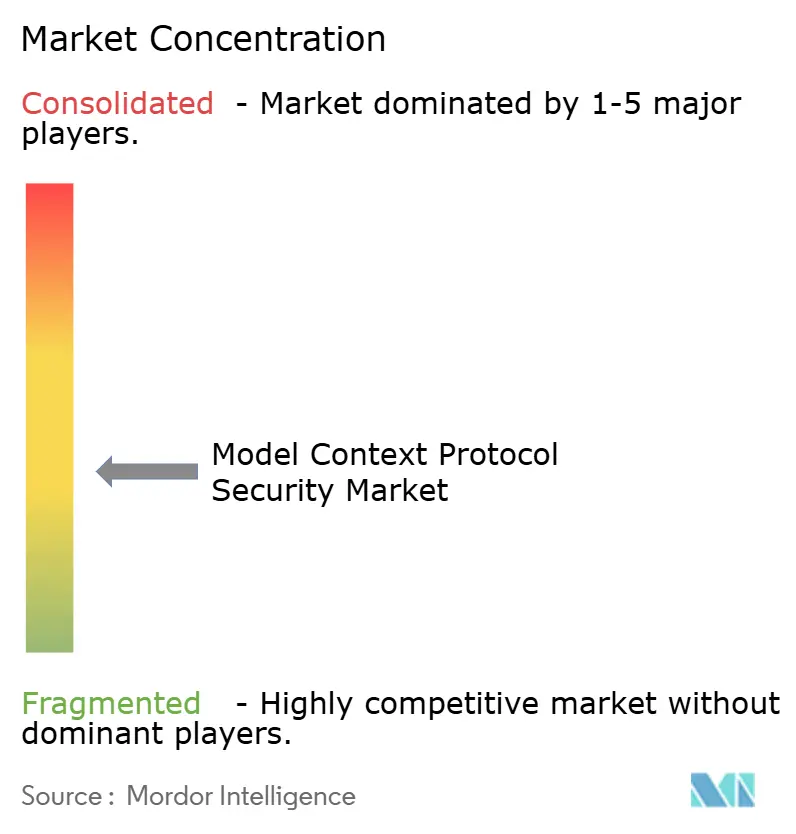
The model context protocol security market is moderately fragmented across gateway enforcement, discovery and inventory, identity and authorization, and managed services. Platform vendors extend existing API, cloud, and zero-trust security portfolios into MCP controls, giving them distribution reach and a broad base of enterprise integrations. MCP-native specialists have focused product depth on protocol-specific threat detection and enforcement. Palo Alto Networks completed its Portkey acquisition in May 2026 and integrated the AI gateway into Prisma AIRS as a centralized control plane for enterprise agents.[6]Palo Alto Networks, “Palo Alto Networks Completes Acquisition of Portkey to Secure AI Agents,” Palo Alto Networks, paloaltonetworks.com The transaction showed that model context protocol security capabilities can be absorbed into broader security platforms.
Cloudflare published an enterprise MCP architecture that combined MCP Server Portals with Gateway data-loss-prevention capabilities. The design examines MCP method headers in TLS-inspected traffic and extends network-layer controls to the protocol layer. Docker has extended containerized isolation and curated server controls to MCP use cases, while Proofpoint launched AI Security in March 2026 with intent-based detection through its Agent Integrity Framework. These moves show that providers are using acquisitions, platform extensions, and new detection models to address agent-to-tool risks. They also reflect the different routes vendors use to enter the model context protocol security market.
Open opportunities remain in behavioral analytics for new tool-chain attacks, cryptographic verification of server provenance, and managed services for mid-market organizations that lack the internal staff needed to operate dedicated MCP controls. Hardware-attested enforcement approaches could position the agent-to-tool boundary as a control surface beyond a software policy engine, particularly where buyers need stronger confidence in the provenance of connected servers. Early MCP-native vendors face pressure to monetize open-source gateway and discovery offerings, while larger platform providers can offer distribution scale, established integration channels, and a broader set of existing customer relationships that many specialists cannot match alone. Patent filings, developer engagement, and standards contributions are becoming competitive differentiators in the model context protocol security market, and the available information does not provide a combined share for leading companies, so a precise concentration measure cannot be derived from market-share data.
Model Context Protocol Security Industry Leaders
Microsoft Corporation
Docker, Inc.
Palo Alto Networks, Inc.
Proofpoint, Inc.
Lasso Security Ltd.
- *Disclaimer: Major Players sorted in no particular order
Model Context Protocol Security Market Companies Covered in this Report
- Microsoft Corporation
- Docker, Inc.
- Palo Alto Networks, Inc.
- Proofpoint, Inc.
- Lasso Security Ltd.
- International Business Machines Corporation
- Anthropic PBC
- OpenAI, Inc.
- Invariant Labs GmbH
- Enkrypt AI, Inc.
- Akto Security, Inc.
- TrueFoundry, Inc.
- MintMCP, Inc.
- Lunar.dev Ltd.
- Composio Technologies, Inc.
- Kong Inc.
- Tyk Technologies Ltd.
- Gravitee.io
- Portkey AI, Inc.
- Runlayer, Inc.
- Obot AI, Inc.
- Okta, Inc.
- Cloudflare, Inc.
- Cisco Systems, Inc.
- Google LLC
- Amazon Web Services, Inc.

Recent Industry Developments in Model Context Protocol Security Market
- August 2026: Cloudflare launched MCP protocol detection in Gateway, introducing an AI Security dashboard that classifies MCP traffic by protocol headers, shows unique users and server counts, and enables policy-based blocking of unauthorized connections. MCP Server Portals were simultaneously updated to support the stateless MCP 2026-07-28 specification.
- August 2026: Cloudflare released WriteGuard for MCP Server Portals in private beta, enabling administrators to classify write-capable tools, block pre-invocation, attach agent attribution metadata, and inspect write activity across connected MCP servers.
- August 2026: Hong Kong's Office of the Privacy Commissioner for Personal Data issued agentic AI guidance, joining EU, UK, Spanish, Dutch, and Singapore regulators that had published AI-agent-specific data protection expectations within the preceding 12 months.
- July 2026: The MCP 2026-07-28 specification was published under the Agentic AI Foundation, a Linux Foundation directed fund, finalizing the protocol's stateless core architecture, hardening OAuth authorization alignment with OIDC deployments, and introducing a formal 12-month deprecation policy with breaking changes for SDK maintainers.


Global Model Context Protocol Security Market Report Scope
The model context protocol security market comprises specialized security solutions that protect the standardized communication layer, enabling AI agents and large language models to connect with external tools, data sources, and enterprise systems. These security offerings address MCP-specific threats including unauthorized tool invocation, prompt injection attacks through MCP servers, data exfiltration via model context protocol (MCP) connections, and privilege escalation through compromised MCP integrations, providing capabilities such as MCP traffic inspection, server authentication, tool access governance, connection encryption, and runtime monitoring to ensure that AI agents can safely leverage external resources without exposing sensitive data or enabling adversarial manipulation of the agent-tool interaction workflow.
The Model Context Protocol Security Market Report is Segmented by Security Capability (MCP Discovery and Inventory, MCP Security Assessment and Scanning, MCP Gateway and Runtime Policy Enforcement, MCP Identity, Authorization and Secrets Security, MCP Tool, Prompt and Context Security, MCP Sandboxing and Runtime Isolation, MCP Monitoring, Analytics and Audit, and MCP Incident Response and Managed Security Services), Deployment (Cloud, On-Premises, and Hybrid), Organization Size (Large Enterprises, and Small and Medium-Sized Enterprises), End User (Government and Public Administration, Industrial Manufacturing, Retail and E-Commerce, Transportation and Logistics, Energy and Utilities, Oil and Gas, IT and Telecommunication, Media and Entertainment, Education and Research Institutions, Healthcare and Life Sciences, Banking, Financial Services, and Insurance (BFSI), and Other End users), and Geography (North America, South America, Europe, Asia-Pacific, and Middle East and Africa). The Market Forecasts are Provided in Terms of Value (USD).
| MCP Discovery and Inventory |
| MCP Security Assessment and Scanning |
| MCP Gateway and Runtime Policy Enforcement |
| MCP Identity, Authorization and Secrets Security |
| MCP Tool, Prompt and Context Security |
| MCP Sandboxing and Runtime Isolation |
| MCP Monitoring, Analytics and Audit |
| MCP Incident Response and Managed Security Services |
| Cloud |
| On-Premises |
| Hybrid |
| Large Enterprises |
| Small and Medium-Sized Enterprises |
| Government and Public Administration |
| Industrial Manufacturing |
| Retail and E-Commerce |
| Transportation and Logistics |
| Energy and Utilities |
| Oil and Gas |
| IT and Telecommunication |
| Media and Entertainment |
| Education and Research Institutions |
| Healthcare and Life Sciences |
| Banking, Financial Services, and Insurance (BFSI) |
| Other End users |
| North America | United States | |
| Canada | ||
| Mexico | ||
| South America | Brazil | |
| Argentina | ||
| Rest of South America | ||
| Europe | Germany | |
| United Kingdom | ||
| France | ||
| Italy | ||
| BENELUX | ||
| Rest of Europe | ||
| Asia-Pacific | China | |
| Japan | ||
| India | ||
| South Korea | ||
| Australia | ||
| Rest of Asia-Pacific | ||
| Middle East and Africa | Middle East | United Arab Emirates |
| Saudi Arabia | ||
| Rest of Middle East | ||
| Africa | South Africa | |
| Nigeria | ||
| Egypt | ||
| Rest of Africa | ||
| By Security Capability | MCP Discovery and Inventory | ||
| MCP Security Assessment and Scanning | |||
| MCP Gateway and Runtime Policy Enforcement | |||
| MCP Identity, Authorization and Secrets Security | |||
| MCP Tool, Prompt and Context Security | |||
| MCP Sandboxing and Runtime Isolation | |||
| MCP Monitoring, Analytics and Audit | |||
| MCP Incident Response and Managed Security Services | |||
| By Deployment | Cloud | ||
| On-Premises | |||
| Hybrid | |||
| By Organization Size | Large Enterprises | ||
| Small and Medium-Sized Enterprises | |||
| By End User | Government and Public Administration | ||
| Industrial Manufacturing | |||
| Retail and E-Commerce | |||
| Transportation and Logistics | |||
| Energy and Utilities | |||
| Oil and Gas | |||
| IT and Telecommunication | |||
| Media and Entertainment | |||
| Education and Research Institutions | |||
| Healthcare and Life Sciences | |||
| Banking, Financial Services, and Insurance (BFSI) | |||
| Other End users | |||
| By Geography | North America | United States | |
| Canada | |||
| Mexico | |||
| South America | Brazil | ||
| Argentina | |||
| Rest of South America | |||
| Europe | Germany | ||
| United Kingdom | |||
| France | |||
| Italy | |||
| BENELUX | |||
| Rest of Europe | |||
| Asia-Pacific | China | ||
| Japan | |||
| India | |||
| South Korea | |||
| Australia | |||
| Rest of Asia-Pacific | |||
| Middle East and Africa | Middle East | United Arab Emirates | |
| Saudi Arabia | |||
| Rest of Middle East | |||
| Africa | South Africa | ||
| Nigeria | |||
| Egypt | |||
| Rest of Africa | |||


Key Questions Answered in the Report
What is the model context protocol security market size?
The model context protocol security market size was valued at USD 134.24 million in 2025 and estimated to grow from USD 169.73 million in 2026 to reach USD 624.46 million by 2031, at a CAGR of 29.76% during the forecast period (2026-2031).
What growth rate is forecast through 2031?
The sector is estimated to grow at a 29.76% CAGR from 2026 to 2031.
Which security capability led spending in 2025?
MCP Gateway and Runtime Policy Enforcement led with 24.63% of spending in 2025.
Which deployment approach is growing fastest?
Hybrid deployment is projected to grow at a 31.57% CAGR through 2031.
Which end-user group is expected to grow fastest?
IT and Telecommunication is projected to expand at a 37.62% CAGR through 2031.
Which region is expected to grow fastest?
Asia-Pacific is projected to advance at a 36.53% CAGR through 2031.
Page last updated on:





