
Mobile Power Plant Market Size and Share
Market Overview
| Study Period | 2021 - 2031 |
|---|---|
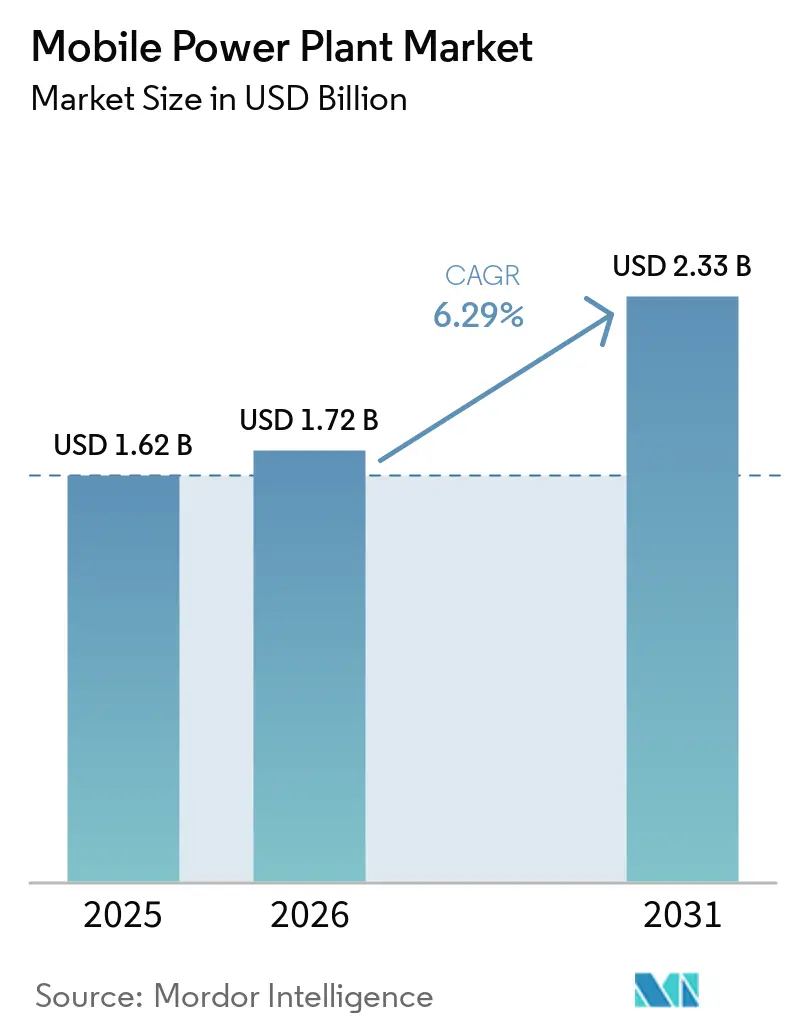
| Market Size (2026) | USD 1.72 Billion |
| Market Size (2031) | USD 2.33 Billion |
| Growth Rate (2026 - 2031) | 6.29 % |
| Fastest Growing Market | Asia-Pacific |
| Largest Market | Europe |
| Market Concentration | Medium |
Major Players *Disclaimer: Major Players sorted in no particular order Image © Mordor Intelligence. Reuse requires attribution under CC BY 4.0. | |
Mobile Power Plant Market Analysis by Mordor Intelligence
The mobile power plant market size is projected to expand from USD 1.62 billion in 2025 and USD 1.72 billion in 2026 to USD 2.33 billion by 2031, at a CAGR of 6.29% between 2026 and 2031. Demand is moving beyond emergency response into data centers, remote industrial sites, and grid support. Long grid interconnection queues have increased the value of generation that can be deployed quickly. The International Energy Agency expects global data center electricity consumption to reach 1,000 TWh in 2026[1]International Energy Agency, “Electricity 2024,” International Energy Agency, iea.org.. This demand creates a role for mobile assets where permanent connections cannot be completed quickly. Operators are also shifting toward hybrid and hydrogen-ready fleets as emissions rules become stricter.
Key Report Takeaways
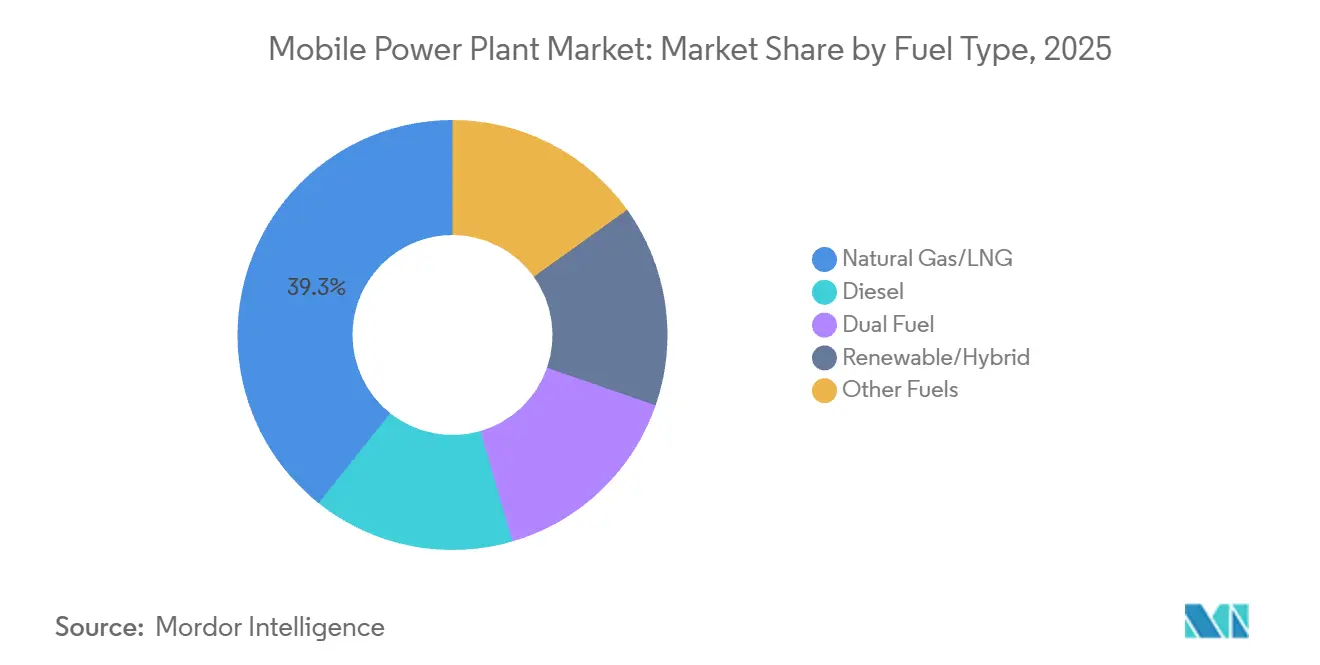
- By fuel type, Natural Gas/LNG held 39.3% of the mobile power plant market share in 2025, while Renewable/Hybrid is forecast to grow at an 8.3% CAGR through 2031.
- By power rating, the 21–50 MW category held a 31.6% segment share in 2025, while the 1–10 MW category is forecast to grow at a 7.8% CAGR through 2031.
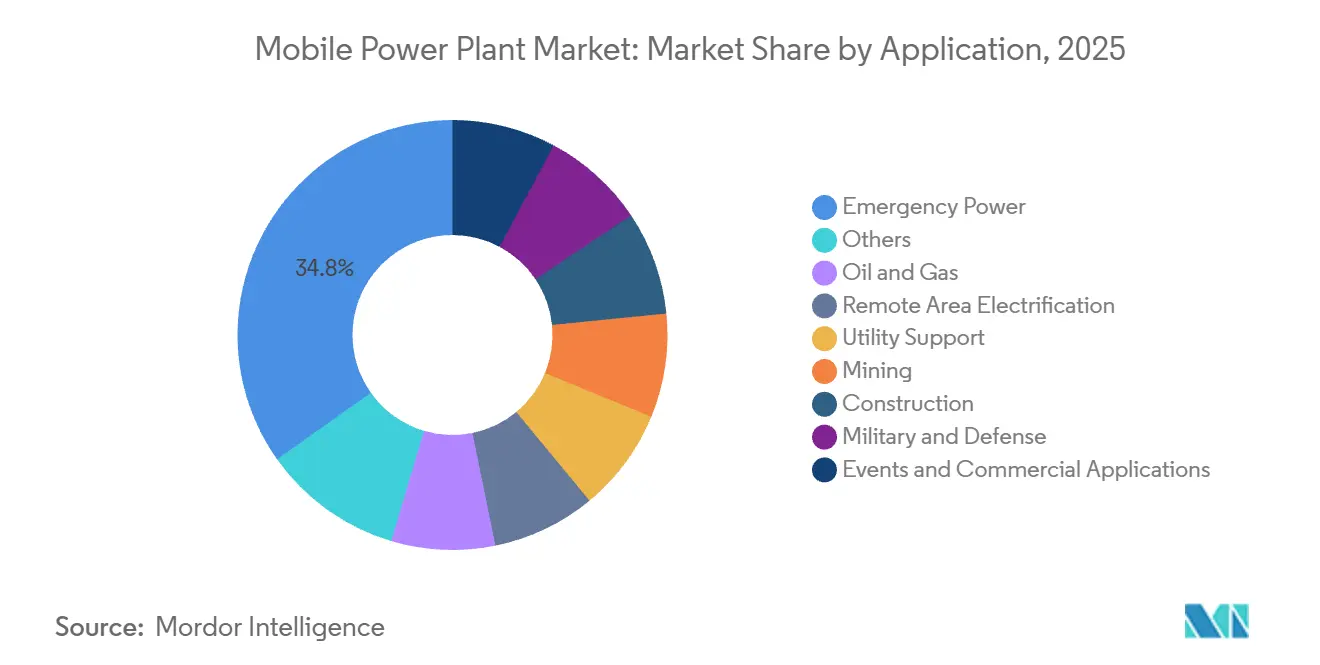
- By application, Emergency Power held a 34.8% segment share in 2025, while Remote Area Electrification is forecast to grow at a 7.6% CAGR through 2031.
- By geography, Europe held a 28.7% segment share in 2025, while Asia-Pacific is forecast to grow at a 7.1% CAGR through 2031.
Note: Market size and forecast figures in this report are generated using Mordor Intelligence’s proprietary estimation framework, updated with the latest available data and insights as of January 2026.
Global Mobile Power Plant Market Trends and Insights
Drivers Impact Analysis*
| Driver | ~% Impact on CAGR Forecast | Geographic Relevance | Impact Timeline |
|---|---|---|---|
| Rising Demand for Emergency and Disaster-Resilience Power | +1.50% | Global, concentrated in North America, Europe, Asia-Pacific | Short term (≤ 2 years) |
| Remote and Rural Electrification Programs | +0.90% | Sub-Saharan Africa, Southeast Asia, South Asia, South America | Medium term (2–4 years) |
| Industrial, Mining, Oil and Gas, and Construction Expansion | +1.10% | APAC, MEA, North America | Medium term (2–4 years) |
| Renewable Integration and Grid-Balancing Requirements | +1.00% | Europe, North America, Australia | Medium term (2–4 years) |
| Data-Center Speed-to-Power Requirements | +1.30% | North America, Europe, Asia-Pacific | Short term (≤ 2 years) |
| Modular Hydrogen-Ready and Fuel-Flexible Mobile Generation | +0.50% | Europe (Germany, Netherlands), North America | Long term (≥ 4 years) |
| Source: Mordor Intelligence | |||
Rising Demand for Emergency and Disaster-Resilience Power
Frequent grid disruptions have made emergency generation a recurring procurement priority. Extreme weather, aging transmission networks, and cybersecurity risks have increased the need for rapid backup capacity. Public agencies in exposed areas are using standing rental contracts instead of crisis tenders. This approach can reduce deployment periods from weeks to hours. Federal and regional grid programs in the United States have also widened funding pathways for temporary backup capability. Emergency Power held 34.8% of the application mix in 2025, giving this demand pattern a substantial installed base.
Data Center Speed-to-Power Requirements
Mobile generation supports data center developers who cannot wait for a long interconnection process. The mobile power plant market benefits when a rental agreement is faster than a permanent connection. The IEA expects data center electricity demand to reach 1,000 TWh in 2026. Wärtsilä received a 790 MW Texas data center order in April 2026[2]Wärtsilä Corporation, “Wärtsilä Continues to Expand Its Data Center Footprint with New 790 MW Order in Texas,” Wärtsilä, wartsila.com.. The company also received a 412 MW Ohio hyperscale order using 40 Wärtsilä 34SG gas engines. Production curtailments during the pandemic created a two to three-year backlog for mobile industrial gas turbines. Existing fleet owners, therefore, have an advantage when customers need near-term power.
Renewable Integration and Grid-Balancing Requirements
Variable wind and solar output has increased demand for fast-ramping generation. This need is most visible where renewable deployment has moved faster than grid investment. The IEA reported that European natural gas use for power generation rose nearly 8% in 2025. Germany’s Hydrogen Acceleration Act took effect on April 2, 2026. The policy supports approval processes for hydrogen-ready generation under the country’s Power Plant Strategy. Mobile systems can provide a bridge while permanent network projects move forward. This favors suppliers that offer gas engines designed for later hydrogen use.
Industrial, Mining, Oil and Gas, and Construction Expansion
Remote industrial sites often face high costs for permanent grid extensions. Mining operations are a core example because many sites are distant from transmission networks. Wärtsilä received a 14 MW order for Fortuna Mining’s Diamba Sud Gold Project in Senegal during 2026[3]Wärtsilä Corporation, “Wärtsilä to Deliver Reliable 14 MW Power Plant for Senegal Mining Operation,” Wärtsilä, wartsila.com.. The plant uses five Wärtsilä 32 engines and can incorporate future wind and solar resources. Aggreko signed a 15-year agreement for Harmony Gold’s Eva copper mine in Queensland in 2026. The facility includes 118 MWp of solar, 250 MWh of battery storage, and 104 MVA of thermal capacity. Long-term power agreements are replacing some short-term rentals and extending revenue visibility. SLB reported that upstream combustion-based generation has 25%–33% energy conversion efficiency, which supports interest in mobile electrification solutions.
Restraints Impact Analysis*
| Restraint | ~% Impact on CAGR Forecast | Geographic Relevance | Impact Timeline |
|---|---|---|---|
| Diesel Price Volatility and Fuel-Logistics Exposure | -0.70% | Global, most acute in Sub-Saharan Africa, South Asia, remote APAC | Short term (≤ 2 years) |
| Stricter Emissions Standards and Low-Emission-Zone Restrictions | -0.50% | Europe (EU Stage V), North America (EPA Tier 4), UK (LEZ) | Medium term (2–4 years) |
| High Operating Costs Compared With Permanent Grid Power | -0.40% | Global; most limiting in markets with subsidised grid tariffs | Long term (≥ 4 years) |
| Transport, Siting, and Fuel-Supply Constraints in Difficult Terrain | -0.30% | Sub-Saharan Africa, mountainous APAC, island markets | Long term (≥ 4 years) |
| Source: Mordor Intelligence | |||
Diesel Price Volatility and Fuel-Logistics Exposure
Fuel represented 60%–75% of operating costs for heavily used diesel plants. Diesel price changes of 20%–30% can alter project economics within a contract cycle. Remote sites also face delivery premiums that increase exposure beyond spot fuel prices. RMI reported fuel savings of 30%–80% in deployments that adopted alternative configurations. Dual-fuel and hybrid designs can reduce diesel use without rebuilding supply infrastructure. Operators can use diesel at efficient loads when battery charge declines, while relying on other sources at other times. High operating costs can still limit mobile generation where permanent grid tariffs are subsidized.
Stricter Emissions Standards and Low-Emission-Zone Restrictions
Stricter emissions rules increase costs for compliant equipment and reduce the usable life of older diesel fleets. Regulation (EU) 2016/1628 applies Stage V requirements to transportable generator sets as non-road mobile machinery. London’s non-road mobile machinery low-emission zone requires Stage V compliance on major construction sites. The United States EPA Tier 4 Final standard increased the cost of new diesel packages by more than 10% in the 56–560 kW class. A January 2026 federal rule also classified large natural gas combustion turbines as stationary sources under the Clean Air Act[4]U.S. Environmental Protection Agency, “Stationary Combustion Turbines,” Federal Register, govinfo.gov.. These requirements favor operators with compliant fleets, while transport, siting, and fuel supply remain difficult in remote and island locations.
*Our forecasts treat driver/restraint impacts as directional, not additive. The impact forecasts reflect baseline growth, mix effects, and variable interactions.
Segment Analysis
By Fuel Type: Natural Gas Holds the Largest Position and Renewable/Hybrid Expands Fastest
Natural Gas/LNG held 39.3% of the fuel-type segment in 2025. This share reflects its lower emissions profile than diesel and its compatibility with large turbine systems. The European Commission reported record EU LNG imports of 35 billion cubic meters during the second quarter of 2025. Greater LNG availability can improve fuel access for larger mobile installations. Diesel remains important because it is widely available and suits shorter projects. However, widening operating cost differences are encouraging some users to select natural gas.
The Renewable/Hybrid mobile power plant market size is forecast to grow at an 8.3% CAGR through 2031. Solar PV, battery energy storage systems, and thermal backup can operate together in one microgrid. This structure lowers fuel use and helps users meet more demanding emissions rules. Aggreko’s Eva copper mine project combines solar, battery storage, and thermal generation under a long-term agreement. Hitachi Energy introduced its HyFlex Compact portable system in June 2026. It combines hydrogen fuel cells, batteries, power electronics, and cooling in one enclosure. These designs show how hybrid systems are moving into commercial temporary power applications.



By Power Rating: The 21–50 MW Range Leads While 1–10 MW Units Grow Fastest
The 21–50 MW category accounted for a 31.6% segment share in 2025. This range serves mining, oil, and gas fields, and utility support projects. A single unit or small group can deliver material capacity without the complexity of much larger systems. Units above 50 MW carry the highest value per contract. They are increasingly used behind the meter for data centers and grid restoration. The 11–20 MW range continues to serve industrial and grid-balancing needs.
The 1–10 MW mobile power plant market size is forecast to increase at a 7.8% CAGR through 2031. Demand comes from edge computing, small-island grids, and distributed industrial facilities. Customers value units that can be transported and commissioned quickly. Rolls-Royce launched its Modular Engine Power Plant range in February 2026. The range uses 10 MW, 20 MW, and 30 MW preconfigured modules. The systems are designed to connect to grids within 12–18 months of order. Hydrogen-ready architecture also helps customers plan for Germany’s future balancing-capacity requirements.
By Application: Emergency Power Leads and Remote Electrification Grows Fastest
Emergency Power represented 34.8% of the application mix in 2025. Climate-exposed utilities and national resilience programs support regular procurement in this category. Federal grid modernization programs in the United States have widened pathways for rapid backup capability. Military and defense users value self-contained, fuel-flexible generation for energy security. Events and commercial users increasingly consider hybrid units as urban emission rules expand. Utility support and construction demand remain linked to infrastructure activity and contract cycles.
Remote Area Electrification is expected to grow at a 7.6% CAGR from 2026 to 2031. National programs in sub-Saharan Africa and Southeast Asia favor modular generation where grid extension is costly. Senegal’s rural electrification agency signed a EUR 120 million contract in July 2026. The project will install 183 solar mini-power plants and connect at least 753 villages. Indonesia established a hybrid power plant procurement framework through Regulation No. 19 of 2025. Oil and gas users also seek mobile gas generation as a substitute for diesel-powered wellsite and processing loads.
Geography Analysis
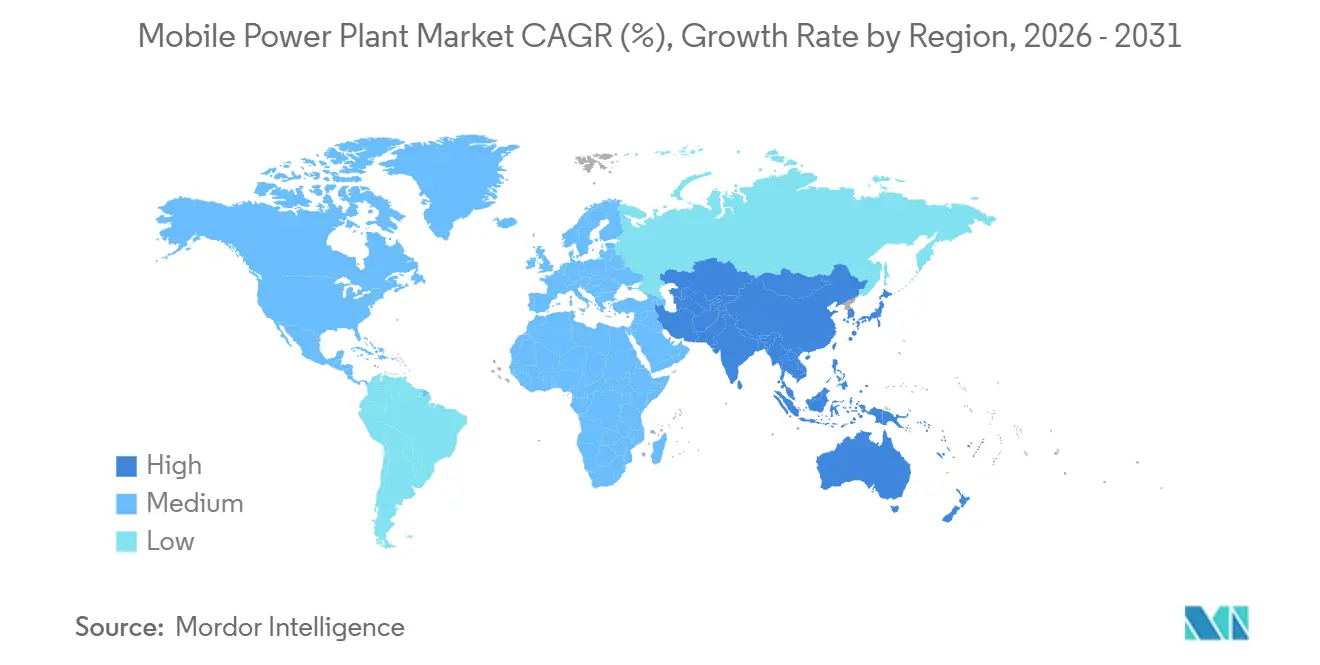
Europe held 28.7% of the global mobile power plant market share in 2025. Emergency infrastructure, renewable balancing requirements, and established rental markets support regional demand. The IEA recorded an almost 8% increase in European gas use for power generation during 2025. Low wind and hydro output created gaps that flexible units could help address. Germany’s Hydrogen Acceleration Act now supports approvals for hydrogen-ready generation infrastructure. Stage V requirements have raised entry barriers and increased demand for type-approved products.
North America remained the second-largest regional block in 2025. AI data centers are changing demand for large behind-the-meter capacity. Wärtsilä has sold more than 2.4 GW to U.S. data centers through 2026. The January 2026 EPA rule adds permitting complexity for large gas turbines. Canada and Mexico support demand through mining, resource, and remote industrial work. South America has separate opportunities in Brazilian capacity projects and Andean mining operations.
Asia-Pacific is forecast to grow at a 7.1% CAGR through 2031. Indonesia’s electrification framework supports hybrid systems for small islands and isolated regions. India’s emissions certification requirements guide diesel generator procurement toward gas and hybrid alternatives. Japan, South Korea, and Southeast Asia add data center, construction, and industrial demand. Australia remains an important reference point for large off-grid hybrid projects. The Middle East and Africa combine high-reliability needs in Gulf states with mining and rural electrification demand in sub-Saharan Africa. Morocco, Egypt, and South Africa provide regional demand centers during grid expansion programs.

Competitive Landscape
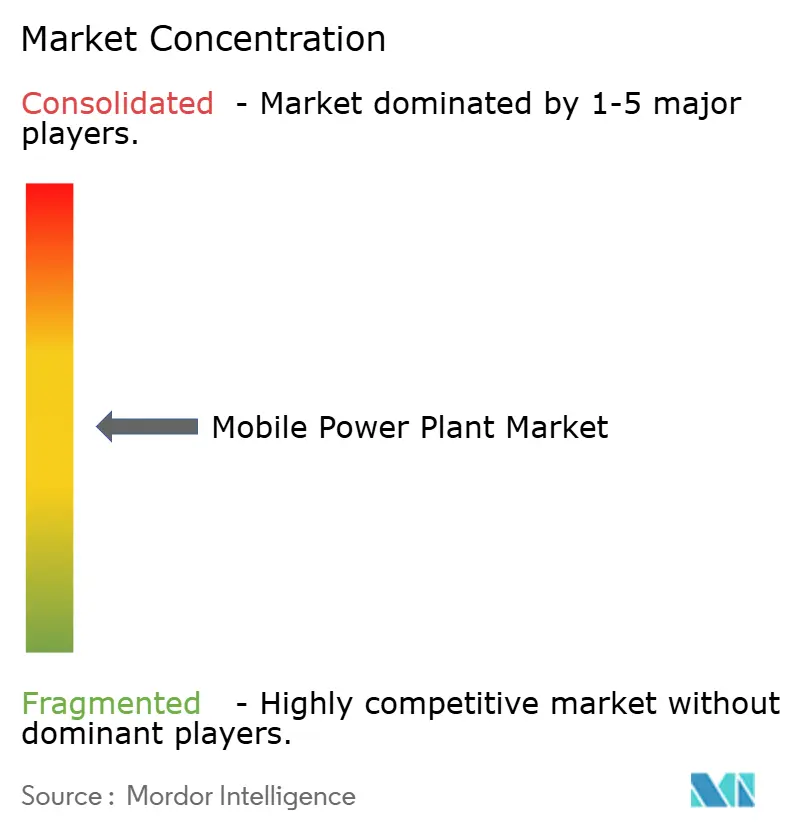
The mobile power plant market includes a concentrated large-scale segment and a fragmented small-rental segment. Wärtsilä, GE Vernova, Siemens Energy, Rolls-Royce, and Caterpillar lead the engineering-led OEM group. Aggreko and APR Energy are key specialist operators with owned temporary power fleets. Large suppliers compete through efficiency, fuel flexibility, lifecycle services, fleet availability, and reliable delivery. Regional firms compete more actively in containerized sub-5 MW rentals. This structure makes scale particularly important for multi-MW contracts with short deployment schedules.
Aggreko’s 15-year agreement for the Eva copper mine shows the shift from equipment rentals to long-term energy services. Under the agreement, Aggreko will build, own, and operate the integrated power facility. Rolls-Royce introduced hydrogen-ready modular engine power plants in February 2026. The systems range from 5 MW to 150 MW and use preconfigured modules. Hitachi Energy also introduced HyFlex Compact in June 2026 for temporary and off-grid applications.
Suppliers are seeking opportunities in hydrogen-ready systems, hybrid fuel-cell solutions, and long-term contracts. These areas are important in sub-Saharan Africa, South Asia, and Southeast Asia. Stage V compliance and Ecodesign requirements influence product plans for Europe and export destinations. Smaller entrants may find type approval costly. Karpowership operates powership-based generation outside the conventional fleet model. Hydrogen-generator startups address smaller off-grid and event requirements, but hydrogen infrastructure constrains immediate scale. Standards participation also affects qualification for utility and public-sector contracts.
Mobile Power Plant Industry Leaders
Aggreko plc
General Electric Company
Siemens AG
Caterpillar Inc.
APR Energy Ltd
- *Disclaimer: Major Players sorted in no particular order

Recent Industry Developments
- August 2026: Wärtsilä books 14 MW captive plant order for Senegal gold mine. Five Wärtsilä 32 engines will serve the Diamba Sud Gold Project, with delivery scheduled for March 2027 and future renewable integration planned.
- June 2026: Hitachi Energy introduces HyFlex Compact zero-emission power hub. The portable system combines hydrogen fuel cells, batteries, power electronics, and cooling for temporary and off-grid applications.
- May 2026: Wärtsilä and Origem Energia sign 371 MW balancing plant contracts for Brazil. The contracts cover 2 groups of 18 Wärtsilä 34SG engines for flexible grid capacity.
- April 2026: Wärtsilä books a 790 MW off-grid Texas data center order. The fifth U.S. data center contract uses 42 Wärtsilä 50SG natural-gas engines, with operations planned for late 2029.


Global Mobile Power Plant Market Report Scope
A mobile power plant is a portable electricity generation system designed to be transported and deployed at different locations to provide temporary, emergency, or supplemental power. It typically integrates power generation equipment such as diesel or gas engines, gas turbines, renewable energy systems, generators, transformers, and control systems into transportable units, including trailers, trucks, containers, or modular platforms. Mobile power plants are widely used for emergency power supply, remote-area electrification, temporary grid support, construction sites, disaster relief, and peak-load management.
The Global Mobile Power Plant Market is segmented by fuel type, power rating, application, and geography. By fuel type, the market is segmented into natural gas/LNG, diesel, dual fuel, renewable/hybrid, and other fuels. By power rating, the market is segmented into 1–10 MW, 11–20 MW, 21–50 MW, and above 50 MW. By application, the market is segmented into emergency power, oil & gas, remote electrification, utility support, mining, construction, military & defense, events, and other applications. The report also covers the market size and forecasts for the global mobile power plant market across 26 countries in key regions. For each segment, the market sizing and forecasts have been provided on the basis of value (USD).
| Natural Gas/LNG |
| Diesel |
| Dual Fuel |
| Renewable/Hybrid |
| Other Fuels |
| 1–10 MW |
| 11–20 MW |
| 21–50 MW |
| Above 50 MW |
| Emergency Power |
| Oil & Gas |
| Remote Area Electrification |
| Utility Support |
| Mining |
| Construction |
| Military & Defense |
| Events and Commercial Applications |
| Others |
| North America | United States |
| Canada | |
| Mexico | |
| Europe | Germany |
| France | |
| Italy | |
| Spain | |
| United Kingdom | |
| Poland | |
| Russia | |
| Rest of Europe | |
| Asia-Pacific | China |
| India | |
| Japan | |
| South Korea | |
| Australia | |
| Indonesia | |
| Vietnam | |
| Thailand | |
| Rest of Asia-Pacific | |
| South America | Brazil |
| Argentina | |
| Chile | |
| Rest of South America | |
| Middle East and Africa | Saudi Arabia |
| United Arab Emirates | |
| Egypt | |
| South Africa | |
| Morocco | |
| Rest of Middle East and Africa |
| By Fuel Type | Natural Gas/LNG | |
| Diesel | ||
| Dual Fuel | ||
| Renewable/Hybrid | ||
| Other Fuels | ||
| By Power Rating | 1–10 MW | |
| 11–20 MW | ||
| 21–50 MW | ||
| Above 50 MW | ||
| By Application | Emergency Power | |
| Oil & Gas | ||
| Remote Area Electrification | ||
| Utility Support | ||
| Mining | ||
| Construction | ||
| Military & Defense | ||
| Events and Commercial Applications | ||
| Others | ||
| By Geography | North America | United States |
| Canada | ||
| Mexico | ||
| Europe | Germany | |
| France | ||
| Italy | ||
| Spain | ||
| United Kingdom | ||
| Poland | ||
| Russia | ||
| Rest of Europe | ||
| Asia-Pacific | China | |
| India | ||
| Japan | ||
| South Korea | ||
| Australia | ||
| Indonesia | ||
| Vietnam | ||
| Thailand | ||
| Rest of Asia-Pacific | ||
| South America | Brazil | |
| Argentina | ||
| Chile | ||
| Rest of South America | ||
| Middle East and Africa | Saudi Arabia | |
| United Arab Emirates | ||
| Egypt | ||
| South Africa | ||
| Morocco | ||
| Rest of Middle East and Africa | ||


Key Questions Answered in the Report
What is driving mobile power plant demand through 2031?
Data center power needs, grid disruptions, industrial activity, rural electrification, and renewable balancing are supporting demand.
How large is the mobile power plant sector in 2026?
It is valued at USD 1.72 billion in 2026 and is forecast to reach USD 2.33 billion by 2031.
Which fuel type led mobile power plant deployments in 2025?
Natural Gas/LNG led the fuel-type segment with a 39.3% share in 2025.
Which mobile generation application is growing fastest?
Remote Area Electrification is forecast to grow at a 7.6% CAGR through 2031.
Why are data centers using mobile generation?
Mobile systems can supply behind-the-meter capacity while developers wait for grid interconnections.
Which region is projected to grow fastest?
Asia-Pacific is projected to grow at a 7.1% CAGR through 2031.
Page last updated on:


 Your data is secure and never sold or shared.


