
Mobile Substation Market Size and Share
Market Overview
| Study Period | 2022 - 2032 |
|---|---|
| Market Size (2027) | USD 1.38 Billion |
| Market Size (2032) | USD 1.75 Billion |
| Growth Rate (2027 - 2032) | 4.86 % |
| Fastest Growing Market | Asia-Pacific |
| Largest Market | Asia-Pacific |
| Market Concentration | Medium |
Major Players *Disclaimer: Major Players sorted in no particular order Image © Mordor Intelligence. Reuse requires attribution under CC BY 4.0. | |
Mobile Substation Market Analysis by Mordor Intelligence
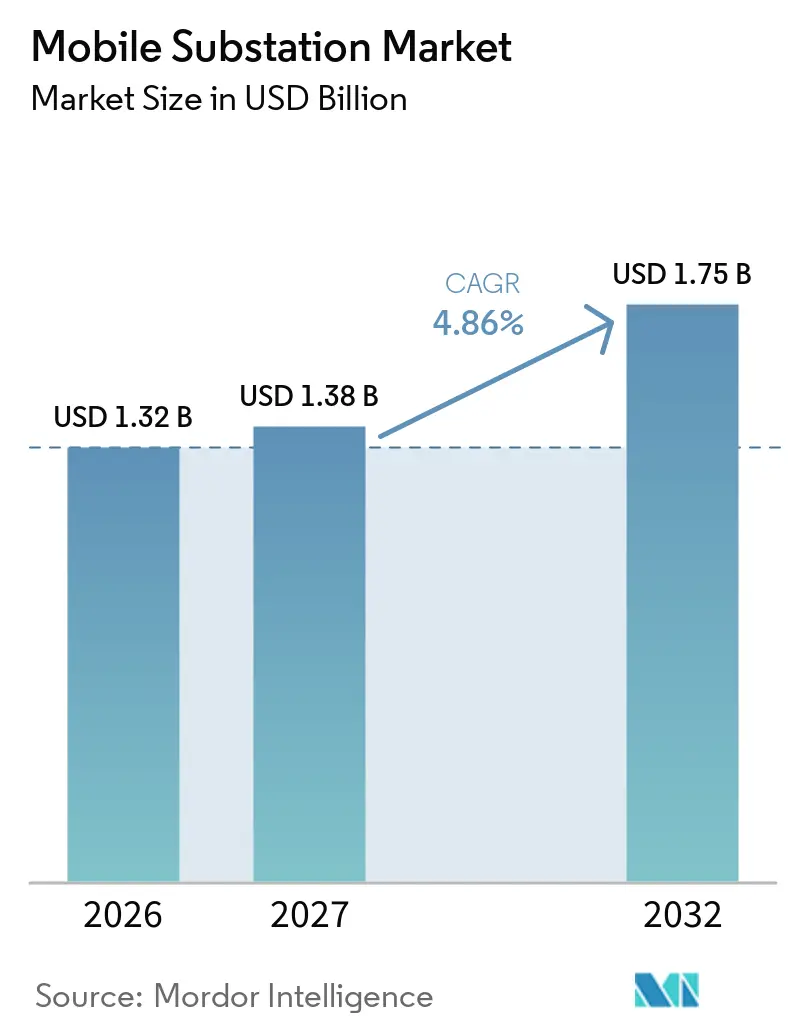
The Mobile Substation Market size was valued at USD 1.32 billion in 2026 and is estimated to grow from USD 1.38 billion in 2027 to reach USD 1.75 billion by 2032, at a CAGR of 4.86% during the forecast period (2027-2032). The mobile substation market is moving from a contingency purchase toward a planned grid-resilience asset as utilities seek faster restoration and controlled maintenance outages. Demand also extends beyond utilities because renewable projects, mines, manufacturers, and data centers need temporary capacity while permanent connections are developed. Aging networks, longer transformer replacement cycles, and more frequent weather-related disruptions make pre-positioned equipment more valuable to operators. Suppliers are responding with higher-capacity, modular, and SF6-free designs, while service agreements help some buyers avoid a large upfront purchase. Cost, transport planning, and differing local grid requirements remain important constraints, especially where capital budgets and heavy-haul infrastructure are limited.
Key Report Takeaways
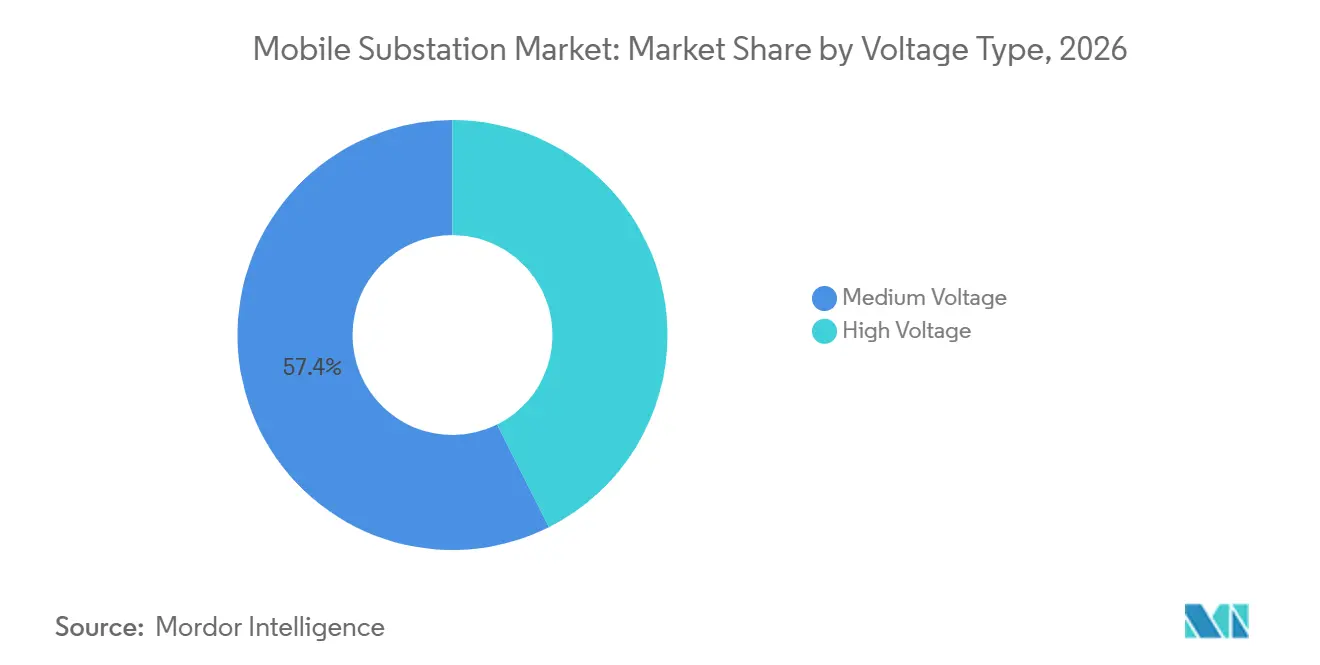
- By voltage type, medium voltage systems held 57.4% of the mobile substation market share in 2026, while high voltage systems are forecast to grow at a 5.7% CAGR through 2032.
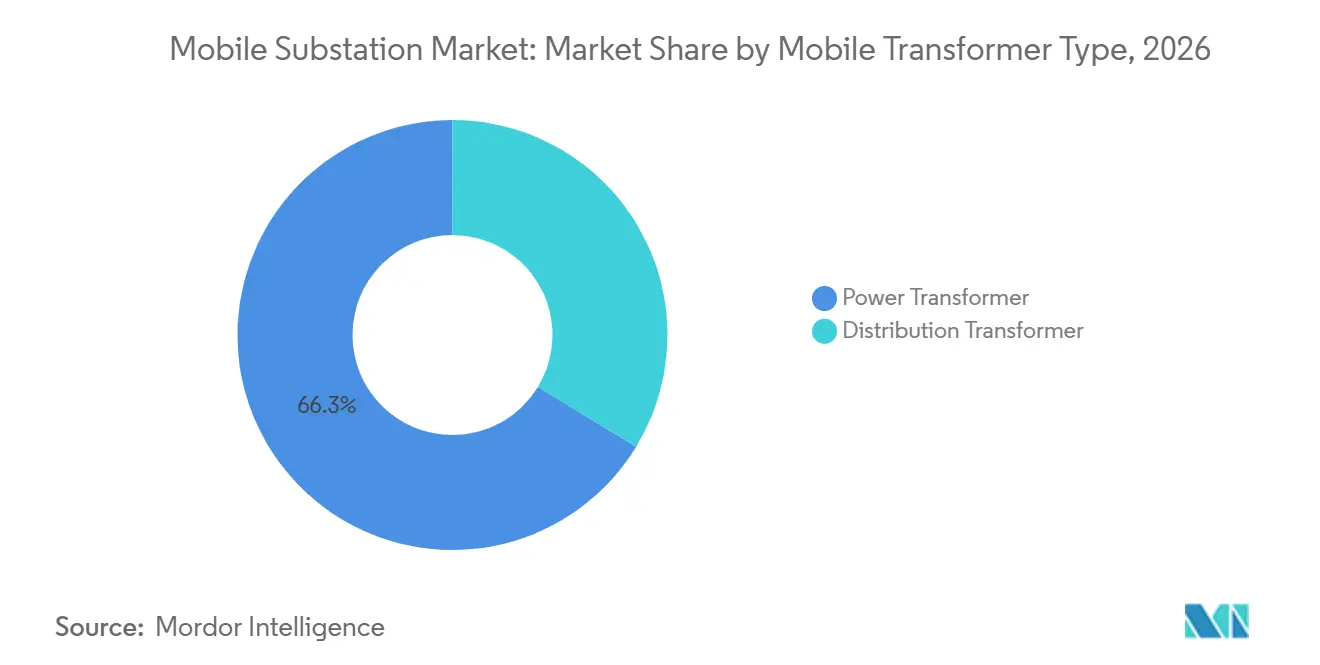
- By mobile transformer type, power transformers held 66.3% revenue share in 2026 and are forecast to grow at a 5.1% CAGR through 2032.
- By power rating, the 25 megavolt-ampere (MVA)-100 MVA range accounted for 39.1% of the mobile substation market share in 2026, while the above 100 MVA range is forecast to grow at a 6.3% CAGR through 2032.
- By application, utility grid operations held 43.7% revenue share in 2026, while data centers are forecast to grow at a 7.4% CAGR through 2032.
- By geography, Asia-Pacific held a 35.8% revenue share in 2026 and is forecast to grow at a 5.6% CAGR through 2032.
Note: Market numbers in this report are based on Mordor Intelligence's proprietary estimation framework, which combines nine months of actuals with Q4 projections for base year 2026.
Market Trends and Insights
Drivers Impact Analysis of Mobile Substation Market*
| Driver | (~) % Impact on CAGR Forecast | Geographic Relevance | Impact Timeline |
|---|---|---|---|
| Rapid Grid Restoration and Resilience Investment | +1.3% | Global, led by North America, Europe, and Asia-Pacific core markets | Medium term (2-4 years) |
| Aging Transmission and Distribution Infrastructure | +1.1% | North America and Europe primarily, with spillover to Asia-Pacific | Long term (≥ 4 years) |
| Renewable-Energy Connection and Grid Expansion | +0.9% | Global, with high intensity in the European Union, China, India, and the Middle East and North Africa | Medium term (2-4 years) |
| Utility Fleet Standardization and Shared-Asset Models | +0.5% | North America and Western Europe | Medium term (2-4 years) |
| High-Voltage Deployment in Remote and Constrained Corridors | +0.4% | Asia-Pacific mining corridors, the Middle East and Africa, and South America | Long term (≥ 4 years) |
| Rapid Deployment for Planned Maintenance and Emergency Outages | +0.7% | Global | Short term (≤ 2 years) |
| Source: Mordor Intelligence | |||
Rapid Grid Restoration and Resilience Investment
Utilities are treating restoration speed as an operating requirement, which supports investment in equipment that can be positioned before a failure occurs. The mobile substation market benefits because a prepared fleet can protect critical transmission and distribution nodes during severe weather or equipment failure. Elering awarded Hitachi Energy a EUR 9.1 million contract in June 2025 for 110 kV mobile substations, linking the purchase to crisis resilience and planned maintenance.[1] The mobile substation market also gains when higher replacement costs make avoiding long outages financially important for utilities and their customers. These assets allow network operators to move from reactive sourcing toward a more deliberate resilience plan.
Aging Transmission and Distribution Infrastructure
Aging equipment creates demand for temporary capacity while utilities replace or refurbish substations without taking customers offline. The mobile substation market is supported by the size of the network renewal task, which requires new lines as well as replacement of existing assets. The International Energy Agency states that advanced economies need 1.8 million km of new transmission lines and 970,000 km of replacements by 2040.[2] Mobile systems can maintain service during the handover between old and new equipment, reducing the operational risk of maintenance programs. The role becomes more important when conventional transformers lead times prevent utilities from relying only on permanent replacements.
Renewable-Energy Connection and Grid Expansion
Renewable developers need grid capacity at times when permanent interconnection facilities are still being permitted, designed, or built. The mobile substation market therefore serves as a bridge between project completion and permanent energization. The International Council on Large Electric Systems (CIGRE) identifies temporary mobile substations as a solution for connecting new loads and generation while permanent grid infrastructure is developed.[3] SSEN Transmission ordered 15 modular substation modules for more than 1 GW of renewable generation under agreements with Hitachi Energy and GE Vernova in 2026.[4] This procurement model places flexible equipment inside longer-term network plans rather than limiting it to emergency use.
Rapid Deployment and Temporary Power Supply During Planned Maintenance and Emergency Outages
Planned maintenance is becoming a recurring source of demand because utilities increasingly schedule load transfers before asset conditions deteriorate. The mobile substation market helps maintain continuity when a circuit, transformer, or substation requires work. The US Department of Energy states that mobile substations can be deployed within 12 to 24 hours and can support planned outages, temporary capacity expansion, and forced-outage repairs. Repeated use during maintenance changes the economics of fleet ownership because one asset can serve several assignments during its operating life. This practical use case also strengthens demand from organizations where an outage can interrupt industrial operations or essential public services.
Restraints Impact Analysis of Mobile Substation Market*
| Restraint | (~) % Impact on CAGR Forecast | Geographic Relevance | Impact Timeline |
|---|---|---|---|
| High Capital, Transport, and Deployment Costs | -0.5% | Global, most acute in emerging markets and island nations | Short term (≤ 2 years) |
| Grid-Compatibility and Regulatory Complexity | -0.3% | Multi-jurisdiction deployments, European Union cross-border and Asia-Pacific fragmented standards | Medium term (2-4 years) |
| Specialized Component and Skilled-Labor Bottlenecks | -0.2% | Global, with highest severity in Asia-Pacific and the Middle East and Africa | Medium term (2-4 years) |
| Road-Route, Weight, and Site-Access Constraints for High-Voltage Units | -0.2% | Remote and constrained corridors, with high impact in mountainous and island markets | Long term (≥ 4 years) |
| Source: Mordor Intelligence | |||
High Capital, Transport, and Deployment Costs
The purchase cost of a mobile substation can be three to four times the cost of an equivalent temporary transformer arrangement. High-voltage units also require specialized trailers, route surveys, permits, storage, testing, and periodic recertification. These expenses can place ownership beyond the maintenance budgets of utilities in capital-constrained markets. Siemens Energy used a mobile-substation-as-a-service arrangement for Grupo Fertinal in Mexico, showing how a service contract can shift spending from capital acquisition to operating expenditure. However, this model depends on local service capabilities, which are not available in every location.
Grid-Compatibility and Regulatory Complexity
A unit designed for one voltage level, protection approach, or earthing arrangement may need changes before it can serve another jurisdiction. These changes can reduce the advantages that rapid deployment provides and can make standardized fleet strategies harder to execute. The IEEE guide for mobile high-voltage gas-insulated substations provides a common technical reference, but adoption and local procurement specifications can differ. Transport rules, site access, vibration limits, and protection settings add work before a unit can be dispatched. The mobile substation market can therefore favor suppliers with local engineering expertise and experience meeting national standards.
*Our forecasts treat driver/restraint impacts as directional, not additive. The impact forecasts reflect baseline growth, mix effects, and variable interactions.
Mobile Substation Market Segment Analysis
By Voltage Type:
High Voltage Units Gain Ground as Grid Scale RisesMedium voltage systems held 57.4% of the mobile substation market share in 2026 because distribution networks contain many more substations than transmission networks. Trailer-mounted medium voltage systems are easier to transport and generally require fewer exceptional permits than larger systems. They serve industrial sites, infrastructure projects, emergency distribution restoration, and planned maintenance work. Their broad set of uses can produce high utilization and recurring orders for fleet operators. Medium voltage demand also benefits from urban load growth and from replacement work at the distribution level.
High voltage systems are forecast to grow at a 5.7% CAGR through 2032 as transmission operators protect high-value nodes and large connected loads. The mobile substation market size for high voltage equipment rises as applications require greater voltage, power, and operating flexibility. Compact mobile designs can support high-voltage duties, although transport clearance, vibration resistance, and site preparation requirements increase engineering complexity. Hitachi Energy offers its Grid-eXpand mobile platform at ratings up to 420 kV and 500 MVA. Toshiba India and POWERGRID launched India’s first indigenous 220 kV mobile Gas Insulated Switchgear (GIS) system in 2025, showing how national partnerships are extending high-voltage capability.

By Mobile Transformer Type:
Power Transformers Anchor Demand, Service Models Add ValuePower transformers held 66.3% of revenue in 2026 because they perform the essential voltage conversion required across transmission and sub-transmission applications. The mobile substation market relies on this configuration for step-up and step-down duties during planned work, failure recovery, and temporary capacity needs. Power transformers serve large mining sites, data center connections, and energy projects where electrical continuity has a direct operating value. Distribution transformers hold a smaller share but remain relevant where urban development raises local load density. Buyers can use mobile distribution systems when conventional pad-mounted replacements cannot arrive quickly enough.
Power transformers are forecast to grow at a 5.1% CAGR through 2032, supported by demand for larger and more flexible mobile fleets. Long lead times for conventional high-voltage transformers encourage utilities to retain mobile units as a supply-chain safeguard. This approach can protect operations when a permanent unit fails or requires refurbishment. Hitachi Energy’s managed-service arrangement with Avangrid includes storage of a mobile transformer for dispatch following a failure notification, extending the value of the asset beyond initial sale. The mobile substation industry also gains from service models that place maintenance, readiness, and logistics with an experienced provider.
By Power Rating:
Above 100 MVA Segment Reshapes Market EconomicsThe 25 MVA-100 MVA range commanded 39.1% of revenue in 2026 because it covers common distribution and industrial requirements. Units in this range can support aging distribution substations and many commercial applications without the full transport burden of the largest systems. The mobile substation market is supported by these systems because their capacity and mobility fit the operational needs of a large installed base. Standard road dimensions and axle-weight limits can simplify movement in many jurisdictions. The category also supports a practical balance between emergency response and planned asset replacement.
The above 100 MVA range is forecast to expand at a 6.3% CAGR through 2032 as data centers and large mining operations require greater temporary capacity. Higher ratings create difficult design and logistics requirements because equipment weight can exceed normal road limits. Research from TU Delft describes the use of multiple single-phase transformers to meet high-capacity needs within transport limits. TGOOD energized 15 units of 132 kV mobile substations in Saudi Arabia within 6 months, demonstrating deployment at a demanding scale and operating environment. These projects support a higher-value segment where engineering capability and logistics execution are important competitive factors.
By Application:
Data Centers Change the Utility-Led Demand ProfileUtility grid operations accounted for 43.7% of revenue in 2026 and remain the largest application because grid operators need equipment for reliability and maintenance programs. The mobile substation market has a durable utility base because extended outages can trigger regulatory, financial, and public-service consequences. Fleet-based procurement gives utilities a way to keep standby equipment available across several locations. Industrial facilities, oil and gas sites, mines, and infrastructure projects form a secondary demand base. These users may favor owned or contracted equipment when utility-owned spare capacity cannot meet their required response time.
Data centers are forecast to grow at a 7.4% CAGR through 2032, the highest rate across applications. Grid interconnection delays can leave completed facilities waiting for permanent electrical infrastructure. Modular and prefabricated equipment allows some electrical work to proceed in parallel with construction of the data facility. TGOOD delivered a prefabricated substation for an AI-computing application in Qingdao during 2026, reflecting the demand for solutions tailored to high-density computing loads. The mobile substation industry is therefore responding to a group of buyers that need both high capacity and short deployment schedules.
Geography Analysis
APAC Mobile Substation Market
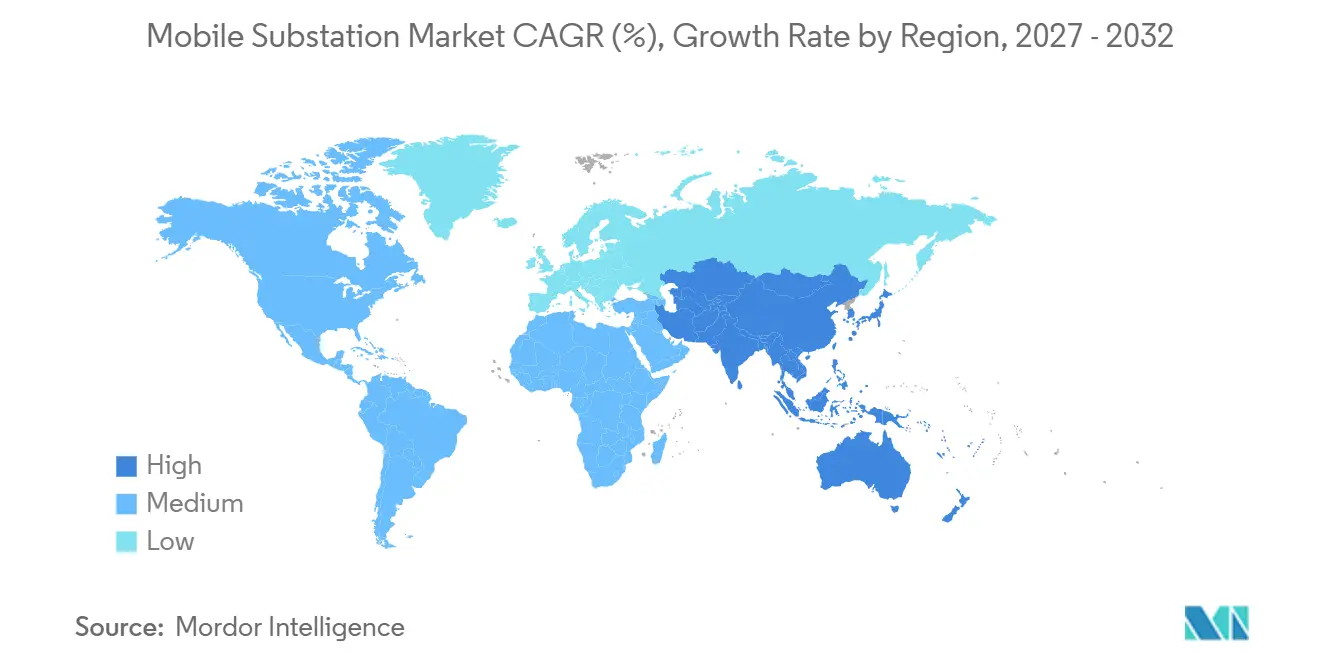
Asia-Pacific held 35.8% of the mobile substation market share in 2026 and is forecast to grow at a 5.6% CAGR through 2032. China, India, and Southeast Asian markets combine grid modernization, industrial expansion, and a need for stronger resilience against service interruptions. State Grid Kashgar used a mobile substation to maintain supply during a live 35 kV line renovation in Xinjiang in October 2025. A 50 MVA prefabricated unit in Henan was commissioned in 10 days during 2025, illustrating the value of faster deployment for industrial development. POWERGRID and Toshiba also introduced India’s first indigenous 220 kV mobile Gas Insulated Switchgear (GIS) system, indicating growing local technical capability.
North America and Europe Mobile Substation Market
North America is the second-largest regional market because of aging infrastructure, severe weather, and resilience funding create several demand channels. Mobile fleets can support planned replacement work and faster restoration following extreme weather events. The US Department of Energy recognizes mobile substations as a tool for rapid restoration and temporary capacity needs. In Europe, renewable targets and transmission reconfiguration are increasing the need for modular equipment during grid work. SSEN Transmission’s 2026 framework orders show how European transmission operators are using modular units to support more than 1 GW of renewable generation.
South America and MEA Mobile Substation Market
South America and the Middle East and Africa have earlier-stage demand, although mining, grid expansion, and emergency restoration create focused opportunities. Hitachi Energy delivered Chile’s first digital high-voltage mobile substation in May 2026 for a mining customer. TGOOD completed a 15-unit, 132 kV fleet for Saudi National Grid in 2025 under difficult heat and desert conditions. Dubai Electricity and Water Authority (DEWA) reports AED 7.6 billion in electricity transmission investments and 49 additional 132 kV substations under construction, which expands the need for flexible bridging capacity during buildout. Nigeria’s Pilot Power Initiative also used mobile substations to add capacity, and support restoration needs.
Competitive Landscape
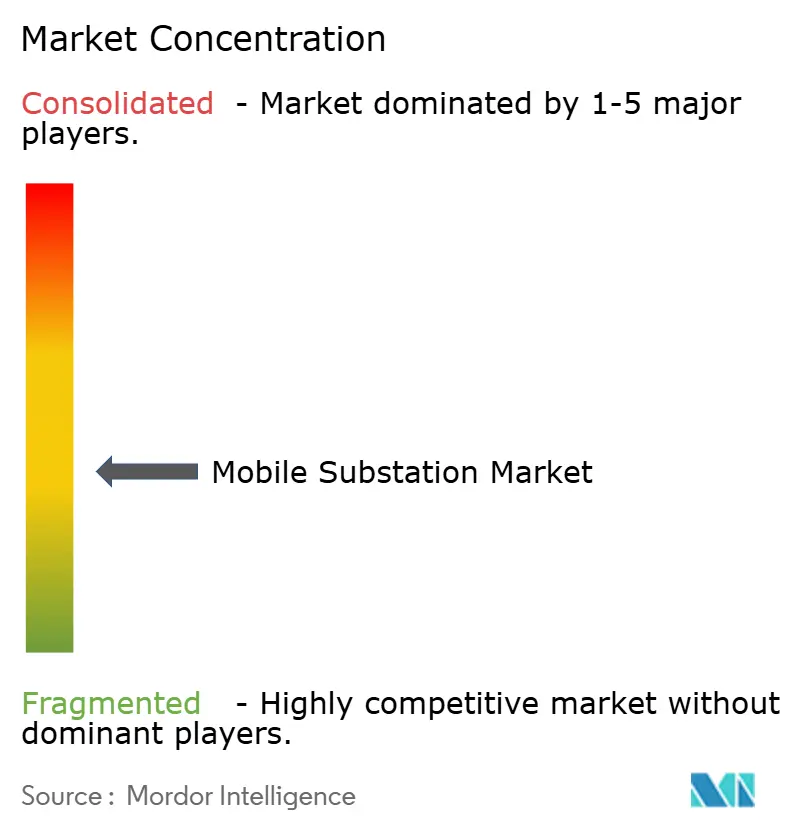
The mobile substation market is moderately consolidated in high-voltage and large-capacity equipment, where proven engineering, service coverage, and compliance experience matter. Hitachi Energy, GE Vernova, Siemens Energy, ABB, and Eaton compete through advanced grid equipment, service agreements, and lower-emission technology. TGOOD Global, Delta Star, Matelec, CG Power, Aktif Elektroteknik, and Efacec compete across medium-voltage and lower-power applications where delivery speed and price can carry more weight. High-voltage work favors suppliers that can meet demanding transport, protection, and commissioning requirements. Buyers also value vendors that can support units throughout storage, testing, dispatch, and return to service.
Suppliers are widening their offers beyond equipment sales as utilities and industrial buyers seek predictable access to reserve capacity. Siemens Energy’s agreement with Grupo Fertinal demonstrates a service approach that can reduce the need for a buyer to own every standby asset. Eaton and Siemens Energy formed a 2025 partnership to provide integrated on-site power and modular substation solutions for data center clients. Hitachi Energy is differentiating through sulfur hexafluoride (SF6)-free equipment, including a planned delivery of the first SF6-free 550 kV Gas-Insulated Switchgear (GIS) for China’s State Grid. These actions show that technology, delivery readiness, and service capability are increasingly connected in supplier strategies.
GE Vernova received contracts in 2026 to deliver SF6-free 110 kV GIS substations for Stromnetz Berlin, reinforcing the shift toward lower-emission grid equipment. TGOOD was prequalified by Saudi Electricity Company as a manufacturer of 380 kV prefabricated substations, strengthening its position in a higher-voltage segment. SSEN Transmission’s framework awards to Hitachi Energy and GE Vernova illustrate the importance of multi-year utility agreements.
Mobile Substation Industry Leaders
-
Siemens Energy AG
-
ABB Ltd.
-
Eaton Corporation plc
-
General Electric Company
-
CG Power and Industrial Solutions Limited
- *Disclaimer: Major Players sorted in no particular order
Mobile Substation Market Companies Covered in this Report
- ABB Ltd.
- Aktif Elektroteknik A.S.
- Ampcontrol Pty Ltd.
- Atlas Electric, Inc.
- AZZ Inc.
- CG Power and Industrial Solutions Limited
- Delta Star, Inc.
- Eaton Corporation plc
- Efacec Power Solutions SGPS, S.A.
- EKOSinerji
- Elgin Power Solutions
- General Electric Company
- Hitachi Energy Ltd.
- Matelec Group
- Meidensha Corporation
- Nari Group Corporation
- PME Power Solutions
- Powell Industries, Inc.
- Siemens Energy AG
- TGOOD Global Ltd.
- Unit Electrical Engineering Ltd.
- WEG Industries
Recent Industry Developments in Mobile Substation Market
- August 2026: SSEN Transmission placed orders for 15 modular substation modules representing over 1 GW of renewable generation capacity, under framework agreements awarded to Hitachi Energy and GE Vernova following a year-long competitive tender. Additional orders are expected through 2027.
- July 2026: GE Vernova was awarded 2 contracts by Stromnetz Berlin to design, deliver, and install 2 new 110 kV SF6-free Gas Insulated Substation (GIS) substations in Wittenau and Neukölln, supporting Berlin’s high-voltage network modernization. The Wittenau project spans June 2026 to March 2031. Neukölln spans June 2026 to January 2032.
- June 2026: TGOOD independently delivered and energized a 150 kV prefabricated substation for BYD’s Subang industrial park in West Java, Indonesia, a full turnkey project covering design, manufacturing, transportation, and commissioning, supporting BYD’s local vehicle manufacturing expansion.
- March 2026: Hitachi Energy delivered Chile’s first digital high-voltage (HV) mobile substation, a 69 kV, 25/33 MVA Grid-eXpand unit, for a global mining company, completing over 5,000 project man-hours with zero safety incidents.
Global Mobile Substation Market Report Scope
A mobile substation is a fully self-contained, trailer-mounted, or skid-mounted electrical facility designed to perform the voltage transformation, switching, and protection functions of a conventional permanent substation.
The global mobile substation market is segmented by voltage type, mobile transformer type, power rating, application, and geography. By voltage type, the market is segmented into high-voltage and medium-voltage mobile substations. By mobile transformer type, the market is segmented into power transformers and distribution transformers. By power rating, the market is segmented into up to 10 MVA, 11–25 MVA, 25–100 MVA, and above 100 MVA. By application, the market is segmented into utility grid operations, industrial facilities, infrastructure projects, oil and gas facilities, mining and metals, renewable energy projects, data centers, emergency power restoration, and other applications. The report also covers the market size and forecasts for the global mobile substation market across 26 countries in key regions. For each segment, the market sizing and forecasts have been provided on the basis of value (USD).
Segmentation Overview
| High Voltage |
| Medium Voltage |
| Power Transformer |
| Distribution Transformer |
| Up to 10 MVA |
| 11 MVA-25 MVA |
| 25 MVA-100 MVA |
| Above 100 MVA |
| Utility Grid Operations |
| Industrial Facilities |
| Infrastructure Projects |
| Oil and Gas Facilities |
| Mining and Metals |
| Renewable Energy Projects |
| Data Centers |
| Emergency Power Restoration |
| Other Applications |
| North America | United States |
| Canada | |
| Mexico | |
| Europe | Germany |
| France | |
| Italy | |
| Spain | |
| United Kingdom | |
| Poland | |
| Russia | |
| Rest of Europe | |
| Asia-Pacific | China |
| India | |
| Japan | |
| South Korea | |
| Australia | |
| Indonesia | |
| Vietnam | |
| Thailand | |
| Rest of Asia-Pacific | |
| South America | Brazil |
| Argentina | |
| Chile | |
| Rest of South America | |
| Middle East and Africa | Saudi Arabia |
| United Arab Emirates | |
| Egypt | |
| South Africa | |
| Morocco | |
| Rest of Middle East and Africa |
| By Voltage Type | High Voltage | |
| Medium Voltage | ||
| By Mobile Transformer Type | Power Transformer | |
| Distribution Transformer | ||
| By Power Rating | Up to 10 MVA | |
| 11 MVA-25 MVA | ||
| 25 MVA-100 MVA | ||
| Above 100 MVA | ||
| By Application | Utility Grid Operations | |
| Industrial Facilities | ||
| Infrastructure Projects | ||
| Oil and Gas Facilities | ||
| Mining and Metals | ||
| Renewable Energy Projects | ||
| Data Centers | ||
| Emergency Power Restoration | ||
| Other Applications | ||
| By Geography | North America | United States |
| Canada | ||
| Mexico | ||
| Europe | Germany | |
| France | ||
| Italy | ||
| Spain | ||
| United Kingdom | ||
| Poland | ||
| Russia | ||
| Rest of Europe | ||
| Asia-Pacific | China | |
| India | ||
| Japan | ||
| South Korea | ||
| Australia | ||
| Indonesia | ||
| Vietnam | ||
| Thailand | ||
| Rest of Asia-Pacific | ||
| South America | Brazil | |
| Argentina | ||
| Chile | ||
| Rest of South America | ||
| Middle East and Africa | Saudi Arabia | |
| United Arab Emirates | ||
| Egypt | ||
| South Africa | ||
| Morocco | ||
| Rest of Middle East and Africa | ||
Key Questions Answered in the Report
What is the expected growth rate for mobile substations through 2032?
The global mobile substation market is forecast to grow at a 4.86% CAGR from 2027 to 2032 and reach USD 1.75 billion by 2032.
Which voltage class has the largest revenue share?
Medium voltage systems hold the largest share at 57.4% in 2026, supported by the breadth of distribution-level uses.
Why are utilities investing in mobile substations?
Utilities use these assets to sustain service during planned maintenance, equipment replacement, and emergency outages. The US Department of Energy states that deployment can occur within 12 to 24 hours.
Which application is growing fastest?
Data centers are the fastest-growing application, with a forecast CAGR of 7.4% through 2032, as permanent grid connections can take longer than facility construction.
Which region leads demand?
Asia-Pacific leads with 35.8% revenue share in 2026 and is expected to grow at a 5.6% CAGR through 2032.
What limits wider adoption of mobile substations?
High purchase and transport costs, different grid standards, limited specialist skills, and access constraints can limit deployment, particularly for high-voltage equipment.