
Market Overview
| Study Period | 2020 - 2031 |
|---|---|
| Market Size (2026) | USD 148.92 Billion |
| Market Size (2031) | USD 241.66 Billion |
| Growth Rate (2026 - 2031) | 10.17 % |
| Fastest Growing Market | Asia Pacific |
| Largest Market | Asia Pacific |
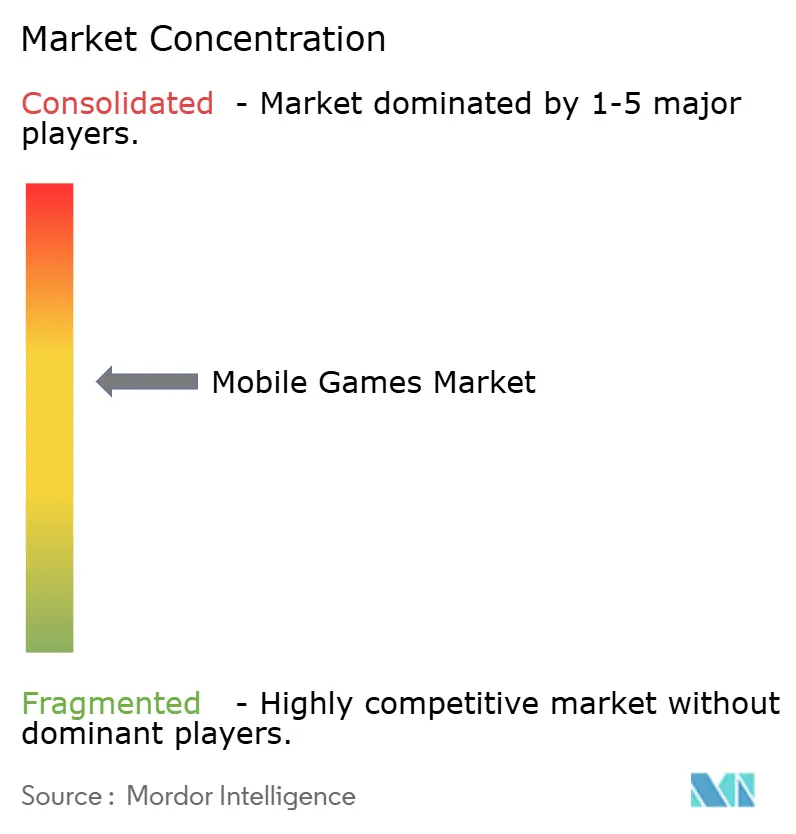
| Market Concentration | Medium |
Major Players *Disclaimer: Major Players sorted in no particular order Image © Mordor Intelligence. Reuse requires attribution under CC BY 4.0. | |
Mobile Games Market Analysis by Mordor Intelligence
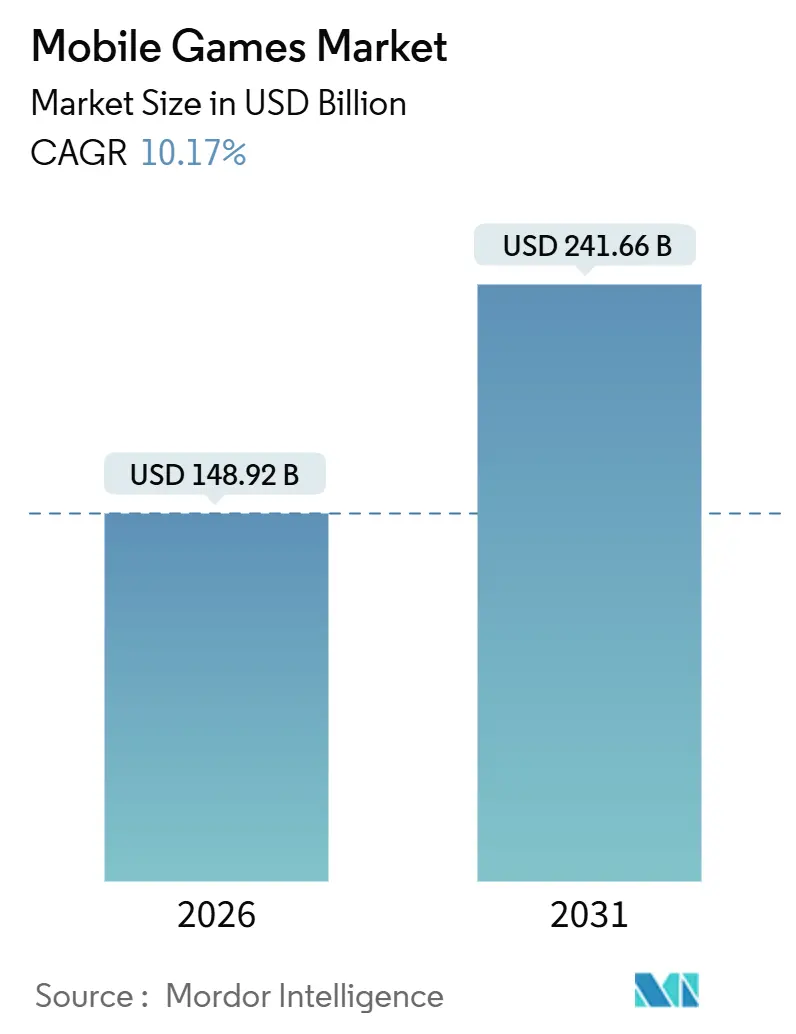
The mobile games market size stood at USD 148.92 billion in 2026 and is projected to reach USD 241.66 billion by 2031, recording a 10.17% CAGR. Expanding 5G coverage is lowering latency below 20 milliseconds, which is unlocking real-time multiplayer play and converting casual smartphone owners into committed gamers. Telco-bundled cloud libraries are widening paid access in emerging economies, while generative artificial intelligence is compressing live-ops production cycles and lifting 30-day retention rates above historical norms. Subscription passes and hybrid monetization are diluting single-purchase dependency, and foldable handsets are redefining premium on-the-go experiences. Competitive intensity remains high as mid-tier studios use AI automation to match update cadences previously reserved for the largest publishers.
Key Report Takeaways
- By monetization type, in-app purchases led with 55.13% of the mobile games market share in 2025, while subscriptions and season passes are forecast to advance at an 18.42% CAGR to 2031.
- By platform, Android held 71.32% revenue share in 2025, whereas cloud streaming and progressive web apps are expanding at a 40.21% CAGR through 2031.
- By device, smartphones accounted for 83.67% of the mobile games market size in 2025 and foldables are set to grow at a 27.56% CAGR between 2026-2031.
- By genre, casual and hyper-casual titles commanded 29.32% of the mobile games market size in 2025, while strategy and MOBA games are on track for a 15.71% CAGR to 2031.
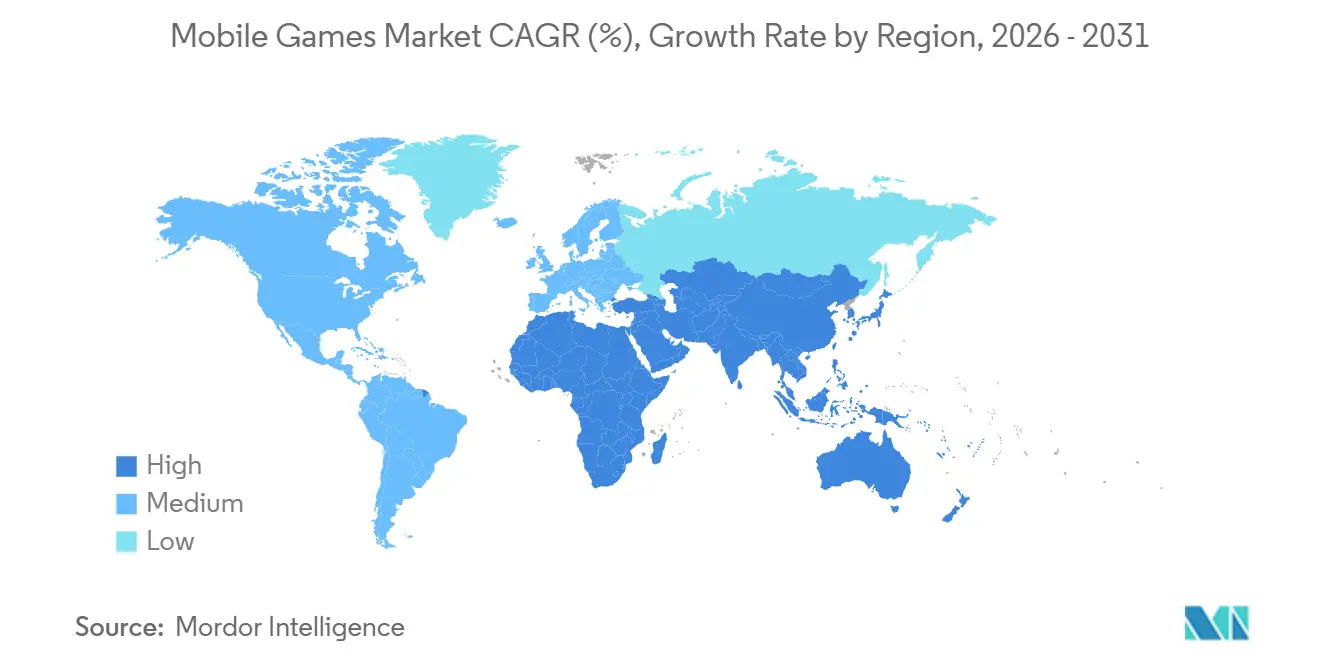
- By geography, Asia Pacific led with 49.23% revenue share in 2025, whereas Africa is positioned for the fastest 12.51% CAGR through 2031.
Note: Market size and forecast figures in this report are generated using Mordor Intelligence’s proprietary estimation framework, updated with the latest available data and insights as of January 2026.
Market Trends and Insights
Drivers Impact Analysis of Mobile Games Market*
| Driver | (~) % Impact on CAGR Forecast | Geographic Relevance | Impact Timeline |
|---|---|---|---|
| 5G Roll-outs Lowering Latency | +2.1% | Global, with early gains in South Korea, China, United States | Medium term (2-4 years) |
| Contextual-First Advertising Revenues Post-IDFA | +1.8% | North America and Europe, spill-over to Asia Pacific | Short term (≤ 2 years) |
| Telco-Led Cloud Gaming Bundles Stimulating ARPDAU | +2.3% | Asia Pacific core, expanding to Middle East and Africa | Medium term (2-4 years) |
| Gen-Z Preference for Hyper-Casual Gameplay | +1.5% | Global, with concentration in North America, Europe, Asia Pacific | Long term (≥ 4 years) |
| AI-Generated Live-Ops Content Boosting Retention | +1.9% | Global, led by North America and Asia Pacific studios | Short term (≤ 2 years) |
| Cross-Platform Progression Increasing LTV | +1.6% | North America and Europe, expanding to Asia Pacific | Medium term (2-4 years) |
| Source: Mordor Intelligence | |||
5G Roll-Outs Lowering Latency
Standalone 5G cores separate control and user planes, driving sub-20 millisecond ping that rivals wired consoles.[1] In 2025, global 5G subscriptions passed 1.9 billion, and operators in South Korea and China began selling gaming-grade network slices to premium subscribers. Smartphone chipsets such as Snapdragon Elite Gaming exploit this bandwidth, ensuring stable 120 frame-per-second play. As a result, esports-ready titles that once required a PC now launch simultaneously on mobile, broadening the mobile games market to competitive segments. Publishers consequently unlock sponsorship and event revenues that were formerly confined to console ecosystems.
Telco-Led Cloud Gaming Bundles Stimulating ARPDAU
Operators including Reliance Jio and Vodafone add curated game libraries to data plans, pushing cloud libraries to more than 50 million monthly active users in India alone. These bundles remove multi-gigabyte downloads, sidestep app-store commissions, and raise average revenue per daily active user by 22%. Ericsson ConsumerLab showed that 40% of cloud gamers in Southeast Asia rely solely on operator portals. For publishers, the model extends the mobile games market into price-sensitive audiences, while telcos monetize fixed assets more efficiently. As the approach spreads across Middle East and Africa, incremental ARPDAU uplift is expected to compound revenue growth.
AI-Generated Live-Ops Content Boosting Retention
Large language models fine-tuned for game design now create quests, seasonal challenges, and dialogue in days rather than weeks. Unity’s 2025 survey reported a 40% cut in live-ops production time and an 8-12-percentage-point lift in 30-day retention after AI adoption. The lowered content cadence barrier allows mid-tier studios to rival top publishers, intensifying competition and supporting steady expansion of the mobile games market. For free-to-play titles, each retention-point gain expands lifetime value by roughly one-quarter, reinforcing investment in automated pipelines.
Contextual-First Advertising Revenues Post-IDFA
Apple’s privacy framework removed device-level identifiers for most iOS users, spiking performance-marketing costs. Publishers pivoted to in-game behavioral signals, rewarded videos, and playable ads, which now convert 30% better than traditional interstitials. Google’s Privacy Sandbox for Android follows a similar path, standardizing on-device ad matching. Contextual approaches reduce reliance on giant acquisition budgets and have widened access for smaller studios, diversifying the mobile games market even as effective CPM rates edge lower.
Restraints Impact Analysis of Mobile Games Market*
| Restraint | (~) % Impact on CAGR Forecast | Geographic Relevance | Impact Timeline |
|---|---|---|---|
| Country-Level Loot-Box Regulations Dampening IAP | -1.4% | Europe (Belgium, Netherlands), expanding to United Kingdom, Australia | Medium term (2-4 years) |
| Rising User Acquisition CPI on iOS | -1.6% | North America and Europe, moderate impact in Asia Pacific | Short term (≤ 2 years) |
| App-Store Tax Policy Uncertainty | -0.9% | Global, with acute impact in United States, European Union | Long term (≥ 4 years) |
| High 5G Device Battery Drain Limiting Session Length | -0.7% | Global, concentrated in markets with high 5G penetration | Medium term (2-4 years) |
| Source: Mordor Intelligence | |||
Country-Level Loot-Box Regulations Dampening IAP
Belgium and the Netherlands classify loot boxes as gambling, prompting publishers to strip random-reward mechanics or exit those storefronts. The United Kingdom and Australia are drafting similar controls that could widen compliance costs. Electronic Arts removed paid packs from its flagship sports titles in the affected markets, losing 12% ARPU in the first year. The clampdown accelerates shifts toward battle passes and cosmetic microtransactions, yet near-term friction trims the mobile games market growth by 1.4 percentage points within the forecast window.
Rising User Acquisition CPI on iOS
App Tracking Transparency lifted average North American mid-core CPI to USD 3.80, 45% above 2023 benchmarks, while Android held near USD 2.10. Despite higher iOS lifetime value, budget reallocation toward Android and influencer channels signals a permanent shift. AppLovin logged an 18% retreat in iOS ad volumes during 2025, illustrating the squeeze. Heightened acquisition expense slows portfolio expansion and drags on the overall mobile games market CAGR until alternative targeting methods fully mature.
*Our forecasts treat driver/restraint impacts as directional, not additive. The impact forecasts reflect baseline growth, mix effects, and variable interactions.
Mobile Games Market Segment Analysis
By Monetization Type:
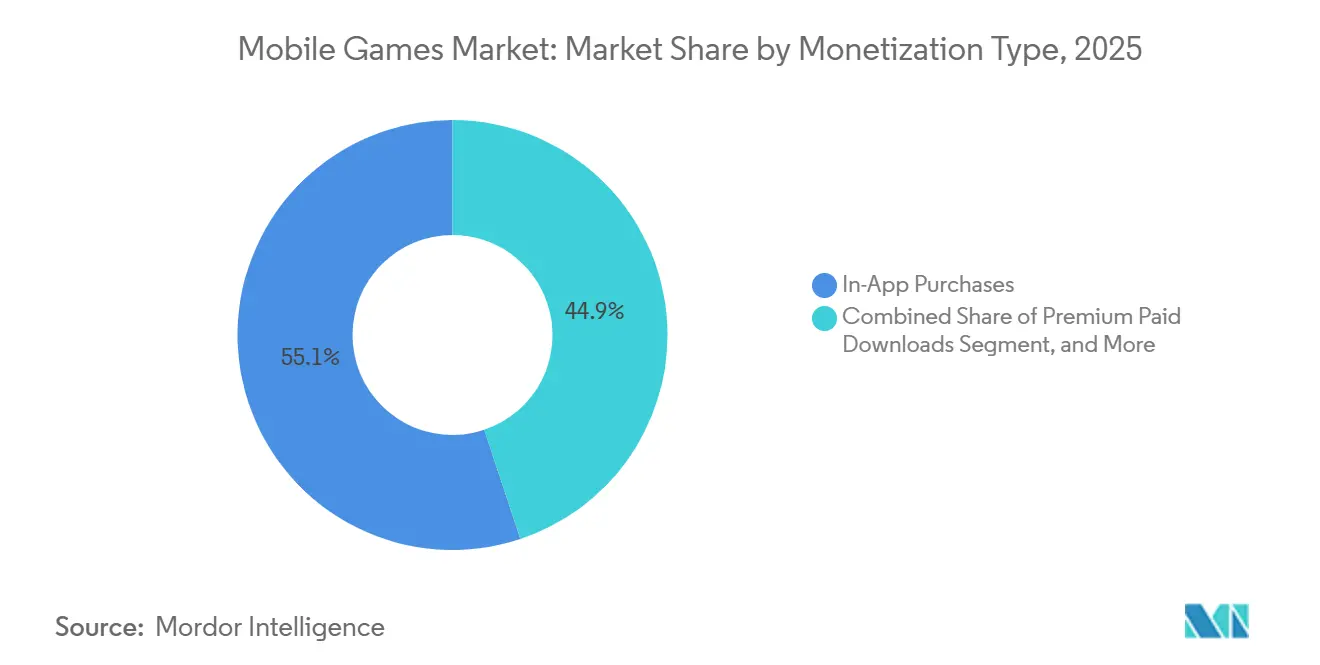
Subscriptions Reshape Revenue MixIn 2025, in-app purchases generated 55.13% of mobile games market revenue, but subscriptions and season passes are pacing for the highest 18.42% CAGR through 2031. The pivot responds to player fatigue with unpredictable spending and to growing scrutiny over random rewards. Publishers such as Epic Games now bundle cosmetics, in-game currency, and premium events into monthly passes that secure recurring cash flow. Hybrid models that layer optional purchases over a base subscription uplift lifetime value by roughly 40%, creating a powerful lever for revenue diversification within the mobile games market.
The strategic impact extends beyond direct earnings. Predictable subscription income enables steadier content investment and cushions against advertising cyclicality. As regulators tighten loot-box rules, transparent fee structures lower legal exposure. With Gen Z players favoring fixed costs, the momentum behind subscription schemes is likely to accelerate, embedding the model as a core pillar of the mobile games industry by the decade’s close.

By Platform:
Cloud Streaming Disrupts Download DominanceAndroid accounted for 71.32% of 2025 spend, reflecting its ubiquity in high-volume emerging regions. Yet a fast-rising platform class (cloud streaming and progressive web apps) holds less than 2% today and is forecast for a 40.21% CAGR to 2031. Telcos that bundle low-latency libraries into premium data plans are bypassing gatekeeper stores and 30% commissions, a dynamic that reshapes distribution economics and enlarges the mobile games market in previously under-monetized territories.
Microsoft, Nvidia, and Alphabet report that mobile devices now drive more than one-third of total cloud-gaming hours, evidence that the market is ready for download-free access. As mature networks reduce buffering, graphically intensive console titles become playable on handsets, drawing new demographics into premium content. The shift also mitigates storage constraints and long install times that have historically suppressed user conversion.
By Device Type:
Foldables Unlock Premium ExperiencesSmartphones captured 83.67% of revenue in 2025 and remain the workhorse of the mobile games market. Foldable handsets, however, are set for a robust 27.56% CAGR into 2031. Dual-screen modes let players keep controls on the outer display while gameplay unfolds on the interior panel, widening field of view without added peripherals. High-end chipsets provide console-like visuals, and average selling prices above USD 1,200 signal a premium audience receptive to exclusive content drops.
Tablets, holding roughly 14% share, retain appeal for strategy and simulation. Yet improving foldable durability and falling prices suggest that many future tablet gamers will carry a single foldable device instead. Publishers are already crafting adaptive user interfaces that exploit larger unfolded real estate, further reinforcing the segment’s upside.
By Game Genre:
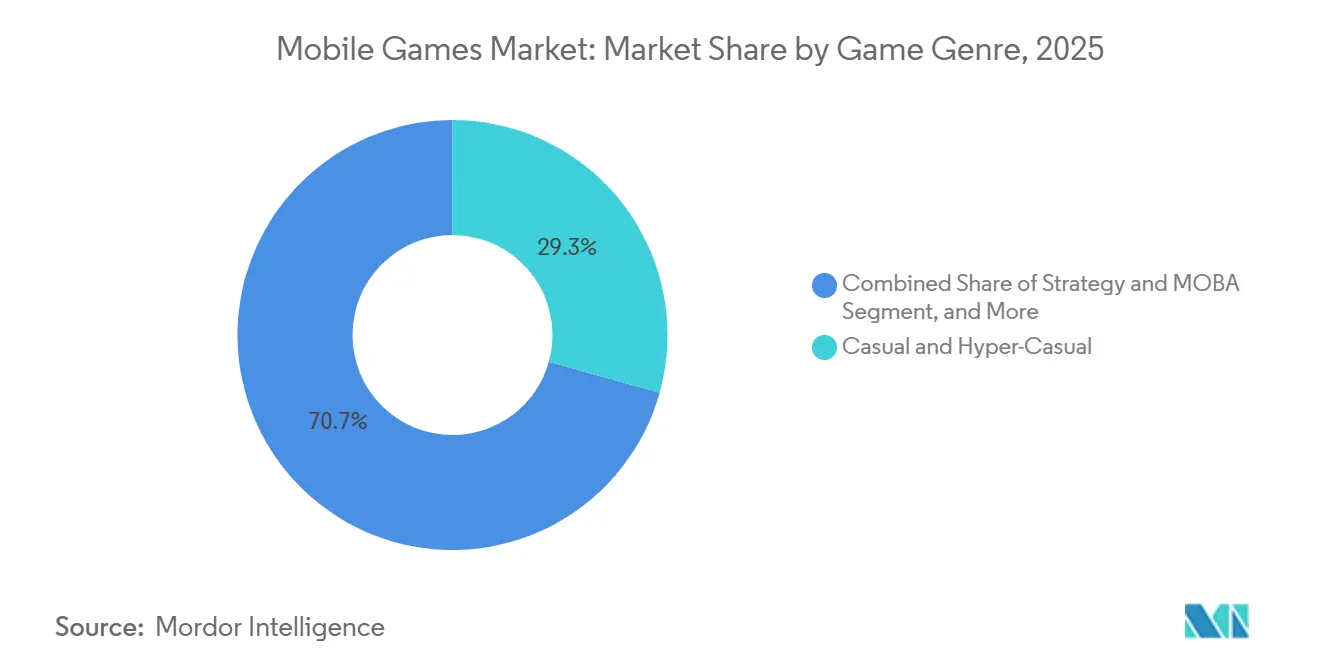
Strategy Titles Capture Esports MomentumCasual and hyper-casual titles led the mobile games market size at 29.32% in 2025 thanks to viral mechanics and ad-supported monetization. Looking forward, strategy and MOBA games are set to post a 15.71% CAGR as tournament prize pools swell and live-streamed events convert viewers to players. Honor of Kings, for example, recorded more than USD 2 billion in 2024 revenue while sustaining daily users above 100 million.[2]
Esports infrastructure lowers acquisition costs by harnessing influencer reach. Meanwhile, casual segments continue generating dependable ad revenue due to their broad base. The genre mix thus balances high-volume, low-spend users with a rising cadre of competitive spenders, enhancing overall resilience in the mobile games market.
By Player Demographic:
Gen Z Drives Engagement MetricsGen Z accounted for 43.63% of 2025 revenue and will expand at a 12.37% CAGR through 2031. Their preference for short, socially integrated play propels hyper-casual and snackable competitive formats, raising daily session frequency by 50% above Millennial averages. Millennials and Gen X sustain higher per-user spend through subscriptions and deeper progression arcs, offering a complementary revenue tier.
Cross-platform progression resonates across age groups by preserving cosmetic investments irrespective of device. Epic Games reports that synchronized inventories reduce churn in multi-device households, cementing loyalty and fortifying the mobile games market against platform migration risk.
Geography Analysis
APAC Mobile Games Market
Asia Pacific produced 49.23% of global revenue in 2025, anchored by China’s resumed game license approvals and India’s explosive smartphone adoption. Chinese regulators cleared more than 1,000 domestic mobile titles in 2024, unlocking pent-up launch pipelines. Meanwhile, India surpassed 450 million gamers, driven by sub-USD 100 handsets and unlimited data bundles at USD 3 per month.[3] Mature spenders in Japan and South Korea lift per-user averages above USD 80, balancing lower-priced mass markets across Southeast Asia.
North America and Europe Mobile Games Market
North America and Europe combined for roughly a 35% share, with the United States remaining the largest single-country contributor. However, divergent European loot-box rules raise compliance burdens, prompting publishers to regionalize monetization mechanics and content. Cloud gaming adoption is high, reflecting households with multiple devices that value seamless migration between console and mobile.
MEA and South America Mobile Games Market
Africa, the fastest-growing region with a 12.51% CAGR, benefits from mobile-money ecosystems that process more than USD 700 billion annually. Carrier billing allows prepaid users to spend within games without bank accounts, broadening the mobile games market beyond traditional financial rails. Middle Eastern youth demographics and sovereign digital-economy investments further amplify regional growth potential, while South America offers resilience through low-cost mobile entertainment demand despite currency volatility.
Regulatory Landscape
The mobile games regulatory environment is tightening around platform governance, consumer protection, and age assurance, with direct effects on monetization and distribution. In the European Union, the Digital Services Act has been fully applicable since February 17, 2024, extending platform-style obligations to covered intermediary services and interactive features common in games (such as chat and user-generated content), while the European Commission continues oversight through its systemic-risk reporting and the VLOP/VLOSE framework.
In other growth markets, gaming- and app-store-focused interventions are also reshaping compliance requirements. India brought the Promotion and Regulation of Online Gaming Rules, 2026 into force on May 1, 2026 under MeitY, adding a structured compliance layer for online gaming, particularly for money-gaming platforms. In the United Kingdom, the CMA-secured commitments from Apple and Google on app store fairness and iOS interoperability took effect on April 1, 2026, and Brazil advanced its sector framework with Law No 14.852/2024, which establishes a legal basis for the electronic games industry and supports state-led age rating mechanisms.
Value Chain Analysis
The mobile games value chain covers (1) creation and production, (2) publishing and live operations, (3) distribution, and (4) monetization and payments. Development depends on engines and toolchains, content creation, QA and localization, and backend services for matchmaking, telemetry, and account management, followed by publishing activities such as UA buying, community management, and continuous live-ops. Performance marketing and analytics (attribution, ad mediation, and LTV measurement) sit between publishers and demand sources, while privacy and attribution limits increase the value of first-party data collected through gameplay.
Distribution remains anchored in Apple App Store and Google Play, but the channel mix is moving toward hybrid models that combine app stores with direct-to-consumer web shops and telco portals. In 2025, 44% of top-grossing mobile games used DTC web shops, backed by a D2C market sized at about USD 17 billion, reflecting both margin and data-control incentives alongside store commissions in the 15% to 30% range. Telco-led cloud gaming bundles (for example, curated libraries integrated into data plans) provide another route to market that can reduce downloads and friction, while payments broaden beyond cards to carrier billing and mobile money in emerging regions.
Competitive Landscape
The top ten publishers accounted for a major share of 2025 revenue, indicating a moderately concentrated field in which incumbents leverage IP depth and vertical ecosystems. Tencent and NetEase integrate games with social and payment services, reinforcing network effects that are difficult for Western rivals to imitate. Activision Blizzard and Electronic Arts port flagship console franchises to mobile, using cross-platform progression to extend lifetime value.
Mid-tier studios counterbalance scale advantages through AI-generated content pipelines that slash costs by up to 45%. Technical arms races now center on procedural design, predictive churn analytics, and cloud delivery rather than pure marketing spend. Blockchain-enabled item ownership remains a niche amid regulatory uncertainty, but it signals long-term potential for decentralized economies.
Strategic partnerships between publishers and telcos are reshaping distribution economics, as evidenced by Tencent’s WeChat Mini Games tie-up with Vodafone across Europe. Investments in regional studios, such as Krafton’s USD 150 million Indian funding program, underscore growing localization requirements. The evolving landscape compels incumbents and challengers alike to blend creative innovation with infrastructure expertise to maintain share in the expanding mobile games market.
Mobile Games Industry Leaders
-
Tencent Holdings Ltd.
-
NetEase Inc.
-
Activision Blizzard Inc.
-
Electronic Arts Inc.
-
Nintendo Co., Ltd.
- *Disclaimer: Major Players sorted in no particular order
Mobile Games Market Companies Covered in this Report
- Tencent Holdings Ltd.
- NetEase Inc.
- Activision Blizzard Inc.
- Electronic Arts Inc.
- Playrix Holding Ltd.
- Lilith Games
- Sea Ltd. (Garena)
- Zynga Inc. (Take-Two)
- Krafton Inc.
- Supercell Oy
- GungHo Online Entertainment Inc.
- miHoYo Co., Ltd.
- Rovio Entertainment Group
- King Digital Entertainment PLC
- Kabam Games Inc.
- Scopely Inc.
- Glu Mobile LLC
- NCSoft Corporation
- DeNA Co., Ltd.
Market Opportunities and Future Outlook
A large whitespace is emerging in owned distribution and monetization stacks that reduce reliance on app-store economics and attribution constraints. The DTC scale is visible in recent research: a June 2026 publication cited a USD 17 billion DTC mobile gaming market, and 44% of top-grossing games already run web shops. This creates room for publishers to standardize app-to-web purchase flows, loyalty, and CRM while keeping the player experience consistent.
In parallel, telco-bundled cloud libraries widen paid access in price-sensitive markets by removing multi-gigabyte downloads and shifting discovery into operator storefronts, aligning with the report’s scope that includes revenues earned through sanctioned third-party Android stores and alternative distribution routes. Opportunities also concentrate in operational efficiency and compliance-by-design as regulators shift from general guidance to enforceable requirements around minors and disclosures. Studios can invest in AI-driven live-ops, security, and analytics tooling to shorten content cycles while strengthening fraud controls and age gating. For example, Com2uS Platform showcased AI analytics and malicious-pattern detection capabilities at AMPLIFY 2026, pointing to ways publishers can connect real-time behavior insights with trust and safety workflows. At the high end of scale, HoYoverse disclosed a June 2026 commitment to build proprietary GPU clusters and model-training frameworks for live-service games, reinforcing a move toward vertically integrated AI infrastructure among leading publishers that want tighter control over performance, data security, and content pipelines.
Recent Industry Developments in Mobile Games Market
- July 2026: Google announced it will comply with a US court order starting July 22, 2026, enabling third-party Android app stores to surface listings for Google Play apps and games in the United States. This changes the distribution layer for mobile games by lowering barriers for alternative storefronts, strengthening multi-store launch strategies and price experimentation outside the default Play Store funnel.
- June 2026: NetEase converted its Hong Kong Stock Exchange listing from secondary to dual-primary status, effective June 30, 2026. The change supports longer-term capital market flexibility for a major mobile game publisher with global ambitions, which can affect investment capacity in live-service operations, localization, and overseas publishing.
- December 2025: Tencent partnered with Vodafone to preload WeChat Mini Games across ten European markets, placing more than 200 titles inside monthly data plans. The tie-up expands telco-led distribution and discovery beyond app stores, giving publishers another scalable route to reach users while aligning monetization with subscription and bundle mechanics.
Mobile Games Market Report Scope and Research Methodology
Market Definition and Coverage
This market is defined as the value of games designed for smartphones and tablets, counted as the money users spend to access and play them through app stores and approved Android stores, including paid downloads and ongoing in-game spending.
Scope exclusions: We exclude gaming hardware, PC and console titles, real-money gambling apps, esports media rights, and cloud-gaming fees that are billed outside a mobile storefront.
Segments Covered in This Report
- By Monetization Type
- In-App Purchases
- Subscription and Season Passes
- Advertising (Rewarded Video, Interstitial, Native)
- Premium Paid Downloads
- By Platform
- Android
- iOS
- Third-Party Android Stores
- Cloud Streaming / Progressive Web App
- By Device Type
- Smartphones
- Foldable Smartphones
- Tablets
- By Game Genre
- Casual and Hyper-Casual
- Action / Adventure
- Strategy and MOBA
- Role-Playing (RPG)
- Sports and Racing
- Casino and Card
- Puzzle
- Simulation
- By Player Demographic
- Gen Z (Below 25 Years)
- Millennials (25-40 Years)
- Gen X and Above (Over 40 Years)
- By Geography
- North America
- United States
- Canada
- Mexico
- South America
- Brazil
- Argentina
- Rest of South America
- Europe
- Germany
- United Kingdom
- France
- Italy
- Spain
- Russia
- Rest of Europe
- Asia Pacific
- China
- Japan
- South Korea
- India
- Australia
- New Zealand
- Rest of Asia Pacific
- Middle East
- United Arab Emirates
- Saudi Arabia
- Turkey
- Rest of Middle East
- Africa
- South Africa
- Nigeria
- Kenya
- Rest of Africa
- North America
Data Sources, Market Sizing, and Validation
Desk Research
Desk research starts by laying down the demand and supply boundaries for mobile game monetization, and then collecting consistent time series so the model can be run year after year. We lean on public sources such as ITU connectivity indicators, World Bank population and income data, OECD digital economy notes, and national telecom regulators for smartphone and broadband context. For digital trade and payments direction, we also use sources such as UN Comtrade, central bank payment statistics, and tax or digital services guidance where it affects consumer spend reporting.
To ground the industry side, we review public company filings, investor presentations, and earnings call commentary to interpret revenue mix, geographic exposure, and monetization shifts across in-app purchases and in-app ads. Reputed press and app store policy updates are read to track material changes (for example, privacy rules that can impact ad yield). Where needed, approved paid subscriptions are used for company financials and intelligence, patent lookups, and shipment-level import and export signals that help sanity-check device availability trends. These sources are illustrative, and many other public and paid references were also used for collection, cross-checking, and clarifying open questions.
Primary Interviews and Surveys
Primary work was used to test how spending is counted and attributed, and to confirm how fast key inputs are moving, especially ad monetization, payer conversion, and regional mix. We spoke with a spread of publishers, monetization specialists, ad ecosystem participants, and channel-side experts across major gaming geographies so assumptions could be adjusted when desk indicators were not lining up.
Distribution of primary research fieldwork respondents
| Company type | Respondent position | Region |
|---|---|---|
| Top tier: 37% | CXOs: 16% | APAC: 45% |
| Mid tier: 46% | Functional/Unit leaders: 38% | EMEA: 31% |
| Smaller Players: 17% | Managers: 46% | Americas: 24% |
Market-Sizing & Forecasting
The sizing logic uses a top-down approach where a country-level player spend pool is reconstructed from smartphone user base, mobile internet access, and gaming participation, and then filtered through payer conversion and average revenue per paying user to reach mobile game revenue. That total is then split into in-app purchases, paid downloads, subscriptions linked to a game, and in-app advertising based on mix signals that were validated in interviews. We also run selective bottom-up approximations, such as sampled title economics and publisher revenue share checks, to see if the modeled total looks reasonable and to correct obvious skews.
A few inputs that matter a lot in this market are smartphone active base, time spent in games, payer rate, ad impressions per session, and ad eCPM direction by region, which together explain most of the revenue movement. Policy shifts that affect tracking and ad targeting are treated as step-change variables rather than smooth trends, because impacts are often sudden and uneven by geography. For forecasting, scenario analysis is used around ad yield recovery, payer mix, and price progression of battle passes and bundles, followed by an exponential smoothing pass to keep the year-to-year curve realistic. When bottom-up checkpoints are thin in smaller countries, we fill gaps using peer-market ratios based on device penetration and income bands, and then revalidate with regional experts.
Data Validation & Update Cycle
Validation is done in layers so the final numbers stay tied to observable market signals. We compare outputs against independent indicators such as app economy spending trends, telecom and device adoption direction, and public financial disclosures that imply revenue mix shifts, and then investigate large variances before sign-off. If a step change is seen (for example, a major store rule update or a sharp ad market swing), follow-up calls are triggered so assumptions can be re-tested.
Each report is refreshed annually, and interim updates are made when material events can move the market materially. Before delivery, a final analyst pass is completed to capture the most recent public data releases and to keep currency conversion timing consistent across the series.
Mordor Intelligence's Mobile Games Market Size Versus Other Published Estimates
Published numbers for mobile games often do not match because the revenue boundary is not the same across sources, and timing choices can shift the value even when growth direction is similar. Differences usually come from how in-app advertising is counted, whether store fees and taxes are treated consistently, and how subscriptions linked to games are handled.
The table shows a visible spread, and in Mordor Intelligence's model the market is counted as mobile game revenues earned through official app stores or sanctioned Android stores, including in-app purchases, rewarded and interstitial ads, season passes, premium downloads, and game-linked subscriptions, while excluding hardware, PC and console editions, real-money gambling apps, esports media rights, and cloud-gaming fees billed outside mobile storefronts. Some other estimates appear to rely more on publisher disclosure rollups or narrower definitions of mobile gaming spend, which can undercount ad-led revenue or treat China and third-party Android distribution differently. Currency conversion timing and whether revenue is booked at the point of spend versus publisher recognized revenue also creates avoidable gaps.
Benchmark comparison
| Source | Market Size | Gaps in Research Methodology |
|---|---|---|
| Mordor Intelligence | USD 148.92 B (2026) | |
| Global Consultancy A | USD 139.38 B (2024) | Uses an earlier base year and does not clearly state inclusion of in-app advertising and game-linked subscriptions in the topline, which can shift totals when ad yield and subscription uptake change quickly. |
| Regional Consultancy B | USD 97.81 B (2024) | Lower base-year value suggests a narrower revenue boundary or more conservative treatment of third-party Android store revenues and ad monetization, with limited transparency on tax, fee, and currency conversion timing. |
When the year reference and revenue components are aligned, most of the gap becomes easier to explain and to track over time. Our approach keeps the market tied to clear monetization levers, and it stays repeatable because the same spend drivers and mix checks can be re-run each refresh.
Key Questions Answered in the Report
How big is the mobile games market today and where is it heading by 2031?
The mobile games market size reached USD 148.92 billion in 2026 and is expected to climb to USD 241.66 billion by 2031 at a 10.17% CAGR.
Which monetization model is growing the fastest in mobile gaming?
Subscriptions and season passes are forecast to rise at an 18.42% CAGR through 2031, outpacing in-app purchases and advertising.
Why are telcos becoming important distribution partners for mobile games?
Bundled cloud libraries integrated into mobile data plans remove downloads, cut acquisition costs, and raise average revenue per daily active user by more than 20%.
What impact do loot-box regulations have on revenue growth?
Countries banning or restricting random rewards reduce in-app purchase conversion by 15-20%, trimming aggregate CAGR growth by about 1.4 percentage points in affected regions.
Which device segment offers the highest growth potential after smartphones?
Foldable smartphones are projected for a 27.56% CAGR to 2031 as dual-screen mechanics attract premium spenders and console-quality graphics migrate to handheld form factors.
Which region is expanding the quickest in mobile gaming?
Africa leads with a 12.51% forecast CAGR, aided by mobile-money integration that enables microtransactions without traditional banking services.