
Authenticator Software Market Size and Share
Market Overview
| Study Period | 2021 - 2032 |
|---|---|
| Market Size (2027) | USD 9.06 Billion |
| Market Size (2032) | USD 17.22 Billion |
| Fastest Growing Market | Asia-Pacific |
| Largest Market | North America |
| Market Concentration | Medium |
Major Players *Disclaimer: Major Players sorted in no particular order Image © Mordor Intelligence. Reuse requires attribution under CC BY 4.0. | |
Authenticator Software Market Analysis by Mordor Intelligence
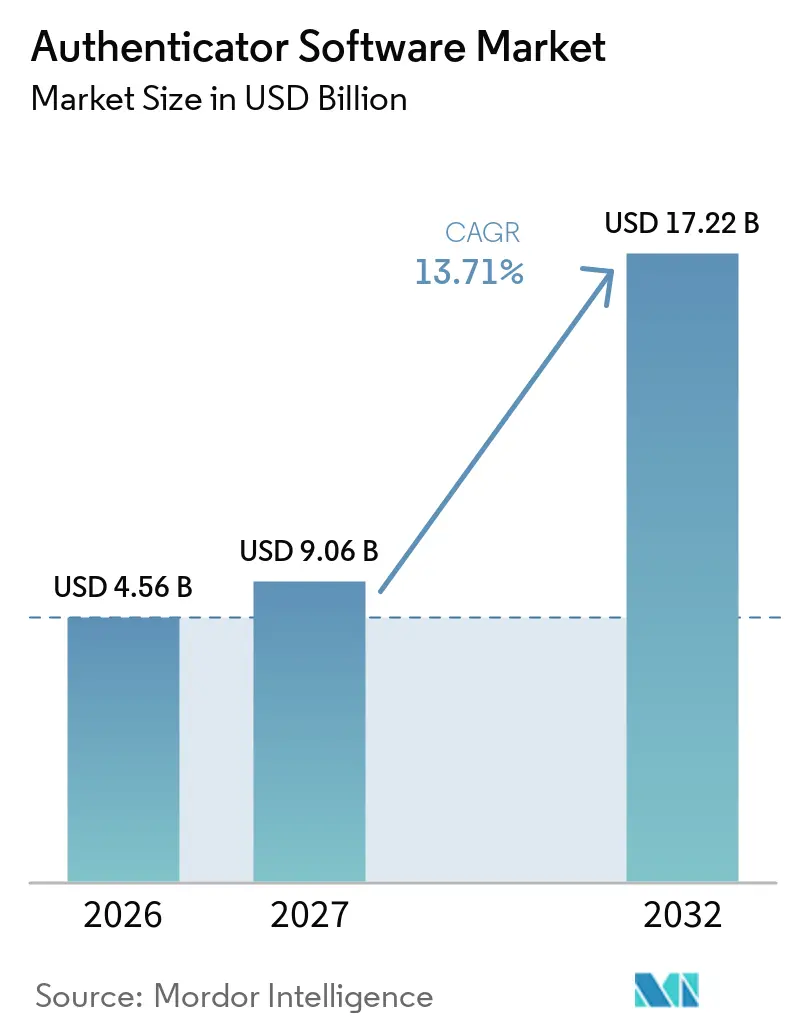
The authenticator software market size is projected to be USD 4.56 billion in 2026, USD 9.06 billion in 2027, and reach USD 17.22 billion by 2032, growing at a CAGR of 13.71% from 2027 to 2032. Rising account takeover activity is making authentication a core enterprise security purchase rather than an optional control, especially where customer accounts, payment access, and privileged administrative systems are at risk. Phishing kits that can bypass conventional multi-factor authentication are increasing demand for device-bound and cryptographic credentials that are harder to reuse or intercept. Cloud-based identity platforms are gaining preference because they can apply updated threat intelligence and common policies across applications, users, and managed devices. Regulatory requirements are adding urgency in financial services and other critical sectors where proof of access control is increasingly important. The authenticator software market is also being shaped by the need to secure AI agents, service accounts, and other non-human identities that access sensitive systems without direct human supervision.
Key Report Takeaways
- By offering type, software held 25.68% of the authenticator software market share in 2026, while hardware authenticators are projected to expand at a 14.16% CAGR through 2032.
- By authentication model, two-factor authentication accounted for 37.26% of 2026 revenue, while passwordless authentication is projected to expand at a 13.97% CAGR through 2032.
- By deployment mode, cloud deployment held 40.76% of revenue in 2026 and is projected to expand at a 14.26% CAGR through 2032.
- By enterprise size, large enterprises held 66.73% of revenue in 2026, while small and medium-sized enterprises are projected to expand at a 14.17% CAGR through 2032.
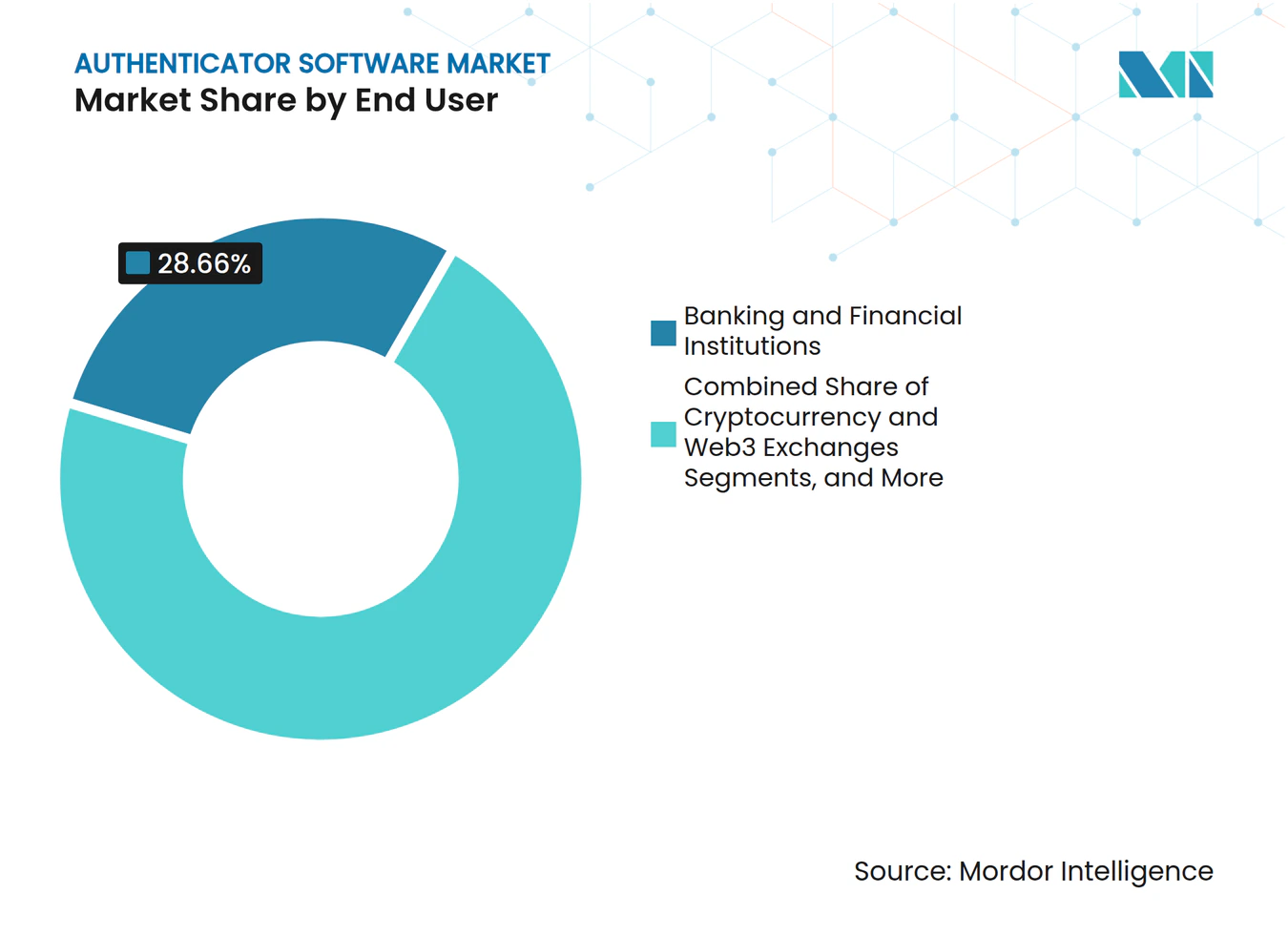
- By end-user industry, banking and financial institutions held 28.66% of revenue in 2026, while cryptocurrency and Web3 exchanges are projected to expand at a 13.98% CAGR through 2032.
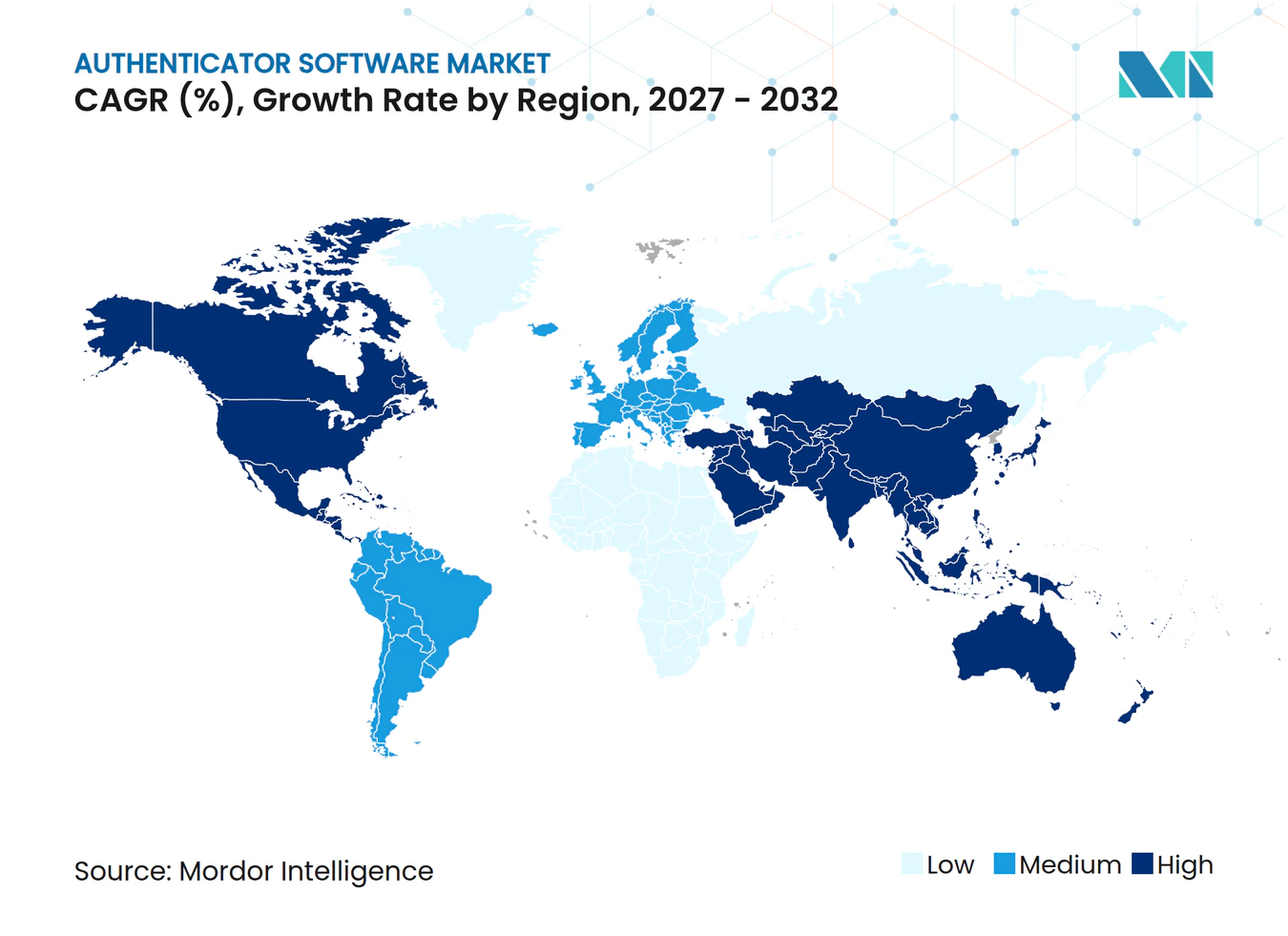
- By geography, North America held 51.99% of revenue in 2026, while Asia-Pacific is projected to expand at a 14.27% CAGR through 2032.
Note: Market numbers in this report are based on Mordor Intelligence's proprietary estimation framework, which combines nine months of actuals with Q4 projections for base year 2026.
Market Trends and Insights
Drivers Impact Analysis of Authenticator Software Market*
| Driver | (~) % Impact on CAGR Forecast | Geographic Relevance | Impact Timeline |
|---|---|---|---|
| Rising Identity-Based Cyberattacks and Account Takeovers | +3.2% | Global, highest intensity in North America and Europe | Short term (≤ 2 years) |
| Tightening Cybersecurity and Data-Protection Regulations | +2.8% | North America and Europe, with spillover to Asia-Pacific and Middle East and Africa | Medium term (2-4 years) |
| Expansion of Zero-Trust Security Architectures | +2.5% | North America core, with strong Asia-Pacific and Europe adoption | Medium term (2-4 years) |
| Growth of Cloud Applications and Hybrid Workforces | +2% | Global, with Asia-Pacific as the fastest-growing contributor | Short term (≤ 2 years) |
| Passkey Adoption in High-Assurance Digital Services | +1.7% | North America, Europe, and Asia-Pacific, including Japan, India, and Australia | Medium term (2-4 years) |
| AI-Enabled Deepfakes Increasing Authentication Assurance Requirements | +1.4% | Global, concentrated in financial services and government | Long term (≥ 4 years) |
| Source: Mordor Intelligence | |||
Rising Identity-Based Cyberattacks and Account Takeovers
Identity-based attacks are moving authentication software into core security architecture, which is strengthening demand across the authenticator software market. eSentire reported a 389% year-over-year increase in identity-based account compromise threats during 2025. It also reported that phishing-as-a-service operations drove 63% of tracked account compromises. Proofpoint found that 99% of organizations were targeted by account takeover attempts between November 2024 and November 2025. It also found that 67% experienced at least 1 successful compromise.[1] Targeted spear-phishing succeeded at a higher rate than non-targeted attacks, which supports demand for authenticators that assess behavioral signals as well as credential possession.
Tightening Cybersecurity and Data-Protection Regulations
Regulatory requirements are a major procurement driver for the authenticator software market, especially in financial services and critical infrastructure where auditability and resilient access controls matter. New York Department of Financial Services requirements under 23 NYCRR Part 500 have made multi-factor authentication an important control for covered financial institutions. France's CNIL published MFA guidance in March 2025 under Deliberation No. 2025-019.[2] These rules place authentication within data-protection and operational-resilience responsibilities. Organizations that delayed investment are now seeking deployment support at the same time. The resulting demand favors platforms with established integration tools and phishing-resistant options.
Expansion of Zero-Trust Security Architectures
Zero-trust programs are changing authentication from a single login event into a continuous access control function, expanding the role of the authenticator software market in enterprise security design. Organizations are increasingly adopting zero-trust strategies that require robust authentication at each important access point. SANS identified passwordless authentication and FIDO2 passkeys as important tools because they remove a phishable credential from the access process. Continuous checks make authenticators a source of session-level risk information. Behavioral analytics can trigger additional authentication when activity departs from normal patterns. This model increases the number of access decisions that enterprise identity platforms must manage.
Growth of Cloud Applications and Hybrid Workforces
Cloud applications and hybrid workforces have expanded the number of identities, devices, and applications that security teams must govern, widening the addressable need for the authenticator software market. Okta reported that workforce MFA adoption reached 70% globally in its 2025 sign-in research. The same research found MFA protection on 74% of SaaS applications but only 50% of legacy applications. Retail recorded a 9-percentage-point increase in MFA adoption, the largest sector increase in that dataset. The authenticator software market benefits when buyers seek one policy layer across cloud, on-premises, and operational technology environments. Vendors that support older applications can be better positioned in replacement cycles.
Restraints Impact Analysis of Authenticator Software Market*
| Restraint | (~) % Impact on CAGR Forecast | Geographic Relevance | Impact Timeline |
|---|---|---|---|
| Integration Complexity Across Legacy Applications and Industrial Systems | -1.8% | Global, most acute in Middle East and Africa and South America | Long term (≥ 4 years) |
| User Friction and Authentication Fatigue | -1.5% | Global, concentrated in sectors with large non-desk workforces | Short term (≤ 2 years) |
| Rising SMS OTP Delivery Costs and Carrier Surcharges | -0.9% | Global, particularly Southeast Asia and South America | Medium term (2-4 years) |
| Secure-Element and Hardware-Token Supply Constraints | -0.7% | Global, particularly in the hardware authenticator segment | Short term (≤ 2 years) |
| Source: Mordor Intelligence | |||
Integration Complexity Across Legacy Applications and Industrial Systems
Legacy applications remain a persistent barrier to full authenticator deployment, limiting how quickly the authenticator software market can reach complete enterprise coverage. HYPR found that 32% of organizations identified legacy application support as their main obstacle to passwordless adoption. A June 2026 survey of 200 financial-sector identity leaders found that more than 50% operated environments where 50% to 74% of infrastructure consisted of legacy systems without modern authentication APIs. Operational technology systems can add complexity because they often follow separate procurement and ownership processes. Organizations can therefore strengthen corporate IT while retaining authentication gaps in production environments. Vendors with RADIUS bridges, mainframe connectors, and broad legacy support can address this demand.
User Friction and Authentication Fatigue
User friction can slow deployment where workers receive frequent push prompts or have limited access to managed devices, a practical constraint for the authenticator software market. RSA found that 90% of organizations reported challenges in moving toward passwordless authentication.[3] It also found that 57% did not use passwordless authentication as their primary method. Frontline workers in retail, health care, and logistics may face more frequent authentication requests than office-based staff. Adaptive authentication can limit added steps to sessions that show elevated risk. The FIDO Alliance reported a 93% passkey sign-in success rate versus 78% for traditional MFA, with an average 27-second time saving per sign-in.
*Our forecasts treat driver/restraint impacts as directional, not additive. The impact forecasts reflect baseline growth, mix effects, and variable interactions.
Authenticator Software Market Segment Analysis
By Offering Type:
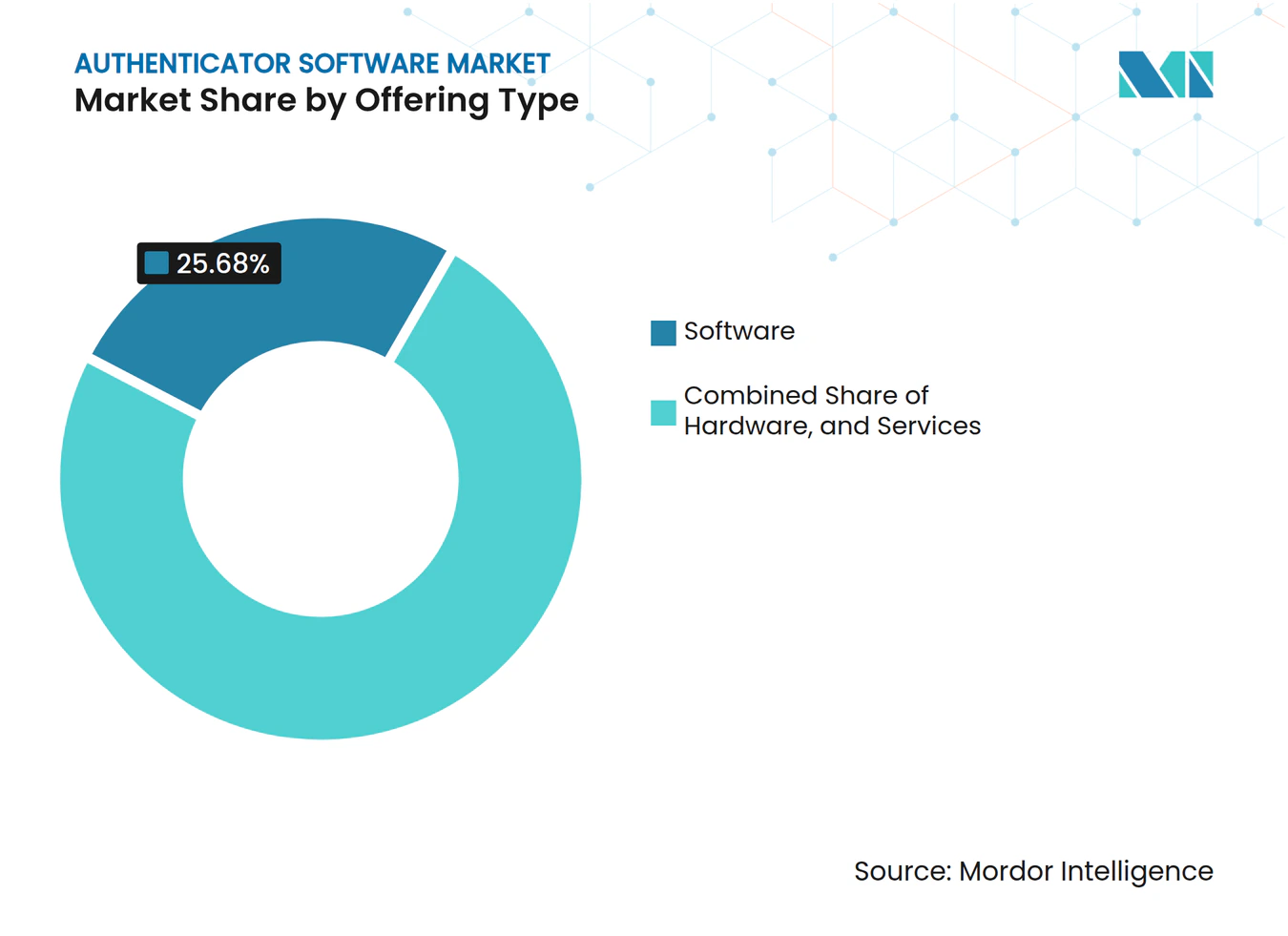
Software Leads Revenue While Hardware Gains MomentumSoftware held 25.68% of the authenticator software market share in 2026. Cloud-native identity platforms, mobile authenticator applications, and developer authentication SDKs support this position across the authenticator software market. These products can be integrated into enterprise identity systems and updated without replacing physical devices, allowing administrators to respond to new threats through centrally managed software changes. Organizations also use software to manage policies across many applications and user groups, which reduces inconsistent configuration when access requirements vary between departments, partners, and customers. The software segment remains central to the authenticator software market where buyers need unified administration, wide deployment coverage, and clear policy ownership.
Hardware authenticators are projected to expand at a 14.16% CAGR through 2032. Security keys, smart cards, and biometric devices respond to demand across the authenticator software market for credentials that are resistant to phishing and stronger impersonation techniques. The FIDO Alliance found that all surveyed participants deploying hardware-backed passkeys reported lower SMS OTP costs. Managed authentication services are also gaining traction as mid-sized organizations seek support with deployment and ongoing operations, particularly when internal teams cannot maintain integrations, recovery processes, and access policies on their own. The authenticator software industry is increasingly combining hardware-backed credentials with cloud-delivered policy management.



By Authentication Model:
Two-Factor Authentication Retains Scale While Passwordless AdvancesTwo-factor authentication held 37.26% of revenue in 2026, giving it the largest position among authentication models. Its installed base is strong in financial services, enterprise IT, and government services, giving the authenticator software market a broad base of established users. These sectors often use it to meet established compliance requirements, protect remote access, and apply an additional verification step before users reach sensitive applications or data. Single-factor authentication remains present in legacy environments and lower-sensitivity access tiers. Three-factor and higher-order methods are used more selectively for privileged access and national-security needs.
Passwordless authentication is projected to expand at a 13.97% CAGR between 2027 and 2032. The FIDO Alliance reported 5 billion active passkeys globally in May 2026. It also reported that 68% of organizations had deployed or were actively deploying passkeys for employee sign-ins. FIDO Alliance 2025 data showed an 81% reduction in login-related help desk incidents after passkey adoption. The authenticator software market is therefore shifting toward methods that can improve both resistance to phishing and login usability.
By Deployment Mode:
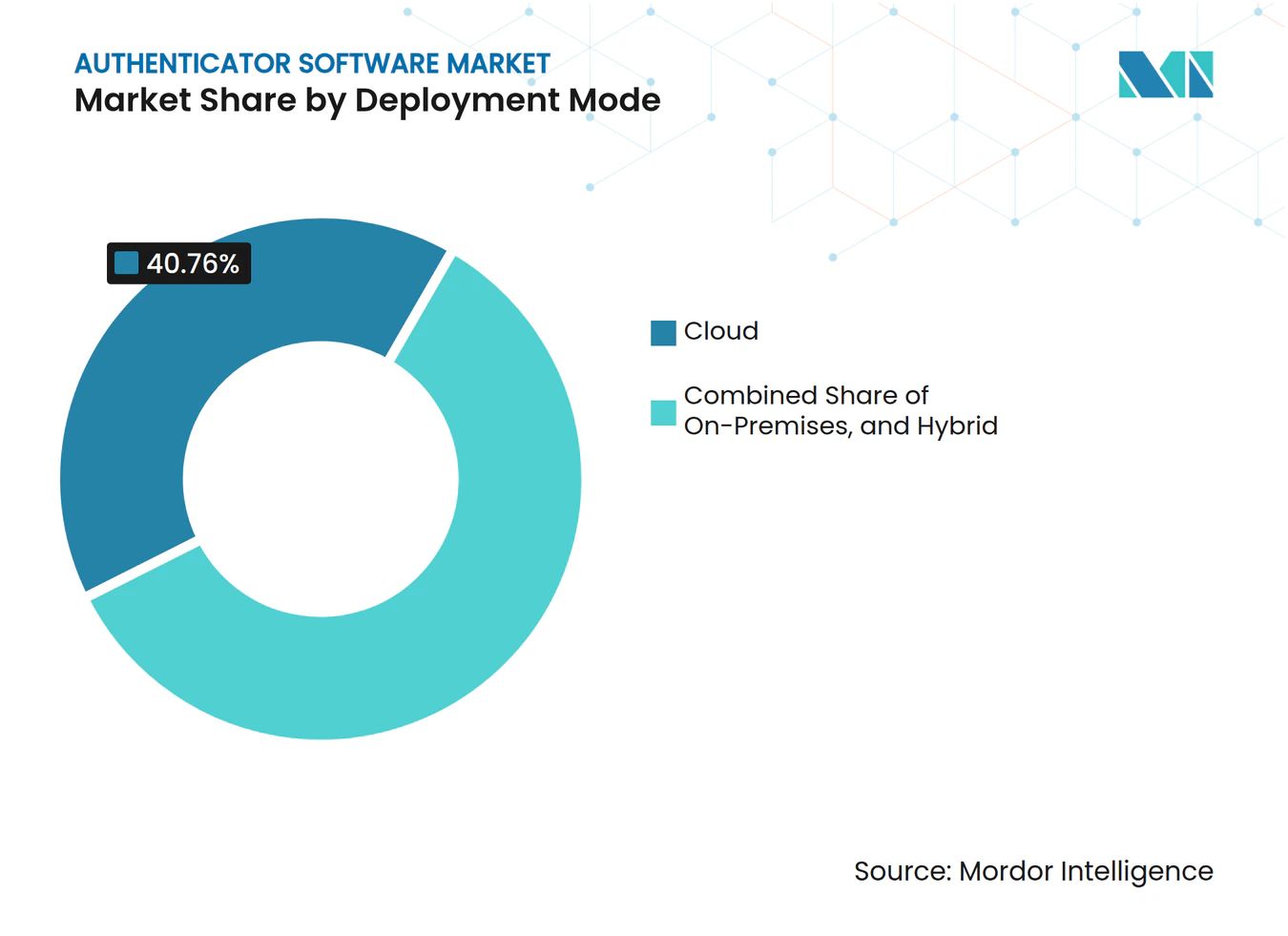
Cloud Deployment Leads in Share and Forecast ExpansionCloud deployment held 40.76% of 2026 revenue and is projected to expand at a 14.26% CAGR through 2032. The segment leads both current adoption and forecast expansion because more enterprise applications are cloud-based. On-premises authentication can become a coverage gap when employees access a wide set of SaaS and remote systems. Cloud platforms can update policies and threat intelligence centrally across users and locations. They also provide the computing capacity needed for continuous risk scoring at high session volumes. This supports a larger role for hosted identity services in the authenticator software market.
Private cloud remains relevant for financial services and healthcare organizations that require data residency and controlled infrastructure. Those requirements are especially significant in European procurement where GDPR compliance is a major factor. Hybrid deployment is also gaining traction because many large organizations run cloud, on-premises, and operational technology systems at the same time. RSA introduced ID Plus for Microsoft M1 in November 2025 to extend phishing-resistant MFA to legacy, on-premises, and operational technology environments. Enterprises using adaptive authentication on local infrastructure can face latency limits as session-level analysis increases. These conditions keep hybrid capabilities important in the authenticator software market even as cloud use expands.

By Enterprise Size:
Large Enterprises Hold the Largest Position While SMEs AccelerateLarge enterprises accounted for 66.73% of revenue in 2026. Earlier adoption of identity platforms and more complex technology estates support their leading position. Many also operate in regulated sectors that require formal authentication controls. RSA reported that 45% of organizations experiencing identity-related breaches faced costs above a typical breach benchmark. It further reported that 24% faced costs exceeding USD 10 million.
Small and medium-sized enterprises are projected to expand at a 14.17% CAGR through 2032. Cloud-delivered platforms and managed services reduce the need for dedicated identity teams, making the authenticator software market more accessible to smaller organizations. Smaller organizations often treat authentication as their main control against account takeover risk. This makes reliability, ease of deployment, and support services important selection factors, since smaller teams may have little capacity to manage complex configurations or respond to a high volume of user requests. The authenticator software market has an opportunity to serve these buyers with simpler packages rather than enterprise-scale implementations.
By End-User Industry:
Banking Supports Demand While Cryptocurrency and Web3 Lead ExpansionBanking and financial institutions held 28.66% of 2026 revenue. High-value accounts and strict regulatory expectations are the main sources of demand in the authenticator software market for this end-user group. A June 2026 survey found that only 28% of workforce MFA in financial institutions was phishing-resistant. This gap exists despite broad MFA coverage and supports replacement of older authentication methods. DORA and FFIEC guidance further increase interest in certified phishing-resistant products, especially where banks must demonstrate that controls remain effective across workforce, customer, and privileged access scenarios.
Cryptocurrency and web3 are projected to expand at a 13.98% CAGR through 2032. Blockchain transactions are difficult to reverse, which makes strong authentication a direct user-trust and operational requirement. Cryptocurrency platforms face elevated account fraud exposure because compromised blockchain transactions are difficult to reverse. Technology, SaaS, IT services, and DevOps also represent an adjacent opportunity for developer-focused SDKs and API tokens. Government, health care, and retail use different assurance models based on their compliance duties and risk profiles.
Geography Analysis
North America Authenticator Software Market
North America accounted for 51.99% of global revenue in 2026. The region benefits from mature enterprise security spending and an established identity and access management ecosystem that supports the authenticator software market. In the United States, New York's financial-services cybersecurity rules support demand among covered institutions. Canada contributes through financial institutions and government bodies adopting phishing-resistant authentication, while a high concentration of identity vendors can shorten procurement cycles and support integration across enterprise tools.
Europe Authenticator Software Market
Europe is shaped by GDPR, NIS2, and DORA obligations, which are advancing the authenticator software market through compliance-led purchasing. France's CNIL issued formal MFA guidance in March 2025 and linked it to security duties under GDPR. CNIL.FR The United Kingdom, Germany, and France lead regional adoption. The GDPR standard for suitable technical and organizational safeguards supports broader consideration of MFA for sensitive data processing. NIS2 is also bringing more critical-sector and mid-market organizations into formal cybersecurity purchasing processes.
APAC and MEA Authenticator Software Market
Asia-Pacific is projected to expand at a 14.27% CAGR from 2027 to 2032, the fastest rate among geographies. Okta recorded a 7-percentage-point year-over-year increase in enterprise MFA adoption across Asia-Pacific. India exceeded 89% enterprise MFA adoption in Okta's regional reporting. Yubico reported that 47% of Chinese enterprises had deployed phishing-resistant MFA in response to AI-driven threats. In Middle East and Africa, Saudi Arabia and the United Arab Emirates lead through national digital transformation programs, while South Africa and Egypt offer demand linked to fintech and mobile use within the authenticator software market.
Competitive Landscape
Market Concentration
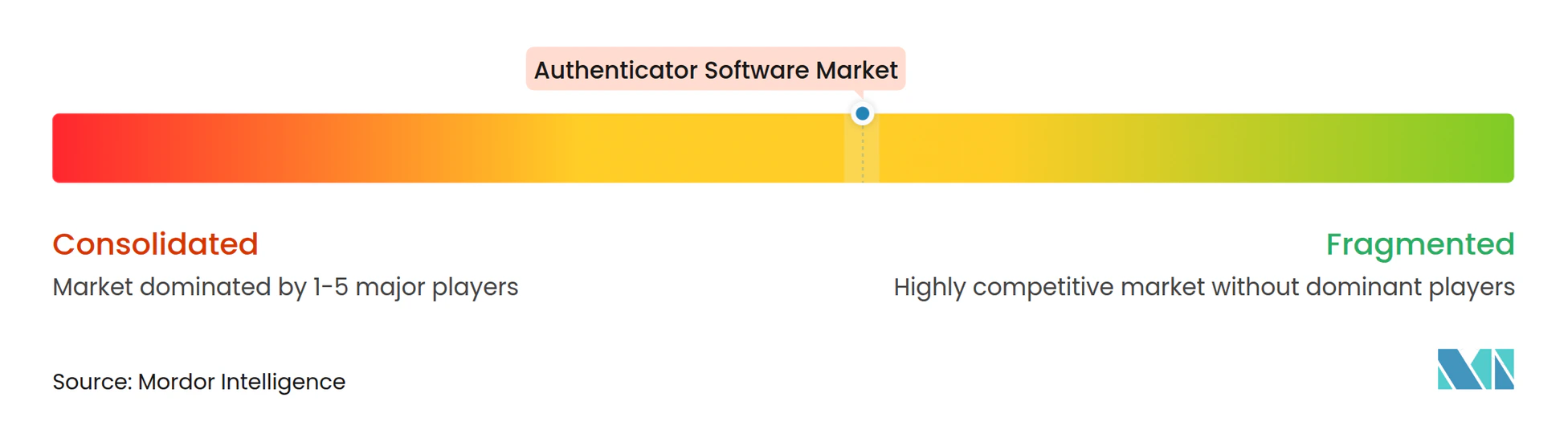
The authenticator software market is moderately concentrated at the platform level. Established identity vendors hold major enterprise accounts, while specialist vendors compete across the authenticator software market on assurance level, deployment coverage, and vertical requirements. AI-driven behavioral analytics and support for non-human identities are important areas of differentiation. Identity security vendors are expanding beyond workforce authentication to secure AI agents, service accounts, and machine identities, broadening the scope of the authenticator software market.
Palo Alto Networks announced an agreement to acquire CyberArk for USD 25 billion in July 2025. The proposed transaction shows the strategic value of combining identity, network, and cloud security controls. Yubico expanded Enrollment Services in March 2026 to support factory-provisioned and in-field YubiKey deployment for Microsoft Entra ID and Ping Identity. This move reduces manual registration work for enterprise passwordless rollouts. RSA expanded its Microsoft partnership in March 2026 to support authentication for human users and AI agents across hybrid, cloud, and on-premises environments.
Hardware vendors use FIDO2 and WebAuthn compliance to meet financial services and government procurement needs in the authenticator software market. The FIDO Alliance has established specifications that support interoperable phishing-resistant authentication. Compliance with NIST identity assurance expectations and European regulations can favor vendors that offer certified products. Smaller firms compete in identity threat detection and response and identity graph analysis, while space remains for providers serving operational technology, machine identity, and mid-market deployments. Managed services and usage-based pricing can help address organizations that are priced out of large enterprise platforms.
Authenticator Software Industry Leaders
-
Microsoft Corporation
-
Okta, Inc.
-
Cisco Systems, Inc.
-
International Business Machines Corporation
-
Oracle Corporation
- *Disclaimer: Major Players sorted in no particular order
Authenticator Software Market Companies Covered in this Report
- Microsoft Corporation
- Okta, Inc.
- Cisco Systems, Inc.
- International Business Machines Corporation
- Oracle Corporation
- Ping Identity Corporation
- CyberArk Software Ltd.
- Thales S.A.
- Broadcom Inc.
- RSA Security LLC
- OneSpan Inc.
- Entrust Corporation
- HID Global Corporation
- Yubico AB
- Google LLC
- ForgeRock, Inc.
- SecureAuth Corporation
- One Identity LLC
- ManageEngine
- Giesecke+Devrient GmbH
- TeleSign Corporation
- Keyless Technologies
- Secret Double Octopus Ltd.
- Trusona, Inc.
- FusionAuth, Inc.
- HYPR Corp.
Recent Industry Developments in Authenticator Software Market
- March 2026: RSA Security announced an expanded partnership with Microsoft at RSA Conference 2026, integrating RSA ID Plus with Microsoft 365 E7 Frontier Suite to secure authentication for both human users and AI agents across hybrid, cloud, and on-premises environments.
- March 2026: Yubico expanded its Enrollment Services at RSA Conference 2026 to support in-field YubiKey enrollment for Microsoft Entra ID and Ping Identity environments, enabling factory-provisioned passwordless deployment at enterprise scale without manual IT-managed registration.
- November 2025: RSA ID Plus for Microsoft M1 reached general availability on the Azure Marketplace, extending phishing-resistant MFA and passwordless coverage to legacy, operational technology, mainframe, and non-Microsoft environments that Microsoft Entra ID cannot natively reach.
- September 2025: Okta announced Okta for AI Agents at Oktane 2025, introducing end-to-end identity lifecycle management for non-human identities and AI agents, with Phase 1 early access targeted for fiscal year 2027 Q1 in response to enterprise demand for authentication governance across AI-driven workflows.
Global Authenticator Software Market Report Scope
The Authenticator Software Market Report is Segmented by Offering Type (Software (Authenticator Solutions, Mobile Authenticator Applications, Authentication SDKs and APIs, Authentication Servers and Policy Engines), Hardware (Security Keys and Hardware Tokens, Smart Cards and Secure Elements, Biometric Devices), Services (Managed Authentication Services, Professional Services, Integration and Support Services)), Authentication Model (Single-Factor Authentication, Two-Factor Authentication, Three-Factor Authentication, Four-Factor Authentication, Five-Factor Authentication and Higher-Order Authentication, Passwordless Authentication, Adaptive and Risk-Based Authentication), Deployment Mode (Cloud, On-Premises, Hybrid), Enterprise Size (Small and Medium-Sized Enterprises, Large Enterprises), End-User Industry (Banking and Financial Institutions, Cryptocurrency and Web3 Exchanges, Technology, SaaS, IT Services and DevOps, Government and Public Services, Healthcare and Pharmaceuticals, Retail and E-Commerce, Other End-User Industry), and Geography (North America, South America, Europe, Asia-Pacific, Middle East, Africa). The Market Forecasts in Value (USD).
Segmentation Overview
| Software | Authenticator Solutions |
| Mobile Authenticator Applications | |
| Authentication SDKs and APIs | |
| Authentication Servers and Policy Engines | |
| Hardware | Security Keys and Hardware Tokens |
| Smart Cards and Secure Elements | |
| Biometric Devices | |
| Services | Managed Authentication Services |
| Professional Services | |
| Integration and Support Services |
| Single-Factor Authentication |
| Two-Factor Authentication |
| Three-Factor Authentication |
| Four-Factor Authentication |
| Five-Factor Authentication and Higher-Order Authentication |
| Adaptive and Risk-Based Authentication |
| Passwordless Authentication |
| Cloud |
| On-Premises |
| Hybrid |
| Small and Medium-Sized Enterprises |
| Large Enterprises |
| Banking and Financial Institutions |
| Cryptocurrency and Web3 Exchanges |
| Technology, SaaS, IT Services and DevOps |
| Government and Public Services |
| Healthcare and Pharmaceuticals |
| Retail and E-Commerce |
| Other End-User Industry |
| North America | United States |
| Canada | |
| Rest of North America | |
| South America | Brazil |
| Rest of South America | |
| Europe | United Kingdom |
| Germany | |
| France | |
| Italy | |
| Russia | |
| Rest of Europe | |
| Asia-Pacific | China |
| Japan | |
| India | |
| South Korea | |
| Australia | |
| Rest of Asia-Pacific | |
| Middle East and Africa | Saudi Arabia |
| United Arab Emirates | |
| South Africa | |
| Egypt | |
| Rest of Middle East and Africa |
| By Offering Type | Software | Authenticator Solutions |
| Mobile Authenticator Applications | ||
| Authentication SDKs and APIs | ||
| Authentication Servers and Policy Engines | ||
| Hardware | Security Keys and Hardware Tokens | |
| Smart Cards and Secure Elements | ||
| Biometric Devices | ||
| Services | Managed Authentication Services | |
| Professional Services | ||
| Integration and Support Services | ||
| By Authentication Model | Single-Factor Authentication | |
| Two-Factor Authentication | ||
| Three-Factor Authentication | ||
| Four-Factor Authentication | ||
| Five-Factor Authentication and Higher-Order Authentication | ||
| Adaptive and Risk-Based Authentication | ||
| Passwordless Authentication | ||
| By Deployment Mode | Cloud | |
| On-Premises | ||
| Hybrid | ||
| By Enterprise Size | Small and Medium-Sized Enterprises | |
| Large Enterprises | ||
| By End-User Industry | Banking and Financial Institutions | |
| Cryptocurrency and Web3 Exchanges | ||
| Technology, SaaS, IT Services and DevOps | ||
| Government and Public Services | ||
| Healthcare and Pharmaceuticals | ||
| Retail and E-Commerce | ||
| Other End-User Industry | ||
| By Geography | North America | United States |
| Canada | ||
| Rest of North America | ||
| South America | Brazil | |
| Rest of South America | ||
| Europe | United Kingdom | |
| Germany | ||
| France | ||
| Italy | ||
| Russia | ||
| Rest of Europe | ||
| Asia-Pacific | China | |
| Japan | ||
| India | ||
| South Korea | ||
| Australia | ||
| Rest of Asia-Pacific | ||
| Middle East and Africa | Saudi Arabia | |
| United Arab Emirates | ||
| South Africa | ||
| Egypt | ||
| Rest of Middle East and Africa | ||
Key Questions Answered in the Report
What is the authenticator software market size?
The authenticator software market is valued at USD 4.56 billion in 2026 and is forecast to reach USD 17.22 billion by 2032 at a 13.71% CAGR.
Which offering type leads authenticator software demand?
Software leads with 25.68% of 2026 revenue because cloud-native identity platforms, mobile applications, and authentication SDKs are widely used.
Which authentication approach is expanding fastest?
Passwordless authentication is projected to expand at a 13.97% CAGR through 2032, supported by wider passkey deployment.
Why do financial institutions invest in stronger authentication?
Banking and financial institutions held 28.66% of 2026 revenue, with regulatory requirements and phishing-resistant MFA gaps increasing investment.
Which region has the fastest outlook for authenticator software?
Asia-Pacific is projected to expand at a 14.27% CAGR through 2032, supported by rising enterprise MFA adoption.
How do passkeys affect authentication operations?
The FIDO Alliance reported that passkeys reduce login-related help desk incidents and can improve sign-in success rates compared with traditional MFA.