
Market Overview
| Study Period | 2021 - 2031 |
|---|---|
| Forecast Data Period | 2026 - 2031 |
| Historical Data Period | 2021 - 2024 |
| Growth Rate | 7.11 % |
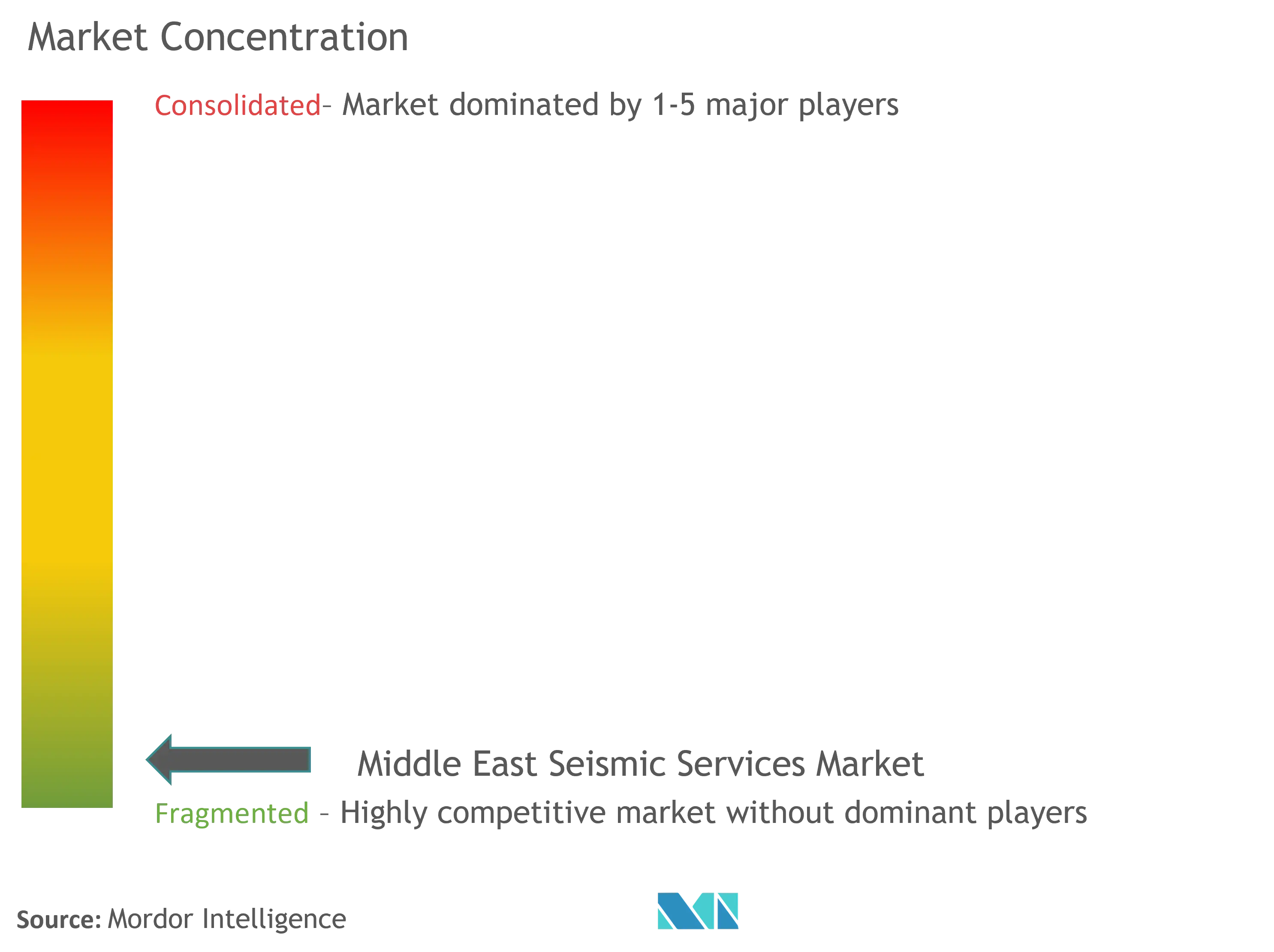
| Market Concentration | Low |
Major Players *Disclaimer: Major Players sorted in no particular order Image © Mordor Intelligence. Reuse requires attribution under CC BY 4.0. | |
Middle East Seismic Services Market Analysis by Mordor Intelligence
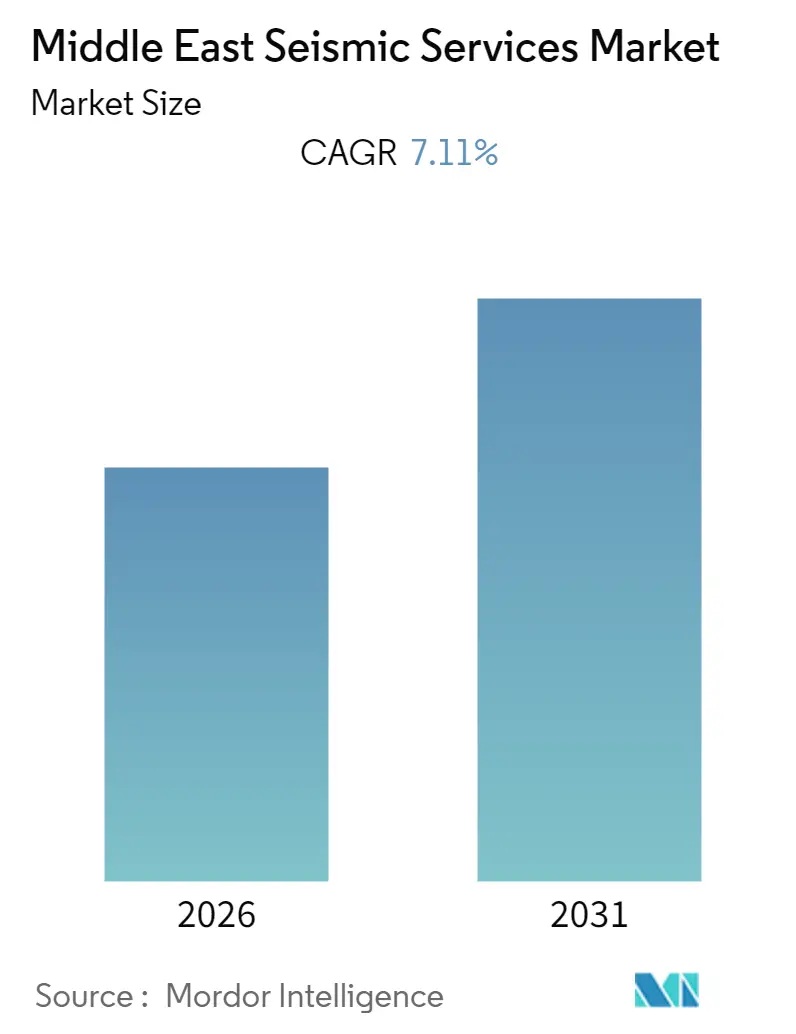
The Middle East Seismic Services Market size is expected to register a CAGR of 7.11% during the forecast period.
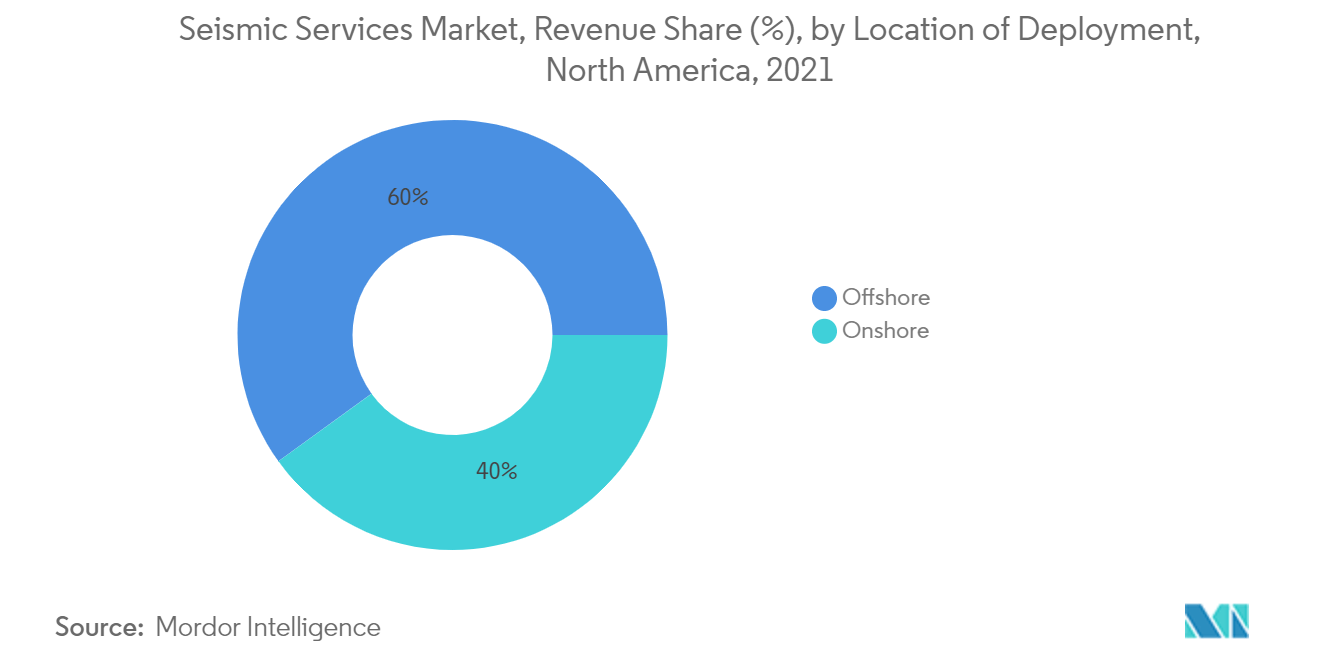
- The offshore segment accounts for the major share in the seismic services market due to a number of favourable conditions compared to onshore.
- Land-based and shallow-water oil fields have reached their maturity, and there is little scope for any new field discovery in these areas. Therefore, the development of deepwater and ultra-deepwater water reserves is expected to create significant opportunities for the middle east seismic services market in the future.
- The Saudi Arabia is expected to witness significant growth in the seismic services market during the forecast period due to rapid growth in exploration and production activities across the country.
Note: Market size and forecast figures in this report are generated using Mordor Intelligence’s proprietary estimation framework, updated with the latest available data and insights as of 2026.
Market Trends and Insights
Offshore Oil and Gas Industry is Expected to Dominate the Market
- The offshore segment accounts for the largest share of the middle-east seismic services market. Offshore seismic data usually has much higher quality compared to onshore due to a number of favorable conditions, including repeatable and consistent sources, good conditions for coupling at sources and receivers, and the uniform property of water as the medium.
- The Middle-East region, is one of the major offshore oil and gas producing regions and offshore oil and gas exploration spending in the region is set to grow significantly over the next few years. With the availability of abundant resources, coupled with increased potential to recover oil and gas from deep water and ultra-deep-water areas, it is expected to provide a great opportunity for the offshore oilfield services market.
- In February 2022, Abu Dhabi's state-owned oil and gas company announced the discovery of between 1.5 to 2 trillion standard cubic feet of gas in an offshore area located in the Emirate's Northwest. Further reservoir development is likely to be carried out, including seismic services work, which is expected to drive the market.
- Moreover, in July 2022, Abu Dhabi National Oil Company (ADNOC) announced a second discovery of natural gas resources through seismic services in the first exploration well in Abu Dhabi's Offshore Block 2 Exploration Concession, operated by Eni. The discovery from a new deeper reservoir indicates between 1 - 1.5 trillion standard cubic feet (TSCF) of raw gas in place.
- Therefore, factors such as increasing exploration and production (E&P) activities in the deepwater and ultra-deepwater reserves and increasing efforts by the oil and gas majors to tap into the undiscovered reserves are expected to drive the middle-east seismic services market.
Saudi Arabia to Dominate the Market
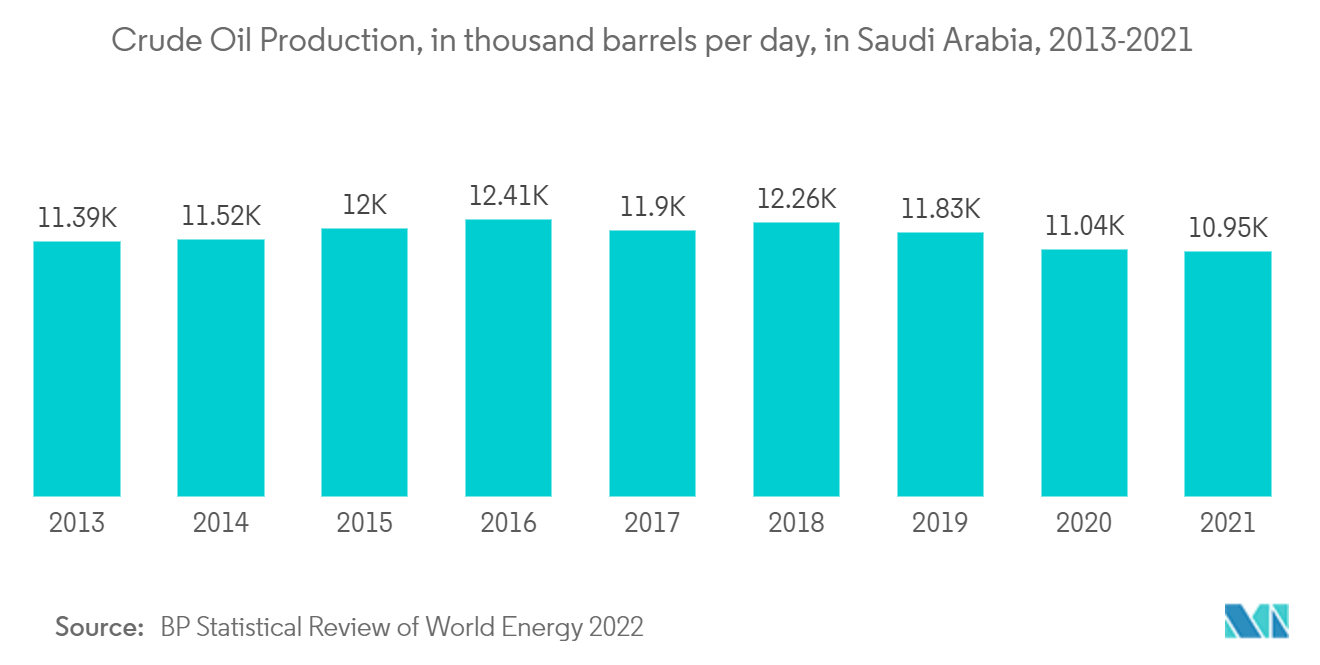
- Saudi Arabia is one of the major global oil producers, with 10.954 million barrels per day (mb/d) of crude oil production in 2021. It is the largest crude oil exporter globally, registering nearly 161.7 billion USD in 2021. As a significant crude oil exporter, the country had great control over the international upstream market. The country plays a crucial role in controlling crude oil prices due to its high surge capacity. This may be considered a good sign for seismic services within the region.
- Also, the country has the world's fifth-largest estimated shale gas reserve, and thus, it has great potential for the country to replicate North America's unconventional reserves development growth. This, inturn, culminates the growth in the use of seismic surveys in the region.
- Moreover, in March 2022, the state oil company Saudi Aramco's Saudi Arabian Oil Company (Aramco) announced it would boost its capital expenditure to USD 40 to 50 billion, which further bolstered the country's the exploration and production activities. This in turn, culminates in the growth of seismic services across the region.
- Furthermore, in February 2022, Saudi Arabia announced the discovery of natural gas fields in five regions of the kingdom, namely, bordering Iraq, i.e. Shadoon, in the central region southeast of Riyadh, Shehab, in the empty quarter, Shehab, Shorfa, Umm Khansir, Samna. These gas discoveries showcase the prominence of seismic services within the region.
- Therefore, owing to the above points, Saudi Arabia is expected to dominate the middle-east seismic services market during the forecast period.
Regulatory Landscape
Regulation affecting seismic services in parts of the Middle East combines upstream licensing oversight with environmental and survey-permitting requirements that shape survey design, seasonality, and documentation. In Lebanon, the Lebanese Petroleum Administration requires operators to submit seismic survey programs for assessment and approval under the Petroleum Activities Regulations framework, tying project readiness to formal program review and related technical submissions.
Environmental review is a consistent gating factor for offshore seismic, particularly in the Eastern Mediterranean. Israel's Natural Resources Administration mandates Environmental Impact Assessments for offshore petroleum activities in coordination with the Ministry of Environmental Protection, while Mediterranean guidance such as REMPEC offshore EIA standards reinforces mitigation and monitoring expectations for geophysical surveys using seismic sources. Together, these frameworks increase the focus on pre-survey planning, stakeholder consultation, and monitoring during acquisition, which can affect offshore campaign timelines and cost structures.
Value Chain Analysis
The Middle East seismic services value chain covers survey planning and permitting, data acquisition (onshore and offshore), data processing and reprocessing, and interpretation and delivery into operator subsurface and reservoir workflows. National oil companies and ministries, such as Kuwait Oil Company and Egypt's petroleum authorities, anchor demand and contracting, while service providers and technology vendors such as SLB and Viridien supply acquisition systems, including ocean bottom node programs, along with advanced processing and interpretation capabilities.
Further downstream, processing and interpretation are increasingly supported by AI-enabled workflows and long-duration service models that bundle multi-vintage data conditioning, imaging, and interpretation support. The broader chain also includes specialized marine and land logistics, vessel and crew providers, equipment supply (nodes, streamers, sensors), and local content and in-country capability buildout. Operator initiatives, including SLB's Ahmadi Innovation Valley engagement in Kuwait, extend the value chain into R&D, testing, and deployment of digital subsurface technologies alongside core seismic deliverables.
Competitive Landscape
The Middle East seismic services market is fragmented. Some of the major companies include Schlumberger Ltd, CGG SA, PGS ASA, TGS ASA, and Halliburton Company.
Middle East Seismic Services Industry Leaders
-
Schlumberger Ltd
-
PGS ASA
-
TGS ASA
-
Halliburton Company
-
CGG SA
- *Disclaimer: Major Players sorted in no particular order
Middle East Seismic Services Market Companies Covered in this Report
- Halliburton Company
- Schlumberger Limited
- CGG SA
- Fugro NV
- ION Geophysical Corporation
- PGS ASA
- TGS ASA
- SAExploration Holdings Inc.
Market Opportunities and Future Outlook
New multi-client and operator-led offshore programs in the Eastern Mediterranean create demand for both acquisition and high-end processing and interpretation, especially where ocean bottom node (OBN) approaches are used to improve imaging in complex geology. In January 2026, SLB and Viridien launched a multi-client OBN seismic program offshore Egypt in the Eastern Mediterranean, indicating an ongoing pipeline for data acquisition, reprocessing tie-ins, and multi-client data licensing and interpretation services.
Unconventional gas development and digital subsurface workflows also create opportunity areas tied to multi-year contracting and repeatable seismic support across appraisal and development phases. Saudi Aramco awarded Halliburton a multi-year contract for unconventional gas development in the Jafurah Basin starting in Q3 2026, supporting demand for integrated subsurface characterization and monitoring services that connect seismic inputs to development decisions. In Kuwait, SLB's seven-year engagement with Kuwait Oil Company under the Ahmadi Innovation Valley initiative, focused on AI and reservoir-management-related technology testing and deployment, supports continued demand for seismic data processing, reprocessing, and interpretation that can be operationalized within national operator workflows.
Recent Industry Developments in Middle East Seismic Services Market
- June 2026: TGS awarded streamer 3D contract in Africa and Middle East region. Expansion of high-density 3D seismic surveying in Middle East and Africa. The capacity addition strengthens regional seismic capabilities and supports offshore exploration growth in Gulf and East Africa corridors.
- January 2026: Schlumberger (SLB) Kuwait Oil Company awarded SLB five-year seismic data processing and reprocessing contract. The arrangement emphasizes AI-enabled processing across offshore, onshore, and urban areas. The contract anchors SLB in Kuwait GCC market and drives continued AI-enabled interpretation workflows.
- November 2025: Schlumberger (SLB) Egyptian Ministry of Petroleum and Mineral Resources and SLB advance 95,000 km2 Ocean Bottom Nodes seismic survey in Eastern Mediterranean (SLB-Veridian alliance). OBN-driven deepwater survey expansion in Eastern Mediterranean. This collaboration sets path for large-scale offshore investments and establishes SLB-Veridian in a key regional basin.
Middle East Seismic Services Market Report Scope and Research Methodology
Market Definition and Coverage
This market covers revenues earned from seismic services used in oil and gas exploration and field development across the Middle East, including data acquisition and data processing and interpretation work delivered for onshore and offshore programs.
Scope exclusions: We exclude non-seismic geophysical work and purely geological consulting that is not tied to seismic data acquisition or seismic data processing and interpretation service billing.
Segments Covered in This Report
- Service
- Data Acquisition
- Data Processing and Interpretation
- Location of Deployment
- Onshore
- Offshore
- Geography
- Saudi Arabia
- United Arab Emirates
- Rest of Middle-East
Data Sources, Market Sizing, and Validation
Desk Research
Desk research was used to set the project pipeline context and to anchor the model to measurable upstream activity in the Middle East. We leaned on public sources such as OPEC and IEA upstream outlooks, national statistics portals, energy ministry releases, and U.S. EIA data for regional production and drilling signals.
To translate activity into a service-demand view, we also reviewed procurement notices, regulator and operator updates, and association materials such as those from geoscience and oil and gas bodies, along with peer-reviewed geophysics journals for typical survey practices. Company filings, investor presentations, and trusted press were used to cross-check fleet utilization commentary and contract timing. Where needed, paid subscriptions for company financials, patent lookups, and tender tracking were used selectively to confirm timelines and pricing direction. The sources listed here are illustrative, and many other public documents and data points were used for collection, validation, and clarification.
Primary Interviews and Surveys
Primary work focused on validating what is actually being purchased in the region, how programs are sequenced, and how pricing is being quoted for acquisition versus processing and interpretation. We spoke with a mix of service providers, independent interpreters, and upstream buyers, and then reconciled differences across core geographies in the Middle East and between onshore and offshore workflows.
Distribution of primary research fieldwork respondents
| Company type | Respondent position |
|---|---|
| Top tier: 27% | CXOs: 14% |
| Mid tier: 59% | Functional/Unit leaders: 37% |
| Smaller Players: 14% | Managers: 49% |
Market-Sizing & Forecasting
Sizing started with a top-down build where upstream exploration and appraisal activity was converted into a seismic service demand pool for the Middle East, and then split across acquisition and processing and interpretation. The model was checked with selective bottom-up approximations using sampled contract benchmarks, typical survey scope (2D line-km and 3D sq-km), and observed pricing ranges to adjust totals when outputs looked stretched.
Key inputs included expected E&P budgets and reallocation between exploration and development, the onshore versus offshore mix, the cadence of multi-client versus proprietary programs, vessel and crew utilization signals, and the pace of reprocessing demand as mature fields are revisited. Where a country-level input was thin, we filled gaps using nearby program analogs and then stress-tested results with interview feedback.
For forecasting, scenario analysis was used so that oil price assumptions, sanctioning delays, and offshore permitting timing could be flexed without breaking the logic. The final growth path was accepted only after it aligned with expert views on near-term tender flow and a realistic normalization of pricing and utilization.
Data Validation & Update Cycle
Outputs were validated through multiple checks, first by comparing implied spend per unit of survey activity with historical contracting patterns, and then by verifying that country splits made sense versus public upstream plans. Outliers were reviewed, assumptions were revisited, and follow-up calls were triggered when interview inputs disagreed materially or when a desk signal changed the likely project mix.
Before sign-off, the model and narrative go through a multi-step analyst review so that definitions, arithmetic, and logic remain consistent across sections. Reports are refreshed annually, and interim updates are made when material events occur, such as a major licensing round, a sharp shift in offshore activity, or a notable pricing reset. Right before delivery, we complete a final pass to ensure the latest public releases are reflected.
Mordor Intelligence's Middle East Seismic Services Market Sizing Compared With Other Published Estimates
Published market values for seismic services in the Middle East can look far apart because not everyone counts the same service lines, the same countries, or even the same timing for when contract revenue is recognized. Differences also show up when one estimate is based on announced project plans while another leans on realized activity and awarded work.
The biggest gaps typically come from whether data processing and interpretation is counted separately or folded into acquisition-only pricing, and whether multi-client survey revenues are treated as regional sales or allocated to where the survey is shot. Some publications also mix Middle East only with a broader Middle East and Africa view, and currency conversion timing can shift the displayed value in volatile years.
Benchmark comparison
| Source | Market Size | Gaps in Research Methodology |
|---|---|---|
| Mordor Intelligence | USD 3.35 B (2024) | |
| Regional Consultancy A | USD 3.20 B (2024) | Often scoped closer to seismic survey acquisition only, which leaves processing and interpretation partially embedded and can understate service revenue in processing-heavy programs. |
| Trade Journal B | USD 4.75 B (2030) | Sometimes extrapolates using aggressive offshore expansion assumptions and a smooth ASP uplift, without fully adjusting for tender slippage and multi-client revenue recognition across years. |
The table shows that the spread is mainly explained by what is included around processing and interpretation, how multi-client revenues are allocated, and which years are used for currency timing and activity assumptions. By tying the 2024 total to observable tender flow, onshore versus offshore mix, and service-line pricing logic, the estimate stays repeatable for decision makers, which is how the scope is treated here by Mordor Intelligence.
Key Questions Answered in the Report
What is the current Middle East Seismic Services Market size?
The Middle East Seismic Services Market is projected to register a CAGR of 7.11% during the forecast period (2026-2031)
Who are the key players in Middle East Seismic Services Market?
Schlumberger Ltd, PGS ASA, TGS ASA, Halliburton Company and CGG SA are the major companies operating in the Middle East Seismic Services Market.
What years does this Middle East Seismic Services Market cover?
The report covers the Middle East Seismic Services Market historical market size for years: 2020, 2021, 2022, 2023 and 2024. The report also forecasts the Middle East Seismic Services Market size for years: 2026, 2027, 2028, 2029, 2030 and 2031.