
Middle East and Africa Video Surveillance Market Size and Share
| Study Period | 2019 - 2030 |
| Forecast Data Period | 2025 - 2030 |
| Historical Data Period | 2019 - 2023 |
| Market Size (2025) | USD 4.57 Billion |
| Market Size (2030) | USD 6.06 Billion |
| CAGR (2025 - 2030) | 5.80% |
| Market Concentration | Low |
Major Players *Disclaimer: Major Players sorted in no particular order |
Middle East and Africa Video Surveillance Market Analysis by Mordor Intelligence
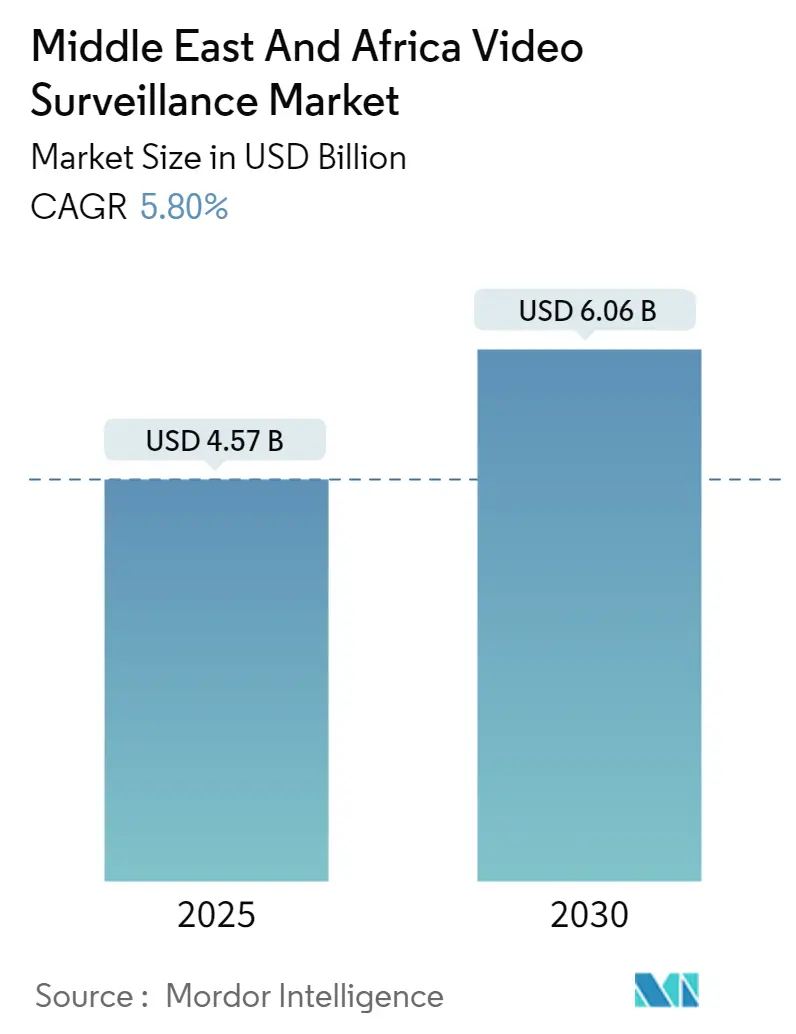
The Middle East And Africa Video Surveillance Market size is estimated at USD 4.57 billion in 2025, and is expected to reach USD 6.06 billion by 2030, at a CAGR of 5.8% during the forecast period (2025-2030).
The countries in the Middle East have technologically advanced digital surveillance infrastructure, especially in the Gulf Cooperation Council (GCC) states. In the past 10 years, governments of the Middle East have employed digital information and communication technologies to reinforce control over their citizens. Drawing inspiration from models provided by China, Russia, and Israel, Middle Eastern governments have implemented policies and strategies aimed at censorship, digital deception, and mass surveillance.
Two factors in the region have majorly supported this growing focus on digital surveillance. First, the GCC states are among the most “successful” models presenting authoritarian adaptation to digital activism in the Middle East. These states primarily avoided the violence and chaos that emerged from the suppression of the “Arab Spring” movements. However, the GCC military, security assistance to Bahrain, and simmering tensions in eastern Saudi Arabia were important exceptions. Domestically, these states are particularly susceptible to the perceived risks of social media and are heavily committed to preventing the resurgence of revolutionary politics. Notably, they have also sought to influence the course of devastating conflicts persisting in Libya, Syria, and Yemen online and offline, with various results.
Secondly, the Gulf states are significantly well-connected, both in terms of their internet penetration rates that are consistently the highest in the region and compare favorably worldwide, and because their openness to global capital has turned them sites of significant digital expertise in e-government, health, energy, and other critical sectors. These states have sought to utilize their reputation as major players in digital innovation to underpin long-term efforts at economic diversification and deflect political criticism.
Moreover, from the ‘Golden Shield Project’ to the Great Firewall, Sky-Net, and Sharp Eyes, China has been a model for digital authoritarianism and remains the main supplier of advanced mass surveillance technologies. The making of a ‘Silk Digital Road’ has further favored the export of technologies and knowledge toward the regions: Egypt, Morocco, Qatar, Saudi Arabia, and the United Arab Emirates (UAE) to build a digital totalitarian state, with the United Arab Emirates investing in sophisticated programs such as smart cities technology and the “Police without Policemen” program.
In April 2024, for the first time since its inception, the Gulf Cooperation Council (GCC) announced its ‘Vision for Regional Security’ at a ceremony held in its headquarters in Riyadh. The ‘Vision for Regional Security’ emphasizes that it is based on the principles of shared destiny and indivisible security of the member states, and any threat to one is a threat to all the member states.
Moreover, in December 2023, the United Arab Emirates announced installing 12,000 surveillance cameras at the United Nations' COP28 climate summit in Dubai. Also, the country already has deployed facial recognition at immigration gates at Dubai International Airport, the world’s busiest for international travel. Thus, with such announcements coming into the picture, the fact gets strength that digital surveillance technologies play a central role in these dynamics, thus driving the role of video surveillance in the regional market.
Middle East and Africa Video Surveillance Market Trends and Insights
Rising Geopolitical Unrest in the Region Driving the Importance of Proper Surveillance
- In the previous years, the broader Middle East and North Africa (MENA) regional security environment has been shaped by the cycle of insecurity and instability. The structural transformation in the MENA has unleashed such forces that the region has been destabilized by multi-faceted conflicts, which have seen the involvement of many local, regional, and global actors.
- For instance, a few years back, a retroactive reading suggests that a decade of turmoil was triggered mainly by the demands for political transformation observed in several countries. The broader transitions in the international order have also significantly accelerated the pace and direction of regional restructuring. The transformation of the regional order has been sparked by a wave of popular uprisings called the Arab Spring. As a result, the United Arab Emirates has welcomed the extensive use of surveillance technology to keep tabs on its citizens and collect and utilize data on a massive and unprecedented scale.
- Further, the humanitarian and security implications of the terrorist attacks on Israel on October 7, 2023, which were further followed by the war in Gaza, were broad and significant. However, they are not limited to the immediate neighborhood of the violent hostilities or the broader Middle East. However, as the conflict worsens and risks spreading, its impact and far-reaching effects have been observed on European, Middle East, and African security, which would likely become more consequential.
- In May 2023, Amnesty published a report titled "Automated Apartheid," which revealed details about Israel's Red Wolf program. This program uses facial recognition technology to monitor Palestinians and is believed to be connected to previous programs known as Blue Wolf and Wolf Pack. Moreover, as per the report, facial-recognition surveillance networks have surged in East Jerusalem, which incorporates places of cultural significance such as the Damascus Gate, which is the old city’s largest entrance and a site of frequent protests against the occupying forces.
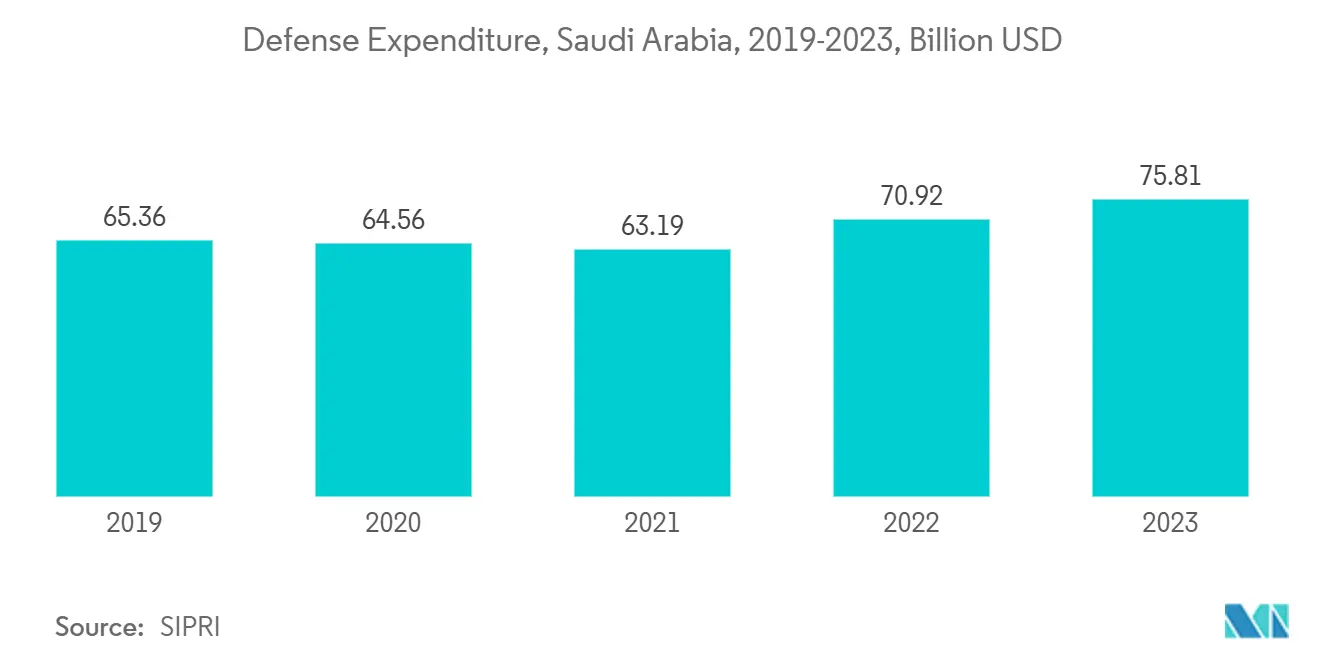
- Moreover, considering the impact of Houthi attacks on maritime traffic in the Red Sea, the concerns caused by the new Houthi threats are understandable. As per Risk Intelligence, following on from dozens of attacks against merchant ships in the Red Sea and the Gulf of Aden since November 2023, the Houthi group further threatened to extend the area of operations to the Eastern Mediterranean. All these factors present the dire need for incorporating proper surveillance setup, further leading the government to surge their defense budgets, thus favoring the growth of the video surveillance market in the region.


Growing Prevalence of Industrial Surveillance in the Region to Drive the Industrial Segment Growth
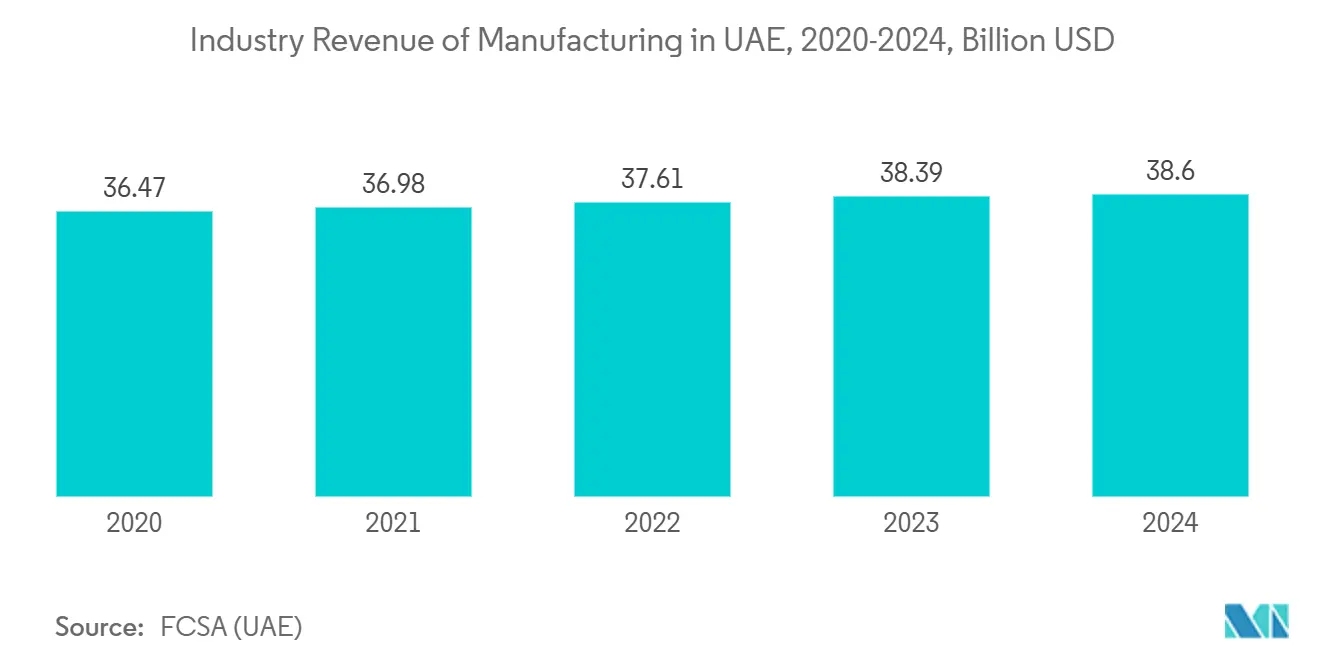
- Infrastructural investment, government mandates, rising risk of perceived threat activities, and stringent implementations are leading to increased adoption of commercial security in the Middle East. Integrating security systems, such as access control and video surveillance, simplifies security management and increases cost efficiency. Regulatory bodies in the GCC have laid down strict rules for installing surveillance cameras across almost all market sectors, along with video surveillance storage requirements of up to 180 days. The Kingdom of Saudi Arabia, the United Arab Emirates, and Qatar are strong contributors to the commercial security market in the Middle East.
- One of the most innovative developments is the incorporation of AI technology with surveillance IP cameras for video analytics within KSA, altering security and surveillance procedures across the sector. Organizations have been utilizing advanced video analytics from Riyadh to Jeddah, including Dammam to Medina and beyond, to enhance their operations' safety and efficiency.
- Also, surveillance in the maritime domain is crucial within the Middle East, with large volumes of cargo being passed through the Indian Ocean, Arabian Sea, and Gulf of Aden. This is an essential event to review the latest piracy threats to cargo ships and fisheries, driving the demand in the video surveillance market in the Middle East and Africa.
- In July 2023, UAE-based port operator AD Ports Group and defense and security company Saab UAE announced they would enter a strategic partnership. Under the agreement, AD Ports Group will facilitate access to relevant testing sites, delivering necessary infrastructure and operational feedback to optimize the development process. Meanwhile, Saab UAE will bring new industry standards and next-generation maritime surveillance technology to market.

Competitive Landscape
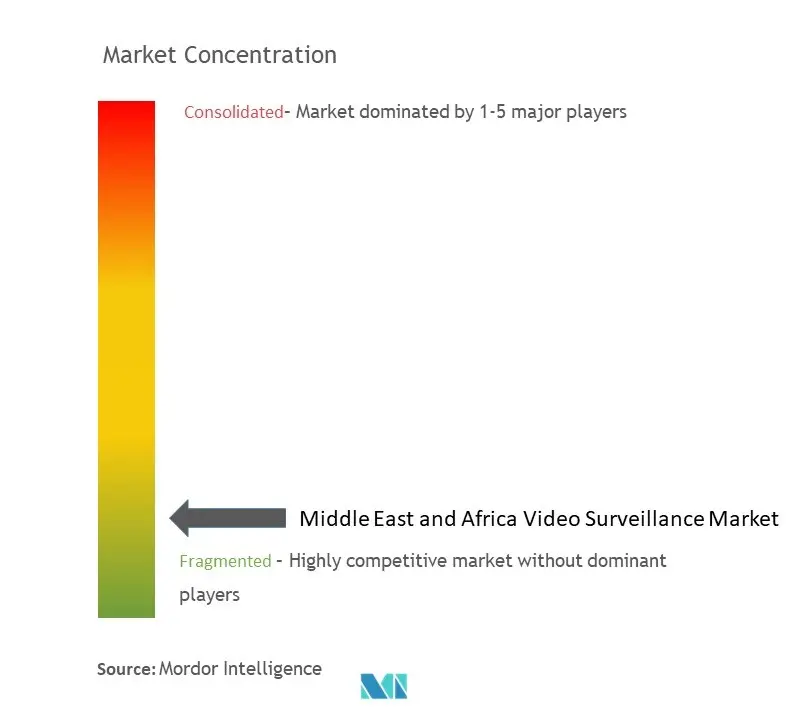
The Middle East and African video surveillance market is fragmented, with major players such as Panasonic Corporation, Samsung, Honeywell, and Bosch. Partnerships, innovations, investments, and acquisitions are among the strategies used by market participants to improve their product offerings and gain a sustainable competitive advantage.
- In May 2024, Practical Security Lab announced the commencement of its operations in the United Arab Emirates (UAE). It has been working toward partnerships and contracts with companies or organizations seeking unparalleled business information security solutions. Practical Security Lab offers various services, including cybersecurity, reverse engineering, and security development.
- In November 2023, Eagle Eye Networks announced the opening of a new data center in Riyadh, Saudi Arabia, to meet the increasing customer demand in the region. Eagle Eye Networks operates a global network of data centers specifically designed for video surveillance, cybersecurity, AI, and sustainability. The Eagle Eye security team manages all data centers directly to ensure maximum cybersecurity, performance, and availability.
Middle East and Africa Video Surveillance Industry Leaders
Axis Communications AB
Bosch Security Systems Incorporated
Honeywell Security Group
Samsung Group
Panasonic Corporation
- *Disclaimer: Major Players sorted in no particular order

Recent Industry Developments
- March 2024: Hikvision announced a technology partnership with Can'nX, enabling Hikvision technologies to be integrated with the KNX protocol, the global standard for home and building automation. Owing to the collaboration, integrators can enhance their building automation solutions by integrating Hikvision AI-enabled devices, such as cameras, into building systems, surging the efficiency of building management and improving overall security.
- October 2023: FUJIFILM introduced the FUJINON SX1600 camera system for long-range surveillance applications for the first time in a European show at the Milipol homeland security and safety show held in ParisNord Villepinte from November 14 to 17, 2023, at booth 4F055. The SX1600 is a state-of-the-art long-range camera system incorporating a 40x-zoom FUJINON lens that covers a focal length range from the wide-angle 40 mm to 1600 mm telephoto and has been further equipped with a newly developed image stabilization system and fast and accurate autofocus to capture a distant subject clearly and instantaneously.


Middle East and Africa Video Surveillance Market Report Scope
Video surveillance systems contain one or more video cameras connected to a network that sends the captured video or audio data to a specific location. The captured images are monitored in real-time or sent to a central location for recording and storage. Many applications, such as crime prevention, industrial process monitoring, and traffic management, increasingly utilize video surveillance systems. The market is defined by the revenue from the sales of different video surveillance products that find applications for various end users across the countries, including the United Arab Emirates, Saudi Arabia, and South Africa.
The Middle East and African video surveillance systems market is segmented by type (hardware [camera [analog, IP cameras, and hybrid], storage], software [video analytics and video management software], services [VsaaS]), end-user vertical (commercial, infrastructure, institutional, industrial, defense, residential), and country (United Arab Emirates, Saudi Arabia, South Africa, and Rest of Middle East and Africa). The market sizes and forecasts are provided in terms of value (USD).
| Hardware | Camera | Analog |
| IP Camera | ||
| Hybrid | ||
| Storage | ||
| Software | Video Analytics | |
| Video Management Software | ||
| Services (VSaaS) |
| Commercial |
| Infrastructure |
| Institutional |
| Industrial |
| Defense |
| Residential |
| United Arab Emirates |
| Saudi Arabia |
| South Africa |
| Iran |
| Nigeria |
| Iraq |
| By Type | Hardware | Camera | Analog |
| IP Camera | |||
| Hybrid | |||
| Storage | |||
| Software | Video Analytics | ||
| Video Management Software | |||
| Services (VSaaS) | |||
| By End-user Vertical | Commercial | ||
| Infrastructure | |||
| Institutional | |||
| Industrial | |||
| Defense | |||
| Residential | |||
| By Country*** | United Arab Emirates | ||
| Saudi Arabia | |||
| South Africa | |||
| Iran | |||
| Nigeria | |||
| Iraq | |||


Key Questions Answered in the Report
How big is the Middle East And Africa Video Surveillance Market?
The Middle East And Africa Video Surveillance Market size is expected to reach USD 4.57 billion in 2025 and grow at a CAGR of 5.80% to reach USD 6.06 billion by 2030.
What is the current Middle East And Africa Video Surveillance Market size?
In 2025, the Middle East And Africa Video Surveillance Market size is expected to reach USD 4.57 billion.
Who are the key players in Middle East And Africa Video Surveillance Market?
Axis Communications AB, Bosch Security Systems Incorporated, Honeywell Security Group, Samsung Group and Panasonic Corporation are the major companies operating in the Middle East And Africa Video Surveillance Market.
What years does this Middle East And Africa Video Surveillance Market cover, and what was the market size in 2024?
In 2024, the Middle East And Africa Video Surveillance Market size was estimated at USD 4.30 billion. The report covers the Middle East And Africa Video Surveillance Market historical market size for years: 2019, 2020, 2021, 2022, 2023 and 2024. The report also forecasts the Middle East And Africa Video Surveillance Market size for years: 2025, 2026, 2027, 2028, 2029 and 2030.
Page last updated on:
Middle East and Africa Video Surveillance Market Report
Statistics for the 2025 Middle East and Africa Video Surveillance market share, size and revenue growth rate, created by Mordor Intelligence™ Industry Reports. Middle East and Africa Video Surveillance analysis includes a market forecast outlook for 2025 to 2030 and historical overview. Get a sample of this industry analysis as a free report PDF download.





