
Market Overview
| Study Period | 2020 - 2031 |
|---|---|
| Forecast Data Period | 2026 - 2031 |
| Base Year Market Size (2025) | USD 17.87 Billion |
| Market Size (2026) | USD 19.82 Billion |
| Market Size (2031) | USD 33.29 Billion |
| Growth Rate (2026 - 2031) | 10.93 % |
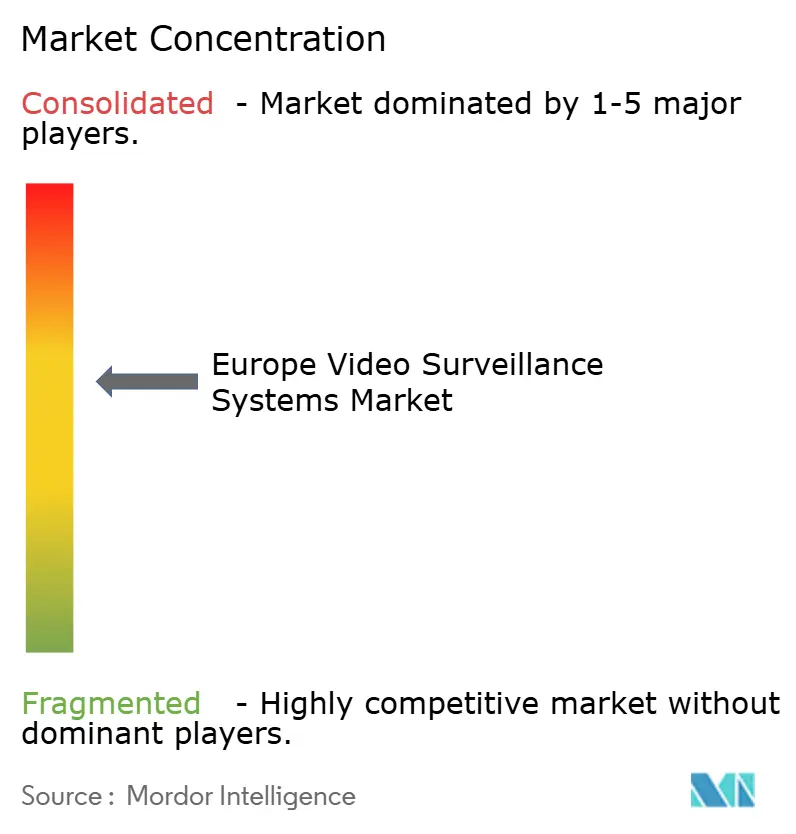
| Market Concentration | Medium |
Major Players
*Disclaimer: Major Players sorted in no particular order Image © Mordor Intelligence. Reuse requires attribution under CC BY 4.0. |
|
Europe Video Surveillance Systems Market Analysis by Mordor Intelligence
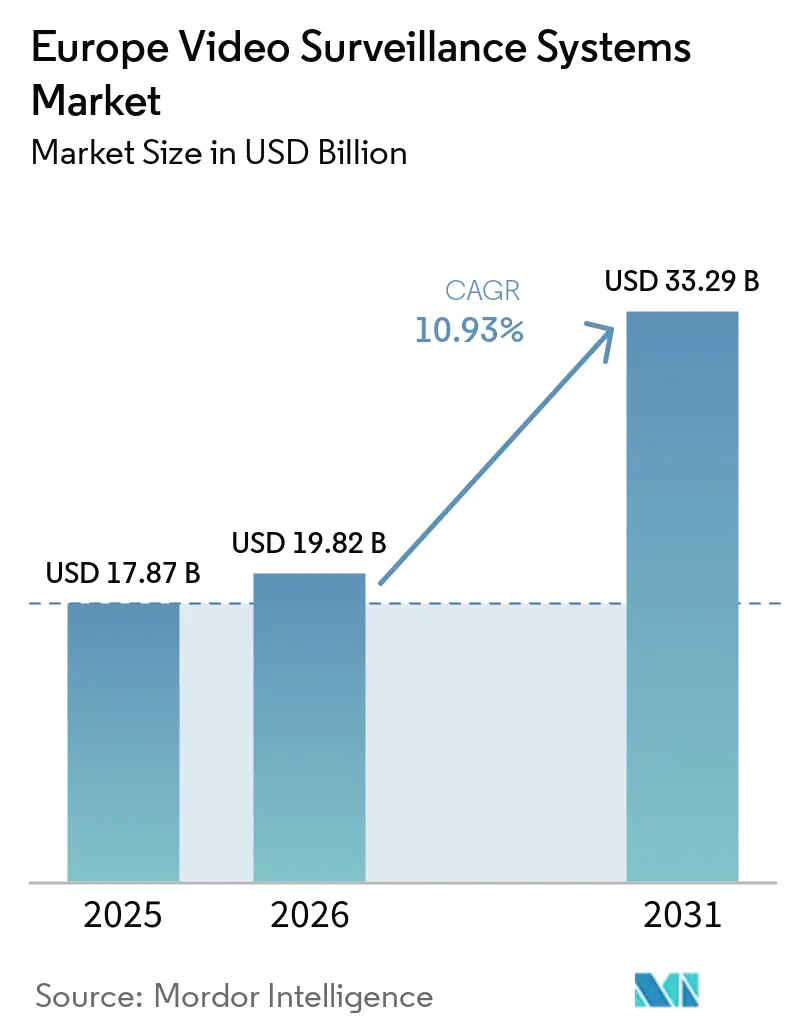
The Europe video surveillance systems market size in 2026 is estimated at USD 19.82 billion, growing from 2025 value of USD 17.87 billion with 2031 projections showing USD 33.29 billion, growing at 10.93% CAGR over 2026-2031. Adoption momentum is shifting from passive monitoring toward predictive, AI-driven platforms that mesh with smart-city roadmaps and ESG disclosure rules. Stringent geosecurity policies such as the United Kingdom’s April 2025 ban on Chinese-made gear are creating short-cycle replacement demand that benefits European and allied suppliers.[1] Parallel legislation the EU AI Act and Cyber Resilience Act forces vendors to re-architect products around edge processing and federated learning, thereby reducing cross-border data transfers. Cloud-managed Video as a Service models appeal to small enterprises that wish to convert capital expense into operating expense, while 5G connectivity accelerates municipal roll-outs in heritage city centers where trenching fiber is infeasible. AI-ready 4K cameras now underpin analytics that lower false-alarm rates, raising the baseline specification for new procurements.
Key Report Takeaways
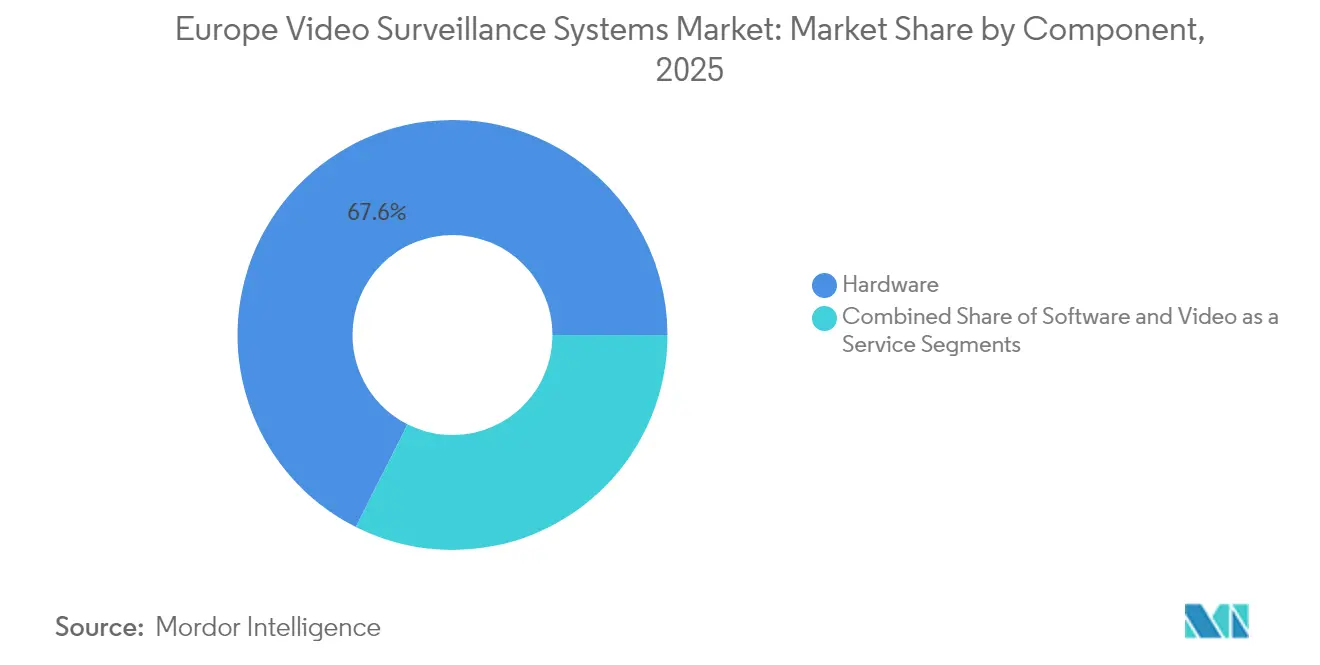
- By component, hardware led with 67.58% of Europe video surveillance systems market share in 2025, whereas Video as a Service is advancing at an 11.48% CAGR to 2031.
- By deployment mode, on-premises retained 60.55% share of the Europe video surveillance systems market size in 2025 and cloud is poised to expand at 11.95% through 2031.
- By connectivity, wired installations dominated with 52.10% share in 2025 while cellular and 5G cameras are forecast to rise at 12.65% CAGR to 2031.
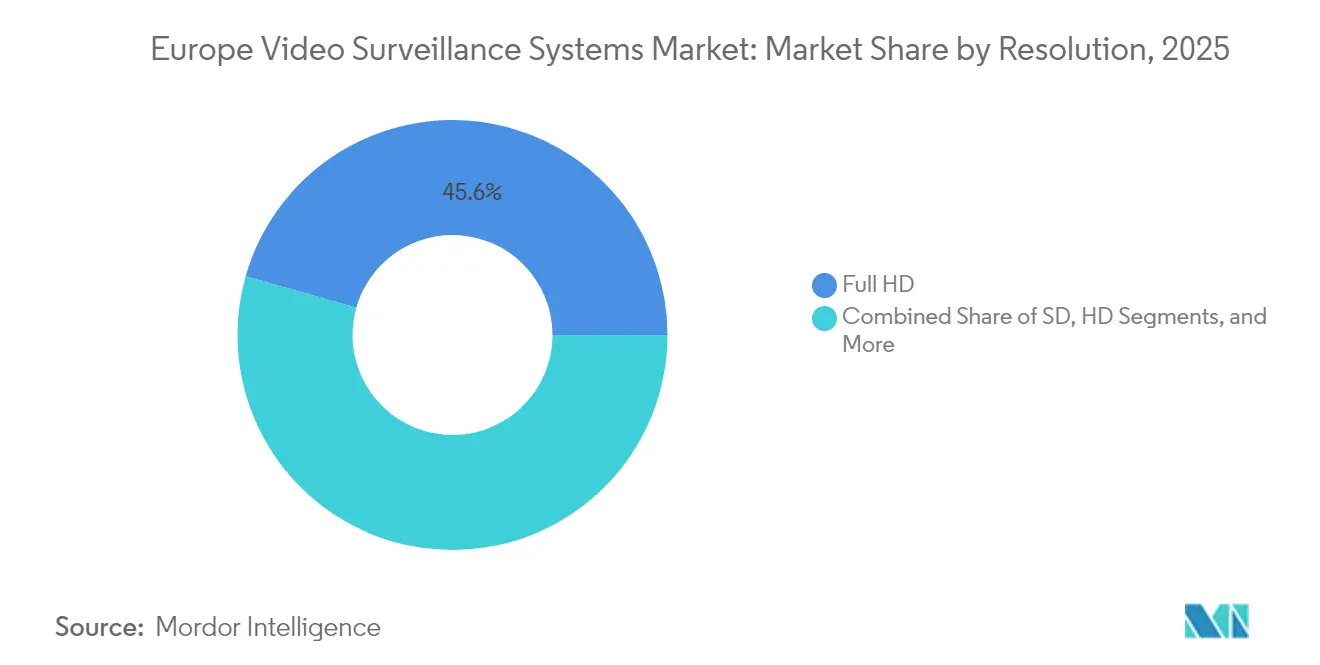
- By resolution, Full HD captured 45.60% share in 2025; 4K Ultra HD is projected to climb at 11.92% CAGR to 2031.
- By end-user, commercial sites held 42.85% in 2025, and the residential segment is expected to register an 11.55% CAGR to 2031.
- By country, the United Kingdom commanded 23.55% revenue in 2025, but Italy is projected to grow at 12.05% CAGR through 2031.
Note: Market size and forecast figures in this report are generated using Mordor Intelligence’s proprietary estimation framework, updated with the latest available data and insights as of 2026.
Market Trends and Insights
Drivers Impact Analysis of Europe Video Surveillance Systems Market*
| Driver | (~) % Impact on CAGR Forecast | Geographic Relevance | Impact Timeline |
|---|---|---|---|
| Increased Spending in Advanced Security Systems | +2.1% | UK, Germany, France, Italy, Rest of Europe | Medium term (2-4 years) |
| Growth in Public and Private Infrastructure | +1.9% | Italy, France, UK, Rest of Europe | Medium term (2-4 years) |
| Regulatory Push for Public Safety Compliance | +1.7% | EU-wide, strongest in Germany and France | Short term (≤ 2 years) |
| Rapid Adoption of AI-Enabled Video Analytics | +2.3% | UK, Germany, Italy, France | Short term (≤ 2 years) |
| Integration of Surveillance with ESG Retrofits | +1.2% | Germany, UK, France, Nordic nations | Long term (≥ 4 years) |
| Demand for GDPR-Compliant Edge Storage | +1.6% | EU-wide, notably Germany and France | Medium term (2-4 years) |
| Source: Mordor Intelligence | |||
Increased Spending in Advanced Security Systems
Public budgets climbed sharply in 2024 as the United Kingdom earmarked GBP 230 million (USD 289 million) for police facial-recognition upgrades, while France set aside EUR 46 million (USD 49 million) to install AI traffic cameras across 4,000 roadside sites. Italy’s EUR 97.7 million (USD 104.3 million) Rome 5G CCTV program modernizes 2,000 analog cameras ahead of the 2025 Jubilee. Germany’s civil security framework funds pilots that favor domestic analytics vendors, reinforcing technological sovereignty. Commercial real-estate owners are mirroring these moves, embedding surveillance into building-management suites to meet ESG metrics that insurers and tenants now demand.
Growth in Public and Private Infrastructure
Critical-asset operators embrace multi-sensor networks to meet EU resilience directives. Europol budgeted EUR 67.8 million (USD 72.3 million) for biometric upgrades linking cameras to travel databases during 2025-2027. Genoa’s Project Hafnia integrates 2,700 cameras with NVIDIA-accelerated analytics for real-time traffic management. France’s defense plan allocates space-based funds for maritime surveillance, highlighting terrestrial-to-satellite convergence. The UK Ministry of Defence’s rising budget includes perimeter-security overhauls at sensitive sites. Utilities deploy thermal and hyperspectral cameras that cut physical patrols by 40%.
Regulatory Push for Public Safety Compliance
The EU AI Act, effective 2024, mandates algorithmic transparency and human oversight for high-risk video analytics. Europol ethical guidelines favor privacy-preserving methods such as federated learning, giving certified vendors a procurement edge.[2] Germany’s NIS2 rollout compels essential-service operators to devote roughly 9% of IT budgets to cybersecurity, boosting demand for hardened cameras. Under the Cyber Resilience Act, manufacturers must patch firmware for five years, accelerating the pivot to edge-based designs that minimize network exposure.
Rapid Adoption of AI-Enabled Video Analytics
Edge processors embedded in cameras now conduct object recognition and license-plate capture locally, slashing bandwidth needs by up to 80%. Axis introduced 4K models with on-device AI that achieve 95% classification accuracy in low-light scenes. Bosch’s new FLEXIDOME line cuts false alarms by 70% via behavioral triggers. Lombardy municipalities saw park-crime fall 80% after deploying i-PRO cameras in 2024. Milestone’s XProtect integrates NVIDIA Metropolis to orchestrate federated learning across multivendor fleets. EU Digital Europe funding of EUR 390 million (USD 454.12million) backs privacy-compliant analytics research through 2027.
Restraints Impact Analysis of Europe Video Surveillance Systems Market*
| Restraint | (~) % Impact on CAGR Forecast | Geographic Relevance | Impact Timeline |
|---|---|---|---|
| Security Concerns Regarding Video Data | −1.4% | EU-wide, notably Germany and France | Short term (≤ 2 years) |
| High Implementation and Maintenance Costs | −1.8% | Southern Europe, Eastern Europe | Medium term (2-4 years) |
| Fragmentation of National Standards | −0.9% | EU-wide, multi-country projects | Long term (≥ 4 years) |
| Semiconductor Supply-Chain Volatility | −1.1% | EU-wide, Asian dependencies | Short term (≤ 2 years) |
| Source: Mordor Intelligence | |||
Security Concerns Regarding Video Data
Breaches targeting unpatched firmware intensified in 2024, prompting Germany’s BSI to recommend edge-level encryption with locally held keys. ENISA surveys show 89% of critical operators adding staff to manage surveillance vulnerabilities. GDPR Article 44 restricts exporting footage to non-adequate jurisdictions, complicating cloud back-ups. Italy’s security trade body reports a pivot to Western hardware amid worries over hidden backdoors, reinforced by the UK’s imminent Chinese-equipment ban. Hardware-level secure enclaves raise unit prices 15-20%, slowing purchases by budget-constrained municipalities.
High Implementation and Maintenance Costs
Enterprise-grade cameras range from EUR 500 (USD 533) to EUR 3,000 (USD 3,200), excluding installation, network upgrades, and software licenses. Southern and Eastern European SMEs often extend analog lifecycles to defer these expenditures. Annual maintenance, including firmware support, adds 10-15% to total cost. Rome’s 5G project earmarked EUR 20 million (USD 21.3 million) solely for upkeep. Subscription VSaaS reduces upfront spend but can exceed on-premises costs over long contracts once bandwidth fees escalate. Fragmented tender rules further erode scale economies, although Germany’s research pilots explore lower-cost deployment archetypes.
*Our forecasts treat driver/restraint impacts as directional, not additive. The impact forecasts reflect baseline growth, mix effects, and variable interactions.
Europe Video Surveillance Systems Market Segment Analysis
By Component:
Subscription Uptake Outpaces Hardware DominanceHardware retained 67.58% share in 2025. Cameras, recorders, and ancillary devices underpin most installed systems across the Europe video surveillance systems market. Yet, Video as a Service is projected to log an 11.48% CAGR, the fastest rise among components, as municipalities and SMEs pivot toward bundled leases that encompass equipment, cloud storage, and analytics within a single monthly invoice. Software platforms orchestrate heterogeneous fleets and embed AI that trims bandwidth by processing events at the edge. Axis released four GDPR-compliant models in Q3 2024 with on-board inference engines. Storage appliances still appeal in banking and defense, where auditors demand air-gapped evidence trails.
Operating-expense preferences give VSaaS momentum as enterprises guard cash in uncertain macro conditions. Verkada’s London hub markets a hybrid cloud that stores data locally for 30–120 days before archiving it to GDPR-aligned data centers. Eagle Eye has added federated learning support, allowing AI to refine models without viewing raw footage. Genetec’s Security Center 5.12 integrates AutoVu ALPR to help police trace vehicle movements while meeting AI Act audit mandates. Hardware OEMs counter by embedding stronger chips, positioning against pure-cloud rivals with hybrid value propositions, thereby sustaining the Europe video surveillance systems market as a balanced capex-opex landscape.

By Deployment Mode:
Hybrid Designs Reconcile Compliance and FlexibilityOn-premises architectures accounted for 60.55% share in 2025, favored by finance, defense, and critical-infrastructure segments that disallow public-cloud footage. Cloud services are forecast to expand at 11.95% CAGR, tapping SMEs that lack IT resources. Hybrid architectures blend local retention with cloud analytics, satisfying GDPR residency while accessing scalable AI. Milestone’s 2024 releases let operators tag streams for on-prem versus cloud processing. Rome’s city network keeps 30 days on local edge servers and archives older data inside national cloud facilities.
Bandwidth economics also shape choices. France’s 4,000 traffic cameras transmit only violation snapshots, lowering LTE overhead. Germany steers procurement toward EU-hosted infrastructure, minimizing foreign dependency. The UK’s Chinese-equipment sunset accelerates swaps to allied hybrid systems. Encryption keys under direct custody further mitigate third-party breach risk, supporting the Europe video surveillance systems market trajectory toward federated hybrid estates.
By Camera Connectivity:
5G Spurs Rapid Urban DeploymentWired Ethernet and fiber remained dominant at 52.10% in 2025, yet cellular and 5G cameras should register 12.65% CAGR to 2031. Historic city centers avoid disruptive trenching; wireless installs reduce lead times from weeks to days. Rome installed 2,000 5G cameras in 2024 using national telecom networks. France’s EUR 46 million (USD 53.56 million) roadside program banks on LTE uploads of enforcement snapshots.
Dedicated network slices guarantee <20 ms latency and strong uplink, enabling real-time analytics. Germany’s research pilots test 5G standalone links for emergency response. Axis’ modular cellular sensor targets remote construction sites, using solar panels to power dormant-until-motion designs that conserve bandwidth. Hanwha’s Wisenet X Plus integrates LTE modems for railway corridors. Police mobility units in the UK feed biometric data to central watch lists over encrypted 5G, underlining the Europe video surveillance systems market’s move toward ultra-flexible connectivity.
By Resolution:
4K Becomes AI-Friendly NormFull HD commanded 45.60% share in 2025, an incumbent workhorse. 4K Ultra HD is projected to climb at 11.92% CAGR as higher pixel density boosts detection accuracy by roughly 25-30%. Axis’ 4K bullet model recognizes license plates at speeds of 120 km/h under 0.1 lux light. Bosch sensors pair 4K with analytics that slash false alerts 70%.
Italy’s Genoa Project Hafnia leaned on 4K streams to train NVIDIA vision-language models for congestion prediction. France’s roadside cameras specify 4K clarity to automate seatbelt and phone enforcement, cutting manual review by 60%. Compression advances (H.265+, H.266) lower storage need nearly 50%, making 4K affordable at scale and reinforcing the Europe video surveillance systems market evolution toward high-definition baselines. Better video compression is reducing storage needs for 4K surveillance, supporting the Europe video surveillance storage market.
By End-User:
Residential Uptake AcceleratesCommercial premises led with 42.85% share in 2025, covering retail, banking, and hospitality. Residential projects are forecast for 11.55% CAGR through 2031 as multi-family developers bundle surveillance into smart-building dashboards to satisfy ESG-minded tenants. Government deployments shape marquee roll-outs such as Italy’s Rome Jubilee network and the UK’s police facial-recognition expansion.
Retailers overlay analytics on POS data to flag internal shrinkage, reporting 10-15% conversion boosts when layout tweaks align with heat-map insights. Banks require tamper-evident housings and encrypted streams at ATMs. Hospitality chains deploy privacy-masking in guest corridors while leaving lobby views unblurred to enhance safety assurances. Manufacturers use thermal cameras to detect PPE compliance and avert downtime. Utilities observe substations with fusion-sensor units, reducing patrols 40%. The Europe video surveillance systems market therefore spans disparate risk profiles, yet converges on AI-enabled insight extraction.
Geography Analysis
Southern, Northern and Eastern Europe Video Surveillance Systems Market
Southern Europe exhibits the fastest compound growth because EU recovery funds subsidize smart-city retrofits that bundle surveillance with traffic management. Italy’s EUR 97.7 million (USD 113.76 million) upgrade ahead of the 2025 Jubilee exemplifies event-linked stimulus that yields lasting infrastructure. Northern Europe, led by the United Kingdom and Germany, emphasizes data sovereignty. German pilots use federated learning to comply with strict privacy norms, while the UK’s procurement terms now prioritize allied supply chains. Eastern European municipalities, constrained by budget, gravitate toward subscription VSaaS models delivered from regional data centers. Collectively, these dynamics shape a mosaic where each subregion balances security imperatives against privacy culture, reinforcing the multifaceted expansion of the Europe video surveillance systems market.
Central Europe and Nordics Video Surveillance Systems Market
Central European states deploy hybrid architectures that route analytics to in-country clouds, curbing latency and aligning with the Cyber Resilience Act’s five-year patch mandate. France’s nationwide AI traffic camera initiative signals how safety enforcement can drive high-volume camera deployments beyond traditional city-center grids. Nordic countries leverage renewable-powered edge nodes, aligning surveillance carbon footprints with local climate targets and ESG reporting. Such geographically varied drivers underpin steady demand yet compel vendors to localize feature sets, certifications, and data-residency options, thereby sustaining competitive diversification within the Europe video surveillance systems market.
Balkans and Baltics Video Surveillance Systems Market
Cross-border data-sharing projects, including Europol’s biometric interoperability upgrades, encourage harmonization of video metadata schemas. Yet divergent national cybersecurity labels still slow continent-wide roll-outs. EU cohesion programs increasingly fund joint tenders that aggregate smaller orders across Balkans and Baltics, improving purchasing power. As these mechanisms mature, they are expected to reduce fragmentation, enabling broader adoption of AI-ready cameras and cloud management tools in less urbanized areas, enlarging the addressable base of the Europe video surveillance systems market.
Regulatory Landscape
The market sits at the intersection of EU privacy, AI, and cybersecurity requirements, which affect camera use cases, how footage is processed, and what support timelines vendors must meet. The EU AI Act (Regulation (EU) 2024/1689) entered into force in August 2024 and establishes strict conditions for high-risk AI-based video analytics, including technical documentation, transparency, and human oversight, while prohibiting practices such as creating or expanding facial recognition databases through untargeted scraping of CCTV footage. GDPR obligations for video devices remain a core constraint as well, with European Data Protection Board (EDPB) guidance emphasizing data minimization, purpose limitation, and privacy by design and by default for controllers deploying cameras.
Product specifications and acceptance testing are increasingly tied to European standards. EN IEC 62676-5-1:2024 (approved by CENELEC on August 22, 2024) updates data specifications and image quality performance expectations for camera devices, and CEN/CLC/TR 17919:2023 provides guidance on applying privacy-by-design principles to video surveillance products and services. Alongside EU-wide rules, national security and geosecurity decisions can also shape vendor eligibility and replacement cycles, as reflected by the United Kingdoms April 2025 ban on certain Chinese-made equipment referenced in market dynamics.
Value Chain Analysis
The value chain includes imaging and compute component suppliers (image sensors, optics, AI-capable SoCs/VPUs), camera and recorder OEMs, and VMS and video analytics software providers. It also relies on cloud and connectivity partners, including telecom operators for cellular and 5G backhaul, as well as distributors and system integrators that design, install, and maintain deployments for municipal, transport, commercial, and critical-infrastructure customers. Europe is strong in VMS and software capabilities and in systems integration, with multi-vendor platforms used in public projects, but it remains structurally dependent on imported high-performance sensors and AI silicon, which elevates lead-time and lifecycle planning requirements for large tenders and refresh programs.
Compliance and cybersecurity requirements increasingly influence how value is created and captured, pushing more functionality into software, secure firmware, and managed services. Recent partnership activity reflects the move toward pre-integrated, compliance-oriented stacks, including AxxonSofts January 2025 partnership with Eurotech to integrate VMS with cybersecurity-certified edge hardware using NVIDIA Jetson Orin for smart cities and critical infrastructure, and Milestones May 2025 MoU with Wintics to co-develop AI models for public safety and mobility. With the EU AI Act timeline tightening toward full applicability in August 2026, vendors and integrators are building modular architectures (hybrid retention, federated learning, edge inference), supported by software and services to reduce the need for hardware-only refresh cycles.
Competitive Landscape
Axis grew its Q3 2024 sales by 14% year-over-year and released four AI-equipped models that support GDPR-aligned edge inference. Bosch is partnered with Microsoft Azure and AWS to offer scalable video analytics, underscoring the growing importance of hyperscale partners. Milestone’s NVIDIA alliance, under Project Hafnia, demonstrates how software vendors leverage AI ecosystems to differentiate themselves.
Cloud-native challengers Verkada and Eagle Eye gain mindshare among SMEs by bundling hardware leasing with low-touch cloud management. Their expansion pressures incumbents to enrich firmware security and subscription offerings. Geopolitical factors reshape the share, the UK ban on certain Chinese brands prompts public agencies to shift toward European and allied portfolios, reallocating contracts worth tens of millions. Vendors achieving early compliance with the EU AI Act and Cyber Resilience Act gain bid advantages as public purchasers demand audit-ready documentation.
Regional specialists thrive in niche verticals, such as MOBOTIX in critical manufacturing and i-PRO in municipal crime reduction, leveraging deep domain expertise. Partner ecosystems remain pivotal, with open-architecture mandates prompting camera makers to certify integrations across Milestone, Genetec, and Hanwha platforms. The evolving mix of hardware, software, and service models keeps the Europe video surveillance systems market competitively dynamic while gradually tilting toward subscription economics and AI-centric differentiation.
Europe Video Surveillance Systems Industry Leaders
-
Hangzhou Hikvision Digital Technology Co. Ltd.
-
Robert Bosch GmbH
-
Axis Communications AB
-
Hanwha Vision Co., Ltd.
-
MOBOTIX AG
- *Disclaimer: Major Players sorted in no particular order
Europe Video Surveillance Systems Market Companies Covered in this Report
- Hangzhou Hikvision Digital Technology Co. Ltd.
- Robert Bosch GmbH
- Axis Communications AB
- Hanwha Vision Co., Ltd.
- MOBOTIX AG
- Milestone Systems A/S
- Genetec Inc.
- Dahua Technology Co., Ltd.
- Videotec SpA
- ABUS Security Tech Germany GmbH
- Ava Security Ltd.
- Infinova Corporation
- Eagle Eye Networks Inc.
- Verkada Inc.
Read Analysis of Europe Video Surveillance Systems Companies
Market Opportunities and Future Outlook
Public-sector modernization programs and compliance-driven refresh cycles are creating demand for unified, open-architecture platforms that consolidate video with access control and intrusion, reducing the number of operator consoles needed for multi-domain security. Completed and approved projects show the direction of travel. In May 2026, the Port of Barcelona modernized security by centralizing video, access control, and intrusion detection on Genetec Security Center, and in May 2026, Gandia approved a EUR 1.33 million program to unify 124 existing cameras with 38 new street cameras and 175 police body-worn cameras, targeting completion by year-end 2026. These rollouts create room for vendors that can integrate mixed fleets, standardize evidence handling, and provide audit-ready reporting across city surveillance and transportation infrastructure.
The AI Act and privacy-by-design expectations are also expanding opportunities for edge analytics and data-sovereign hybrid architectures that reduce cross-border transfers while preserving advanced detection and search. As the EU AI Act entered into force in August 2024 and moves toward full applicability in August 2026, procurement emphasis is shifting toward human oversight features, documentation toolchains, and secure-by-design firmware support. Suppliers can bundle these requirements into VSaaS and managed offerings aimed at SMEs and mid-market customers. Parallel adoption of edge-computing cameras in local authority upgrades, such as Barnet Councils July 2026 CCTV upgrade using i-PRO edge-AI cameras with Genetec VMS, indicates near-term pull for solutions that combine analytics performance with cyber hardening and governance controls.
Recent Industry Developments in Europe Video Surveillance Systems Market
- July 2026: Barnet Council completed a major CCTV upgrade using i-PRO edge-AI cameras and Genetec VMS, adding capabilities such as heat-mapping and people-counting. The program illustrates how edge processing is being adopted to deliver analytics without sending all raw video to centralized systems, supporting deployments under data-minimization and bandwidth constraints.
- May 2026: Robert Bosch GmbH released the DINION 7100s enclosure-ready box camera series on the CPP16 platform, bundling IVA Pro analytics with cybersecurity-oriented specifications referenced in launch coverage (including FIPS 140-3 Level 3 and IEC 62443). The release reinforces the shift toward cyber-hardened cameras as baseline requirements for regulated end users and critical infrastructure tenders.
- September 2024: Axis Communications introduced four new AI-ready camera families for enterprise and public-sector deployments. The addition of on-device analytics options supports the broader move toward edge inference and hybrid architectures that reduce network load while improving compliance options for GDPR-focused customers.
Europe Video Surveillance Systems Market Report Scope and Research Methodology
Market Definition and Coverage
For this study, the Europe video surveillance systems market covers solutions used to capture, store, manage, and analyze video for security and monitoring, across cameras, recording and storage, software layers (VMS and analytics), and video surveillance as a service delivered through cloud or hybrid setups.
Scope exclusions: We exclude general physical security items that do not generate or manage video (such as stand-alone access control readers, intrusion sensors, and guarding services) unless they are bundled and priced as part of a video surveillance system sale.
Segments Covered in This Report
-
By Component
-
Hardware
- Camera
- Storage
-
Software
- Video Analytics
- Video Management Software
- Video as a Service (VSaaS)
-
Hardware
-
By Deployment Mode
- On-Premises
- Cloud
- Hybrid
-
By Camera Connectivity
- Wired
- Wireless (Wi-Fi)
- Cellular/5G
-
By Resolution
- Standard Definition (SD)
- High Definition (HD)
- Full HD
- 4K Ultra HD
- 8K and Above
-
By End-User
-
Commercial
- Retail
- Banking, Financial Services and Insurance (BFSI)
- Hospitality
-
Industrial
- Manufacturing
- Energy and Utilities
-
Residential
- Single-Family
- Multi-Family
-
Government
- City Surveillance
- Transportation Infrastructure
-
Commercial
-
By Country
- United Kingdom
- Germany
- France
- Italy
- Rest of Europe
Data Sources, Market Sizing, and Validation
Desk Research
Desk research is used to set the market frame, understand how demand is changing across European countries, and collect steady reference points that can be checked each year. We leaned on public sources such as Eurostat for construction and business activity signals, the European Commission for security and digital policy direction, and ENISA for cybersecurity risk themes that influence adoption of connected cameras and cloud use.
We also reviewed technical and standards context from sources such as IEC and CENELEC publications where accessible, along with procurement and public safety signals from TED (Tenders Electronic Daily) and national open contracting portals. To connect market activity back to supplier reality, we complemented this with annual reports, investor decks, and press releases from system and component suppliers, plus patent databases to track changes in analytics features and camera capabilities. Select paid subscriptions were used for company financials and news screening, and for patent and tender monitoring where public listings were fragmented. The sources listed here are illustrative, and many other public and commercial references were also used to collect data, validate assumptions, and clarify gaps.
Primary Interviews and Surveys
Primary work focused on validating the Europe-specific demand mix across commercial sites, industrial facilities, residential deployments, and public sector projects, since buying cycles and budget owners differ by country. We spoke with a spread of camera and recorder suppliers, software and VSaaS providers, distributors and installers, and end users responsible for security and facilities, and then cross-checked pricing and upgrade patterns (IP migration, cloud storage choices, and analytics attach) across major European sub-regions.
Distribution of primary research fieldwork respondents
| Company type | Respondent position |
|---|---|
| Top tier: 28% | CXOs: 17% |
| Mid tier: 54% | Functional/Unit leaders: 26% |
| Smaller Players: 18% | Managers: 57% |
Market-Sizing & Forecasting
Sizing started with a top-down build that reconstructs spend by mapping the installed base refresh cycle and new site additions across Europe, and then applying product mix and pricing to cameras, recording and storage, VMS and analytics, and VSaaS. The model uses practical inputs that can be observed and stress-tested, such as construction activity for new commercial space, public procurement intensity for city and transport projects, the pace of analog to IP replacement, cloud and hybrid adoption rates, and typical resolution upgrades that change average selling prices.
Those totals were then corroborated with selective bottom-up approximations, mainly using sampled price points from channel checks, distributor and installer feedback on volumes, and a roll-up of reported regional revenue splits from supplier disclosures where available. When bottom-up visibility was weak (for example, small private installers or projects with bundled pricing), gaps were handled through country-level penetration assumptions and by anchoring to tender counts and replacement cycle logic, followed by analyst review and interview re-checks. Forecasts were built using scenario analysis tied to drivers that interviews repeatedly flagged as decision levers, including compliance pressure, cybersecurity hardening spend, and the speed of VSaaS conversion in multi-site customers.
Data Validation & Update Cycle
Outputs were validated through multiple checks so the final numbers do not rely on one data stream. We compared results against independent signals such as public tenders, supplier revenue direction, and country-level adoption narratives, and any sharp variance triggered a deeper cut by component and country before sign-off.
A second analyst review was used to re-check key assumptions like ASP steps by resolution, cloud share progression, and the split between new installs and replacement demand. The report is refreshed annually, and interim updates are made when major events materially change pricing, regulation, or supply conditions. Before delivery, we run a final pass to ensure the latest public releases and policy updates are reflected in the model.
Mordor Intelligence's Europe Video Surveillance Systems Market Size Versus Other Published Estimates
It is normal to see different market sizes published for Europe video surveillance, because studies can count different parts of the value chain and they also vary in how they treat cloud services and software attach. Differences also come from the year used, the exchange rate timing, and whether the forecast assumes faster or slower migration from analog to IP.
Some published figures emphasize cameras and core on-premise systems only, and others expand into broader security spending that includes more service revenue. In Mordor Intelligence, the count is limited to video surveillance systems spend across hardware, software (VMS and analytics), and VSaaS, and it excludes adjacent non-video physical security items unless they are priced inside a video system package.
Benchmark comparison
| Source | Market Size | Gaps in Research Methodology |
|---|---|---|
| Mordor Intelligence | USD 17.87 B (2025) | |
| Industry Research Portal A | USD 6.89 B (2025) | This estimate appears to lean toward equipment-led revenue, with cameras taking the main weight and limited visibility into software attach and recurring VSaaS value, which can materially lower totals in markets shifting to cloud and analytics. |
| Global Consultancy A | USD 26.80 B (2026) | The published scope is described as an ecosystem including broader professional services around video systems, and the cited year is different, which can raise the value when more service layers and later-year pricing are included. |
The spread in the table is mainly explained by what is counted beyond cameras, and by how recurring software and cloud delivery are treated versus one-time hardware sales. By keeping the scope tied to clear system components and then checking the totals against procurement signals, pricing reality, and upgrade cycles, the final value stays traceable to inputs that can be revisited as the market changes.
Key Questions Answered in the Report
How large is the Europe video surveillance systems market in 2026?
The market stands at USD 19.82 billion in 2026, with a 10.93% CAGR outlook to 2031.
Which component segment is growing fastest?
Video as a Service is projected to expand at 11.48% annually as users favor subscription models over capital purchases.
Why are 5G cameras gaining ground?
5G connectivity enables rapid deployment in heritage city centers where fiber trenching is costly and provides low-latency links for real-time analytics.
What drives Italys leading growth rate?
Smart-city projects such as Romes EUR 97.7 million (USD 113.76 million) 5G CCTV and Genoas AI-powered traffic network push Italy toward a 12.05% CAGR to 2031.
How is EU regulation shaping vendor strategy?
The AI Act and Cyber Resilience Act compel manufacturers to provide transparent, edge-processed analytics and five-year firmware support, favoring compliant vendors in public tenders.
Who are the major market players?
Hikvision, Bosch, Axis Communications, Hanwha Vision, and Milestone Systems together hold roughly 45-50% of regional revenue, with cloud-native firms like Verkada rising fast.