
Market Overview
| Study Period | 2020 - 2031 |
|---|---|
| Forecast Data Period | 2026 - 2031 |
| Base Year Market Size (2025) | USD 1.68 Billion |
| Market Size (2026) | USD 1.74 Billion |
| Market Size (2031) | USD 2.09 Billion |
| Growth Rate (2026 - 2031) | 3.73 % |
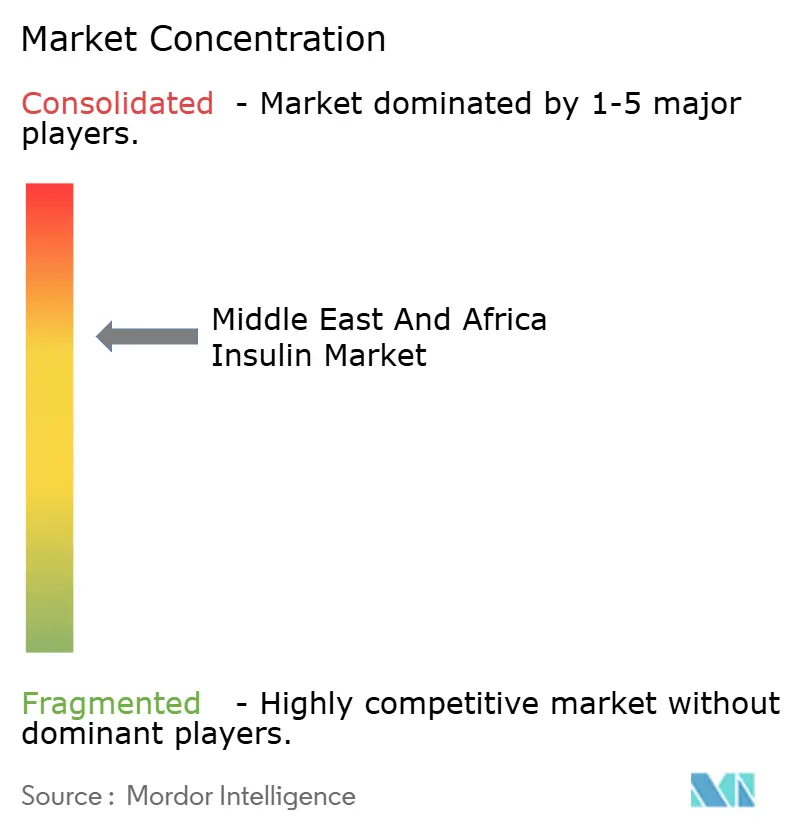
| Market Concentration | Medium |
Major Players *Disclaimer: Major Players sorted in no particular order Image © Mordor Intelligence. Reuse requires attribution under CC BY 4.0. | |
Middle East And Africa Insulin Market Analysis by Mordor Intelligence
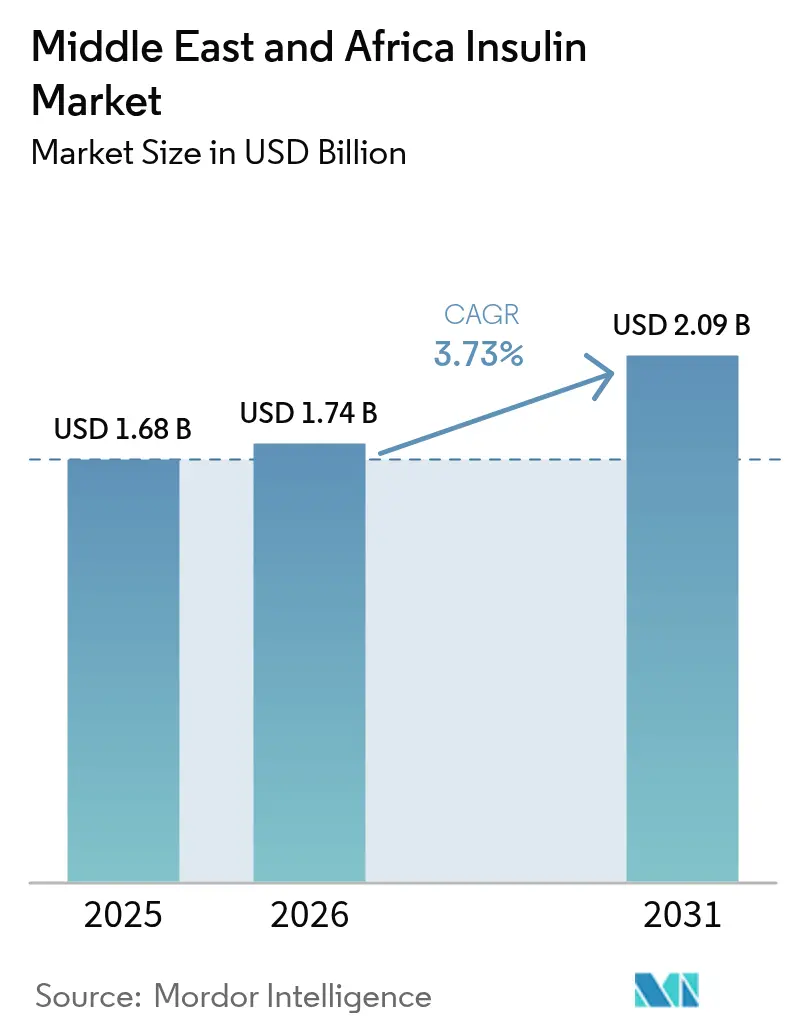
The Middle East And Africa Insulin Market size is expected to grow from USD 1.68 billion in 2025 to USD 1.74 billion in 2026 and is forecast to reach USD 2.09 billion by 2031 at 3.73% CAGR over 2026-2031.
The Middle East And Africa insulin market size is estimated at USD 1.68 billion in 2025, and is expected to reach USD 2.02 billion by 2030, at a CAGR of 3.78% during the forecast period (2025-2030).
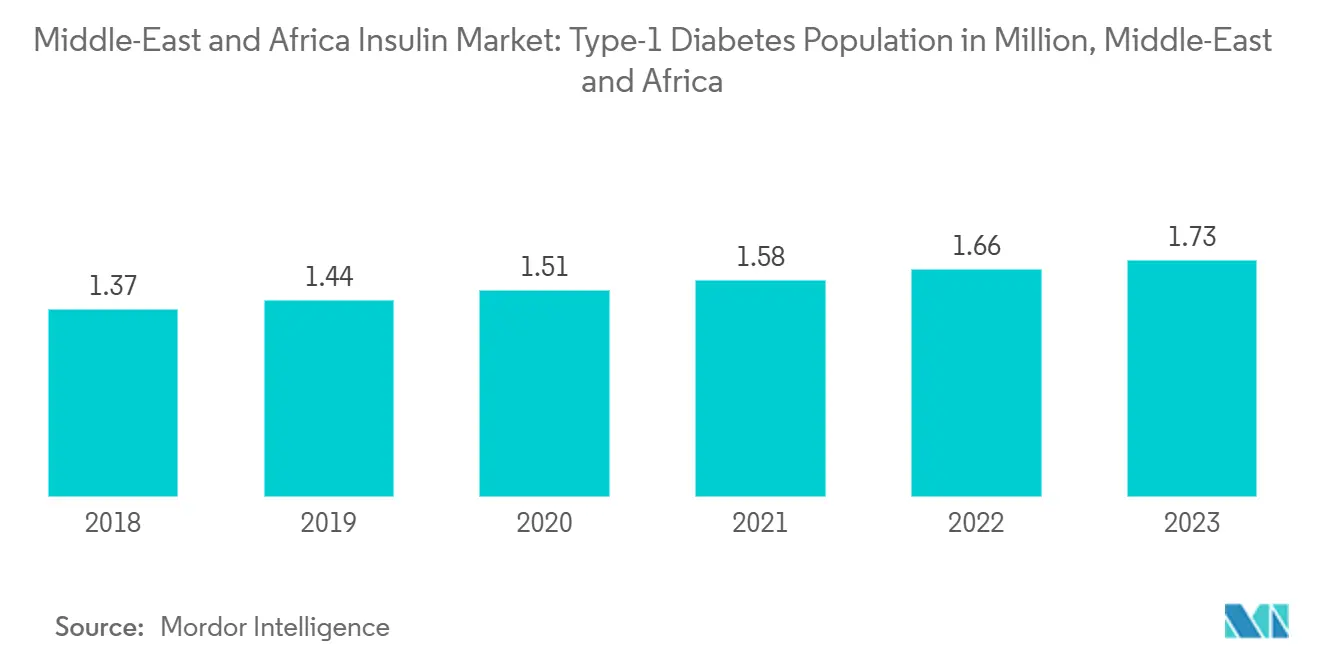
In the Middle East and Africa, Type 1 diabetes forms approximately 10% of the diabetes conditions, and Type 2 contributes to 90%. Type 1 patients require lifelong insulin therapy while maintaining a healthy diet and regular physical exercise.
Type 2 patients need to eat healthily, remain physically active, and perform regular tests to check their blood glucose levels. They may also need to take oral medication and insulin medication to control the glucose levels in their blood. There are many complications associated with diabetes, like diabetic ketoacidosis and non-ketotic hyperosmolar coma. Serious long-term complications include heart disease, stroke, kidney failure, foot ulcers, and damage to the eyes.
The insulin market is experiencing significant growth due to the rapid increase in the diabetes population in the Middle East and Africa diabetes market. Diabetes has become a major health concern in these regions, with a rising number of individuals being diagnosed with the disease.
One of the primary factors driving the growth of the insulin market in the Middle East and Africa is the changing lifestyle and dietary habits of the population. Urbanization, sedentary lifestyles, and the adoption of unhealthy diets high in sugar and processed foods have contributed to the rise in diabetes cases. As a result, there is a growing demand for insulin treatment to manage and control blood sugar levels among diabetic patients.
Additionally, the aging population in the Middle East and Africa is another significant factor contributing to the increased demand for insulin. With advancing age, the risk of developing diabetes increases, leading to a larger diabetic population that requires insulin therapy.
As the production of recombinant insulin and synthetic insulin is very complex, there are very few companies in the market that manufacture these insulin products. Thus, there is high competition between these manufacturers, and they always strive to meet the patient's needs and supply the best-quality insulin.
Note: Market size and forecast figures in this report are generated using Mordor Intelligence’s proprietary estimation framework, updated with the latest available data and insights as of 2026.
Middle East And Africa Insulin Market Trends and Insights
Biosimilar Insulin Segment Holds Highest Market Share in Middle-East and Africa Insulin Market.
Biosimilar insulin is highly popular in the Middle East and Africa region because of its low cost as compared to branded insulins. The Middle East and African countries have substantial economic diversity. The per-capita expenditure on diabetes in the region is low, although some countries in the region have managed to modify their healthcare expenditure to include biologic and biosimilar insulin therapies.
The governments of the Middle East and African countries are recognizing the importance of driving biosimilar insulin uptake to create a competitive and sustainable biosimilar market. With no clinically significant differences in efficacy, safety, purity, or potency, several companies are developing insulin biosimilars that are very similar to the reference insulin glargine.
The total diabetes population in the Middle East and Africa has increased by more than 200% over the past few years. Approximately 8% of the diabetic population in the region has type-1 diabetes. The Middle East and Africa were two of the largest markets for these biosimilar insulin products in 2022. There is increasing adoption of insulin glargine biosimilar insulin across the Middle East and Africa, which is contributing to the overall growth of the segment.
Several governments are recognizing the importance of driving biosimilar insulin uptake to create a competitive and sustainable biosimilar market. Driven by government initiatives, several companies are developing biosimilars that are highly similar to the reference insulin glargine with no clinically meaningful differences in efficacy, safety, purity, or potency. Developments are expected to help the growth of the insulin biosimilar market during the forecast period.
Saudi Arabia Holds Highest Market Share in Middle-East and Africa Insulin Market.
Diabetes is one of the mounting health problems the country is facing. Saudi Arabia is ranked among the top three in the Middle East and African countries with the highest prevalence of diabetes. In Saudi Arabia, diabetes mellitus is a condition that is on the rise. In this context, a cross-sectional retrospective study was done to assess Saudi Arabia's non-insulin-dependent diabetic mellitus disease management costs and medicine usage patterns.
According to the WHO, the number of people with diabetes in Saudi Arabia is expected to rise by almost 300% from 890,000 in 2000 to 2,523,000 in 2030. Its prevalence was strongly correlated with energy use, sedentary behavior, and Gross Domestic Product (GDP).
Saudi Arabia, which has the second-highest rate of DM in the Middle East, and seven million and three million people with diabetes and pre-diabetes, respectively, is vulnerable to the worldwide diabetes epidemic. Few studies, however, have looked at the levels of treatment compliance and adherence among diabetic patients living in different parts of Saudi Arabia. According to a study by Ahmed et al., 54.8% of diabetic patients disregarded follow-up schedules, medication instructions, and recommendations for healthy foods, and 45.5% of patients with diabetes skipped follow-up sessions.
Saudi Arabia is aiming to reduce the prevalence of the disease by 10% over the next decade. Several initiatives, including taxing sugary drinks, fitness initiatives, and focusing on preventative care, are being taken up by the government to stem the rising epidemic. The government's focus on combating diabetes and the higher purchasing power of the people in the country may help the market for diabetes medications, including insulin medication, during the forecast period.
Competitive Landscape
The Middle East and Africa insulin market is dominated by Novo Nordisk, Sanofi, and Eli Lilly. However, there are many local players like Biocon, Julphar, Sedico, and Exir, who hold a significant market share supplying various insulin products.
Middle East And Africa Insulin Industry Leaders
-
Novo Nordisk
-
Sanofi
-
Eli lilly
-
Wockhardt
-
Pfizer
- *Disclaimer: Major Players sorted in no particular order
Market Opportunities and Future Outlook
Localization and supply security initiatives across the Middle East and Africa are opening capacity for insulin fill-finish and, in some cases, wider manufacturing partnerships with multinational insulin suppliers. The Egyptian Drug Authority approval in December 2024, linked to Eli Lilly and EVA Pharma for locally manufactured insulin glargine, and the Algeria-focused partnership announced in April 2026 between Sanofi and Frater-Razes Laboratories to enable local next-generation insulin production through technology transfer, both sit alongside public-sector affordability and continuity-of-supply objectives.
A second opportunity area is regional distribution and cold-chain capability to improve availability across multi-country footprints, where cross-border supply complexity can limit insulin access. In May 2026, Novo Nordisk announced a major pharmaceutical distribution hub in the UAE to serve 70 countries across the Gulf, Africa, and Central Asia. In June 2026, it signed an MoU with the Emirates Drug Establishment to reinforce manufacturing and supply chain security, complementing Saudi Arabia's localization push, including the Sudair Pharma insulin plant initiative and related activity for insulin pens, and expanding pathways for tenders, localized device assembly, and more reliable insulin supply across MEA.
Recent Industry Developments
- June 2026: Novo Nordisk signed an MoU with the Emirates Drug Establishment (EDE) to enhance pharmaceutical manufacturing and strengthen supply chain security in the UAE. The collaboration supports national resilience goals and can improve continuity of insulin availability across public and private channels by aligning local manufacturing and distribution.
- May 2026: Novo Nordisk announced the opening of a major regional pharmaceutical distribution hub in the UAE, positioned as one of its three global hubs and serving 70 countries across the Gulf, Africa, and Central Asia. The hub strengthens cold-chain logistics and replenishment speed for insulin and related diabetes products across MEA, reinforcing the UAE's role as a regional supply node.
- February 2025: Sanofi signed an offtake agreement with Sudair Pharma Company and NUPCO to support localization of SoloStar insulin pens in Saudi Arabia. The offtake structure links local production ambitions to secured demand through centralized procurement, improving supply assurance and supporting price and availability objectives in one of the region's largest insulin markets.
Research Methodology Framework and Report Scope
Market Definition and Coverage
This market covers the value of insulin used to manage diabetes across the Middle East and Africa, counted at the point of sale to healthcare channels and patients for the included countries in scope.
Scope exclusions: We exclude non-insulin diabetes drugs, glucose monitoring devices, and insulin delivery devices that are priced and procured separately from insulin.
Segmentation Overview
- Product
- Basal or Long-acting Insulins
- Lantus (Insulin Glargine)
- Levemir (Insulin Detemir)
- Toujeo (Insulin Glargine)
- Tresiba (Insulin Degludec)
- Basaglar (Insulin Glargine)
- Bolus or Fast-acting Insulins
- NovoRapid/Novolog (Insulin Aspart)
- Humalog (Insulin Lispro)
- Apidra (Insulin Glulisine)
- Traditional Human Insulins
- Novolin/Actrapid/Insulatard
- Humilin
- Insuman
- Combination Insulins
- NovoMix (Biphasic Insulin Aspart)
- Ryzodeg (Insulin Degludec and Insulin Aspart)
- Xultophy (Insulin Degludec and Liraglutide)
- Soliqua/Suliqua (Insulin glargine/Lixisenatide)
- Biosimilar Insulins
- Insulin Glargine Biosimilars
- Human Insulin Biosimilars
- Basal or Long-acting Insulins
- Geography
- Saudi Arabia
- Iran
- Egypt
- Oman
- South Africa
- Rest of Middle East and Africa
Data Sources, Market Sizing, and Validation
Desk Research
Desk research is used to establish the factual base for the model, especially the size of the diabetes pool and how treatment access differs by country. We relied on public sources such as the International Diabetes Federation (IDF) diabetes atlas updates, World Health Organization (WHO) health statistics, World Bank health expenditure series, national ministries of health publications, and UN Comtrade trade statistics for insulin related product codes where relevant.
We also reviewed company annual reports and regulatory filings, investor presentations, press releases, and hospital and pharmacy network announcements to understand pricing direction and whether insulin supply appears consistent through procurement cycles. To cross-check availability and trade flow signals, we used paid subscriptions for company financials and intelligence, patent lookups, and shipment-level import and export data in selective cases. The desk sources listed above are illustrative, and we also used other public documents and datasets for clarification and verification during the work.
Primary Interviews and Surveys
Our interviews and surveys cover manufacturers, distributors, hospitals, pharmacies, and public procurement teams in the Middle East and Africa. Respondents help clarify access conditions, therapy mix, units, prices, and purchasing practices where published data is incomplete. These inputs are compared with secondary data before assumptions and final estimates are set.
Distribution of primary research fieldwork respondents
| Company type | Respondent position |
|---|---|
| Top tier: 29% | CXOs: 18% |
| Mid tier: 46% | Functional/Unit leaders: 30% |
| Smaller Players: 25% | Managers: 52% |
Market-Sizing & Forecasting
For sizing, we rebuilt the demand pool using a top-down approach based on country diabetes prevalence and treated patient assumptions, then adjusted for insulin usage rates by diabetes type and care setting. We corroborated the totals with selective bottom-up approximations, such as sampled SKU price points, channel markups, and distributor level volume checks, so the final number remains realistic even when some country data is thin.
Key inputs used in the model included the diagnosed and treated diabetes population, insulin penetration within treated patients, mix across basal and bolus therapies, analog versus human insulin split, average annual units per patient, and average selling price progression by channel and reimbursement intensity. Where country-level pricing was not fully visible, we filled gaps using proxy countries with similar tender practices and income levels, and then pressure-tested the result using interview feedback. Forecasts were built using scenario analysis supported by short-run trend smoothing, with the key drivers (patient pool growth, access expansion, and price movement) reviewed with regional experts before the final outputs were locked.
Data Validation & Update Cycle
Outputs are checked through multiple steps so inconsistencies do not remain unaddressed, including unit-to-value coherence checks, country share sanity checks, and growth-rate variance reviews against healthcare spending and diabetes prevalence direction. When a result falls outside expected bounds, we revisit assumptions, re-open the input series, and, if needed, re-contact primary respondents for clarification.
Before sign-off, the model and write-up are reviewed by another analyst, and then a final pass is completed close to publication to reflect the latest public updates. Reports refresh annually, and interim updates are triggered when material events occur, such as major tender shifts, supply disruptions, or pricing policy changes.
Mordor Intelligence's Middle East and Africa Insulin Market Sizing Compared With Other Published Estimates
Published insulin market sizes for the region do not always match because the geography boundary, what is counted as insulin versus adjacent diabetes solutions, and the base year choice can differ across publications. Even when the label looks similar, differences in the underlying patient pool, price logic, and currency timing can lead to different totals.
Import and export signals, diabetes prevalence updates, and tender and reimbursement checks are the evidence points used to keep Mordor Intelligence focused on an insulin-only demand pool for Middle East and Africa, rather than blending in devices, monitoring, or broader diabetes treatment revenues.
Benchmark comparison
| Source | Market Size | Gaps in Research Methodology |
|---|---|---|
| Mordor Intelligence | USD 1.74 B (2026) | |
| Industry Data Publisher A | USD 0.86 B (2024) | Often uses a narrower counted basket tied to specific diabetes types or channels, and the lower base year value can reflect limited coverage of analog insulin pricing and public tender volumes across all MEA countries. |
| Regional Research House B | USD 2.50 B (2024) | Covers Middle East only and may also blend adjacent diabetes technologies or service revenues into the insulin headline, which inflates the value when compared with an insulin product-only scope and full MEA geography. |
The spread is mainly explained by scope boundaries and the year used for the stated market size, and then by how pricing and volume are validated across public and private channels. By keeping inputs traceable to treated patients, insulin mix, and country access signals, our estimate stays easier to reproduce and less sensitive to any single-source assumptions.
Key Questions Answered in the Report
How big is the Middle East And Africa Insulin Market?
The Middle East And Africa Insulin Market size is expected to reach USD 1.74 billion in 2026 and grow at a CAGR of 3.73% to reach USD 2.09 billion by 2031.
What is the current Middle East And Africa Insulin Market size?
In 2026, the Middle East And Africa Insulin Market size is expected to reach USD 1.74 billion.
Who are the key players in Middle East And Africa Insulin Market?
Novo Nordisk, Sanofi, Eli lilly, Wockhardt and Pfizer are the major companies operating in the Middle East And Africa Human Insulin Market.
What years does this Middle East And Africa Insulin Market cover, and what was the market size in 2025?
In 2025, the Middle East And Africa Insulin Market size was estimated at USD 1.74 billion. The report covers the Middle East And Africa Human Insulin Market historical market size for years: 2019, 2020, 2021, 2022, 2023 and 2024. The report also forecasts the Middle East And Africa Human Insulin Market size for years: 2026, 2027, 2028, 2029, 2030 and 2031.