
| Study Period | 2019 - 2030 |
| Forecast Data Period | 2025 - 2030 |
| Historical Data Period | 2019 - 2023 |
| CAGR | 5.81% |
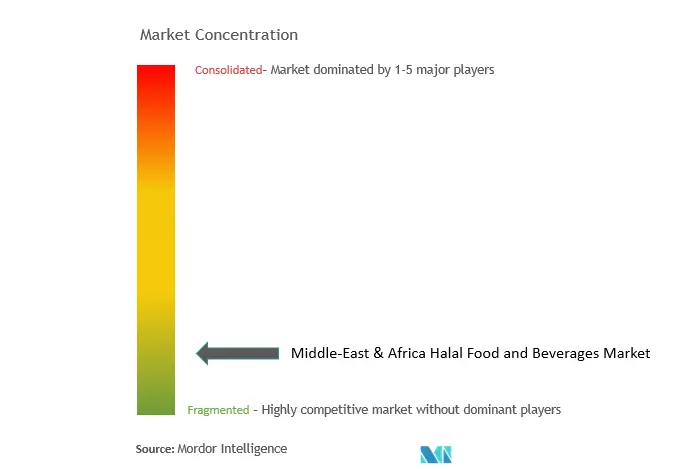
| Market Concentration | Low |
Major Players *Disclaimer: Major Players sorted in no particular order |
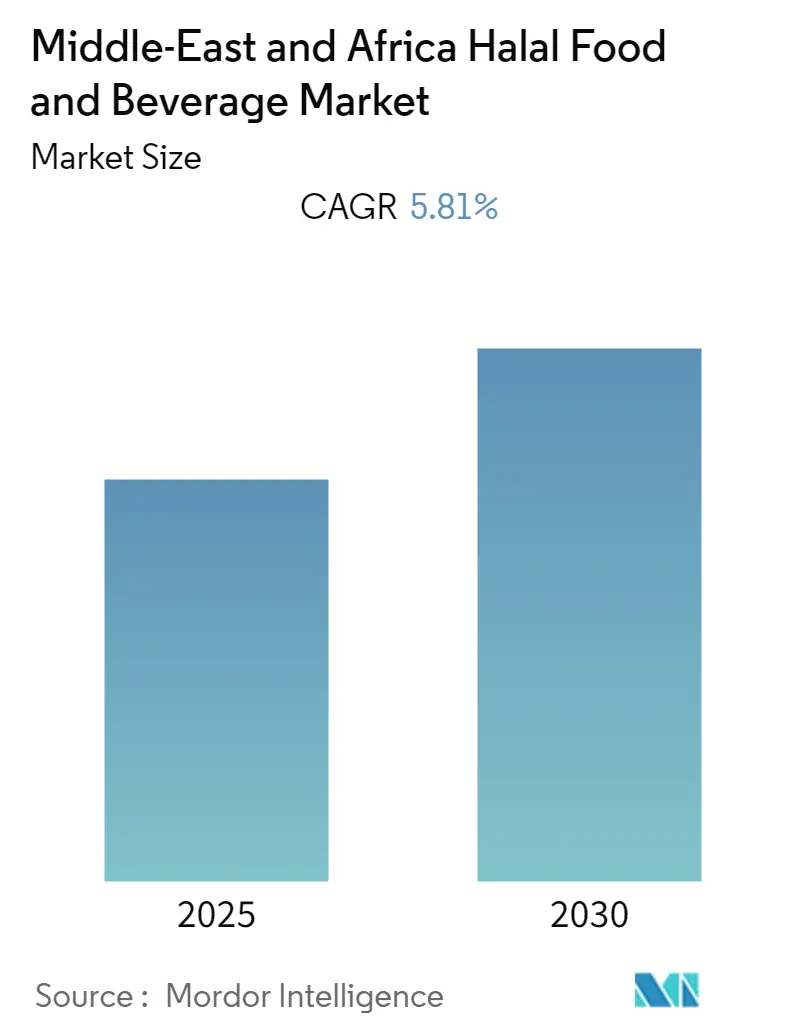
Middle-East and Africa Halal Food and Beverage Market Analysis by Mordor Intelligence
The Middle-East and Africa Halal Food and Beverage Market is expected to register a CAGR of 5.81% during the forecast period.
The unprecedented outbreak of the COVID-19 pandemic has not only been a tragic health issue globally but has severely impacted the global economy on account of restrictions set by the government. However, despite its massive impact on the industries worldwide, the challenges posed to the Halal food industry in the middle-east and Africa region have not been significant enough, owing to the ever-increasing demand for halal food & beverage products majorly across countries like Saudi Arabia, United Arab Emirates, Kuwait, Egypt, and Bahrain, among others. Also, Ramadan was a period amidst the pandemic, which accelerated the sales of halal products in the region. Additionally, consumers shifted to home cooking, and online shopping for their daily essentials. The Saudi supermarket BinDaWood Holding reported their e-commerce sales increased by 200%, according to the World Halal Authority. With manufacturing, production, and logistical operations being disrupted, key exporters have had a challenging year financially, but, an increase in e-commerce, increased the demand for food security initiatives, and more clear labelling of healthier foods including halal products in the region.
Over the medium term, the growing awareness of halal food and its positioning as hygienic and healthy food among, both, Muslim and non-Muslim communities, has resulted in an increase in the consumption and acceptance of halal food, which is expected to drive the demand over the forecast period. Furthermore, the assurance of integrity throughout the Halal supply chain has become a major concern for Muslim consumers, with fraudulent Halal certification and physical contamination of food products on the rise. Hence, supply chain integrity needs to be protected right from the point of animal slaughter and including transportation, storage, to the handling of Halal products.
Middle-East and Africa Halal Food and Beverage Market Trends and Insights
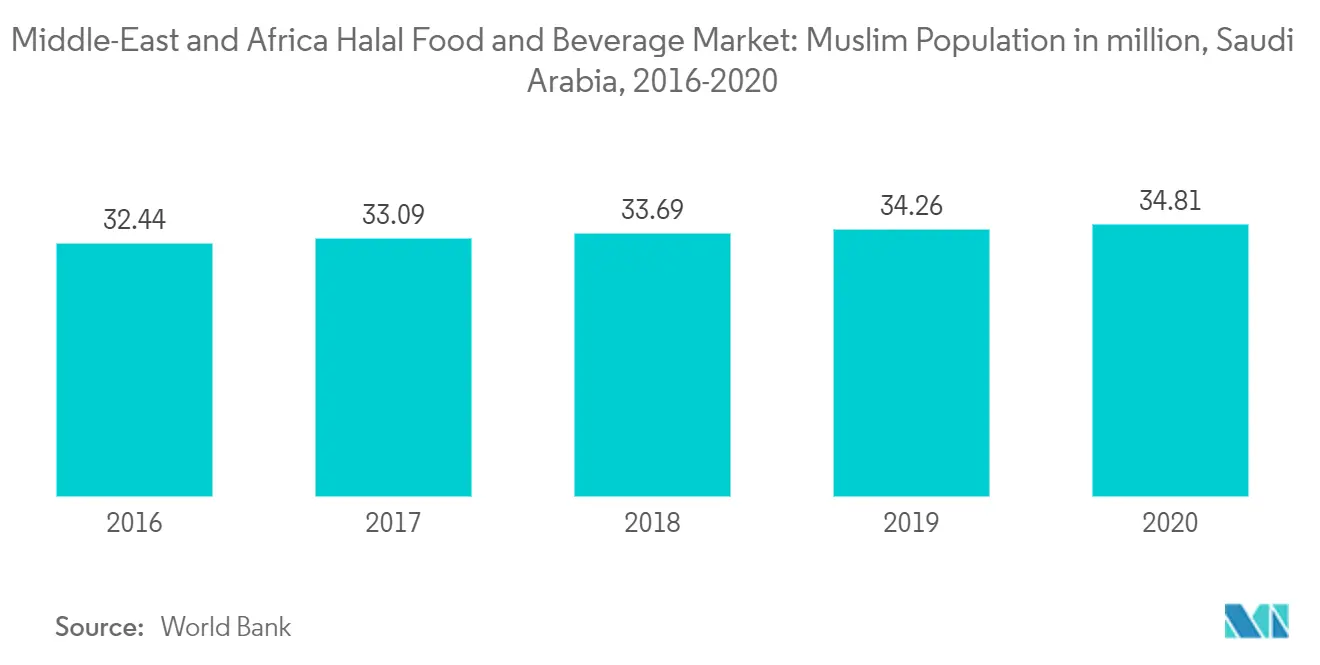
Growing Muslim Population in the Middle East
The increased demand for halal-certified products in the past few years is attributed to the growing population of Muslims and the rise in disposable income to utilize these products and services, and the same factors are expected to further augment the growth of the market over the coming years. Finally, there is greater awareness among Muslims on the need and necessity to consume only Halal food. Halal products are gaining wider recognition as they meet Sharia requirements and hygiene, sanitation, and safety aspects. Islam is now the fastest-growing religion in the world. Thus, the growing Muslim population and economic development in countries with large populations of Muslims make halal food and beverages a profitable segment to invest in to meet the demand.


Saudi Arabia Holds the Major Share in the Market
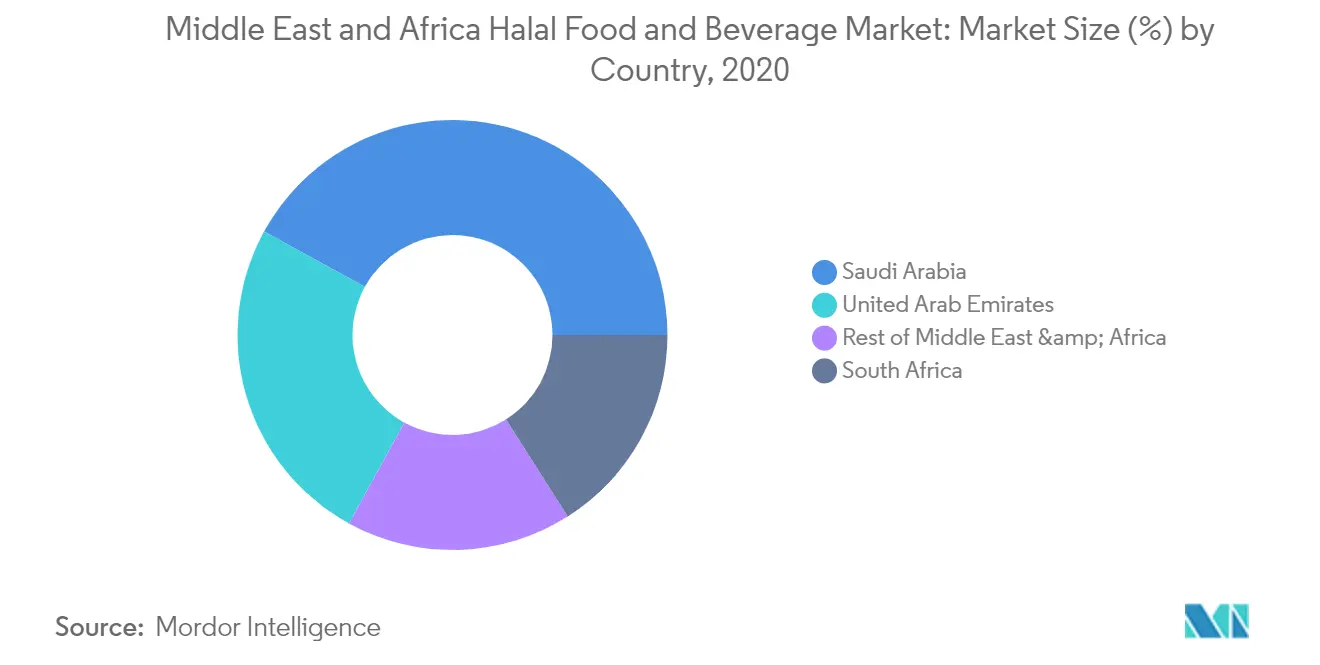
During the forecast period, Saudi Arabia is likely to be the fastest-growing country and holds the largest market share in the halal food and beverage market of the region. The country is also the largest food and beverage producer in the Gulf region. However, the rapidly increasing population has surpassed the food supply and forced the country to depend on imports, which fuels the demand for Halal food products. The Government of Saudi Arabia has been introducing new policies to support the production of more halal food. These policies are anticipated to make the country self-sufficient in food and beverage production and offer better opportunities for domestic producers to vary in livestock, such as poultry, camel, sheep, and dairy production.

Competitive Landscape
The Middle-East and Africa halal food and beverage market is fragmented and highly competitive owing to the presence of several regional and multinational players competing for market share. The key players in the market are Al Islami Foods, Podravka Gulf FZE, Al Rawdah, JBS SA, and BRF SA, among others. In addition, companies are focusing on optimizing their production processes and product innovations, in harmony with ethical practices. Furthermore, companies are making use of advanced technology for a multitude of reasons including detection of haram ingredients such as rennet in cheese manufacturing. Additionally, with advancements in technology, companies now have the option of using fungal rennet as a substitute in halal-certified products.
Middle-East and Africa Halal Food and Beverage Industry Leaders
Al Islami Foods
Podravka Gulf FZE
JBS S.A.
BRF SA
Al Rawdah Foods
- *Disclaimer: Major Players sorted in no particular order

Recent Industry Developments
In August 2021, Riyadh-based Tanmiah Food Company announced its plans to expand regionally and globally. The company which is also Saudi Arabia's leading poultry producer, raised SAR 402 million (USD 107 million) by means of its initial public offering in August 2021, and aims to expand operations pertaining to halal food products regionally and into international markets like the United States, Europe, Asia, and Latin America to cater to the muslim population.
In January 2021, United Arab Emirates-based halal food producer Al Islami Foods, one of the leading frozen food companies in the Gulf Cooperation Council region, launched its first halal-certified plant-based product - a 100% vegan burger made with a combination of organic sunflower protein, plant-based protein from fava beans and peas, and extracts from onion, bell bell pepper, garlic, celery root, carrot and beet juice. According to the company, the new burger patty is designed to appeal especially to the meat eaters in terms of taste and texture.
In October 2018, JBS SA's Seara became the first Brazilian company to introduce 100% anti-biotic-free chicken line into the Middle-East market that meets the halal requirements and Islamic rules. The new 100% natural chicken line included whole breasts, drumsticks, breast strips, and thigh fillets.


Middle-East and Africa Halal Food and Beverage Market Report Scope
Halal is an Arabic word that means 'permissible'. The Middle-East and Africa market for halal food and beverages is segmented by product type that includes halal food, halal beverages, and halal supplements. The halal food section is further divided into meat, processed meat, and other products. Based on the distribution channel, the market is segmented into hypermarkets/supermarkets, specialty stores, convenience stores, online retail stores, and other distribution channels. The study also involves the analysis of regions, such as Saudi Arabia, United Arab Emirates, South Africa, and the Rest of the Middle-East and Africa. For each segment, the market sizing and forecasts have been done on the basis of value (in USD million).
By Type
| Halal Food | Halal Meat |
| Processed Meat | |
| Other Products | |
| Halal Beverage | |
| Halal Supplements |
By Distribution Channel
| Hypermarkets/Supermarkets |
| Specialty Stores |
| Convenience Stores |
| Online Retail Stores |
| Other Distribution Channels |
By Geography
| Saudi Arabia |
| United Arab Emirates |
| South Africa |
| Rest of Middle-East and Africa |
| By Type | Halal Food | Halal Meat |
| Processed Meat | ||
| Other Products | ||
| Halal Beverage | ||
| Halal Supplements | ||
| By Distribution Channel | Hypermarkets/Supermarkets | |
| Specialty Stores | ||
| Convenience Stores | ||
| Online Retail Stores | ||
| Other Distribution Channels | ||
| By Geography | Saudi Arabia | |
| United Arab Emirates | ||
| South Africa | ||
| Rest of Middle-East and Africa |


Key Questions Answered in the Report
What is the current Middle-East and Africa Halal Food and Beverage Market size?
The Middle-East and Africa Halal Food and Beverage Market is projected to register a CAGR of 5.81% during the forecast period (2025-2030)
Who are the key players in Middle-East and Africa Halal Food and Beverage Market?
Al Islami Foods, Podravka Gulf FZE, JBS S.A., BRF SA and Al Rawdah Foods are the major companies operating in the Middle-East and Africa Halal Food and Beverage Market.
What years does this Middle-East and Africa Halal Food and Beverage Market cover?
The report covers the Middle-East and Africa Halal Food and Beverage Market historical market size for years: 2019, 2020, 2021, 2022, 2023 and 2024. The report also forecasts the Middle-East and Africa Halal Food and Beverage Market size for years: 2025, 2026, 2027, 2028, 2029 and 2030.
Page last updated on:
Middle-East and Africa Halal Food and Beverage Market Report
Statistics for the 2025 Middle-East and Africa Halal Food and Beverage market share, size and revenue growth rate, created by Mordor Intelligence™ Industry Reports. Middle-East and Africa Halal Food and Beverage analysis includes a market forecast outlook for 2025 to 2030 and historical overview. Get a sample of this industry analysis as a free report PDF download.


 Your data is secure and never sold or shared.


