
Middle-East And Africa Expansion Vessel Membrane Market Size and Share
Market Overview
| Study Period | 2020 - 2031 |
|---|---|
| Forecast Data Period | 2026 - 2031 |
| Historical Data Period | 2020 - 2024 |
| Growth Rate | 5.08 % |
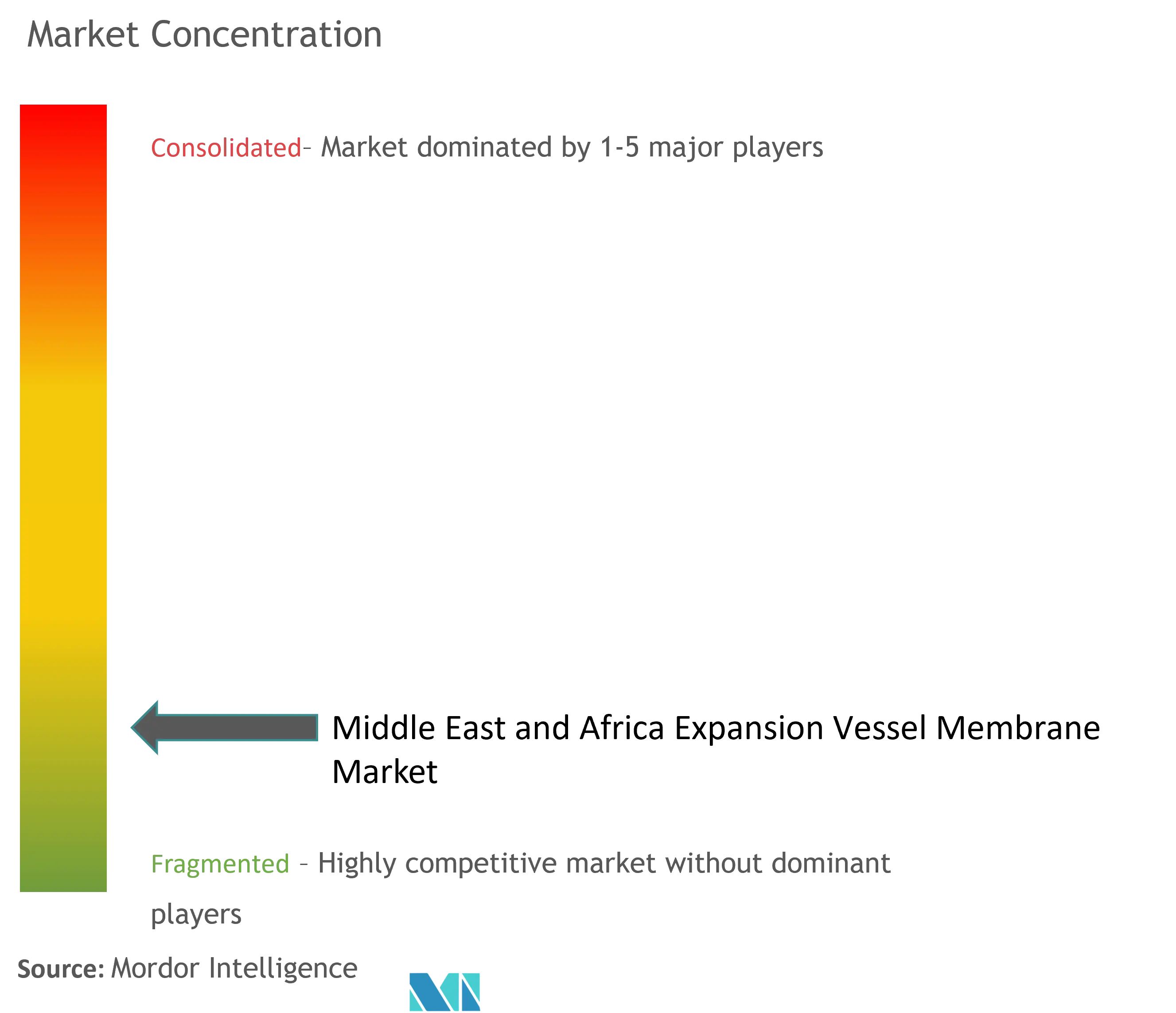
| Market Concentration | Low |
Major Players *Disclaimer: Major Players sorted in no particular order Image © Mordor Intelligence. Reuse requires attribution under CC BY 4.0. | |
Middle-East And Africa Expansion Vessel Membrane Market Analysis by Mordor Intelligence
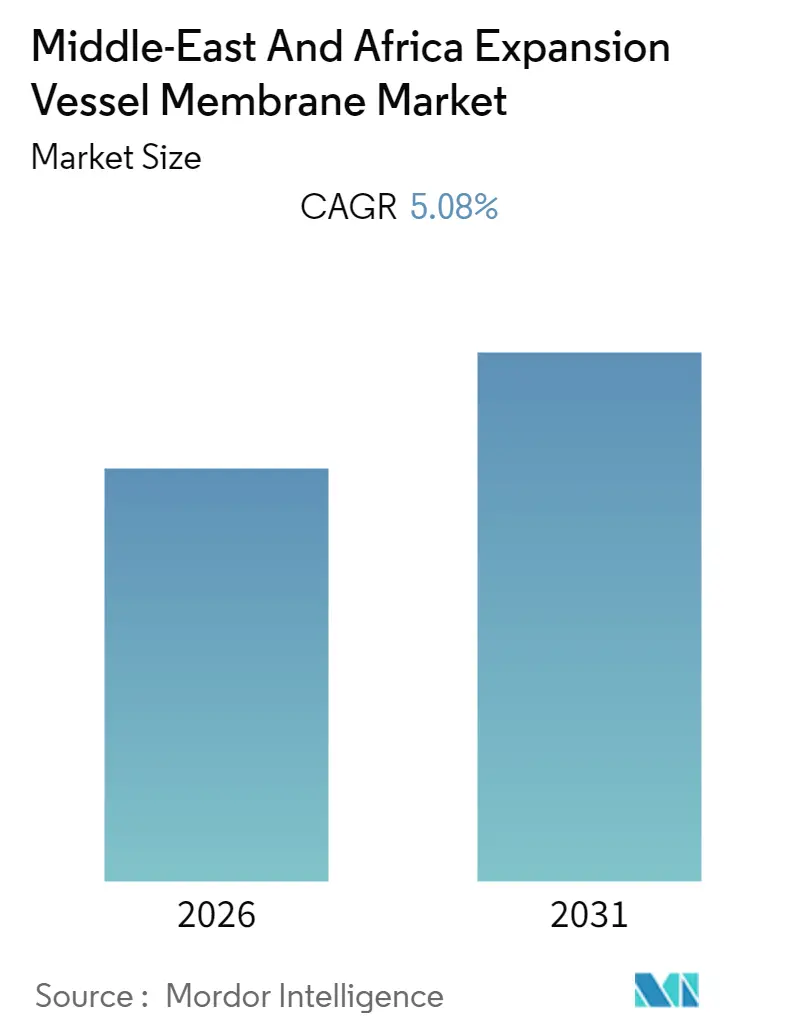
The Middle-East and Africa Expansion Vessel Membrane Market size is expected to register a CAGR of 5.08% during the forecast period.
COVID-19 negatively impacted the market in 2020. Several countries imposed duties on importing a particular variety of steel products. All the construction work and other activities were on hold to curb the spreading of the virus, thereby negatively affecting the market. However, the market is projected to grow steadily, owing to increased building and construction activities in the post-pandemic period.
- Over the short term, bullish growth trends in residential and commercial construction, coupled with increasing demand from the power generation industry, are major factors driving the growth of the Middle-East and Africa Expansion Vessel Membrane Market.
- However, high capital investment is a key factor anticipated to restrain the growth of the target industry over the forecast period.
- Nevertheless, developing newer materials for expansion vessel membrane construction will likely create lucrative growth opportunities.
Note: Market size and forecast figures in this report are generated using Mordor Intelligence’s proprietary estimation framework, updated with the latest available data and insights as of 2026.
Middle-East And Africa Expansion Vessel Membrane Market Trends and Insights
Increasing Demand from the Construction Industry
- Due to its applicability in water systems, the expansion vessel membrane is widely used in construction.
- Saudi Arabia is embarking on many residential and commercial projects, which are expected to increase the construction activities in the country. Some projects were undertaken or in various development phases, including a USD 500 billion futuristic mega-city 'Neom' project, the Red Sea Project - Phase 1. It is due to be completed in 2022. It includes 14 luxury and hyper-luxury hotels with 3,000 rooms across five islands and two inland resorts, Qiddiya Entertainment City, Amaala - the uber-luxury wellness tourism destination, Jean Nouvel's Sharman resort in Al-Ula, Ministry of Housing's Sakai homes, and Jeddah Tower.
- The construction industry in South Africa got severely hit by pandemic restrictions causing many significant projects to get delayed or canceled. The government launched an ambitious USD 60 billion economic reconstruction and recovery plan to stabilize the country's economy in October 2020. This plan includes four priority interventions: fundamental investment in facilities, expanding energy production capacity, creating jobs to support livelihoods, and industrial growth.
- The largest residential project being developed by South Africa in the north of Durban is the Cornubia housing project. This project will include residential, commercial, and industrial sites. The area allocated for this project is 1200 hectares, and the budget is USD 1.5 billion.
- One of the residential complexes developed in Abu Dhabi is Louvre Abu Dhabi Residences, which aims to construct 400 apartments within Saadiyat Grove.
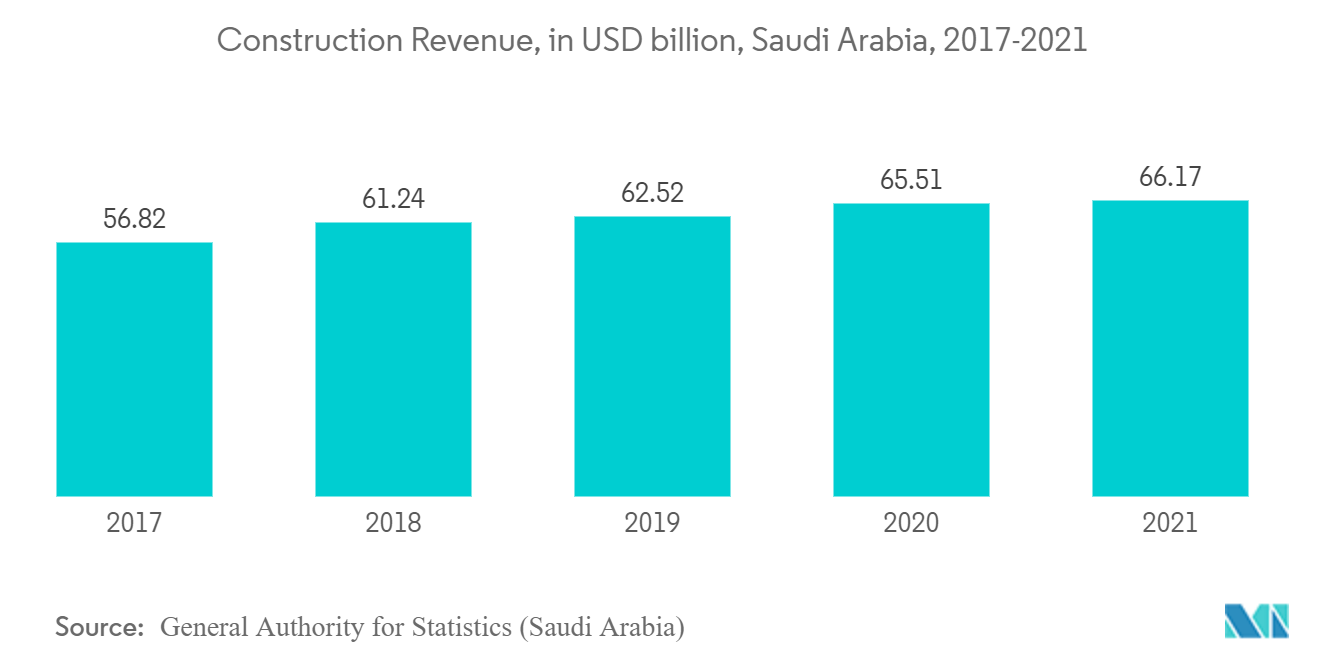
- As per data published by General Authority for Statistics (Saudi Arabia), the construction revenue increased significantly in 2021 compared to 2017.
- All the above factors are expected to drive the market for expansion vessel membranes in the Middle-East and Africa Expansion Vessel Membrane Market the coming years.


South Africa to Dominate the Market in Middle East and Africa Region
- South Africa is expected to dominate the market in the Middle East and Africa region because of the country's increased automotive production and construction sector revenue.
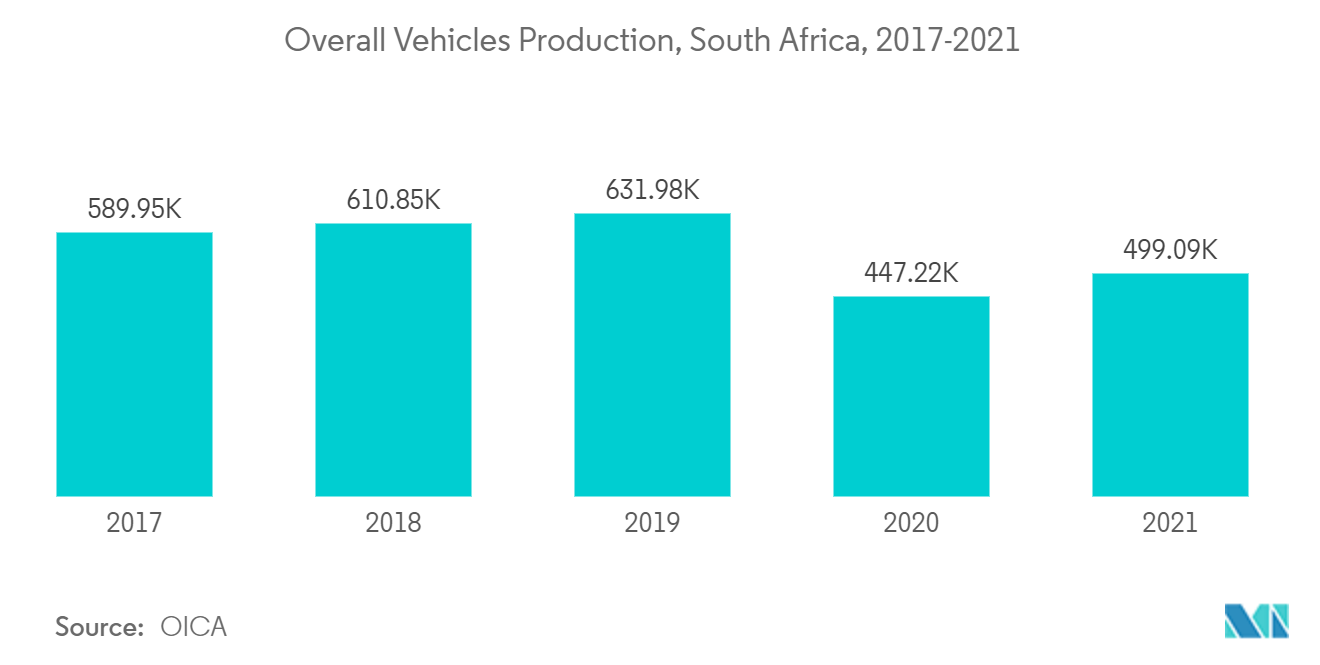
- As per OICA, South Africa produced around 447.22 thousand vehicles in 2020, which declined by 29% compared to 631.98 thousand in 2019. In 2021, 499,087 cars were made, resulting in a rise of about 12% compared to 2020.
- In recent years, several vehicle manufacturers expanded their production and exported from their South African operations, backed by incentives offered through the government's Automotive Production and Development Plan (APDP). For instance, The International Finance Corporation (IFC), a member of the World Bank Group, announced an agreement to help BMW build local capacity by providing a loan of USD 150 million.
- Further, according to the National Association of Automobile Manufacturers of South Africa (NAAMSA), new passenger and commercial vehicle sales in South Africa increased by 7.6% year-on-year to 41,019 units in June 2022. Further, in the first half of 2022, sales volume increased by 11.4% year-on-year to 253,442 units.
- The largest residential project developed by South Africa in the north of Durban is the Cornubia housing project. This project will include residential, commercial, and industrial sites. The area allocated for this project is 1200 hectares, and the budget is USD 1.5 billion.
- Overall, all such factors are expected to increase the vessel membranes market growth in South Africa over the forecast period.
Value Chain Analysis
Upstream supply for expansion vessel membranes in the Middle East and Africa connects to elastomer and polymer compounds (rubber-based diaphragm or bladder materials) and to metals used in pressure vessel assemblies that house the membrane. Regional heavy-plate availability and processing, supported by players such as Dillinger Middle East FZE (Jebel Ali Free Zone, Dubai), underpins local fabrication of vessel bodies and related pressure equipment, which helps shorten lead times for membrane-containing assemblies used across domestic water systems and industrial applications.
Midstream manufacturing and integration are carried out by certified fabricators and equipment suppliers that design and produce pressure vessels, tanks, and related process equipment, then source and fit diaphragm or bladder membranes as part of packaged systems. Companies such as Al Shirawi Equipment Company LLC (ASME U/U2, National Board NB and R stamps, API Spec Q1) and Lloyds Engineering Co. LLC (ISO 9001:2015) illustrate how compliance and QA shape regional fabrication, while logistics and distribution are supported by hubs and service networks including Jafza-linked supply chain infrastructure and industrial distributors such as Kanoo Group. Downstream demand comes from building services and water systems, as well as energy and industrial plants, with procurement typically routed through EPCs, MEP contractors, and aftermarket maintenance channels for replacement membranes.
Competitive Landscape
The Middle East and Africa expansion vessel membrane market is partially fragmented. Some of the major players in the market include Dillinger Middle East FZE, Hidayath Group, Kanoo Group, Lloyds Engineering Co. LLC, and Al Shirawi Equipment Company LLC, among others.
Middle-East And Africa Expansion Vessel Membrane Industry Leaders
Dillinger Middle East FZE
Hidayath Group
Kanoo Group
Lloyds Engineering Co. LLC
Al Shirawi Equipment Company LLC
- *Disclaimer: Major Players sorted in no particular order

Market Opportunities and Future Outlook
The key opportunity is material upgrades and specification-driven replacements in diaphragm and bladder membranes, where users place value on higher temperature and chemical resistance and longer service intervals. The region already has certified pressure equipment manufacturing and integration capacity, as reflected by ASME- and National Board-stamped fabrication at Al Shirawi Equipment Company LLC and ISO 9001:2015-certified fabrication at Lloyds Engineering Co. LLC, which creates openings for membrane suppliers that can meet performance requirements while matching local QA and traceability expectations.
A second opportunity is supply-chain localization and faster fulfillment for membrane-inclusive expansion vessel assemblies, particularly in Gulf hubs that support multi-country project work. Dillinger Middle East FZE operating in Jebel Ali Free Zone, supported by logistics linkages through Jafza, points to a strengthening regional industrial supply base that can support shorter lead times for vessel fabrication and refurbishment cycles, and in turn supports aftermarket membrane replacement demand and project-based procurement for water and industrial infrastructure.
Recent Industry Developments
- June 2026: Kanoo Group continued to highlight its diversified industrial and energy-oriented footprint across the Middle East through its corporate platform. This ongoing presence supports distribution, procurement, and service pathways used by pressure equipment and related components in the region, which are relevant to expansion vessel membrane-containing systems.
- April 2025: Dillinger Middle East FZE expanded its regional footprint by inaugurating a new office in Abu Dhabi, UAE. This strengthened proximity to major project owners and EPC activity in the Gulf, improving commercial coverage for heavy plate supply and related services that feed into pressure vessel fabrication supply chains.
- March 2024: Al Shirawi Equipment Company LLC continued to position its pressure vessel and process equipment offering around internationally recognized certifications, including ASME U/U2 and National Board stamps. Its emphasis on certified manufacturing supports regional buyers in sourcing compliant, traceable equipment builds and refurbishments, which in turn supports demand for compatible membrane components supplied through qualified channels.


Research Methodology Framework and Report Scope
Market Definition and Coverage
For this study, the market covers the revenue earned from membranes used inside expansion vessels that manage pressure changes in closed-loop water and thermal systems across the Middle East and Africa, counted at the point of sale into the region.
Scope exclusions: It excludes complete expansion vessels, pumps, valves, and general rubber sheet sales that are not engineered and sold as expansion vessel membranes.
Segmentation Overview
- Type
- Diaphragm
- Bladder
- Application
- Domestic Water Systems
- Automotive
- Other Applications
- Geography
- Saudi Arabia
- South Africa
- United Arab Emirates
- Rest of Middle-East and Africa
Data Sources, Market Sizing, and Validation
Desk Research
Desk research was used to map the real-world demand pool and to anchor assumptions that are hard to see from product brochures alone. We reviewed public construction and building-services signals, HVAC and plumbing installation patterns, and industrial maintenance cycles that typically pull replacement membranes into the market.
Common reference points included public datasets and publications such as national statistics offices, UN Comtrade trade statistics for relevant rubber and fabricated component codes (used carefully because codes are not perfectly clean), standards bodies that cover pressure equipment safety, and technical journals covering elastomer performance in hot water and heating loops. We also relied on company annual reports, investor presentations, and reputable regional press for capacity additions, distributor footprints, and project timing. Where available, paid subscriptions for company financials, shipment-level import and export data, and patent databases were used to cross-check directional trends and to fill gaps in smaller private-company visibility. This list is not exhaustive, and many other public and subscription sources were used for data collection, validation, and clarification during the work.
Primary Interviews and Surveys
Primary work focused on confirming what gets counted as an expansion vessel membrane sale in practice, and how demand splits between new installations and replacements across major MEA markets. We spoke with a mix of membrane suppliers, channel partners, and service-oriented buyers to validate typical membrane lifetimes, average selling price movement, and the influence of building activity versus industrial maintenance.
To reduce single-country bias, outreach covered the Gulf as well as South Africa and other active import markets. We also re-checked responses when desk indicators and interview feedback did not line up.
Distribution of primary research fieldwork respondents
| Company type | Respondent position |
|---|---|
| Top tier: 26% | CXOs: 12% |
| Mid tier: 53% | Functional/Unit leaders: 39% |
| Smaller Players: 21% | Managers: 49% |
Market-Sizing & Forecasting
Sizing starts from a top-down reconstruction of demand, where HVAC and plumbing build activity, installed base of closed-loop systems, and replacement cycles are used to form a realistic consumption pool for membranes across the covered countries. Once that pool is built, price bands are applied using interview-led ranges and desk signals, then converted to revenues in USD using consistent exchange-rate timing.
To keep the totals grounded, the model is corroborated with selective bottom-up approximations, including sampled supplier and distributor revenue splits, channel checks on import intensity, and sanity checks on typical membrane ASP by diaphragm versus bladder use. When a country had limited direct visibility, the gap was handled by using proxy indicators like construction spending direction, HVAC equipment shipments, and the share of imported versus locally assembled system components, followed by expert re-validation.
For forecasting, we used scenario analysis supported by short time-series smoothing to reflect the small base and project-led swings that can occur in the region. Key inputs that drove the outlook included new building completions, refurbishment rates in commercial buildings, industrial facility uptime and maintenance budgeting, elastomer input cost pass-through behavior, and shifts in importer mix that can change average realized prices.
Data Validation & Update Cycle
Validation is done through multiple checks so the final number is not driven by any single dataset. Model outputs are compared against independent signals such as trade-flow direction, project announcements for large building and industrial sites, and the expected replacement cadence implied by typical membrane service life, and then outliers are reviewed before sign-off.
A second analyst reviews the assumptions, unit conversions, and currency handling, followed by a final consistency pass across countries and applications. If a major variance shows up, we re-contact selected respondents to confirm whether it is a real change (for example, a price jump) or a modeling artifact. Reports are refreshed annually, with interim updates when material events occur, and a last-minute review is done before delivery so clients receive the latest view.
Mordor Intelligence's Middle East and Africa Expansion Vessel Membrane Market Size Compared With Other Published Estimates
Published estimates for this niche market can look far apart because the boundary is easy to blur, especially between membrane-only revenues and full expansion vessel sales. Differences also come from how replacement demand is treated, which countries are included inside MEA, and whether values are reported in local currency then converted using different exchange-rate timing.
By checking replacement-cycle inputs, import intensity, and country-level pricing ranges, Mordor Intelligence sits in the middle of the spread because the model counts membranes as a component revenue line and does not blend in the full vessel bill of materials, which can inflate totals.
Benchmark comparison
| Source | Market Size | Gaps in Research Methodology |
|---|---|---|
| Mordor Intelligence | USD 0.00 M (2024) | |
| Regional Consultancy A | USD 0.10 M (2024) | This estimate appears to include complete expansion vessels and related accessories in addition to membranes, which pushes the number higher even if unit demand assumptions are similar. |
| Trade Journal B | USD 0.06 M (2024) | This value is likely built from a narrow set of import codes and a conservative pricing assumption, which can undercount local distribution sales and replacement-driven demand. |
The spread in the table mainly comes down to what is being counted and how demand is reconstructed in markets with uneven data coverage. When the scope is kept to membrane-only revenues and the replacement cycle is explicitly modeled, the resulting market size stays traceable to clear variables and can be repeated with the same steps in future updates.


Key Questions Answered in the Report
What is the current Expansion Vessel Membrane Market size?
The Expansion Vessel Membrane Market is projected to register a CAGR of 5.08% during the forecast period (2026-2031)
Who are the key players in Expansion Vessel Membrane Market?
Dillinger Middle East FZE, Hidayath Group, Kanoo Group, Lloyds Engineering Co. LLC and Al Shirawi Equipment Company LLC are the major companies operating in the Expansion Vessel Membrane Market.
What years does this Expansion Vessel Membrane Market cover?
The report covers the Expansion Vessel Membrane Market historical market size for years: 2019, 2020, 2021, 2022, 2023 and 2024. The report also forecasts the Expansion Vessel Membrane Market size for years: 2026, 2027, 2028, 2029, 2030 and 2031.
Page last updated on:





