
Middle East and Africa Data Center Real Estate Market Size and Share
Market Overview
| Study Period | 2020 - 2031 |
|---|---|
| Forecast Data Period | 2026 - 2031 |
| Base Year Market Size (2025) | USD 4.12 Billion |
| Market Size (2026) | USD 4.70 Billion |
| Market Size (2031) | USD 8.83 Billion |
| Growth Rate (2026 - 2031) | 13.44 % |
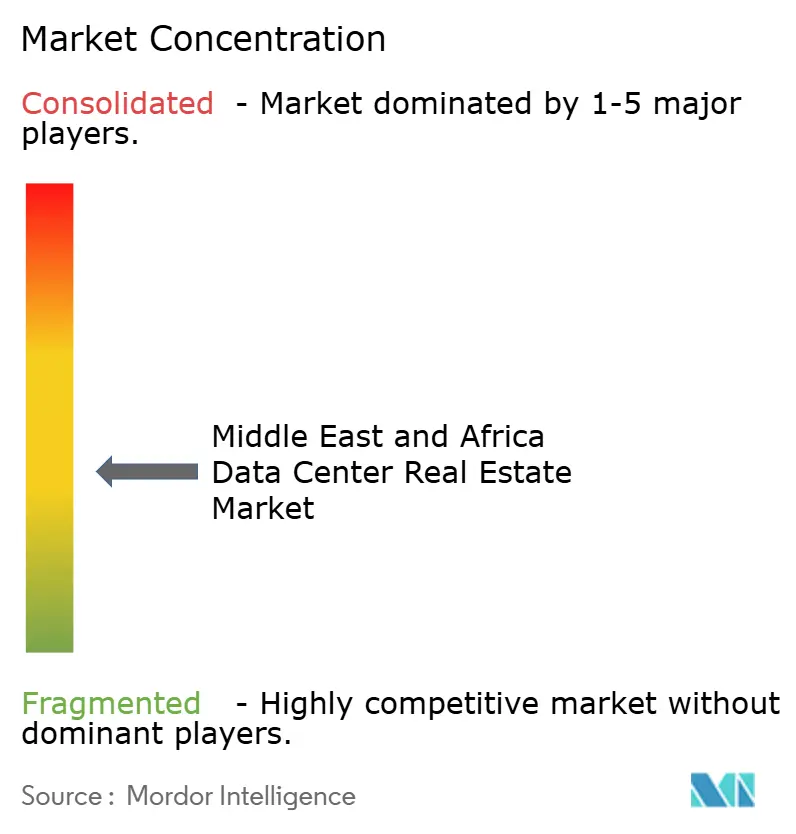
| Market Concentration | Medium |
Major Players *Disclaimer: Major Players sorted in no particular order Image © Mordor Intelligence. Reuse requires attribution under CC BY 4.0. | |
Middle East and Africa Data Center Real Estate Market Analysis by Mordor Intelligence
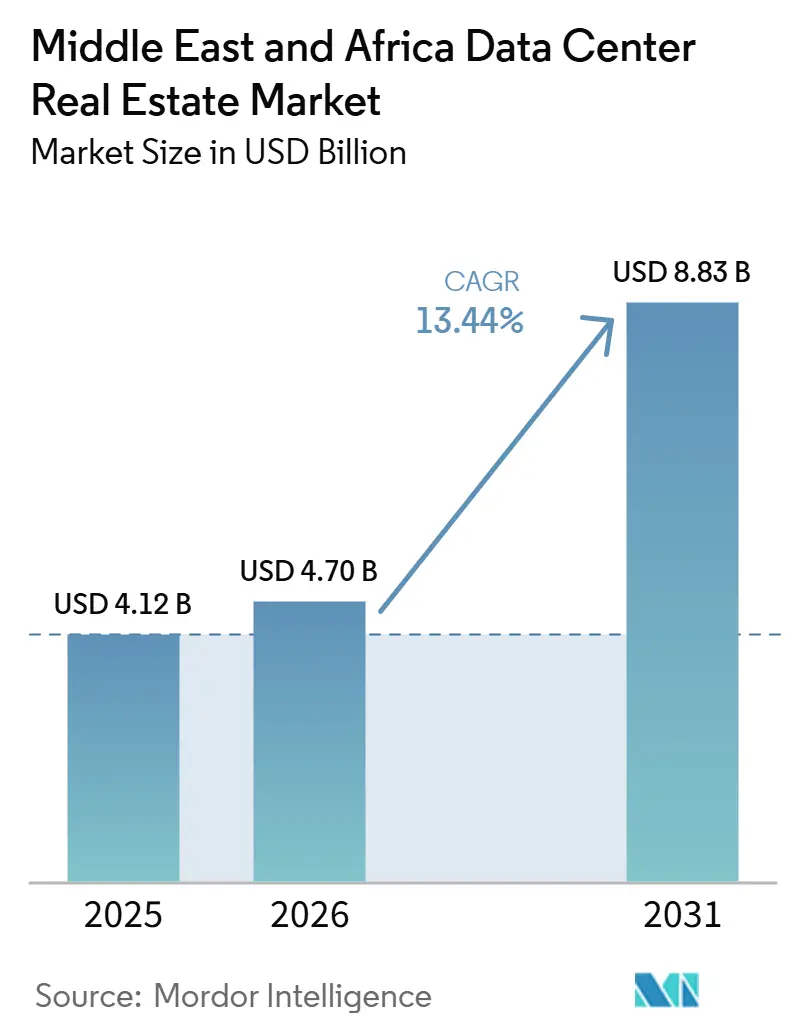
The Middle East And Africa Data Center Real Estate Market size was valued at USD 4.12 billion in 2025 and is estimated to grow from USD 4.70 billion in 2026 to reach USD 8.83 billion by 2031, at a CAGR of 13.44% during the forecast period (2026-2031).
The Middle East and Africa data center real estate market is entering a phase in which digital infrastructure is treated as a sovereign asset rather than backup capacity. Government artificial intelligence (AI) programs in the Gulf and broader enterprise digitalization across Sub-Saharan Africa are creating firmer demand visibility and longer capacity planning cycles. This growth cycle differs from the earlier cloud migration phase because current demand is tied more closely to sovereign compute programs, hyperscale campus development, and edge deployment across secondary cities. Operators are also adjusting their strategies as power density, cooling design, and data residency requirements become more central to leasing and site planning. Private capital is entering the asset class more aggressively, which is accelerating development and raising facility specifications across the region[1]Public Investment Fund, “HUMAIN Artificial Intelligence Infrastructure Initiative,” Public Investment Fund, pif.gov.sa.
Key Report Takeaways
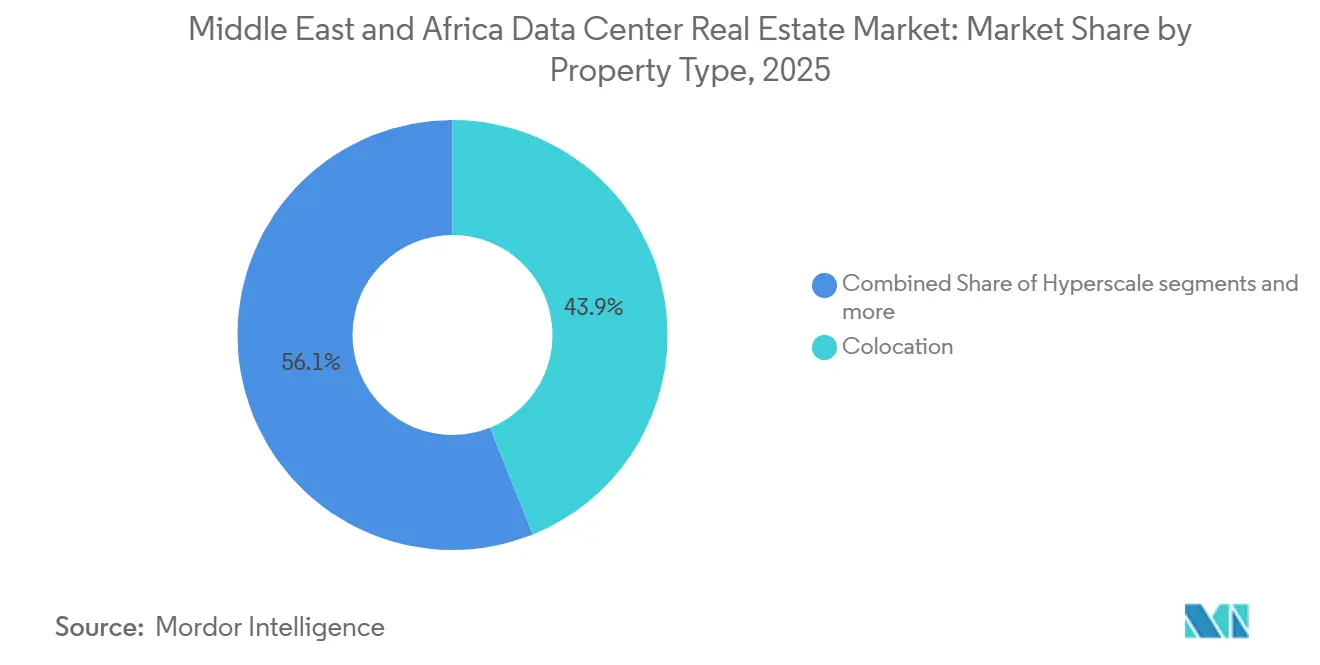
- By property type, colocation accounted for 43.90% of revenue in 2025, while edge data center properties are forecast to grow at a 16.80% CAGR through 2031.
- By ownership, leased facilities held 74.60% of the Middle East and Africa data center real estate market share in 2025, and this segment is projected to expand at a 14.20% CAGR through 2031.
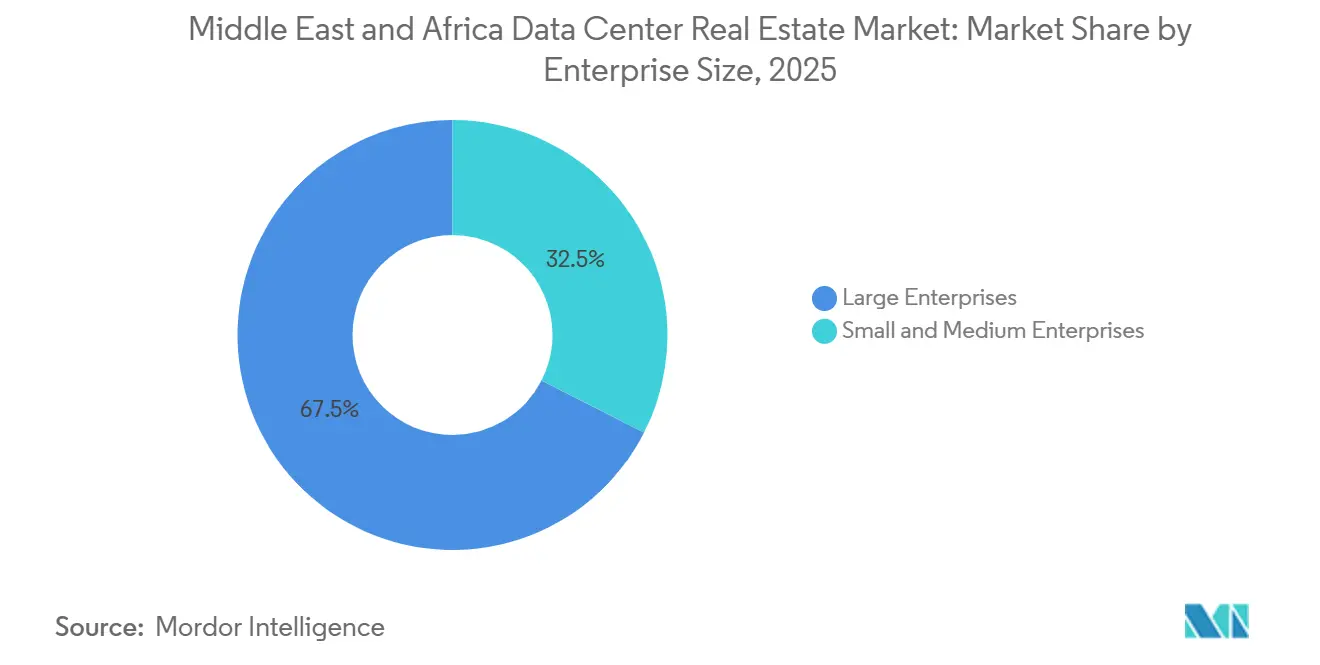
- By enterprise size, large enterprises captured 67.50% revenue share in 2025, while small and medium enterprises are forecast to advance at a 15.10% CAGR through 2031.
- By end-user, information technology and telecom accounted for 44.30% of revenue in 2025, while the government and public sector are expected to grow at a 15.80% CAGR through 2031.
- By geography, the United Arab Emirates held a 31.80% share of the Middle East and Africa data center real estate market in 2025, while Saudi Arabia recorded the fastest projected CAGR of 17.50% through 2031.
Note: Market size and forecast figures in this report are generated using Mordor Intelligence’s proprietary estimation framework, updated with the latest available data and insights as of January 2026.
Market Trends and Insights
Drivers Impact Analysis of Middle East and Africa Data Center Real Estate Market*
| Drivers | (~) % Impact on CAGR Forecast | Geographic Relevance | Impact Timeline |
|---|---|---|---|
| Sovereign AI Investments Accelerate Data Center Development | +3.5% | United Arab Emirates, Saudi Arabia | Short term (≤ 2 years) |
| Cloud-First Government Policies Increase Local Data Center Demand | +2.8% | United Arab Emirates, Saudi Arabia, Egypt, Rest of Middle East and Africa | Medium term (2-4 years) |
| Subsea Cable Expansion Strengthens Regional Connectivity Infrastructure | +1.9% | United Arab Emirates, Saudi Arabia, Egypt, South Africa | Medium term (2-4 years) |
| Liquid Cooling Adoption Supports High-Density Data Center Deployments | +1.5% | United Arab Emirates, Saudi Arabia | Short term (≤ 2 years) |
| Free Zone Incentives Attract Data Center Investments | +1.4% | United Arab Emirates | Short term (≤ 2 years) |
| Waste Heat Recovery and Alternative Power Solutions Improve Sustainability | +1.2% | United Arab Emirates, Saudi Arabia | Long term (≥ 4 years) |
| Source: Mordor Intelligence | |||
Sovereign AI Investments Accelerate Data Center Development
Sovereign AI spending has become one of the clearest demand signals in the Middle East and Africa data center real estate market. Saudi Arabia’s HUMAIN initiative is designed around USD 77 billion of investment and a target of 1.9 GW of data center capacity by 2030, which materially changes the scale of expected build activity in the Kingdom. This form of demand is more durable than a normal enterprise cycle because it is tied to national diversification plans and long-term digital priorities. It is also changing what kind of real estate is valuable, since AI training and inference require much higher power density and more advanced thermal design than standard workloads. That shift is pushing operators toward larger campuses, deeper utility planning, and facilities designed from the start for GPU-heavy demand.
Cloud-First Government Policies Increase Local Data Center Demand
Cloud-first directives are making public sector demand more visible in the Middle East and Africa data center real estate market. In the United Arab Emirates, the approved Agentic AI framework aims to deploy across 50% of government services within 2 years, directly supporting the need for domestic compute and storage capacity. That pattern matters because government workloads usually require stronger controls around residency, security, and procurement compliance than many commercial deployments. It also creates a preference for facilities that can meet sovereign operating requirements rather than only offer generic colocation space. The result is a more stable leasing pipeline for certified, locally compliant operators already positioned near government demand centers.
Subsea Cable Expansion Strengthens Regional Connectivity Infrastructure
Connectivity expansion is changing which locations can compete for future data center projects in the Middle East and Africa data center real estate market. SEACOM’s 2.0 initiative, announced in September 2025, added a new regional network plan focused on AI, cloud, and real-time traffic across the Indian Ocean Basin, the Middle East, and the Mediterranean. Better subsea reach improves the case for facilities near cable landing points and key interconnection hubs. It also gives operators in gateway markets a stronger value proposition beyond domestic enterprise demand. Over time, site selection is likely to favor assets that combine power access, terrestrial fiber links, and submarine connectivity in the same corridor.
Liquid Cooling Adoption Supports High-Density Data Center Deployments
Liquid cooling is moving from a specialty feature to a core requirement for AI-ready capacity in the Middle East and Africa data center real estate market. Khazna’s QAJ01 facility in Ajman received Uptime Institute Tier III Certification of Design Documents in February 2026 and is set to be the first certified AI data center with liquid cooling in the Middle East and North Africa, supporting 100 MW of IT load across 20 data halls. This matters because AI workloads are pushing rack density beyond the range that conventional air cooling can handle well. The shift is creating a clear divide between legacy inventory and assets that can serve higher-value tenants. Facilities that validate liquid cooling at scale are therefore likely to secure stronger pricing power and higher-quality tenants.
Restraints Impact Analysis of Middle East and Africa Data Center Real Estate Market*
| Restraints | (~) % Impact on CAGR Forecast | Geographic Relevance | Impact Timeline |
|---|---|---|---|
| High Cooling Costs Increase Data Center Operating Expenses | -1.8% | United Arab Emirates, Saudi Arabia | Short term (≤ 2 years) |
| Grid Capacity Constraints and Permitting Delays Slow Project Development | -1.5% | United Arab Emirates, Saudi Arabia | Medium term (2-4 years) |
| Shortage of Certified Data Center Professionals Limits Operational Capacity | -1.2% | Global, concentrated in United Arab Emirates and Saudi Arabia | Medium term (2-4 years) |
| Water-Use Restrictions Challenge Cooling Infrastructure Development | -0.9% | Saudi Arabia, United Arab Emirates | Long term (≥ 4 years) |
| Source: Mordor Intelligence | |||
High Cooling Costs Increase Data Center Operating Expenses
Cooling remains a structural cost challenge for the Middle East and Africa data center real estate market, especially in Gulf climates. The move toward AI-ready infrastructure does not remove that issue, because higher-density environments still need robust heat rejection and redundancy. Operators that rely on older air-cooled designs face additional pressure when trying to retrofit to meet newer tenant requirements. This tends to favor platforms with larger capital budgets and more mature engineering capability. As a result, cost pressure can narrow the field of operators that can compete for premium AI and hyperscale mandates.
Grid Capacity Constraints and Permitting Delays Slow Project Development
Power access and project approvals remain important limits on how quickly the Middle East and Africa data center real estate market can add new capacity. Large campuses require more than land and tenant demand, since they also depend on timely interconnection agreements, utility readiness, and multiagency clearances. When those pieces move slowly, project delivery can slip even if capital and demand are available. That creates an advantage for incumbents that already have established utility relationships and approved sites. It also raises the value of development pipelines that are further along in the permitting and grid connection process.
*Our forecasts treat driver/restraint impacts as directional, not additive. The impact forecasts reflect baseline growth, mix effects, and variable interactions.
Middle East and Africa Data Center Real Estate Market Segment Analysis
By Property Type:
Colocation Leads Revenues as Edge Data Center Properties Signal the Next WaveColocation accounted for 43.90% of revenue in 2025, making it the largest segment in the Middle East and Africa data center real estate market. That lead reflects a clear preference among enterprises and many cloud tenants for third-party managed facilities that offer flexibility without requiring direct ownership of land and buildings. Carrier neutrality also remains important in a region where tenants often value ecosystem access and interconnection options as much as raw space. In practical terms, colocation is still the baseline product around which many commercial leasing decisions are made.
Edge data center properties are forecast to expand at a 16.80% CAGR through 2031, making them the fastest-growing property format in the Middle East and Africa data center real estate market. This growth is tied to 5G rollout, lower latency needs, and the spread of AI inference closer to end users. Demand is also becoming more distributed, which improves the case for facilities in secondary cities rather than only in the main hubs. Hyperscale formats are reshaping lease structures as power pass-through clauses and stricter infrastructure specifications become more common. Modular properties are gaining relevance in African markets where rollout speed and infrastructure flexibility matter. Khazna’s October 2025 plan to add more than 1 GW of capacity across multiple countries shows how leading operators are balancing colocation, hyperscale, and edge assets as one portfolio rather than as isolated formats[2] Khazna Data Centers, “Khazna Data Centers to Add Over 1GW Hyperscale Capacity Across Multiple Countries by 2030,” Khazna Data Centers, khaznadatacenters.com.


By Ownership:
Leased Agreements Anchor Operator EconomicsLeased facilities accounted for 74.60% of revenue in 2025. They posted the highest projected growth at a 14.20% CAGR, giving the segment both scale and momentum in the Middle East and Africa data center real estate market. This pattern shows that tenants and operators still prefer asset-light or shared-capital structures as facility costs, power density, and cooling requirements rise. Leasing also lowers the hurdle for market entry and expansion, especially when projects need large upfront commitments. In that sense, the leading ownership model is closely aligned with the region’s current capital cycle.
Owner-occupied assets accounted for the remaining 25.40% share and remain more common among sovereign entities and operators serving captive demand. Those assets are important because they often anchor highly regulated government workloads that are less exposed to normal commercial demand swings. At the same time, institutional capital is making leased structures even more attractive as investors separate property ownership from operating risk. Sale-leaseback logic fits well in a market where development costs are rising, and long-term tenants are becoming easier to underwrite. KKR’s January 2025 partnership with Gulf Data Hub shows how private capital is moving into the platform level of the Middle East and Africa data center real estate market rather than staying at the asset edge. That capital structure shift is likely to reinforce leasing as the default route for future expansion.
By Enterprise Size:
Large Enterprises Set Baseline Demand, Small and Medium Enterprises Drive Growth RateLarge enterprises accounted for 67.50% of revenue in 2025, indicating they still define the base demand profile of the Middle East and Africa data center real estate market. This is consistent with the region’s dependence on government-linked entities, telecom groups, banks, and other large institutions that sign longer contracts and require more resilient infrastructure. Their presence also provides operators with clearer visibility into occupancy and power allocation. In many cases, one large tenant can anchor a site and improve financing conditions for the broader asset.
Small and medium enterprises are forecast to grow at a 15.10% CAGR through 2031, giving them the strongest forward growth profile among enterprise sizes. Their demand differs from hyperscale or sovereign demand because it is usually more distributed, more location-sensitive, and more dependent on shared services. That helps explain why urban edge sites and smaller colocation footprints are becoming more relevant in dense commercial districts. The United Arab Emirates government’s broader digital push strengthens that trend by bringing more services, workflows, and business activity onto digital platforms.

By End-Users:
Information Technology and Telecom Anchors Revenue While Government AcceleratesInformation technology and telecom accounted for 44.30% of revenue in 2025, making it the largest end-user group in the Middle East and Africa data center real estate market. The segment sits at the center of network cloud migration, interconnection demand, and the region’s expanding AI infrastructure base. Telecom operators also need distributed compute for lower-latency services, which adds another layer of demand for edge-oriented facilities. As a result, the segment combines both core capacity needs and network-adjacent expansion.
The government and public sector are projected to grow at a 15.80% CAGR through 2031, which is the strongest growth rate among end users. The United Arab Emirates Cabinet’s approval of an Agentic AI framework for 50% of government services within 2 years gives this growth path a direct policy anchor. Government demand also carries strong data residency and procurement rules, which benefit local compliant facilities. Banking, financial services, and insurance remain another important demand pool because regulated financial workloads require dependable domestic hosting conditions. Healthcare and other regulated verticals are smaller today, but they create expansion room as protected data volumes rise and digital service delivery becomes more common. The government segment, therefore, has an outsized role in the future growth of the Middle East and Africa data center real estate market, even though information technology and telecom still lead current revenue.
Geography Analysis
United Arab Emirates Data Center Real Estate Market
The United Arab Emirates accounted for 31.80% of revenue in 2025, maintaining its leading position in the Middle East and Africa data center real estate market. Its role is supported by a long lead in digital infrastructure buildout, strong interconnection logic, and policy settings that remain attractive for foreign capital. That combination makes the country both a mature operating base and a launch point for regional expansion. The United Arab Emirates Cabinet’s 2026 approval of the Agentic AI framework adds another layer of domestic demand by linking public service delivery to local compute capacity[3]UAE Media Office, “Mohammed Bin Rashid Chairs UAE Cabinet Meeting,” UAE Media Office, mediaoffice.ae . For operators, the United Arab Emirates remains the market where execution quality, certification readiness, and ecosystem depth matter most.
Saudi Arabia Data Center Real Estate Market
Saudi Arabia is the fastest-growing country in the Middle East and Africa data center real estate market, with a projected 17.5% CAGR through 2031. HUMAIN has become the main signal behind that trajectory because it ties AI infrastructure demand to a large sovereign commitment and a measurable capacity target. This is pushing the Kingdom from a promising market into a major development theater for hyperscale and AI-ready real estate. Khazna’s land acquisition in Dammam and the broader pattern of regional operator entry both support that shift. Geographically, Saudi Arabia is where future gains in the Middle East and Africa data center real estate market share are most likely to emerge.
South Africa and Egypt Data Center Real Estate Market
South Africa and Egypt form the next layer of relevance in the Middle East and Africa data center real estate market. South Africa remains the most developed Sub-Saharan market. It benefits from its role as a regional digital gateway, even though several high-profile project figures in the source draft were tied to non-qualified publications and are not repeated here. Egypt stands out for its strategic transit position and its importance to regional connectivity corridors, which enhance its long-term appeal as a hub for digital infrastructure. Across the wider region, earlier-stage Gulf Cooperation Council and African markets are becoming more viable overflow destinations as land, power, or compliance conditions tighten in the biggest hubs. SEACOM’s 2.0 initiative reinforces that broader regional logic by improving the network layer that underpins future site selection.
Competitive Landscape
The Middle East and Africa data center real estate market is moving from a moderately fragmented structure toward a more concentrated platform model. Larger operators are separating themselves through scale, technical validation, and access to institutional capital. Khazna is one of the clearest examples, with 30 live facilities and a strategy centered on hyperscale and AI-ready infrastructure. Its February 2026 IDCA Grade 1 certification added another marker of operating credibility in a region where standards are becoming more important in customer selection. Uptime-backed design validation for QAJ01 also shows how the competitive field is shifting from simple capacity claims to certified AI-ready delivery.
Capital access is now shaping competition as much as location or customer relationships in the Middle East and Africa data center real estate market. KKR’s USD 5 billion commitment to Gulf Data Hub marked a step change in the amount of global private equity funding targeting the region. That kind of backing enables faster land assembly, deeper power planning, and a shorter path to large-scale deployment. It also puts pressure on smaller operators that cannot match the same pace of technical investment or the same level of tolerance for development risk. In effect, access to capital is becoming a competitive filter rather than only a growth enabler.
Strategic moves by leading companies show how competition is defined in practice. Khazna’s October 2025 plan to add more than 1 GW across multiple markets signaled a cross-border scale strategy built around hyperscale demand. Its February 2026 launch of NexOps showcased a second strategy: tighter operational control through an in-house model rather than a vendor-led setup. The Ooredoo and Iron Mountain partnership around the Middle East and North Africa (MENA) Digital Hub points to another route, combining telecom reach and infrastructure expertise to target hyperscale and enterprise colocation demand. Taken together, these moves show a market where capital depth, technical readiness, and execution discipline are defining who can scale.
Middle East and Africa Data Center Real Estate Industry Leaders
Khazna Data Centers LLC
Digital Realty Trust, Inc.
Equinix, Inc.
Gulf Data Hub LLC
Africa Data Centres Ltd.
- *Disclaimer: Major Players sorted in no particular order
Middle East and Africa Data Center Real Estate Market Companies Covered in this Report
- Khazna Data Centers LLC
- Digital Realty Trust, Inc.
- Equinix, Inc.
- Gulf Data Hub LLC
- Africa Data Centres Ltd.
- Teraco Data Environments (Pty) Ltd.
- center3 Company
- DataVolt
- Data Hub Integrated Solutions (Moro Hub)
- MedOne Data Centers Ltd.
- Raxio Group
- NTT DATA Group Corporation (NTT Global Data Centers)
- Vantage Data Centers
- EDGNEX Data Centres by DAMAC
- MEEZA QSTP LLC
- Pure Data Centres Group
- ODATA
- e&
- Saudi Telecom Company
- Oman Data Park

Recent Industry Developments in Middle East and Africa Data Center Real Estate Market
- April 2026: The United Arab Emirates Cabinet, chaired by Sheikh Mohammed bin Rashid, approved a framework for deploying Agentic AI across 50% of United Arab Emirates government services within 2 years, a mandate that structurally anchors demand for sovereign on-soil data center real estate through at least 2028.
- February 2026: Khazna Data Centers received Uptime Institute Tier III Certification for the Design Documents of its 100 MW QAJ01 facility in Ajman, the largest in its portfolio. It is set to be the first certified AI data center with liquid cooling in the Middle East and North Africa (MENA), establishing a new regional benchmark for AI-ready real estate specifications.
- October 2025: Khazna Data Centers announced plans to add more than 1 GW of operational capacity across the United Arab Emirates, Saudi Arabia, Italy, and other markets over 5 years, including the delivery of more than 400 MW in international markets, the largest single capacity commitment by a regional operator.
- January 2025: KKR and Gulf Data Hub formed a strategic partnership with a commitment of over USD 5 billion to scale GDH's carrier-neutral Middle East and Africa platform across the United Arab Emirates, Saudi Arabia, Kuwait, Qatar, Bahrain, and Oman, the largest single PE investment in Middle East and Africa data center infrastructure at that date.


Middle East and Africa Data Center Real Estate Market Report Scope
| Colocation |
| Hyperscale |
| Edge Data Center Properties |
| Modular Data Center Properties |
| Others (Wholesale, Retail and Enterprise) |
| Leased |
| Owner Occupied |
| Large Enterprises |
| Small and Medium Enterprises |
| Information Technology and Telecom |
| Banking, Financial Services, and Insurance |
| Government and Public Sector |
| Healthcare |
| Other End Users |
| United Arab Emirates |
| Saudi Arabia |
| South Africa |
| Egypt |
| Rest of Middle East and Africa |
| By Property Type | Colocation |
| Hyperscale | |
| Edge Data Center Properties | |
| Modular Data Center Properties | |
| Others (Wholesale, Retail and Enterprise) | |
| By Ownership | Leased |
| Owner Occupied | |
| By Enterprise Size | Large Enterprises |
| Small and Medium Enterprises | |
| By End-Users | Information Technology and Telecom |
| Banking, Financial Services, and Insurance | |
| Government and Public Sector | |
| Healthcare | |
| Other End Users | |
| By Country | United Arab Emirates |
| Saudi Arabia | |
| South Africa | |
| Egypt | |
| Rest of Middle East and Africa |


Key Questions Answered in the Report
What is the 2031 outlook for Middle East and Africa data center real estate?
The Middle East and Africa data center real estate market is forecast to reach USD 8.83 billion by 2031 from USD 4.70 billion in 2026, growing at a 13.44% CAGR.
Which country is growing the fastest across this region?
Saudi Arabia is the fastest-growing country, with a projected 17.50% CAGR through 2031, supported by sovereign AI and digital infrastructure commitments.
Which property type leads revenue today?
Colocation leads current revenue, with 43.90% share in 2025, because tenants still value flexible third-party infrastructure and carrier-neutral ecosystems.
Why is edge capacity gaining momentum in this space?
Edge data center properties are forecast to grow at a 16.80% CAGR through 2031 as 5G rollout and AI inference increase the value of lower latency infrastructure closer to users.
Why does government demand matter so much for future capacity additions?
Public sector demand is becoming more structural because sovereign AI programs and digital government mandates require secure domestic compute capacity over multiple years.
Page last updated on:





