
Middle East and Africa Built To Rent Residential Market Size and Share
Market Overview
| Study Period | 2020 - 2031 |
|---|---|
| Forecast Data Period | 2026 - 2031 |
| Base Year Market Size (2025) | USD 1.04 Billion |
| Market Size (2026) | USD 1.24 Billion |
| Market Size (2031) | USD 2.42 Billion |
| Growth Rate (2026 - 2031) | 14.31 % |
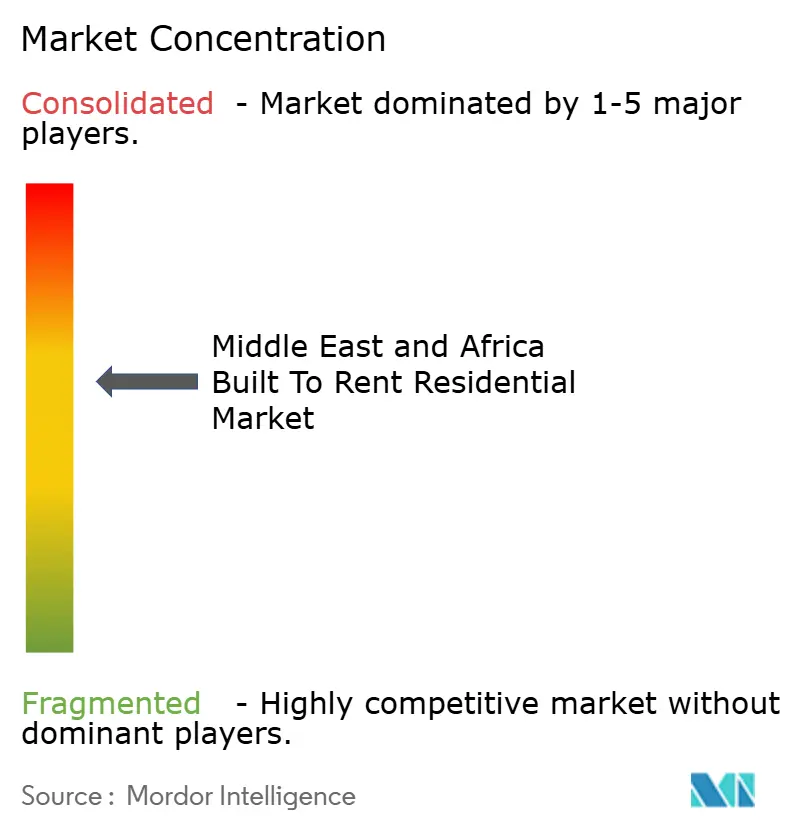
| Market Concentration | Medium |
Major Players *Disclaimer: Major Players sorted in no particular order Image © Mordor Intelligence. Reuse requires attribution under CC BY 4.0. | |
Middle East and Africa Built To Rent Residential Market Analysis by Mordor Intelligence
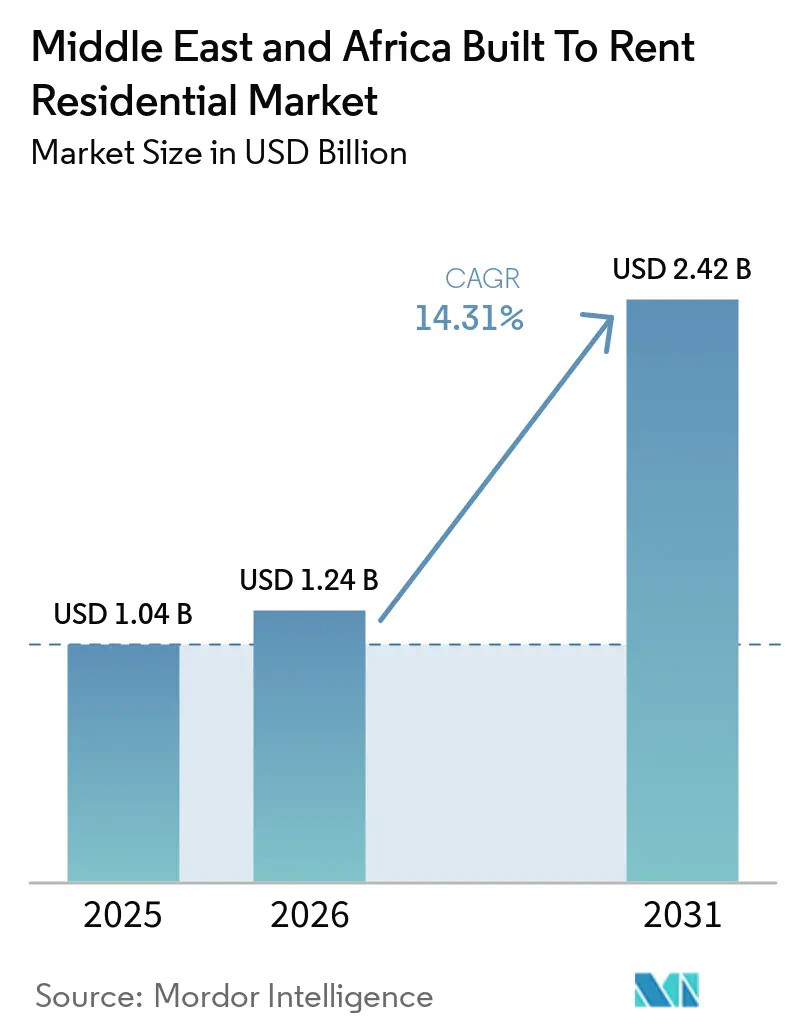
The Middle East and Africa built to rent residential market size is expected to increase from USD 1.04 billion in 2025 to USD 1.24 billion in 2026 and reach USD 2.42 billion by 2031, growing at a CAGR of 14.31% over 2026-2031.
The Middle East and Africa built to rent residential market is being shaped by formal rental supply, mobile professional households, and institutional ownership models. Listed and government-linked owners are helping create operating and disclosure benchmarks in markets where individual landlords previously held rental homes. This favors platforms that can manage leasing, maintenance, and resident services as a single operating function. Housing affordability constraints also sustain rental demand among households that cannot or do not want to buy a home. Regulatory rules on rent increases remain important because stable occupancy does not fully offset limits on revenue growth for long-term owners.
Key Report Takeaways
- By type, multifamily built to rent held 42.60% of the Middle East and Africa built to rent residential market share in 2025, while single-family built to rent / built to rent communities are projected to grow at a 16.80% CAGR through 2031.
- By management model, third-party operators held 51.80% of the Middle East and Africa built to rent residential market share in 2025, while hybrid management is projected to grow at a 16.10% CAGR through 2031.
- By price segment, mid-market held 46.70% of the Middle East and Africa built to rent residential market size in 2025, while affordable & workforce housing is projected to grow at a 16.50% CAGR through 2031.
- By country, the United Arab Emirates held 32.80% of the Middle East and Africa built to rent residential market size in 2025, while Saudi Arabia is projected to grow at an 18.20% CAGR through 2031.
Note: Market size and forecast figures in this report are generated using Mordor Intelligence’s proprietary estimation framework, updated with the latest available data and insights as of January 2026.
Middle East and Africa Built To Rent Residential Market Trends and Insights
Drivers Impact Analysis*
| Drivers | (~) % Impact on CAGR Forecast | Geographic Relevance | Impact Timeline |
|---|---|---|---|
| Expanding Expatriate and Mobile Professional Tenant Base Drives Rental Demand | +3.5% | United Arab Emirates core, spillover to Saudi Arabia, Egypt | Short term (≤ 2 years) |
| Institutionalization of Residential Leasing Capital Supports Built to Rent Investment | +3.0% | United Arab Emirates and Saudi Arabia, with Africa emerging | Medium term (2-4 years) |
| Housing Affordability Gaps and Mortgage Friction Extend Rental Demand | +2.8% | Saudi Arabia, South Africa, Egypt | Medium term (2-4 years) |
| Mega-Projects and Workforce Mobility Increase Purpose-Built Rental Demand | +2.4% | Saudi Arabia, United Arab Emirates | Medium term (2-4 years) |
| Flexible and Amenity-Rich Living Preferences Boost Built to Rent Adoption | +1.8% | United Arab Emirates, South Africa urban cores | Short term (≤ 2 years) |
| Digital Leasing and Unified Property Operations Improve Rental Efficiency | +1.5% | Global, with early gains in the United Arab Emirates and Saudi Arabia | Long term (≥ 4 years) |
| Source: Mordor Intelligence | |||
Expanding Expatriate and Mobile Professional Tenant Base Drives Rental Demand
The Middle East and Africa built to rent residential market benefits from households that need housing flexibility near employment centers. Dubai registered 253,992 lease contracts worth USD 8.77 billion in the first quarter of 2026, and cancellations declined 25%, according to Dubai Land Department data reported[1]Dubai Land Department, “Dubai Rental Market Q1 2026 Lease Contract Data,” UAE News Agency, wam.ae.. The fall in cancellations indicated that more tenants renewed their leases rather than leaving the city. Professionally managed homes can simplify renewals because residents deal with a single operator for contracts, repairs, and service requests. That consistency is valuable to investors who require recurring income from a long-held residential asset. It also gives operators a clearer view of occupancy and tenant retention than fragmented landlord ownership provides, including recurring evidence on renewal behavior, service demand, and the performance of individual communities.
Institutionalization of Residential Leasing Capital Supports Built to Rent Investment
The Middle East and Africa built to rent residential market is gaining a clearer institutional reference point through listed residential portfolios. Dubai Residential REIT reported a net profit of USD 349 million for 2025 and an average occupancy of 98.3%, according to the Emirates News Agency. These results show how stabilized rental portfolios can report operating performance in a consistent public format. The REIT’s listing also broadened the regional case for residential leasing assets that are managed as income-producing portfolios. Dubai Holding stated that the vehicle was the GCC’s first listed pure-play residential leasing-focused REIT when it debuted in May 2025[2]Dubai Holding, “Dubai Residential REIT Debuts on DFM as the GCC’s Largest and First Listed Pure-Play Residential Leasing-Focused REIT,” Dubai Holding, dubaiholding.com.. Greater visibility can help domestic owners compare leasing operations with other real estate asset classes and assess whether to retain projects for rental income, particularly where conventional unit sales do not provide a continuing revenue stream.
Housing Affordability Gaps and Mortgage Friction Extend Rental Demand
The Middle East and Africa built to rent residential market serves households for whom ownership remains difficult or unsuitable. The World Bank reported that Egypt’s mortgage market grew from USD 132 million in 2014 to USD 2.2 billion in 2026, but also noted that affordability barriers continue to limit access for low-income households. This gap means mortgage expansion does not remove the need for formal rental options. Rental homes can provide an alternative for workers with limited savings, who change work locations, or whose income is uncertain. The need is strongest where residents are close to jobs but cannot absorb the cost of a down payment and long-term debt. Operators that keep rents, service charges, and lease terms clear can reach a broader segment of this demand base while reducing uncertainty for households comparing formal rental homes with informal alternatives.
Mega-Projects and Workforce Mobility Increase Purpose-Built Rental Demand
Large-scale development projects in Saudi Arabia are increasing demand for rental housing near new employment hubs, with workers moving between project locations and requiring flexible, well-managed homes that can support short-term and longer-term stays. As workforce mobility increases, purpose-built rental communities can provide housing with maintenance, transport access, and shared services in one location, helping address the accommodation needs created by major construction and infrastructure developments. This growing requirement is also encouraging developers to retain residential assets and operate them as long-term rental portfolios, creating recurring income while improving asset utilization. A similar approach is emerging in Abu Dhabi, where a partnership between the Department of Municipalities and Transport and Aldar covers 9,000 rental units in Mohamed Bin Zayed City and Baniyas by 2029[3]Abu Dhabi Media Office, “Aldar and Department of Municipalities and Transport to Deliver 9,000 Rental Units in Abu Dhabi as Part of Value Housing Programme,” Abu Dhabi Media Office, mediaoffice.abudhabi., reflecting the broader regional shift toward professionally managed rental communities. In Saudi Arabia, continued mega-project activity and workforce relocation are therefore expected to strengthen demand for purpose-built rental housing near emerging employment centers.
Restraints Impact Analysis*
| Restraints | (~) % Impact on CAGR Forecast | Geographic Relevance | Impact Timeline |
|---|---|---|---|
| Rent Freezes and Regulatory Uncertainty Reduce Investment Flexibility | -2.5% | Saudi Arabia, United Arab Emirates | Short term (≤ 2 years) |
| Limited Transaction and Operating Data Complicates Institutional Valuation | -1.8% | Sub-Saharan Africa, Egypt | Medium term (2-4 years) |
| High Operating Costs and Service Delivery Risks Pressure Built to Rent Returns | -1.5% | Global, with a concentration in the Gulf Cooperation Council | Medium term (2-4 years) |
| Off-Plan Sales and Fragmented Ownership Intensify Competition for Tenants | -1.0% | United Arab Emirates, Saudi Arabia | Short term (≤ 2 years) |
| Source: Mordor Intelligence | |||
Rent Freezes and Regulatory Uncertainty Reduce Investment Flexibility
The Middle East and Africa built to rent residential market must balance tenant protection with predictable income growth. Saudi Arabia’s regulatory provisions for Riyadh took effect in September 2025 and regulate the relationship between landlords and tenants through the Ejar platform. A five-year rent freeze can support tenant stability and reduce sudden moves. However, it limits the rent escalation that investors may have included in their forecasts. Owners then need to place greater weight on initial rent setting, cost control, and steady occupancy. Different rules across cities can also make it harder for a regional platform to apply one underwriting approach across its portfolio, even when the homes, residents' needs, and basic operating processes appear similar.
Limited Transaction and Operating Data Complicates Institutional Valuation
The Middle East and Africa built to rent residential market has limited comparable data in several African markets. An Absa and Centre for Affordable Housing Finance in Africa study identified South Africa as the region’s most developed multifamily rental market, with relevant institutional activity and a growing base of managed assets. Even so, institutional buyers need reliable information on rents, operating costs, vacancy, and portfolio transactions before they can apply standardized valuation methods. Limited data can increase the equity required for development because lenders have less evidence to assess income risk. This can delay projects that would otherwise meet renters' demand. Operators that build credible operating records may therefore have an advantage when they seek financing or partnerships, since well-documented performance can reduce uncertainty for lenders and long-term capital providers.
*Our forecasts treat driver/restraint impacts as directional, not additive. The impact forecasts reflect baseline growth, mix effects, and variable interactions.
Segment Analysis
By Type: Multifamily Built to Rent Units Anchor the Market as Single-Family Built to Rent / Built to Rent Communities Scale
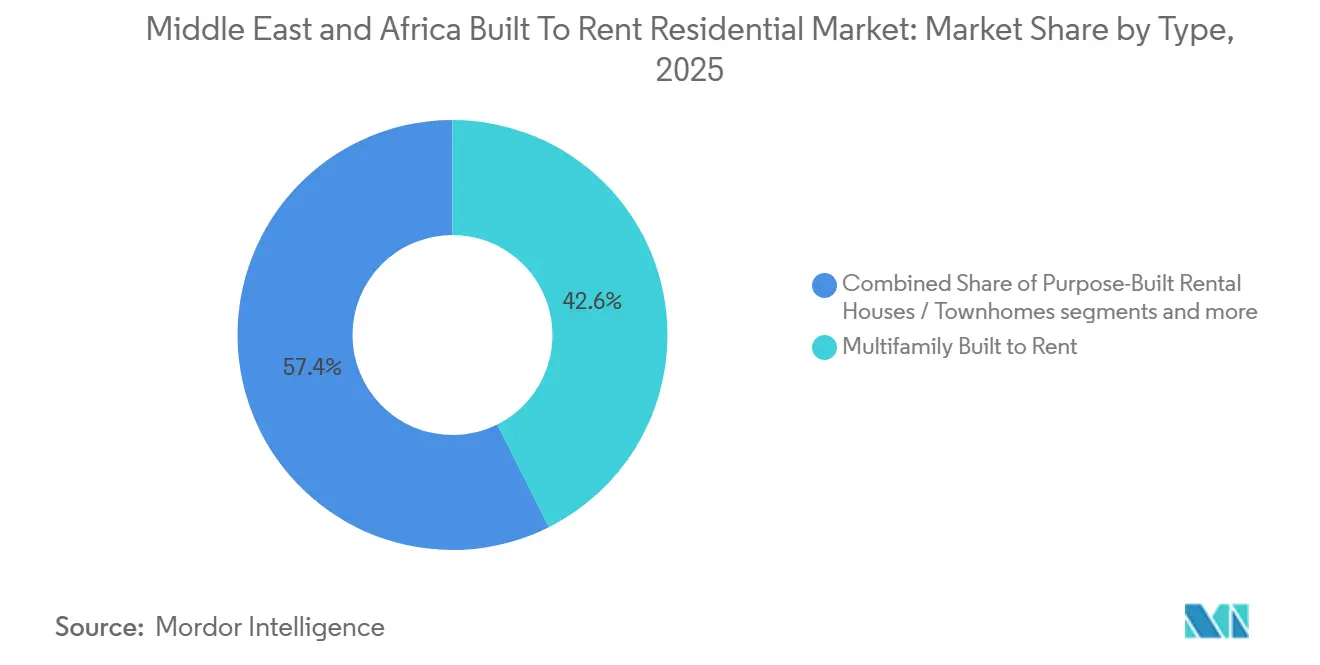
Multifamily built to rent held 42.60% of the Middle East and Africa built to rent residential market share in 2025. Its lead reflects dense urban development patterns in Gulf cities and major South African metros. A multifamily property allows a single operator to manage a larger number of homes at a single location. Shared amenities, security, maintenance teams, and leasing staff can reduce the per-unit operating burden. This structure is also easier for an institutional owner to monitor because occupancy and maintenance activities are concentrated in a single asset. Dubai Residential REIT provides a regional example, with 35,700 units across 21 communities and an average occupancy of 98.3% in 2025. The scale of that portfolio shows why multifamily formats are well-suited to a professional leasing model. It also provides a public operating reference for other owners considering long-term residential holdings.
Single-family built to rent / built to rent communities are forecast to grow at a 16.80% CAGR through 2031. This format suits families who want more space and neighborhood amenities without taking on a mortgage. Community-scale projects can combine homes with schools, retail, parks, and transport links. The model requires careful coordination because the owner must manage homes across a larger physical area than in a tower. In Saudi Arabia, converting planned residential communities into managed rental supply can broaden choices for households relocating for work. Operators will need durable maintenance processes and responsive local service teams to retain residents in these communities. The format also gives developers an option to hold completed homes for recurring income rather than rely only on initial sales. This supports a broader mix of rental products within the Middle East and Africa, built for the residential rental market.



By Management Model: Third-Party Operators Lead Market Share, While Hybrid Management Grows Faster
Third-party operators held 51.80% of the Middle East and Africa built to rent residential market share in 2025. The position reflects a developer-to-operator model in which property owners use specialist firms for leasing and daily building operations. This allows a developer to retain the asset while accessing staff with experience in tenant services, facilities management, and collection processes. The arrangement can be useful when a new rental platform does not yet have a full internal operating team. It can also separate development risk from resident-facing operations. For institutional owners, clear service agreements are important because they define responsibilities for occupancy, repairs, compliance, and reporting. A third-party model can therefore help early portfolios reach operating consistency without building every function internally. It remains relevant where developers have strong construction skills but limited rental management experience.
Hybrid management is expected to grow at a 16.10% CAGR through 2031. This approach keeps core decisions such as pricing, data control, and portfolio strategy inside the owner’s organization. It then uses outside providers for selected functions such as facilities management, leasing support, or resident acquisition. The model can give owners more direct access to tenant data while avoiding the cost of a fully internal operating platform. It also allows a platform to change providers as a portfolio expands or local needs change. The Middle East and Africa built to rent residential market may favor this model as operators seek both control and flexibility. A hybrid arrangement only works when responsibilities are clearly divided, and performance data are shared consistently. Otherwise, residents may experience gaps between the owner, the leasing agent, and the service provider.
By Price Segment: Mid-Market Leads Market Share, While Affordable & Workforce Housing Grows Faster
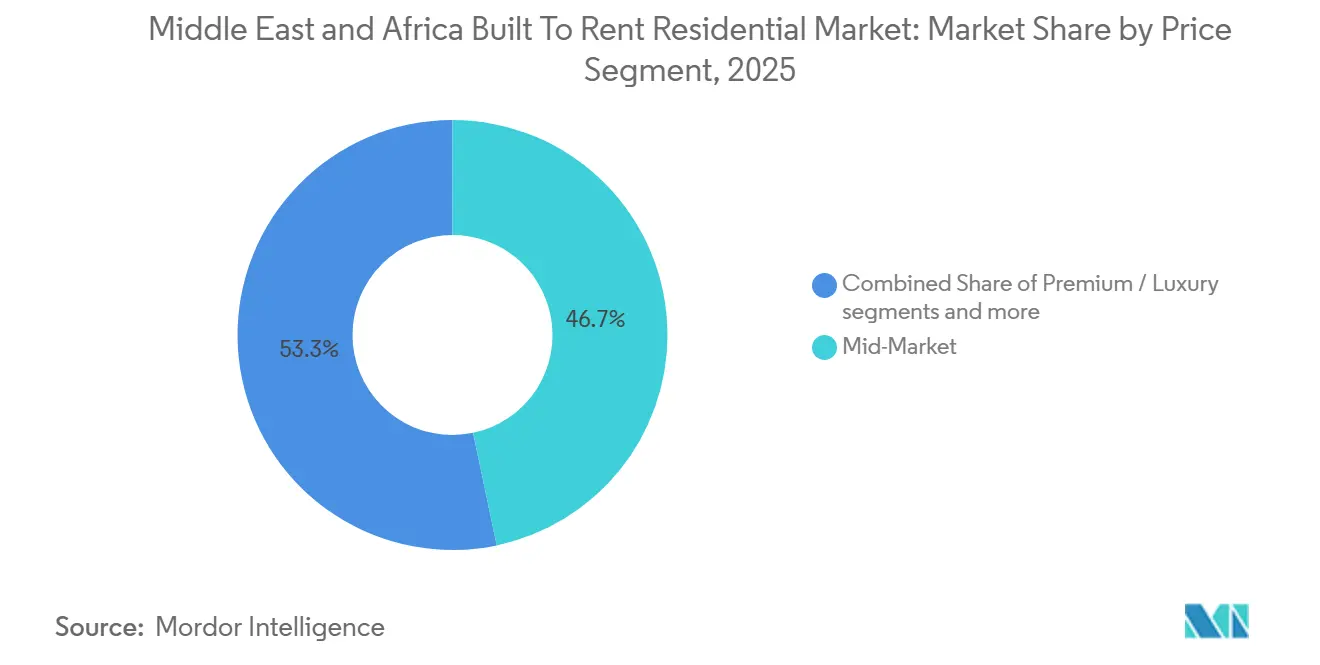
The mid-market held 46.70% of the Middle East and Africa built to rent residential market size in 2025. This tier serves professionals who need well-managed homes near employment centers but are not seeking luxury products. It includes workers in fields such as health care, engineering, education, and corporate services. These renters generally value reliable maintenance, transparent contracts, and practical access to transport and daily services. In Abu Dhabi, the Department of Municipalities and Transport and Aldar agreed to develop 9,000 value housing rental units by 2029. The program targets the middle-to-affordable housing range and demonstrates how public land and private delivery can work together. Premium rental homes remain important in selected locations, but the mid-market has a larger potential tenant base. Its position depends on operators keeping rents and service quality aligned with household budgets.
Affordable & workforce housing is forecast to grow at a 16.50% CAGR through 2031. Demand is supported by workers who need housing close to jobs but have limited capacity to buy a home. The World Bank has described the continuing affordability challenge in Egypt and the role of housing support for low-income households. This segment requires a disciplined operating model because even modest cost increases can affect residents’ ability to pay. Developers may need public-sector coordination, lower-cost land, or financing support to maintain viable rents. The segment can create stable demand when homes are near workplaces and transport routes. It also gives long-term owners a role in reducing the gap between informal rentals and formal managed housing. As a result, workforce supply is likely to remain a central area of expansion in the Middle East and Africa built to rent residential market.
Geography Analysis
The United Arab Emirates held 32.80% of the Middle East and Africa built to rent residential market share in 2025. Dubai’s 253,992 lease contracts in the first quarter of 2026 indicate the scale of formal rental activity in the country. The country’s rental ecosystem has a stronger public reporting base than many regional peers. Dubai Residential REIT’s 2025 results also provided investors with a clear record of occupancy and net profit from a stabilized leasing portfolio. The United Arab Emirates is therefore an important testing ground for formal residential leasing vehicles. Dubai Holding’s 2025 REIT listing showed that a residential leasing platform could access a public market in the GCC. In Abu Dhabi, the value housing program with Aldar adds a separate source of rental supply that is focused on the mid-to-affordable range. Together, these developments support a wider range of professionally managed rental homes.
Saudi Arabia is projected to record the highest geographic CAGR of 18.20% through 2031. The country has a significant need for housing that accommodates a growing, mobile workforce. Its regulatory provisions in Riyadh are intended to create a more balanced landlord-tenant relationship. These rules can support occupancy stability, but owners must account for restrictions on rental increases. Saudi Arabia’s potential lies in its scale, planned communities, and workforce mobility. The main challenge is converting that demand into homes that can be managed consistently over a long period. Developers who keep ownership after completion may add to the country’s formal rental base. Their ability to achieve stable returns will depend on location, operating discipline, and the evolution of local leasing rules.
South Africa remains an important institutional rental market within Africa, while Egypt and Kenya show the breadth of the regional opportunity. Research by Absa and the Centre for Affordable Housing Finance in Africa identified a significant managed multifamily base in South Africa. Its housing needs support demand for affordable rental formats with professional management. Egypt has a growing need for supply that works alongside mortgage and subsidy programs. World Bank support for inclusive housing finance shows the policy attention being directed toward lower-income households. Kenya is earlier in the formalization cycle, but its development can widen the regional investor base over time. The Middle East and Africa built to rent residential market will not develop at the same pace in every country because legal systems, financing options, and operating data differ widely.
Competitive Landscape
The Middle East and Africa built to rent residential market is moderately fragmented. Government-linked developers and large owners have a strong position in the Gulf, while South Africa has an expanding group of specialist rental operators. Dubai Residential REIT has set a clear benchmark with public results showing 98.3% average occupancy and USD 349 million in net profit for 2025. Its May 2025 listing created a public route for an institutional residential leasing portfolio in the Gulf Cooperation Council (GCC). Large owners can use their balance sheets, land access, and operating platforms to build scale. Smaller providers can compete by focusing on local leasing knowledge, tenant service, and affordable formats. Competition is likely to center on execution quality as much as on the number of units delivered.
Aldar’s agreement with Abu Dhabi’s Department of Municipalities and Transport is a major strategic move in the Middle East and Africa, built to tap into the residential market. The partnership covers 9,000 rental units by 2029, with Aldar responsible for development, leasing, and management. This model pairs public-sector objectives with a private company’s delivery and operating capabilities. It allows the company to build a long-term portfolio while serving a defined housing need. Dubai Holding made another strategic move by listing Dubai Residential REIT as the first pure-play residential leasing REIT in the Gulf Cooperation Council (GCC). These actions raise the standard for disclosure, portfolio management, and access to capital. They may also encourage other developers to retain assets rather than exit through unit sales.
South African operators face a different competitive setting that is more dependent on local affordability and financing conditions. Research from the Centre for Affordable Housing Finance in Africa points to a managed rental base capable of supporting institutional participation. Companies that can operate efficiently at attainable rents may find durable demand, but they must manage maintenance and collections carefully. The most attractive openings remain in markets where formal leasing supply is scarce relative to the number of working households. Data quality will distinguish operators that can approach lenders and long-term capital with credible forecasts. The Middle East and Africa built to rent residential market also needs local partnerships because a model that works in Dubai will not automatically suit Cairo, Johannesburg, or Nairobi. The competitive field is likely to remain diverse rather than dominated by a small group across the full region.
Middle East and Africa Built To Rent Residential Industry Leaders
Dubai Residential REIT
Aldar Properties PJSC
National Housing Company
ROSHN Group
Emaar Properties PJSC
- *Disclaimer: Major Players sorted in no particular order

Recent Industry Developments
- May 2026: Dubai Holding Asset Management broke ground on Lantana Hills in Dubai Science Park, appointing Group Amana as the main contractor under a USD 185.2 million agreement, adding to the Dubai Residential REIT portfolio, per Dubai Holding.
- April 2026: Abu Dhabi’s DMT and Aldar Properties PJSC signed a partnership to develop 9,000 affordable rental units in Mohamed Bin Zayed City and Baniyas by 2029, at a gross development value of USD 762.4 million, bringing Aldar’s develop-to-hold pipeline to USD 5.5 billion, per Abu Dhabi Media Office.
- March 2026: ROSHN signed a SAR 650 million (USD 177 million) strategic agreement with Miskan to develop residential units within the Warefa community in Riyadh; Miskan develops over 68,000 sqm of land, part of ROSHN's broader private-sector partnership model to scale residential delivery.


Middle East and Africa Built To Rent Residential Market Report Scope
| Multifamily Built to Rent |
| Single-Family Built to Rent / Built to Rent Communities |
| Purpose-Built Rental Apartments |
| Purpose-Built Rental Houses / Townhomes |
| In-house Operator |
| Third-party Operator |
| Hybrid Management |
| Premium / Luxury |
| Mid-Market |
| Affordable & Workforce Housing |
| United Arab Emirates |
| Saudi Arabia |
| South Africa |
| Egypt |
| Rest of Middle East and Africa |
| By Type | Multifamily Built to Rent |
| Single-Family Built to Rent / Built to Rent Communities | |
| Purpose-Built Rental Apartments | |
| Purpose-Built Rental Houses / Townhomes | |
| By Management Model | In-house Operator |
| Third-party Operator | |
| Hybrid Management | |
| By Price Segment | Premium / Luxury |
| Mid-Market | |
| Affordable & Workforce Housing | |
| By Country | United Arab Emirates |
| Saudi Arabia | |
| South Africa | |
| Egypt | |
| Rest of Middle East and Africa |


Key Questions Answered in the Report
What is the projected value of the Middle East and Africa built to rent residential market by 2031?
The Middle East and Africa built to rent residential market is projected to reach USD 2.42 billion by 2031, following growth from USD 1.24 billion in 2026 at a 14.31% CAGR. The projection reflects the growing role of formal, professionally managed rental supply across varied country housing systems and urban employment locations.
Which built to rent format had the largest share in 2025?
Multifamily built to rent led with a 42.60% share in 2025. The format can centralize leasing, maintenance, security, and resident amenities, which makes it well-suited to institutional owners seeking consistent operating procedures, clear oversight, and predictable resident services across a concentrated portfolio.
Which management model is growing fastest in the region?
Hybrid management is projected to grow at a 16.10% CAGR through 2031. It enables an owner to retain control over key decisions and tenant data while assigning selected functions, such as facilities management or leasing support, to specialist providers with local delivery capacity.
Why is workforce rental housing growing quickly?
Affordable & workforce housing is projected to grow at a 16.50% CAGR because many workers need formal housing near employment areas and continue to face barriers to homeownership. Viable delivery depends on cost discipline, reliable local services, suitable financing structures, and rents that remain accessible to the intended resident group.
Which country is expected to grow fastest through 2031?
Saudi Arabia is expected to record the highest CAGR at 18.20% through 2031. Its opportunity is tied to housing demand, planned communities, and workforce mobility. At the same time, operators must continue to account for local rules governing residential leases, pricing, and the timing of portfolio expansion.
What is the main policy risk for rental investors?
Rent controls can improve tenant stability and support occupancy, but they can also limit rental escalation and make income forecasting more difficult. Investors need to assess the local regulatory framework, operating costs, original lease pricing, and the practical capacity to maintain service quality before committing long-term capital.
Page last updated on:


 Your data is secure and never sold or shared.


