
Middle East and Africa Advertising Video-on-Demand (AVOD) Market Size and Share
Market Overview
| Study Period | 2020 - 2031 |
|---|---|
| Forecast Data Period | 2026 - 2031 |
| Base Year Market Size (2025) | USD 3.29 Billion |
| Market Size (2026) | USD 3.53 Billion |
| Market Size (2031) | USD 5.92 Billion |
| Growth Rate (2026 - 2031) | 10.89 % |
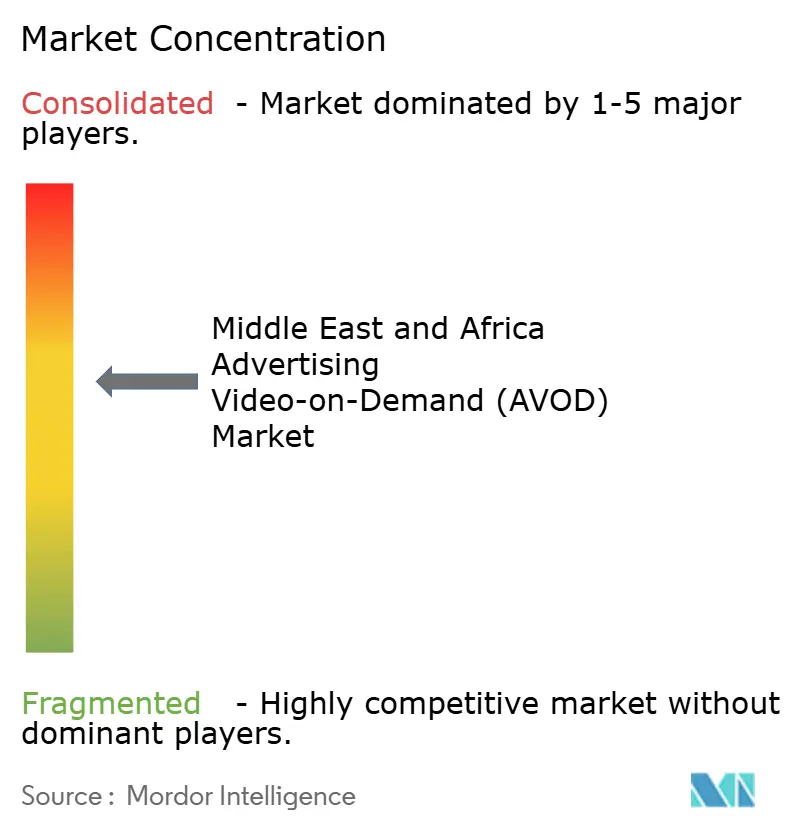
| Market Concentration | Medium |
Major Players *Disclaimer: Major Players sorted in no particular order Image © Mordor Intelligence. Reuse requires attribution under CC BY 4.0. | |
Middle East and Africa Advertising Video-on-Demand (AVOD) Market Analysis by Mordor Intelligence
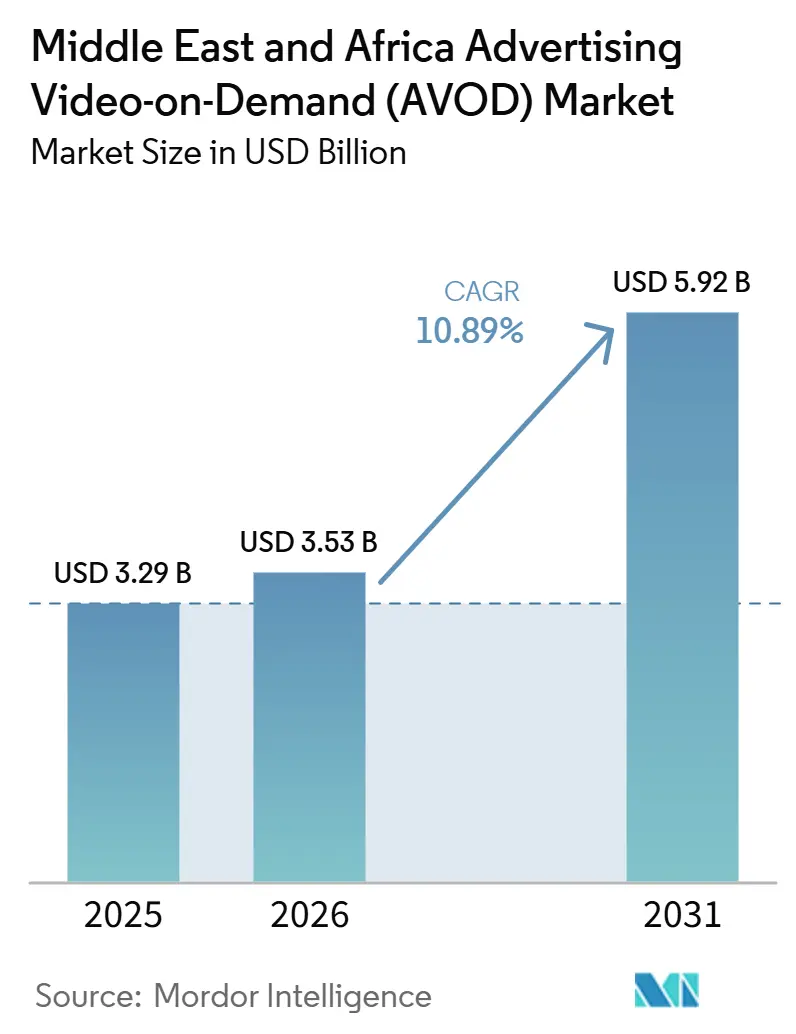
The Middle East and Africa advertising video-on-demand (AVOD) market size is projected to expand from USD 3.29 billion in 2025 to USD 3.53 billion in 2026, and to USD 5.92 billion by 2031, registering a CAGR of 10.89% between 2026 and 2031. The Middle East and Africa advertising video-on-demand (AVOD) market is supported by free viewing models that reduce payment barriers in markets where card use and subscription spending remain limited. Smartphone-led viewing broadens the available audience, while connected TV creates higher-value inventory in Gulf households. Advertisers are moving more spending toward streaming, programmatic video, and retail-linked formats, which strengthens the revenue opportunity for platforms with reliable targeting and local content. The Middle East remains the primary revenue base, while growth in Africa depends on achieving scale despite lower advertising yields, currency pressures, and uneven measurement standards. The resulting opportunity favors services that can combine broad mobile access with premium screens, localized programming, and advertising systems that give buyers clearer evidence of campaign delivery.
Key Report Takeaways
- By content type, TV Shows and Episodic Content held 35.61% of the Middle East and Africa advertising video-on-demand (AVOD) market share in 2025, while Documentaries are projected to expand at a 11.49% CAGR through 2031.
- By device type, Smartphones and Tablets held 33.56% of the Middle East and Africa advertising video-on-demand (AVOD) market share in 2025, while Smart TVs are projected to expand at a 11.33% CAGR through 2031.
- By end user, Media and Entertainment accounted for 32.48% of the Middle East and Africa advertising video-on-demand (AVOD) market size in 2025, while Retail and E-Commerce are projected to expand at a 11.74% CAGR through 2031.
- By ad format, Pre-Roll held 40.55% of the Middle East and Africa advertising video-on-demand (AVOD) market share in 2025, while Mid-Roll is projected to expand at a 11.68% CAGR through 2031.
- By geography, Middle East held 87.52% of Middle East and Africa advertising video-on-demand (AVOD) market size in 2025, while Africa is projected to grow at a 11.61% CAGR through 2031.
Note: Market size and forecast figures in this report are generated using Mordor Intelligence’s proprietary estimation framework, updated with the latest available data and insights as of January 2026.
Middle East and Africa Advertising Video-on-Demand (AVOD) Market Trends and Insights
Drivers Impact Analysis*
| Driver | (~) % Impact on CAGR Forecast | Geographic Relevance | Impact Timeline |
|---|---|---|---|
| Rising Smartphone-First Video Consumption | +3.5% | Regionwide, with strong effects in GCC countries, Nigeria, Kenya, and South Africa | Short term (≤ 2 years) |
| Advertiser Shift Toward CTV and Programmatic Video | +2.8% | GCC countries, with spillover to Egypt and South Africa | Medium term (2-4 years) |
| Growth of Free and Hybrid Streaming Models | +1.8% | Sub-Saharan Africa and middle-income MENA audiences | Medium term (2-4 years) |
| Expansion of Local-Language and Culturally Relevant Content | +1.2% | Arabic-speaking MENA, Nigeria, Ghana, and East Africa | Long term (≥ 4 years) |
| Ramadan and Event-Led Viewing Concentration | +0.8% | GCC countries, Egypt, Turkey, and Arab MENA | Short term (≤ 2 years) |
| Mobile-Money Enabled Monetization in African Markets | +0.6% | Sub-Saharan Africa, especially Kenya, Nigeria, Tanzania, and Uganda | Medium term (2-4 years) |
| Source: Mordor Intelligence | |||
Rising Smartphone-First Video Consumption
Smartphones are the main screen for video viewing across much of the Middle East and Africa advertising video-on-demand market. Nokia expects smartphones to represent 78% of connected devices in the region by 2029, while video streaming is expected to account for 90% of mobile data traffic.[1]Nokia, “5G Investments Transform MEA's Digital Future,” CIO Africa, cioafrica.co This pattern gives free, mobile-first services a wider addressable audience than services that depend on fixed broadband or recurring card payments. YouTube has established the baseline for mass reach because its free model works across varied income levels and device types. Competing platforms, therefore, need differentiated programming, more precise targeting, or a stronger brand-safe environment rather than scale alone. The Middle East and Africa advertising video-on-demand market also benefits when mobile operators improve data access, as longer viewing sessions increase the available advertising inventory.
Advertiser Shift Toward CTV and Programmatic Video
Connected TV advertising in MENA grew 31% in 2025, making it the region's fastest-growing digital advertising channel. Daily streaming use among UAE residents and time spent on open-internet video support a larger pool of premium streaming impressions. IAB MENA identified expanding CTV and original equipment manufacturer supply across more than 30 platforms, although buying methods and attribution remain inconsistent. This shift allows the Middle East and Africa advertising video-on-demand market to earn more from living-room viewing than from standard display placements. Dentsu introduced a curated programmatic CTV marketplace for MENA in June 2025, using Magnite technology to consolidate inventory, targeting, and measurement into a single buying environment. These systems make premium video easier for agencies to buy, even though consistent cross-screen measurement remains necessary.
Growth of Free and Hybrid Streaming Models
Free and hybrid access models provide the Middle East and Africa advertising video-on-demand market with a practical route to viewers who cannot afford recurring subscriptions. Sub-Saharan African AVOD revenue is projected to reach USD 1.3 billion by 2031, up 103% from its 2026 level, compared with 59% growth in subscription video revenue. Showmax was discontinued in April 2026 after cumulative losses of USD 522 million, illustrating the difficulty of sustaining a standalone subscription model in lower-income markets. Daily, weekly, and wallet-based access have shown demand for lower-commitment viewing, while free advertising-supported options remove the payment step altogether. MTN announced a partnership with Synamedia in April 2025 to develop a pan-African streaming service with live television, video-on-demand, and ad-supported channels. Telco distribution can extend access by linking content services to existing mobile relationships and data connectivity.
Expansion of Local-Language and Culturally Relevant Content
Local programming helps platforms in the Middle East and Africa advertising video-on-demand market retain viewers and offer advertisers more relevant placement environments. Shahid's catalog contains 51% local and co-produced titles, compared with 96% foreign titles in Netflix MENA's catalog. Arabic-language contextual ads achieved 3.5 times the attention of standard formats in MENA programmatic campaigns. Regional services also use cinema-first release windows before advertising-supported distribution to protect the value of selected films. Saudi Media Rules introduced in 2025 formalized compliance requirements that favor professionally produced, locally appropriate inventory. Streaming advertising in MENA is projected to grow 38.3% in 2026, supported in part by platform-exclusive local originals that maintain viewing outside Ramadan.
Restraints Impact Analysis*
| Restraint | (~) % Impact on CAGR Forecast | Geographic Relevance | Impact Timeline |
|---|---|---|---|
| Low Advertising Yields and Uneven CPMs Across African Markets | -1.8% | Sub-Saharan Africa, with effects in North Africa | Long term (≥ 4 years) |
| Currency Volatility and Low Consumer Purchasing Power | -1.2% | Nigeria, Egypt, Kenya, Ghana, and Tanzania | Medium term (2-4 years) |
| Fragmented Measurement, Identity, and Data Standards | -0.7% | Regionwide, especially MENA and Sub-Saharan Africa | Medium term (2-4 years) |
| Content Regulation, Censorship, and Rights-Clearance Complexity | -0.4% | Saudi Arabia, Turkey, Egypt, Kenya, and Nigeria | Long term (≥ 4 years) |
| Source: Mordor Intelligence | |||
Low Advertising Yields and Uneven CPMs Across African Markets
Low advertising yields limit how quickly audience growth becomes revenue in the Middle East and Africa advertising video-on-demand market. YouTube playback CPMs range from USD 0.75 in Ghana and USD 1.16 in Kenya to USD 1.72 in South Africa, compared with USD 6.21 in the United States and USD 14.08 in Israel. Lower domestic advertising budgets keep revenue per impression below levels seen in more mature markets. Nigeria's digital advertising spending is projected to reach 84% of total advertising spending by 2029, but data costs and economic conditions still limit the adoption of premium video outside major cities. Platforms consequently require high impression volumes and stronger targeting to make low-CPM inventory profitable. Africa can grow faster in percentage terms than the Middle East while generating less revenue in absolute terms, thereby preserving the Gulf region's lead in advertising density.
Currency Volatility and Low Consumer Purchasing Power
Currency volatility creates a mismatch for platforms in the Middle East and Africa advertising video-on-demand market because advertising contracts may be priced locally, while licensing and infrastructure costs are often priced in USD. Nigerian currency depreciation has reduced revenue growth relative to subscriber growth in subscription video, and the same pressure affects local-currency advertising revenue. Nigeria and Kenya also present distinct foreign-exchange conditions, requiring separate pricing and investment decisions rather than a single African approach. Inflation and currency pressure reduce consumer spending in Nigeria, South Africa, and Kenya, keeping higher-value advertising demand concentrated among urban audiences with more stable incomes. This condition constrains revenue per user even when reach and viewing time continue to increase. It also makes advertisers more cautious when committing to longer campaign periods.
*Our forecasts treat driver/restraint impacts as directional, not additive. The impact forecasts reflect baseline growth, mix effects, and variable interactions.
Segment Analysis
By Content Type: Serialized Drama Supports Revenue While Documentaries Grow Faster
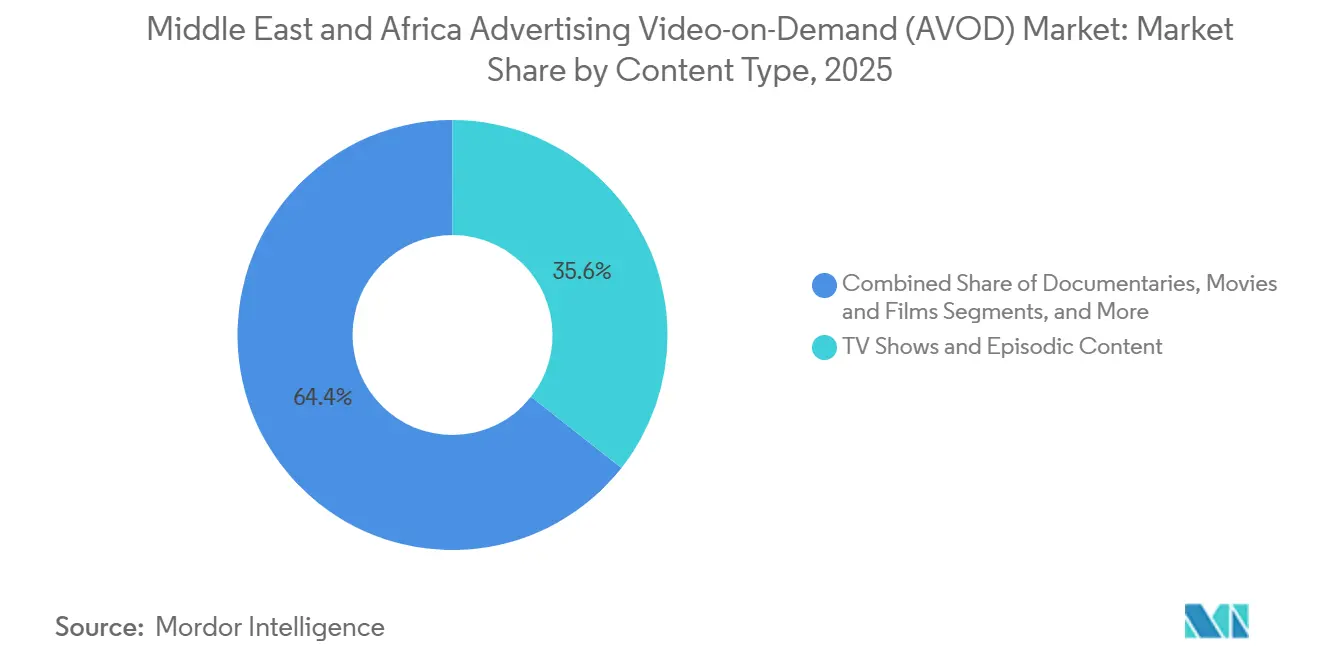
TV Shows and Episodic Content held 35.61% of the Middle East and Africa advertising video-on-demand market share in 2025. Arabic serialized drama and the Ramadan programming cycle support this position by concentrating viewing and advertising demand in a seasonal period. Shahid reported a 55.8% increase in AVOD viewing during Ramadan 2025, showing how episode schedules can shape advertising revenue. Documentaries are projected to expand at an 11.49% CAGR through 2031, helped by factual programming on YouTube and growing Nollywood production for diaspora audiences.
Documentaries can offer lower licensing costs than drama while maintaining strong completion rates. Movies and Films retain a stable role, and regional services use cinema-first release windows before advertising-supported distribution. Other Content Types include short-form vertical video and sports-adjacent programming that can attract programmatic pre-roll spending. A 2026 Ramadan report found that younger MENA audiences increasingly prefer 10-15 episode series over traditional 30-episode formats. Shorter seasons let platforms refresh catalogs more often and create additional opportunities for mid-season advertising placements. This change can give advertisers a steadier supply of fresh programming outside the traditional Ramadan peak. It also allows content teams to plan release schedules around audience retention rather than relying only on long seasonal runs.



By Device Type: Mobile Provides Reach While Smart TVs Improve Monetization
Smartphones and Tablets accounted for 33.56% of the Middle East and Africa advertising video-on-demand market size in 2025. This share reflects mobile-first viewing across both subregions and the broad availability of handheld screens. Smartphone penetration exceeded 90% in GCC countries in 2024, supporting longer-form viewing in Saudi Arabia and the UAE. Smart TVs are projected to expand at an 11.33% CAGR through 2031 as streaming services are embedded in television operating systems. Samsung found that Ramadan 2025 raised television use in MENA by 42% after Iftar and by up to 80% after midnight. Smart TV home screens, therefore, provide a central route into streaming services for household audiences.
Connected TV can support higher-value advertising than mobile or standard display because viewers are engaged in longer sessions. Laptops and Desktops remain relevant for professional and student users in urban areas. Gaming consoles and other devices serve smaller audience groups, especially in higher-income GCC households. Device choice also affects how platforms package advertising, with large screens better suited to longer commercial breaks and premium video formats. A mixed-device audience requires platforms to keep the viewing and advertising experience consistent across mobile, television, and desktop environments.
By End User: Media and Entertainment Leads While Retail and E-Commerce Expands
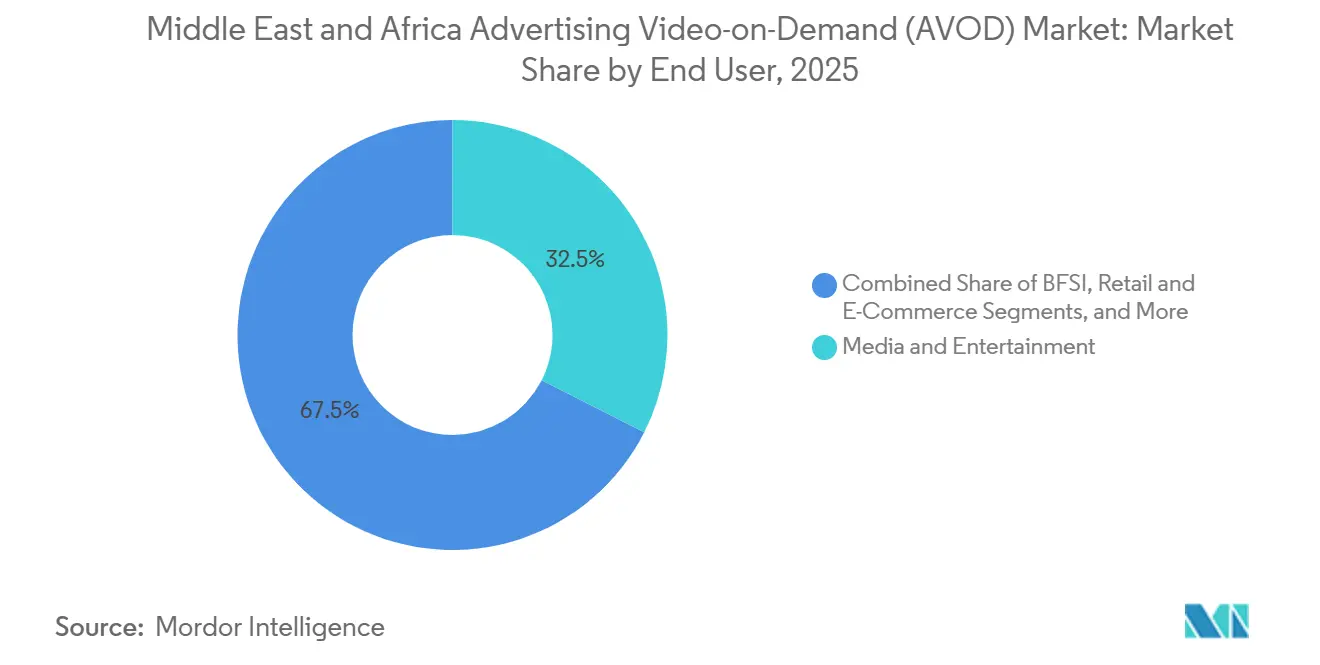
Media and Entertainment held 32.48% of the Middle East and Africa advertising video-on-demand market share in 2025. The sector has long allocated significant budgets to video advertising and aligns closely with entertainment content that draws large audiences. Retail and E-Commerce are projected to expand at an 11.74% CAGR through 2031 as advertisers use shoppable pre-roll and mid-roll formats. Retail commerce media in MENA is projected to grow 22.2% to USD 636 million in 2026 and is expected to exceed the region's television advertising value within 12 months.
BFSI advertisers use video formats for mobile banking promotion, app installs, and financial literacy campaigns. Government-supported digital learning initiatives create demand from Education, particularly in GCC countries. Information Technology and Telecommunications, Healthcare, and other end users broaden the advertiser base. IAB MENA reported that retail media grew by up to 40.5% year-on-year in 2025.[2]Interactive Advertising Bureau MENA, “CTV and OEM Capabilities in MENA,” IAB MENA, iabmena.com Platforms that combine shoppable units with retail audience data can improve attribution and compete for performance-focused budgets. This approach can help advertisers link video exposure to action during the buying journey. It also gives AVOD services a way to diversify revenue beyond campaigns focused mainly on reach and brand awareness.
By Ad Format: Pre-Roll Retains Reach While Mid-Roll Gains Value
Pre-Roll held 40.55% of the Middle East and Africa advertising video-on-demand market share in 2025. Its broad reach makes it a practical format for awareness campaigns across large and emerging services. The 5-second skip threshold gives advertisers a defined early-viewing window for delivery at scale. Mid-Roll is projected to expand at an 11.68% CAGR through 2031 as longer TV shows and documentaries provide natural insertion points during viewing. Mid-Roll can achieve stronger completion rates because it appears within content that viewers have already chosen to watch. Connected TV viewing of 40-60 minute episodes may also reduce avoidance compared with short mobile sessions.
Post-Roll remains the smallest format and suits direct-response campaigns aimed at viewers who complete content. In 2025, 71% of surveyed MENA consumers said excessive advertising during Ramadan felt overwhelming. This response encourages platforms to use fewer, more relevant advertisements instead of repeated pre-roll exposure. A more controlled ad load can protect the viewing experience while preserving inventory for advertisers. It can also support mid-roll placements, where the program structure provides viewers with a clearer break in the content.
Geography Analysis
The Middle East held 87.52% of the Middle East and Africa advertising video-on-demand (AVOD) market share in 2025. GCC spending power, high smartphone adoption in Saudi Arabia and the UAE, and Ramadan viewing concentration made the subregion the principal revenue base. The MENA digital advertising market reached USD 8.185 billion in 2025, while Egypt recorded 23.1% year-on-year growth. Ramadan advertising spending reached USD 1.1 billion in 2025, and digital platforms accounted for 44% of television viewing during the period. Advertising across Arab countries is projected to surpass USD 2 billion in 2026, with streaming platforms competing directly for entertainment and advertising budgets.
Africa is projected to expand at a 11.61% CAGR through 2031, the highest geographic growth rate in the Middle East and Africa advertising video-on-demand (AVOD) market. Sub-Saharan African streaming revenue is projected to rise from USD 1.8 billion in 2026 to USD 3.1 billion by 2031, with AVOD accounting for 35% of revenue in 2026. YouTube is projected to generate USD 583 million in AVOD revenue across Sub-Saharan Africa in 2026. South Africa has the region's most developed advertising environment, while Nigeria offers large viewing volumes with lower revenue per impression.
East Africa generated combined streaming revenue of USD 189 million in 2026 and is projected to reach USD 374 million by 2031. Kenya's internet advertising segment is projected to grow at a 16% CAGR, supported by smartphone adoption and improving connectivity. Direct carrier billing covers more than 300 million mobile users in Sub-Saharan Africa, helping content services reach people without card credentials.[3]Mobile Ecosystem Forum, “Mobile Content Consumption Trends and Growth in Sub-Saharan Africa: The Role of Mobile Payments,” Mobile Ecosystem Forum, mobileecosystemforum.com Ghana, Tanzania, and Uganda remain earlier-stage AVOD markets, where YouTube receives most advertising spending and local platform investment is still limited.
Competitive Landscape
The Middle East and Africa advertising video-on-demand (AVOD) market is moderately consolidated at the platform level, although advertising inventory trading and measurement are more fragmented. Shahid and YouTube use different strengths in the region, with Shahid centered on pan-Arab programming and YouTube providing broad reach in Africa. YouTube is projected to account for 92% of Sub-Saharan Africa's AVOD revenue by 2031. MBC Group reported 27.1% AVOD revenue growth in fiscal 2025 and a 55.8% increase during Ramadan, indicating sustained and seasonal advertiser demand. This regional split means that platforms need different content, distribution, and advertising strategies in the advertising video-on-demand market in the Middle East and Africa.
MBC Group launched the MBCNOW bundle with Netflix in Saudi Arabia in July 2025, combining Netflix content, Shahid programming, and MBC television channels. The bundle reduces the cost of separate subscriptions and makes aggregation a defense against churn. OSN Group also partnered with The Trade Desk in 2025, giving the demand-side platform direct programmatic access to OSN's premium video inventory.[4]OSN Group and The Trade Desk, “It’s a Mistake to Treat MENA as a Single Market,” ExchangeWire, exchangewire.com Samsung TV Plus has a different advantage because device-level viewing data can support audience targeting that content-only platforms may not match.
MTN's planned streaming service with Synamedia could use its more than 280 million subscribers to distribute live television, video-on-demand, and free ad-supported channels across Africa. The Showmax closure created opportunities for DStv Stream, local distributors, and telco-integrated services to pursue viewers and content relationships in 44 African markets. Local compliance requirements in Saudi Arabia and Turkey add rights-clearance and operational costs for international services. These requirements can favor established platforms with localized content teams and existing regulatory relationships. The Middle East and Africa advertising video-on-demand (AVOD) market therefore rewards firms that combine local content, reliable advertising systems, and efficient distribution.
Middle East and Africa Advertising Video-on-Demand (AVOD) Industry Leaders
Alphabet Inc.
MBC Group
Meta Platforms, Inc.
MultiChoice Group Limited
Samsung Electronics Co., Ltd.
- *Disclaimer: Major Players sorted in no particular order

Recent Industry Developments
- July 2026: Alphabet disclosed that YouTube generated USD 9.88 billion in advertising revenue in Q1 2026, up 11% year-on-year, following USD 40.4 billion in global advertising revenue in 2025. YouTube's sustained position in free ad-supported streaming reinforced its role in Africa's AVOD monetization layer.
- May 2026: IAB MENA published its CTV Capability Map, which covers more than 30 CTV and original equipment manufacturer platforms across MENA. The assessment documented fragmented buying methods, inconsistent targeting capabilities, and attribution discrepancies as principal barriers to programmatic CTV scaling, while confirming rapid inventory expansion.
- May 2026: MBC Group reported Q1 2026 results with MBC Shahid revenues increasing 17.5% year-on-year to SAR 459.9 million (USD 122.6 million). MBC Shahid's net profit rose 257.7% year-on-year to SAR 47.4 million (USD 12.6 million), making the streaming platform the group's key earnings contributor.
- July 2025: MBC Group and Netflix launched MBCNOW in Saudi Arabia, a bundled subscription combining Netflix's full international catalog, Shahid's Arabic content library, and MBC's linear television channels at a saving of more than 21% compared with individual subscriptions. MBC Group confirmed expansion across the GCC and wider MENA region after the initial Saudi launch.


Middle East and Africa Advertising Video-on-Demand (AVOD) Market Report Scope
The Middle East and Africa advertising video-on-demand (AVOD) market comprises digital video streaming services that offer users free or low-cost access to content supported by advertising revenue. The report covers AVOD platforms and services across the region, analyzing market trends, growth drivers, restraints, and opportunities. It also examines key segments, including content type, platform, device type, and country, along with the competitive landscape and major companies operating in the market.
The Middle East and Africa Advertising Video-on-Demand (AVOD) Market Report is Segmented by Content Type (Movies and Films, TV Shows and Episodic Content, Documentaries, and Other Content Types), Device Type (Smartphones and Tablets, Smart TVs, Laptops and Desktops, and Other Device Types), End User (Media and Entertainment, Retail and E-Commerce, BFSI, Education, Information Technology and Telecommunications, Healthcare, and Other End Users), Ad Format (Pre-Roll, Mid-Roll, and Post-Roll), and Geography (Middle East [Saudi Arabia, United Arab Emirates, Qatar, Kuwait, Bahrain, Oman, Turkey, and Rest of Middle East] and Africa [South Africa, Nigeria, Egypt, Kenya, Ghana, Tanzania, Uganda, and Rest of Africa]). The Market Forecasts are Provided in Terms of Value (USD).
| Movies and Films |
| TV Shows and Episodic Content |
| Documentaries |
| Other Content Types |
| Smartphones and Tablets |
| Smart TVs |
| Laptops and Desktops |
| Other Device Types |
| Media and Entertainment |
| Retail and E-Commerce |
| BFSI |
| Education |
| Information Technology and Telecommunications |
| Healthcare |
| Other End Users |
| Pre-Roll |
| Mid-Roll |
| Post-Roll |
| Middle East | Saudi Arabia |
| United Arab Emirates | |
| Qatar | |
| Kuwait | |
| Bahrain | |
| Oman | |
| Turkey | |
| Rest of Middle East | |
| Africa | South Africa |
| Nigeria | |
| Egypt | |
| Kenya | |
| Ghana | |
| Tanzania | |
| Uganda | |
| Rest of Africa |
| By Content Type | Movies and Films | |
| TV Shows and Episodic Content | ||
| Documentaries | ||
| Other Content Types | ||
| By Device Type | Smartphones and Tablets | |
| Smart TVs | ||
| Laptops and Desktops | ||
| Other Device Types | ||
| By End User | Media and Entertainment | |
| Retail and E-Commerce | ||
| BFSI | ||
| Education | ||
| Information Technology and Telecommunications | ||
| Healthcare | ||
| Other End Users | ||
| By Ad Format | Pre-Roll | |
| Mid-Roll | ||
| Post-Roll | ||
| By Geography | Middle East | Saudi Arabia |
| United Arab Emirates | ||
| Qatar | ||
| Kuwait | ||
| Bahrain | ||
| Oman | ||
| Turkey | ||
| Rest of Middle East | ||
| Africa | South Africa | |
| Nigeria | ||
| Egypt | ||
| Kenya | ||
| Ghana | ||
| Tanzania | ||
| Uganda | ||
| Rest of Africa | ||


Key Questions Answered in the Report
What is the size of the Middle East and Africa advertising video-on-demand (AVOD) market?
The Middle East and Africa advertising video-on-demand (AVOD) market is projected to grow from USD 3.53 billion in 2026 to USD 5.92 billion by 2031 at a 10.89% CAGR.
What is driving advertising-supported streaming growth in the region?
Smartphone viewing, free access models, rising CTV inventory, and advertiser demand for programmatic video support growth.
Which content type leads regional AVOD revenue?
TV Shows and Episodic Content led with 35.61% share in 2025, supported by Arabic drama and Ramadan programming.
Which device category is growing fastest for AVOD viewing?
Smart TVs are projected to grow at an 11.33% CAGR through 2031 as CTV use deepens in GCC households.
Which advertiser group is expanding fastest in streaming video?
Retail and E-Commerce are projected to expand at an 11.74% CAGR through 2031, supported by shoppable video formats.
Why are African AVOD returns lower than Middle Eastern returns?
Lower CPMs, currency volatility, and fragmented measurement reduce revenue per impression despite rapid growth in viewing volume.
Page last updated on:





