
Middle East 5G Technology Market Size and Share
Market Overview
| Study Period | 2020 - 2031 |
|---|---|
| Forecast Data Period | 2026 - 2031 |
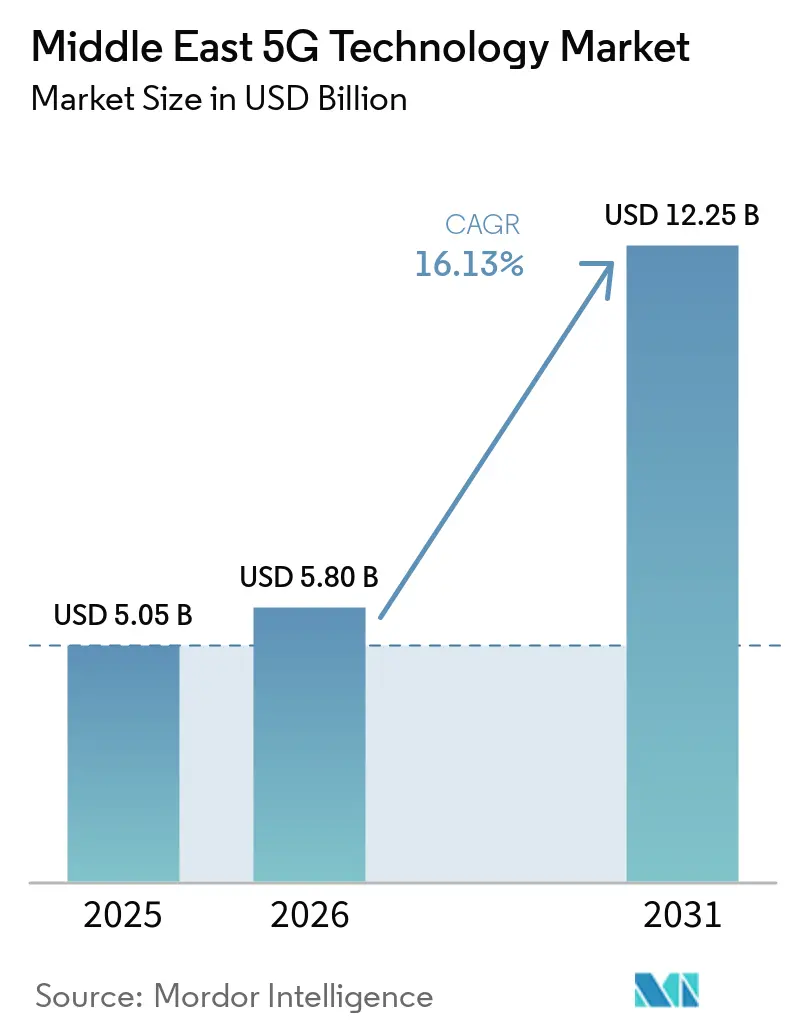
| Base Year Market Size (2025) | USD 5.05 Billion |
| Market Size (2026) | USD 5.80 Billion |
| Market Size (2031) | USD 12.25 Billion |
| Growth Rate (2026 - 2031) | 16.13 % |
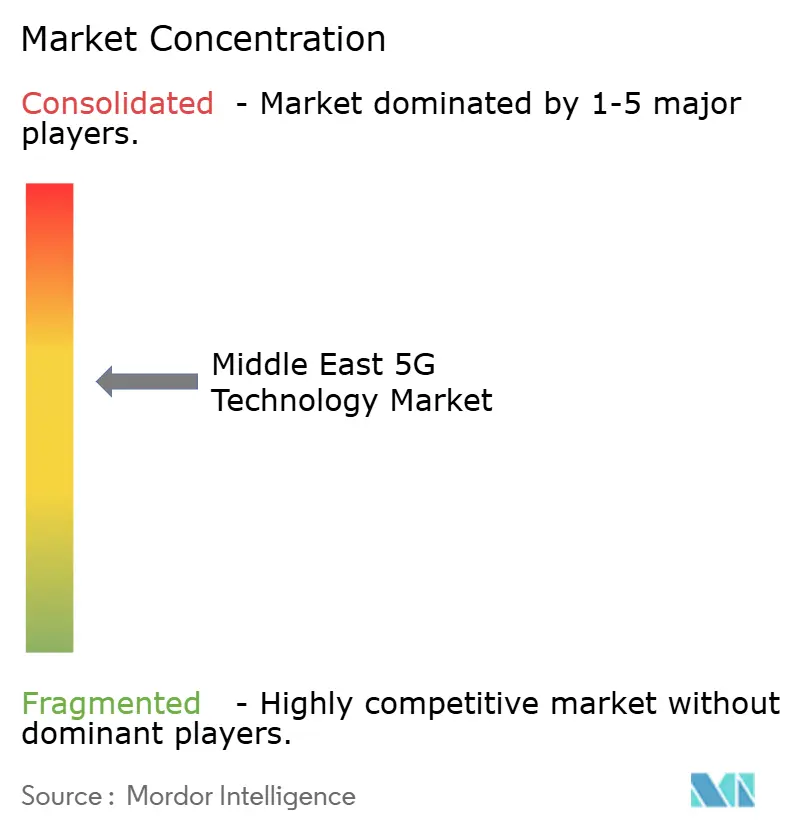
| Market Concentration | Medium |
Major Players *Disclaimer: Major Players sorted in no particular order Image © Mordor Intelligence. Reuse requires attribution under CC BY 4.0. | |
Middle East 5G Technology Market Analysis by Mordor Intelligence
The Middle East 5G Technology Market size is expected to increase from USD 5.05 billion in 2025 to USD 5.80 billion in 2026 and reach USD 12.25 billion by 2031, growing at a CAGR of 16.13% over 2026-2031. Government digital programs, spectrum planning, and operator investment are supporting deployment across the region. The Middle East 5G Technology market is shifting from broad consumer coverage to networks that support enterprise services. Standalone cores are becoming more important because they enable network slicing, low-latency communications, and more flexible service delivery. This shift gives operators a route to serve manufacturing, logistics, energy, and public-sector users with services beyond mobile broadband. The pace of the Middle East 5G technology market will still vary because GCC countries have stronger infrastructure and purchasing power than several non-GCC markets.
Key Report Takeaways
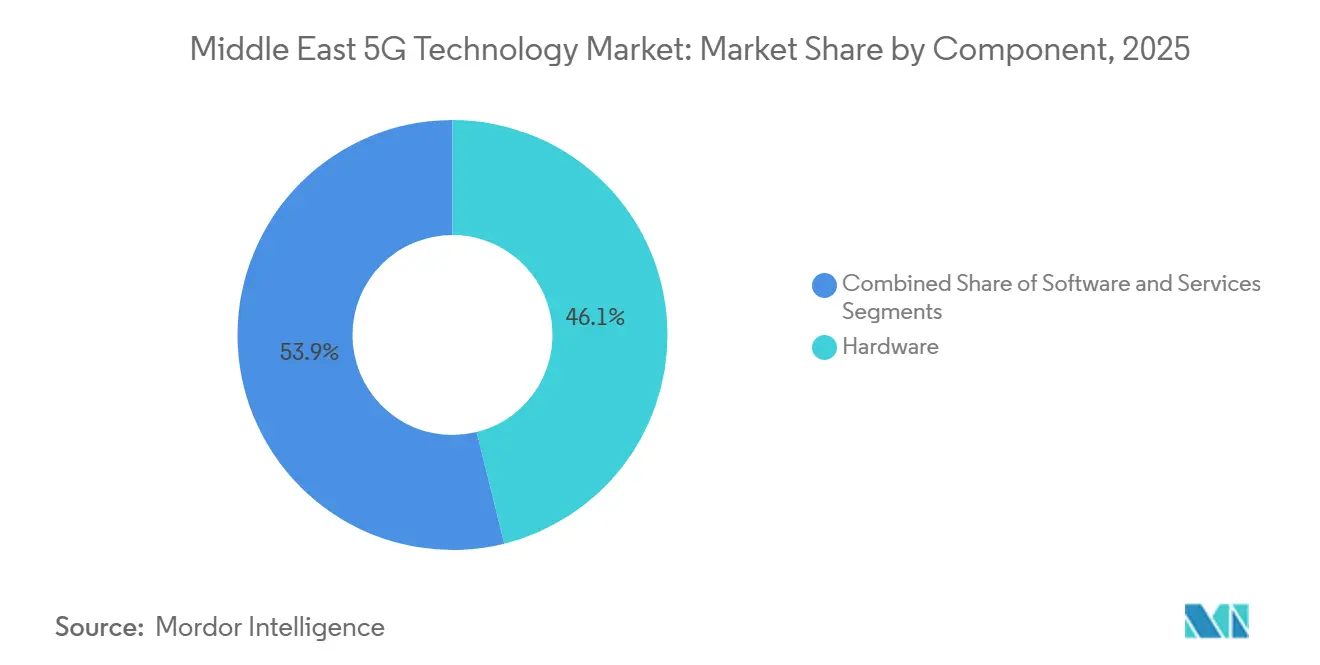
- By component, hardware accounted for 46.12% of the Middle East 5G Technology Market in 2025, while services are projected to expand at a 17.21% CAGR through 2031.
- By spectrum band, sub-6 GHz held 64.59% of the Middle East 5G technology market in 2025, while hybrid (sub-6 GHz and mmWave) is projected to expand at an 18.51% CAGR through 2031.
- By application, eMBB held 36.98% of the Middle East 5G technology market in 2025, while URLLC is projected to expand at an 18.80% CAGR through 2031.
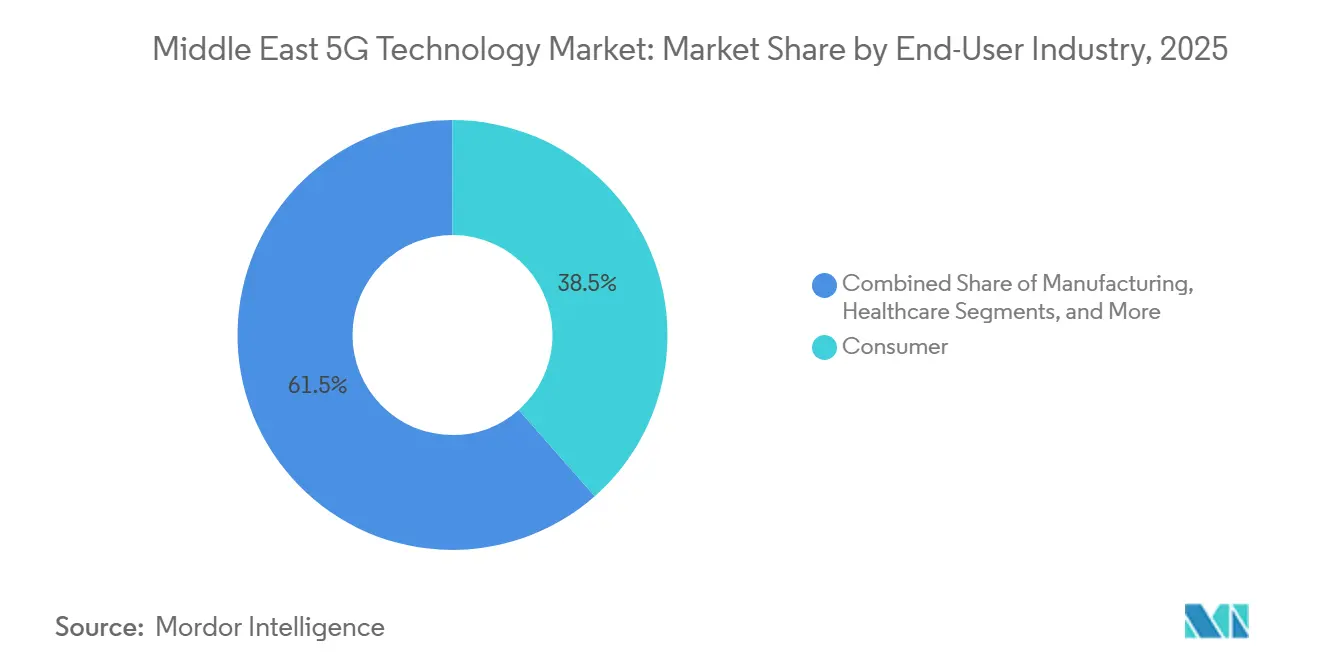
- By end-user industry, the consumer segment held 38.49% of the Middle East 5G technology market in 2025, while manufacturing is projected to expand at a 17.95% CAGR through 2031.
- By network architecture, NSA held 60.10% of the Middle East 5G technology market in 2025, while SA is projected to expand at a 19.49% CAGR through 2031.
- By country, Saudi Arabia held 33.49% of the Middle East 5G technology market in 2025, while Turkey is projected to expand at a 19.61% CAGR through 2031.
Note: Market size and forecast figures in this report are generated using Mordor Intelligence’s proprietary estimation framework, updated with the latest available data and insights as of January 2026.
Middle East 5G Technology Market Trends and Insights
Drivers Impact Analysis*
| Driver | (~) % Impact on CAGR Forecast | Geographic Relevance | Impact Timeline |
|---|---|---|---|
| Government-Led 5G Infrastructure Programs and Spectrum Roadmaps | +4.2% | Saudi Arabia, United Arab Emirates, Turkey, Kuwait | Short term (≤ 2 years) |
| Enterprise Digitalization Across Energy, Logistics, and Public Services | +3.5% | Saudi Arabia, United Arab Emirates, Qatar | Medium term (2-4 years) |
| Private 5G and Campus Network Demand in Industrial Clusters | +2.8% | United Arab Emirates, Saudi Arabia, Bahrain, Oman | Medium term (2-4 years) |
| Rising Use of Network Slicing for Mission-Critical Connectivity | +2.1% | United Arab Emirates, Saudi Arabia, Qatar | Medium term (2-4 years) |
| Cross-Border Carrier and Cloud Interconnect Investment | +1.8% | Saudi Arabia, United Arab Emirates, Turkey | Long term (≥ 4 years) |
| Edge Computing Demand for Low-Latency Industrial Applications | +1.5% | United Arab Emirates, Saudi Arabia, Qatar, Bahrain | Medium term (2-4 years) |
| Source: Mordor Intelligence | |||
Government-Led 5G Programs and Spectrum Roadmaps Drive Deployment at Scale
National policy is a central force behind the Middle East 5G Technology market. Government roadmaps turn broad digital goals into spectrum allocations, coverage obligations, and incentives for operators. Saudi Arabia's National Spectrum Strategy 2025 prioritized 5G+ deployment and authorized private networks for manufacturing, logistics, and smart-city uses. The strategy was supported by USD 15 billion in 5G infrastructure investment under Vision 2030.[1]Saudi Government, “Emerging Technologies Adoption - 5G Networks,” Saudi Government National Platform, my.gov.sa Turkey's 2025 auction allocated 400 MHz across the 700 MHz and 3.5 GHz bands, giving operators the spectrum base for a national launch. Large public procurement programs can reduce uncertainty for major suppliers, but they can also concentrate contracts among a small group of vendors.
Enterprise Digitalization Across Energy, Logistics, and Public Services Reshapes Revenue Mix
Enterprise demand is directing the Middle East 5G Technology market toward managed connectivity and integrated digital services. Energy sites, ports, utilities, and public services need dependable networks that connect equipment, people, and operational systems. GSMA reported that enterprises in the region were advancing the adoption of AI, big data, private 5G, and edge computing. The UAE's Operation 300bn program identifies advanced technology as part of its industrial development agenda through 2031.[2]Ministry of Industry and Advanced Technology, “Operation 300bn,” UAE Government, moiat.gov.ae Automotive, utilities, and logistics activities have clear needs for connected monitoring and control. Operators that add integration and managed-service capabilities can participate in more of this spending than operators that only sell bandwidth.
Private 5G and Campus Networks in Industrial Clusters Move From Pilots to Production
Private networks are becoming a practical part of the Middle East 5G Technology market for industrial locations. Manufacturing plants, ports, and energy assets need secure local coverage with predictable performance. EMSTEEL Group and e& UAE activated a dedicated private industrial 5G network at EMSTEEL's facilities in November 2025.[3]Emirates News Agency, “EMSTEEL, e& Collaborate to Launch First-of-Its-Kind Advanced Private 5G Network Pilot in Manufacturing,” Emirates News Agency, wam.ae The network supported on-site coverage and AI-driven asset-management processes. Heavy manufacturing and port operations often have clearer financial cases than office or retail sites because unreliable Wi-Fi can interrupt physical operations. These deployments are helping buyers define the service, security, and reliability requirements for future industrial networks.
Network Slicing for Mission-Critical Connectivity Differentiates Standalone Network Revenue
Network slicing is becoming an important commercial feature of standalone deployment in the Middle East 5G Technology market. It allows an operator to create logical network capacity for users with specified performance needs. This is relevant for industrial users, public safety organizations, and ports that cannot rely on best-effort connectivity. Standalone 5G can support traffic separation and service commitments that NSA systems cannot fully provide. The capability is also tied to 3GPP Release 16 and Release 17 features for reliable, low-latency services. Operators that align their deployments with these requirements can support applications with operational, safety, or certification obligations.
Restraints Impact Analysis*
| Restraint | (~) % Impact on CAGR Forecast | Geographic Relevance | Impact Timeline |
|---|---|---|---|
| High Fiber Backhaul and Site Acquisition Costs in Non-Core Markets | -1.8% | Turkey, Iraq, Rest of Middle East | Medium term (2-4 years) |
| Uneven Device Affordability and 5G Handset Replacement Cycles | -1.2% | Iraq, Egypt, Rest of Middle East | Short term (≤ 2 years) |
| Spectrum Fragmentation and Cross-Country Regulatory Variation | -0.8% | Turkey, Iraq, Jordan, Rest of Middle East | Long term (≥ 4 years) |
| Power Availability and Energy Efficiency Constraints for Dense 5G Rollouts | -0.6% | Iraq, Yemen, Rest of Middle East | Long term (≥ 4 years) |
| Source: Mordor Intelligence | |||
High Fiber Backhaul and Site Acquisition Costs Constrain Densification Economics
Fiber backhaul remains a significant constraint outside the largest GCC cities. Dense mid-band and mmWave networks need fiber-connected radio sites, which are costly in older urban areas and remote corridors. New macro-site permits can take 4-8 months, where zoning and municipal coordination add complexity. Remote macro-site deployment costs can reach USD 25,000, compared with USD 8,000-15,000 for urban sites. Traditional site-by-site buildouts can make coverage expansion difficult in lower-revenue areas of Turkey and Iraq. Shared infrastructure and fixed wireless access can offer operators other ways to extend coverage when fiber economics are weak.
Uneven Device Affordability and 5G Handset Replacement Cycles Limit Consumer Adoption
Device affordability limits consumer adoption in parts of the Middle East 5G Technology market. Network availability does not increase operator revenue if many users cannot replace their existing handsets. GSMA data showed that 30% of mobile users in the wider MENA region still used 3G or earlier technology in 2025. Higher entry-level handset prices can delay replacement decisions in Iraq, Egypt, and Yemen. Operators may then postpone densification because the expected 5G revenue does not support further capital spending. This interaction between devices and coverage can delay broad consumer monetization in lower-income markets.
*Our forecasts treat driver/restraint impacts as directional, not additive. The impact forecasts reflect baseline growth, mix effects, and variable interactions.
Segment Analysis
By Component: Services Gain Importance as Networks Mature
Hardware accounted for 46.12% of the Middle East 5G Technology market share in 2025, reflecting the ongoing buildout of radio access networks. Base stations, remote radio units, massive MIMO antennas, and outdoor small cells remain necessary to meet coverage targets. Software generates revenue from network orchestration, cloud-native core platforms, and AI-based management tools. Vendors are shifting from periodic firmware work toward continuous software delivery and managed operations. Hardware demand remains essential, as operators need new sites and additional capacity. Its relative role may lessen as large GCC networks move beyond their first coverage phase.
Services are projected to expand at a 17.21% CAGR from 2026 to 2031. Multiyear managed-service contracts, integration work, and network-as-a-service models support recurring revenue. These arrangements connect hardware supply with ongoing operating requirements. stc Group's five-year agreement with Ericsson, signed in December 2025, covered 5G hardware and software, cloud-native solutions, managed services, SA, 5G-Advanced, and massive MIMO. The Middle East 5G Technology industry is therefore placing more value on full-lifecycle supplier relationships.



By Spectrum Band: Hybrid Networks Extend 5G Use Across More Locations
Sub-6 GHz held 64.59% of the Middle East 5G Technology market in 2025. GCC operators have used C-band spectrum to provide broad coverage and high mobile data speeds. Saudi Arabia and the UAE hold large contiguous mid-band allocations that support this approach. The band offers greater coverage than mmWave while providing more capacity than the lower-frequency spectrum. It is therefore the core layer for most public network deployments. This position supports consumer services and early enterprise use cases across urban and suburban areas.
mmWave remains most suitable for dense venues, corporate campuses, and sports facilities. These locations can justify more demanding site design and beamforming requirements. Hybrid (sub-6 GHz and mmWave) networks are projected to expand at an 18.51% CAGR from 2026 to 2031. They combine mid-band coverage with high localized capacity for indoor services and fixed wireless access. Ericsson and du completed a UAE proof of concept for standalone mmWave extended-range fixed wireless access in 2026.[4]Ericsson, “Ericsson and du Trial 5G mmWave Fixed Wireless Access in UAE,” Ericsson, ericsson.com This shows that the hybrid deployment can extend beyond enterprise campuses into residential access use cases.
By Application: URLLC Supports Higher-Value Industrial Connectivity
Enhanced mobile broadband (eMBB) accounted for 36.98% of the Middle East's 5G Technology market share in 2025. High-speed mobile internet, video streaming, cloud gaming, and general data use support its leading position. GCC consumers have already adopted mobile plans that provide high downlink speeds. Fixed wireless access is gaining relevance in secondary cities and rural areas where new fiber can be costly. Massive machine-type communications are also supporting smart-city sensors and logistics tracking. Together, these applications provide the broad traffic base for 5G networks.
URLLC is projected to expand at an 18.80% CAGR from 2026 to 2031. Manufacturing, port automation, and energy monitoring require predictable response times for control activities. LTE and networks optimized primarily for eMBB cannot consistently provide the same level of service under demanding conditions. GSMA identified the automotive, utilities, and logistics sectors as those expected to be significantly affected by 5G IoT across the GCC. The Middle East 5G Technology industry can use URLLC to address use cases where dependable connectivity is part of day-to-day operations. This places enterprise reliability, rather than only data speed, at the center of application development.
By End-User Industry: Manufacturing Leads the Next Phase of Enterprise Use
The consumer segment represented 38.49% of the Middle East 5G Technology market in 2025. High smartphone penetration and established use of eMBB in GCC countries supported this position. Consumer spending still provides the largest base of connections and traffic. However, many affluent users already have access to mature 5G plans. This can limit additional spending for incremental speed improvements. Healthcare, automotive, energy and utilities, media, public safety, and defense each have separate requirements that are attracting attention.
Manufacturing is projected to expand at a 17.95% CAGR from 2026 to 2031. Smart factories use dedicated wireless networks for autonomous guided vehicles, robotic arms, computer vision, and digital-twin synchronization. The UAE's regulatory framework allows industrial users to consider private 5G licenses separately from public mobile spectrum. This gives enterprises a route to build non-public networks that meet their security and latency requirements. The Middle East 5G Technology market size for manufacturing is supported by demand for reliable operational technology connectivity. This use of 5G moves the value discussion from personal communications to live production systems.
By Network Architecture: Standalone Deployment Broadens Enterprise Capabilities
NSA accounted for 60.10% of the Middle East 5G Technology market in 2025. Under this design, 5G radio operates alongside an existing 4G LTE core. The approach improves mobile data speeds and helps operators begin commercial 5G services quickly. It still depends on LTE for signaling and mobility functions. NSA does not provide the full range of standalone capabilities for URLLC, slicing, and application programming interfaces. Strong 4G coverage, therefore, remains important to a consistent NSA user experience.
SA is projected to expand at a 19.49% CAGR from 2026 to 2031. Operators are investing in cloud-native cores, subscriber data management, and AI-based orchestration to use dedicated 5G functions. GSMA estimated that SA deployment across MENA could unlock USD 127 billion in enterprise revenue opportunity. A dedicated core supports the slicing and low-latency features that enterprise users seek. Zain Kuwait and Rakuten Symphony began a cloud-native Open RAN pilot for standalone 5G sites in May 2025. The Middle East 5G Technology market is using these architecture changes to reduce dependence on older network designs.
Geography Analysis
Saudi Arabia accounted for 33.49% of the Middle East 5G Technology market share in 2025, supported by national digital programs and major network investment. The country invested USD 6.5 billion in 5G infrastructure between 2020 and 2024, with a further USD 8.0 billion planned through 2030 across stc, Mobily, and Zain. Its 5G tower count reached 21,000 at the end of 2025, and its median 5G download speed was 320 Mbps in 2026. stc also committed USD 2.4 billion to expand fiber-to-the-home coverage to 1.6 million additional households by 2028.
The UAE remains a regional test bed for advanced network services and commercial launches. e& UAE introduced the region's first commercial 5G network slicing product in May 2025 and deployed 4-carrier aggregation on its live 5.5G network in December 2025. In April 2026, e& UAE and Huawei completed a dynamic network-slicing proof of concept. Saudi Arabia and the UAE both provide regulatory pathways for industrial private 5G networks, supporting dedicated enterprise connectivity.
Turkey is projected to expand at a 19.61% CAGR from 2026 to 2031. Its October 2025 spectrum auction raised USD 3.53 billion and allocated 400 MHz across the 700 MHz and 3.5 GHz bands, ahead of a nationwide commercial launch on April 1, 2026. Türk Telekom and ZTE completed a 1.6 Tbps live network trial in Istanbul in March 2026, demonstrating readiness in the optical backbone. Qatar, Kuwait, Bahrain, Oman, Jordan, Iraq, and other markets have different levels of network maturity, shaped by infrastructure, spectrum access, and device affordability. Qatar and Bahrain have notable private-network activity, while Kuwait and Oman are strengthening fixed infrastructure and managing standalone network use cases.
Competitive Landscape
The Middle East 5G Technology market shows a moderate concentration of vendor layer. Huawei Technologies, Ericsson, and Nokia hold much of the regional radio access and core contract volume. ZTE competes by positioning itself as lower-cost in markets with fewer procurement limits on Chinese vendors. Huawei has strong commercial relationships with GCC operators. Ericsson is building multiyear relationships that cover hardware, automation, managed services, and cloud-native platforms. Nokia emphasizes architecture flexibility and Open RAN compatibility. These positions give major suppliers different ways to compete for operator investment.
stc Group and e& are active technology partners rather than only network buyers. Their deployments of slicing, carrier aggregation, and 5G-Advanced capabilities encourage other regional operators to accelerate similar programs. In July 2026, stc Group and Huawei deployed Saudi Arabia's first full-duplex 5G transport solution in Riyadh. The deployment used a single-frequency channel to reduce spectrum consumption. In December 2025, stc Group signed a five-year Master Frame Agreement with Ericsson. The agreement covered 5G hardware and software, cloud-native solutions, advanced managed services, SA, 5G-Advanced, and massive MIMO. Competition will remain active as operators pursue coverage, performance, and enterprise revenue simultaneously.
Competition is also developing in Open RAN software and AI-based network orchestration. Mavenir and Parallel Wireless are seeking opportunities during the transition from NSA to SA networks. Zain Kuwait's Open RAN pilot with Rakuten Symphony is an important regional test of alternative procurement. 3GPP Release 18 provides a standards-based basis for differentiation in spectrum sharing, slicing orchestration, and advanced radio systems. Chipset suppliers Qualcomm and MediaTek also influence the capabilities of devices and customer-premises equipment.
Middle East 5G Technology Industry Leaders
Huawei Technologies Co., Ltd.
Telefonaktiebolaget LM Ericsson (Ericsson)
Nokia Corporation
ZTE Corporation
Mavenir plc
- *Disclaimer: Major Players sorted in no particular order

Recent Industry Developments
- August 2026: Advanced Communications and Electronic Systems Company (ACES) and Movandi announced a strategic partnership through a Memorandum of Understanding (MoU) signed during LEAP 2026 in Riyadh. The partnership aims to advance the development, validation, and commercialization of next-generation 5G and future 6G wireless technologies.
- December 2025: stc Group signed a five-year Master Frame Agreement with Ericsson covering 5G hardware and software, cloud-native solutions, advanced managed services, 5G Standalone, 5G Advanced, and massive MIMO, anchoring Saudi Arabia's 5G and 6G readiness investment through the end of the decade.
- November 2025: EMSTEEL Group and e& UAE launched the world's first dedicated industrial private 5G network in the manufacturing sector at EMSTEEL's UAE production facilities, delivering on-premises guaranteed high-speed coverage with AI-driven asset management integration and predictive maintenance.
- February 2025: Ooredoo Qatar selected Nokia's 5G Standalone core network to modernize its infrastructure for more than 3.4 million customers, enabling ultra-low latency bandwidth, multi-access edge computing, AI and machine learning integration, and advanced network slicing.


Middle East 5G Technology Market Report Scope
The Middle East 5G technology market revenue is generated through the sale of 5G network hardware, software licenses and subscriptions, network deployment and integration, managed and professional services, maintenance, and other 5G connectivity solutions supporting eMBB, FWA, mMTC, and URLLC applications across consumer, manufacturing, healthcare, automotive, energy and utilities, media and entertainment, and public safety and defense sectors.
The Middle East 5G technology market report is segmented by component (hardware, software, and services), spectrum band (sub-6 GHz, mmWave, and hybrid (sub-6GHz and mmWave)), application (enhanced mobile broadband (eMBB), fixed wireless access (FWA), massive machine-type communications (mMTC), and ultra-reliable low-latency communications (URLLC)), end-user industry (consumer, manufacturing, healthcare, automotive, energy and utilities, media and entertainment, and public safety and defense), network architecture (stand-alone (SA) and non-stand-alone (NSA)), and country (Saudi Arabia, United Arab Emirates, Turkey, and rest of Middle East). The market forecasts are provided in terms of value (USD).
| Hardware |
| Software |
| Services |
| Sub-6 GHz |
| mmWave |
| Hybrid (Sub-6 GHz and mmWave) |
| Enhanced Mobile Broadband (eMBB) |
| Fixed Wireless Access (FWA) |
| Massive Machine-Type Communications (mMTC) |
| Ultra-Reliable Low-Latency Communications (URLLC) |
| Consumer |
| Manufacturing |
| Healthcare |
| Automotive |
| Energy and Utilities |
| Media and Entertainment |
| Public Safety and Defense |
| Stand-Alone (SA) |
| Non-Stand-Alone (NSA) |
| Saudi Arabia |
| United Arab Emirates |
| Turkey |
| Rest of Middle East |
| By Component | Hardware |
| Software | |
| Services | |
| By Spectrum Band | Sub-6 GHz |
| mmWave | |
| Hybrid (Sub-6 GHz and mmWave) | |
| By Application | Enhanced Mobile Broadband (eMBB) |
| Fixed Wireless Access (FWA) | |
| Massive Machine-Type Communications (mMTC) | |
| Ultra-Reliable Low-Latency Communications (URLLC) | |
| By End-User Industry | Consumer |
| Manufacturing | |
| Healthcare | |
| Automotive | |
| Energy and Utilities | |
| Media and Entertainment | |
| Public Safety and Defense | |
| By Network Architecture | Stand-Alone (SA) |
| Non-Stand-Alone (NSA) | |
| By Country | Saudi Arabia |
| United Arab Emirates | |
| Turkey | |
| Rest of Middle East |


Key Questions Answered in the Report
What is the Middle East 5G Technology market size?
The Middle East 5G Technology market was valued at USD 5.05 billion in 2025, stood at USD 5.8 billion in 2026, and is forecast to reach USD 12.25 billion by 2031.
What is driving 5G adoption in the Middle East?
Government spectrum roadmaps, enterprise digitalization, private networks, and standalone network investment are supporting adoption across the region.
Which country leads 5G deployment in the Middle East?
Saudi Arabia led with 33.49% share in 2025, supported by network investment, 21,000 towers, and national digital programs.
Why is standalone 5G important for enterprises?
Standalone networks support slicing, low-latency connectivity, and more flexible service delivery for manufacturing, logistics, energy, and public services.
Which 5G application is advancing fastest in the region?
URLLC is projected to expand at an 18.80% CAGR through 2031, supported by manufacturing, port automation, and energy monitoring needs.
Which end-user group has the strongest future demand?
Manufacturing is projected to expand at a 17.95% CAGR through 2031 as smart factories add connected automation and monitoring systems.
Page last updated on:





