
Middle East 5G Services Market Size and Share
Market Overview
| Study Period | 2020 - 2031 |
|---|---|
| Forecast Data Period | 2026 - 2031 |
| Base Year Market Size (2025) | USD 1.62 Billion |
| Market Size (2026) | USD 2 Billion |
| Market Size (2031) | USD 4.53 Billion |
| Growth Rate (2026 - 2031) | 17.81 % |
| Market Concentration | Medium |
Major Players *Disclaimer: Major Players sorted in no particular order Image © Mordor Intelligence. Reuse requires attribution under CC BY 4.0. | |
Middle East 5G Services Market Analysis by Mordor Intelligence
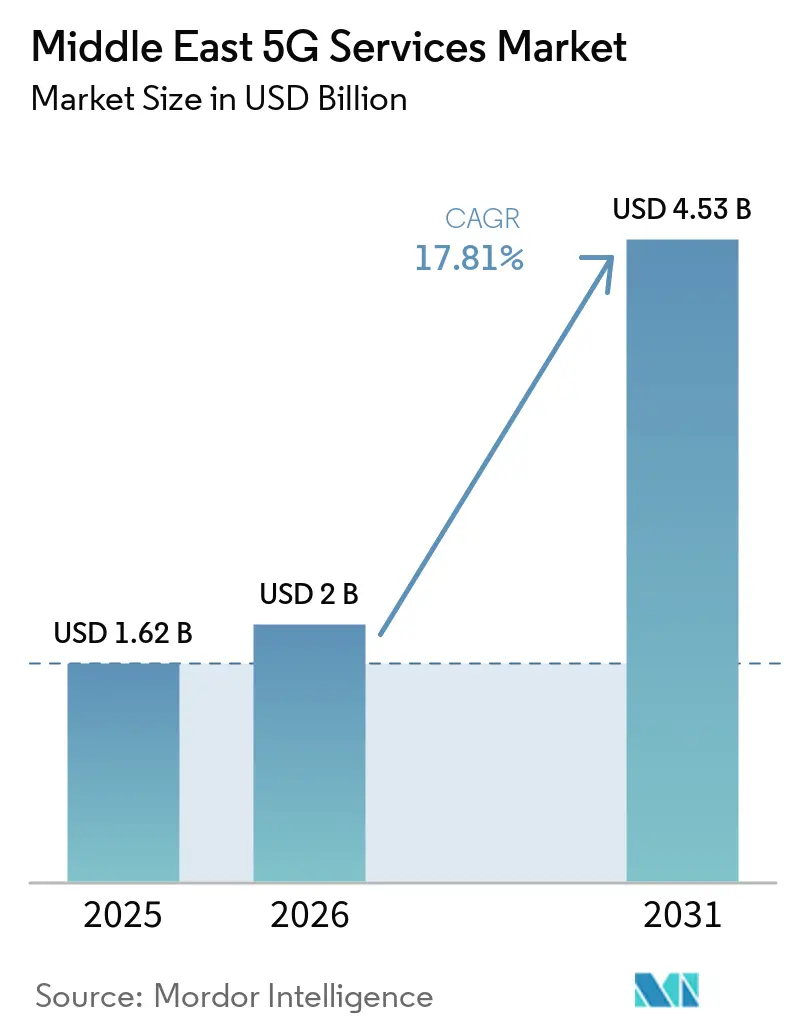
The Middle East 5G Services Market size is projected to be USD 1.62 billion in 2025, USD 2 billion in 2026, and reach USD 4.53 billion by 2031, growing at a CAGR of 17.81% from 2026 to 2031.
Demand is moving beyond basic mobile broadband as operators develop enterprise connectivity, fixed wireless access, and managed network services. Public digital programs in Saudi Arabia, the UAE, Kuwait, and Qatar support the pace of network investment and enterprise adoption. Higher data use from AI-enabled applications and extended-reality services is increasing the value of additional network capacity. Competition increasingly depends on the ability to commercialize standalone networks, network slicing, and fixed wireless access rather than adding subscribers alone. Uneven spectrum policy, device readiness, and the cost of industrial deployments remain important limits across markets outside the GCC.
Key Report Takeaways
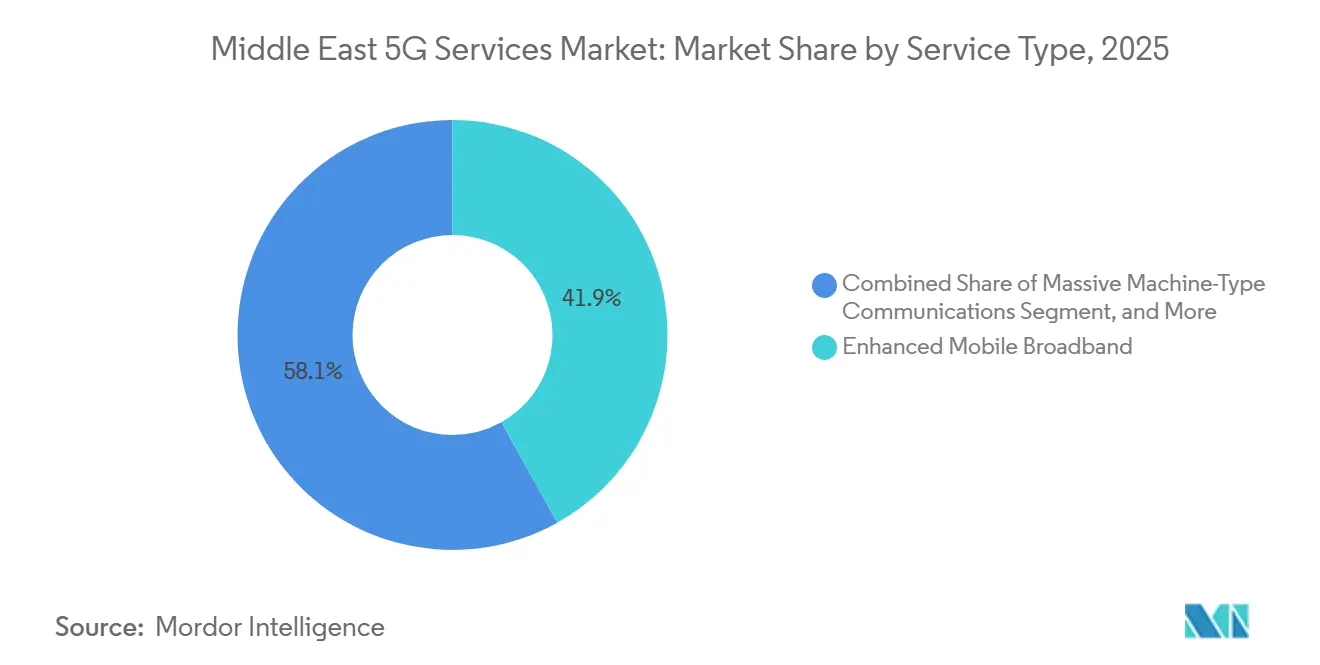
- By service type, enhanced mobile broadband held 41.89% of the Middle East 5G Services market revenue share in 2025, while fixed wireless access is projected to expand at an 18.47% CAGR through 2031.
- By network architecture, non-standalone 5G accounted for 66.45% of the Middle East 5G Services market size in 2025, while standalone 5G is expected to advance at a 19.88% CAGR through 2031.
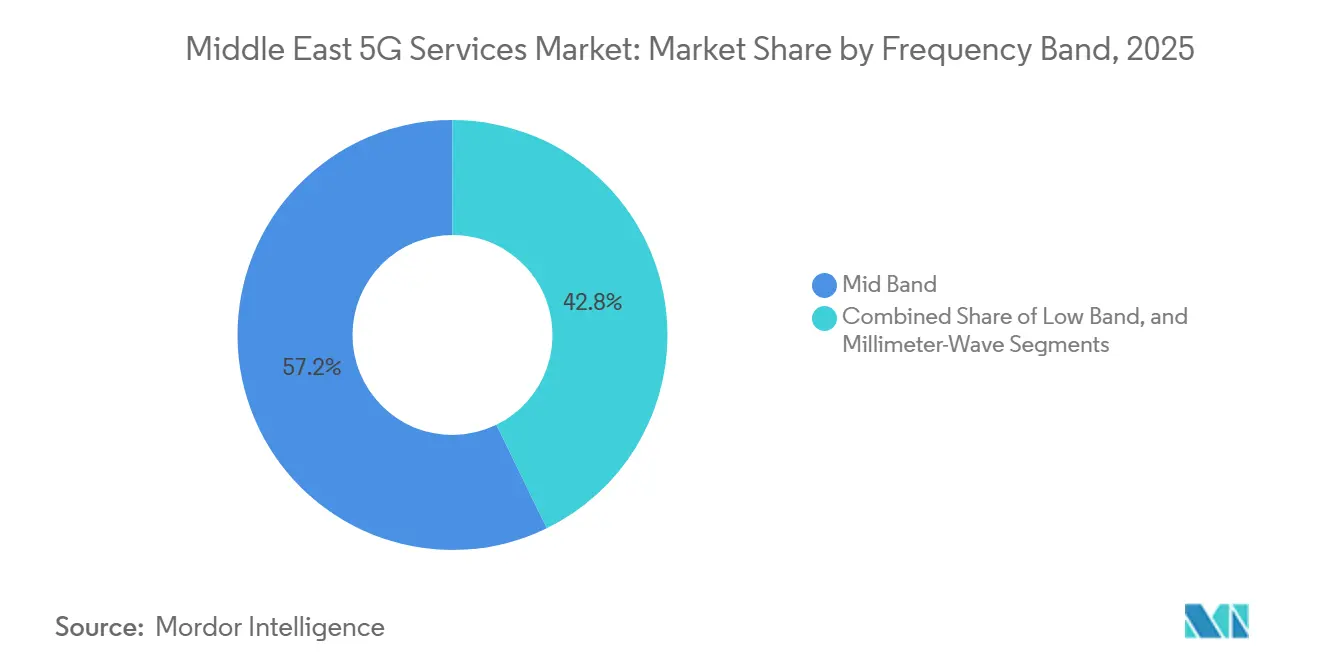
- By frequency band, mid band represented 57.23% of revenue in 2025, while millimeter-wave is projected to expand at a 19.37% CAGR through 2031.
- By end-user industry, IT and telecom held 30.08% of revenue in 2025, while manufacturing, energy, and utilities are expected to record a 17.97% CAGR through 2031.
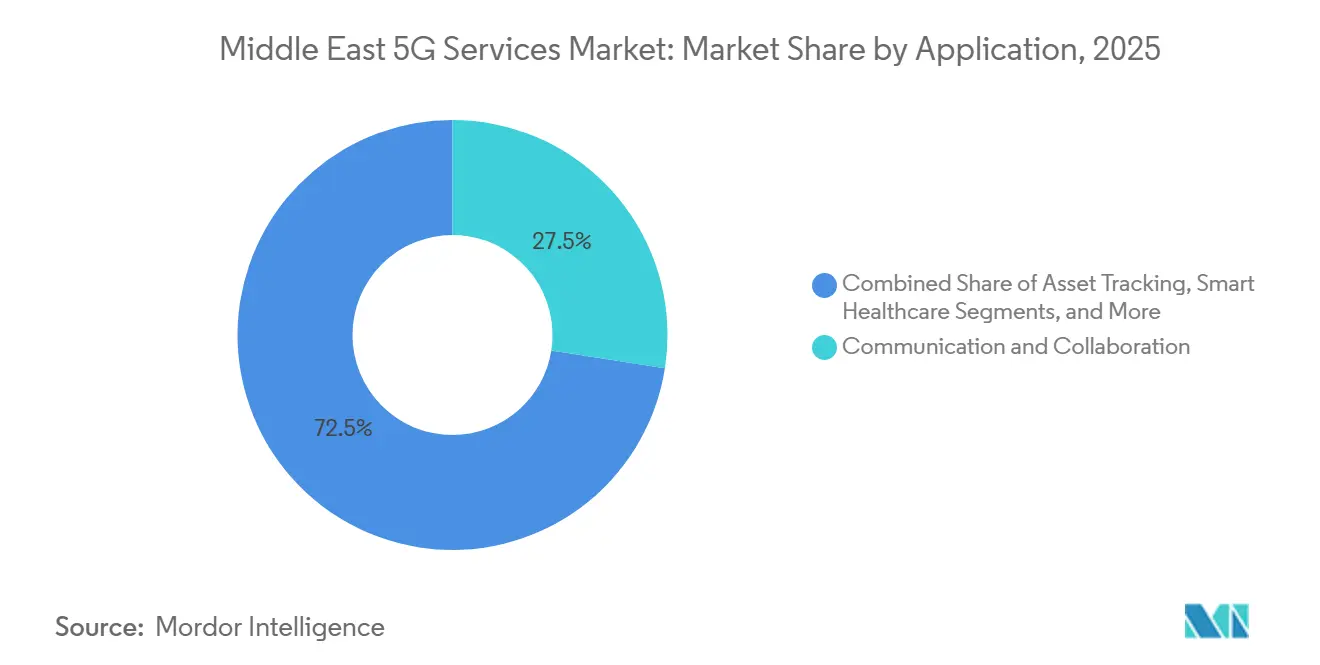
- By application, communication and collaboration accounted for 27.47% share of the Middle East 5G Services market size in 2025, while Industry 4.0 is projected to expand at an 18.65% CAGR through 2031.
- By geography, Saudi Arabia held 31.45% of revenue in 2025, while the UAE is expected to record a 19.56% CAGR through 2031.
Note: Market size and forecast figures in this report are generated using Mordor Intelligence’s proprietary estimation framework, updated with the latest available data and insights as of January 2026.
Middle East 5G Services Market Trends and Insights
Drivers Impact Analysis*
| Driver | (~) % Impact on CAGR Forecast | Geographic Relevance | Impact Timeline |
|---|---|---|---|
| Rising 5G Subscriber and Mobile-Data Demand | +4.8% | Global, concentrated in GCC and Turkey | Short term (≤ 2 years) |
| Enterprise Digital Transformation Use Cases | +3.5% | Saudi Arabia, UAE, Qatar | Medium term (2-4 years) |
| Government Digital Economy and Smart City Programs | +2.8% | Saudi Arabia and UAE, with spillover to Kuwait and Qatar | Medium term (2-4 years) |
| Fixed Wireless Access for Underserved Premises | +2.1% | Saudi Arabia, UAE, Rest of Middle East | Short term (≤ 2 years) |
| Industrial Private 5G in Energy, Ports, and Giga Projects | +1.7% | UAE, Saudi Arabia, Qatar | Medium term (2-4 years) |
| 5G-Advanced and Network Slicing Monetization | +1.3% | UAE, Kuwait, Saudi Arabia | Long term (≥ 4 years) |
| Source: Mordor Intelligence | |||
Rising 5G Subscriber and Mobile-Data Demand
Subscriber momentum remains stronger than the region’s current penetration level suggests in the Middle East 5G services market. GCC 5G penetration reached 53% at the end of 2025 and is forecast to represent 88% of mobile connections, or 84 million subscriptions, by 2031. MENA 5G subscriptions reached 80 million in 2026, compared with 60 million in 2025, and Ericsson expects them to exceed 370 million by 2031.[1]Ericsson, “Mobility Report: MENA as a Fast-Growing 5G Market,” Ericsson, ericsson.com MENA mobile data traffic is expected to rise from 11 exabytes per month to 30 exabytes per month as smartphone use approaches 47 GB per month. Kuwait’s 3G retirement in 2025 released spectrum and reinforced the migration from older networks to 5G services. In Turkey, limited 5G handset ownership among the country’s 85 million mobile subscribers could delay revenue conversion until device replacement accelerates.
Enterprise Digital Transformation Use Cases
Enterprise spending is becoming a more important source of service revenue than consumer connectivity alone in the Middle East 5G services market. A GSMA survey of 851 MENA enterprises found that digital transformation spending is expected to average 9.8% of revenue during 2025-2030.[2]GSMA, “MENA Emerges as Global Leader in Enterprise Digital Transformation, New GSMA Report Finds,” GSMA, gsma.com Saudi Arabia recorded the fastest return-on-investment period in the survey at 3.3 years. AI, mobile connectivity, and related devices are expected to represent nearly 45% of regional technology investment through 2030. Automotive, utilities, and logistics respondents reported the strongest expected effect from 5G IoT applications. Operators can improve revenue per connection when they provide managed connectivity and performance-based services instead of basic bandwidth.
Government Digital Economy and Smart City Programs
Government programs are shortening the adoption cycle for 5G-enabled services in the Middle East 5G services market. Saudi Arabia invested more than USD 27 billion in digital infrastructure during the past 6 years and reached 99% internet penetration. The same source reported mobile internet speeds of 218 Mbps in the country. National programs place connectivity within smart city, public service, and industrial modernization plans. This approach supports demand for traffic management, connected utilities, sensor networks, and AI-enabled government services. It also gives operators a clearer route to develop enterprise relationships around long-term public projects.
Fixed Wireless Access for Underserved Premises
Fixed wireless access is serving residential districts, mixed-use developments, and industrial parks where fiber deployment remains difficult or costly in the Middle East 5G services market. In the GCC, the service can compete with fiber at comparable prices in new developments. Nokia reported that GCC 5G fixed wireless access share is expected to rise from 15% in 2023 to 35% by 2030. Standalone 5G lets operators direct available network capacity toward households and small businesses. This model can improve the use of radio assets where fixed-line coverage is limited. Bundling connectivity with household digital services can further raise value per connected home.
Restraints Impact Analysis*
| Restraint | (~) % Impact on CAGR Forecast | Geographic Relevance | Impact Timeline |
|---|---|---|---|
| High Deployment Cost and Long Enterprise Payback | -2.2% | Global | Medium term (2-4 years) |
| Fragmented Spectrum Policy and Uneven Coverage Economics | -1.5% | Outside GCC and Turkey | Medium term (2-4 years) |
| Limited 5G Device Affordability and Readiness Outside GCC | -1.0% | Non-GCC markets and Turkey | Short term (≤ 2 years) |
| Site Access, Fiber Backhaul, and Specialized Skills Bottlenecks | -0.7% | Global, concentrated in new deployment markets | Medium term (2-4 years) |
| Source: Mordor Intelligence | |||
High Deployment Cost and Long Enterprise Payback
Industrial private networks require substantial site-specific investment and often have multi-year payback periods in the Middle East 5G services market. Oilfield and port deployments can need ruggedized radio equipment, distributed antenna systems, and hardened core infrastructure. These requirements make projects harder to fund for small and medium-sized enterprises. Operators also face major spectrum and site investment needs before enterprise revenue is fully established. Infrastructure sharing and neutral-host arrangements can lower the total cost of ownership for customers. Their wider use depends on regulatory rules that support shared spectrum and shared backhaul.
Fragmented Spectrum Policy and Uneven Coverage Economics
Spectrum availability differs substantially across the Middle East 5G services market and shapes how quickly operators can extend comparable services across national borders. Early GCC allocations across 3.5 GHz and other mid-band frequencies supported broader capacity deployment. Other markets have followed different licensing schedules and allocation approaches. This variation complicates regional equipment planning and can raise deployment costs. Rural coverage obligations also require investment in sites with limited financial return. Without cost-sharing arrangements, operators may defer service in lower-density areas, leaving uneven coverage for enterprise applications.
*Our forecasts treat driver/restraint impacts as directional, not additive. The impact forecasts reflect baseline growth, mix effects, and variable interactions.
Segment Analysis
By Service Type: Enhanced mobile broadband Leads Revenue While Fixed Wireless Access Expands
Enhanced mobile broadband held 41.89% of regional 5G service revenue in 2025, reflecting the consumer broadband foundation established after regional rollouts began in 2019. It remains central to the Middle East 5G services market because rising smartphone use is increasing demand for reliable high-capacity connections. Ultra-reliable low-latency communications support industrial automation, port logistics, and autonomous vehicle corridors where response times and dependable connectivity are important. Massive machine-type communications support smart metering, asset tracking, and agricultural monitoring in areas that are less densely served. Together, these services show that the Middle East 5G services market is developing from a consumer broadband offering into a platform for several connectivity needs.
Fixed wireless access is projected to expand at an 18.47% CAGR through 2031, making it the fastest-moving service type in the Middle East 5G services market. Operators in Saudi Arabia and the UAE use standalone networks to serve residential districts and industrial parks where extending fiber remains difficult or economically unattractive. Available standalone capacity allows operators to connect homes and businesses without waiting for conventional fixed-line construction. Its wider use could gradually reduce the relative revenue weight of eMBB as enterprises and households adopt more tailored service packages. Network slicing gives providers a way to organize connectivity around required performance, customer type, and location, rather than selling only standard data allowances.



By Network Architecture: Non-standalone 5G Leads Deployment While SA Enables New Services
Non-standalone 5G held 66.45% of revenue in 2025 and remained the prevailing architecture across the Middle East 5G services market. Operators have continued to use 4G anchors for signaling and mobility management because the approach supports coverage expansion without an immediate full core-network replacement. This strategy has been practical for mobile broadband, where broad availability was initially more important than specialized performance. It also reduces the near-term cost and operational disruption associated with a standalone core deployment. However, non-standalone networks provide fewer options for the differentiated enterprise services that operators increasingly seek to provide.
Standalone 5G is expected to expand at a 19.88% CAGR through 2031 as customers seek lower latency, network slicing, and network application programming interfaces. The standalone revenue outlook is supported by its ability to sell defined service quality, including latency, jitter, and throughput commitments. Vodafone Qatar launched a commercial standalone network with Nokia in November 2025 for enterprise uses in ports, natural gas operations, and data centers. This transition changes the commercial logic of the Middle East 5G services market because it permits performance-based pricing instead of pricing centered only on data volume. It also requires operators to strengthen their enterprise sales, service assurance, and network operations capabilities.
By Frequency Band: Mid Band Supports Coverage While mmWave Adds Capacity
Mid band contributed 57.23% of frequency-band revenue in 2025, giving it the most established role in regional 5G deployment. Early GCC commitments to 3.5 GHz capacity provided a balance between coverage and capacity that suits enterprise applications and fixed wireless access. These bands support the Middle East 5G services market by allowing operators to address city-wide demand while maintaining usable capacity for high-value services. Low band spectrum, including 700 MHz and 600 MHz allocations, improves rural reach and indoor penetration for broader network availability. The two spectrum layers work together, with low band extending coverage and mid band carrying a larger share of capacity demand.
Millimeter-wave is projected to expand at a 19.37% CAGR through 2031, although it remains concentrated in dense locations and capacity-led applications. Its rate reflects an early commercial stage rather than broad deployment across the region. Extended-range technology may make millimeter-wave more useful for residential fixed wireless access, particularly in areas needing higher throughput. Zain Kuwait reported a 31 Gbps throughput test using sub-6 GHz and millimeter-wave multi-carrier aggregation, indicating the technical potential of the approach. The UAE assigned the upper 6 GHz band to operators in November 2024, giving the Middle East 5G services market additional future mobile broadband capacity options.
By End-User Industry: IT and Telecom Leads While Industrial Demand Builds
IT and telecom held the largest end-user industry share at 30.08% in 2025 because the sector both consumes and enables 5G connectivity. Its role includes building network capacity, operating digital services, and providing the systems that connect customers and enterprises. This lead may narrow as industrial users deploy more private networks across production sites and critical facilities. Manufacturing, energy, and utilities need reliable connections for automation and real-time operations that older wireless systems may not support well. These requirements make industrial users a major source of future demand in the Middle East 5G services market.
Manufacturing, energy, and utilities are expected to record a 17.97% CAGR through 2031 as private networks are introduced at complex operating sites. ADNOC and e& completed a private 5G network across 11,000 square kilometers of onshore and offshore operations in 2025. The project is expected to generate USD 1.5 billion in value in its first 5 years through autonomous operations, AI integration, and real-time connectivity across more than 12,000 wells and pipelines. Healthcare, life sciences, government, defense, financial services, and retail also have managed connectivity requirements. Saudi Arabia leads MENA in IoT adoption, while Qatar ranks highest globally in enterprise use of private 5G networks, according to GSMA. These cases diversify the Middle East 5G services market beyond traditional consumer plans.
By Application: Communication Leads While Industry 4.0 Gains Relevance
Communication and collaboration captured 27.47% of application revenue in 2025, supported by enterprise communication tools and public-sector unified communications deployments. Its position shows the continued importance of dependable connectivity for government and business users across GCC countries. Smart city programs also contribute through traffic management, sensor networks, and AI-enabled urban services in Riyadh, Abu Dhabi, and Kuwait City. In these projects, the network is an underlying service that links platforms, devices, and public functions. This role keeps communications-related services significant in the Middle East 5G services market even as specialized applications gain ground.
Industry 4.0 is projected to expand at an 18.65% CAGR through 2031, driven by manufacturing automation, logistics systems, asset monitoring, and similar private 5G uses. EMSTEEL Group and e& UAE announced a dedicated private 5G network for industrial manufacturing in November 2025 using on-premises infrastructure. The network supported secure real-time automation, predictive maintenance, and protected data processing within the production environment. Asset tracking, smart buildings, connected vehicles, smart utilities, immersive media, gaming, and public safety are additional application areas for the Middle East 5G services market. e& UAE tested enhanced Reduced Capability on its live network in August 2026, which supports a future move from LTE IoT toward 5G-native connected devices.[3]Emirates News Agency, “e& UAE Becomes First Telecom Operator Globally to Test eRedCap on Live Network,” Emirates News Agency, wam.ae
Geography Analysis
Saudi Arabia held 31.45% of the Middle East 5G service revenue in 2025. The country’s early network rollout and large infrastructure commitments supported its leading revenue position. stc was on track to reach 99% population coverage by the end of 2026, including millimeter-wave deployments in NEOM, Diriyah, and the Riyadh Metropolitan Area. Saudi Arabia’s mobile services revenue was USD 13.9 billion in 2025 and is projected to reach USD 17.4 billion by 2030. 5G subscriptions are expected to represent 93% of total mobile connections in the country by 2030. Recent spectrum auctions increased the country’s licensed mobile spectrum from 1,110 MHz to 1,400 MHz.
The UAE is expected to record the fastest CAGR at 19.56% through 2031. Its mature enterprise base and rapid adoption of advanced network capabilities support this outlook for the Middle East 5G services market. e& UAE deployed a commercial upper 6 GHz network in June 2026 using 256TRX Giga-MIMO technology.[4]e&, “e& Secures Global Leadership with World’s First Commercial U6GHz Network,” e&, zawya.com The deployment delivered peak downlink speeds of up to 10 Gbps. Kuwait retired its 3G network in 2025 and launched nationwide 5G-Advanced services during the summer of that year. Qatar deployed a Nokia standalone core in February 2025 to support network slicing for ports, mining, and natural gas operations.
Turkey began commercial 5G service on April 1, 2026, after Turkcell, Türk Telekom, and Vodafone Türkiye launched across all 81 provincial centers. Turkcell committed USD 1.22 billion in spectrum and obtained a USD 1 billion loan for 5G infrastructure. Türk Telekom’s 500,000-kilometer national fiber network provides a backhaul base for further rollout. Pilot tests at Istanbul Airport and major stadiums recorded peak speeds of 1.8 Gbps. Device readiness remains limited because only 1 in 4 of Turkey’s 85 million subscribers has a 5G-compatible handset. Bahrain and Oman have lower revenue bases but show industrial activity through private network deployments at Alba and the Port of Salalah.
Competitive Landscape
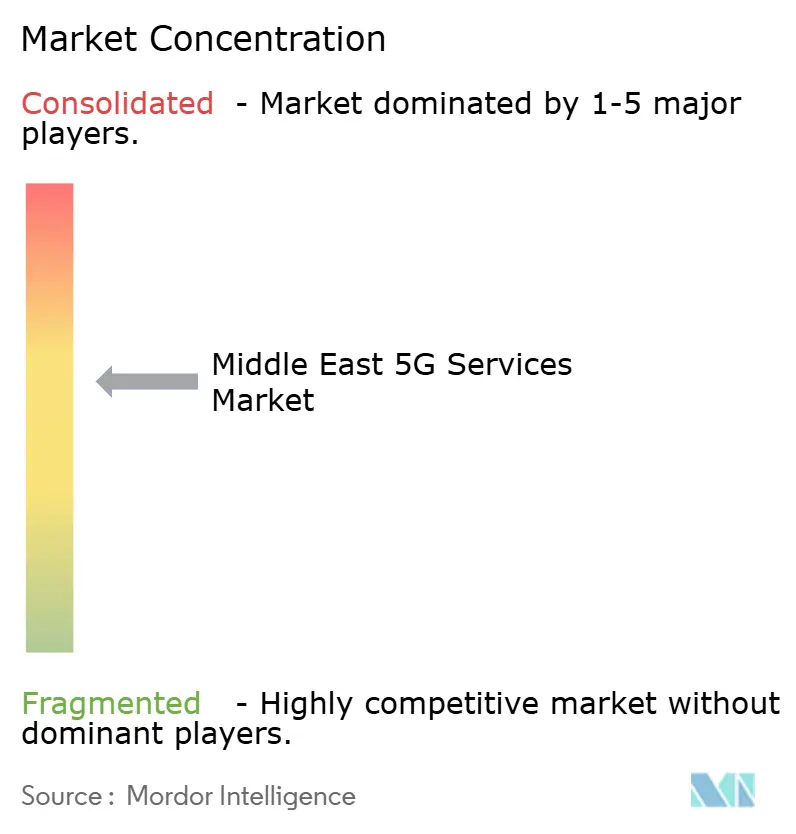
The Middle East 5G services market has a concentrated operator layer in the GCC and a competitive vendor layer, creating different competitive conditions for service providers and equipment suppliers. stc Group, e&, Ooredoo Q.P.S.C., Zain Group, and Vodafone Qatar P.Q.S.C. are the principal regional operators identified in the draft. Their competition centers on coverage, standalone network capability, enterprise services, and spectrum assets. Ericsson, Huawei, Nokia, and ZTE compete for multi-year infrastructure contracts across the region. Vendor choice remains important because operators need radio, core, cloud, and managed-service capabilities. This structure encourages operators to use more than 1 vendor where possible.
stc Group signed a 5-year Master Frame Agreement with Ericsson in December 2025. The agreement covered 5G hardware and software, cloud-native platforms, Massive MIMO, managed services, and standalone deployment. Ericsson also signed a new agreement with stc Group in February 2026 to add sites, capacity, standalone coverage, and low-band radio. In the same month, Ericsson and Mobily signed an MoU to explore AI-powered radio access network optimization. These actions show that network modernization remains a central competitive tool. They also indicate that operators are seeking automation to improve capacity management and service quality.
Service differentiation is increasingly based on capabilities above the radio network in the Middle East 5G services market. e& UAE launched the MENA region’s first commercial 5G network slicing product for enterprise customers in May 2025. The offer linked standalone network capability with bandwidth-based service packages for manufacturing, public safety, and port customers. Tawal and Nokia began a multi-tenant Open RAN platform initiative in Saudi Arabia. Zain Kuwait also signed an MoU with Rakuten Symphony for a cloud-native Open RAN pilot. Turkey’s local equipment sourcing requirements will create a distinct vendor environment as commercial networks expand.
Middle East 5G Services Industry Leaders
stc Group
e&
Ooredoo Q.P.S.C.
Zain Group
Vodafone Qatar P.Q.S.C.
- *Disclaimer: Major Players sorted in no particular order

Recent Industry Developments
- August 2026: e& UAE announced the successful live-network testing of enhanced Reduced Capability (eRedCap), claiming to be the first telecom operator globally to announce such testing. The test achieved up to 10 Mbps using 5 MHz NR-FDD spectrum.
- July 2026: Zain KSA launched Saudi Arabia's first commercial 5G-Advanced (5G+) service for consumers in July 2026, initially in Riyadh and Jeddah. The rollout uses 600 MHz alongside other bands.
- April 2026: Turkcell, Türk Telekom, and Vodafone Türkiye launched commercial 5G services on 1 April 2026 across all 81 provincial centers. The EU 5G Observatory confirms the nationwide launch following the October 2025 spectrum awards.
- December 2025: stc Group and Ericsson signed the five-year Master Frame Agreement on 16 December 2025. It covers 5G hardware/software, cloud-native solutions, managed services, 5G SA, 5G-Advanced, Massive MIMO and network modernization.


Middle East 5G Services Market Report Scope
The Middle East 5G Services Market Report is Segmented by Service Type (Enhanced Mobile Broadband, Ultra-Reliable Low-Latency Communications, Massive Machine-Type Communications, Fixed Wireless Access), Network Architecture (Non-Standalone 5G, Standalone 5G), Frequency Band (Low Band, Mid Band, Millimeter-Wave), End-User Industry (IT and Telecom, Automotive, Mobility and Transportation, Manufacturing, Energy and Utilities, Healthcare and Life Sciences, Banking, Financial Services, Insurance and RegTech, Retail, Media and E-Commerce, Government, Defense, Education and Public Sector, Other Industries), Application (Communication and Collaboration, Asset Tracking, Smart Cities, Smart Buildings, Autonomous Vehicles and Vehicle-to-Everything, Smart Healthcare, Industry 4.0, Smart Utilities, Immersive Media and Gaming, Public Safety and Mission-Critical Communications), and Geography (Saudi Arabia, United Arab Emirates, Kuwait, Qatar, Turkey, Rest of Middle East). The Market Forecasts are provided in Value (USD).
| Enhanced Mobile Broadband |
| Ultra-Reliable Low-Latency Communications |
| Massive Machine-Type Communications |
| Fixed Wireless Access |
| Non-Standalone 5G |
| Standalone 5G |
| Low Band |
| Mid Band |
| Millimeter-Wave |
| IT and Telecom |
| Automotive, Mobility and Transportation |
| Manufacturing, Energy and Utilities |
| Healthcare and Life Sciences |
| Banking, Financial Services, Insurance and RegTech |
| Retail, Media and E-Commerce |
| Government, Defense, Education and Public Sector |
| Other End-User Industries |
| Communication and Collaboration |
| Asset Tracking |
| Smart Cities |
| Smart Buildings |
| Autonomous Vehicles and Vehicle-to-Everything |
| Smart Healthcare |
| Industry 4.0 |
| Smart Utilities |
| Immersive Media and Gaming |
| Public Safety and Mission-Critical Communications |
| Saudi Arabia |
| United Arab Emirates |
| Kuwait |
| Qatar |
| Turkey |
| Rest of Middle East |
| By Service Type | Enhanced Mobile Broadband |
| Ultra-Reliable Low-Latency Communications | |
| Massive Machine-Type Communications | |
| Fixed Wireless Access | |
| By Network Architecture | Non-Standalone 5G |
| Standalone 5G | |
| By Frequency Band | Low Band |
| Mid Band | |
| Millimeter-Wave | |
| By End-User Industry | IT and Telecom |
| Automotive, Mobility and Transportation | |
| Manufacturing, Energy and Utilities | |
| Healthcare and Life Sciences | |
| Banking, Financial Services, Insurance and RegTech | |
| Retail, Media and E-Commerce | |
| Government, Defense, Education and Public Sector | |
| Other End-User Industries | |
| By Application | Communication and Collaboration |
| Asset Tracking | |
| Smart Cities | |
| Smart Buildings | |
| Autonomous Vehicles and Vehicle-to-Everything | |
| Smart Healthcare | |
| Industry 4.0 | |
| Smart Utilities | |
| Immersive Media and Gaming | |
| Public Safety and Mission-Critical Communications | |
| By Geography | Saudi Arabia |
| United Arab Emirates | |
| Kuwait | |
| Qatar | |
| Turkey | |
| Rest of Middle East |


Key Questions Answered in the Report
What is the Middle East 5G services market size?
The Middle East 5G services market size is estimated at USD 2.00 billion in 2026 and is forecast to reach USD 4.53 billion by 2031 at a 17.81% CAGR.
Which service type leads regional 5G revenue?
Enhanced mobile broadband led service revenue with a 41.89% share in 2025, while fixed wireless access is projected to expand fastest at an 18.47% CAGR.
Why is standalone 5G important for operators?
Standalone 5G supports network slicing, lower latency, and performance-based enterprise service packages that non-standalone networks cannot provide.
Which country leads 5G service revenue in the Middle East?
Saudi Arabia led with a 31.45% revenue share in 2025, supported by extensive spectrum allocation and network investment.
Which country is expected to expand fastest through 2031?
The UAE is expected to record the fastest CAGR at 19.56%, supported by advanced network deployment and enterprise demand.
Which end users create the strongest future demand?
Manufacturing, energy, and utilities are projected to record a 17.97% CAGR as private networks support automation and real-time operations.
Page last updated on:





