
Microfocus X-Ray Inspection Systems Market Size and Share
Market Overview
| Study Period | 2020 - 2031 |
|---|---|
| Market Size (2026) | USD 95.88 Million |
| Market Size (2031) | USD 158.69 Million |
| Growth Rate (2026 - 2031) | 10.61 % |
| Fastest Growing Market | Asia-Pacific |
| Largest Market | Asia-Pacific |
| Market Concentration | Medium |
Major Players *Disclaimer: Major Players sorted in no particular order Image © Mordor Intelligence. Reuse requires attribution under CC BY 4.0. | |
Microfocus X-Ray Inspection Systems Market Analysis by Mordor Intelligence
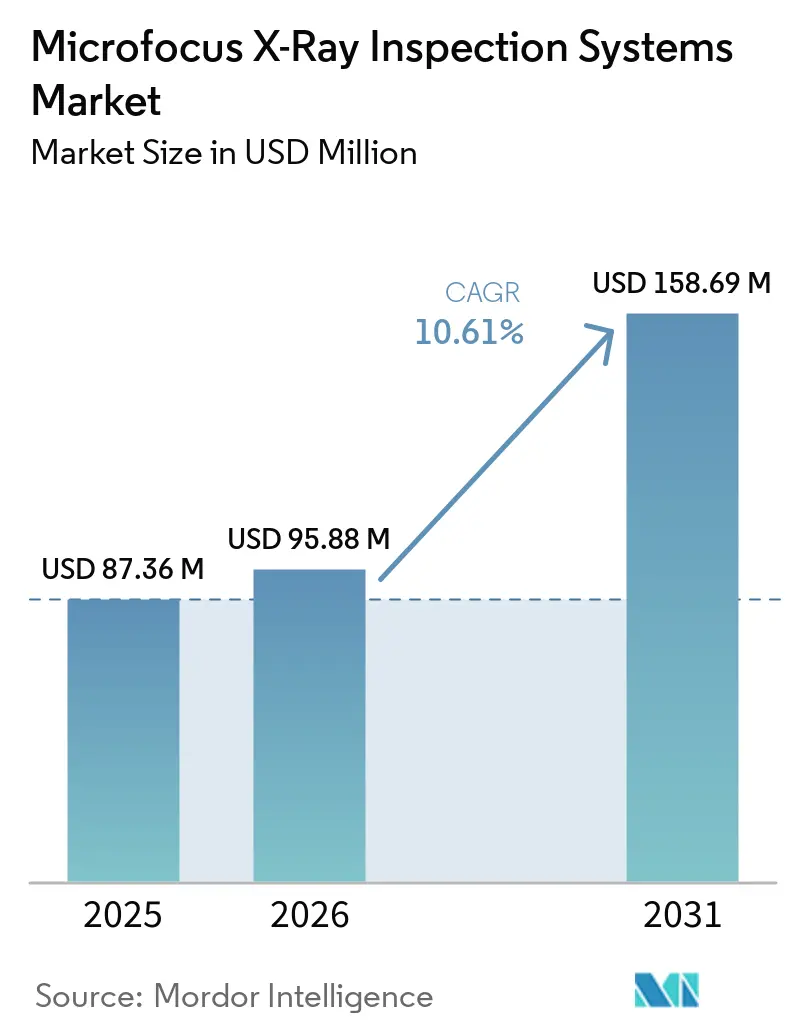
The microfocus X-ray inspection systems market size is projected to expand from USD 87.36 million in 2025 and USD 95.88 million in 2026 to USD 158.69 million by 2031, registering a CAGR of 10.61% between 2026 and 2031. The microfocus X-ray inspection systems market is supported by component designs that optical and acoustic methods cannot examine internally. CoWoS, HBM, and fan-out wafer-level packaging place interconnects beneath the surface, making volumetric X-ray imaging necessary during production. Automotive and aerospace suppliers are also applying zero-defect requirements because failures in advanced components carry high operational and warranty costs. These conditions move inspection from final verification toward quality checks at several assembly stages. Suppliers are responding through brighter sources, stable focal spots, low-dose collimators, photon-counting detectors, defect-recognition software, and systems designed for specific production environments.
Key Report Takeaways
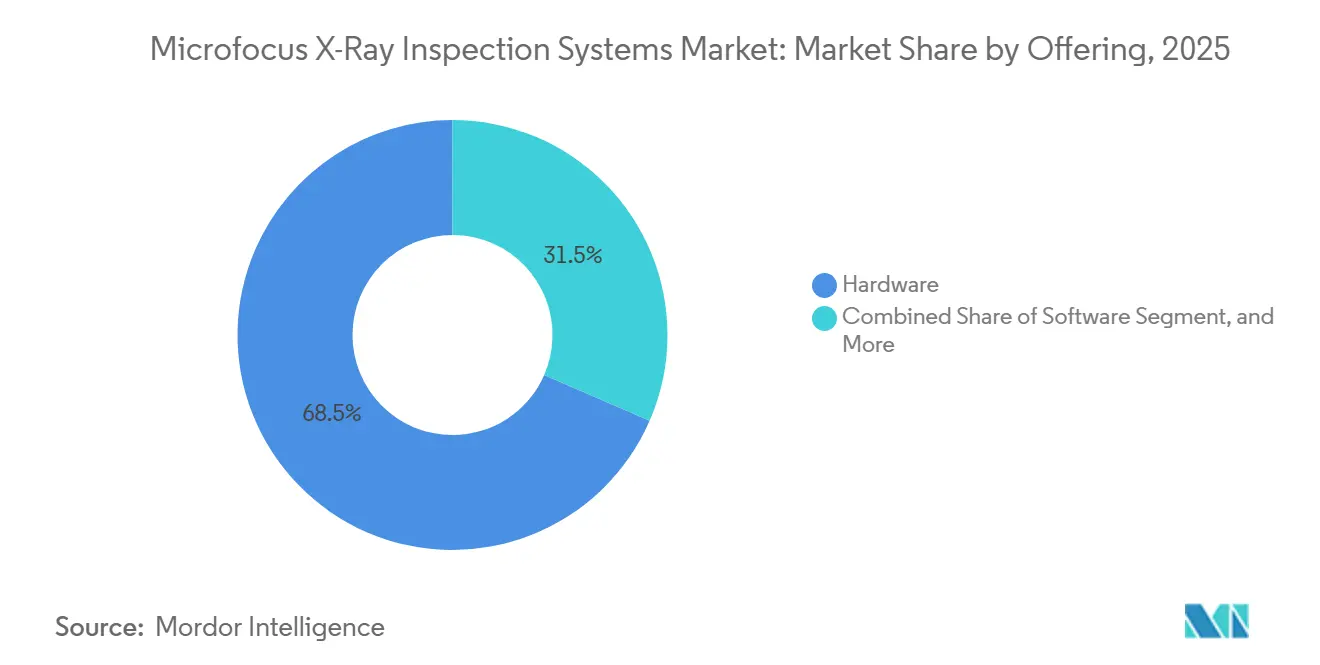
- By offering, hardware accounted for 68.47% of revenue in 2025 for the microfocus x-ray inspection systems market, while services are projected to expand at a 11.21% CAGR through 2031.
- By system configuration, inline systems held 36.82% revenue share in 2025, while portable and mobile systems are projected to expand at a 11.58% CAGR through 2031.
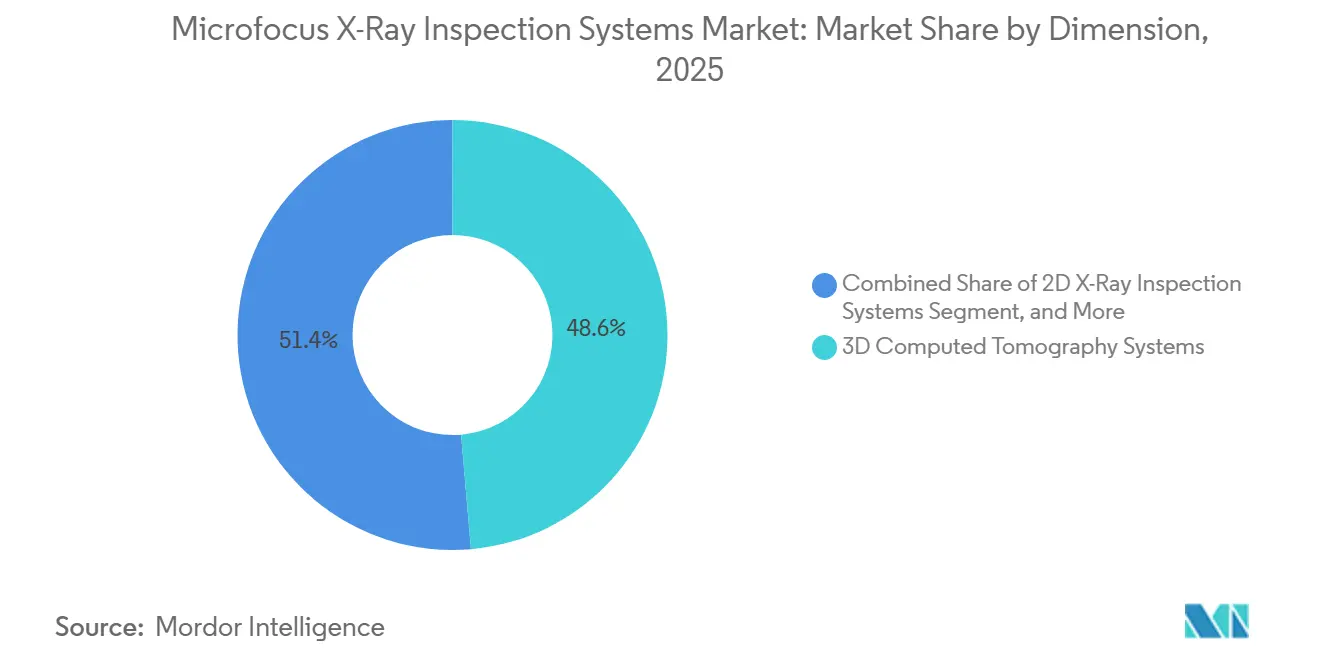
- By dimension, 3D computed tomography systems held a 48.63% revenue share in 2025 for the microfocus x-ray inspection systems market, and the segment is the fastest-growing category, with a forecast CAGR of 11.18%.
- By end-user industry, semiconductor and IC packaging accounted for 25.74% of revenue in 2025 and is the fastest-growing segment, with a 12.19% CAGR over the forecast period.
- By geography, Asia-Pacific accounted for 42.58% of revenue in 2025 and is projected to expand at a 11.62% CAGR through 2031.
Key Report Takeaways
| Segmentation | Segment | Metric | Year | Value |
|---|---|---|---|---|
| By Offering | Hardware | Market Share | 2025 | 68.47% |
| By Offering | Services | CAGR | 2031 | 11.21% |
| By System Configuration | Inline Systems | Market Share | 2025 | 36.82% |
| By System Configuration | Portable and Mobile Systems | CAGR | 2031 | 11.58% |
| By Dimension | 3D Computed Tomography Systems | Market Share | 2025 | 48.63% |
| By Dimension | 3D Computed Tomography Systems | CAGR | 2031 | 11.18% |
| By End-User Industry | Semiconductor and IC Packaging | Market Share | 2025 | 25.74% |
| By End-User Industry | Semiconductor and IC Packaging | CAGR | 2031 | 12.19% |
| By Geography | Asia-Pacific | Market Share | 2025 | 42.58% |
| By Geography | Asia-Pacific | CAGR | 2031 | 11.62% |
| Source: Mordor Intelligence | ||||
Note: Market size and forecast figures in this report are generated using Mordor Intelligence’s proprietary estimation framework, updated with the latest available data and insights as of January 2026.
Global Microfocus X-Ray Inspection Systems Market Trends and Insights
Drivers Impact Analysis*
| Driver | (~) % Impact on CAGR Forecast | Geographic Relevance | Impact Timeline |
|---|---|---|---|
| High-Density Semiconductor and Advanced Packaging Inspection | +3.2% | Global, concentrated in East Asia, including South Korea, Japan, China, and Taiwan, with spillover to South and Southeast Asia | Long term (≥ 4 years) |
| EV Battery and Power Electronics Quality Assurance | +2.0% | Global, with high concentration in China, Germany, and South Korea | Medium term (2-4 years) |
| Automated Inline and 3D X-Ray Inspection | +1.8% | Global, with early acceleration in North America and Europe | Medium term (2-4 years) |
| Zero-Defect Manufacturing and Traceability Requirements | +1.2% | North America and Europe, with spillover to Asia-Pacific contract manufacturers | Long term (≥ 4 years) |
| AI-Enabled Defect Recognition and Closed-Loop Process Control | +1.0% | Global | Short term (≤ 2 years) |
| Inspection of Complex Additive-Manufactured Components | +0.5% | North America and Europe, concentrated in aerospace and defense | Long term (≥ 4 years) |
| Source: Mordor Intelligence | |||
Rising Demand for High-Density Semiconductor and Advanced Packaging Inspection
3D IC architectures, including HBM3 and HBM4 stacks, CoWoS configurations, and through-glass via designs, create inspection tasks that surface methods cannot resolve. Micro-voids in through-silicon vias, bump shift, head-in-pillow defects, and die tilt require volumetric X-ray imaging at sub-micron resolution. JEDEC published JEP375 in December 2025, providing reliability guidelines for thinned wafers with copper through-silicon vias and redistribution layers. The guidance raises the expected inspection capability for advanced packaging lines by addressing nondestructive characterization of these structures.[1] Excillum and SFA Engineering Corporation announced a 2026 collaboration on in-fab systems that use the NanoTube N3 X-ray source for through-glass via, HBM, and advanced packaging applications. The collaboration places source brightness and focal-spot stability alongside complete system integration as central considerations in purchasing microfocus X-ray inspection systems.
Electric Vehicle Battery and Power Electronics Quality Assurance
Battery pack inspection has different cadence, component size, and throughput needs from semiconductor inspection. Inline CT systems used at gigafactory speeds require scan times below 2 seconds per cell, which calls for high-flux source-detector combinations. Fraunhofer EZRT presented a 2-step workflow at ECNDT 2026 that combined rapid 2D X-ray screening with high-energy CT. The work examined electrode misalignment, swelling, and separator damage in cells and battery modules without disassembly. Waygate Technologies and Liminal Insights reported that testing at UKBIC reduced inspection costs by over 10% and improved defect capture by 12% compared with a single inspection method. Their partnership combines CT, radiography, and AI-driven ultrasound for inline production, reflecting the value of complementary inspection methods at battery scale in the microfocus X-ray inspection systems market.
Migration Toward Automated Inline and 3D X-Ray Inspection
The shift from offline sampling to 100% inline inspection increases the number of units examined during each production cycle. Higher line throughput can require more systems per line and can shorten replacement cycles as capacity requirements increase. IPC-J-STD-001J requires X-ray inspection for hidden solder joints, including ball grid arrays, across several product classes. This requirement provides a basis for compliance with the microfocus X-ray inspection systems market demand that does not depend solely on production volumes. Inline use has favored closed-tube sources because they avoid filament-replacement downtime, although open-tube sources can provide higher brightness for sub-micron work. Comet X-ray introduced its Quickswap pre-adjusted filament unit in June 2026, allowing field replacement without manual tuning and reducing the operating difference between source types.
Zero-Defect Manufacturing and Traceability Requirements
Requirements associated with IATF 16949, AS9100D, and Automotive SPICE are moving microfocus X-ray inspection earlier in manufacturing. Suppliers now use it for incoming verification, mid-process bond checks, and die-attach analysis before encapsulation. Traceability rules require a serialized inspection record that can be traced through the supply chain for each unit. This changes the role of equipment from a standalone instrument to a source of quality data within a wider management system. X-ray records can also document the condition of a component prior to a field failure, supporting warranty reviews and product liability defense for EV powertrains and aerospace actuation systems. ZEISS presented its CT and X-ray NDT portfolio at IMTS 2026 as part of a real-time quality data architecture rather than as isolated inspection hardware.
Restraints Impact Analysis*
| Restraint | (~) % Impact on CAGR Forecast | Geographic Relevance | Impact Timeline |
|---|---|---|---|
| High Capital and Lifecycle Costs of High-Resolution Systems | -1.8% | Global, more pronounced in South America, the Middle East and Africa, and smaller Asian contract manufacturers | Long term (≥ 4 years) |
| Shortage of Certified X-Ray Inspection Personnel | -1.0% | Global, with acute shortages in India, Southeast Asia, and Africa | Medium term (2-4 years) |
| Radiation Dose Constraints for Sensitive Semiconductor Devices | -0.5% | Global, most acute in semiconductor-dense East Asia and North America | Medium term (2-4 years) |
| Data Interoperability and Cybersecurity Risks in Connected Inspection Cells | -0.3% | Global, with heightened sensitivity in defense and government-linked manufacturing | Long term (≥ 4 years) |
| Source: Mordor Intelligence | |||
High Capital and Lifecycle Costs of High-Resolution Systems
Open-tube microfocus systems with very small focal-spot performance require capital spending that many smaller contract manufacturers cannot support. The cost extends beyond the system, as installations require radiation-shielded enclosures that comply with applicable safety standards. Inline deployment also requires custom conveyor interfaces and connections to manufacturing execution system software. Open-tube systems incur recurring maintenance costs due to filament replacement cycles. Leasing, X-as-a-service arrangements, and lower-priced desktop CT platforms broaden access for smaller users, but they do not eliminate the barrier at the semiconductor and aerospace performance levels. The microfocus X-ray inspection systems market, therefore, retains a substantial group of users that depend on service providers or shared inspection facilities.
Shortage of Certified X-Ray Inspection Personnel
The available pool of technicians qualified to interpret industrial X-ray and CT results does not keep pace with new semiconductor and battery inspection deployments. Certification under ASNT SNT-TC-1A or EN ISO 9712 requires field experience and periodic recertification. This process takes multiple years and cannot readily match the commissioning schedules of battery gigafactories or advanced packaging facilities. The shortage is particularly evident in India, Vietnam, Malaysia, and other rapidly industrializing locations that are adding OSAT facilities and battery plants. Equipment vendors are investing in AI-assisted automatic defect recognition partly to reduce dependence on scarce inspection operators. This gives software modules a different economic role in the microfocus X-ray inspection systems market, where the pipeline of qualified personnel remains limited.
*Our forecasts treat driver/restraint impacts as directional, not additive. The impact forecasts reflect baseline growth, mix effects, and variable interactions.
Segment Analysis
By Offering: Hardware Leads Revenue While Services Expand
Hardware held 68.47% of the microfocus X-ray inspection systems market share in 2025, supported by capital spending on new production lines in semiconductor, automotive, and electronics manufacturing. Advanced X-ray tubes, high-resolution flat-panel detectors, and precision multi-axis motion stages remain the main elements of system revenue. Multi-system contracts for individual facilities also concentrate hardware purchases among larger buyers. The microfocus X-ray inspection systems market size, in terms of hardware, reflects the cost and technical scope required to commission a complete inspection line. Software is increasingly included in enterprise hardware sales, which lifts the value of packages that include automatic defect recognition and smart-factory interfaces.
Bundling can reduce the role of standalone software revenue while making integrated systems more valuable to large facilities. Services are projected to expand at a 11.21% CAGR through 2031 as maintenance, calibration, and operator-training requirements rise with the installed base. Smaller manufacturers are also using third-party inspection services when they must meet IPC-7095E obligations for BGA assemblies and lack a complete system. Varex Imaging presented its TrueSpectrum dual-energy photon-counting method at ECNDT 2026, demonstrating how component suppliers are embedding more intelligence directly into the hardware. This narrows the boundary between hardware and software within the microfocus X-ray inspection systems industry.

By System Configuration: Inline Systems Lead While Portable Systems Broaden Access
Inline systems captured 36.82% of revenue in 2025 because semiconductor and electronics plants are seeking automated 100% inspection coverage at production speeds. These systems support continuous checks that offline equipment cannot maintain on high-volume lines. Offline equipment remains important in aerospace maintenance, failure-analysis facilities, and research laboratories where flexibility matters more than throughput. Benchtop and cabinet systems provide an intermediate option for quality-control laboratories at contract manufacturers, component distributors, and academic institutions. Together, these established formats account for much of the installed base of microfocus X-ray inspection systems.
Portable and mobile systems are projected to expand at a 11.58% CAGR through 2031 as users inspect energy infrastructure and in-service aerospace equipment outside fixed facilities. Their applications include wind turbine blades, pipeline welds, and aircraft structures where a permanent installation is impractical. Improvements to battery-powered microfocus generators have enabled field-deployable systems weighing below 15 kg that comply with ISO 17636-2 for metallic weld inspection. Maintenance-related field work can remain active when manufacturers defer capital spending, giving portable-system suppliers a more stable demand pattern than vendors focused solely on inline replacement cycles. This configuration extends the microfocus X-ray inspection systems industry into inspection settings that conventional fixed systems cannot easily serve.
By Dimension: 3D CT Systems Lead Volumetric Inspection Requirements
3D computed tomography systems accounted for 48.63% of revenue in 2025 and are expected to generate a 11.18% CAGR over the forecast period because they reconstruct defect depth, morphology, orientation, and size across multi-material assemblies. This capability resolves the depth ambiguity that can limit 2D radiography in complex components. The microfocus X-ray inspection systems market size for 3D CT is supported by applications that require a complete internal record of a part. 2D X-ray remains useful for high-throughput solder-joint inspection, power-module void measurement, and field screening of geometrically simple defects. Its lower cost helps preserve its use among mid-tier electronics manufacturing service providers.
2.5D laminography serves larger panels and wafer-level products that cannot complete a 360-degree CT rotation. Its role is expanding with panel-level packaging in semiconductor back-end manufacturing. Rigaku launched the CT Lab HR160 in September 2026 with Excillum's NanoTube N3 source and reported true spatial resolution of 250 nm for solid-state batteries, semiconductor devices, MLCCs, and power electronics. Research published in 2025 found that Simurgh, DeepRecon, and DeepScout can reduce scan time and improve resolution recovery for dense materials such as Inconel 718. These advances support the use of 3D CT in the microfocus X-ray inspection systems market for aerospace and additive manufacturing inspection programs.
By End-User Industry: Semiconductor and IC Packaging Drives Inspection Intensity
Semiconductor and IC packaging accounted for 25.74% of revenue in 2025 and is expected to grow at a CAGR of 12.19% over the forecast period, reflecting the highest inspection intensity among the stated end-user groups. Advanced packaging lines operate at 100% inspection rates, requiring sub-micron defect resolution. Electronics manufacturing services and contract assembly form the second-largest cluster, covering BGA void analysis, wire-bond verification, and power-module solder-joint checks. Demand for these facilities is tied to the IPC-J-STD-001J requirements for coverage of hidden solder joints. Automotive and EV installations are increasing, driven by battery-pack inspections and quality checks of SiC and IGBT power modules.
Solder-joint voids as small as 50 microns can lead to early thermal-cycling failure in EV inverters, increasing the need for close inspection. Aerospace and defense remain high-value, lower-volume fields where ASTM E2737 and AS9100D require nondestructive inspection records for critical structures. Energy and power applications include solar-cell metallization contacts, wind-turbine composite bonds, and high-voltage transmission hardware. Medical and pharmaceutical manufacturers, research institutes, and testing laboratories also use these systems, with research users taking a notable share of high-end nanofocus CT equipment for characterization and process work. This range of applications spreads the microfocus X-ray inspection systems market across several industrial cycles rather than tying it to a single end-user category.
Geography Analysis
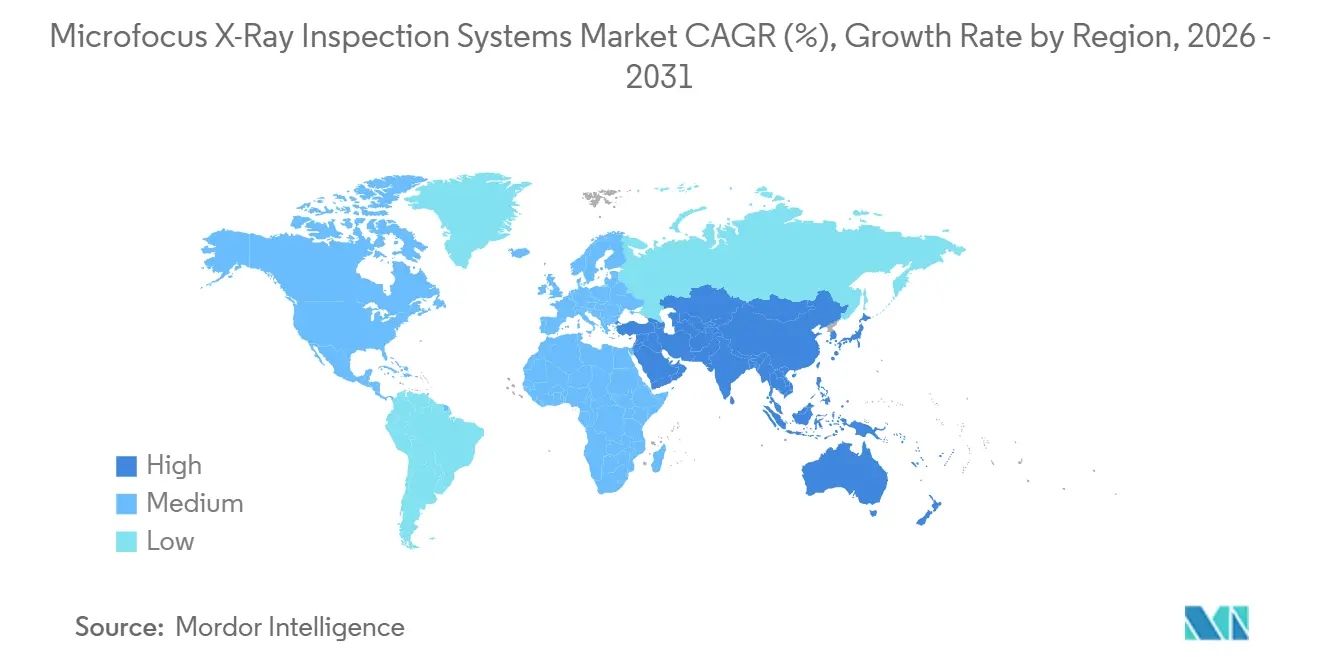
Asia-Pacific accounted for 42.58% of regional revenue in 2025 and is projected to expand at a 11.62% CAGR through 2031. South Korea, Japan, China, and Taiwan host a large share of advanced packaging production. China’s battery gigafactory buildout is adding demand for inline inspection at cell and pack assembly lines. Japan is both a demand center and a technology supply hub for the microfocus X-ray inspection systems market. Nikon launched the VOXLS 20 C 225 in April 2025 for production-floor integration across electronics, additive manufacturing, aerospace, automotive, and medical-device applications.[2]
These countries provide emerging demand locations in the microfocus X-ray inspection systems market as local semiconductor capacity develops. North America is the second-largest region, supported by aerospace and defense activity, packaging investment under the CHIPS and Science Act, and battery-gigafactory construction. Hexagon signed a definitive agreement in April 2026 to acquire Waygate Technologies from Baker Hughes for USD 1.45 billion in cash, subject to regulatory approval, with the transaction expected to close in the second half of 2026. The planned transaction combines Hexagon's precision-measurement software with Waygate's CT and radiography offerings into a broader quality-management portfolio.
Europe remains a technology-intensive part of the microfocus X-ray inspection systems market, with Germany, the United Kingdom, and France as the principal demand centers. Airbus tier-1 suppliers and European battery-facility requirements linked to EV traceability support demand for inline systems. South America, the Middle East, and Africa are earlier-stage regions for the microfocus X-ray inspection systems market. Service models and portable systems are more accessible in these regions because they align with current production volumes and infrastructure conditions. Fixed hardware adoption is expected to increase as manufacturing volumes reach levels that can support inline-system investment.
Competitive Landscape
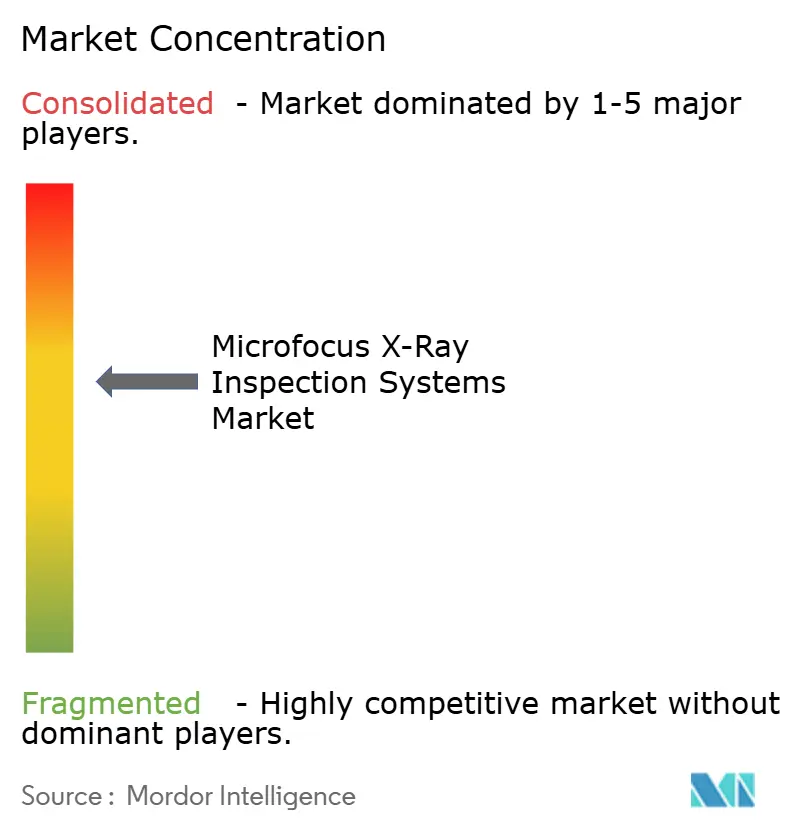
The microfocus X-ray inspection systems market is moderately concentrated among leading suppliers, including Nikon Corporation, Comet Yxlon GmbH, ZEISS, Waygate Technologies, and Nordson Corporation. These companies compete through source brightness, focal-spot stability, and integrated automatic defect-recognition capability. Their strategies center on comprehensive platforms that integrate hardware, reconstruction software, AI-based defect detection, and smart-factory connectivity. This approach helps microfocus X-ray inspection systems market suppliers serve technical applications where inspection performance and usable data are equally important.
Hexagon’s April 2026 agreement to acquire Waygate Technologies for USD 1.45 billion is a major recent transaction in the microfocus X-ray inspection systems market. The planned acquisition would bring nondestructive testing into Hexagon’s quality-intelligence offering and combine inspection hardware with measurement software. Comet Yxlon enhanced its CA20 for wafer-level inspection at Productronica 2025 with an ISO Class 1 interior and an EFEM loader. Nikon added a low-dose collimator and related hardware and software enhancements to its XT V Series in December 2025 for radiation-sensitive semiconductor devices.[3]
Wuxi Unicomp Technology Co., Ltd. and Viscom SE compete below the top tier on price-to-resolution positioning, which places pressure on mid-tier hardware margins. Large-panel and wafer-level inspection remains an opportunity in the microfocus X-ray inspection systems market, where current inline systems do not always meet the required production speeds for fan-out wafer-level and panel-level packaging. AI-centered analysis frameworks can reduce the effort required for defect assessment and shift the position of established defect-recognition suppliers. A 2026 IEEE Transactions on Reliability paper described InsightX Agent as a large multimodal model that coordinates defect detection and evidence-verification tools for X-ray NDT analysis. Dose management under JEDEC JESD22-B121 and acceptance requirements under IPC-A-610 increasingly influence procurement, favoring systems with inspection procedures and dose-monitoring records that can be audited. The available information does not provide combined shares for the leading suppliers, so a concentration score cannot be assigned using the specified share-based scale.
Microfocus X-Ray Inspection Systems Industry Leaders
-
Nikon Corporation
-
Comet Yxlon GmbH
-
Nordson Corporation
-
Waygate Technologies
-
North Star Imaging Inc.
- *Disclaimer: Major Players sorted in no particular order
Recent Industry Developments
- September 2026: Rigaku Corporation launched the CT Lab HR160 high-resolution X-ray CT system, developed in collaboration with Excillum AB using the NanoTube N3 X-ray source and achieving a true spatial resolution of 250 nm at up to 160 kV. The system targets solid-state batteries, semiconductor devices, MLCCs, and power electronics, establishing a new benchmark in laboratory-class CT resolution for advanced materials analysis.
- April 2026: Hexagon AB signed a definitive agreement to acquire Waygate Technologies from Baker Hughes for USD 1.45 billion in cash, expected to close in the second half of 2026 subject to regulatory approvals. The transaction integrates Waygate's CT, radiography, and Krautkrämer ultrasound portfolio with Hexagon's precision measurement hardware and quality management software across aerospace, automotive, and energy inspection markets globally.
- April 2026: Comet Yxlon introduced the UX50 large-component X-ray and CT system at 450 kV, targeting e-mobility inspection including electric motor blocks, large steel castings, and heavy EV drivetrain assemblies. The platform extends Comet Yxlon's range from electronics-scale microfocus into heavier industrial inspection applications.
- March 2026: Waygate Technologies and Liminal Insights announced a strategic partnership for integrated multi-modal battery inspection combining CT, radiography, and AI-driven EchoStat ultrasound for in-line production. Proof-of-concept testing at the UK Battery Industrialisation Centre (UKBIC) demonstrated over 10% cost reduction and a 12% improvement in defect capture rate versus single-modality inspection.
Global Microfocus X-Ray Inspection Systems Market Report Scope
The Microfocus X-Ray Inspection Systems Market comprises revenue generated from the sale, integration, software, maintenance, and inspection services associated with industrial X-ray systems that use a very small X-ray focal spot to produce high-resolution images of internal and external features in components, assemblies, and materials. These systems perform non-destructive inspection by detecting hidden defects, verifying assembly integrity, measuring dimensions, and reconstructing three-dimensional structures without physically sectioning or damaging the inspected item. Microfocus sources commonly use focal spots below 100 micrometers, with advanced systems achieving substantially smaller spot sizes to improve magnification and spatial resolution.
The Microfocus X-Ray Inspection Systems Market Report is Segmented by Offering (Hardware, Software, and Services), System Configuration (Inline Systems, Offline Systems, Benchtop Systems, Cabinet Systems, and Portable and Mobile Systems), Dimension (2D X-Ray Inspection Systems, 2.5D X-Ray Inspection Systems, and 3D Computed Tomography Systems), End-User Industry (Semiconductor and IC Packaging, Electronics Manufacturing Services (EMS) and Contract Assembly, Automotive and Electric Vehicles, Aerospace and Defense, Energy and Power, Medical and Pharmaceutical, Research Institutes and Testing Laboratories, and Other End-User Industries), and Geography (North America, South America, Europe, Asia-Pacific, and Middle East and Africa). The Market Forecasts are Provided in Terms of Value (USD).
| Hardware |
| Software |
| Services |
| Inline Systems |
| Offline Systems |
| Benchtop Systems |
| Cabinet Systems |
| Portable and Mobile Systems |
| 2D X-Ray Inspection Systems |
| 2.5D X-Ray Inspection Systems |
| 3D Computed Tomography Systems |
| Semiconductor and IC Packaging |
| Electronics Manufacturing Services (EMS) and Contract Assembly |
| Automotive and Electric Vehicles |
| Aerospace and Defense |
| Energy and Power |
| Medical and Pharmaceutical |
| Research Institutes and Testing Laboratories |
| Other End-User Industries |
| North America | United States | |
| Canada | ||
| Mexico | ||
| South America | Brazil | |
| Argentina | ||
| Rest of South America | ||
| Europe | Germany | |
| United Kingdom | ||
| France | ||
| Italy | ||
| Spain | ||
| Rest of Europe | ||
| Asia-Pacific | China | |
| Japan | ||
| India | ||
| South Korea | ||
| ASEAN | ||
| Rest of Asia-Pacific | ||
| Middle East and Africa | Middle East | Saudi Arabia |
| United Arab Emirates | ||
| Turkey | ||
| Rest of the Middle East | ||
| Africa | South Africa | |
| Nigeria | ||
| Rest of Africa | ||
| By Offering | Hardware | ||
| Software | |||
| Services | |||
| By System Configuration | Inline Systems | ||
| Offline Systems | |||
| Benchtop Systems | |||
| Cabinet Systems | |||
| Portable and Mobile Systems | |||
| By Dimension | 2D X-Ray Inspection Systems | ||
| 2.5D X-Ray Inspection Systems | |||
| 3D Computed Tomography Systems | |||
| By End-User Industry | Semiconductor and IC Packaging | ||
| Electronics Manufacturing Services (EMS) and Contract Assembly | |||
| Automotive and Electric Vehicles | |||
| Aerospace and Defense | |||
| Energy and Power | |||
| Medical and Pharmaceutical | |||
| Research Institutes and Testing Laboratories | |||
| Other End-User Industries | |||
| By Geography | North America | United States | |
| Canada | |||
| Mexico | |||
| South America | Brazil | ||
| Argentina | |||
| Rest of South America | |||
| Europe | Germany | ||
| United Kingdom | |||
| France | |||
| Italy | |||
| Spain | |||
| Rest of Europe | |||
| Asia-Pacific | China | ||
| Japan | |||
| India | |||
| South Korea | |||
| ASEAN | |||
| Rest of Asia-Pacific | |||
| Middle East and Africa | Middle East | Saudi Arabia | |
| United Arab Emirates | |||
| Turkey | |||
| Rest of the Middle East | |||
| Africa | South Africa | ||
| Nigeria | |||
| Rest of Africa | |||
Key Questions Answered in the Report
What is the microfocus X-ray inspection systems market size?
The market size is projected to expand from USD 95.88 million in 2026 to USD 158.69 million by 2031, at a 10.61% CAGR.
What is driving demand for microfocus X-ray inspection systems?
Advanced semiconductor packaging, EV battery quality assurance, automated inline inspection, and traceability requirements support demand.
Which offering leads microfocus X-ray inspection system revenue?
Hardware held 68.47% revenue share in 2025, while services are projected to expand at a 11.21% CAGR through 2031.
Which system configuration is expanding most quickly?
Portable and mobile systems are projected to expand at a 11.58% CAGR through 2031 because they support field inspection.
Which end-user uses these inspection systems most intensively?
Semiconductor and IC packaging held 25.74% revenue share in 2025 and requires sub-micron inspection of advanced packages.
Which region leads demand for microfocus X-ray inspection systems?
Asia-Pacific held 42.58% revenue share in 2025 and is projected to expand at a 11.62% CAGR through 2031.