
Battery Cell X-Ray Inspection Systems Market Size and Share
Market Overview
| Study Period | 2020 - 2031 |
|---|---|
| Market Size (2026) | USD 236.27 Million |
| Market Size (2031) | USD 440.14 Million |
| Growth Rate (2026 - 2031) | 13.25 % |
| Fastest Growing Market | Asia-Pacific |
| Largest Market | Asia-Pacific |
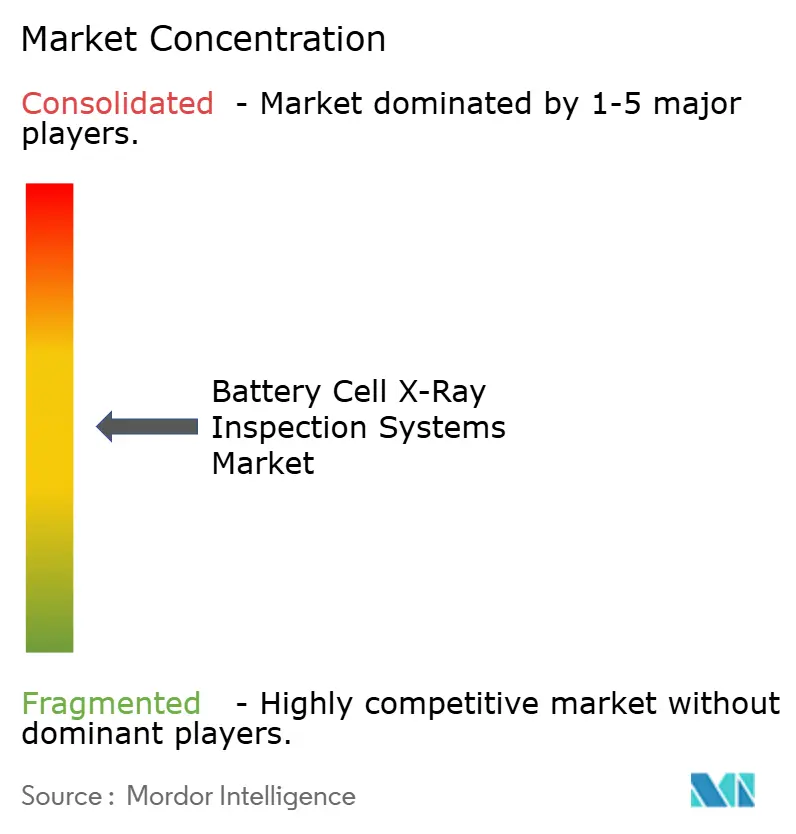
| Market Concentration | Medium |
Major Players *Disclaimer: Major Players sorted in no particular order Image © Mordor Intelligence. Reuse requires attribution under CC BY 4.0. | |
Battery Cell X-Ray Inspection Systems Market Analysis by Mordor Intelligence
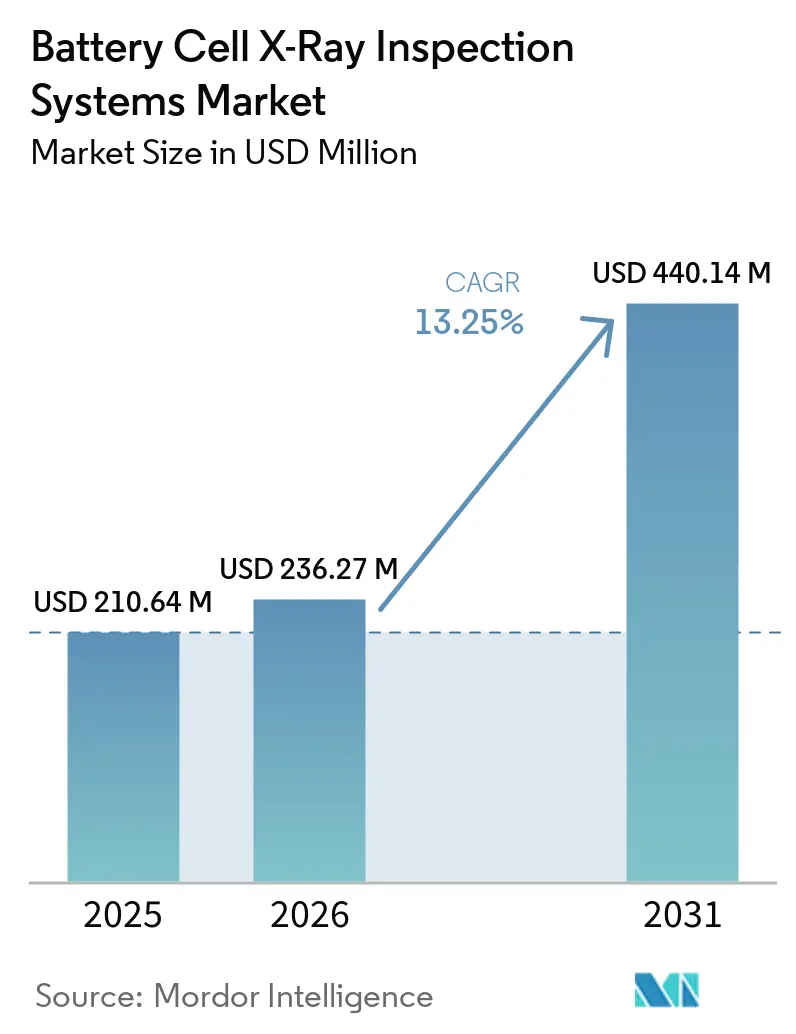
The battery cell X-ray inspection systems market size was valued at USD 210.64 million in 2025 and is estimated to expand from USD 236.27 million in 2026 to reach USD 440.14 million by 2031, at a CAGR of 13.25% during the forecast period 2026-2031. Gigafactory additions in East Asia, Europe, and North America are increasing the need for inspection capacity that can keep pace with cell production. Cell-level failures can affect modules and packs, so manufacturers are placing more weight on defect prevention and documented quality controls. Procurement is moving beyond individual 2D systems toward staged platforms that can support both cells and modules within a single site. This creates larger opportunities within the battery cell X-ray inspection systems market for vendors that combine imaging equipment, analysis software, integration, and ongoing service. Capital availability, component lead times, and differences in certification requirements may delay some purchase decisions, although recall risk continues to support investment in inline inspection.
Key Report Takeaways
- By technology, 2D X-Ray Radiography held 52.84% of the battery cell X-ray inspection systems market share in 2025, while X-Ray Computed Tomography is projected to expand at a CAGR of 14.68% through 2031.
- By battery cell format, Prismatic Cells accounted for 41.73% of the battery cell X-ray inspection systems market share in 2025, while Cylindrical Cells are projected to expand at a CAGR of 14.47% through 2031.
- By end-user industry, Automotive accounted for 57.68% of the market in 2025, while Energy Storage Systems are projected to expand at a CAGR of 14.21% through 2031.
- By component, X-Ray Hardware accounted for 72.46% of the market in 2025, while Inspection and Image Analysis Software is projected to expand at a CAGR of 14.74% through 2031.
- By geography, Asia-Pacific held 58.91% of the market in 2025 and is projected to expand at a CAGR of 14.96% through 2031.
Note: Market size and forecast figures in this report are generated using Mordor Intelligence’s proprietary estimation framework, updated with the latest available data and insights as of January 2026.
Global Battery Cell X-Ray Inspection Systems Market Trends and Insights
Drivers Impact Analysis*
| Driver | (~) % Impact on CAGR Forecast | Geographic Relevance | Impact Timeline |
|---|---|---|---|
| Gigafactory Production Capacity Expansion | +3.5% | Global, with core impact in China, South Korea, Germany, and the United States | Short term (≤ 2 years) |
| Shift to 100% Inline Inspection | +2.8% | Global, with early adoption in Asia-Pacific and expansion to North America and Europe | Short term (≤ 2 years) |
| Stricter Battery Safety and Quality Standards | +2.1% | North America and Europe, with expansion to Asia-Pacific under China’s GB 38031-2025 | Medium term (2-4 years) |
| AI-Based Defect Classification Adoption | +1.8% | Global, led by China and Germany | Medium term (2-4 years) |
| Large-Format Battery Cell Adoption | +1.4% | Global, concentrated in South Korea, China, and Germany | Medium term (2-4 years) |
| Closed-Loop Manufacturing Traceability Demand | +0.9% | Europe and North America | Long term (≥ 4 years) |
| Source: Mordor Intelligence | |||
Expansion of Gigafactory Production Capacity
Gigafactory capacity additions directly increase demand across the battery cell X-ray inspection systems market for battery cell inspection equipment because each new production line needs inline inspection stations for its relevant cell formats. Tesla committed USD 250 million to additional 4680-cell production capacity at Grünheide, Germany, in May 2026, raising its planned annual output target from 8GWh to 18GWh and adding more than 1,500 battery-related jobs. Cell production is expected to begin during the first half of 2027, extending the need for qualified production equipment. LG Energy Solution also planned two additional cylindrical-cell lines at Nanjing Plant 9 during the second half of 2026, each rated at 2GWh. As output per shift rises, inspection systems must examine cells without restricting line speed. The battery cell X-ray inspection systems market therefore benefits when manufacturers replace offline checks with inline systems that can operate in less than 2 seconds per cell.
Shift to 100% Inline Inspection
Manufacturers are moving from statistical sampling toward inspection of every cell produced, which raises the number of systems required across the battery cell X-ray inspection systems market at each facility. A January 2024 study showed that an Excillum MetalJet X-ray source and a high-speed photon-counting detector could complete a 1-second CT scan of a prismatic cell for inline overhang inspection on a line producing 20 cells per minute.[1] A separate study described a cross-process X-ray method that combines several inspection points into one CT scan before electrolyte filling, reducing the number of scans and the cycle time. These findings make high-speed detectors and image reconstruction capability more important in equipment selection. Vendors are increasingly assessed on the cost of inspecting each cell, rather than only on X-ray tube specifications. The battery cell X-ray inspection systems market is also supported by automated pipelines that cover overhang measurement, weld integrity, and foreign-particle detection at production speed.
Stricter Battery Safety and Quality Standards
Battery standards are becoming more demanding for products and for the systems used to manufacture them. IEC 62933-5-2:2025 expanded fire-propagation safety requirements for grid-connected battery energy storage systems, including revised validation tests for gas generation and fire-spread controls.[2] China’s GB 38031-2025 raised thermal propagation test requirements and became mandatory in January 2026. The EU Battery Passport requirement takes effect in February 2027 and requires information that includes chemistry, recycled content, and manufacturing quality records. Equipment buyers consequently need systems that can retain and export cell-level records in compatible formats. Changes in cell chemistry or format for regulated applications can also create demand for different CT configurations and energy levels.
AI-Based Defect Classification Adoption
AI-based defect recognition is shifting inspection from a pass-or-fail task to a source of process feedback. A 2026 study of an enhanced YOLOv8 model using visible-light and X-ray data reported 87.5% mean average precision at 0.5 and 97.49% overall industrial recognition accuracy at 35.9 frames per second. ZEISS INSPECT X-Ray, Nikon Metrology AI Reconstruction, and Comet Yxlon Battery Insights apply automated analysis to reduce dependence on specialist review. Classified data can also identify patterns in anode overhang variation or other recurring defects. Production teams can use this information to correct upstream alignment before scrap accumulates. As a result, software capability is becoming a larger point of competition in the battery cell X-ray inspection systems market, while Inspection and Image Analysis Software is forecast to expand at a CAGR of 16.74% through 2031.
Restraints Impact Analysis*
| Restraint | (~) % Impact on CAGR Forecast | Geographic Relevance | Impact Timeline |
|---|---|---|---|
| High Capital and Integration Costs | -2.0% | Global, most acute in North America and South America | Medium term (2-4 years) |
| Long Supplier Qualification Cycles | -1.6% | Global, most pronounced in Europe and South Korea | Medium term (2-4 years) |
| X-Ray Tube and High-Performance Detector Shortages | -1.1% | Global, with acute pressure in Asia-Pacific | Short term (≤ 2 years) |
| Regulatory Fragmentation Across Markets | -0.8% | Cross-border, particularly among Europe, the United States, China, and Japan | Long term (≥ 4 years) |
| Source: Mordor Intelligence | |||
High Capital and Integration Costs
High initial investment can delay adoption across the battery cell X-ray inspection systems market, especially among smaller manufacturers and greenfield operators outside established East Asian supply chains. Production-line CT systems need shielded enclosures, conveyors, manufacturing execution system connectivity, and image analysis software. A facility producing several cell formats may require 8-12 dedicated inspection points to provide complete inline coverage across its process steps. Brownfield projects can require more spending on mechanical and software changes than on the equipment itself. Vendors also face separate radiation-safety certification requirements in the United States, Germany, and China. Although lower scrap and lower recall risk can support the long-term business case, up-front capital requirements remain a constraint for the battery cell X-ray inspection systems market.
Long Supplier Qualification Cycles
Battery makers apply automotive-grade qualification processes to systems used for traction cells. Supplier qualification can take 12-24 months from initial assessment through validation at a customer location. This means a system with strong laboratory performance may not generate production revenue for 2 or more years after its launch. Vendors working with several original equipment manufacturers must manage different evaluation procedures at the same time. Customers may also require application engineers to remain on site during qualification. These demands favor established suppliers with proven records and can slow adoption of new inspection technologies.
*Our forecasts treat driver/restraint impacts as directional, not additive. The impact forecasts reflect baseline growth, mix effects, and variable interactions.
Segment Analysis
By Technology: 2D Radiography Supports Production Volumes While CT Expands Inspection Capability
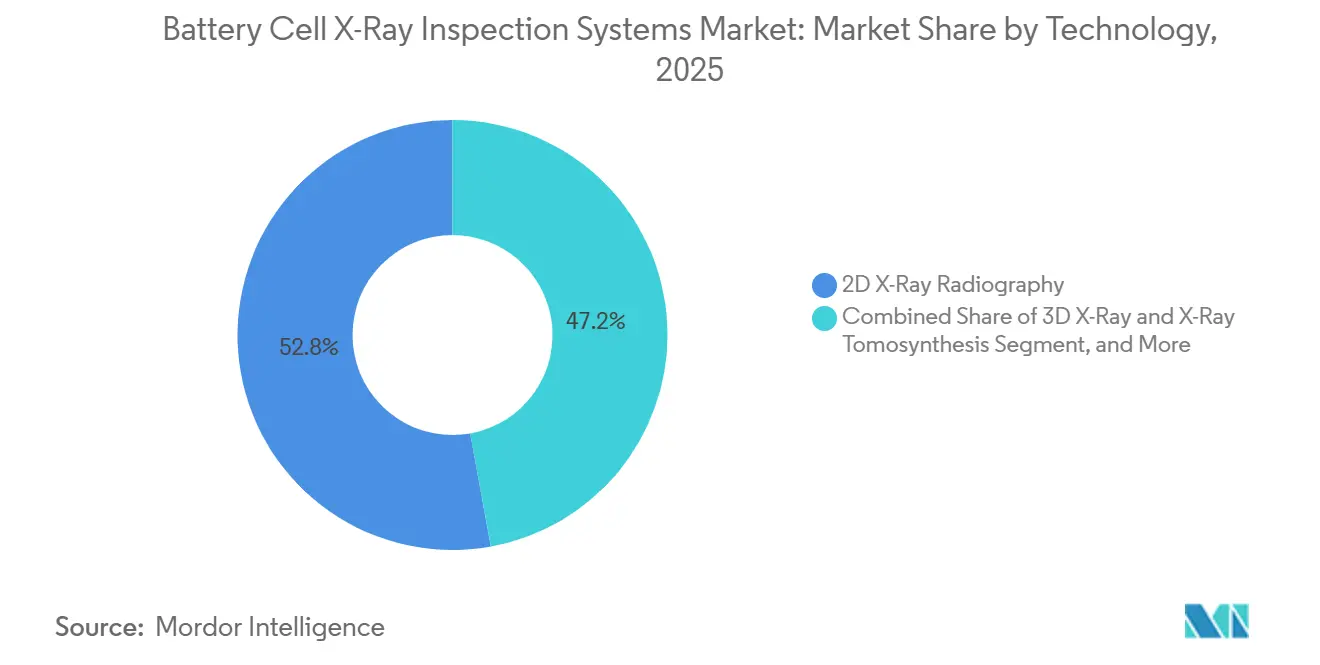
2D X-Ray Radiography held 52.84% of the battery cell X-ray inspection systems market share in 2025, reflecting its role in high-volume inspection of electrode overhangs, welds, and tab positions. Its short cycle times make it suitable for cylindrical and prismatic production lines with demanding throughput requirements. A 2D system also has a lower capital cost than a complete CT system. This makes the technology a practical choice for operators that prioritize continuous line operation, while 3D X-Ray and X-Ray Tomosynthesis provide limited-angle reconstruction for layer-count issues and major delamination in pouch cells.
X-Ray Computed Tomography is projected to expand at a CAGR of 14.68% through 2031 as manufacturers require more detail on internal safety-critical features. CT can assess anode-cathode overhang, separator condition, and void distribution in electrolyte fill. The battery cell X-ray inspection systems market size for CT is supported by the need for volumetric imaging that 2D radiography cannot provide. The 2024 MetalJet study demonstrated 1-second CT imaging for prismatic cells at a rate compatible with 20 cells per minute. This performance threshold makes inline CT more relevant to production use, and similar speed requirements are expected to support installations through 2031.

By Battery Cell Format: Prismatic Cells Lead While Cylindrical Cells Gain Momentum
Prismatic Cells accounted for 41.73% of the battery cell X-ray inspection systems market share in 2025. Their role in Chinese electric vehicle supply chains, including blade-cell and large prismatic designs used by CATL and BYD, supports consistent inspection demand. Their rectangular shape simplifies fixture design, while large-format packs make complete inspection economically important. Pouch cells need specialized fixtures because their flexible housings can affect repeatability.
Coin and button cells remain a focused application for hearing aids, medical devices, and IoT sensors. Inspection for these cells centers on electrode alignment and casing-seal integrity. Cylindrical Cells are projected to expand at a CAGR of 14.47% through 2031 as 46-series capacity increases. Samsung SDI began mass production of 46mm cylindrical cells in South Korea in early 2025. LG Energy Solution reported a backlog above 100GWh for new cylindrical-cell orders in April 2026, with 46-series production at its U.S. plant planned by year-end. A 2026 patent application also addressed multi-unit CT inspection of cylindrical batteries to identify internal defects through batch scanning, indicating attention to methods for higher-volume production.
By End-User Industry: Automotive Remains the Largest User While Energy Storage Gains Pace
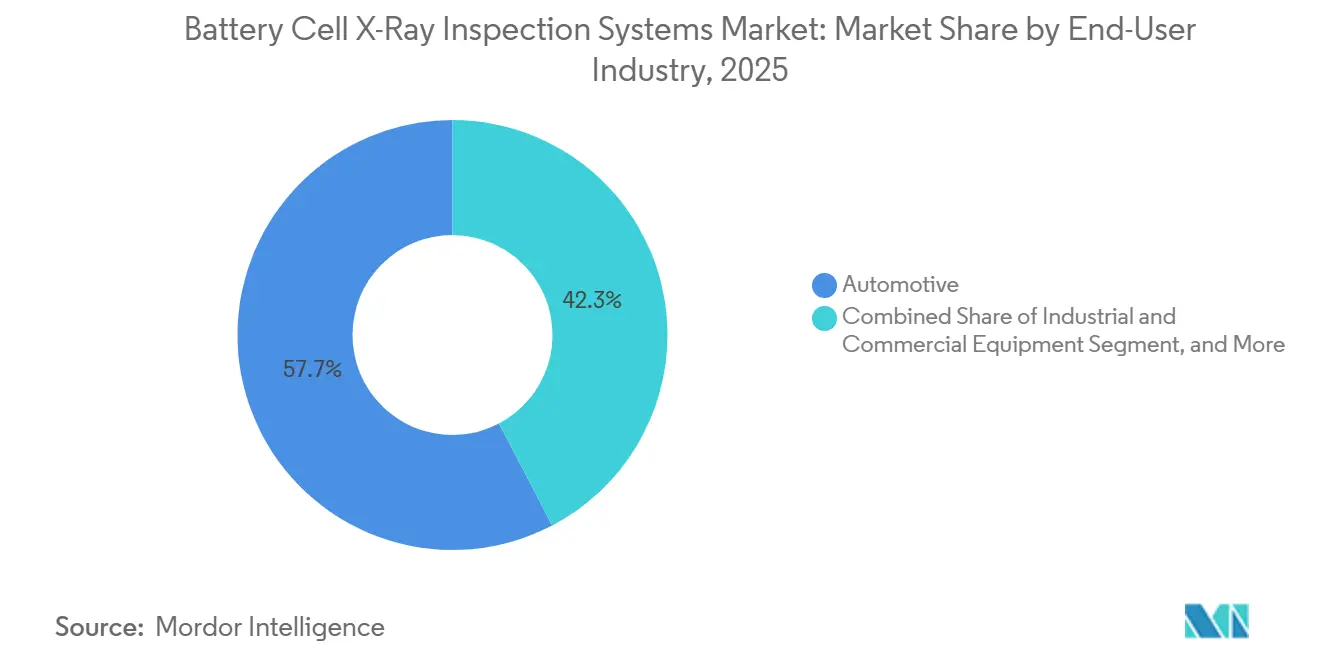
Automotive applications represented 57.68% of the battery cell X-ray inspection systems market share in 2025. Electric vehicle cell production remains the largest source of inspection demand because traction batteries are subject to high safety and quality expectations. Thermal runaway incidents can create safety and reputational risks for original equipment manufacturers. Consumer electronics use cylindrical, prismatic, and pouch cells for phones, laptops, and wearables, which favors flexible systems. Aerospace and Defense is smaller by volume but requires premium systems and documented cell-level records.
Battery Recycling and Second-Life Operations are gaining attention as returned cells are assessed before reuse in second-life packs. X-ray inspection can evaluate internal structure without opening the cell, and micro-CT has measured overhang, porosity, and contact loss in all-solid-state pouch cells. Energy Storage Systems are projected to expand at a CAGR of 14.21% through 2031, supported by Tesla’s August 2026 Megapack 3 production start at its 50GWh Brookshire facility. Industrial and Commercial Equipment adds demand as lead-acid installations shift to lithium-ion systems.
By Component: Hardware Leads Revenue While Software Gains Strategic Weight
X-Ray Hardware accounted for 72.46% of component revenue in 2025, making it the largest part of the battery cell X-ray inspection systems market size by component. This category includes X-ray tubes, high-voltage power supplies, detectors, shielded enclosures, and motion-control stages. Detector and source technology remain capital-intensive, which keeps spending concentrated in physical systems. X-ray tubes create aftermarket demand through recalibration and replacement, while services include installation, integration, commissioning, maintenance, repair, and modernization. More complex systems increase the value of service agreements that support uptime.
Inspection and Image Analysis Software is projected to expand at a CAGR of 14.74% through 2031. The shift reflects a move from hardware-only differentiation toward platforms that can interpret and share inspection results. Software can connect inspection outcomes with manufacturing execution system data and support traceable quality records. Comet Yxlon Battery Insights and Waygate Technologies offerings show its importance in the battery cell X-ray inspection systems industry. Recurring software upgrades can extend supplier relationships and reduce hardware’s relative revenue share over the forecast period.
Geography Analysis
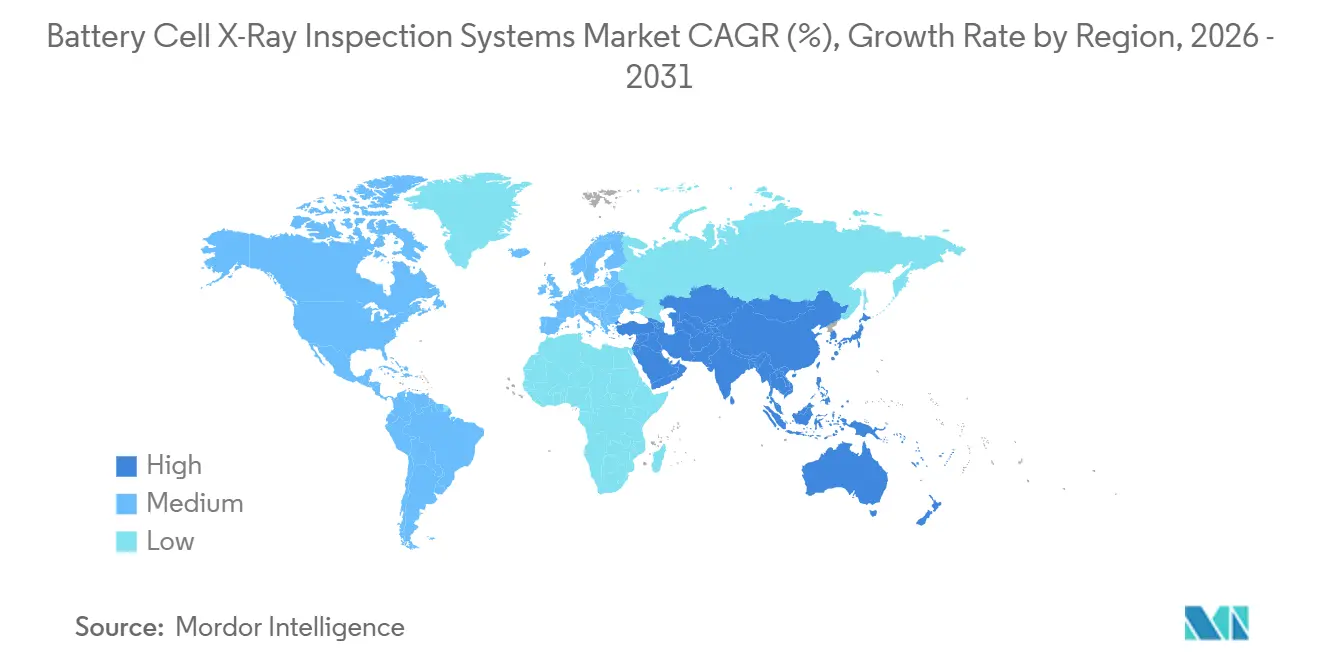
Asia-Pacific held 58.91% of the battery cell X-ray inspection systems market share in 2025 and is projected to expand at a CAGR of 14.96% through 2031. China, South Korea, and Japan account for most regional demand because they host dense lithium-ion cell manufacturing networks. China’s position is supported by CATL, BYD, and a wider group of cell suppliers. The GB 38031-2025 standard and internal quality requirements reinforce demand for defect documentation and process control. Chinese vendors including Unicomp Technology and Dandong Aolong compete in mid-tier inline equipment, while South Korea benefits from 46-series additions and Japan remains relevant through Shimadzu and Matsusada Precision.
Europe and North America are the next significant regions for the battery cell X-ray inspection systems market. Europe’s demand comes from projects in Germany, the United Kingdom, and the Nordic region. Tesla’s planned 18GWh capacity at Giga Berlin, PowerCo’s Salzgitter facility, and AESC Sunderland support long-cycle infrastructure demand. The EU Battery Passport requirement from February 2027 will require quality records in compatible formats.[3] In North America, DOE-supported capacity programs and energy-storage production support demand, including Forge Nano’s North Carolina project and Tesla’s Brookshire facility.
The Middle East and Africa and South America remain early-stage markets for inspection systems. Demand currently relates more to supply-chain localization and imported equipment than to broad domestic cell production. Saudi Arabia and the UAE have reference installations connected with electric vehicle and clean-energy programs, while Brazil is advancing lithium extraction and downstream processing. Commercial-scale cell manufacturing remains a medium-term prospect, but trade and origin requirements may support local supply chains before 2031.
Competitive Landscape
The battery cell X-ray inspection systems market is moderately consolidated in high-performance applications. Five to 8 vendors account for much of the revenue from tier-1 gigafactory customers. Comet Yxlon, Waygate Technologies, Nikon Metrology, ZEISS Group, and Shimadzu Corporation form the premium group. They compete on CT resolution, software functions, and service coverage across the battery cell X-ray inspection systems market. Comet Yxlon launched the large-scale FF85 CT configuration in April 2026. The system scans electric vehicle battery packs up to 1,000kg at 24-micrometer resolution, extending its offering from cell-level systems to pack inspection.
Waygate Technologies and Liminal Insights announced a technology and channel partnership in March 2026. Their combined approach links industrial CT and radiography with AI-driven ultrasound analysis. A proof of concept at the UK Battery Industrialisation Centre covered more than 400 cells and reported over 10% cost savings with a 12% improvement in defect-capture rate. Viscom SE raised its 2026 incoming-order forecast to EUR 90 million-EUR 100 million, equivalent to USD 101 million-USD 113 million, following a major inline CT contract. Its H1 2026 order book increased 62.2% year over year.
Chinese suppliers led by Unicomp Technology and Dandong Aolong are strengthening their position in mid-tier systems. AI-native software suppliers also provide retrofit options for existing X-ray systems, supporting automation without replacing all installed hardware. A 2026 patent application covering simultaneous CT inspection of multiple cylindrical cells reflects the focus on throughput as 46-series volumes rise. The battery cell X-ray inspection systems industry therefore has established premium suppliers, while software integration and cost-focused regional competition continue to shape supplier selection.
Battery Cell X-Ray Inspection Systems Industry Leaders
-
YXLON International GmbH
-
Nikon Metrology NV
-
Viscom AG
-
Nordson Corporation
-
Waygate Technologies GmbH
- *Disclaimer: Major Players sorted in no particular order
Recent Industry Developments
- August 2026: Tesla began production of Megapack 3 at its Brookshire, Texas facility, with designed capacity of 50GWh per year dedicated to the energy storage product. The facility’s scale makes it Tesla’s largest dedicated energy storage manufacturing site and directly expands the addressable volume requiring cell-level quality control.
- June 2026: Viscom SE raised its 2026 order-intake forecast to EUR 90 million-EUR 100 million (USD 101 million-USD 113 million) following a major contract in inline CT inspection for battery cell applications. New orders rose 30.2% to EUR 55.7 million in the first half of 2026, with the order book increasing 62.2% year over year to EUR 38 million as of June 30, 2026.
- April 2026: LG Energy Solution reported its order backlog had exceeded 440GWh following new orders totaling 100GWh for 46-series cylindrical cells. The company had started 4695-format production at Ochang, South Korea, and planned to begin 4680-46120 production at its Arizona plant by year-end.
- April 2026: Nikon Metrology has completed one year since announcing a strategic partnership with Varex Imaging Corporation to develop high-resolution X-ray detectors and integrated inspection workflows for lithium-ion battery cells and modules.
Global Battery Cell X-Ray Inspection Systems Market Report Scope
The Battery Cell X-Ray Inspection Systems Market Report is Segmented by Technology (2D X-Ray Radiography, 3D X-Ray and X-Ray Tomosynthesis, and X-Ray Computed Tomography), Battery Cell Format (Cylindrical Cells, Prismatic Cells, Pouch Cells, and Coin and Button Cells), End-User Industry (Automotive, Consumer Electronics, Energy Storage Systems, Industrial and Commercial Equipment, Aerospace and Defense, Battery Recycling and Second-Life Operations, and Other End-Use Industries), Component (X-Ray Hardware, Inspection and Image Analysis Software, and Services [Installation and Integration, Calibration and Commissioning, Maintenance and Repair, and Upgrades and Modernization]), and Geography (North America, South America, Europe, Asia-Pacific, and Middle East and Africa). The Market Forecasts are Provided in Terms of Value (USD).
| 2D X-Ray Radiography |
| 3D X-Ray and X-Ray Tomosynthesis |
| X-Ray Computed Tomography |
| Cylindrical Cells |
| Prismatic Cells |
| Pouch Cells |
| Coin and Button Cells |
| Automotive |
| Consumer Electronics |
| Energy Storage Systems |
| Industrial and Commercial Equipment |
| Aerospace and Defense |
| Battery Recycling and Second-Life Operations |
| Other End-Use Industries |
| X-Ray Hardware | |
| Inspection and Image Analysis Software | |
| Services | Installation and Integration |
| Calibration and Commissioning | |
| Maintenance and Repair | |
| Upgrades and Modernization |
| North America | United States | |
| Canada | ||
| Mexico | ||
| South America | Brazil | |
| Argentina | ||
| Rest of South America | ||
| Europe | Germany | |
| United Kingdom | ||
| France | ||
| Italy | ||
| Spain | ||
| Rest of Europe | ||
| Asia-Pacific | China | |
| Japan | ||
| India | ||
| South Korea | ||
| ASEAN | ||
| Rest of Asia-Pacific | ||
| Middle East and Africa | Middle East | Saudi Arabia |
| United Arab Emirates | ||
| Turkey | ||
| Rest of the Middle East | ||
| Africa | South Africa | |
| Nigeria | ||
| Rest of Africa | ||
| By Technology | 2D X-Ray Radiography | ||
| 3D X-Ray and X-Ray Tomosynthesis | |||
| X-Ray Computed Tomography | |||
| By Battery Cell Format | Cylindrical Cells | ||
| Prismatic Cells | |||
| Pouch Cells | |||
| Coin and Button Cells | |||
| By End-User Industry | Automotive | ||
| Consumer Electronics | |||
| Energy Storage Systems | |||
| Industrial and Commercial Equipment | |||
| Aerospace and Defense | |||
| Battery Recycling and Second-Life Operations | |||
| Other End-Use Industries | |||
| By Component | X-Ray Hardware | ||
| Inspection and Image Analysis Software | |||
| Services | Installation and Integration | ||
| Calibration and Commissioning | |||
| Maintenance and Repair | |||
| Upgrades and Modernization | |||
| By Geography | North America | United States | |
| Canada | |||
| Mexico | |||
| South America | Brazil | ||
| Argentina | |||
| Rest of South America | |||
| Europe | Germany | ||
| United Kingdom | |||
| France | |||
| Italy | |||
| Spain | |||
| Rest of Europe | |||
| Asia-Pacific | China | ||
| Japan | |||
| India | |||
| South Korea | |||
| ASEAN | |||
| Rest of Asia-Pacific | |||
| Middle East and Africa | Middle East | Saudi Arabia | |
| United Arab Emirates | |||
| Turkey | |||
| Rest of the Middle East | |||
| Africa | South Africa | ||
| Nigeria | |||
| Rest of Africa | |||
Key Questions Answered in the Report
What is the battery cell X-ray inspection systems market size?
The battery cell X-ray inspection systems market size is estimated at USD 236.27 million in 2026 and is forecast to reach USD 440.14 million by 2031, at a CAGR of 13.25%.
Why are battery makers adopting inline X-ray inspection?
Manufacturers are adopting inline inspection to identify cell defects at production speed, support traceability, and reduce the risk of safety events and costly recalls.
Which X-ray technology is expanding fastest for battery cells?
X-Ray Computed Tomography is projected to expand at a CAGR of 14.68% through 2031 because it provides volumetric imaging of internal cell features.
Which battery cell format creates the largest inspection demand?
Prismatic Cells held 41.73% of demand in 2025, while Cylindrical Cells are projected to expand at a CAGR of 14.47% through 2031.
Which end user is expected to adopt inspection systems fastest?
Energy Storage Systems are projected to expand at a CAGR of 14.21% through 2031, supported by larger grid-scale battery deployments.
Which region leads demand for battery cell X-ray inspection systems?
Asia-Pacific held 58.91% in 2025 and is projected to expand at a CAGR of 14.96% through 2031, supported by cell manufacturing in China, South Korea, and Japan.