
Micro Turbines Market Size and Share
Market Overview
| Study Period | 2021 - 2031 |
|---|---|
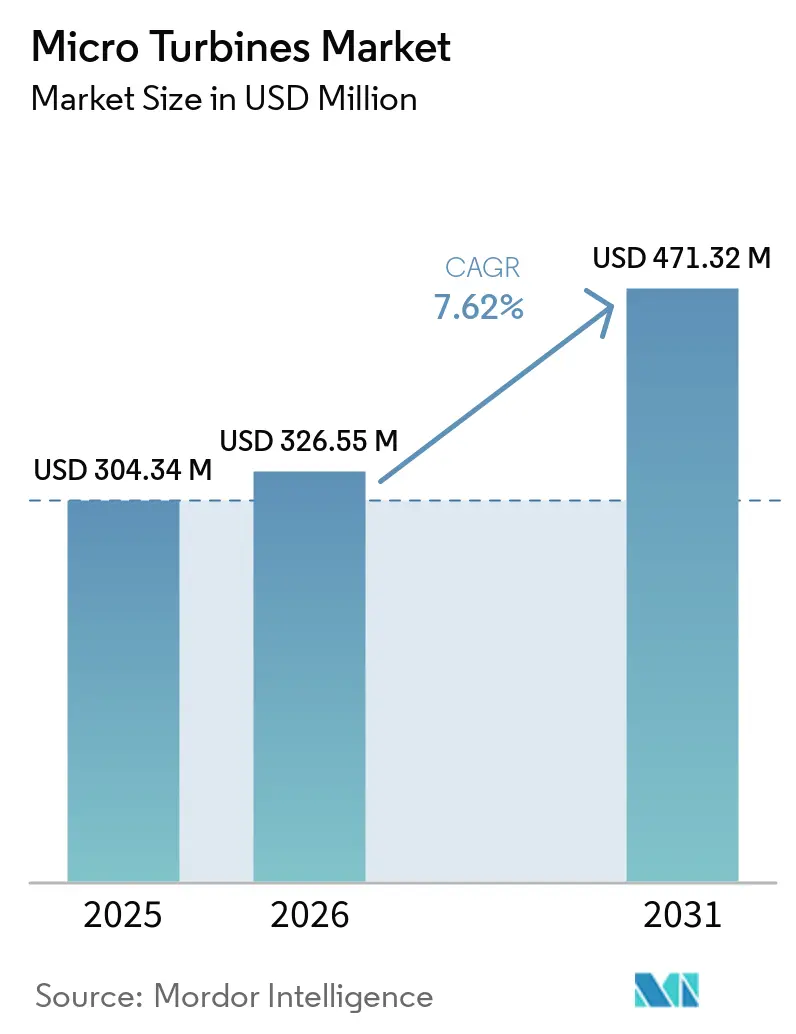
| Market Size (2026) | USD 326.55 Million |
| Market Size (2031) | USD 471.32 Million |
| Growth Rate (2026 - 2031) | 7.62 % |
| Fastest Growing Market | Asia-Pacific |
| Largest Market | North America |
| Market Concentration | Low |
Major Players *Disclaimer: Major Players sorted in no particular order Image © Mordor Intelligence. Reuse requires attribution under CC BY 4.0. | |
Micro Turbines Market Analysis by Mordor Intelligence
The Micro Turbines Market size was valued at USD 304.34 million in 2025 and is estimated to grow from USD 326.55 million in 2026 to reach USD 471.32 million by 2031, at a CAGR of 7.62% during the forecast period (2026-2031). Demand centers on sites that need dependable on-site power, including commercial facilities, industrial plants, oil and gas operations, data centers, and remote locations. Combined heat and power systems support adoption because they produce electricity and useful heat from the same fuel supply. Multi-fuel operation, air bearings, and lower maintenance requirements also shape purchasing decisions. Suppliers compete with solar paired with storage and fuel cells, so resilience, emissions performance, and fuel availability remain central to their positioning. Tighter rules on flaring and new direct-current data center designs can widen the addressable demand base beyond established CHP and backup uses.
Key Report Takeaways
- By power rating, 51–250 kW held 44.3% of the Micro turbines market share in 2025, while 251–500 kW is forecast to grow at a 7.9% CAGR through 2031.
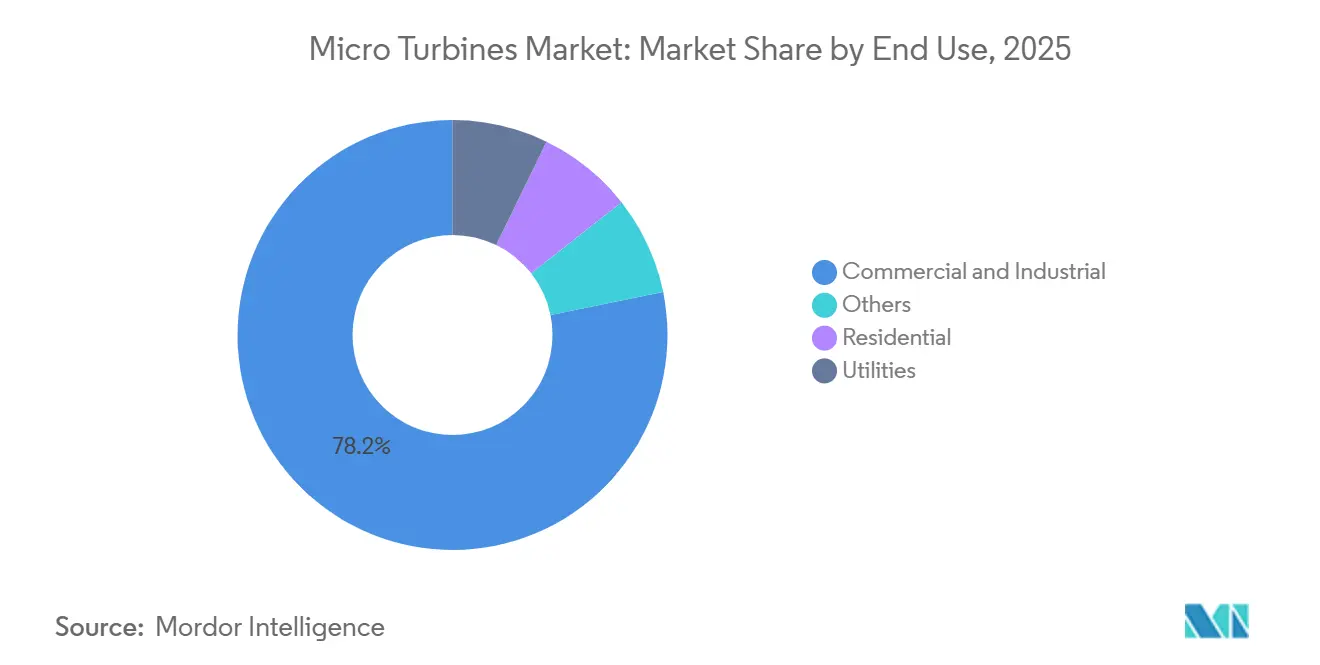
- By application, CHP accounted for 64.4% of the Micro turbines market share in 2025, while microgrids are forecast to grow at an 8.1% CAGR through 2031.
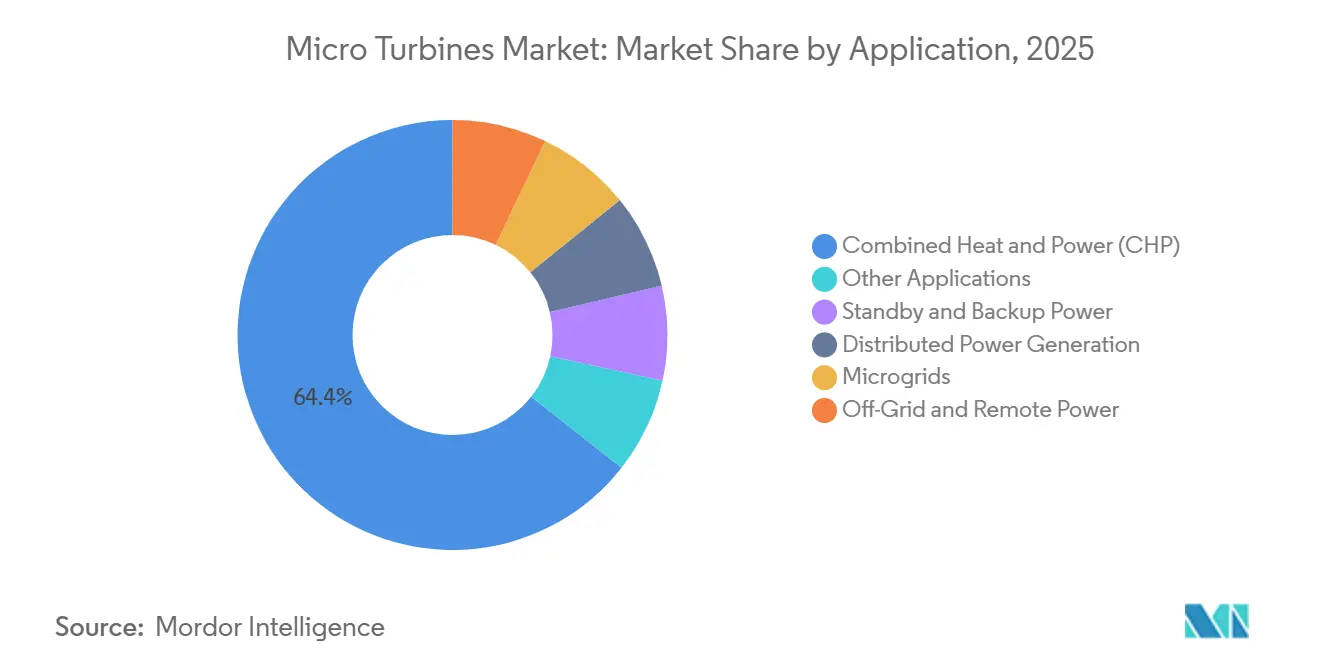
- By end use, commercial and industrial users held 78.2% of 2025 revenue, while utilities are forecast to grow at a 7.8% CAGR through 2031.
- By geography, North America held 37.9% of 2025 revenue, while Asia-Pacific is forecast to grow at an 8.4% CAGR through 2031.
Note: Market size and forecast figures in this report are generated using Mordor Intelligence’s proprietary estimation framework, updated with the latest available data and insights as of January 2026.
Global Micro Turbines Market Trends and Insights
Drivers Impact Analysis*
| Driver | % Impact on CAGR Forecast | Geographic Relevance | Impact Timeline |
|---|---|---|---|
| Rising Adoption of Combined Heat and Power | +2.50% | Global | Medium term (2–4 years) |
| Demand for Resilient Distributed Power | +1.80% | North America & EU, spill-over to APAC | Short term (≤ 2 years) |
| Emissions Reduction and Energy-Efficiency Mandates | +1.00% | North America & EU core, APAC emerging | Medium term (2–4 years) |
| Fuel Flexibility Across Natural Gas and Renewable Gases | +0.70% | Global | Medium term (2–4 years) |
| Data Center and Critical-Facility Power Requirements | +1.20% | North America & APAC core | Short term (≤ 2 years) |
| Microturbine Integration With Virtual Power Plants and Hybrid Assets | +0.60% | Europe & APAC | Long term (≥ 4 years) |
| Source: Mordor Intelligence | |||
Rising Adoption of Combined Heat and Power
CHP remains the principal application for the Micro turbines market because it supports both electrical output and heat recovery. Micro turbines in CHP service can achieve combined thermal and electrical efficiency of 75% to 90%[1]European Commission, “Commission Recommendation (EU) 2024/2395,” Official Journal of the European Union, eur-lex.europa.eu.. The European Commission published updated assessment guidance in September 2024 under Directive (EU) 2023/1791. The guidance strengthened the efficiency criteria used in support decisions for heating and cooling projects. Clearer qualification criteria can give lenders more certainty when they assess CHP projects. Food processing, hotels, refineries, and commercial properties provide demand across several customer groups.
The regulatory setting supports multiyear CHP project pipelines in Germany, France, Italy, and Poland. These markets value equipment that can replace separate electricity and boiler systems. CHP systems also help customers assess energy performance across their full site rather than only the electrical load. That broader calculation favors micro turbines where exhaust heat can be used consistently. It also reduces exposure to a decline in any one end-user category. The Micro turbines market, therefore, remains closely linked to the rate at which customers can use recovered heat on site.
Demand for Resilient Distributed Power
Longer grid connection timelines have made on-site generation more relevant for the Micro turbines market. The University of Texas reported in 2026 that data center developers were considering on-site power technologies as grid constraints delayed expansion[2]Bureau of Economic Geology, University of Texas at Austin, “On-Site Power Generation Technologies Reshaping Data Center Power Strategy,” COMPASS White Paper, compass.beg.utexas.edu. . The same report stated that large-project interconnection timelines in constrained areas exceeded 3 years. On-site equipment can allow a project to operate before a permanent grid connection is available. It can also provide a bridge while developers wait for network upgrades. This is especially relevant in weather-exposed regions where customers place a higher value on continuity of supply.
Micro turbines fit behind-the-meter projects where diesel equipment faces stricter emissions requirements and larger turbines exceed site demand. Modular units allow customers to add capacity as their load grows. The University of Texas estimated that 27% of data centers had some form of on-site generation in 2026. It is estimated that the share could reach 50% by 2035. Microgrids were identified as a primary architecture for this expansion. European energy-security concerns have also sustained interest in resilient supply at industrial and commercial sites.
Emissions Reduction and Energy-Efficiency Mandates
Emissions and efficiency rules affect equipment choices in the Micro turbines market. The U.S. Environmental Protection Agency finalized amendments for stationary combustion turbines in January 2026. The rules revised nitrogen oxide limits by turbine size, utilization rate, and fuel type[3]U.S. Environmental Protection Agency, “Final Rule: New Source Performance Standards Review for Stationary Combustion Turbines and Stationary Gas Turbines,” U.S. Environmental Protection Agency, epa.gov.. Micro turbines using lean-premix combustion can reach nitrogen oxide emissions as low as 9 parts per million at full load. The amended standards can favor lower-emitting turbine systems over older diesel and reciprocating equipment. This matters most in locations with stricter local air-quality requirements.
Compliance can become a purchasing condition in western U.S. air basins where diesel backup faces growing pressure. CHP also benefits when buyers are required to examine total energy use rather than only site electricity consumption. The Micro turbines market has an advantage where heat recovery reduces fuel use at the facility level. Manufacturers must still show how a system performs under the fuel and operating conditions of each site. Rules differ across subcategories, so compliance claims require careful equipment selection. This gives service capability and documented operating performance more weight in procurement.
Data Center and Critical-Facility Power Requirements
Data center construction is creating new demand for the Micro turbines market in primary and hybrid power roles. Capstone Energy+ stated in its 2026 Form 10-K that its 800 VDC platform was designed to interface with NVIDIA Kyber and Rubin Ultra architectures[4]Capstone Energy+ Inc., “Annual Report on Form 10-K for the Period Ending March 31, 2026,” U.S. Securities and Exchange Commission EDGAR, sec.gov.. The company stated that micro turbines natively produce close to 760 VDC. It also reported that its design could reduce copper use by up to 45% and improve power efficiency by up to 5% against legacy 54V systems. Fewer power-conversion stages could matter for facilities that are designed around direct-current distribution. This gives equipment suppliers a route into new data center power designs.
Aurelia Technologies reported a 232 MW supply role within a 1.18 GW AI factory and hyperscale data center project. The project shows that smaller suppliers are pursuing data center orders at a substantial scale. Pure DC and AVK deployed a 110 MW on-site microgrid at a Dublin campus in March 2026. The partners planned full operation of Energy Centres 1 and 2 by the end of 2026. These projects place on-site generation within core facility design rather than only emergency planning. The Micro turbines market can benefit where data center loads exceed the pace of local grid expansion.
Restraints Impact Analysis*
| Restraint | % Impact on CAGR Forecast | Geographic Relevance | Impact Timeline |
|---|---|---|---|
| High Upfront Installation Cost and Long Payback Periods | -0.90% | Global | Short to medium term (≤ 4 years) |
| Competition From Solar-Plus-Storage, Fuel Cells, and Engines | -0.60% | North America & EU | Medium term (2–4 years) |
| Fuel-Price Volatility and Gas-Infrastructure Exposure | -0.40% | Global | Short term (≤ 2 years) |
| Interconnection and Control Complexity in Hybrid Microgrids | -0.30% | Europe & North America | Medium term (2–4 years) |
| Source: Mordor Intelligence | |||
High Upfront Installation Cost and Long Payback Periods
High initial cost remains a constraint on the Micro turbines market. A 2024 Applied Energy study placed installed micro gas turbine costs at USD 800 to USD 2,000 per kW. The same comparison placed diesel generator costs at USD 300 to USD 500 per kW. This gap is difficult for smaller companies and buyers without long-term financing. Lifecycle operating costs can support prime-power projects, but capital and operating budgets are often assessed separately. That budget structure can disadvantage a system with a higher initial cost and lower operating cost over time.
A limited manufacturing base can also slow unit-cost reductions. Peer-reviewed research described how low production volume can limit learning effects for micro gas turbines. Lower volumes can then preserve the same cost barrier that limits new deployments. Lease-to-own, power purchase agreement, and build-to-own-transfer structures seek to move the initial cost from the customer's balance sheet. Capstone Energy+ uses these types of commercial structures for its offerings. Such models can help customers evaluate energy value across the full operating period. They do not remove the need for suppliers to fund equipment and support capacity.
Competition From Solar-Plus-Storage, Fuel Cells, and Engines
Competition from solar paired with storage, fuel cells, and engines limits some opportunities in the Micro turbines market. A 2024 technical review noted the long decline in solar photovoltaic module costs through 2020. That cost trend narrows the advantage of a micro turbine where a site cannot use its recovered heat. Solid oxide fuel cells can achieve an electrical efficiency of 45% to 60% in power-only operation. The review placed micro turbine electrical efficiency in power-only service at 26% to 35%. This difference matters when electrical efficiency is the primary selection criterion.
Micro turbine suppliers respond by emphasizing fuel flexibility, resilient operation, and heat recovery. This position is strongest at remote sites, oil and gas facilities, and critical installations. It is harder to sustain at urban commercial sites that have access to several alternatives. Fuel-price volatility can also change operating economics for gas-fired systems. Hybrid microgrids add control and interconnection requirements that can delay implementation. These conditions make project design, fuel access, and service support central to competitive selection.
*Our forecasts treat driver/restraint impacts as directional, not additive. The impact forecasts reflect baseline growth, mix effects, and variable interactions.
Segment Analysis
By Power Rating: Higher-Capacity Bands Gain Ground in Industrial and Data Center Projects
The 51–250 kW band accounted for 44.3% of the Micro turbines market size in 2025. Hotels, food producers, hospitals, and light manufacturers form the core customer base for this range. These sites often need a scale of output that supports useful heat recovery without requiring a large turbine installation. The up to 50 kW category serves telecom backup and remote sensing applications. Its demand comes from locations where transportable equipment and multi-fuel operation matter more than high output. The 501–1,000 kW range serves larger industrial CHP and data center projects.
The 251–500 kW category is forecast to grow at a 7.9% CAGR through 2031. This part of the Micro turbines market size reflects projects that stack modular units for larger behind-the-meter loads. Aurelia Technologies offers its A400 and A800 platforms in this range. The company states that these systems have hydrogen and biogas compatibility and electrical efficiency up to 40%. In June 2026, Aurelia and Velo3D announced an additive manufacturing partnership for next-generation components. The partnership targets more integrated components and lower maintenance risk.
By Application: CHP Leads While Microgrids Grow on Grid-Constrained Site Development
CHP held 64.4% of the Micro turbines market size in 2025. Its lead reflects the value of producing heat and power from one fuel stream. The European policy framework recognizes the role of efficient heating and cooling assessments for CHP projects. Standby power remains relevant for healthcare, financial services, and other facilities where interruption costs are high. Distributed generation and off-grid applications serve mines, oil fields, and island systems. These applications are important where grid service is unavailable or diesel delivery is costly.
Microgrids is forecast to grow at an 8.1% CAGR through 2031. The growth reflects data center construction in areas where utility connections can take 3 or more years. Capstone Energy+ introduced its Energy Surplus Program for AI data centers in March 2026. The program combines micro turbines with cooling, storage, and microgrid controls. A 2025 IEEE paper reported that a multi-resource virtual power plant bidding model improved portfolio profit by 12.86% over a traditional optimization method. The finding shows why dispatchable distributed assets are receiving attention in electricity market frameworks.


By End Use: Commercial and Industrial Leads While Utilities Gain Momentum
Commercial and industrial users accounted for 78.2% of the Micro turbines market size in 2025. Food manufacturing, hospitality, healthcare, and refining are major customer settings. These users can often use the exhaust heat for processes or building needs. In August 2025, Capstone Green Energy received a 5.8 MW follow-on order from a Mexican food manufacturer. The equipment uses exhaust heat to support dehydration processes. Residential use remains small because the capital cost is high relative to household demand.
Utilities are forecast to grow at a 7.8% CAGR through 2031. Utilities are incorporating more distributed energy resources and virtual power plants into their operating models. This can move micro turbines from a stand-alone on-site role into an aggregated dispatchable supply. A 2026 Frontiers in Energy Research study found that adaptive multi-energy virtual power plant frameworks could reduce operating costs while supporting stability in extreme weather. The research supports the operational case for distributed generation in utility portfolios. Deployment will depend on local rules for aggregation, interconnection, and dispatch.
Geography Analysis
North America held 37.9% of the Micro turbines market share in 2025. Natural gas pipeline coverage and CHP incentives support the region's established position. California, New York, and New England provide state-level support for eligible CHP systems. PJM and MISO connection queues exceeded 36 months for large projects in 2026. That has encouraged data center developers to assess micro turbine and microgrid systems as primary or bridge generation. Capstone Energy+ received orders in Utah, North Carolina, Brazil, Chile, and West Africa during 2026.
The company packages turbines, absorption chillers, dry coolers, battery storage, and controls through its Energy Surplus Program. A major U.S. natural gas producer expanded its Marcellus Shale fleet beyond 150 units after a September 2025 follow-on order. The order reflects demand where upstream operators lack an available grid connection. Mexico added a 5.8 MW CHP follow-on order during August 2025. Existing fleet expansions are therefore part of regional demand alongside new installations.
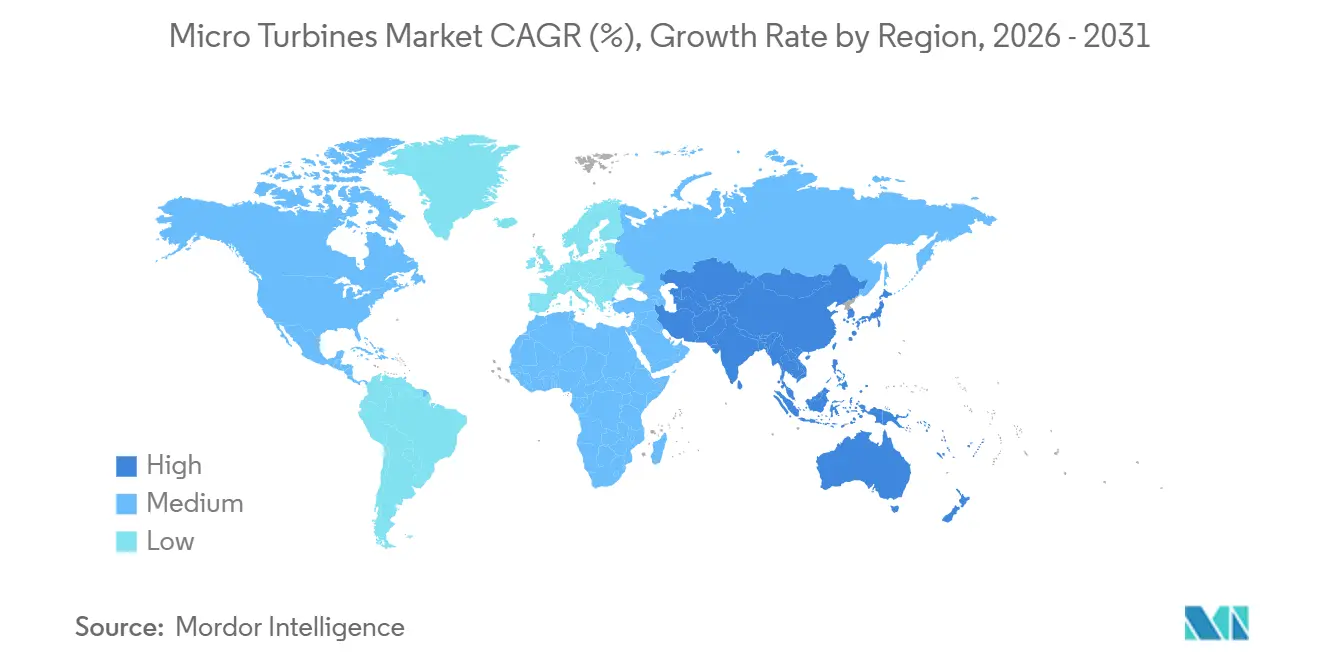
Asia-Pacific is forecast to grow at an 8.4% CAGR through 2031. China and India add industrial demand, while Singapore, South Korea, Japan, and Australia add data center demand. India’s non-fossil installed power capacity exceeded 242 GW in June 2026 and passed 50% of national installed generation capacity. Industrial customers need dispatchable on-site power that can complement intermittent renewable supply. China offers the largest single-country opportunity through industrial CHP and distributed energy programs. Europe retains a significant position through efficiency mandates and carbon pricing, while South America and the Middle East and Africa offer wellhead flare-gas applications.

Competitive Landscape
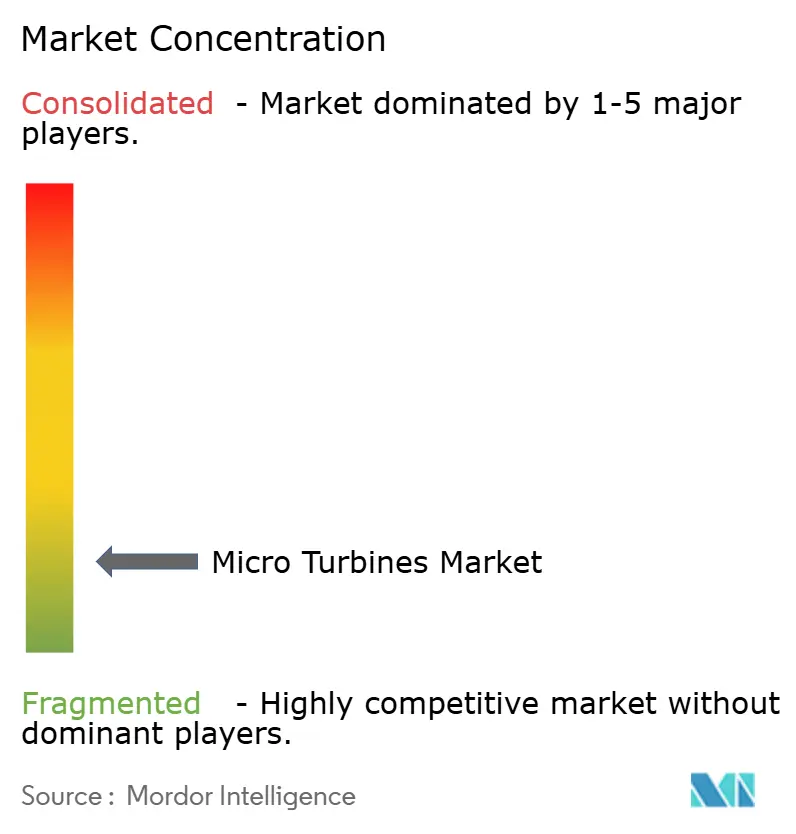
The Micro turbines market is fragmented, with no supplier holding a dominant position across power ratings, fuels, and regions. Capstone Energy+ has the largest installed base and reported manufacturing capacity up to 728 MW annually in its existing factory. Its lease-to-own, power purchase agreement, and build-to-own-transfer models reduce initial customer cost. FlexEnergy Solutions focuses on ultra-low-BTU and waste-gas applications for oil and gas operators. Ansaldo Energia offers the AE-T100, which can support up to 80% hydrogen in its fuel mix. The company states that the platform can achieve a combined efficiency of up to 90%.
Aurelia Turbines is active in the 251–500 kW range and states that its radial-outflow design can reach electrical efficiency up to 40%. Its June 2026 agreement with Velo3D focuses on additive manufacturing and integrated turbine components. The agreement targets supply chain simplification and lower maintenance risk. Capstone Energy+ is advancing an 800 VDC AI Power Block and has a C600 pilot unit in qualification testing in August 2026. Aurelia also reported a 232 MW supply role within a 1.18 GW AI infrastructure project. These moves show a focus on direct-current data center power and larger modular installations.
The U.S. EPA rules finalized in January 2026 can strengthen the role of low-emission turbine systems in regulated U.S. markets. Fuel flexibility, service coverage, financing, and data center compatibility remain key points of differentiation. Small off-grid deployments in emerging markets remain an underserved area. Bladon Micro Turbine addresses that need with equipment for telecom tower and remote applications. The AI data center segment is also still forming around 800 VDC system designs. Supplier scale and regional service reach will affect which firms can convert technical offerings into repeatable deployments.
Micro Turbines Industry Leaders
Capstone Energy+
Ansaldo Energia
FlexEnergy Solutions
Bladon Micro Turbine
Aurelia Turbines
- *Disclaimer: Major Players sorted in no particular order

Recent Industry Developments
- September 2026: Ansaldo Energia advanced its fuel flexibility strategy with certifications from TÜV SÜD for Hydrogen Readiness for the GT36 platform and DNV for the AE94.3A combustion system validated on Hydrotreated Vegetable Oil, preparing its turbine portfolio for low-carbon fuel operation ahead of tightening EU 2030 targets.
- July 2026: Capstone Energy+ secured a 36-month lease-to-own agreement to supply a C600 Signature Series microturbine to Maurel & Prom for flare gas recovery at an onshore asset in Gabon, with commissioning expected in November 2026.
- June 2026: Velo3D and Aurelia Technologies announced a strategic additive manufacturing partnership for next-generation micro gas turbine components using Velo3D’s Sapphire XC platform.
- March 2026: Pure DC and AVK deployed a 110 MW on-site microgrid at a Dublin data center campus, with Energy Centres 1 and 2 targeted for full operation by the end of 2026.


Global Micro Turbines Market Report Scope
Micro turbines are compact, high-speed combustion turbine systems that generate electricity by converting energy from fuels such as natural gas, biogas, diesel, or hydrogen into mechanical power and subsequently electrical power. Typically ranging from a few kilowatts to around 1 MW, they are used for distributed power generation, combined heat and power (CHP), standby/backup power, and remote or off-grid applications.
The Micro Turbines Market is segmented by power rating, application, end use, and geography. By power rating, the market is segmented into up to 50 kW, 51–250 kW, 251–500 kW, and 501–1,000 kW. By application, the market is segmented into combined heat and power (CHP), standby power, distributed power generation, microgrids, and off-grid power. By end use, the market is segmented into residential, commercial and industrial, utilities, and others. The report also covers the market size and forecasts for the global micro turbines market across 26 countries in key regions. For each segment, the market sizing and forecasts have been provided on the basis of value (USD).
| Up to 50 kW |
| 51–250 kW |
| 251–500 kW |
| 501–1,000 kW |
| Combined Heat and Power (CHP) |
| Standby and Backup Power |
| Distributed Power Generation |
| Microgrids |
| Off-Grid and Remote Power |
| Other Applications |
| Residential |
| Commercial and Industrial |
| Utilities |
| Others |
| North America | United States |
| Canada | |
| Mexico | |
| Europe | Germany |
| France | |
| Italy | |
| Spain | |
| United Kingdom | |
| Poland | |
| Russia | |
| Rest of Europe | |
| Asia-Pacific | China |
| India | |
| Japan | |
| South Korea | |
| Australia | |
| Indonesia | |
| Vietnam | |
| Thailand | |
| Rest of Asia-Pacific | |
| South America | Brazil |
| Argentina | |
| Chile | |
| Rest of South America | |
| Middle East and Africa | Saudi Arabia |
| United Arab Emirates | |
| Egypt | |
| South Africa | |
| Morocco | |
| Rest of Middle East and Africa |
| By Power Rating | Up to 50 kW | |
| 51–250 kW | ||
| 251–500 kW | ||
| 501–1,000 kW | ||
| By Application | Combined Heat and Power (CHP) | |
| Standby and Backup Power | ||
| Distributed Power Generation | ||
| Microgrids | ||
| Off-Grid and Remote Power | ||
| Other Applications | ||
| By End Use | Residential | |
| Commercial and Industrial | ||
| Utilities | ||
| Others | ||
| By Geography | North America | United States |
| Canada | ||
| Mexico | ||
| Europe | Germany | |
| France | ||
| Italy | ||
| Spain | ||
| United Kingdom | ||
| Poland | ||
| Russia | ||
| Rest of Europe | ||
| Asia-Pacific | China | |
| India | ||
| Japan | ||
| South Korea | ||
| Australia | ||
| Indonesia | ||
| Vietnam | ||
| Thailand | ||
| Rest of Asia-Pacific | ||
| South America | Brazil | |
| Argentina | ||
| Chile | ||
| Rest of South America | ||
| Middle East and Africa | Saudi Arabia | |
| United Arab Emirates | ||
| Egypt | ||
| South Africa | ||
| Morocco | ||
| Rest of Middle East and Africa | ||


Key Questions Answered in the Report
What is driving demand for micro turbines?
CHP, resilient on-site power, emissions requirements, and data center power needs support demand through 2031.
How large is the Micro turbines market in 2026?
The Micro turbines market size stands at USD 326.55 million in 2026 and is forecast to reach USD 471.32 million by 2031.
Which power rating leads micro turbine demand?
The 51–250 kW range held 44.3% of 2025 revenue, while the 251–500 kW range has the fastest 7.9% forecast CAGR.
Why do data centers use micro turbines?
On-site systems can address delayed grid connections and align with emerging 800 VDC power designs.
Which region is growing fastest for micro turbines?
Asia-Pacific is forecast to grow at an 8.4% CAGR through 2031, supported by industrial and data center investment.
What is the main limitation for micro turbine adoption?
Initial system cost can be higher than diesel alternatives, especially for buyers with limited long-term financing.
Page last updated on:


 Your data is secure and never sold or shared.


