
Market Overview
| Study Period | 2021 - 2031 |
|---|---|
| Forecast Data Period | 2026 - 2031 |
| Base Year Market Size (2025) | USD 15.17 Billion |
| Market Size (2026) | USD 15.80 Billion |
| Market Size (2031) | USD 19.30 Billion |
| Growth Rate (2026 - 2031) | 4.10 % |
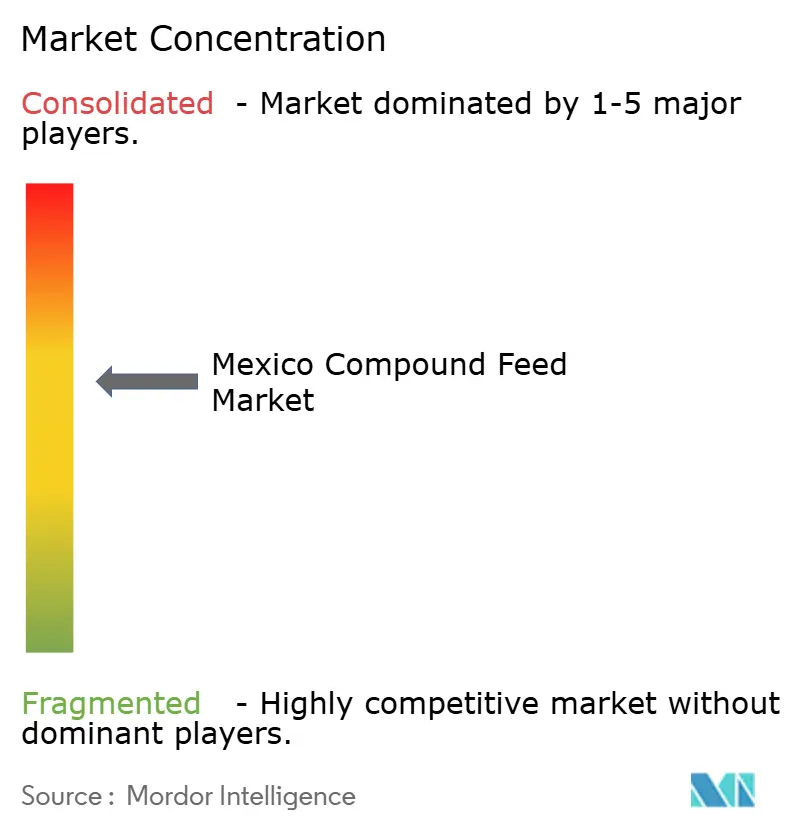
| Market Concentration | Medium |
Major Players *Disclaimer: Major Players sorted in no particular order Image © Mordor Intelligence. Reuse requires attribution under CC BY 4.0. | |
Mexico Compound Feed Market Analysis by Mordor Intelligence
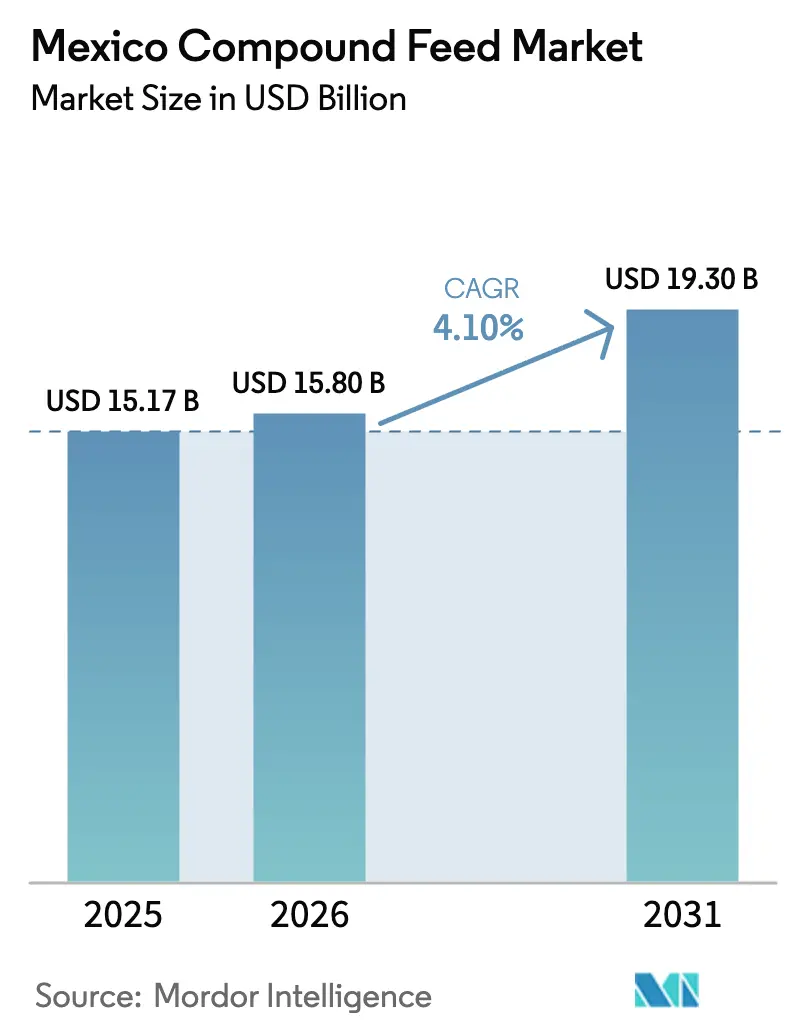
The Mexico compound feed market size is projected to be USD 15.17 billion in 2025, USD 15.80 billion in 2026, and reach USD 19.30 billion by 2031, growing at a CAGR of 4.10% from 2026 to 2031. Volume growth is rooted in Mexico’s status as the world’s fifth-largest feed producer, continued government incentives that reward feed-conversion efficiency, and a nearshoring wave that draws United States meat processors to border states. Tight vertical integration by leading poultry firms links genetics, nutrition, and processing, enabling precision-feeding programs that trim waste and lift margins. Rising aquaculture capacity along both coasts increases demand for specialty extrusion feeds, while digital tools such as Cargill’s Galleon and Evonik’s AMINOSys allow millers to fine-tune formulations in real time. Headline risks include grain-price volatility tied to United States-Mexico-Canada Agreement (USMCA) trade flows, strict mycotoxin rules, and drought-related water caps in northern states.
Key Report Takeaways
- By ingredient, cereals led with 46.0% revenue share in 2025, while supplements are forecast to expand at a 7.8% CAGR through 2031.
- By animal type, poultry feed captured 54.5% of Mexico compound feed market share in 2025, while aquaculture feed is anticipated to register the fastest growth at an 8.9% CAGR through 2031.
- The five largest suppliers, Cargill, Incorporated, Industrias Bachoco S.A.B. de C.V., Archer Daniels Midland Company, Nutreco N.V. (SHV Holdings N.V.), and Land O’Lakes, Inc., held a majority share in 2025, underscoring a moderately concentrated landscape.
Note: Market size and forecast figures in this report are generated using Mordor Intelligence’s proprietary estimation framework, updated with the latest available data and insights as of January 2026.
Mexico Compound Feed Market Trends and Insights
Drivers Impact Analysis*
| Driver | (~) % Impact on CAGR Forecast | Geographic Relevance | Impact Timeline |
|---|---|---|---|
| Heightened demand for value-added animal proteins | +0.8% | National, early gains in Jalisco, Veracruz, Querétaro | Medium term (2-4 years) |
| Expansion of Mexico’s commercial poultry integrators | +1.0% | Jalisco, Veracruz, Aguascalientes, Querétaro | Long term (≥ 4 years) |
| Government's Programa de Fomento a la Productividad Ganadera (PROGAN) - Production subsidies for feed efficiency | +0.5% | Jalisco, Sonora, Puebla, Yucatán | Short term (≤ 2 years) |
| Adoption of precision-feeding and smart-mill technologies | +0.6% | Jalisco, Guanajuato, Querétaro | Medium term (2-4 years) |
| Nearshoring of United States meat processors triggering feed demand | +0.7% | Sonora, Chihuahua, Coahuila, Nuevo León, Tamaulipas | Medium term (2-4 years) |
| Growing aquaculture investments in Pacific and Gulf states | +0.5% | Sinaloa, Sonora, Veracruz, Campeche, Yucatán | Long term (≥ 4 years) |
| Source: Mordor Intelligence | |||
Heightened Demand for Value-Added Animal Proteins
Quick-service restaurants and hotels have shifted menus toward higher protein offerings, lifting demand for premium poultry, pork, and seafood. Per-capita meat consumption has shown a significant growth in Mexico, well above the global average and a clear pull for compound feed. Industrias Bachoco’s revenue has recorded a significant growth year on year in 2025, showing how premium meat sales flow back to feed demand. Jalisco, Veracruz, and Querétaro benefit first because dense poultry clusters let millers supply specialized formulas quickly.
Expansion of Mexico’s Commercial Poultry Integrators
Large integrators such as Bachoco run in-house hatcheries, feed mills, and processing plants, locking in margins at every stage. Acquisitions and new breeder farms add capacity, as seen in the MXN 1,100 million (USD 54 million) Yucatán project that cut inter-state egg flows. Scale supports investment in near-infrared analyzers and automated dosing that smaller mills cannot match. Over time, consolidation steers feed demand toward a few well-capitalized buyers.
Government's Programa de Fomento a la Productividad Ganadera (PROGAN)-Production subsidies for feed efficiency
The Programa de Fomento Ganadero (PROGAN) Productivo pays producers who document feed-conversion gains, effectively reducing delivered ration costs[1]Source: Secretaría de Agricultura y Desarrollo Rural, “Programa de Fomento Ganadero 2025,” SAGARPA, gob.mx . In 2025 the Production for Well-Being scheme disbursed MXN 15.2 billion (USD 745 million) for forage and equipment, supporting a shift from pasture to concentrate feeding. Farmers rush to qualify before funds expire, creating seasonal spikes for high-efficiency starter feeds. Uptake is strongest in Jalisco, Sonora, Puebla, and Yucatán, where supplement sales also rise fastest.
Nearshoring of United States Meat Processors Triggering Feed Demand
United States meat companies are shifting slaughter and fabrication lines to Mexican border states to capture lower labor costs and tariff advantages[2]Source: USDA Foreign Agricultural Service, “Grain and Feed Annual: Mexico,” fas.usda.gov . Projects like SuKarne’s USD 580 million Lucero complex in Durango exemplify the scale, feeding 300,000 head daily and requiring 130 metric tons of feed per hour. These plants demand finishing rations that meet United States export rules on antibiotic residues and mycotoxins. Border-state mills gain from shorter grain hauls but must navigate periodic rail congestion.
Restraints Impact Analysis*
| Restraint | (~) % Impact on CAGR Forecast | Geographic Relevance | Impact Timeline |
|---|---|---|---|
| High corn and soybean price volatility post United States–Mexico–Canada Agreement (USMCA) | −0.9% | National, acute in border states | Short term (≤ 2 years) |
| Strict mycotoxin limits in NORMA Oficial Mexicana (NOM) | −0.5% | Sonora, Chihuahua, Sinaloa, Coahuila, Durango | Medium term (2-4 years) |
| Water-use restrictions in drought-prone northern states | −0.4% | National, tighter near export plants | Medium term (2-4 years) |
| Biosecurity gaps raising African Swine Fever (ASF)-related insurance premiums | −0.3% | Jalisco, Sonora, Puebla, Yucatán | Short term (≤ 2 years) |
| Source: Mordor Intelligence | |||
Strict mycotoxin limits in NORMA Oficial Mexicana (NOM)
Mexico now enforces strict ceilings for aflatoxin and ochratoxin in feed, raising testing and certification costs by about 3% per metric ton [3]Source: Servicio Nacional de Sanidad, Inocuidad y Calidad Agroalimentaria, “Normas Oficiales Mexicanas,”gob.mx. Humid states such as Veracruz see higher rejection rates on local corn, forcing mills to blend imports or add costly binders. Export-oriented integrators demand certified mycotoxin-free rations, splitting the market into premium and commodity tiers. Millers without in-house labs face longer turnaround times and lost orders.
Biosecurity gaps raising African Swine Fever (ASF)-related insurance premiums
African Swine Fever has not entered Mexico, yet insurers lifted swine-sector premiums by up to 25% in dense production zones. Feed mills that serve hog farms must prove pathogen-free supply chains, especially for blood meal and animal proteins banned under NOM-060. Grupo KUO invested in traceability and rendering to lower risk, but independent mills shoulder higher compliance costs. In the short term, added overhead cuts profitability where feed already represents most of swine production cost.
*Our forecasts treat driver/restraint impacts as directional, not additive. The impact forecasts reflect baseline growth, mix effects, and variable interactions.
Segment Analysis
By Ingredient: Cereals Anchor Rations While Supplements Surge
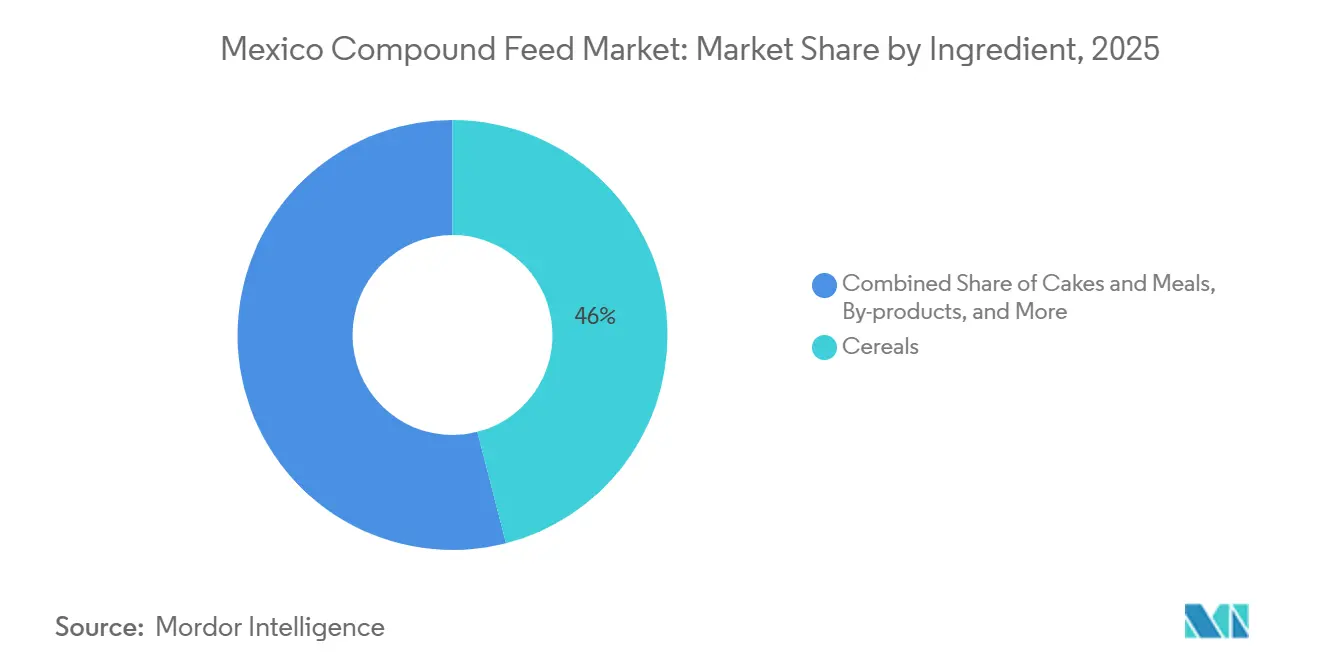
Cereals led the ingredient portfolio with 46.0% Mexico compound feed market share in 2025, anchored by corn that supplies cost-effective metabolizable energy. Supplements posted the fastest growth, advancing at a 7.8% CAGR through 2031 as millers adopt lysine, phytase, and probiotics to meet stricter mycotoxin and antibiotic-free rules. This pivot toward precision nutrition shifts value capture from bulk grains to functional additives and enlarges the Mexico compound feed market size attributed to high-margin inputs. Better feed-conversion ratios and sustainability claims help early adopters justify premium prices to integrated poultry and aquaculture buyers.
Cakes and meals, primarily soybean meal, remain the main protein source but face volatile import costs that squeeze independent mills. Distillers dried grains with solubles gain traction as a lower-priced protein alternative and already absorb 15% of United States DDGS exports to Mexico, signaling further penetration potential. Vitamins, minerals, and toxin binders round out the mix, with sales lifted by tougher enforcement of NOM-187 mycotoxin ceilings. Together, these remaining segments diversify ingredient sourcing and create niche openings for regional premix specialists that tailor formulas to local grain quality.



By Animal Type: Poultry Holds Sway as Aquaculture Accelerates
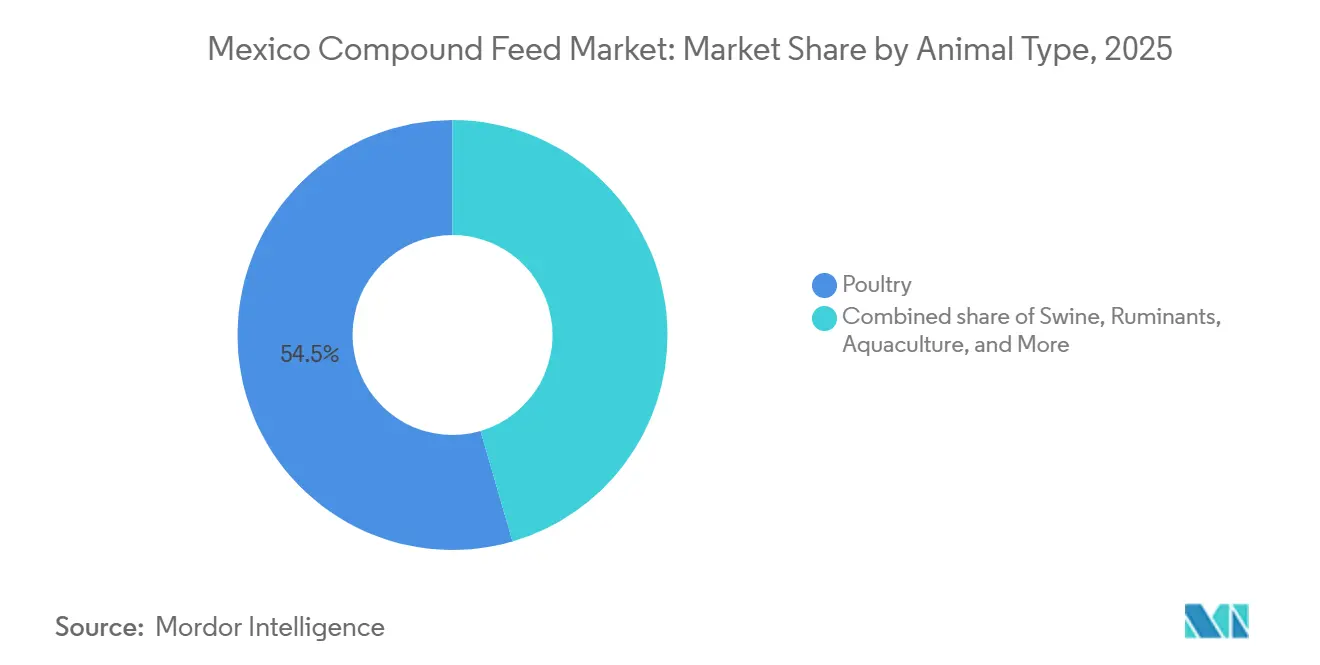
Poultry feed commanded 54.5% Mexico compound feed market share in 2025, reflecting dense broiler and layer clusters in Jalisco, Veracruz, and Querétaro. Aquaculture feed recorded the quickest expansion, projected to rise at an 8.9% CAGR through 2031 on the back of shrimp farms in Sinaloa and Sonora that produced 273,940 metric tons in 2024. Strong demand for export-grade shrimp drives adoption of enzyme-fortified extruded rations that lift the Mexico compound feed market size for specialty coastal products. The twin pillars of poultry scale and aquaculture momentum underscore a widening gap between commodity and high-specification diets.
Swine feed held a significant share of national demand, anchored by integrated systems in Yucatán and Sonora where biosecurity investments temper African Swine Fever risk. Ruminant diets for dairy and feedlot cattle represent prominent demand and benefit from government forage subsidies that encourage moves from pasture to concentrate finishing. Pet nutrition accounts for a limited share of tonnage yet offers the highest margins, prompting Archer-Daniels-Midland to open a USD 39 million wet pet-food plant in Morelos. These remaining segments add resilience by balancing commodity-heavy poultry volumes with value-added niches that cushion revenue during grain-price swings.
Geography Analysis
Jalisco remained the foremost hub in the Mexican compound feed market share in 2025, supported by dense broiler, layer, and cattle clusters that provide mills with scale advantages. Its proximity to import ports and central highway corridors ensures efficient grain inflows and rapid distribution of finished feed. Pacific and Gulf coastal states, including Sinaloa, Sonora, Veracruz, Campeche, and Yucatán, form the fastest-growing region, with compound feed demand projected to rise through 2031 as shrimp and tilapia farming expand. Aquaculture’s need for high-protein extruded diets lifts margins despite lower overall feed tonnage relative to inland poultry centers.
Durango leverages integrated beef complexes to anchor local feed consumption, while Veracruz and Guanajuato cater to mixed poultry and cattle bases supported by modern milling assets. Northern border states such as Sonora, Chihuahua, and Coahuila capture nearshoring-driven demand from United States meat processors yet contend with drought-linked water caps that slow new plant approvals. Southern interior states including Chiapas and Tabasco remain underpenetrated but attract fresh investment in tilapia feed lines that diversify production footprints. Together, these areas balance commodity poultry volumes with emerging niche species, smoothing national feed demand.
Regional growth now hinges on logistics, environmental constraints, and species specialization rather than sheer population density. Central states exploit rail and highway links that shrink grain hauls and lower inbound costs for imported soybean meal. Coastal zones benefit from export-oriented shrimp operations that justify premium diets, while drought-prone northern territories invest in water recycling to sustain output. These intertwined strengths are expected to keep the Mexico compound feed market on an upward trajectory as diversified regional engines offset localized risks.
Regulatory Landscape
Mexico regulates compound feed and feed ingredients under the Ley Federal de Sanidad Animal, administered by the Secretariat of Agriculture and Rural Development (SADER) through SENASICA, which oversees authorization, surveillance, and enforcement for products for animal use or consumption. A key anchor is NOM-012-SAG/ZOO-2020, enforceable from May 2024, which sets requirements for production, storage, distribution, marketing, quality control, and verification across the feed supply chain.
For traded inputs, SENASICA requires zoosanitary compliance at points of entry, including inspection and the issuance of a zoosanitary certificate, with product-specific import requirements managed through its consultation modules. The regulatory framework also covers higher-risk inputs through NOM-060-SAG-ZOO-2020 for the transformation of animal by-products used in feed, reinforcing traceability and biosafety expectations for mills and integrators serving export-oriented poultry, swine, and aquaculture value chains.
Competitive Landscape
The five largest suppliers including Cargill, Incorporated, Industrias Bachoco S.A.B. de C.V., Archer Daniels Midland Company, Nutreco N.V. (SHV Holdings N.V.), and Land O’Lakes, Inc. together controlled a majority of Mexico compound feed revenue in 2025, underscoring a moderately concentrated arena. Cargill, Incorporated leverages its Galleon, CattleView, and Agriness digital suites to offer precision-feeding services that raise client feed-conversion ratios. Industrias Bachoco vertically integrates breeder genetics, feed milling, processing, and branded retail channels, which secures captive demand and smooths raw-material risk. These two leaders use scale and technology to win multi-year contracts with poultry and pork integrators that favor consistent nutrient profiles and documented sustainability claims.
Archer-Daniels-Midland Company expands through specialty additives and a new wet pet-food plant that balances livestock exposure with higher-margin consumer segments. Nutreco N.V. (SHV Holdings N.V.) builds its presence via a fourth Mexican mill in Querétaro and focuses on shrimp and swine premixes that meet export market specifications. Land O’Lakes, Inc. upgrades its Purina Animal Nutrition site in Guanajuato to supply dairy and beef concentrates aligned with rising forage-to-grain feeding systems. Mid-tier regional millers still serve local demand, yet they face competitive pressure as these multinationals roll out precision-nutrition services countrywide.
Growth strategies hinge on functional ingredients, digital platforms, and targeted acquisitions that close geographic or species gaps. Joint ventures such as the 2026 Alltech-Archer-Daniels-Midland alliance signal a shift toward bundled solutions that combine global distribution with natural gut-health additives. Sustainability metrics, including mycotoxin compliance and carbon-reduced amino acids, enable premium pricing that lifts overall market value. As leading firms pair data analytics with specialty inputs, they are expected to accelerate Mexico compound feed adoption among export-oriented integrators and niche producers alike.
Mexico Compound Feed Industry Leaders
Cargill, Incorporated
Industrias Bachoco S.A.B. de C.V.
Nutreco N.V. (SHV Holdings N.V.)
Land O’Lakes, Inc.
Archer Daniels Midland Company
- *Disclaimer: Major Players sorted in no particular order

Market Opportunities and Future Outlook
Premiumization and specialization are creating whitespace beyond commodity rations, particularly where large integrators and export-facing producers want tighter nutrient consistency and documented safety. Mexico produced about 41.88 million metric tons of compound feed in 2025, with broiler (11.8 MMT), layer (8.0 MMT), and swine (7.2 MMT) as the main demand pillars. This scale supports deployment of precision-feeding tools, in-mill analytics, and higher-value supplements that can help manage performance as quality expectations rise.
Compliance-driven differentiation is a practical route to value capture as NOM-012-SAG/ZOO-2020 (effective May 2024, with labeling requirements phased through November 2025) pushes mills toward stronger QA, labeling discipline, and traceable inputs, favoring players that can bundle testing, formulation support, and service. Import dependency for key grains, especially yellow corn from the United States, keeps supply-chain engineering and risk management central. That opens opportunities in logistics-backed procurement models, alternative ingredient optimization, and localized premix/additive capacity near major production corridors. High vertical integration (about 61% of total compound feed) also supports partnership models with integrated producers that standardize diets across multi-site operations and adopt digital formulation and monitoring platforms to stabilize conversion under drought and raw-material volatility.
Recent Industry Developments
- June 2026: Cargill Animal Nutrition and Health expanded its Next Level: Gut Performance program to field trials with multiple Mexican poultry integrators, announced at the 50th ANECA convention. The company broadened service-led offerings in Mexico and aligned the program with on-farm diagnostics and data-driven nutrition management.
- February 2025: Nutreco (Trouw Nutrition) inaugurated a new animal feed plant in Colon, Queretaro, backed by an investment reported at about 1,000 million pesos, with capacity cited at 100,000 metric tons per year. The project added manufacturing scale near a key logistics corridor, increasing local supply for species-specific formulations and intensifying competitive pressure on regional mills.
- May 2024: NOM-012-SAG/ZOO-2020 entered into force as a core Mexican standard governing production, storage, distribution, marketing, and quality control for products for animal use or consumption, including feed. The enforcement cycle increased the role of standardized QA and documentation for mills supplying integrated poultry, swine, and aquaculture operations, and it elevated the importance of compliant labeling and verification practices in supplier selection.


Research Methodology Framework and Report Scope
Market Definition and Coverage
For this report, the market is defined as the sales value of compound feed produced and sold in Mexico for farm animals, where feed is a formulated mix of cereals, protein meals, by-products, and supplements.
Scope exclusions: We exclude on-farm single-ingredient feeding materials, forage and pasture, and pet food, and we also avoid double counting internal transfers inside integrated producers where no third-party sale occurs.
Segmentation Overview
- By Ingredient
- Cereals
- Cakes and Meals
- By-products
- Supplements
- By Animal Type
- Poultry
- Swine
- Ruminants
- Aquaculture
- Other Animal Types
Data Sources, Market Sizing, and Validation
Desk Research
Desk research was used to set the Mexico demand-and-supply context before the model was calculated, and then to cross-check early totals. We referred to public and official sources such as FAOSTAT for livestock and poultry indicators, USDA FAS for grains and oilseeds balance sheet context, Mexico government agriculture and trade releases (including customs-style HS trade tables where available), and official statistics from Mexico's national institute that track production and price signals.
Along with these, we reviewed peer-reviewed journals on animal nutrition and feed formulation, association publications that discuss livestock and feed production, and company filings and investor presentations for capacity additions and operational changes that shift commercial volumes. For extra checks, we also used paid subscriptions for company financials and news, and an import-export shipment-level database to sanity-check ingredient flow direction and timing. The sources named here are illustrative only, and many other public references were used for data collection, validation, and clarification.
Primary Interviews and Surveys
Primary work focused on Mexico-based perspectives across the value chain, including feed manufacturers, ingredient distributors, integrators, and large farm operators that consume compound feed. We used interviews and short surveys to confirm species-level demand shifts, typical formulation changes tied to grain prices, and what gets counted as commercial compound feed versus internal use in integrated operations.
Distribution of primary research fieldwork respondents
| Company type | Respondent position |
|---|---|
| Top tier: 39% | CXOs: 15% |
| Mid tier: 45% | Functional/Unit leaders: 30% |
| Smaller Players: 16% | Managers: 55% |
Market-Sizing & Forecasting
Sizing started with a top-down reconstruction that links Mexico livestock output to feed demand, and then applies compound feed penetration by species to convert the demand pool into market value. The key inputs used in the model include livestock and poultry population trends, meat and egg output signals, feed conversion assumptions by animal type, typical inclusion rates for cereals and oilseed meals, and observable changes in ingredient pricing that affect formulation and selling prices.
After the initial total was built, selective bottom-up checks were used to keep totals realistic, such as sampled price-per-ton ranges shared in interviews and channel checks on how much volume is sold commercially versus consumed internally by integrated players. Where company-level coverage was incomplete, gaps were handled by using species mix and regional production intensity as scaling factors, which were then re-tested in follow-up calls.
Forecasts were built using scenario analysis supported by a simple multivariate regression layer for the strongest drivers, mainly animal protein production outlook, expected feed price direction, and feed penetration by species. Assumptions were kept consistent across years so the forecast change is explainable through a small set of drivers rather than model rework.
Data Validation & Update Cycle
Validation was done through triangulation across independent signals, and then checked again through analyst review before final sign-off. We compared model outputs against livestock production trends, ingredient trade and availability signals, and the commercial structure of the feed industry, and any outliers were reworked until the logic matched what operators described.
If a major variance appeared, such as an unexpected shift in grain prices, drought-related production impacts, or a clear policy change affecting imports, respondents were re-contacted and assumptions were adjusted. Reports are refreshed annually, and material events trigger interim updates when needed. Before delivery, a fresh pass is completed so clients receive the latest updated view.
Mordor Intelligence's Mexico Compound Feed Market Estimate Compared With Other Published Estimates
Published market sizes for Mexico compound feed often do not match because the counted scope is not always the same, even when the title looks identical. Differences usually come from whether internal feed consumption is included, whether value is measured at factory gate or after distribution margins, and how base-year pricing is updated.
Feed output signals by species, livestock production trend checks, and ingredient flow indicators are the evidence that keep Mordor Intelligence's estimate aligned to commercial compound feed sold in Mexico, instead of a broader animal feed spend number.
Benchmark comparison
| Source | Market Size | Gaps in Research Methodology |
|---|---|---|
| Mordor Intelligence | USD 15.17 B (2025) | |
| Trade Publisher A | USD 7.50 B (2025) | Likely narrower value capture, with revenue counted closer to manufacturer sales for selected commercial feed, and limited adjustment for internal consumption within integrated poultry and livestock operations. |
| Consultancy B | USD 6.82 B (2024) | Uses a different base year and may treat pricing and channel margins differently, which can reduce the stated value if factory gate prices are used or if parts of feed used internally are excluded from market revenue totals. |
Across the two external figures, the largest differences trace back to what is treated as a third-party sale and how pricing is carried across the base year, which directly changes the value total even when volumes look similar.


Key Questions Answered in the Report
What is the current value of the Mexico compound feed market?
The Mexico compound feed market size stands at USD 15.80 billion in 2026 and is forecast to reach USD 19.30 billion by 2031.
Which ingredient category leads demand?
Cereals, especially corn, hold a 46.0% revenue share in 2025, serving as the primary energy source in broiler, layer, and swine diets.
How fast will aquaculture feed grow?
Aquaculture feed volume is projected to advance at an 8.9% CAGR through 2031, the fastest among all animal types.
Who are the top players in this market?
Cargill, Incorporated, Industrias Bachoco S.A.B. de C.V., Archer-Daniels-Midland Company, Nutreco N.V. (SHV Holdings N.V.), and Land O’Lakes, Inc. collectively capture a majority of sales.
What is the main risk facing millers?
Exposure to corn and soybean price volatility, driven by dependence on United States imports and currency fluctuations, poses the most immediate margin risk.
Page last updated on:


 Your data is secure and never sold or shared.


