
Market Overview
| Study Period | 2021 - 2031 |
|---|---|
| Forecast Data Period | 2026 - 2031 |
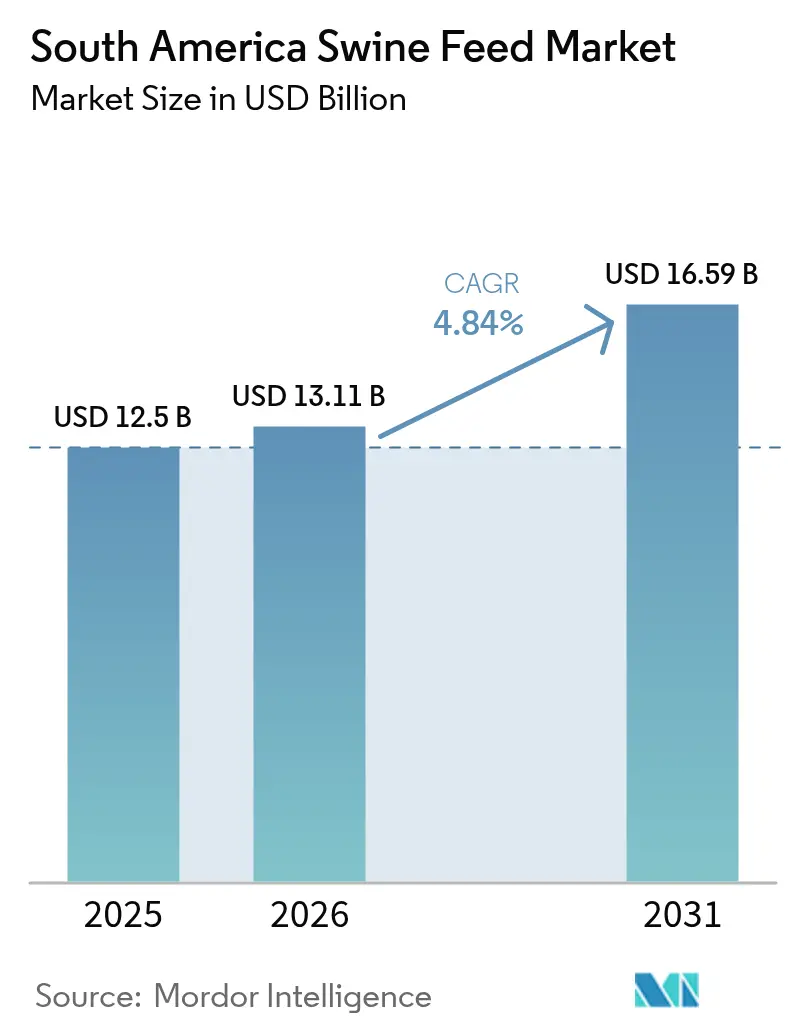
| Base Year Market Size (2025) | USD 12.5 Billion |
| Market Size (2026) | USD 13.11 Billion |
| Market Size (2031) | USD 16.59 Billion |
| Growth Rate (2026 - 2031) | 4.84 % |
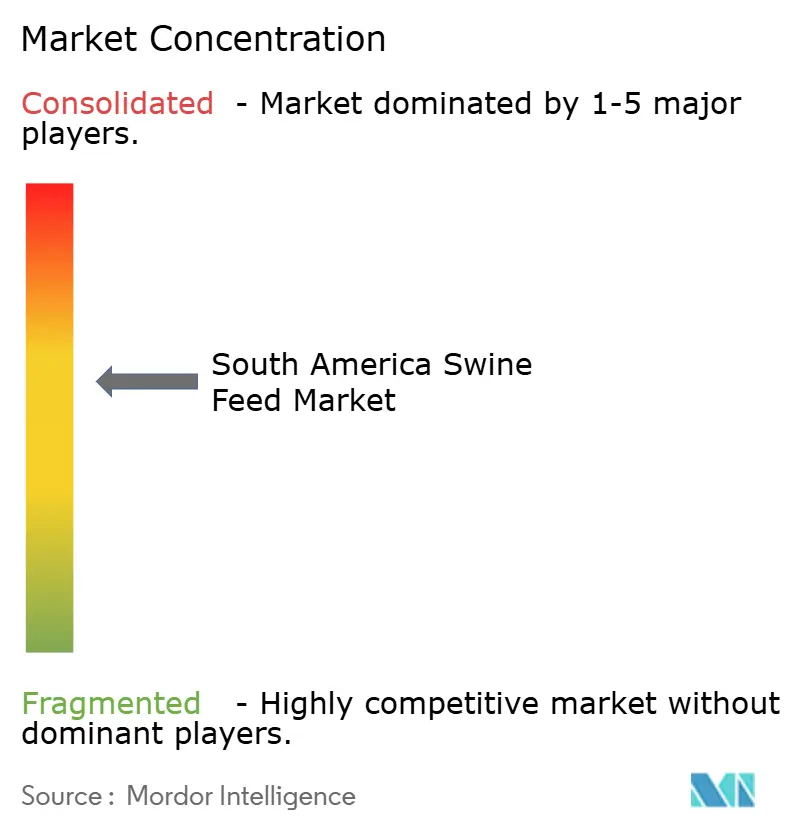
| Market Concentration | Medium |
Major Players *Disclaimer: Major Players sorted in no particular order Image © Mordor Intelligence. Reuse requires attribution under CC BY 4.0. | |
South America Swine Feed Market Analysis by Mordor Intelligence
South America swine feed market size in 2026 is estimated at USD 13.11 billion, growing from 2025 value of USD 12.5 billion with 2031 projections showing USD 16.59 billion, growing at 4.84% CAGR over 2026-2031. Recent strength reflects robust pork production growth, fueled by domestic protein demand shifts and sustained export opportunities, especially into Asian destinations recovering from African swine fever disruptions. Brazil’s integrated producers continue scaling output to match foreign contracts, while Argentina’s pork‐centric dietary transition accelerates feed purchases amid persistent beef price inflation. Exchange‐rate swings create formulation cost volatility, yet technology investments in precision nutrition and supply-chain analytics are helping manufacturers defend margins. Currency conversions, tax reform benefits and improved harvest prospects have combined to widen capital budgets for feed-mill upgrades that bolster long-term competitiveness in the South America swine feed market.
Key Report Takeaways
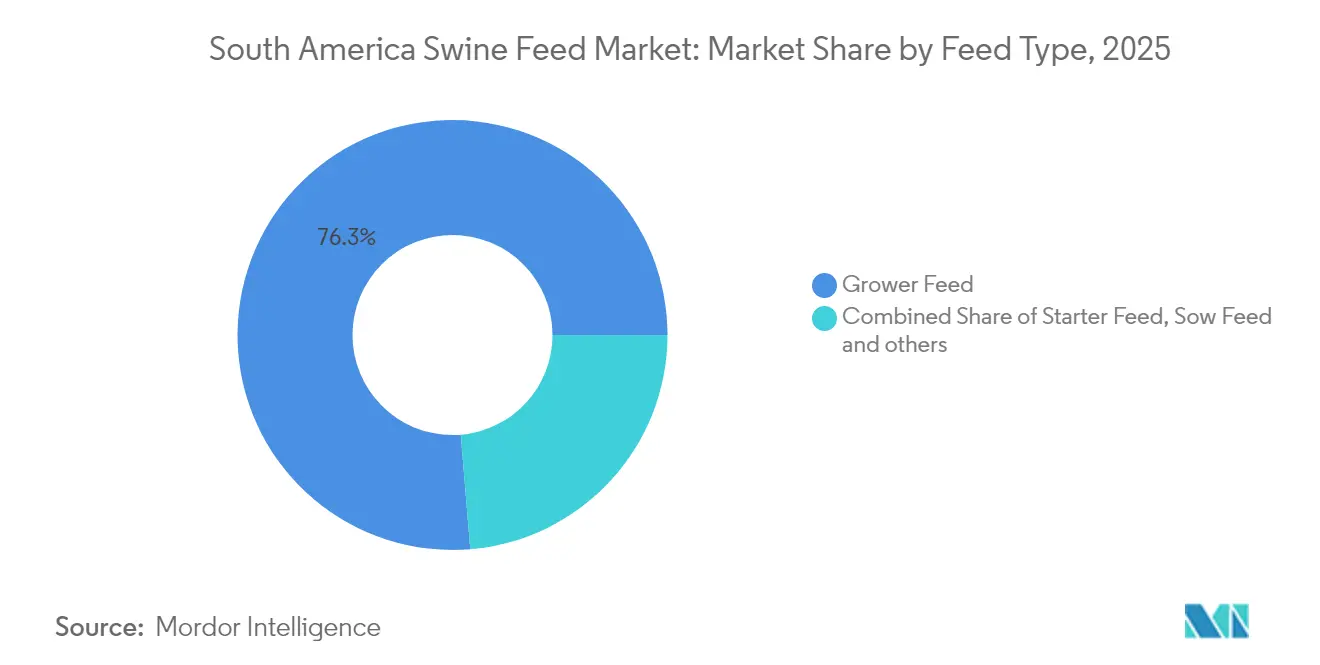
- By feed type, grower feed dominated with a 76.32% market share in 2025, while starter feed grew at a 6.56% CAGR (2026-2031), reflecting increased focus on early-life performance optimization.
- By country, Brazil maintained leadership with 57.55% of the South America swine feed market in 2025, driven by its dominant pork production capacity and export-oriented feed industry. Argentina emerged as the fastest-growing market with a 6.05% CAGR during the forecast period, driven by economic pressures shifting preferences away from beef.
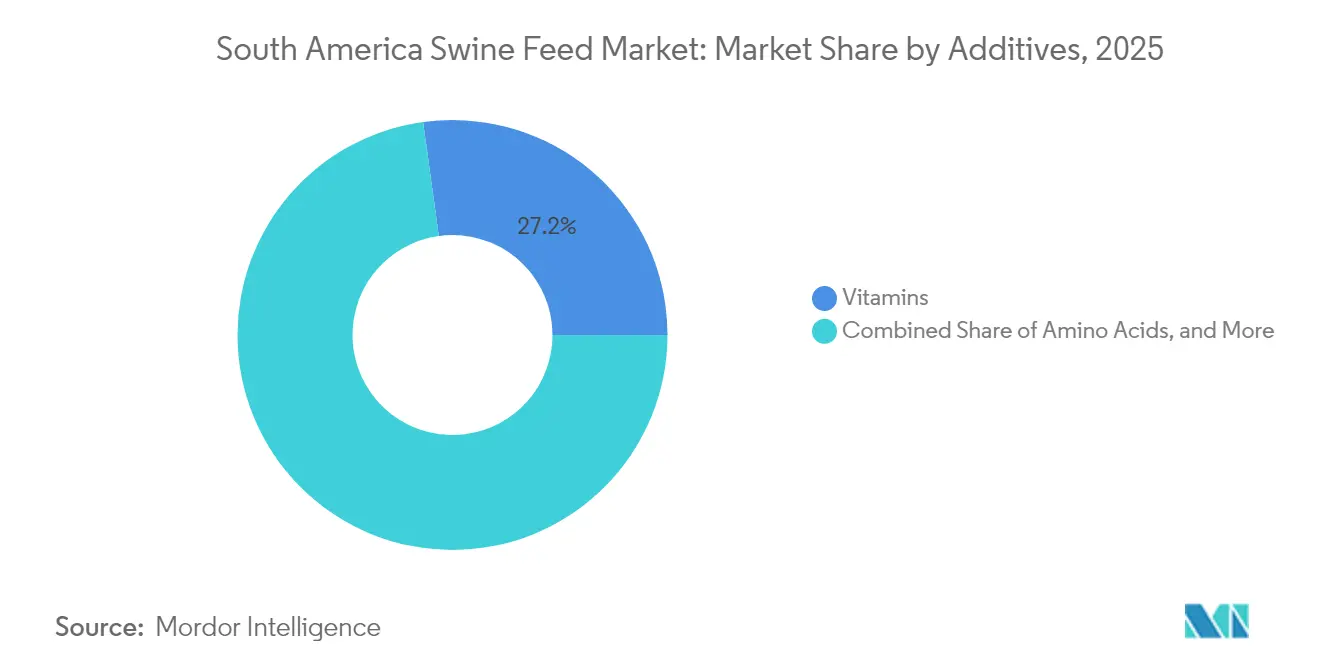
- By additives, vitamins held a 27.62% share of the market in 2025, driven by increasing demand for immune-boosting nutrition. Probiotics and prebiotics are estimated to grow at a 7.18% CAGR during 2026-2031, as manufacturers focus on premium product differentiation and export competitiveness.
- By company, Cargill, ADM, and SHV Holdings together controlled a significant share of the South America swine feed market in 2024, reflecting moderate industry concentration.
Note: Market size and forecast figures in this report are generated using Mordor Intelligence’s proprietary estimation framework, updated with the latest available data and insights as of 2026.
South America Swine Feed Market Trends and Insights
Drivers Impact Analysis*
| Driver | (~) % Impact on CAGR Forecast | Geographic Relevance | Impact Timeline |
|---|---|---|---|
| Expansion of export-oriented pork production in Brazil | 1.20% | Brazil, with spillover to Argentina and Chile | Medium term (2-4 years) |
| Adoption of antibiotic alternatives (probiotics, organic acids) | 0.80% | Global, with early adoption in Brazil and Chile | Long term (≥ 4 years) |
| Lower corn and soybean input prices after 2024 harvest recovery | 0.60% | South America core, particularly Brazil and Argentina | Short term (≤ 2 years) |
| Government tax-reform incentives for feed manufacturing | 0.40% | Brazil, with potential expansion to other countries | Medium term (2-4 years) |
| Precision-nutrition tech deployment in commercial feed mills | 0.30% | Brazil and Chile leading, Argentina following | Long term (≥ 4 years) |
| Growth of specialty premixes tailored to genotype-specific diets | 0.20% | Regional, concentrated in commercial operations | Long term (≥ 4 years) |
| Source: Mordor Intelligence | |||
Expansion of Export-Oriented Pork Production in Brazil
Brazil shipped 990.7 thousand metric tons of pork during the first nine months of 2024, a 7.7% year-over-year jump that intensified feed demand. Revenue increased significantly, despite currency headwinds, reflecting the demand for specialized nutrient-rich feed formulations. Major integrated companies like JBS and BRF are increasing their hog populations, driving higher demand for grow-finish feed across their vertically integrated feed mills. New slaughter facilities in Santa Catarina and Paraná are increasing regional corn consumption while boosting demand for soybean-based protein concentrates. Trade agreements with Mexico, Chile, and Japan are reducing market risks and securing long-term feed volume commitments. The South American swine feed market is projected to maintain steady growth through 2030, supported by export opportunities.
Adoption of Antibiotic Alternatives (Probiotics, Organic Acids)
Regulators and import customers are phasing out antibiotic growth promoters, prompting swine integrators to reformulate diets with Bacillus-based probiotics, organic acids and targeted enzymes. Peer-reviewed trials show a 30% reduction in post-weaning diarrhea when Bacillus strains replace in-feed antibiotics. Chilean and Brazilian mills have pioneered commercial blends that preserve average daily gain while enhancing carcass uniformity, allowing exporters to qualify for premium label claims in Europe and North America. The shift has motivated ingredient suppliers to expand regional R&D centers capable of tailoring multi-strain products to local corn–soy meal matrices. As regulatory momentum spreads, probiotic inclusion is poised to permeate everyday rations across the South America swine feed market.
Lower Corn and Soybean Input Prices After 2024 Harvest Recovery
The United States Department of Agriculture (USDA) projects Brazil’s corn output at 129 million tonnes for 2024-2025, up 7 million from the prior season, alleviating raw-material tightness [1]. Soybean crushing expansions by multinationals have similarly improved meal availability, trimming finished-feed cost curves. Although domestic corn premiums remained elevated in early 2025, forward curves indicate easing into the second half as on-farm inventories normalize. Lower raw-material prices widen gross margins for compounders, freeing up capital for enzyme inclusion, quality-control testing and digital traceability tools. Cost relief also supports competitive export pricing, reinforcing volume gains for the South America swine feed market.
Government Tax-Reform Incentives for Feed Manufacturing
Brazil’s constitutional tax overhaul replaces the layered PIS/COFINS and ICMS structure with a dual VAT, exempting staple meat products and creating straightforward credit recovery for imported micro-ingredients [2]. Feed mills gain from simpler compliance and reduced cascading taxes on vitamin and amino-acid imports, cutting formulation costs. The phased rollout between 2026 and 2033 offers planning certainty, incentivizing multinationals to accelerate capex on mill modernization. Improved fiscal efficiency underpins Brazil’s bid to solidify its hub status within the South America swine feed market.
Restraints Impact Analysis*
| Restraint | (~) % Impact on CAGR Forecast | Geographic Relevance | Impact Timeline |
|---|---|---|---|
| African swine fever biosecurity costs despite no outbreaks yet | -0.70% | South America, with highest impact in border regions | Medium term (2-4 years) |
| High currency volatility raising additive import costs | -0.50% | Regional, particularly Argentina and Brazil | Short term (≤ 2 years) |
| Climate-linked harvest risks for corn and soy supplies | -0.40% | Argentina and southern Brazil primarily | Medium term (2-4 years) |
| Public pressure to curb deforestation in soy supply chains | -0.20% | Brazil Cerrado region, with global implications | Long term (≥ 4 years) |
| Source: Mordor Intelligence | |||
African Swine Fever Biosecurity Costs Despite No Outbreaks Yet
South America remains ASF-free, yet preventive biosecurity investments have surged as importers tighten sanitary requirements. Brazil’s bilateral agreement with Singapore guarantees trade continuity via compartmentalization but mandates rigorous traceability and feed decontamination protocols [3]. Producers now employ organic-acid feed treatments shown to lower ASFV viability in ingredients, raising per-ton feed costs. Capital diverted to bio-exclusion measures restrains spending on productivity drivers, tempering near-term gains in the South America swine feed market.
High Currency Volatility Raising Additive Import Costs
The Argentine peso’s slide and the Brazilian real’s depreciation have inflated landed costs of imported vitamins and amino acids. Argentina’s pork imports increased significantly in Q1-2025 partly because local processors struggled with additive inflation that eroded cost competitiveness. Smaller mills lacking hedging facilities adjust formulations frequently, compounding operational complexity. Currency swings thus squeeze margins and obscure budgeting visibility for stakeholders in the South America swine feed market.
*Our forecasts treat driver/restraint impacts as directional, not additive. The impact forecasts reflect baseline growth, mix effects, and variable interactions.
Segment Analysis
By Feed Type: Grower Rations Dominate Volume While Starter Diets Accelerate
Grower rations constitute the largest slice, with 76.32% of the total market in 2025, reflecting the extended 25-100 kg phase when pigs consume the highest daily intake. The South America swine feed market size for grower diets benefited from Brazil’s record export shipments in 2024, lifting factory output in Santa Catarina and Paraná. Multisite integrators exploit scale economies by sourcing high-energy corn locally and balancing amino-acid profiles with domestically crushed soybean meal. Formulators are layering enzymes such as phytase to elevate phosphorus availability and control cost per kilogram of gain. Although sow diets claim modest tonnage, they remain strategically important as genetic lines push litter sizes higher. Mills are piloting precision micro-bin systems that modulate vitamin E and selenium inclusion according to gestation stage, safeguarding farrowing performance.
Starter diets are the fastest climber with an estimated CAGR of 6.56% during 2026-2031, mirroring the industry’s pivot toward improved early-life nutrition. Formulas now blend highly digestible plasma proteins, heat-stable probiotics, and short-chain fatty acids to support gut maturation. Larger capital outlays for specialty proteins are justified by tighter feed conversion and lower nursery mortality. Chilean integrators report weaning-to-sale improvements of 5 days following the adoption of enhanced starter packs. As export customers demand tighter antibiotic stewardship, early gut-health programs are expected to unlock further growth within the South America swine feed market.

By Additives: Functional Ingredients Move Center Stage
Vitamins retain a baseline role, holding the largest market share at 27.62% in 2025, as they are essential across all swine production stages for supporting immunity, reproduction, and metabolic functions. The shift toward high-quality diets has increased vitamin inclusion rates in feed formulations, while functional feed additives generate additional market value.
The South America swine feed market share captured by probiotics continues climbing, with an estimated CAGR of 7.18% during 2026-2031, as integrated producers pursue antibiotic-free label differentiation. Bacillus subtilis strains formulated for tropical feed conditions deliver stable spore counts during pelleting, securing performance advantages in high-temperature mills. Organic acidifiers, especially buffered formic–propionic blends, have become standard across large Brazilian complexes for Salmonella risk mitigation. Enzyme solutions targeting non-starch polysaccharide breakdown improve digestive energy yield, lowering feed cost per kilogram of gain amid currency swings.
Amino acids are gaining strategic attention as formulators lean on low-crude-protein diets to cut nitrogen emissions aligned with Environmental, Social and Governance metrics demanded by global buyers. Regional crushers have expanded threonine and tryptophan premix capacity, reducing import dependency. Emerging additive niches include precision-chelated minerals and essential oils backed by in-vivo efficacy data. Collectively, these innovations highlight the premiumization wave coursing through the South America swine feed market.
Geography Analysis
Brazil anchors regional dynamics, commanding 57.55% of value and sustaining trajectory at a 4.63% CAGR through 2031. Concentrated feed hubs in São Paulo, Paraná and Santa Catarina capitalize on proximity to grain belts and container ports, reducing inland transport premiums. AI-enabled logistics platforms now synchronize raw-material intake with production schedules, shrinking safety stocks and improving cash conversion cycles. Tax-reform credits slated for 2026-2033 will further enhance competitiveness by streamlining VAT recovery on imported micro-ingredients.
Argentina represents the fastest-moving geography, expanding at 6.05% CAGR (2026-2031) as pork solidifies its place in household menus. Consumer migration from beef accelerated in 2024 when retail prices for prime cuts surged beyond inflationary thresholds. Local crushers supply abundant soybean meal, allowing mills to deploy lower inclusion rates of imported amino acids. Government approval of Paraguay’s pork import certificate in March 2025 broadens outbound trade horizons, reinforcing producer confidence to build finisher barns that feed directly into the South America swine feed market.
Chile, Peru and Colombia combine cutting-edge technology with smaller herd bases, yielding niche opportunities for high-specification additives and data-driven herd management services. Chile’s Agrosuper sets the regional benchmark for feed-mill dosing precision, while Peru leverages new free-trade agreements to grow export-oriented pork segments. Colombia’s macro stability invites foreign direct investment into modern feed plants. Elsewhere, Uruguay, Paraguay and Bolivia slowly transition toward commercial rations, aided by knowledge transfer programs under the Standards and Trade Development Facility. These diverse trajectories collectively enrich growth prospects for the South America swine feed market.
Regulatory Landscape
Swine feed manufacturing and product access in South America is governed by national sanitary and agriculture authorities, with Brazil led by the Ministry of Agriculture and Livestock (MAPA), Argentina by SENASA, and Chile by SAG. In Brazil, MAPA updated and digitized compliance pathways for animal feed and facilities, including mandatory use of the PGA-SIGSIF platform for product label registration starting in July 2025, raising the importance of formal documentation, traceability, and audit-ready labeling for commercial mills.
Antimicrobial stewardship tightened in 2026 in Brazil, with MAPA publishing Portaria SDA/MAPA No. 1.600/2026 restricting antimicrobials reserved for human use in animals intended for human consumption, and Portaria SDA/MAPA No. 1.617/2026 prohibiting specific antimicrobial performance enhancers with a transition period for existing products. In Argentina, SENASA Resolution 1415/2024 consolidated and updated the technical framework for animal feed and reinforced registration requirements via the Coordination of Animal Feed Registration (CRAA), affecting timelines and documentation for introducing new premixes, additives, and complete feeds in the market.
Competitive Landscape
Moderate concentration characterizes the South America swine feed market, with the top five suppliers holding the majority of sales. Cargill, Inc. leads the market after layering AI-powered inventory tools onto its Brazilian mills in early 2025. ADM follows, leveraging proprietary premix blends and on-farm advisory teams to lock in loyalty among fast-scaling integrators. SHV Holdings’ position was reinforced by the acquisition of Bigsal, granting it a foothold in northern Brazil’s grain-deficit zone, where the logistics premium favors local manufacturing.
Strategic playbooks revolve around vertical integration and digital solutions that blend formulation science with real-time farm data. Cargill’s minority stake in Agriness embeds its nutritional algorithms inside a software ecosystem monitoring over 2 million sows. ADM has partnered with upstream growers to secure low-mycotoxin corn streams, mitigating quality risk amid climate variability. Regional challenger CLADAN taps exclusive distribution of CBS Bio Platforms’ feed enzymes, providing middle-tier mills with advanced solutions without the capital burden of in-house R&D.
Barriers to entry include stringent product registration at the Ministry of Agriculture, Livestock and Supply (MAPA) and National Service of Agrifood Health and Quality (SENASA), capital-intensive micro-ingredient handling and the technical expertise required for modern antibiotic-free diets. Localized service networks, credit facilities and sustainability credentials further separate incumbents from aspirants, shaping future consolidation waves within the South America swine feed market.
South America Swine Feed Industry Leaders
-
Cargill, Inc.
-
ADM
-
SHV Holdings
-
BRF Global
-
De Heus Animal Nutrition
- *Disclaimer: Major Players sorted in no particular order
Market Opportunities and Future Outlook
The shift away from antibiotic growth promoters, together with importer-driven sanitary expectations, is expanding whitespace for probiotic and organic-acid programs that can be documented and repeated at scale, especially in Brazil and Chile where commercial mills already market functional blends. Regulatory moves in Brazil during 2026 that restrict classes of antimicrobials elevate demand for alternative performance and gut-health tools, strengthening the business case for local technical service, in-mill dosing accuracy, and stability-tested additive systems that hold up under pelleting conditions.
Capacity additions and portfolio moves by large suppliers underline opportunity in higher-value premixes and feed additives near the main swine belt in southern Brazil. ADM opened a 7,500 square meter premix and additives facility in Apucarana, Parana in June 2026 (40,000 tonnes per year), and Cargill announced a binding offer in July 2025 to acquire Mig-Plus in Rio Grande do Sul, a platform spanning premixes, concentrates, and complete feeds for swine and ruminants. These actions align with the region's push toward automation, traceability, and formulation specialization, while also increasing competitive pressure on mid-tier mills to differentiate through genotype-specific premixes, digital formulation support, and validated antibiotic-alternative packages.
Recent Industry Developments
- June 2026: ADM opened a new premix and feed additives facility in Apucarana, Parana, expanding local output capacity for higher-value nutrition solutions. The site strengthens ADM's proximity to southern Brazil livestock clusters and supports faster customization and quality control for swine-focused premixes and micro-ingredients.
- July 2025: Cargill announced a binding offer to acquire Mig-Plus, a Brazil-based animal nutrition company with premixes, feed concentrates, and complete feeds serving swine and ruminants. The deal adds product breadth and regional reach in southern Brazil, supporting cross-selling into integrated pork systems and raising the competitive bar for specialized feed solutions.
- February 2024: Cargill received CADE approval related to its acquisition of the Anhambi animal production plant in Minas Gerais, adding pelleted feed manufacturing capability linked to pig feed production. The asset strengthens domestic capacity and provides additional flexibility for supplying commercial and integrated operations amid raw material and logistics volatility.
Research Methodology Framework and Report Scope
Market Definition and Coverage
This market covers formulated feed sold for pigs across South America, including complete feed and nutrient blends that support different production stages and typical use on farms and in commercial operations.
Scope exclusions: We do not count on-farm use of single raw grains when they are not mixed or marketed as swine feed.
Segmentation Overview
- By Feed Type
- Starter Feed
- Grower Feed
- Sow Feed
- Rest of Feed Types
- By Additives
- Vitamins
- Amino Acids
- Enzymes
- Organic Acids
- Probiotics and Prebiotics
- Antibiotics
- Rest of Feed Additives
- By Country
- Brazil
- Argentina
- Chile
- Peru
- Colombia
- Rest of South America
Data Sources, Market Sizing, and Validation
Desk Research
Desk research started by mapping the demand pool for swine feed using public livestock and feed indicators, and then aligning those signals to what feed manufacturers typically supply in the region. We used FAOSTAT and related UN datasets, USDA production and trade tables, and national agriculture and statistics agencies in major countries where animal inventory and slaughter series are published. For trade exposure, customs statistics and open trade databases were used to cross-check flows for key feed inputs and additives, so import dependence and price shocks were reflected rather than assumed away.
To keep assumptions realistic, we also reviewed feed and animal health association publications, peer reviewed animal nutrition studies, and company annual reports or investor presentations that describe capacity, product mix, and channel focus. In a few cases, paid subscriptions were used only for company financials and structured news tracking, and for shipment-level trade checks where classification detail matters. The desk research sources listed here are illustrative only, and other public documents were consulted to collect, validate, and clarify data points during the study.
Primary Interviews and Surveys
We use expert interviews and surveys with feed producers, integrators, independent mills, ingredient specialists, and pork producers in South America. Respondents help test feed volumes, average selling prices, channel movement, feed conversion assumptions, capacity use, and changes in pork output or exports. Follow-up checks help fill country gaps and reconcile desk evidence before the final analysis.
Distribution of primary research fieldwork respondents
| Company type | Respondent position |
|---|---|
| Top tier: 28% | CXOs: 18% |
| Mid tier: 47% | Functional/Unit leaders: 32% |
| Smaller Players: 25% | Managers: 50% |
Market-Sizing & Forecasting
Sizing was built using a top-down and bottom-up logic, where livestock and production indicators were first used to reconstruct feed demand, and then supplier and pricing checks were used to keep totals realistic. On the top-down side, the model starts from country-level swine herd, slaughter, and pork output signals, then applies feed intensity by production stage to arrive at an implied feed requirement. That demand pool is translated into value using stage-wise pricing and a view of mix shifts across starter, grower, sow, and other feeds.
To avoid relying on a single data line, several inputs were tracked and refreshed, including compound feed output signals, corn and soybean meal price direction, additive penetration trends (for example enzymes, amino acids, and organic acids), and country trade exposure for key inputs that can move costs quickly. Bottom-up approximations were used selectively through roll-ups of observable supplier presence, capacity and throughput discussions, and sampled price points from channel checks. Where coverage gaps remained, conservative ranges were used and then re-tested in primary calls. Forecasts were developed using scenario analysis, where pork production outlook, feed input price paths, and expected productivity gains were combined into a few cases, and then the final curve was selected after expert feedback converged on the most likely path.
Data Validation & Update Cycle
Outputs were checked through triangulation across independent signals, so the modeled feed value could be compared against livestock production direction, input price movement, and reported performance cues from the supply chain. When a country-level result looked inconsistent, the assumptions were re-opened, followed by variance checks on feed intensity, mix, and pricing before the numbers were signed off. Reviews happen in multiple steps with a second analyst pass, and respondents are re-contacted when a major mismatch appears, or when a new policy, disease event, or cost shock changes the short-term picture.
The report is refreshed annually, and interim updates are made when material events occur. Before delivery, a final update sweep is completed so clients receive the latest view tied to the same repeatable model structure.
Mordor Intelligence's South American Swine Feed Market Size Compared With Other Published Estimates
Published market numbers for South American swine feed often do not match because the scope and the pricing logic are not the same from one study to another, and the base year can also be different. Differences also come from whether estimates treat premixes and additives as part of the full feed value, or as a separate market that is later added back in.
The main gap drivers in this market are usually the geography cut (South America versus wider Latin America), the year used for currency conversion and pricing, and how feed value is built from volume and average pricing when raw material costs are moving fast. Some estimates appear to use very broad feed spend assumptions without tying them back to swine herd and production-stage feed intensity, which can inflate totals in years when feed inflation is high, a step handled differently in the approach applied by Mordor Intelligence.
Benchmark comparison
| Source | Market Size | Gaps in Research Methodology |
|---|---|---|
| Mordor Intelligence | USD 12.5 B (2025) | |
| Global Consultancy A | USD 10.90 B (2022) | Uses a wider Latin America framing and an older base year, and it also emphasizes additive-based splits, which can understate full-feed pricing effects seen in later years. |
| Industry Publisher B | USD 118.0 B (2024) | The stated value is not aligned with realistic regional feed spend for swine, and the approach is unclear on currency timing and whether adjacent feed categories are being folded into the total. |
Looking across the three figures, the spread can be explained mainly by region selection, base-year pricing, and how feed value is reconstructed from production realities versus broad spend assumptions. By anchoring the model to herd and output signals, then stress-testing prices and mix with channel feedback, the final number stays traceable to clear drivers and can be repeated consistently in future updates.
Key Questions Answered in the Report
How big is the South America Swine Feed Market?
The South America Swine Feed Market size is expected to reach USD 13.11 billion in 2026 and grow at a CAGR of 4.84% to reach USD 16.59 billion by 2031.
Which country drives the most demand for compound swine feed in South America?
Brazil supplies 57.55% of regional value, leveraging integrated supply chains and strong export orientation.
What is the expected growth rate for Argentina’s swine feed sector?
Argentina’s feed demand is forecast to grow at a 6.05% CAGR through 2031 as consumers substitute pork for costlier beef.
Which additives are gaining traction as antibiotic replacements?
Bacillus-based probiotics, buffered organic acids and tailored enzyme complexes are showing rapid adoption across major herds.