
Market Overview
| Study Period | 2020 - 2031 |
|---|---|
| Forecast Data Period | 2026 - 2031 |
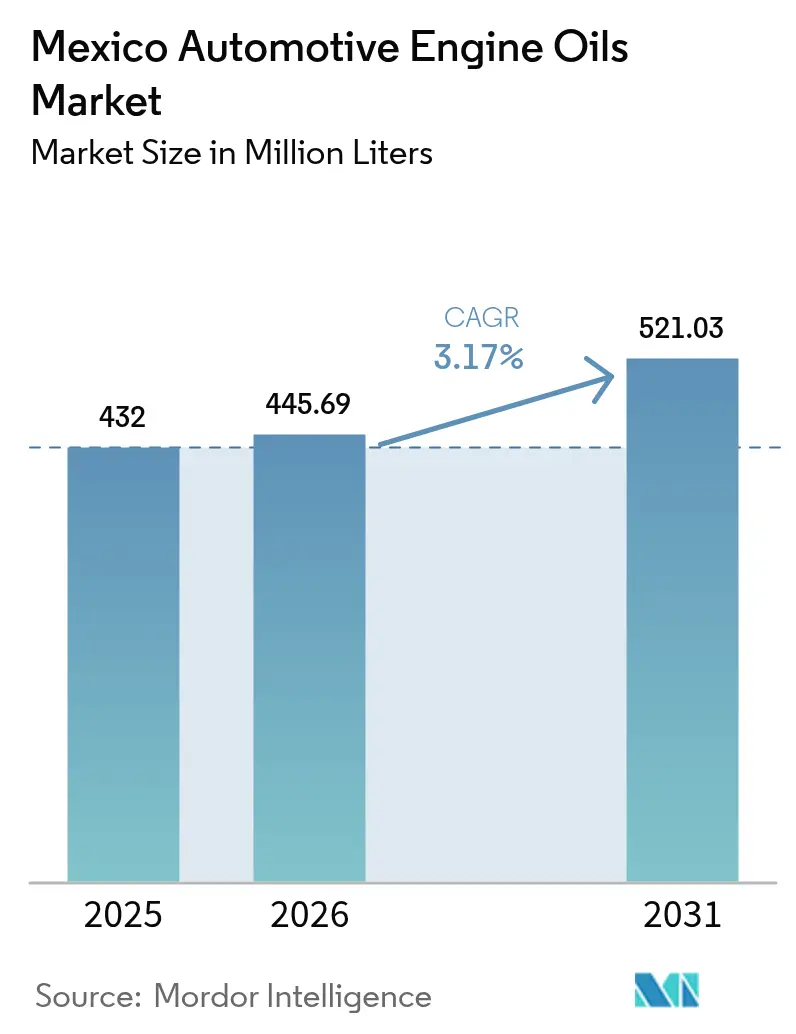
| Base Year Market Size (2025) | 432 Million Liters |
| Market Volume (2026) | 445.69 Million Liters |
| Market Volume (2031) | 521.03 Million Liters |
| Growth Rate (2026 - 2031) | 3.17 % |
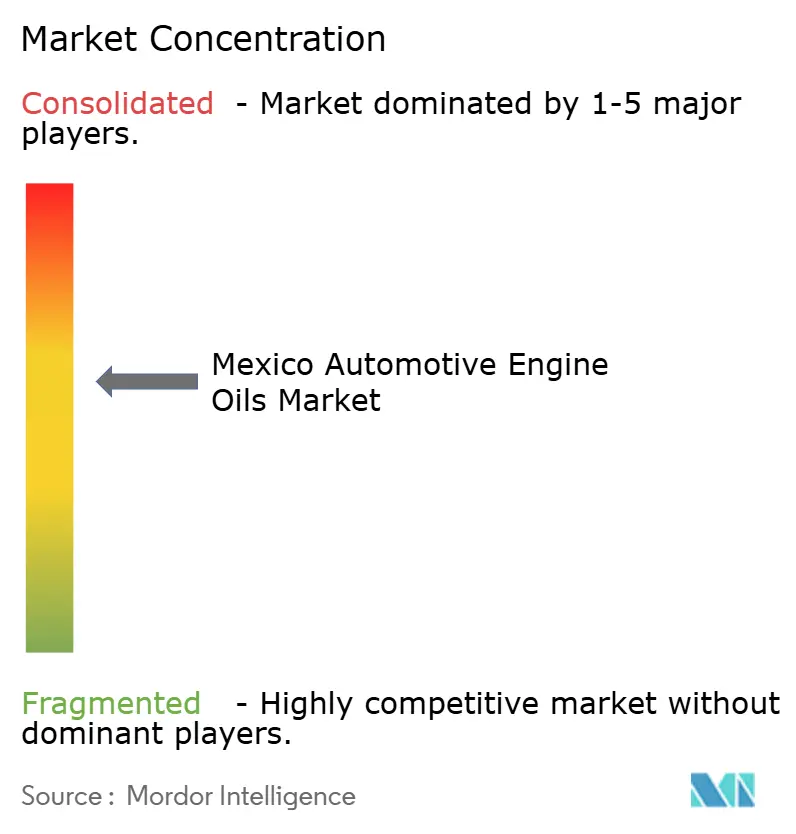
| Market Concentration | Medium |
Major Players *Disclaimer: Major Players sorted in no particular order Image © Mordor Intelligence. Reuse requires attribution under CC BY 4.0. | |
Mexico Automotive Engine Oils Market Analysis by Mordor Intelligence
The Mexico Automotive Engine Oils Market size was valued at 432 Million Liters in 2025 and estimated to grow from 445.69 Million Liters in 2026 to reach 521.03 Million Liters by 2031, at a CAGR of 3.17% during the forecast period (2026-2031). Mexico’s position as Latin America’s second-largest vehicle producer, its expanding passenger-car fleet, and the upcoming alignment of NOM-116 specifications with ILSAC GF-7 collectively underpin steady demand for advanced lubricants. Low-viscosity synthetics are gaining traction as OEM mandates expand, while freight growth related to nearshoring drives sustained demand for heavy-duty applications. The Mexico automotive engine oils market is also benefiting from stricter enforcement against illicit trade, increasing the formal sales base, and from investments in domestic additive and blending capacity that mitigate recent base-oil import restrictions.
Key Report Takeaways
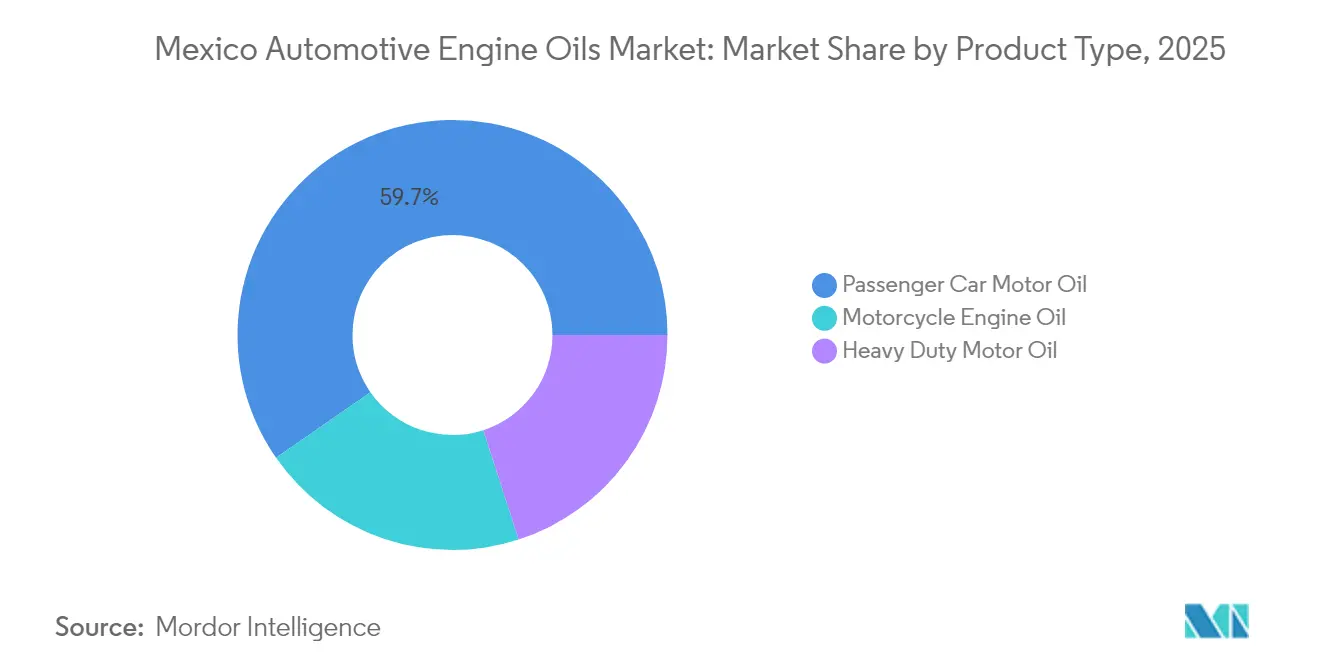
- By product type, passenger car motor oil (PCMO) accounted for 59.68% market share in 2025. However, the market share of motorcycle engine oil (MCO) is expected to increase with the fastest CAGR of 3.42% during the forecast period (2026-2031).
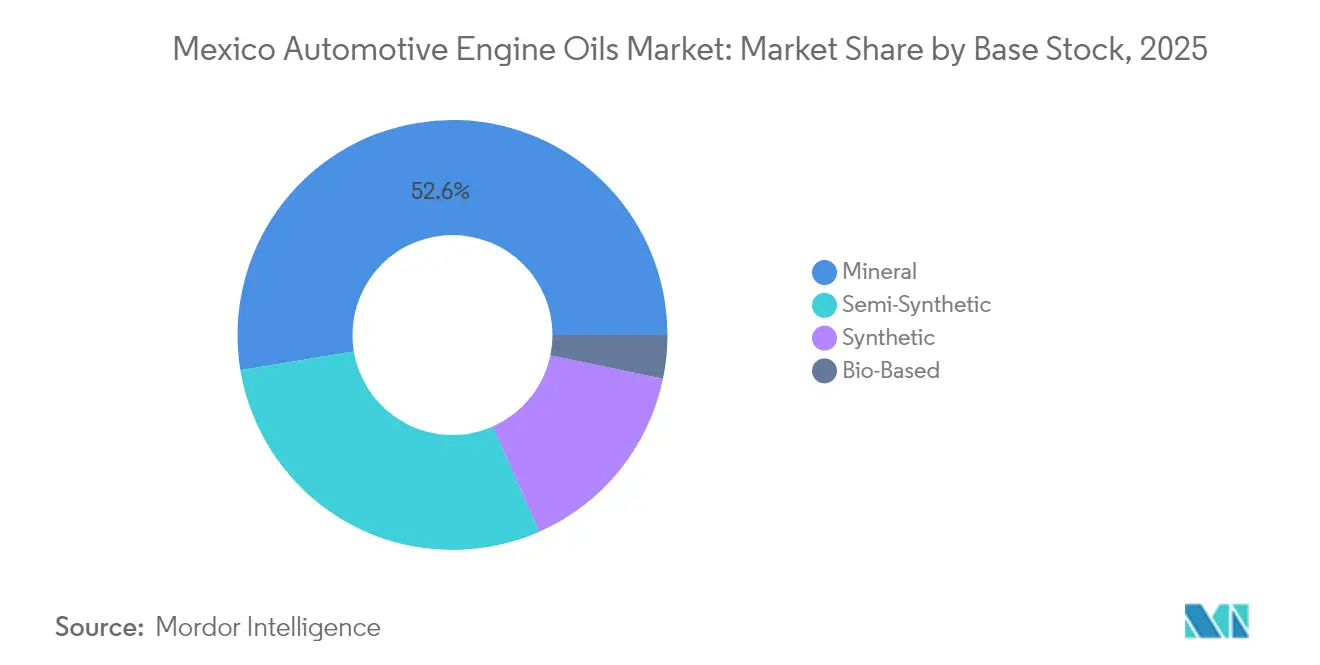
- By base stock, mineral held a share of 52.62% in 2025, and the synthetic base stock's share is expected to grow at a CAGR of 3.54% during the forecast period (2026-2031).
Note: Market size and forecast figures in this report are generated using Mordor Intelligence’s proprietary estimation framework, updated with the latest available data and insights as of 2026.
Mexico Automotive Engine Oils Market Trends and Insights
Drivers Impact Analysis*
| Driver | (~) % Impact on CAGR Forecast | Geographic Relevance | Impact Timeline |
|---|---|---|---|
| Rising passenger-car parc and frequent oil changes | +1.2% | Mexico City, Guadalajara, Monterrey metro areas | Medium term (2-4 years) |
| E-commerce freight boom lifting heavy-duty demand | +0.8% | Border states and national logistics corridors | Short term (≤ 2 years) |
| OEM-mandated low-viscosity synthetics under NOM-116 | +0.6% | Nation-wide OEM service networks | Medium term (2-4 years) |
| Anti-smuggling crackdown expanding formal volumes | +0.4% | Tijuana–San Diego and Juárez–El Paso corridors | Short term (≤ 2 years) |
| Rail-served base-oil terminals improving supply | +0.3% | Central industrial belt and Pacific coast | Long term (≥ 4 years) |
| Source: Mordor Intelligence | |||
Rising Passenger-Car Parc and High Oil-Change Frequency
Mexico added more than 850,000 passenger vehicles to its national fleet in 2024, and ownership patterns favor two annual oil changes —a rate well above that of the United States[1]Editorial, “La flota vehicular mexicana sigue creciendo,” expansion.mx. The Mexico automotive engine oils market, therefore, enjoys a compounding effect: more vehicles simultaneously require more frequent service. Retail infrastructure is adapting quickly as chains such as OXXO Gas expand from 570 to 1,000 stations, placing branded lubricant kiosks alongside forecourts. Urban air-quality programs also motivate owners to keep engines in peak condition, reinforcing demand for premium PCMO grades that support emission system durability. Taken together, these factors add 1.2 percentage points to the forecast CAGR of the Mexico automotive engine oils market.
E-commerce Freight Boom Lifting Heavy-Duty Demand
Online retail penetration reached 25% of auto-parts sales in 2025 and continues to rise, driving parcel volumes through fulfillment centers located in Monterrey, Tijuana, and Toluca. Each additional van or Class 8 truck in these networks multiplies lubricant consumption because routes combine harsh city stop-and-go traffic with long cross-border hauls. Heavy-duty truck output grew 12.1% year-over-year in 2024, and fleets increasingly specify premium 10W-30 synthetic formulations to gain fuel-economy savings over mineral 15W-40 blends. This logistics-led uptrend contributes 0.8 percentage points to the growth of the Mexico automotive engine oils market.
OEM-Mandated Low-Viscosity Synthetics (NOM-116)
Mexico will publish the revised NOM-116-SCFI standard in 2025 in tandem with ILSAC GF-7, effectively harmonizing labelling, performance tests, and viscosity-grade charts with U.S. and Japanese norms. Hyundai dealers, for example, converted entirely to Shell Helix 0W-20 and 5W-30 under a three-year exclusive signed in February 2024. Field trials demonstrate a 3.5% fuel-economy gain when fleets switch from 5W-40 to 0W-20, yielding significant cost benefits, given that domestic gasoline averages USD 1.22 per liter. These gains, combined with stricter OEM warranty language, increase synthetic penetration and add 0.6 points to the market's CAGR.
Anti-Smuggling Crackdown Expanding Formal Volumes
Customs authorities installed non-intrusive scanners at six major border crossings in 2024, slashing the flow of undeclared lubricant drums. Legitimate suppliers now see higher channel throughput, and consumers report greater confidence in product authenticity. The expanded taxable base enhances public revenue and raises compliance costs for grey-market operators, prompting them to adopt formality or exit. The resulting volume shift supports a 0.4-point increase in the growth rate of the Mexico automotive engine oils market.
Restraints Impact Analysis*
| Restraint | (~) % Impact on CAGR Forecast | Geographic Relevance | Impact Timeline |
|---|---|---|---|
| Crude-price volatility squeezing blender margins | -0.9% | Nation-wide, strongest for independent blenders | Short term (≤ 2 years) |
| Gradual EV penetration eroding ICE oil demand | -0.5% | Mexico City and Guadalajara early-adopter zones | Long term (≥ 4 years) |
| Counterfeit lubricants hurting premium adoption | -0.3% | Border regions and open-air markets | Medium term (2-4 years) |
| Source: Mordor Intelligence | |||
Crude-Price Volatility Squeezing Blender Margins
Independent blenders import more than 65% of their base-oil requirements, exposing them to Brent swings and peso–dollar fluctuations, which ranged between MXN 18.6 and MXN 19.4 per USD in 2024. In October 2023, administrative barriers lengthened customs clearance to 15 days, increasing working capital needs and warehousing fees[2]Informe trimestral, “Refinación y logística,” pemex.com. Integrated majors offset these shocks with upstream cash flow, yet smaller firms struggle to pass through spot cost spikes, compressing gross margins by up to 3 percentage points and shaving 0.9 points off market CAGR.
Gradual EV Penetration Eroding ICE Oil Demand
Electric-vehicle sales in Mexico reached 2.1% of light-duty vehicle registrations in 2025, a modest base yet growing at a rate of 38% annually as battery-assembly projects in Chihuahua and Coahuila come online. Each new EV eliminates the 3.8 liters of engine oil a typical ICE car consumes per service, curbing future volume growth. While EVs require e-drive fluids, early real-world drain intervals exceed 100,000 km, which limits the near-term offset. The net effect is a 0.5-point CAGR drag on the Mexico automotive engine oils market.
*Our forecasts treat driver/restraint impacts as directional, not additive. The impact forecasts reflect baseline growth, mix effects, and variable interactions.
Segment Analysis
By Product Type: PCMO Dominance Driven by Fleet Modernization
Passenger Car Motor Oil (PCMO) held a 59.68% market share of the Mexican automotive engine oils market in 2025, reflecting an installed base of more than 35 million light vehicles. Motorcycle Engine Oil is the fastest-growing sub-segment, with a 3.42% CAGR, driven by two-wheeler registrations for cost-effective commuting. Heavy-Duty Motor Oil ranks second in volume terms, buttressed by the 12.1% jump in class-8 truck output that accompanies nearshoring.
Brands are now orienting their marketing toward durability warranties measured in mileage, with LIQUI MOLY’s Italika tie-up extending drain intervals to 6,000 km on entry-level bikes. PCMO buyers are migrating to 0W-20 and 5W-30 synthetics to secure warranty compliance and fuel savings, a dynamic that nudges average per-liter revenue higher, even if the absolute number of liters remains constant. In heavy-duty fleets, operators are embracing mid-SAPs 10W-30 blends to adhere to emissions limits without the oil-consumption penalties associated with earlier low-ash formulations. These trends collectively reinforce the primacy of PCMO within the Mexico automotive engine oils market.



By Base Stock: Synthetic Transition Accelerates Performance Migration
Mineral oils retained a 52.62% share of the Mexico automotive engine oils market in 2025, primarily driven by cost-sensitive taxi and light truck fleets. Yet, synthetic grades exhibit the strongest momentum, expanding at a 3.54% CAGR as NOM-116 and ILSAC GF-7 mandate tighter control over volatility, shear, and LSPI. Semi-synthetics offer a bridge solution, capturing 29% of the Mexican automotive engine oil industry volume by blending Group II base stocks with performance additives that meet most OEM requirements without the full cost premium.
BASF’s USD investment in Puebla to increase aminic antioxidant output will strengthen the domestic supply of key synthetic additives and reduce lead times for blenders. The parallel development of renewable feedstock blends, such as the BMBcert series, lowers carbon footprints by up to 95%, appealing to ESG-minded corporate fleets. Looking ahead to 2030, the Mexico automotive engine oils market size for synthetic formulations could approach parity with mineral volumes as price gaps narrow and warranty clauses become more stringent.
Geography Analysis
Central Mexico, encompassing Ciudad de México, Estado de México, Puebla, and Querétaro, accounts for approximately 45.60% of Mexico's automotive engine oils market size, thanks to its dense vehicle parc and concentration of assembly plants. This corridor hosts OEMs such as Volkswagen, Toyota, and KIA, ensuring both factory fill and aftermarket throughput. The Bajío region, particularly Guanajuato and Aguascalientes, has seen double-digit annual growth, stimulated by parts suppliers that have relocated from Asia under USMCA rules.
Northern border states—including Nuevo León, Chihuahua, and Coahuila—account for roughly 28.70% of the total volume, driven by cross-border freight and maquila activity. Heavy-duty motor oil demand in the Laredo–Monterrey logistics lanes exceeds national averages by 17%, reflecting the round-the-clock utilization of trucks. Border crackdowns on undeclared lubricant imports have begun to formalize this regional market, resulting in a 4% increase in per-liter realized prices since late 2023. Pacific coast ports, aided by new rail-served tank terminals, now experience faster containerized lube inflows, which trim delivery lead times to states such as Jalisco and Colima.
Southern Mexico presently accounts for less than 7.80% of national volume, limited by lower vehicle density and disposable income. Nonetheless, federal infrastructure spend on the Trans-Isthmus Corridor and near-term refinery upgrades at Salina Cruz aim to catalyze industrial growth that will raise lubricant demand. Blenders view Oaxaca and Chiapas as frontier territories for small-pack mineral oils, banking on rising motorcycle ownership to seed future market expansion.
Regulatory Landscape
Mexico regulates automotive engine oils primarily through NOM-116-SCFI-2018, which sets mandatory specifications, testing methods, and commercial information requirements for gasoline and diesel engine lubricants sold, produced, or imported in the country. Oversight and enforcement are led by the Secretaria de Economia and PROFECO, which makes conformity assessment and compliant labeling a gating requirement for formal-market access and a lever against counterfeit or non-compliant products.
Emissions-related rules are also tightening lubricant performance needs, particularly for diesel applications. In April 2024, SEMARNAT published an agreement in the Diario Oficial de la Federacion that nullified prior extensions tied to NOM-044-SEMARNAT-2017 compliance for heavy-vehicle diesel engines, accelerating adoption of stricter emissions standards. In May 2026, SEMARNAT published NOM-174-SEMARNAT-2026, establishing emissions limits for new diesel engines used in non-road mobile machinery, which raises demand for higher-performance formulations that fit modern aftertreatment systems.
Value Chain Analysis
The value chain starts with base oils (domestic and imported) and performance additives, then moves into blending, packaging, and distribution into OEM service networks and the independent aftermarket. Mexico remains structurally exposed to imported inputs, especially additives, with the United States accounting for the majority of import value (around 89% in 2024 in the evidence pack), while many independent blenders also import significant volumes of base oils. Standards and compliance steps, particularly under NOM-116-SCFI-2018, run through the chain and shape testing, labeling, and batch release requirements for producers and importers.
Downstream, distribution depends on dealership channels, quick-lube outlets, parts retailers, workshops, service stations, and fleet maintenance depots, with availability influenced by port and customs performance. Logistics frictions, including continued clearance delays at the Port of Manzanillo following a major customs stoppage in May 2025, reduce supply predictability for blenders and importers and can lead to inventory buffering in core manufacturing corridors. Energy-product quality and import compliance requirements, including NOM-016-CRE-2016 obligations for certain petroleum-derived products, further increase documentation needs and extend lead-time sensitivity for supply into automotive and industrial corridors.
Competitive Landscape
The Mexico Automotive Engine Oils Market is moderately consolidated. International majors—Shell, ExxonMobil, and BP Castrol—dominate premium synthetics through dealership tie-ins and nationwide quick-lube chains. Domestic champions such as Akron and Roshfrans leverage flexible batch sizes, widespread truck delivery, and trusted neighborhood branding to defend mineral and semi-synthetic niches. Independent blenders respond by co-batching mineral and synthetic lines to share processing costs, preserving margins despite volatile crude inputs.
Mexico Automotive Engine Oils Industry Leaders
Bardahl
BP PLC (Castrol)
ExxonMobil Corporation
Roshfrans
Royal Dutch Shell Plc
- *Disclaimer: Major Players sorted in no particular order

Market Opportunities and Future Outlook
The main opportunity in Mexico is in compliant low-viscosity synthetic and semi-synthetic engine oils that align with modern OEM and emissions-driven needs under NOM-116-SCFI-2018 and with tighter diesel emissions rules for heavy-duty and non-road equipment, anchored by SEMARNAT actions tied to NOM-044 and the May 2026 publication of NOM-174-SEMARNAT-2026. In dealership service networks and broader aftersales channels, OEM-mandated grades and the fuel-economy benefit described in the report context are pushing demand toward higher-performance formulations, creating room for suppliers that can deliver consistent quality, documentation, and authentication through formal distribution.
Supply-chain disruption is also creating a practical demand signal for domestic capacity and more localized input sourcing. Late-2025 shortages linked to tighter import protocols and extended approval timelines for lubricant imports highlighted a vulnerability for automotive plants in key producing states, shifting procurement toward better inventory coverage and more reliable supply. Investments that expand local additive availability, such as BASF's Puebla investment to increase aminic antioxidant capacity announced in March 2025, plus product-line refreshes from domestic brands, including Roshfrans' new light-vehicle portfolio launched in May 2026, support broader SKU availability across workshops, parts stores, and service-station channels where most aftermarket purchasing decisions are made.
Recent Industry Developments
- May 2026: Roshfrans launched a national light-vehicle lubricant lineup under the \"Mucho mas alla de la meta\" platform, spanning fully synthetic (HI-ZYNTEX), semi-synthetic (HI-FLUX), and mineral (HI-ENERGY) formulations. The rollout broadened its portfolio coverage across price tiers, strengthening shelf presence in the passenger-car aftermarket as buyers shift toward higher-performance grades.
- March 2025: BASF announced an investment at its Puebla manufacturing site to increase capacity for aminic antioxidants used in lubricants, including automotive engine oils. Greater local availability of performance additives helps blenders meet higher stability requirements and can reduce lead times for formulated products in Mexico.
- December 2024: LIQUI MOLY partnered with the Carrera Panamericana as the event's official automotive engine oil partner and ran promotional activities across workshops, retail stores, and dealerships in Mexico. The campaign reinforced brand visibility in performance-oriented segments and supported pull-through in independent service channels.


Research Methodology Framework and Report Scope
Market Definition and Coverage
This market covers finished automotive engine oils sold and used in Mexico for internal combustion engine passenger cars and commercial vehicles, across OEM fill and the aftermarket. We size demand and value based on volumes consumed through oil change activity and the average selling prices observed in Mexico.
Scope exclusions: Excludes industrial engine oils, marine and rail lubricants, and non-engine automotive lubricants such as transmission fluids and greases.
Segmentation Overview
- By Product Type
- Passenger Car Motor Oil (PCMO)
- 0W-XX
- 5W-XX
- 10W-XX
- 15W-XX
- Monogrades
- Other Grades
- Heavy Duty Motor Oil (HDMO)
- 0W-XX
- 5W-XX
- 10W-XX
- 15W-XX
- Monogrades
- Other Grades
- Motorcycle Engine Oil (MCO)
- 0W-XX
- 5W-XX
- 10W-XX
- 15W-XX
- Monogrades
- Other Grades
- Passenger Car Motor Oil (PCMO)
- By Base Stock
- Mineral
- Synthetic
- Semi-Synthetic
- Bio-Based
Data Sources, Market Sizing, and Validation
Desk Research
Desk research started with public signals that help describe the Mexico vehicle base and its usage, then we mapped those signals into lubricant demand. Sources used include official transportation and road safety statistics in Mexico, such as vehicle registrations and fleet age, fuel and mobility indicators from energy agencies, and cross-checks on trade flows using customs and tariff line data.
To keep pricing and product mix realistic, we reviewed technical standards and service guidance, including SAE viscosity and API performance categories, from standards bodies and industry associations. We then compared those benchmarks against public company filings, investor presentations, and reputable news coverage. Where needed, we referenced paid subscriptions for company financial intelligence and lubricant-specific market information to sanity-check ranges. The sources listed here are illustrative, and we used additional public and private references for data collection, validation, and clarification.
Primary Interviews and Surveys
Primary work focused on interviews and structured surveys with channel participants and technical stakeholders, so we could confirm drain intervals, typical pack sizes, and the synthetic versus mineral mix by vehicle category. These discussions also helped validate Mexico-specific pricing, including wholesale to retail spreads, and pressure-test assumptions linked to fleet age, maintenance frequency, and the shift toward newer engine requirements across key regions.
Distribution of primary research fieldwork respondents
| Company type | Respondent position |
|---|---|
| Top tier: 34% | CXOs: 12% |
| Mid tier: 46% | Functional/Unit leaders: 42% |
| Smaller Players: 20% | Managers: 46% |
Market-Sizing & Forecasting
The core sizing starts from a top-down demand pool build that reconstructs engine oil consumption from the in-use vehicle parc in Mexico, split of passenger and commercial vehicles, and expected oil-change activity. Since service behavior differs by segment, we calibrate the model using primary feedback on drain intervals, typical sump fill volumes, and the share of DIY versus workshop-led changes. The market total is then compiled at the end of the build.
We also run a selective bottom-up cross-check to avoid overstating the market, using sampled price points and channel checks to approximate ASP multiplied by volume for key product grades. Inputs that matter most include fleet age distribution, annual miles driven proxies, the penetration of synthetics and semi-synthetics, viscosity mix (for example 5W-30 versus 10W-40), and retail price movement tied to base oil and additive costs. Forecasts were built using scenario analysis around vehicle parc growth, maintenance behavior, and product mix shifts, and the scenarios were aligned to what experts expect for the country.
Data Validation & Update Cycle
Outputs are checked against independent signals so the market does not drift away from observable demand, including implied liters per vehicle, trends in oil-change frequency, and price progression versus public cost indicators. Variances are flagged, key assumptions are rechecked, and a second analyst reviews the logic before sign-off. We also re-contact respondents when a key input appears inconsistent with what we heard in the field.
The report is refreshed annually, and interim updates are done when material events occur, such as major pricing swings or regulation-led specification changes. Before delivery, a final review pass is completed so clients receive an up-to-date view reflecting the latest information gathered.
Mordor Intelligence's Mexico Automotive Engine Oils Market Size Versus Other Published Estimates
Published market values for Mexico automotive engine oils do not always line up because groups measure different scopes and apply different pricing logic to convert liters into USD. Differences also show up in the year used, whether retail or wholesale pricing is assumed, and how quickly synthetic penetration is expected to rise.
Non-engine automotive lubricants, such as transmission fluids, sit outside Mordor Intelligence's scope here, which can pull some broader automotive lubricant estimates higher even when they appear similar at first glance. Gaps also come from how drain intervals are treated for older fleets versus newer engines, whether the model uses stable versus fast-rising ASPs, and how frequently underlying assumptions are refreshed after raw material price changes.
Benchmark comparison
| Source | Market Size | Gaps in Research Methodology |
|---|---|---|
| Mordor Intelligence | USD 0.33 B (2026) | |
| Trade Journal A | USD 0.32 B (2024) | Uses an earlier base year and typically applies retail shelf prices without a consistent channel margin check, which can understate or overstate value when promotions are common. |
| Regional Consultancy B | USD 0.40 B (2026) | Often bundles adjacent lubricant categories and assumes faster ASP expansion tied to premiumization, without clearly reconciling liters per vehicle to realistic drain intervals for Mexico. |
Looking across the table, the spread is largely explained by what gets counted as engine oil only, the year chosen for the snapshot, and the price level assumed along the channel. With the market tied back to vehicle parc, service frequency, and a transparent price build, the estimate stays traceable to inputs that can be checked and updated in a repeatable way.


Key Questions Answered in the Report
What is the current size of the Mexico automotive engine oils market?
The market reached 445.69 million liters in 2026.
How fast is demand expected to grow by 2031?
Volume is forecast to climb to 521.03 million liters, reflecting a 3.17% CAGR during the forecast period (2026-2031).
Which product type holds the largest share?
Passenger Car Motor Oil leads with 59.68% of 2025 volume.
Why are synthetics gaining ground?
Revised NOM-116 rules, OEM warranties, and demonstrated 3.5% fuel-economy gains are shifting buyers toward low-viscosity synthetic grades.
Which region consumes the most engine oil?
Central Mexico, including Mexico City and the Bajío corridor, accounts for nearly half of national volume.
Page last updated on:




