
Merchant Banking Services Market Size and Share
Market Overview
| Study Period | 2020 - 2031 |
|---|---|
| Market Size (2026) | USD 119.68 Billion |
| Market Size (2031) | USD 157.59 Billion |
| Growth Rate (2026 - 2031) | 5.66 % |
| Fastest Growing Market | Middle East and Africa |
| Largest Market | North America |
| Market Concentration | Low |
Major Players *Disclaimer: Major Players sorted in no particular order Image © Mordor Intelligence. Reuse requires attribution under CC BY 4.0. | |
Merchant Banking Services Market Analysis by Mordor Intelligence
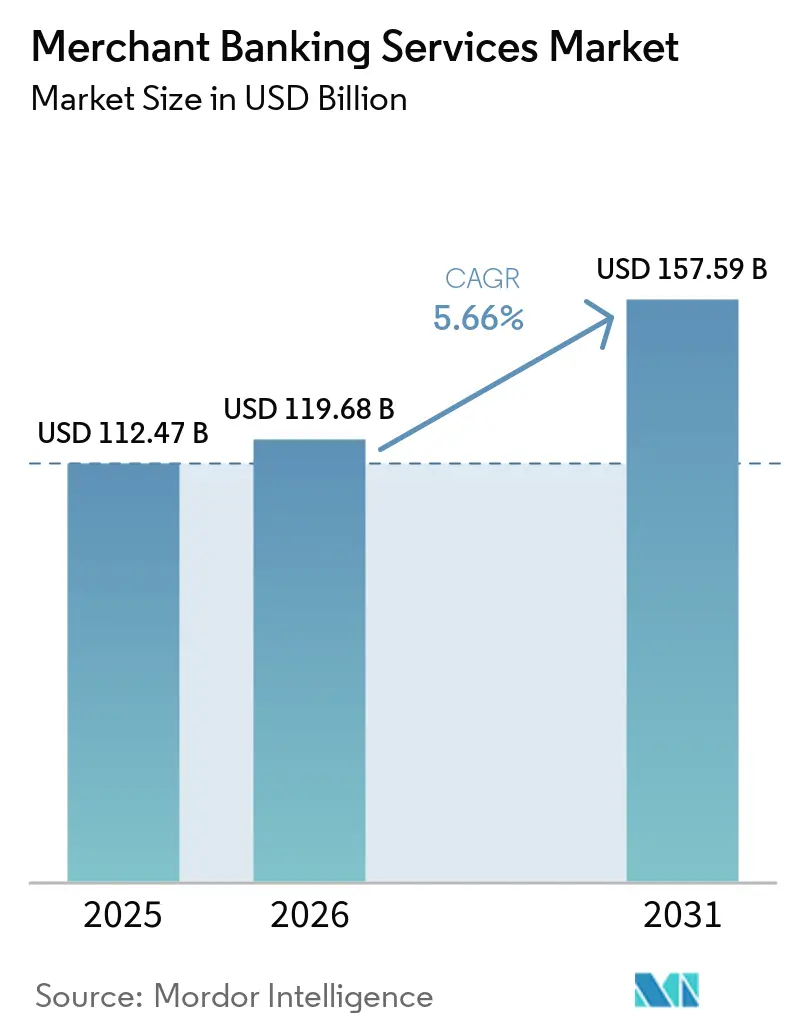
The Merchant Banking Services Market size is projected to expand from USD 112.47 billion in 2025 and USD 119.68 billion in 2026 to USD 157.59 billion by 2031, registering a CAGR of 5.66% between 2026 and 2031.
The recovery in merger and acquisition activity is supporting demand for origination, transaction structuring, and advisory work. Cross-border M&A reached USD 820 billion in H1 2026, up 63% year over year, which increased the need for advice across foreign investment, sanctions, and data protection requirements. Corporations are also seeking capital solutions as refinancing needs and AI-related investment requirements converge. Private capital has become a more important source of financing, which broadens the work available in fund placement, secondary transactions, and tailored credit structures. The merchant banking services market is therefore shaped by both large deal activity and demand for more specialized advisory support.
Key Report Takeaways
- By service type, debt capital markets captured 32.82% of the merchant banking services market share in 2025, while M&A and takeover advisory is projected to grow at 7.14% CAGR through 2031.
- By market venue, public and registered markets held 57.45% of the merchant banking services market share in 2025, while private and unregistered markets are forecast to grow at 6.93% CAGR through 2031.
- By end user, non-financial corporations accounted for 49.11% of the merchant banking services market share in 2025, while financial sponsors are projected to grow at 7.45% CAGR through 2031.
- By client size, large-cap and large enterprise clients held 61.51% of the merchant banking services market share in 2025, while lower mid-market and emerging growth are forecast to grow at 7.88% CAGR through 2031.
- By industry vertical, financial services captured 25.77% of the merchant banking services market share in 2025, while technology, media, and telecom is projected to grow at 7.63% CAGR through 2031.
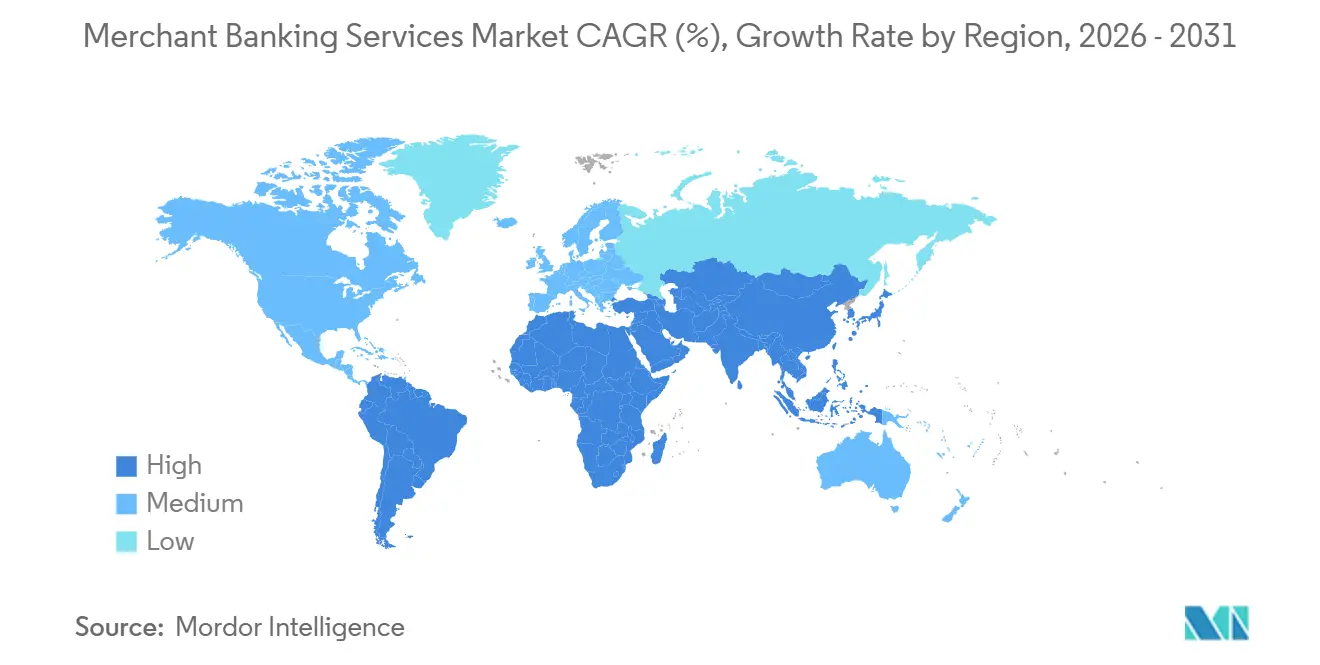
- By geography, North America held 51.23% of the merchant banking services market share in 2025, while the Middle East and Africa are forecast to grow at 8.12% CAGR through 2031.
Note: Market size and forecast figures in this report are generated using Mordor Intelligence’s proprietary estimation framework, updated with the latest available data and insights as of January 2026.
Global Merchant Banking Services Market Trends and Insights
Drivers Impact Analysis*
| Driver | (~) % Impact on CAGR Forecast | Geographic Relevance | Impact Timeline |
|---|---|---|---|
| Increasing Cross-Border M&A and Corporate Transaction Activity | +1.5% | Global, concentrated in North America, EMEA, and Asia-Pacific | Medium term (2-4 years) |
| Growing Demand for Private Capital Raising and Alternative Financing Solutions | +1.2% | Global, with accelerated adoption in North America and Europe | Medium term (2-4 years) |
| Increasing Complexity of Corporate Capital Structures and Strategic Transactions | +0.9% | North America and EU | Long term (≥ 4 years) |
| Expansion of Corporate Investment and Financing Activity in Emerging Markets | +0.7% | Asia-Pacific core, with spillover to MEA | Medium term (2-4 years) |
| Rising Demand for Specialized M&A, Capital-Raising, and Corporate Restructuring Advisory | +0.6% | Global | Short term (≤ 2 years) |
| Digitalization of Deal Execution, Due Diligence, and Financial Analysis | +0.5% | Global, with early gains in North America and Singapore | Short term (≤ 2 years) |
| Source: Mordor Intelligence | |||
Increasing Cross-Border M&A and Corporate Transaction Activity
Cross-border M&A reached USD 820 billion in H1 2026, a 63% year-over-year increase and the highest level in 2 decades[1]J.P. Morgan, “2026 Global M&A Mid-Year Outlook,” J.P. Morgan, jpmorgan.com. The 2025 full-year cross-border value was USD 1.24 trillion, representing a 46% increase. Technology, energy, and financial institutions are pursuing overseas assets to secure AI capabilities, supply chains, and infrastructure. These transactions require advisors to address foreign investment reviews, sanctions rules, and data protection requirements at the same time. The EU Foreign Subsidies Regulation has made regulatory navigation a more direct part of advisory work. The Merchant Banking Services Market benefits because cross-border mandates require more extensive structuring and execution support than domestic transactions.
Growing Demand for Private Capital Raising and Alternative Financing Solutions
Private credit is becoming a structural alternative to broadly syndicated loans, expanding work in private origination, GP capital solutions, and secondary advisory. Annual flows into semi-liquid private credit funds rose from USD 10 billion in 2020 to USD 100 billion in 2025[2]MSCI, “The State of Private Markets 2026,” MSCI, theesk.org. Gross issuance across corporate debt and loan markets reached USD 1.8 trillion in H1 2026, supported in part by AI-related capital expenditure. Asset managers that offer tailored private credit now compete with bank syndication desks for financing roles. This can reduce the traditional intermediary role of banks, but it adds demand for liability management, capital structuring, and financing advice. The Merchant Banking Services Market is gaining from this shift because clients need help selecting and structuring financing across public and private channels.
Increasing Complexity of Corporate Capital Structures and Strategic Transactions
Corporations are managing AI investment and refinancing needs simultaneously. United States investment-grade corporate bond issuance reached USD 1.19 trillion in H1 2026, with technology companies contributing USD 210 billion of non-financial IG issuance[3]U.S. Investment Grade Credit: 2H26 Update, advisors.voya.com/insights. The OECD reports that 24% of outstanding investment-grade debt and 31% of non-investment-grade debt are due for refinancing over the next three years, as of end-2025. Much of this debt was issued at lower rates, with 65% of investment-grade debt maturing in 2026–2028 carrying rates of 4% or less. Basel III capital and leverage requirements increase the capital cost of balance-sheet risk, creating potential demand for capital-efficient structuring and risk-transfer solutions. Together, these trends create recurring opportunities across refinancing, acquisition finance, capital raising, and capital-structure advisory.
Digitalization of Deal Execution, Due Diligence, and Financial Analysis
AI is reducing the time needed for document review, financial analysis, and preparation of client materials. DBS rolled out an agentic AI system to 1,500 corporate banking employees in August 2026, covering more than 70 task categories and producing review-ready credit memoranda from client data[4]DBS, “DBS Scales Agentic AI to Transform Way of Working for Corporate Bankers,” DBS Newsroom, dbs.com. AI contract review tools can identify key provisions across large document sets in hours rather than days. This improves delivery speed, but it also makes basic first-draft analysis less differentiated across firms. Advisory firms are therefore placing greater value on origination relationships, regulatory judgment, and transaction execution. The merchant banking services market is likely to favor firms that use these tools to move staff toward higher-value clients and structuring work.
Restraints Impact Analysis*
| Restraint | (~) % Impact on CAGR Forecast | Geographic Relevance | Impact Timeline |
|---|---|---|---|
| High Advisory and Transaction Costs, Particularly for Smaller Enterprises | -0.6% | Global, most acute in South America, MEA, and Southeast Asia | Medium term (2-4 years) |
| Prolonged Transaction Timelines and Complex Regulatory Approval Requirements | -0.5% | North America and the EU for antitrust, Asia-Pacific for foreign investment reviews | Long term (≥ 4 years) |
| Data-Privacy, Cybersecurity, and Transaction Confidentiality Risks | -0.4% | Global | Short term (≤ 2 years) |
| Potential Conflicts of Interest Between Advisory and Principal Investment Activities | -0.3% | North America and the EU | Long term (≥ 4 years) |
| Source: Mordor Intelligence | |||
High Advisory and Transaction Costs, Particularly for Smaller Enterprises
Merchant banking fee structures remain designed around larger mandates, creating an access barrier for smaller and mid-market businesses. Sell-side success fees for transactions with enterprise values of USD 10 million to USD 100 million typically range from 4% to 8% of deal value. These costs can materially affect founder-owned companies with limited balance-sheet flexibility. Large mandates have scale efficiencies that smaller transactions do not offer, which helps preserve a split between large-cap and middle-market service coverage. The issue is more acute in emerging markets, where smaller issuers may need to use international banks with high minimum fees. This leaves an opening for digital and specialized advisory models, but it limits immediate access to merchant banking services for many businesses.
Prolonged Transaction Timelines and Complex Regulatory Approval Requirements
Cross-border and large transactions face longer approval periods because they can require antitrust review, foreign investment screening, licensing, and reviews in several jurisdictions. Technology due diligence was cited by 51% of senior bankers as the most burdensome part of M&A review in a 2025 to 2026 study. The same study found that 84% expected increased cybersecurity scrutiny over the following 12 to 24 months. Longer timelines can weaken assignments with time-variable fees and add risk to bridge-financed transactions. In Europe, the Foreign Subsidies Regulation, revised merger thresholds, and national controls can create overlapping requirements. The United Kingdom’s 2025 money laundering regulations also add compliance work to client onboarding and know-your-customer processes.
*Our forecasts treat driver/restraint impacts as directional, not additive. The impact forecasts reflect baseline growth, mix effects, and variable interactions.
Segment Analysis
By Service Type: Debt Markets Hold the Largest Position While M&A Advisory Grows Fastest
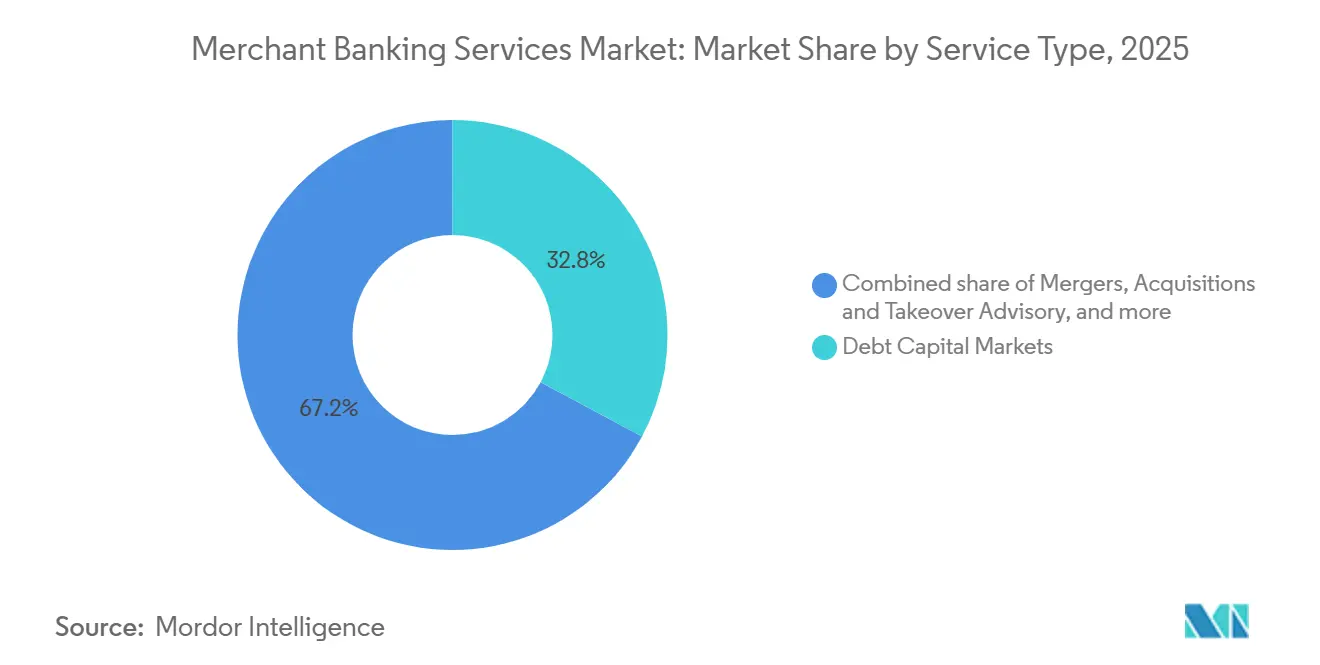
Debt capital markets held 32.82% of the merchant banking services market in 2025, making it the largest service segment. Gross issuance across corporate debt and loan markets reached USD 1.8 trillion in H1 2026. AI infrastructure financing supported issuance, and AI-related borrowers accounted for 40% of net new high-yield issuance in 2026. Equity Capital Markets also benefited from private equity-backed IPO exits, which reached USD 141.4 billion in 2025. Syndication and acquisition-finance arrangement remains linked to sponsor-led buyouts and leveraged transactions.
M&A and takeover advisory is projected to grow at a 7.14% CAGR from 2026 to 2031. Global M&A volume rose 48% year over year in H1 2026, while mega-deal volume rose 125%. The deal cycle is supporting advisory assignments that require valuation, negotiation, and regulatory expertise. Restructuring and recapitalization advisory also has a durable base because corporate debt is coming due across credit tiers. The OECD refinancing data supports continued need for liability management and recapitalization mandates


By Market Venue: Public Markets Retain Scale While Private Markets Expand Advisory Demand
Public and registered markets accounted for 57.45% of the merchant banking services market in 2025. Exchange-listed securities provide established issuance infrastructure, broad institutional participation, and large fee pools from equity and bond transactions. Public markets remain important for listed equity issuance, registered debt, and broad investor distribution. Their scale continues to anchor capital markets activity for established issuers. The Merchant Banking Services Market industry serves these venues through underwriting, distribution, and disclosure-related advisory services.
Private and unregistered markets are forecast to grow at a 6.93% CAGR from 2026 to 2031. Global private equity held more than 32,000 portfolio companies in Q2 2026, and 34% had been held for more than 5 years. These holdings increase demand for GP-led secondaries, continuation vehicles, tender offers, and hybrid capital solutions. Lazard agreed in April 2026 to acquire Campbell Lutyens to create a larger private capital advisory platform. Evergreen and semi-liquid funds are also reducing the practical divide between public and private channels.
By End User: Non-Financial Corporates Lead Revenue While Financial Sponsors Expand Exit Work
Non-financial corporates held 49.11% of the merchant banking services market in 2025. These clients use M&A advisory, debt issuance, equity capital raising, and restructuring services across business cycles. Their mandates are becoming more complex as technology investment and refinancing needs occur together. Corporate buyers also require support for portfolio optimization and cross-border acquisition activity. This broad mandate mix keeps non-financial corporates at the center of the sector’s revenue base.
Financial sponsors are projected to grow at a 7.45% CAGR from 2026 to 2031. The private equity exit backlog increased from 12,000 companies at the end of 2024 to more than 13,500 in Q2 2026. Nearly 1-third of these companies had been held for more than 6 years. This supports advisory work in restructuring, continuation funds, secondary sales, and other liquidity structures. Financial institutions also remain active as bank consolidation, insurance repositioning, and asset manager combinations continue.
By Client Size: Large Enterprises Generate Most Revenue While Lower Mid-Market Demand Broadens
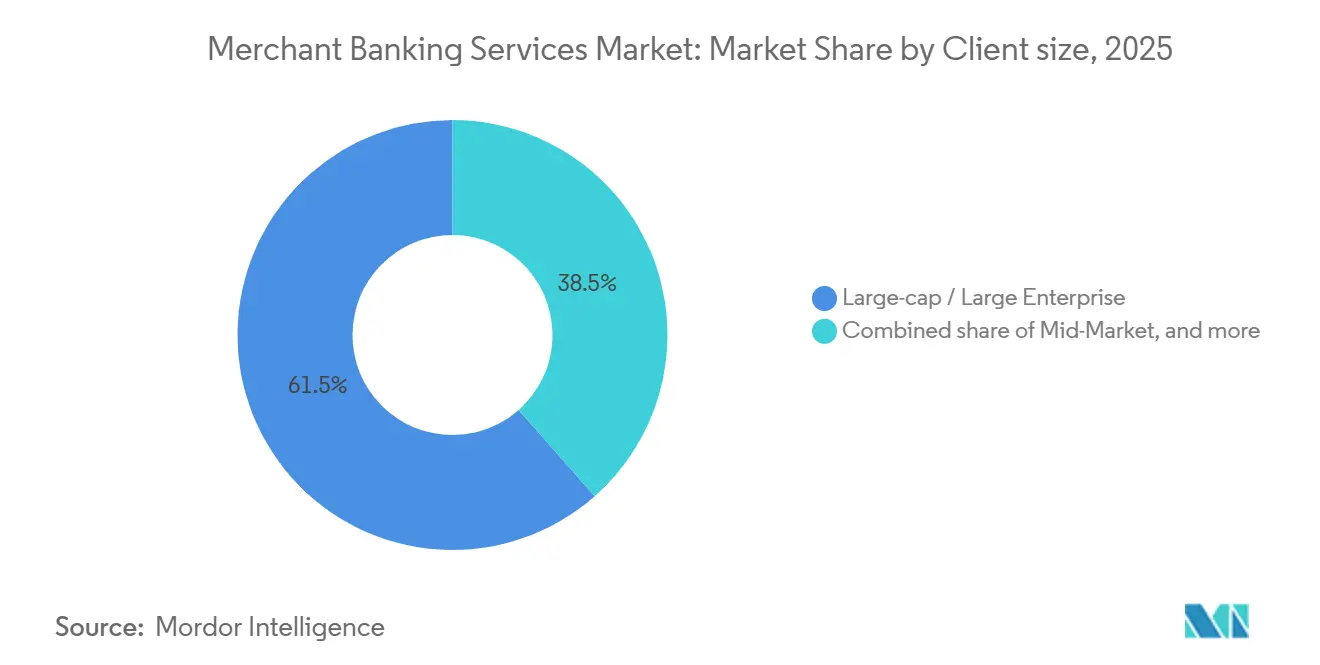
Large-cap and large enterprise clients held 61.51% of the merchant banking services market in 2025. Transactions above USD 5 billion represented 48% of global deal value in 2026, compared with 39% in 2025. This concentration supports the revenue position of firms with established large-cap coverage and financing capacity. Large enterprises commonly need coordinated advice across acquisitions, debt markets, equity raising, and regulatory processes. Their assignments also support higher absolute fee pools than smaller mandates.
Lower mid-market and emerging growth is forecast to grow at a 7.88% CAGR from 2026 to 2031. Private equity dry powder approached USD 2.5 trillion, encouraging investment in founder-owned businesses, buy-and-build platforms, and regional consolidation. Mid-market clients need a mix of structured advice and tailored private capital solutions. Elite boutiques and specialist firms can compete in this space where large banks maintain high minimum fees. The merchant banking services market can broaden as these clients seek more practical access to specialized advisory services.
By Industry Vertical: Financial Services Leads Revenue While TMT Builds on AI Transactions
Financial services captured 25.77% of revenue in 2025. Bank consolidation, asset management combinations, and insurance transactions provide recurring advisory demand. The vertical has a durable mandate base because these institutions regularly adjust business models, capital positions, and distribution capabilities. Financial institution M&A volume rose 20% year over year in H1 2026. This activity supports advisory work that combines strategic, capital, and regulatory requirements.
Technology, media, and telecom are projected to grow at a 7.63% CAGR from 2026 to 2031. AI-linked transactions totaled USD 370 billion in H1 2026, and 4 of the 10 largest global transactions related to AI and digital infrastructure. Healthcare and life sciences M&A volume rose 80% year over year in H1 2026, supporting specialist valuation work. Power and renewables M&A volume rose 95% year over year in the same period. Industrials, consumer and retail, real estate, public sector, and infrastructure assignments add to the addressable mandate pool.
Geography Analysis
North America held 51.23% of the merchant banking services market in 2025. United States megadeals represented 64% of total United States deal value in 2026, compared with 54% in 2025. The Americas contributed USD 2.1 trillion of the USD 3.2 trillion in global M&A volume in H1 2026 and included 37 mega-deals. United States corporate bond issuance reached USD 1,681 billion through July 2026, rising 26.9% year over year. Canada contributes mid-market work in natural resources and financial services, while Mexico benefits from nearshoring-related cross-border transactions.
EMEA generated USD 1 trillion in M&A volume in H1 2026, its strongest first half since 2007. The United Kingdom represented 33% of regional activity, while Germany, France, and Italy recorded M&A volume growth of more than 100%, 51%, and 200%, respectively. The OECD found that 65% of investment-grade corporate debt due in 2026 to 2028 carries coupons of 4% or below, supporting refinancing activity. Inbound North American flows to EMEA were USD 199 billion in H1 2026, while reciprocal flows totaled USD 132 billion. The Foreign Subsidies Regulation and revised antitrust thresholds can lengthen execution, but they also increase demand for regulatory advice.
Asia-Pacific contributed USD 630 billion in M&A volume in H1 2026, and China represented 30% of the regional total. China recorded 7,316 M&A transactions in H1 2026, up nearly 30% year over year, with a value of USD 241.6 billion, up 56%. The Middle East and Africa are forecast to grow at an 8.12% CAGR from 2026 to 2031. MENA investment banking fees reached USD 2.1 billion in 2025, while M&A volume involving the region reached USD 193.1 billion and bond issuance reached USD 171.1 billion. Brookfield completed a USD 2 billion first close for its PIF-anchored Middle East fund in July 2026, with at least 50% committed to Saudi Arabia.

Competitive Landscape
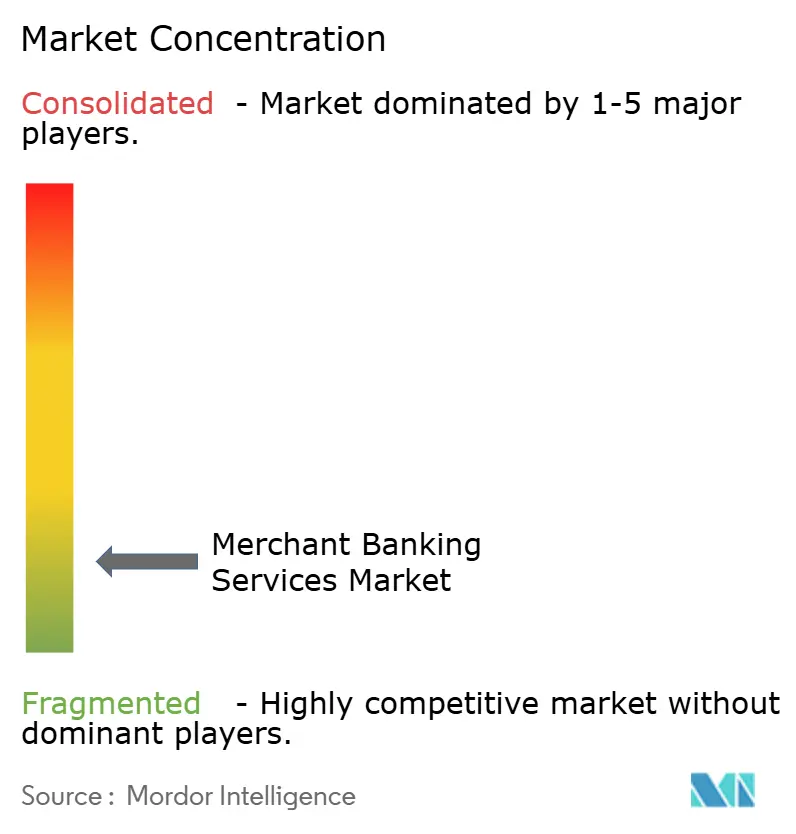
The merchant banking services market is fragmented. Goldman Sachs, JPMorgan, Morgan Stanley, Bank of America, and Citigroup collectively earned USD 16.5 billion in investment banking revenue in the first 5 months of 2026 and held nearly 35% of the global fee pool. Large banks retain strong positions in megadeal advice and debt capital markets because of their client coverage, distribution capacity, and balance-sheet resources. Within the merchant banking services market, these strengths support leadership in the highest-value assignments. Elite boutiques compete through conflict-free advice, senior banker productivity, and focused capability building.
Lazard entered an agreement in April 2026 to acquire Campbell Lutyens, increasing its capabilities in fund placement, secondary advisory, and GP capital advisory. The transaction reflects competition for a larger role in private capital advisory. Evercore advised Orange on the EUR 20.35 billion (USD 23.71 billion) joint acquisition of SFR in June 2026. Evercore also advised Pioneer Natural Resources on its USD 58 billion merger with Coterra Energy in February 2026. These mandates show that independent advisory firms can execute large and sector-specific assignments.
AI capability is becoming another factor in competitive positioning. UBS invested in Finster AI in August 2026 to support AI applications in research, client service, and advisory workflows. RBC Capital Markets disclosed the rollout of Aiden, an AI-embedded financial modeling tool, in August 2026. Firms in the merchant banking services market are using these tools to improve model construction, scenario analysis, and client preparation. Opportunities remain in cross-border middle-market advice in MEA and South and Southeast Asia, as well as climate-transition capital structuring.
Merchant Banking Services Industry Leaders
JPMorgan Chase & Co.
The Goldman Sachs Group, Inc.
Morgan Stanley
Bank of America Corporation
UBS Group AG
- *Disclaimer: Major Players sorted in no particular order

Recent Industry Developments
- August 2026: Goldman Sachs announced an agreement to acquire NEOS Investments, a systematic options-based income ETF manager with USD 30 billion in assets across 19 funds. The combined Goldman Sachs Asset Management and NEOS platform manages over USD 130 billion in ETF assets under supervision, creating the eighth-largest active ETF manager globally.
- August 2026: DBS Bank rolled out an agentic AI credit assessment system to approximately 1,500 corporate banking employees, synthesizing raw client data into review-ready credit memos across more than 70 distinct task types. This is among the largest agentic AI deployments in institutional banking in Asia to date, directly accelerating credit memo generation and advisory throughput for mid-to-large corporate clients.
- July 2026: Brookfield Asset Management completed a first close of USD 2 billion for Brookfield Middle East Partners, a private equity fund anchored by Saudi Arabia's Public Investment Fund with a minimum 50% commitment to Saudi Arabia. Target investment sectors include financial services, technology, industrials, and healthcare, representing a significant expansion of private capital advisory mandates in the MEA region.
- April 2026: Lazard entered a definitive agreement to acquire Campbell Lutyens, a global private markets advisor focused on fund placement, secondary advisory, and GP capital advisory. The combined Lazard CL platform creates a larger global private capital advisory business, directly expanding Lazard's addressable market into private and unregistered markets.


Global Merchant Banking Services Market Report Scope
| Mergers, Acquisitions and Takeover Advisory |
| Equity Capital Markets |
| Debt Capital markets |
| Syndication and Acquisition-Finance Arrangement |
| Restructuring and Recapitalization Advisory |
| Public / Registered Markets |
| Private / Unregistered Markets |
| Non-Financial Corporates |
| Financial Institutions |
| Financial Sponsors |
| Sovereigns, Agencies, SOEs and Public-Sector Issuers. |
| Large-cap / Large Enterprise |
| Mid-Market |
| Lower Mid-Market and Emerging Growth |
| Technology, Media and Telecom |
| Healthcare and Life Sciences |
| Energy, Resources and Utilities |
| Industrials and Chemicals |
| Consumer and Retail |
| Financial Services |
| Real Estate and Real Assets |
| Public Sector and Infrastructure |
| North America | United States |
| Canada | |
| Mexico | |
| South America | Brazil |
| Argentina | |
| Rest of South America | |
| Europe | United Kingdom |
| Germany | |
| France | |
| Italy | |
| Spain | |
| Rest of Europe | |
| Asia-Pacific | China |
| Japan | |
| India | |
| South Korea | |
| Australia | |
| Indonesia | |
| Thailand | |
| Malaysia | |
| Singapore | |
| Vietnam | |
| Rest of Asia-Pacific | |
| Middle East and Africa | Saudi Arabia |
| United Arab Emirates | |
| Turkey | |
| South Africa | |
| Egypt | |
| Rest of Middle East and Africa |
| By Service Type | Mergers, Acquisitions and Takeover Advisory | |
| Equity Capital Markets | ||
| Debt Capital markets | ||
| Syndication and Acquisition-Finance Arrangement | ||
| Restructuring and Recapitalization Advisory | ||
| By Market Venue | Public / Registered Markets | |
| Private / Unregistered Markets | ||
| By End User | Non-Financial Corporates | |
| Financial Institutions | ||
| Financial Sponsors | ||
| Sovereigns, Agencies, SOEs and Public-Sector Issuers. | ||
| By Client Size | Large-cap / Large Enterprise | |
| Mid-Market | ||
| Lower Mid-Market and Emerging Growth | ||
| By Industry Vertical | Technology, Media and Telecom | |
| Healthcare and Life Sciences | ||
| Energy, Resources and Utilities | ||
| Industrials and Chemicals | ||
| Consumer and Retail | ||
| Financial Services | ||
| Real Estate and Real Assets | ||
| Public Sector and Infrastructure | ||
| By Geography | North America | United States |
| Canada | ||
| Mexico | ||
| South America | Brazil | |
| Argentina | ||
| Rest of South America | ||
| Europe | United Kingdom | |
| Germany | ||
| France | ||
| Italy | ||
| Spain | ||
| Rest of Europe | ||
| Asia-Pacific | China | |
| Japan | ||
| India | ||
| South Korea | ||
| Australia | ||
| Indonesia | ||
| Thailand | ||
| Malaysia | ||
| Singapore | ||
| Vietnam | ||
| Rest of Asia-Pacific | ||
| Middle East and Africa | Saudi Arabia | |
| United Arab Emirates | ||
| Turkey | ||
| South Africa | ||
| Egypt | ||
| Rest of Middle East and Africa | ||


Key Questions Answered in the Report
What is the expected value of merchant banking services by 2031?
The sector is forecast to reach USD 157.59 billion by 2031, growing from USD 119.68 billion in 2026 at a 5.66% CAGR.
Which service type holds the largest revenue position?
Debt capital markets held 32.82% of revenue in 2025, supported by substantial corporate debt and loan issuance.
Which end user is growing fastest in merchant banking services?
Financial sponsors is projected to grow at a 7.45% CAGR through 2031, supported by a private equity exit backlog of more than 13,500 companies in Q2 2026.
Why are private capital advisory services expanding?
Private and unregistered markets is projected to grow at a 6.93% CAGR as sponsors require fund placement, secondary, continuation vehicle, and hybrid capital advice.
Which region has the highest projected growth rate?
Middle East and Africa is forecast to grow at an 8.12% CAGR through 2031, supported by sovereign capital deployment and private capital activity.
How concentrated is the merchant banking services sector?
The 5 largest banks held nearly 35% of the global fee pool in the first 5 months of 2026.
Page last updated on:





