
Materiovigilance Market Size and Share
Market Overview
| Study Period | 2020 - 2031 |
|---|---|
| Market Size (2026) | USD 103.01 Billion |
| Market Size (2031) | USD 152.41 Billion |
| Growth Rate (2026 - 2031) | 8.15 % |
| Fastest Growing Market | Asia-Pacific |
| Largest Market | North America |
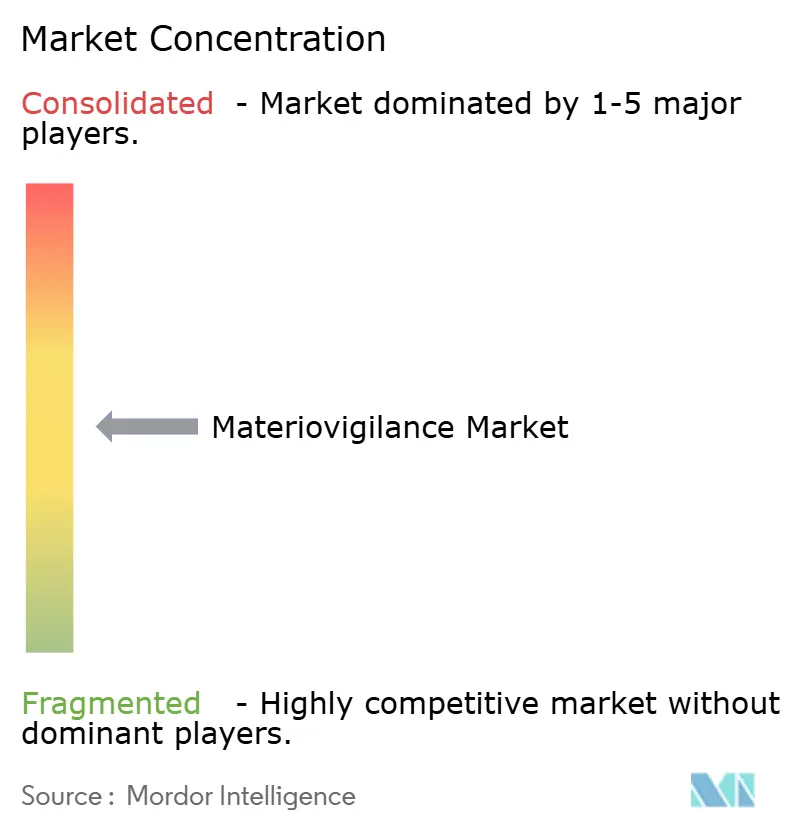
| Market Concentration | Medium |
Major Players *Disclaimer: Major Players sorted in no particular order Image © Mordor Intelligence. Reuse requires attribution under CC BY 4.0. | |
Materiovigilance Market Analysis by Mordor Intelligence
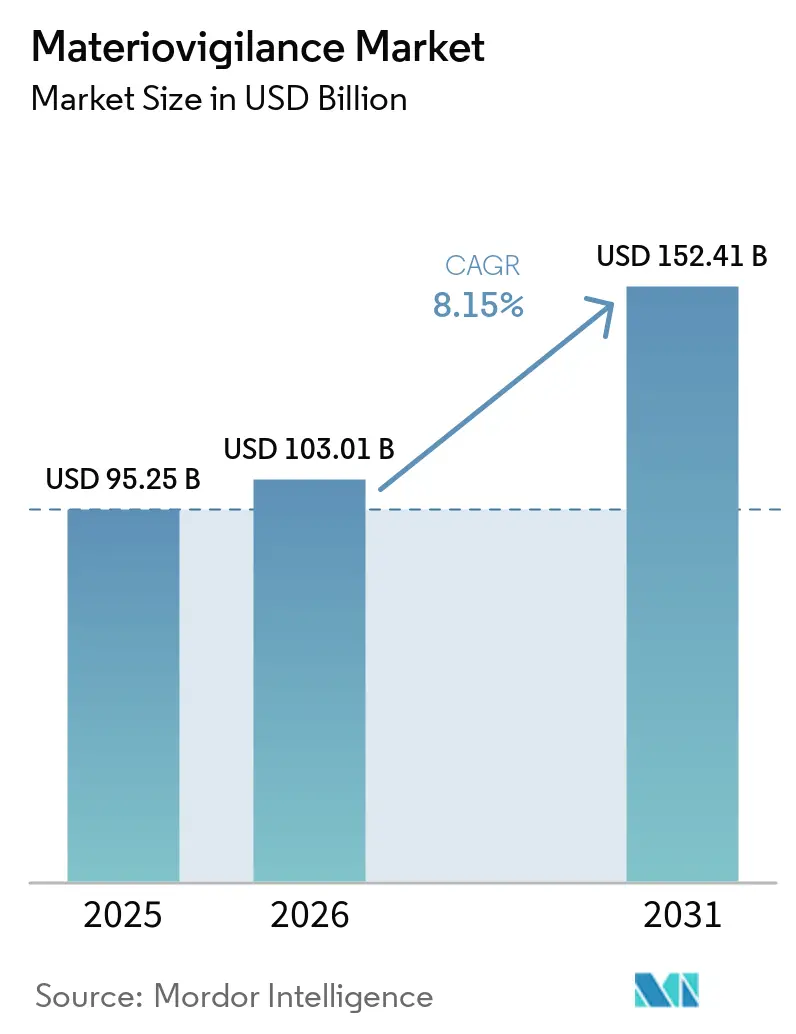
The Materiovigilance Market size is projected to expand from USD 95.25 billion in 2025 and USD 103.01 billion in 2026 to USD 152.41 billion by 2031, registering a CAGR of 8.15% between 2026 and 2031.
Mandatory reporting requirements in the European Union and the United States are making post-market surveillance systems a more immediate compliance priority for device manufacturers. The materiovigilance market is also moving toward platforms that connect complaint intake, surveillance, clinical follow-up, risk management, and corrective action records in one auditable environment. Demand is shifting toward software and service models that can support reporting obligations across several jurisdictions without relying on larger internal regulatory teams. Data-residency duties, cyber safeguards, and the monitoring needs of connected devices are increasing the value of flexible deployment models. The materiovigilance market, therefore, offers opportunities for providers that combine global reporting capability with local data controls and continuous software performance monitoring.
Key Report Takeaways
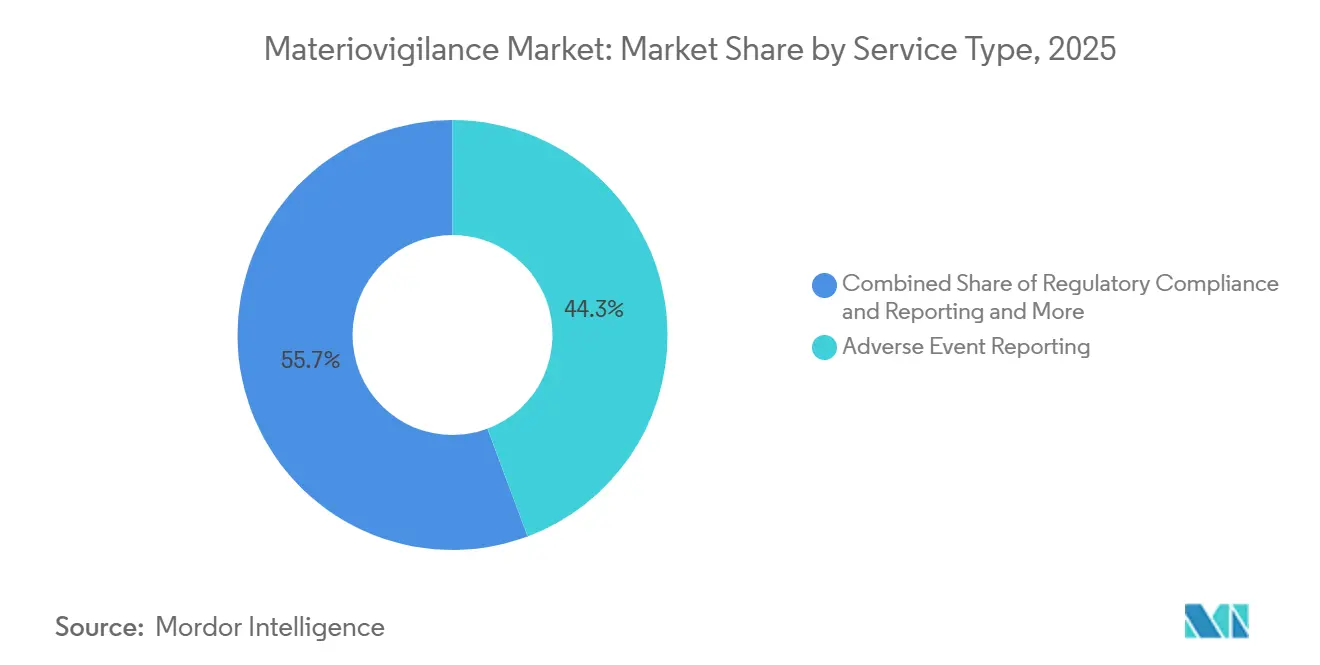
- By service type, Adverse Event Reporting held 44.31% of the materiovigilance market share in 2025, while Regulatory Compliance and Reporting is forecast to grow at a 12.65% CAGR through 2031.
- By delivery mode, Cloud-Based delivery accounted for 66.24% of the materiovigilance market share in 2025, while Hybrid deployment is forecast to expand at a 13.42% CAGR through 2031.
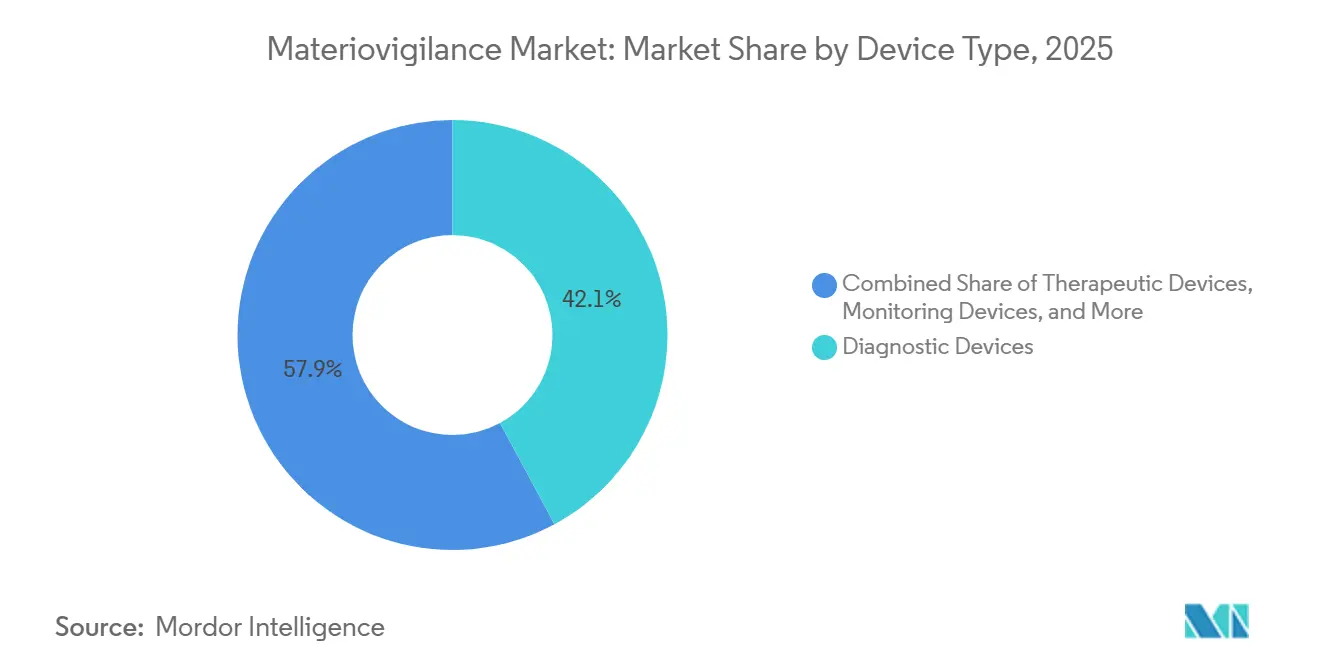
- By device type, Diagnostic Devices held 42.14% of the materiovigilance market share in 2025, while Therapeutic Devices are forecast to grow at a 9.42% CAGR through 2031.
- By end user, Original Equipment Manufacturers accounted for 44.61% of the materiovigilance market share in 2025, while Regulatory Authorities and Public-Health Programs are forecast to expand at a 13.25% CAGR through 2031.
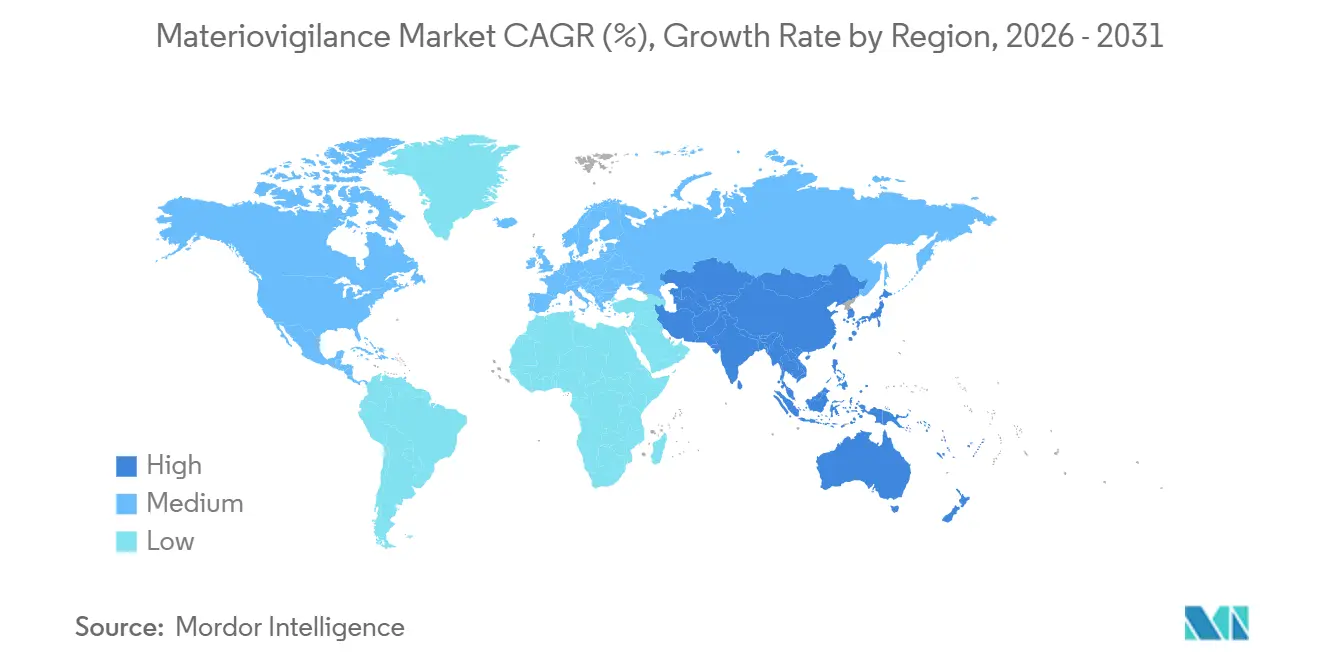
- By geography, North America held 38.42% of the materiovigilance market share in 2025, while Asia-Pacific is forecast to grow at a 12.33% CAGR through 2031.
Note: Market size and forecast figures in this report are generated using Mordor Intelligence’s proprietary estimation framework, updated with the latest available data and insights as of January 2026.
Global Materiovigilance Market Trends and Insights
Drivers Impact Analysis*
| Driver | (~) % Impact on CAGR Forecast | Geographic Relevance | Impact Timeline |
|---|---|---|---|
| Expansion of Mandatory Device Incident Reporting | +2.0% | Global, early enforcement in North America and Europe, with spillover to Asia-Pacific and Middle East and Africa | Short term (≤ 2 years) |
| Cloud Consolidation of Complaint, Vigilance, and PMS Data | +1.5% | Global, with the highest uptake in North America, Europe, and core Asia-Pacific markets | Medium term (2-4 years) |
| AI-Assisted Signal Detection From Unstructured Complaints | +1.2% | Global, with the highest maturity in North America and Western Europe | Medium term (2-4 years) |
| Rising Complexity of Connected and Software-Enabled Devices | +1.0% | Global, with particular relevance in North America, Germany, South Korea, and Japan | Long term (≥ 4 years) |
| Localization of Surveillance Programs in Emerging Device Markets | +0.8% | Core Asia-Pacific markets, including China, India, and South Korea, with spillover to the Middle East and Africa | Medium term (2-4 years) |
| Continuous Evidence Linkage Across PMS, PMCF, Risk, and CAPA | +0.7% | Europe and North America, influenced by MDR Articles 83-86 and FDA QMSR | Long term (≥ 4 years) |
| Source: Mordor Intelligence | |||
Expansion of Mandatory Device Incident Reporting
Mandatory incident reporting is moving from a compliance backstop to a central source of demand in the materiovigilance market. The European Commission made 4 EUDAMED modules compulsory from May 28, 2026, covering actor registration, UDI and device registration, notified bodies and certificates, and market surveillance. These requirements direct manufacturers, authorized representatives, importers, and notified bodies toward a shared digital reporting structure. The FDA Quality Management System Regulation became effective on February 2, 2026, and incorporated ISO 13485:2016 into 21 CFR Part 820. Smaller manufacturers face a greater need for external reporting platforms and managed services because they may lack dedicated regulatory resources. The materiovigilance market benefits from obligations that continue regardless of device demand cycles or broader economic conditions.
Cloud Consolidation of Complaint, Vigilance, and PMS Data
Cloud adoption supports regulatory readiness because surveillance records must remain current, connected, and accessible across reporting locations. The materiovigilance market is favoring platforms that bring complaint data, field safety corrective actions, clinical follow-up records, and risk documentation into one controlled workflow. This arrangement can reduce manual handoffs between case intake, corrective action, and surveillance teams. It also supports the documented quality systems required under the FDA QMSR, which now incorporates ISO 13485:2016. Providers can strengthen client retention when reporting taxonomies, regulatory rules, and periodic safety report templates are configured within the same environment. The value of cloud consolidation is limited in locations where patient identifiers and related safety data must remain within national or regional boundaries.
AI-Assisted Signal Detection From Unstructured Complaints
The growing volume of complaint narratives makes manual review harder to complete within regulatory reporting periods. AI-supported triage can extract adverse-event labels from unstructured text and prepare information for more consistent review. A 2025 study reported that PVLens achieved an F1 score of 0.88 for automated adverse-event label extraction. Research based on FDA MAUDE data found that AI and machine-learning device reports differed from reports for conventional devices, which points to a need for updated signal-detection methods. An ISPOR presentation in 2026 reported content validity of Aiken’s V = 0.85 and reliability of Cronbach’s alpha from 0.68 to 0.77 for an AI-integrated causality assessment tool across 70 cases[1]ISPOR, “SMART SAFETY: Integrating AI with the Materiovigilance Causality Assessment Tool for Enhanced Medical Device Monitoring,” ISPOR AP Summit 2026, ispor.org. Providers that add duplicate detection, case routing, and completeness checks can respond to this operational need within the materiovigilance market.
Rising Complexity of Connected and Software-Enabled Devices
Connected devices and software as a medical device require teams to monitor software behavior alongside physical device failures. The EU AI Act adds high-risk and substantial-modification obligations for relevant AI-enabled devices, alongside existing medical-device requirements. The cited analysis described an emergency-admission AI model whose AUC declined from 0.86 to 0.83 during the COVID-19 pandemic without a visible malfunction. This type of model drift cannot be reliably captured through spontaneous reports alone. FDA clearances for more than 870 AI and machine-learning medical devices by mid-2023 added to the ongoing surveillance workload for deployed products. The materiovigilance market has room for platforms that incorporate ongoing drift detection, calibration review, and model-performance controls into standard post-market processes.
Restraints Impact Analysis*
| Restraint | (~) % Impact on CAGR Forecast | Geographic Relevance | Impact Timeline |
|---|---|---|---|
| Fragmented Reporting Taxonomies and Cross-Border Rules | -1.5% | Global, most acute in Asia-Pacific and Middle East and Africa, where national frameworks diverge sharply | Short term (≤ 2 years) |
| Cybersecurity, Privacy, and Data-Residency Exposure | -0.8% | Europe, North America, and the Asia-Pacific data-localization regimes | Medium term (2-4 years) |
| Scarcity of Device-Specific Regulatory and Clinical Expertise | -0.7% | Global, most limiting in emerging markets and mid-size manufacturers | Long term (≥ 4 years) |
| Weak Causality and Denominator Data in Voluntary Reporting | -0.5% | Global, most pronounced in Asia-Pacific, Africa, and Latin America | Long term (≥ 4 years) |
| Source: Mordor Intelligence | |||
Fragmented Reporting Taxonomies and Cross-Border Rules
The materiovigilance market must operate across national reporting rules that differ in classifications, filing languages, data fields, and submission deadlines. A 2025 review found continuing differences between the European Union’s EudraVigilance and EUDAMED structures and the more centralized U.S. FAERS and MAUDE approach. A manufacturer selling a device in 15 jurisdictions may need 15 differently formatted periodic safety reports and separate regulatory contacts. These requirements raise the effort needed to design and validate global reporting software. The burden falls most heavily on mid-size OEMs that do not have the regulatory affairs capacity of larger multinational companies. As a result, some manufacturers may concentrate surveillance investment in their largest sales jurisdictions, which can leave gaps in global safety records.
Cybersecurity, Privacy, and Data-Residency Exposure
Materiovigilance systems process patient information and incident narratives, so privacy and security controls are fundamental to their use. The FDA describes cybersecurity considerations for medical devices across the product lifecycle, including premarket and postmarket activities[2]U.S. Food and Drug Administration, “Cybersecurity,” U.S. Food and Drug Administration, fda.gov. Cross-border deployments must also address GDPR duties in Europe and data-residency requirements in China and India. These obligations can require regional data storage, controlled access, and coordinated incident-response procedures. The cost of meeting these requirements across several jurisdictions favors providers with established regional infrastructure. Security reviews and validation expectations can also lengthen the adoption process for new systems in the materiovigilance market.
*Our forecasts treat driver/restraint impacts as directional, not additive. The impact forecasts reflect baseline growth, mix effects, and variable interactions.
Segment Analysis
By Service Type: Regulatory Compliance Reporting Outpaces Legacy Adverse Event Functions
Adverse Event Reporting held 44.31% of the materiovigilance market share in 2025 because it remains the legally required base of device post-market surveillance. The FDA MAUDE system and the EUDAMED vigilance framework require timely reporting of relevant events. Missed reporting obligations can lead to inspection scrutiny and other compliance consequences. Post-Market Surveillance services support structured evidence collection rather than only reactive complaint handling. Risk Assessment and Management services support ongoing review of device risks and benefits. Material Safety Monitoring also addresses biocompatibility information and early signs of product issues.
Regulatory Compliance and Reporting is forecast to grow at a 12.65% CAGR through 2031. The materiovigilance market is being shaped by concurrent implementation of EUDAMED requirements and the U.S. QMSR. The service can become a broader entry point when OEMs expand from case processing to inspection preparation and regulatory documentation. Countries such as India, Australia, Canada, and the United States have established post-marketing systems, while other locations are still developing similar structures. This uneven maturity creates demand for providers that can apply requirements across jurisdictions. Documentation linkages under ISO 13485:2016 further support the need for integrated compliance services.



By Delivery Mode: Hybrid Architectures Gain Ground as Data Localization Pressures Mount
Cloud-Based delivery accounted for 66.24% of the materiovigilance market size in 2025. It supports large reporting volumes, multi-site coordination, and real-time aggregation of complaint and surveillance information. Cloud platforms can also embed regulatory rules that reduce the specialized expertise required to maintain current workflows. This feature is important for mid-size OEMs managing changing U.S. and European requirements. On-Premise delivery remains relevant for large OEMs, public institutions, and national health authorities with strict data-sovereignty controls. It is also relevant where rules restrict transfers of identifiable health information outside a country or region.
Hybrid deployment is forecast to grow at a 13.42% CAGR through 2031. This approach combines cloud-based analytics and signal detection with local storage for sensitive patient identifiers. It responds to the need for analysis at scale while respecting local data controls in Asia-Pacific, the Middle East, and Europe. Hybrid configurations can increase switching costs because a new provider must revalidate connections between local infrastructure and analytical systems. AB Cube’s 2026 roadmap highlighted security, resilience, and future-readiness features, including CasEasy V3 and Converter V2. These product investments reflect the emphasis on configurations that can serve different data-control requirements.
By Device Type: Diagnostic Devices Lead, But Therapeutic Portfolio Complexity Commands Faster Investment
Diagnostic Devices held 42.14% of the materiovigilance market share in 2025. Their position reflects the breadth of instruments in use, including in vitro diagnostic platforms and AI-supported radiology tools. The range of product types produces varied complaint categories and monitoring requirements. This requires structured intake, assessment, and signal detection capabilities. Surgical Devices carry intensive post-approval surveillance needs because of their higher-risk applications. Monitoring Devices also require attention to connectivity, cybersecurity, and software updates in addition to traditional safety reporting.
Therapeutic Devices is forecast to grow at a 9.42% CAGR through 2031. Implantable and connected therapeutic products can generate continuous data on performance and safety, rather than only discrete incident records. Combination products used in oncology, neurology, and chronic disease management require drug and device reporting workflows at the same time. This increases the need to align EudraVigilance and FAERS drug reporting with EUDAMED and MAUDE device reporting. The materiovigilance market is therefore responding to a broader set of therapeutic safety and compliance requirements.
By End User: OEMs Drive Volume, But Public Health Programs Set the Regulatory Agenda
Original Equipment Manufacturers held 44.61% of the materiovigilance market size in 2025. Their obligations include adverse-event reporting, post-market surveillance, periodic safety reports, and related documentation. These requirements make OEMs demand a predictable source of revenue for software and service providers. Contract Research Organizations and Business Process Outsourcing Providers handle overflow work when OEM portfolios expand faster than in-house teams. Healthcare institutions are also becoming more relevant buyers when reporting duties create a need for local reporting coordination. The combined requirements support a continued role for managed services across the materiovigilance industry.
Regulatory Authorities and Public-Health Programs are forecast to expand at a 13.25% CAGR through 2031. Public bodies are investing in surveillance capacity as national vigilance programs become more formalized. India’s Indian Pharmacopeia Commission reinforced adverse-event reporting compliance under the Materiovigilance Program of India in February 2026[3]Indian Pharmacopoeia Commission, “Strengthening Adverse Event Reporting Under the Materiovigilance Programme of India (MvPI),” Indian Pharmacopoeia Commission, ipc.gov.in. Uppsala Monitoring Center’s VigiLyze serves national pharmacovigilance centers and regulatory authorities participating in the WHO Program for International Drug Monitoring. Public-sector accounts can be embedded in national surveillance programs over several years. That structure can make these accounts harder to replace than commercial contracts affected by mergers or portfolio changes.
Geography Analysis
North America held 38.42% of the materiovigilance market share in 2025. The region benefits from an established adverse-event reporting infrastructure and a dense U.S. medical-device ecosystem. The FDA QMSR took effect in February 2026 and incorporated ISO 13485:2016 into 21 CFR Part 820. U.S. demand includes enterprise quality management platforms, AI-supported signal tools, and contract research organization services. FDA cybersecurity guidance also supports investment in systems that connect safety reporting with connected-device and software-update records.
Europe remains an important geography because the EU MDR provides a shared regulatory baseline for the 27-member market. Germany, France, the United Kingdom, Italy, and Spain provide much of the region’s demand. EUDAMED’s first 4 modules become mandatory on May 28, 2026, which increases the need for coordinated digital reporting. The United Kingdom retains a separate MHRA framework after Brexit, creating additional submission requirements for manufacturers operating in both systems. Germany’s medical-device manufacturing base supports domestic demand for platform and service providers. The region also faces scrutiny of privacy, security, and data-transfer controls.
Asia-Pacific is forecast to grow at a 12.33% CAGR through 2031. The region’s expansion reflects stronger reporting expectations and a growing device base in China, India, South Korea, and Japan. India’s February 2026 notice reinforced reporting compliance for medical-device marketing authorization holders under MvPI. Japan and South Korea are mature enforcement-focused systems, so their contribution is more incremental. The Middle East and Africa remain early-stage areas supported by healthcare investment and regional partnerships. South America is supported by Brazil’s ANVISA framework and Argentina’s evolving regulatory structure.

Competitive Landscape
The materiovigilance market is moderately fragmented, with no single provider dominant across software, managed services, and geographic coverage. IQVIA, Oracle, and Honeywell International, with Sparta Systems, have broad compliance capabilities and international capacity. These firms compete with specialist providers that focus on AI-enabled signal detection or narrower reporting workflows. Larger vendors can connect quality, safety, complaint, and risk functions through wider enterprise platforms. Their existing regulatory configurations can make migration more difficult for customers. This structure supports continued competition between integrated suites and specialist tools.
Honeywell launched TrackWise Recall Management in May 2025 as a cloud-based, AI-assisted platform for recall workflow management and signal detection. The company stated that the platform can reduce recall execution time from weeks to minutes through automated workflows. Oracle continues to offer Empirica Signal Management for safety-signal detection, analysis, and management across premarket and post-market products. Its documented alignment with EU GVP Module IX and FDA reporting requirements supports its position in regulated workflows. These moves show how established vendors are adding automation while retaining broader compliance coverage.
AB Cube expanded its 2026 roadmap with vigilance coverage for Korea and Japan and introduced AI modules for extraction accuracy and case configuration. Specialist vendors are differentiating through multi-vigilance integration and tools designed to reduce the technical burden of automation. A remaining gap involves routine detection of algorithmic drift, calibration changes, and performance differences across patient groups. Published research has identified gaps in post-market oversight methods for AI and machine-learning medical devices. Providers that develop such functions could serve a distinct need as expectations for software-device monitoring evolve. The materiovigilance market remains open to both enterprise vendors and specialists that can demonstrate reliable, audit-ready workflows.
Materiovigilance Industry Leaders
IQVIA Inc.
Oracle Corporation
Honeywell International Inc.
AssurX, Inc.
Xybion Corporation
- *Disclaimer: Major Players sorted in no particular order

Recent Industry Developments
- July 2026: India’s CDSCO issued a circular reminding medical device and pharmaceutical licensees to maintain systems for collecting, processing, and forwarding adverse reaction reports. Central, state, and local regulators could verify compliance during routine inspections. The notice increased the enforcement visibility of Materiovigilance Programme of India (MvPI) obligations and signaled a shift toward inspection-linked accountability.
- April 2026: China’s NMPA launched a pilot medical device vigilance framework across 17 provinces and municipalities. The framework introduced structured requirements for vigilance management, periodic safety update reports (PSURs), trend reports, and vigilance plans. The pilot shifted post-market oversight toward a structured, inspection-ready compliance regime. Overseas manufacturers needed to align global PSURs and post-market surveillance (PMS) plans with China-specific documentation requirements to avoid compliance gaps during the pilot review phase.


Global Materiovigilance Market Report Scope
As per the scope of the report, materiovigilance is the process of monitoring, detecting, assessing, and preventing adverse events related to the use of medical devices to ensure their safety and effective use in healthcare.
The materiovigilance market is segmented by service type into adverse event reporting, post-market surveillance, risk assessment and management, regulatory compliance and reporting, and material safety monitoring. By delivery mode, the market is segmented into cloud-based, on-premises, and hybrid solutions. By device type, the market is segmented into diagnostic devices, therapeutic devices, monitoring devices, surgical devices, and other device types. By end user, the market is segmented into original equipment manufacturers, contract research organizations, business process outsourcing providers, healthcare institutions, regulatory authorities, public health programs, and other end users. By geography, the market is segmented into North America, Europe, Asia-Pacific, the Middle East and Africa, and South America. The market report also covers the estimated market sizes and trends for 17 countries across major regions globally. For each segment, the market size and forecast are provided in terms of value (USD).
| Adverse Event Reporting |
| Post-Market Surveillance |
| Risk Assessment and Management |
| Regulatory Compliance and Reporting |
| Material Safety Monitoring |
| Cloud-Based |
| On-Premise |
| Hybrid |
| Diagnostic Devices |
| Therapeutic Devices |
| Monitoring Devices |
| Surgical Devices |
| Other Device Types |
| Original Equipment Manufacturers |
| Contract Research Organizations |
| Business Process Outsourcing Providers |
| Healthcare Institutions |
| Regulatory Authorities and Public-Health Programs |
| Other End Users |
| North America | United States |
| Canada | |
| Mexico | |
| Europe | Germany |
| United Kingdom | |
| France | |
| Italy | |
| Spain | |
| Rest of Europe | |
| Asia-Pacific | China |
| Japan | |
| India | |
| Australia | |
| South Korea | |
| Rest of Asia-Pacific | |
| Middle East and Africa | GCC |
| South Africa | |
| Rest of Middle East and Africa | |
| South America | Brazil |
| Argentina | |
| Rest of South America |
| By Service Type | Adverse Event Reporting | |
| Post-Market Surveillance | ||
| Risk Assessment and Management | ||
| Regulatory Compliance and Reporting | ||
| Material Safety Monitoring | ||
| By Delivery Mode | Cloud-Based | |
| On-Premise | ||
| Hybrid | ||
| By Device Type | Diagnostic Devices | |
| Therapeutic Devices | ||
| Monitoring Devices | ||
| Surgical Devices | ||
| Other Device Types | ||
| By End User | Original Equipment Manufacturers | |
| Contract Research Organizations | ||
| Business Process Outsourcing Providers | ||
| Healthcare Institutions | ||
| Regulatory Authorities and Public-Health Programs | ||
| Other End Users | ||
| By Geography | North America | United States |
| Canada | ||
| Mexico | ||
| Europe | Germany | |
| United Kingdom | ||
| France | ||
| Italy | ||
| Spain | ||
| Rest of Europe | ||
| Asia-Pacific | China | |
| Japan | ||
| India | ||
| Australia | ||
| South Korea | ||
| Rest of Asia-Pacific | ||
| Middle East and Africa | GCC | |
| South Africa | ||
| Rest of Middle East and Africa | ||
| South America | Brazil | |
| Argentina | ||
| Rest of South America | ||


Key Questions Answered in the Report
What is driving demand for materiovigilance services?
Mandatory EUDAMED use from May 28, 2026, and the FDA QMSR, effective February 2, 2026, are increasing the need for connected post-market reporting systems. These requirements make reliable reporting and documented quality processes more important for manufacturers.
What is the projected growth rate for materiovigilance through 2031?
The sector is projected to grow at a CAGR of 8.15% from 2026 to 2031, reaching USD 152.41 billion by 2031. Its value in 2026 stands at USD 103.01 billion.
Which service type holds the largest share?
Adverse Event Reporting held a 44.31% share in 2025, reflecting its role as a required part of device post-market surveillance. Regulatory Compliance and Reporting is the fastest-growing service type at a 12.65% CAGR.
Why are hybrid deployment models growing?
Hybrid deployment is forecast to grow at a 13.42% CAGR because it combines cloud analytics with local handling of sensitive data. It addresses both multi-location reporting needs and data-residency controls.
Which region is growing fastest?
Asia-Pacific is forecast to grow at a 12.33% CAGR through 2031 as reporting requirements strengthen across key device markets. India's MvPI compliance notice in February 2026 illustrates the region's higher enforcement focus.
How are AI-enabled medical devices changing post-market monitoring?
AI-enabled products require surveillance of software behavior and possible model drift alongside conventional device issues. Published research has identified gaps in current post-market oversight methods for these products.
Page last updated on:





