
Managed Sustainable Device Lifecycle Services Market Size and Share
Market Overview
| Study Period | 2021 - 2032 |
|---|---|
| Market Size (2027) | USD 9.89 Billion |
| Market Size (2032) | USD 19.11 Billion |
| Growth Rate (2027 - 2032) | 14.08 % |
| Fastest Growing Market | Asia-Pacific |
| Largest Market | North America |
| Market Concentration | Low |
Major Players *Disclaimer: Major Players sorted in no particular order Image © Mordor Intelligence. Reuse requires attribution under CC BY 4.0. | |
Managed Sustainable Device Lifecycle Services Market Analysis by Mordor Intelligence
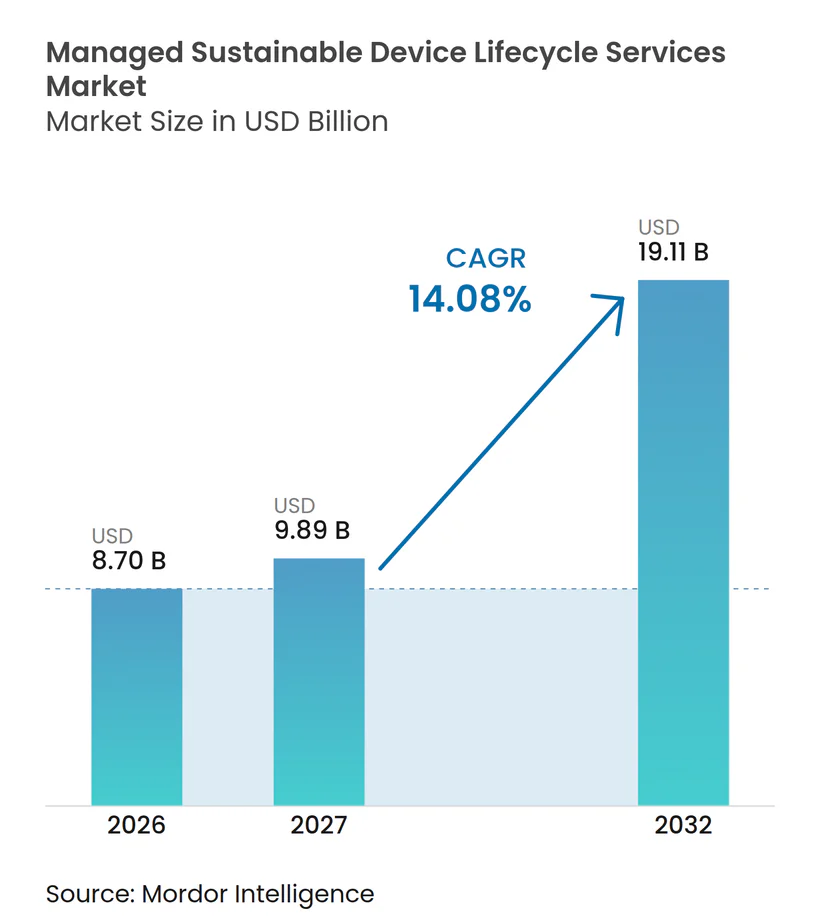
The managed sustainable device lifecycle services market size is projected to expand from USD 8.70 billion in 2026 and USD 9.89 billion in 2027 to USD 19.11 billion by 2032, registering a CAGR of 14.08% between 2027 to 2032. Shorter replacement cycles for enterprise endpoints and AI servers are increasing the volume of retired equipment requiring secure disposition, refurbishment, and materials recovery. Sustainability commitments are shifting device retirement into procurement and finance decisions, as companies need credible records of asset recovery and hardware-related emissions. Strong resale values for server components support recovery programs that can offset part of the cost of infrastructure refreshes. Providers that combine secure data handling, traceable logistics, and recovery reporting can address this wider set of enterprise requirements. The managed sustainable device lifecycle services market also faces pressure from rapidly changing AI hardware values, varied cross-border regulations, and high processing costs for low-value devices.
Key Report Takeaways
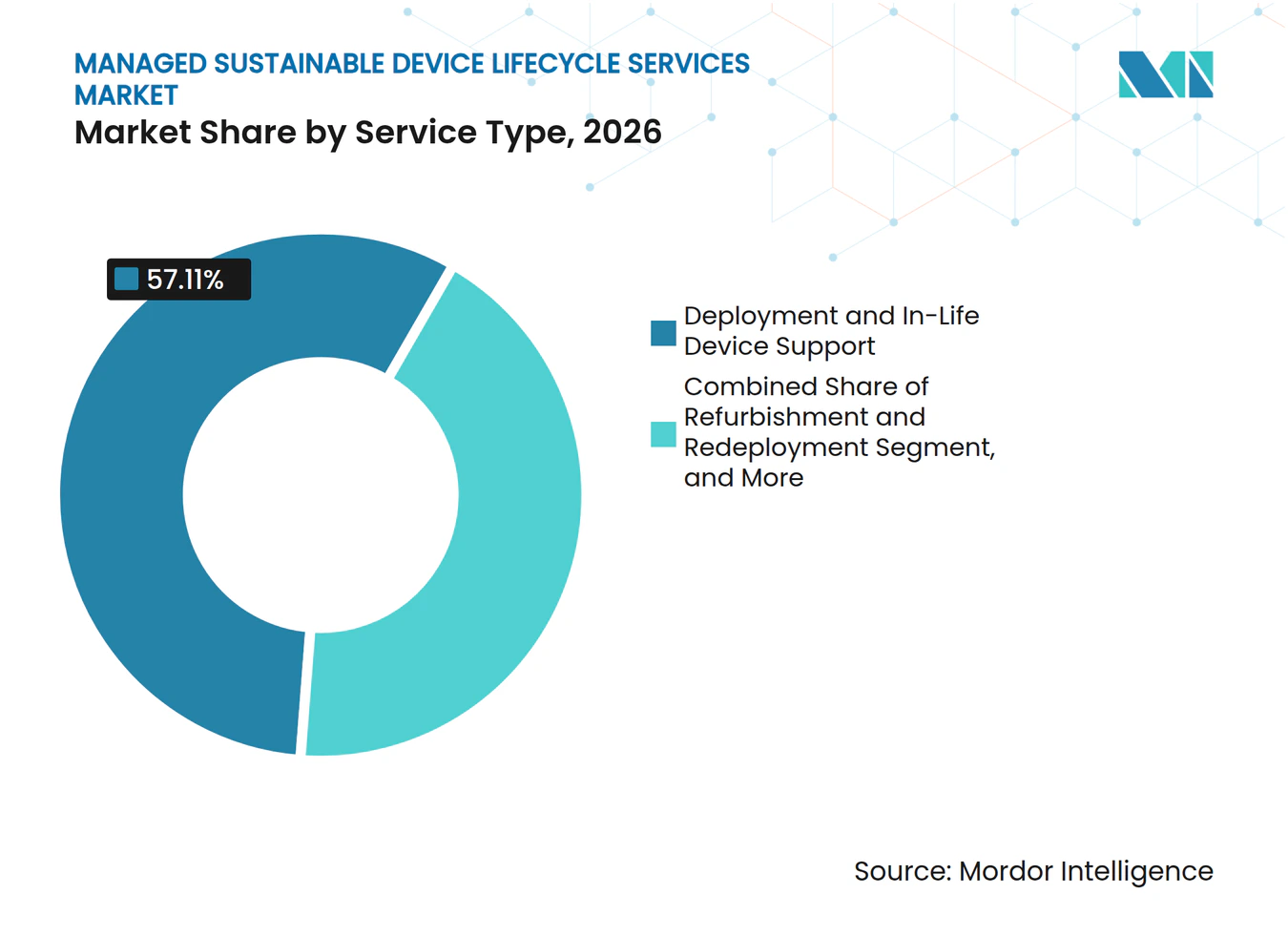
- By service type, Deployment and In-Life Device Support held 57.11% of the managed sustainable device lifecycle services market revenue in 2026, while Asset Recovery and Circularity Management is projected to expand at a 15.34% CAGR through 2032.
- By delivery model, Off-Site Centralized Processing held 68.17% of the managed sustainable device lifecycle services market revenue in 2026, while Hybrid Processing is projected to expand at a 15.71% CAGR through 2032.
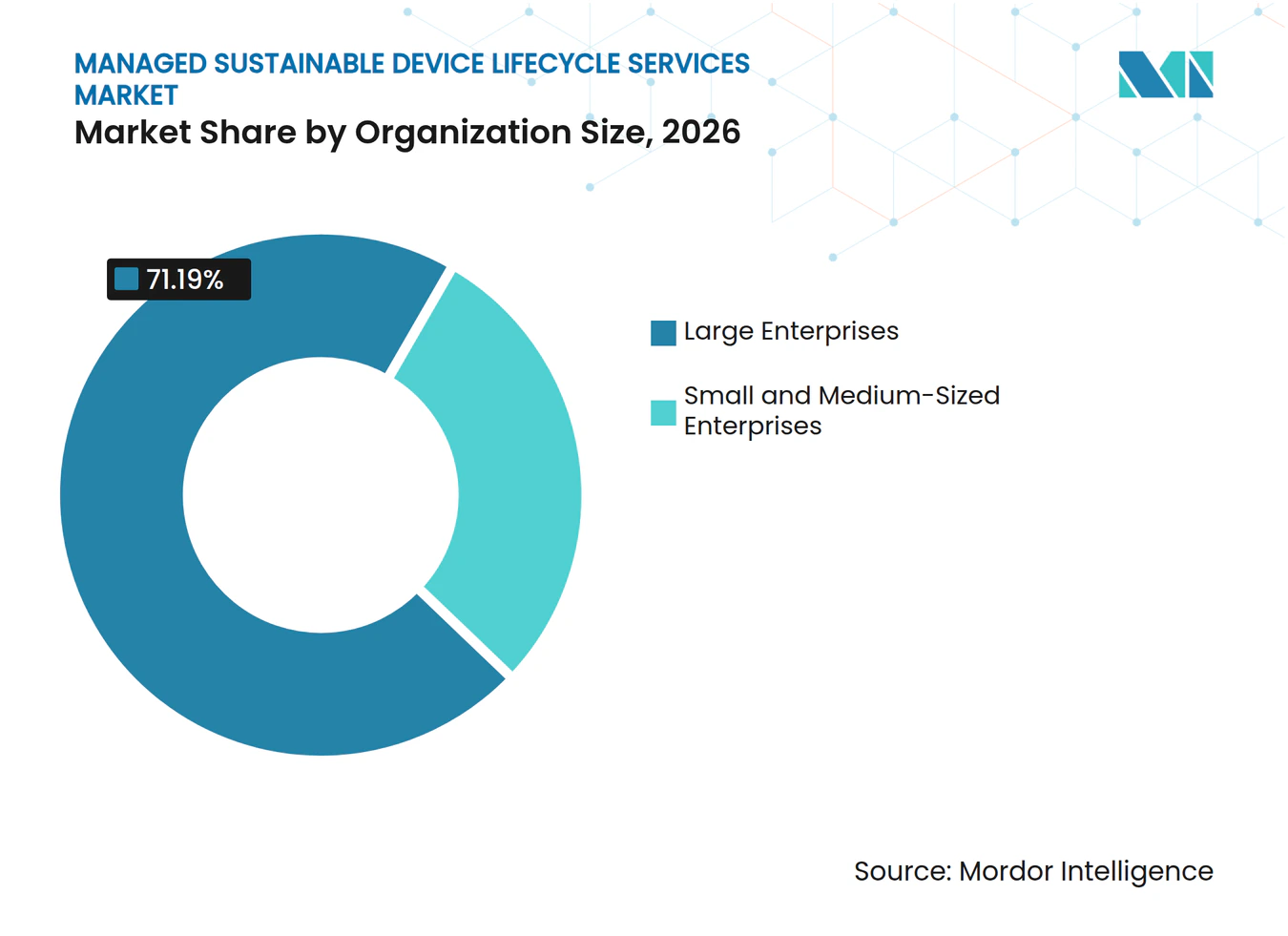
- By organization size, Large Enterprises accounted for 71.19% of the managed sustainable device lifecycle services market revenue in 2026, while Small and Medium-Sized Enterprises are projected to expand at a 16.04% CAGR through 2032.
- By end-user industry, IT and Telecommunications accounted for 28.55% of the managed sustainable device lifecycle services market revenue in 2026, while Government and Public Administration is projected to expand at a 14.67% CAGR through 2032.
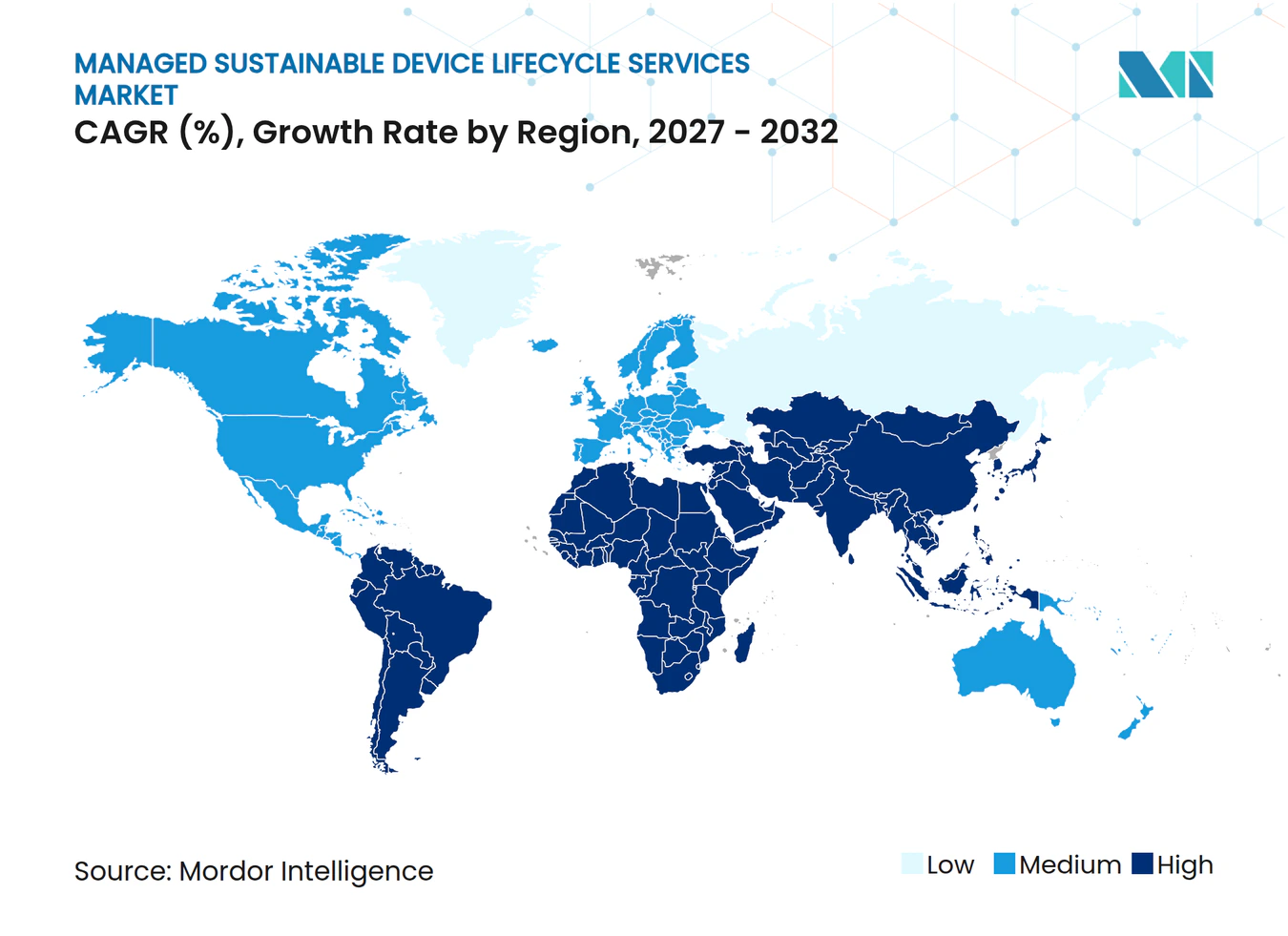
- By geography, North America accounted for 37.61% of the managed sustainable device lifecycle services market revenue in 2026, while Asia-Pacific is projected to expand at a 14.98% CAGR through 2032.
Note: Market numbers in this report are based on Mordor Intelligence's proprietary estimation framework, which combines nine months of actuals with Q4 projections for base year 2026.
Global Managed Sustainable Device Lifecycle Services Market Trends and Insights
Drivers Impact Analysis*
| Driver | (~) % Impact on CAGR Forecast | Geographic Relevance | Impact Timeline |
|---|---|---|---|
| Enterprise Shift Toward Circular IT Procurement | +3.9% | Global, with lead adoption in North America and Europe | Medium term (2-4 years) |
| Regulatory Demand for Traceable E-Waste and Data Handling | +2.8% | Europe and North America, expanding into Asia-Pacific | Long term (≥ 4 years) |
| Accelerating AI and Data Center Hardware Refresh Cycles | +2.5% | Global, concentrated in North America and Asia-Pacific | Short term (≤ 2 years) |
| Rising Need for Secure Multi-Vendor Fleet Visibility | +1.7% | Global, particularly North America and Europe | Medium term (2-4 years) |
| Serialized Device-Level Carbon and Recovery Reporting | +1.3% | Europe and North America, expanding into Asia-Pacific | Long term (≥ 4 years) |
| On-Site Sanitization for Sovereign and Distributed Workforces | +0.8% | Europe, Middle East, and Australia | Medium term (2-4 years) |
| Source: Mordor Intelligence | |||
Enterprise Shift Toward Circular IT Procurement
Procurement teams are placing circularity conditions into device contracts at the acquisition stage. This change makes end-of-life planning part of vendor selection rather than a separate activity after deployment. Higher resale values for server components in 2025 gave finance teams a clearer case for formal recovery programs. ITU-T Recommendation L.1061 asks public buyers to assess information and communication technology equipment against end-of-life recovery and waste-neutrality criteria. Similar requirements extend from public procurement to large-company supplier reviews. In the managed sustainable device lifecycle services market, providers need serialized evidence of recovery to qualify for more formal procurement programs.
Regulatory Demand for Traceable E-Waste and Data Handling
Tighter disposal, shipment, and data-handling rules create a stable need for auditable services across the managed sustainable device lifecycle services market. The European Commission stated in 2025 that nearly 50% of electronic waste in Europe still bypassed formal collection channels. The planned Circular Economy Act is expected to strengthen collection and digital traceability arrangements. The European Union will require digital documentation for waste shipments from May 21, 2026, replacing paper-based processes for relevant cross-border flows. The United Kingdom's 2025-2029 IT hardware and disposition framework requires suppliers to meet WEEE, GDPR, and National Cyber Security Center secure sanitization requirements. These rules favor managed sustainable device lifecycle services market participants that can show a complete chain of custody.
Accelerating AI and Data Center Hardware Refresh Cycles
Generative AI infrastructure is shortening refresh cycles for high-performance servers. SK Tes stated in 2026 that GPU-dense servers are being refreshed in 10-18 months, compared with 4-6 years for traditional enterprise systems. This creates concentrated groups of high-value sthe memory chips produced worldwide, thereby supporting systems entering decommissioning within a narrow period. SK Tes also reported that AI data centers use 70% of the memory chips produced worldwide, thereby supporting demand for valuable memory modules.[1] Standard enterprise laptop cycles shortened from 4.3 years to 4.0 years in 2025 as organizations prepared for Windows 10 end of support and AI-capable devices. The managed sustainable device lifecycle services market must therefore handle faster and more variable equipment returns.
Rising Need for Secure Multi-Vendor Fleet Visibility
The managed sustainable device lifecycle services market serves large device estates spanning multiple suppliers, operating systems, and asset classes. Compliance, finance, and sustainability teams need a single record of each device's location, sanitization status, and final disposition. The share of information technology organizations following NIST 800-88 sanitization practices rose from 34% in 2024 to 52% in 2025. Banking, financial services, insurance, and government organizations face higher consequences when documentation is incomplete. Demand is rising for fleet dashboards, automated certificates, and serialized chain-of-custody records. Platform integration capability has become as important as processing capacity when selecting vendors for managed sustainable device lifecycle services.
Restraints Impact Analysis*
| Restraint | (~) % Impact on CAGR Forecast | Geographic Relevance | Impact Timeline |
|---|---|---|---|
| Fragmented Legacy Asset Records | -1.8% | Global, most acute in small and medium-sized enterprises and emerging markets | Medium term (2-4 years) |
| High Cost of Certified Processing for Low-Value Devices | -1.4% | Global, particularly burdensome in South America and Africa | Long term (≥ 4 years) |
| Cross-Border Chain-of-Custody and Compliance Variability | -0.9% | Cross-regional, most acute in Asia-Pacific with spillover to the Middle East and Africa | Long term (≥ 4 years) |
| Residual-Value Volatility for AI Servers and Emerging Devices | -0.7% | Global, concentrated in North America and Asia-Pacific | Short term (≤ 2 years) |
| Source: Mordor Intelligence | |||
Fragmented Legacy Asset Records
Decentralized information technology procurement has left many organizations with incomplete asset records. Some companies cannot accurately identify the devices they own, their configuration, warranty age, or prior sanitization history. These gaps make onboarding to serialized lifecycle platforms slower and more expensive. Inconsistent asset tags, model records, and historical disposition documentation were identified in the 2026 Sage benchmarking study. Providers must absorb discovery work or charge clients for it, which can extend sales cycles. Until firms manage asset data from procurement onward, adoption of managed sustainable device lifecycle services will remain harder for some buyers.
High Cost of Certified Processing for Low-Value Devices
Certified processing involves data sanitization, logistics, environmental documentation, and verification of downstream treatment. For older peripherals, consumer endpoints, and legacy network equipment, these costs can exceed the recoverable value of materials. The constraint is acute for education providers, public agencies, and small businesses that hold large volumes of lower-value assets. Electronic Recyclers International deployed 25 AI-enabled robotic systems for material recovery and grading in 2025, showing how automation can reduce handling costs. Widespread adoption of automation could make certified processing viable across more device categories. Until then, tight unit economics will limit parts of the managed sustainable device lifecycle services market.
*Our forecasts treat driver/restraint impacts as directional, not additive. The impact forecasts reflect baseline growth, mix effects, and variable interactions.
Segment Analysis
By Service Type: Deployment Support Anchors Revenue as Circularity Gains Importance
Deployment and In-Life Device Support accounted for 57.11% of the managed sustainable device lifecycle services market share in 2026. Multi-year contracts cover configuration, imaging, staging, break-fix work, and fleet support, which makes this service central to daily enterprise operations. AI-capable endpoints need a more involved setup, while distributed workforces increase support needs across locations. Refurbishment and Redeployment ranked second as companies extend equipment life to reduce capital spending and support Scope 3 hardware reporting. End-of-Life Processing and Compliance remained necessary where WEEE and related rules require formal treatment.
Asset Recovery and Circularity Management is projected to expand at a 15.34% CAGR through 2032. Valuable server components and the use of disposition proceeds to offset refresh costs are supporting adoption. Server resale values reached nearly 2.5 times their 7-year average in 2025 amid constrained component supply and AI demand. Apto Solutions launched a domestic recovery program with Tusaar in January 2026 for neodymium and dysprosium from shredded hard drives.[2] Battery management, digital product passport integration, and carbon insetting certificates create early-stage revenue opportunities in the managed sustainable device lifecycle services industry.



By Delivery Model: Centralized Scale Is Balanced by Hybrid Security Needs
Off-Site Centralized Processing accounted for 68.17% of revenue in 2026. Dedicated facilities offer scale, specialized certifications, and consistent processes for standardized equipment estates. Large companies can send palletized assets under serialized manifests to high-throughput centers, which supports logistics efficiency. The United Kingdom framework requires compliance with WEEE, GDPR, and secure sanitization for relevant information technology hardware and disposition services. PlanITROI's 2025 move to a 54,000-square-foot facility in North Carolina, featuring robotic automation and AI-based tracking, illustrates continued investment in centralized capacity.
Hybrid Processing is projected to expand at a 15.71% CAGR through 2032. It allows secure on-site handling during retirement while retaining the efficiency of centralized processing later in the workflow. Government bodies, financial institutions, and defense contractors may require storage devices to be sanitized before transport. Bloom ESG and Dynamic Lifecycle Innovations introduced carbon-reporting integration for on-site and hybrid workflows in May 2025. On-Site Processing remains relevant where sovereignty, contract, or regulation prevents hardware from leaving a client site.
By Organization Size: Large Enterprises Lead While Smaller Clients Scale Faster
Large Enterprises held 71.19% of revenue in 2026. Their scale reflects high annual asset volumes and more established governance across multi-country fleets. Differing e-waste and data requirements push these buyers toward managed sustainable device lifecycle services market providers that manage equipment from procurement integration through certified disposition. Iron Mountain added nearly 2 dozen Fortune 1000 Asset Lifecycle Management customers in the first quarter of 2026. Contracts covering decommissioning, remarketing, and recycling across more than 30 countries favor suppliers with broad operating coverage and consistent procedures.
Small and Medium-Sized Enterprises are projected to expand at a 16.04% CAGR through 2032. Managed platforms reduce the cost and effort of creating structured disposition programs, while regulatory and supply-chain requirements are reaching more mid-market firms. These clients have lower volumes but can offer higher per-device margins and need simple digital onboarding. Dynamic Lifecycle Innovations launched Dynamic ITAD Sync on the ServiceNow store in July 2026 to integrate disposition workflows with existing service management systems. Managed sustainable device lifecycle services market providers that simplify enrollment and reporting can reach a wider base of smaller organizations.

By End-User Industry: IT and Telecommunication Leads as Government Demand Advances
IT and Telecommunications accounted for 28.55% of revenue in 2026. Cloud providers and telecom operators retire servers, networking equipment, and edge devices on planned cycles, making them key clients for large lifecycle contracts. SK Tes reported 126 million kg of reused and recycled information technology assets in 2025. This activity reflects the operational importance of certified recovery for managed sustainable device-lifecycle services in the technology fleets market. Banking, financial services, and insurance organizations also prioritize these services to meet data-security requirements.
Government and Public Administration is projected to expand at a 14.67% CAGR through 2032. Digitalization spending, sustainable procurement, and data-destruction obligations support demand from public buyers. ITU-T L.1061 includes end-of-life recovery considerations for information and communication technology equipment in circular public procurement. Healthcare, manufacturing, retail, e-commerce, education, and research add demand through secure destruction, device refresh, refurbishment, and donation programs. The managed sustainable device lifecycle services market draws on this broad end-user base beyond the largest technology fleets.
Geography Analysis
North America accounted for 37.61% of the managed sustainable device lifecycle services market share in 2026. The region combines mature secondary hardware channels, established R2v3 and e-Stewards certification ecosystems, and a dense hyperscale data center base. United States climate disclosure expectations, state e-waste rules, and health data protection requirements reinforce demand for certified providers. Iron Mountain secured its first Canadian information technology asset disposition contract in 2025 for an insurance customer. Canada remains less developed than its enterprise information technology base would suggest.
Asia-Pacific is projected to expand at a 14.98% CAGR through 2032. Enterprise digitization, hyperscale investment, and tighter regulation underpin demand for managed sustainable device lifecycle services in the region. China issued a mandatory standard on electronic product information clearance in December 2025, creating a formal data-sanitization requirement for enterprise retirement programs. India generated 1.751 million metric tons of electronic waste in 2023-2024, up from 1.01 million metric tons in 2019-2020, according to United Nations reporting cited in the source draft. Japan is building circular technology arrangements that link procurement, maintenance, remarketing, and disposition.
The managed sustainable device lifecycle services market in Europe held the second-largest regional revenue share in 2026. The European Commission's 2025 dialogue identified the large share of electronic waste that does not enter formal collection channels.[3] The forthcoming Circular Economy Act and digital product passport mechanisms support more traceable equipment records. Germany, France, and the United Kingdom are mature markets, while South America, the Middle East, and Africa remain smaller but are seeing emerging device-retirement volumes driven by new digital infrastructure.
Competitive Landscape
Market Concentration
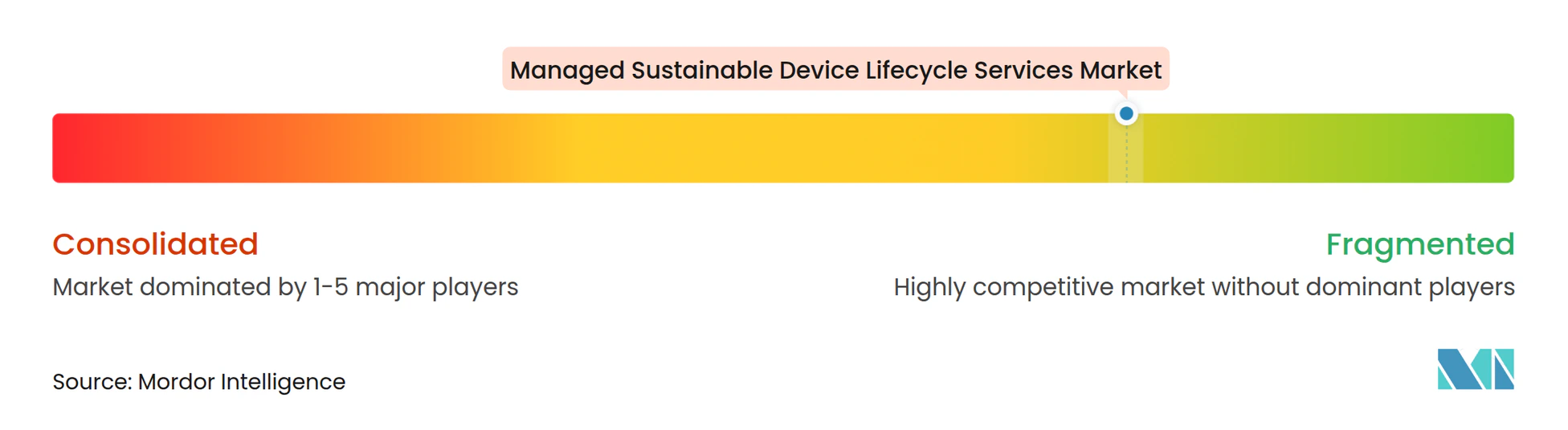
The managed sustainable device lifecycle services market is highly fragmented, with no supplier dominant across services and geographies. Global integrators compete for multi-country contracts requiring a common operating model, while regional specialists rely on local processing capacity, certifications, and client relationships. Specialized providers focus on critical mineral recovery, AI-server decommissioning, and serialized carbon reporting. Iron Mountain reported first-quarter 2026 Asset Lifecycle Management revenue of USD 232 million, an increase of 92% year over year, with 77% organic expansion. Its multi-year mandate for a global advertising company covers decommissioning and remarketing in more than 30 countries.
In the managed sustainable device lifecycle services market, acquisitions are expanding processing coverage and enterprise relationships. Iron Mountain acquired Premier Surplus and ACT Logistics, which contributed USD 17 million of first-quarter 2026 Asset Lifecycle Management revenue. DMD Systems Recovery acquired Lifespan International in June 2026, combining program management with refurbishment, resale, data destruction, and reporting capabilities. Dynamic Lifecycle Innovations opened a Waco, Texas, facility in August 2026 for information technology asset disposition and data-center clients. Providers are also investing in automation, recovery processes, and reporting tools that lower costs and strengthen environmental evidence.
Procurri partnered with Reformation Metals in February 2026 to recover up to 99% of surface gold content from retired circuit boards through a certified route. Electronic Recyclers International's 25 AI-enabled robotic systems show the larger role of automation in grading and material recovery. In the managed sustainable device lifecycle services market, managed programs for smaller firms, hybrid platforms, and sovereign-government contracts remain areas of opportunity. R2v3, ISO 14001, NAID AAA, e-Stewards, and SOC 2 certifications are important entry requirements in enterprise and public procurement.
Managed Sustainable Device Lifecycle Services Industry Leaders
-
SK Tes Pte. Ltd.
-
Apto Solutions, Inc.
-
CEAR, Inc.
-
HOBI International, Inc.
-
Maxicom Network, Inc.
- *Disclaimer: Major Players sorted in no particular order
Recent Industry Developments
- October 2026: SK Tes confirmed in its market insights update that GPU-dense AI servers are refreshing in 10-18 months versus traditional 4-6 year cycles, that AI data centers consume 70% of all memory chips produced worldwide, and that DDR4 price surges followed by inventory-driven corrections are creating secondary-market pricing volatility that materially affects IT asset disposition program economics. The update reinforces the company's investment in global capacity, standardized onsite decommissioning, and advanced data-sanitization technologies at its 40-plus worldwide facilities.
- September 2026: Denmark-based T1A Group and Netherlands-based Flex IT completed a business combination creating a circular-IT enterprise with EUR 150 million (USD 169 million) in annual revenue, linking T1A's enterprise-equipment collection and refurbishment platform with Flex IT's 13,000-reseller European distribution network. Eurazeo's Planetary Boundaries Fund backed the deal with Danish Growth Capital as minority investor.
- August 2026: Dynamic Lifecycle Innovations opened a new ITAD and data center services facility in Waco, Texas, positioned between the Dallas-Fort Worth and Austin technology corridors, citing the state's rapid growth in digital infrastructure investment as the primary driver of demand and expanding its United States processing footprint to 4 states.
- July 2026: Dynamic Lifecycle Innovations launched Dynamic ITAD Sync in the ServiceNow store, enabling enterprise clients to manage ITAD workflows from their existing information technology service management platforms. The release was intended to reduce onboarding friction for mid-market customers by connecting asset disposition activities to established service management processes.
Global Managed Sustainable Device Lifecycle Services Market Report Scope
The Managed Sustainable Device Lifecycle Services Market comprises outsourced services that manage the complete lifecycle of enterprise devices while supporting sustainability, circular economy, compliance, and asset-value recovery objectives. These services include deployment, support, refurbishment, redeployment, recovery, recycling, end-of-life processing, and regulatory compliance management.
The Managed Sustainable Device Lifecycle Services Market Report is Segmented by Service Type (Deployment and In-Life Device Support, Refurbishment and Redeployment, Asset Recovery and Circularity Management, End-of-Life Processing and Compliance, and Other Service Types), Delivery Model (On-Site Processing, Off-Site Centralized Processing, and Hybrid Processing), Organization Size (Large Enterprises, and Small and Medium-Sized Enterprises), End-User Industry (Banking, Financial Services, and Insurance [BFSI], Government and Public Administration, Healthcare and Life Sciences, IT and Telecommunication, Industrial Manufacturing, Retail and E-commerce, Education and Research Institutions, and Other End-User Industries), and Geography (North America, South America, Europe, Asia-Pacific, Middle East, and Africa). The Market Forecasts are Provided in Terms of Value (USD).
| Servers |
| Storage Systems |
| Hardware Maintenance and Repair |
| Technical Support and Remote Diagnostics |
| Spare Parts and Logistics Management |
| Installation and Relocation Support |
| Other Service Types |
| Large Enterprises |
| Small and Medium-Sized Enterprises |
| Banking, Financial Services, and Insurance (BFSI) |
| Government and Public Administration |
| Healthcare and Life Sciences |
| IT and Telecommunication |
| Industrial Manufacturing |
| Retail and E-commerce |
| Education and Research Institutions |
| Other End-User Industries |
| North America | United States |
| Canada | |
| Mexico | |
| South America | Brazil |
| Argentina | |
| Rest of South America | |
| Europe | Germany |
| United Kingdom | |
| France | |
| Italy | |
| Russia | |
| Rest of Europe | |
| Asia-Pacific | China |
| Japan | |
| India | |
| South Korea | |
| Rest of Asia-Pacific | |
| Middle East | Saudi Arabia |
| United Arab Emirates | |
| Rest of Middle East | |
| Africa | South Africa |
| Nigeria | |
| Rest of Africa |
| By Equipment Type | Servers | |
| Storage Systems | ||
| By Service Type | Hardware Maintenance and Repair | |
| Technical Support and Remote Diagnostics | ||
| Spare Parts and Logistics Management | ||
| Installation and Relocation Support | ||
| Other Service Types | ||
| By Organization Size | Large Enterprises | |
| Small and Medium-Sized Enterprises | ||
| By End-User Industry | Banking, Financial Services, and Insurance (BFSI) | |
| Government and Public Administration | ||
| Healthcare and Life Sciences | ||
| IT and Telecommunication | ||
| Industrial Manufacturing | ||
| Retail and E-commerce | ||
| Education and Research Institutions | ||
| Other End-User Industries | ||
| By Geography | North America | United States |
| Canada | ||
| Mexico | ||
| South America | Brazil | |
| Argentina | ||
| Rest of South America | ||
| Europe | Germany | |
| United Kingdom | ||
| France | ||
| Italy | ||
| Russia | ||
| Rest of Europe | ||
| Asia-Pacific | China | |
| Japan | ||
| India | ||
| South Korea | ||
| Rest of Asia-Pacific | ||
| Middle East | Saudi Arabia | |
| United Arab Emirates | ||
| Rest of Middle East | ||
| Africa | South Africa | |
| Nigeria | ||
| Rest of Africa | ||
Key Questions Answered in the Report
What is the size of the managed sustainable device lifecycle services market?
The managed sustainable device lifecycle services market is projected to increase from USD 8.70 billion in 2026 and USD 9.89 billion in 2027 to USD 19.11 billion by 2032, at a 14.08% CAGR.
What is driving demand for managed sustainable device lifecycle services?
Shorter server and endpoint refresh cycles, traceable e-waste rules, secure data handling, and stronger asset-recovery programs are supporting demand.
Which service type has the largest share?
Deployment and In-Life Device Support held 57.11% of revenue in 2026 because it supports configuration, deployment, and ongoing fleet management.
Which delivery model is expanding fastest?
Hybrid Processing is projected to expand at a 15.71% CAGR through 2032 as clients combine on-site sanitization with centralized processing.
Which customer group is expanding fastest?
Small and Medium-Sized Enterprises are projected to expand at a 16.04% CAGR through 2032 as managed platforms reduce onboarding effort.
Which region is projected to expand fastest?
Asia-Pacific is projected to expand at a 14.98% CAGR through 2032, supported by digitization, data-center investment, and tighter disposal requirements.