
Managed Mobile Device Lifecycle Services Market Size and Share
Market Overview
| Study Period | 2021 - 2032 |
|---|---|
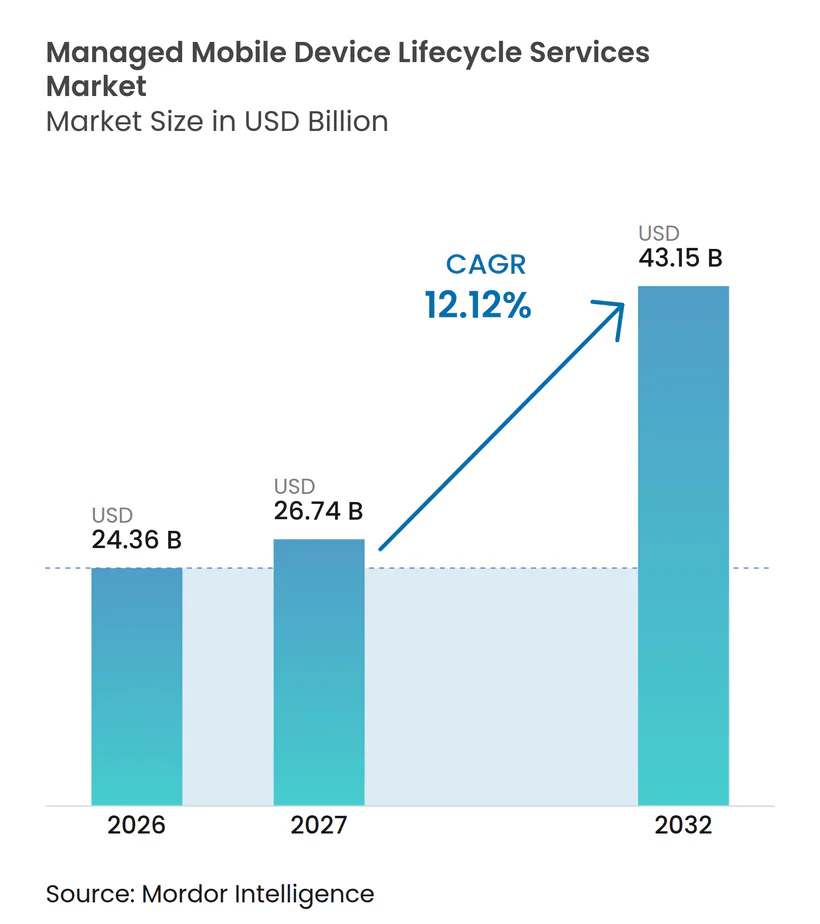
| Market Size (2027) | USD 26.74 Billion |
| Market Size (2032) | USD 43.15 Billion |
| Growth Rate (2027 - 2032) | 12.12 % |
| Fastest Growing Market | Asia-Pacific |
| Largest Market | North America |
| Market Concentration | Medium |
Major Players *Disclaimer: Major Players sorted in no particular order Image © Mordor Intelligence. Reuse requires attribution under CC BY 4.0. | |
Managed Mobile Device Lifecycle Services Market Analysis by Mordor Intelligence
The managed mobile device lifecycle services market size is projected to expand from USD 24.36 billion in 2026 to USD 43.15 billion by 2032, registering a CAGR of 12.12% between 2027 and 2032. Organizations are combining device procurement, deployment, management, support, recovery, and disposal under integrated service contracts rather than managing each activity as a separate cost center. This approach puts more weight on providers that can link technical operations with secure logistics and verifiable custody records, while giving enterprise teams clearer accountability for device condition, user access, replacement timing, approved applications, data protection, inventory reconciliation, and the recovery of units when employees leave or devices reach end of service. Data sovereignty rules in the European Union, Brazil, and China also require providers to organize device data workflows around local legal requirements. The addressable base remains broad because many organizations have not yet adopted end-to-end managed lifecycle services across their full device portfolios, locations, and support functions. The managed mobile device lifecycle services market is also supported by AI-enabled device refresh programs that require faster provisioning and more dependable endpoint control.
Key Report Takeaways
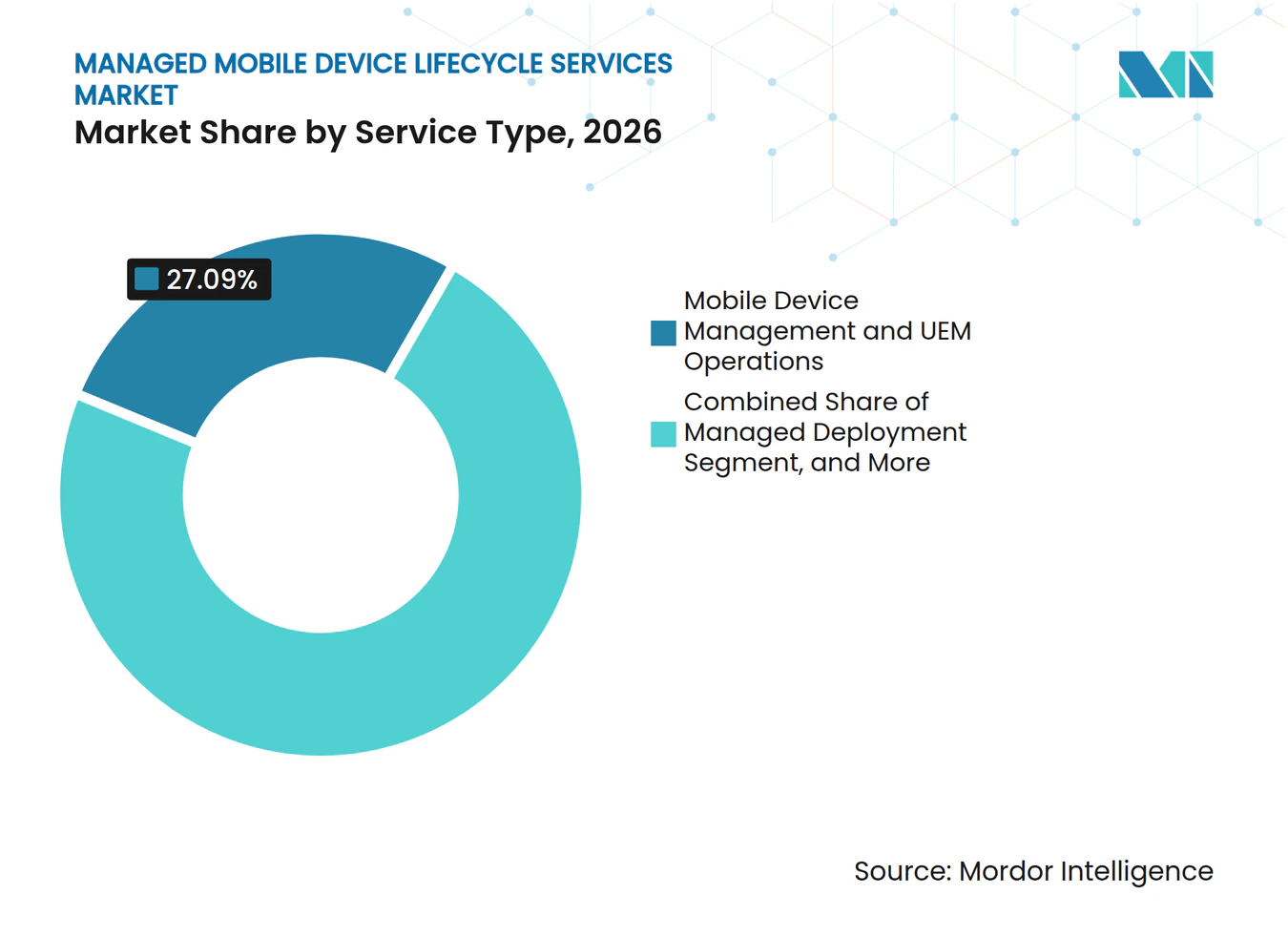
- By service type, Mobile Device Management and UEM Operations held 27.09% of the managed mobile device lifecycle services market share in 2026, while Asset Disposition, Remarketing and Recycling Services is projected to expand at a 13.65% CAGR through 2032.
- By device type, Smartphones accounted for 40.02% of the managed mobile device lifecycle services market share in 2026, while IoT and Edge Devices is projected to expand at a 13.72% CAGR through 2032.
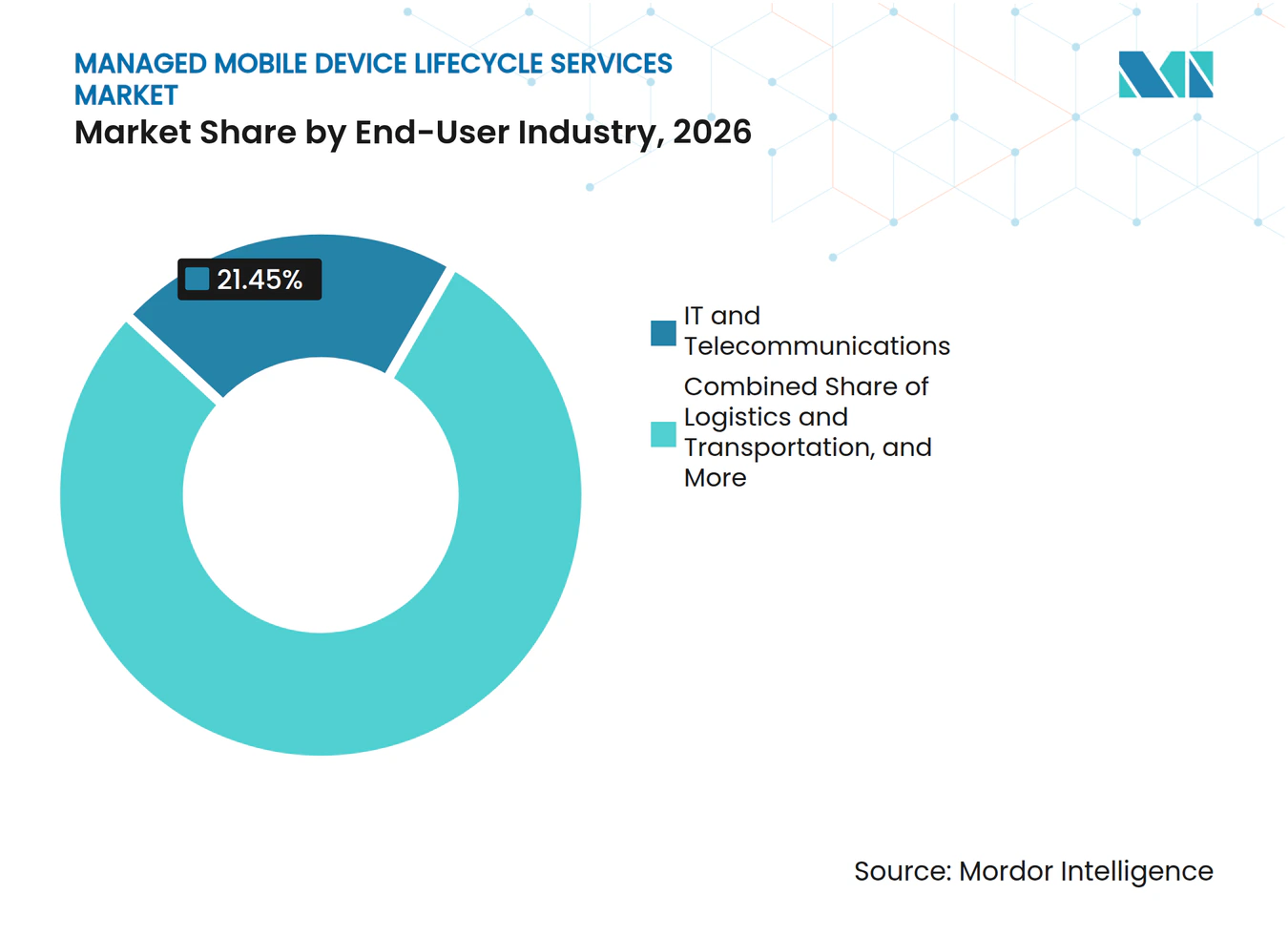
- By end-user industry, IT and Telecommunications held 21.45% of the managed mobile device lifecycle services market share in 2026, while Logistics and Transportation is projected to expand at a 13.68% CAGR through 2032.
- By geography, North America held 41.01% of the managed mobile device lifecycle services market share in 2026, while Asia-Pacific is projected to expand at a 13.87% CAGR through 2032.
Note: Market numbers in this report are based on Mordor Intelligence's proprietary estimation framework, which combines nine months of actuals with Q4 projections for base year 2026.
Market Trends and Insights
Drivers Impact Analysis of Managed Mobile Device Lifecycle Services Market*
| Driver | (~) % Impact on CAGR Forecast | Geographic Relevance | Impact Timeline |
|---|---|---|---|
| Enterprise Device Fleet Complexity and Outsourcing Demand | +3.2% | Global | Medium term (2-4 years) |
| Hybrid Work and Distributed Workforce Enablement | +2.5% | Global, with North America and Europe as primary markets | Medium term (2-4 years) |
| Zero-Touch Provisioning and Cloud-Native UEM Adoption | +2.0% | Global | Short term (≤ 2 years) |
| Device Trade-In, Refurbishment and Residual-Value Recovery | +1.5% | North America, Asia-Pacific, Europe | Medium term (2-4 years) |
| E-Waste, Circularity and Extended Producer Responsibility Requirements | +1.0% | Europe, Asia-Pacific, with spillover to North America | Long term (≥ 4 years) |
| AI-Enabled Predictive Support and Automated Device Grading | +0.8% | Global | Short term (≤ 2 years) |
| Source: Mordor Intelligence | |||
Enterprise Device Fleet Complexity and Outsourcing Demand
Enterprise fleets include smartphones, tablets, laptops, rugged handhelds, wearables, and IoT endpoints across several operating systems and carrier arrangements. Managing those fleets internally requires device configuration, UEM administration, carrier coordination, IT service management integration, secure logistics capabilities, trained personnel, and consistent processes across every office, warehouse, and remote-work location. The managed mobile device lifecycle services market benefits when organizations transfer these combined duties to providers under per-device service agreements, since the same operating model can bring procurement records, enrollment settings, security requirements, user support, replacement plans, recovery procedures, and disposal evidence into a coordinated service process with defined responsibilities. Security teams increasingly influence those decisions because they need consistent policy enforcement and reliable compliance records across varied endpoints. A government requirement for integrated wireless management and lifecycle support shows that centralized mobile services can also be relevant in security-sensitive environments. The managed mobile device lifecycle services market therefore rewards providers that can run large and diverse fleets without disrupting business operations.
Hybrid Work and Distributed Workforce Enablement
Distributed work has made remote delivery, zero-touch enrollment, and replacement logistics essential parts of device operations. A failed device at an employee home needs a different response from a device used in an office, which increases the value of coordinated support and shipping services. Providers must be able to stage, configure, send, recover, and replace devices across several locations without routine visits to an IT office. The managed mobile device lifecycle services market is supported by this operational requirement because centralized management can reduce the burden on internal support teams, give managers one accountable service contact, and provide workers with a defined process for receiving replacements, returning failed devices, and retaining access to required applications. Modern device management practices using Microsoft Intune and Microsoft Defender were associated with a 24% decline in help-desk tickets in a 2025 NTT DATA account.[1] Service quality increasingly depends on whether logistics coverage matches the geographic distribution of the customer workforce.
Zero-Touch Provisioning and Cloud-Native UEM Adoption
Zero-touch provisioning allows organizations to prepare and enroll devices before employees receive them, reducing manual setup work. This model gives providers a practical role in deployment as well as ongoing endpoint administration, inventory accuracy, policy enforcement, software maintenance, and fast remediation when a device does not comply with established security settings. Cloud-native UEM platforms can bring iOS, Android, Windows, macOS, and edge operating systems into one management environment. The managed mobile device lifecycle services market gains from platform consolidation because clients can expect one service partner to manage a broader set of endpoints, maintain standardized enrollment and security practices, provide consolidated reporting, and coordinate changes as a workforce adds new operating systems, applications, business locations, or connected equipment. BBVA manages 100,000 enterprise devices through zero-touch Android Enterprise enrollment and reported a 70% reduction in provisioning time.[2] Providers with certified integrations for Apple Business Manager, Google Zero-Touch, and Windows Autopilot can reduce onboarding friction for mixed-device fleets.
Device Trade-In, Refurbishment and Residual-Value Recovery
Residual-value recovery has become an important financial consideration in device lifecycle programs because an enterprise needs a clear view of condition, age, repair history, data-erasure status, resale eligibility, and the most suitable channel for each returned unit. Assurant reported that mobile trade-in programs returned USD 1.34 billion in consumer value during Q2 2025, 60% higher than the prior year, and the average traded-in device was 3.88 years old.[3] Longer useful lives can increase recoverable value, but delayed disposition can also reduce the resale value available to organizations. The managed mobile device lifecycle services market gives providers an opportunity to combine secure data erasure, device grading, refurbishment, and resale within the same agreement, helping enterprise clients maintain a documented handoff from the departing employee or worksite through inspection, processing, reuse, resale, recycling, and financial reconciliation. Providers that choose the right resale channel can make end-of-life handling a revenue-recovery process rather than a simple compliance expense. Assurant states that its asset disposition process directs retired devices to higher-value resale channels in real time.
Restraints Impact Analysis of Managed Mobile Device Lifecycle Services Market*
| Restraint | (~) % Impact on CAGR Forecast | Geographic Relevance | Impact Timeline |
|---|---|---|---|
| Integration Costs Across Legacy ITSM, IAM and Carrier Systems | -1.5% | Global | Medium term (2-4 years) |
| Data Sovereignty and Cross-Border Chain-of-Custody Complexity | -1.0% | Europe, Asia-Pacific, with spillover to North America | Long term (≥ 4 years) |
| Vendor Lock-In and Limited Cost Visibility in Managed-Service Contracts | -0.8% | North America and Europe primarily | Medium term (2-4 years) |
| Volatile Residual Values and Inconsistent Device-Grading Standards | -0.5% | Global | Short term (≤ 2 years) |
| Source: Mordor Intelligence | |||
Integration Costs Across Legacy ITSM, IAM and Carrier Systems
Integration costs can slow adoption when a provider platform must connect with existing IT service management, identity management, carrier billing systems, asset records, procurement processes, security controls, and established service-desk practices that were created independently over many years. Large organizations often operate a mix of older systems that require tailored work before a managed lifecycle program can begin. Those requirements can extend implementation schedules and increase contract entry costs for smaller enterprises. They can also create switching costs when a client has already invested in a provider-specific configuration. The managed mobile device lifecycle services market can therefore favor established providers with tested connectors for common enterprise systems. Providers still need to present costs clearly because long-term dependencies may limit a customer’s willingness to expand the service relationship, renew at the end of a term, or move additional device groups into a program that appears difficult to compare with internal operations or competing proposals.
Data Sovereignty and Cross-Border Chain-of-Custody Complexity
Data sovereignty requirements create a compliance challenge for providers serving multinational device fleets because a physical endpoint may contain business information, employee information, security credentials, application data, and audit records at several points during collection, transport, repair, or disposal. A device moving across a border may involve obligations under the European Union General Data Protection Regulation, China’s Personal Information Protection Law, Japan’s Act on the Protection of Personal Information, and Brazil’s General Data Protection Law. Banking, healthcare, and government customers need custody records that satisfy local audit requirements, which can require local sanitization and processing capacity. The International Telecommunication Union issued Recommendation ITU-T L.1037 in September 2025 on requirements for the collection, transport, storage, dismantling, recovery, and final disposal of waste electrical and electronic equipment. These duties can limit cross-border service standardization in the managed mobile device lifecycle services market. They also create demand for providers that can document each stage of collection, processing, and disposal, show where a device was held, identify the party responsible at each transfer, and provide records that are usable during client reviews and regulatory examinations.
*Our forecasts treat driver/restraint impacts as directional, not additive. The impact forecasts reflect baseline growth, mix effects, and variable interactions.
Managed Mobile Device Lifecycle Services Market Segment Analysis
By Service Type:
UEM Operations Hold the Largest Revenue Position as Disposition Services ExpandMobile Device Management and UEM Operations held 27.09% of the managed mobile device lifecycle services market share in 2026, making it the largest service category. The category reflects the need for unified endpoint management as a security and compliance foundation, particularly where organizations need a single policy framework that can support employees, contractors, shared devices, frontline workers, and devices used outside traditional office networks. Organizations use UEM operations to establish policies, monitor devices, apply updates, and maintain control across operating systems. The category remains central to contracts because it connects deployment, support, and recovery work with daily device management. Integration Labs also add value by preparing and certifying devices for specific customer environments before release. Managed Deployment services benefit from headcount changes and device refresh cycles, particularly when zero-touch enrollment reduces manual setup.
Asset Disposition, Remarketing and Recycling Services is projected to expand at a 13.65% CAGR through 2032, the fastest rate among service categories. The managed mobile device lifecycle services market size for this service is supported by refresh programs that link device health data with residual-value decisions. SHI International introduced its Intelligent Refresh Program in January 2026 to use device health telemetry and residual-value analytics instead of calendar-based refresh decisions. The company stated that Omdia-validated research found a 21% total cost of ownership reduction over 3 years for participating organizations. Device-as-a-Service agreements can bundle procurement, management, and end-of-life recovery into a per-device subscription. Support, Maintenance and Repair Services remains a high-volume area where break-fix logistics and overnight replacement commitments are important differentiators.



By Device Type:
Smartphones Lead While IoT and Edge Devices Broaden Fleet RequirementsSmartphones accounted for 40.02% of the managed mobile device lifecycle services market share in 2026. They remain the main productivity device for field, retail, and corporate workforces because they support communication, authentication, task management, field data capture, customer engagement, and access to applications that increasingly replace paper-based or fixed-terminal processes. Their scale supports demand for managed deployment, UEM operations, repair, and certified resale services. Smartphone programs also require timely replacements because device failures can interrupt customer-facing and operational work. Tablets and laptops are important for workforces that use desktop applications, collaboration tools, or mobile data capture. Wearable devices remain a smaller category, with use concentrated in healthcare and logistics settings where hands-free operation can support daily work.
IoT and Edge Devices is projected to expand at a 13.72% CAGR through 2032. The managed mobile device lifecycle services market applies similar processes to industrial scanners, warehouse handhelds, and connected field equipment that were previously managed less formally. Large device estates at logistics and manufacturing sites can make zero-touch enrollment and centralized policy management more practical than local IT administration. Advantech describes remote management for embedded systems as a way to improve oversight of edge equipment in connected operations. Rugged mobile devices need specialized maintenance and uptime-focused replacement programs because their users work in demanding environments. Research published in 2025 found that a deep-learning model achieved 70.4% precision with 8 millisecond inference time in smartphone cosmetic defect grading. Automated grading can increase refurbishment throughput while placing pressure on providers that rely solely on manual processes.
By End-User Industry:
IT and Telecommunications Lead While Logistics and Transportation Advances FastestIT and Telecommunications held 21.45% of the managed mobile device lifecycle services market share in 2026. Technology businesses manage diverse device estates across developer, sales, and field-service workforces in several locations. These environments require coordinated management across multiple operating systems and security rules. Banking, Financial Services and Insurance is another significant demand area because device security, data separation, and audit requirements can add operating complexity. Healthcare also requires secure device management and sanitization practices for clinical environments. Manufacturing, Retail, and E-Commerce operate high-volume fleets of rugged and shared-use endpoints where reliable uptime is important.
Logistics and Transportation is projected to expand at a 13.68% CAGR through 2032. E-commerce fulfillment, last-mile delivery digitization, and warehouse automation programs require larger deployments of rugged devices that are configured consistently, protected against misuse, readily repaired, and replaced quickly when a failure would delay order processing or transport activity. The managed mobile device lifecycle services market is relevant to this vertical because providers can handle staging, policy control, repair, and replacement at depot and warehouse scale. Stratix Corporation and NomadGo announced a January 2026 partnership that combines on-device Inventory AI with Stratix managed mobility services on Apple hardware. Government and public sector contracts can also have long terms and strict custody requirements. Those needs place a premium on suppliers with well-documented processes and dependable service coverage.

Geography Analysis
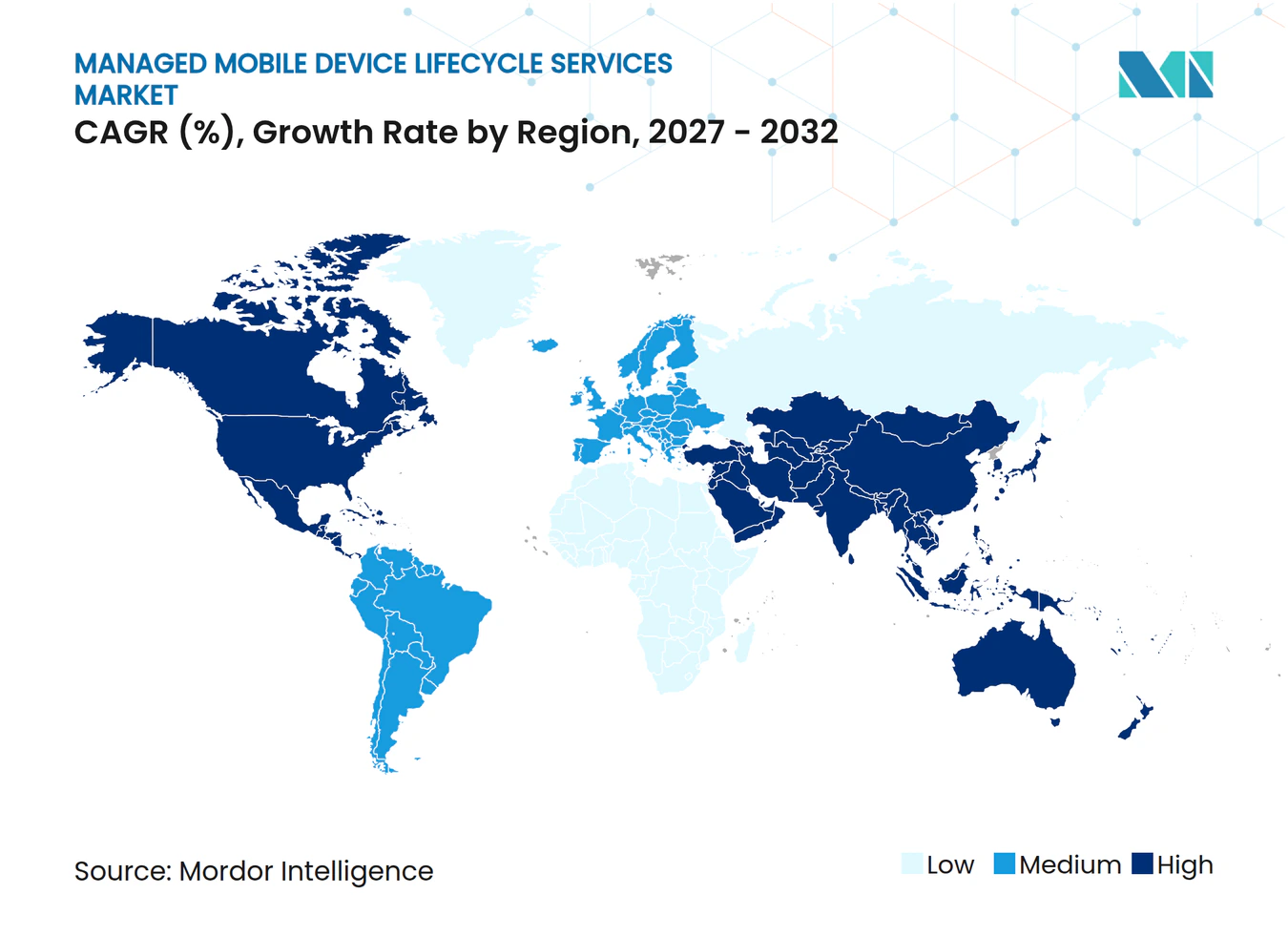
North America held 41.01% of the managed mobile device lifecycle services market share in 2026. The United States accounts for much of regional demand because enterprise fleets have reached a scale where internal lifecycle management can create material operating costs. Mature outsourcing practices and a concentration of multinational organizations support adoption, while Canada and Mexico add manufacturing and logistics demand. South America is led by Brazil, where the corporate device base and data protection obligations support structured lifecycle services. Regional providers must still meet different carrier, shipping, and custody requirements across national markets.
Europe holds a substantial position in the managed mobile device lifecycle services market, led by Germany, the United Kingdom, and France, where globally distributed mobile fleets require reliable lifecycle documentation. European Union rules that started applying on June 20, 2025 require smartphones and tablets to meet durability, energy-efficiency, and repairability requirements, including 800 charge cycles with 80% battery retention, spare-part availability for 7 years, and operating system updates for at least 5 years. An A to E repairability score now appears on European Union device labels, which can extend useful lives and raise the value of repair, refurbishment, and support programs. Foxway processed 1.8 million reused mobile devices, tablets, and computers in 2025, with reuse rates reaching 90%. These conditions favor providers that can document condition, repair history, data erasure, and onward channels for each device.
Asia-Pacific is projected to expand at a 13.87% CAGR through 2032, the fastest geographic rate. India is seeing rising demand for managed deployment as technology organizations expand hybrid workforces into tier-2 cities, while Japan requires management of rugged devices and IoT endpoints for manufacturing. China’s Personal Information Protection Law can favor local chain-of-custody providers, while the United Arab Emirates and Saudi Arabia support enterprise digitization and South Africa, Egypt, and Nigeria build early adoption through financial services and telecommunications activity. These varied requirements make local operations and regional partnerships important to service delivery.
Competitive Landscape
Market Concentration
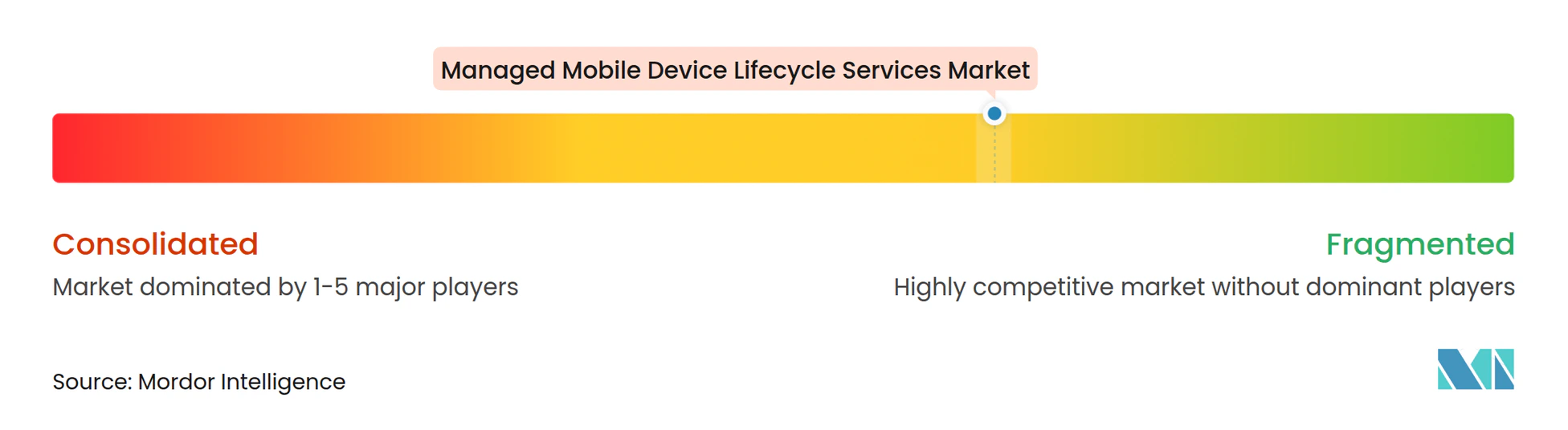
The managed mobile device lifecycle services market is moderately fragmented. Assurant, Ingram Micro, and Computacenter compete across several service categories and geographic markets, while regional specialists address distinct fleet types, industries, and disposition needs. Larger providers increasingly differentiate through automation, analytics, security controls, and service coverage rather than basic service breadth alone. This structure leaves room for specialists that meet local custody, repair, or regulated-industry requirements. It also gives buyers a choice between broad global contracts and more focused regional capabilities.
Assurant acquired OptoFidelity’s mobile-device test automation portfolio in October 2025, expanding automation capabilities in its Device Care Centers for certified pre-owned device grading and certification.Ingram Micro uses its Xvantage platform and Intelligent Digital Assistant to support automated lifecycle workflows. These investments make asset tracking, grading, and customer reporting more important to competitive positioning. Automation can improve throughput and consistency in refurbishment-intensive services. Providers that cannot automate key steps may face tighter margins and slower turnaround times.
Stratix Corporation is developing a position in retail and logistics by incorporating AI-based operational tools within managed mobility contracts. deviceNOW GmbH uses Device-as-a-Service programs and circular device services for European enterprise customers. Computacenter has been listed as a representative vendor in the Gartner Market Guide for Managed Device Lifecycle Services for 2 consecutive years, according to the company’s October 2025 announcement. IoT and edge devices, as well as emerging Asia-Pacific and African markets, remain areas of opportunity because adoption is rising faster than unified lifecycle service capacity.
Managed Mobile Device Lifecycle Services Industry Leaders
-
Assurant, Inc.
-
DMI (Digital Management, LLC)
-
Ingram Micro, Inc.
-
Foxway AB
-
Likewize Corp.
- *Disclaimer: Major Players sorted in no particular order
Managed Mobile Device Lifecycle Services Market Companies Covered in this Report
- Assurant, Inc.
- DMI (Digital Management, LLC)
- Ingram Micro, Inc.
- Foxway AB
- Recommerce Solutions SA
- PCS Wireless, LLC
- Likewize Corp.
- Alchemy Global Solutions Limited
- MCE Systems Ltd.
- Mobile Klinik Inc.
- TES-AMM (Holdings) Pte. Ltd.
- Computacenter plc
- JIGSAW24 LIMITED
- SHI International Corp.
- Softcat plc
- Hemmersbach GmbH & Co. KG
- Stratix Corporation
- Utelize Communications Ltd
- deviceNOW GmbH
- Tialis Essential IT PLC
- CellDe Innovation Labs Private Limited
- TRG Solutions, Inc.
- ThingsAt Pty., Ltd.
Recent Industry Developments in Managed Mobile Device Lifecycle Services Market
- October 2026: Assurant celebrated one year after its acquisition of OptoFidelity’s mobile device test-automation technology portfolio and deployed its optical metrology systems across Device Care Centers, increasing grading precision and throughput for Certified Pre-Owned devices and advancing Assurant’s automation roadmap across global refurbishment facilities.
- September 2026: Foxway broke ground on an approximately 10,000 m² expansion of its tech center in Tartu, Estonia, bringing total floor area to 16,890 m². The project will consolidate operations currently split across 2 buildings, advance automation capabilities, and significantly increase refurbishment and trade-in processing volumes for European partners, with completion targeted for 2027.
- February 2026: Foxway announced development of an AI-powered Circular Platform for Retailers and Telcos, a multi-vendor trade-in solution designed for transparent and scalable device trade-in across Europe, with MySWOOOP from Germany named as the initial ecosystem partner.
- January 2026: Stratix Corporation and NomadGo announced a partnership to deliver an AI-powered restaurant operations platform combining on-device Inventory AI with Stratix’s end-to-end managed mobility services on Apple hardware, including lifecycle management, overnight device replacements, and real-time analytics.
Global Managed Mobile Device Lifecycle Services Market Report Scope
The Managed Mobile Device Lifecycle Services Market refers to the industry encompassing outsourced services that manage the complete lifecycle of enterprise mobile devices, including planning, procurement, provisioning, deployment, configuration, mobile device management (MDM), unified endpoint management (UEM), security administration, application deployment, carrier and mobility expense management, technical support, repair, replacement, asset tracking, device refresh, decommissioning, data wiping, recycling, and disposal.
The Managed Mobile Device Lifecycle Services Market Report is Segmented by Service Type (Integration Labs, Managed Deployment, Mobile Device Management and UEM Operations, Support, Maintenance and Repair Services, and Asset Disposition, Remarketing and Recycling Services), Device Type (Smartphones, Tablets, Laptops and Notebooks, Rugged Mobile Devices, Wearable Devices, and IoT and Edge Devices), End-User Industry (IT and Telecommunications, Banking, Financial Services and Insurance, Healthcare, Retail and E-Commerce, Manufacturing, Logistics and Transportation, Government and Public Sector, and Other End-User Industries), and Geography (North America [United States, Canada, Mexico], South America [Brazil, Argentina, Colombia, Chile], Europe [Germany, United Kingdom, France, Italy, Spain, Russia, and Rest of Europe], Asia-Pacific [China, Japan, India, South Korea, Australia, and Rest of Asia-Pacific], Middle East [Saudi Arabia, United Arab Emirates, Turkey, Israel, and Rest of Middle East], and Africa [South Africa, Egypt, Nigeria, and Rest of Africa]). The Market Forecasts are Provided in Terms of Value (USD).
Segmentation Overview
| Integration Labs |
| Managed Deployment |
| Mobile Device Management and UEM Operations |
| Support, Maintenance and Repair Services |
| Asset Disposition, Remarketing and Recycling Services |
| Smartphones |
| Tablets |
| Laptops and Notebooks |
| Rugged Mobile Devices |
| Wearable Devices |
| IoT and Edge Devices |
| IT and Telecommunications |
| Banking, Financial Services and Insurance |
| Healthcare |
| Retail and E-Commerce |
| Manufacturing |
| Logistics and Transportation |
| Government and Public Sector |
| Other End-User Industries |
| North America | United States |
| Canada | |
| Mexico | |
| South America | Brazil |
| Argentina | |
| Colombia | |
| Chile | |
| Europe | Germany |
| United Kingdom | |
| France | |
| Italy | |
| Spain | |
| Russia | |
| Rest of Europe | |
| Asia-Pacific | China |
| Japan | |
| India | |
| South Korea | |
| Australia | |
| Rest of Asia-Pacific | |
| Middle East | Saudi Arabia |
| United Arab Emirates | |
| Turkey | |
| Israel | |
| Rest of Middle East | |
| Africa | South Africa |
| Egypt | |
| Nigeria | |
| Rest of Africa |
| By Service Type | Integration Labs | |
| Managed Deployment | ||
| Mobile Device Management and UEM Operations | ||
| Support, Maintenance and Repair Services | ||
| Asset Disposition, Remarketing and Recycling Services | ||
| By Device Type | Smartphones | |
| Tablets | ||
| Laptops and Notebooks | ||
| Rugged Mobile Devices | ||
| Wearable Devices | ||
| IoT and Edge Devices | ||
| By End-User Industry | IT and Telecommunications | |
| Banking, Financial Services and Insurance | ||
| Healthcare | ||
| Retail and E-Commerce | ||
| Manufacturing | ||
| Logistics and Transportation | ||
| Government and Public Sector | ||
| Other End-User Industries | ||
| By Geography | North America | United States |
| Canada | ||
| Mexico | ||
| South America | Brazil | |
| Argentina | ||
| Colombia | ||
| Chile | ||
| Europe | Germany | |
| United Kingdom | ||
| France | ||
| Italy | ||
| Spain | ||
| Russia | ||
| Rest of Europe | ||
| Asia-Pacific | China | |
| Japan | ||
| India | ||
| South Korea | ||
| Australia | ||
| Rest of Asia-Pacific | ||
| Middle East | Saudi Arabia | |
| United Arab Emirates | ||
| Turkey | ||
| Israel | ||
| Rest of Middle East | ||
| Africa | South Africa | |
| Egypt | ||
| Nigeria | ||
| Rest of Africa | ||
Key Questions Answered in the Report
What is the size of the managed mobile device lifecycle services market?
The market is valued at USD 24.36 billion in 2026 and is projected to reach USD 43.15 billion by 2032, growing at a 12.12% CAGR.
Which service category holds the largest share?
Mobile Device Management and UEM Operations leads the market with a 27.09% share in 2026.
Which device category is expanding fastest?
IoT and Edge Devices is projected to expand at a 13.72% CAGR through 2032.
Why are enterprises outsourcing mobile device lifecycle services?
Enterprises use service providers to coordinate deployment, endpoint management, repair, secure recovery, and disposition across increasingly complex mobile device fleets.
Which end-user sector has the fastest projected expansion?
Logistics and Transportation is projected to expand at a 13.68% CAGR through 2032, supported by warehouse automation and delivery digitization initiatives.
Which region has the fastest projected expansion?
Asia-Pacific is projected to expand at a 13.87% CAGR through 2032, supported by increasing device deployments and growing IoT management requirements.