
Managed Secondary DNS Services Market Size and Share
Market Overview
| Study Period | 2021 - 2032 |
|---|---|
| Market Size (2027) | USD 462.71 Million |
| Market Size (2032) | USD 694.07 Million |
| Growth Rate (2027 - 2032) | 8.45 % |
| Fastest Growing Market | Middle East |
| Largest Market | North America |
| Market Concentration | Medium |
Major Players *Disclaimer: Major Players sorted in no particular order Image © Mordor Intelligence. Reuse requires attribution under CC BY 4.0. | |
Managed Secondary DNS Services Market Analysis by Mordor Intelligence
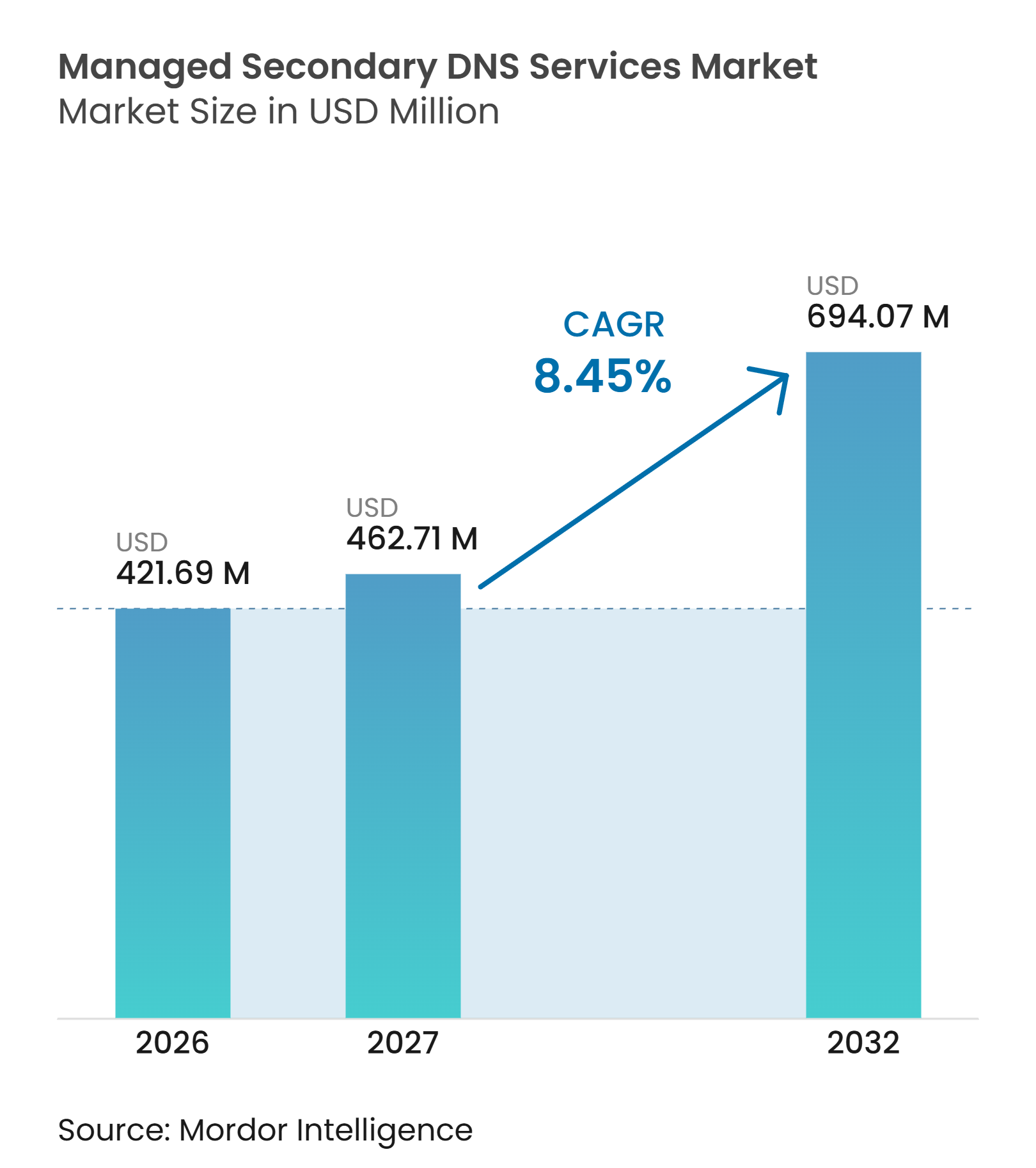
The managed secondary DNS services market size is projected to expand from USD 421.69 million in 2026 and USD 457.32 million in 2027 to USD 694.07 million by 2032, registering a CAGR of 8.45% between 2027 and 2032. Growth reflects the need to keep domains available when a primary DNS provider, cloud region, or network route fails. Multi-cloud deployments make independent DNS copies more valuable because native services do not provide cross-provider zone-transfer guarantees. Security requirements are also changing buying decisions, as DNS is now treated as part of an organization’s availability and security controls rather than a background network service. Providers are responding by combining secondary DNS with DDoS protection, DNSSEC, threat intelligence, and automated management. The managed secondary DNS services market also benefits from rules that prioritize operational resilience and incident reporting for essential organizations.
Key Report Takeaways
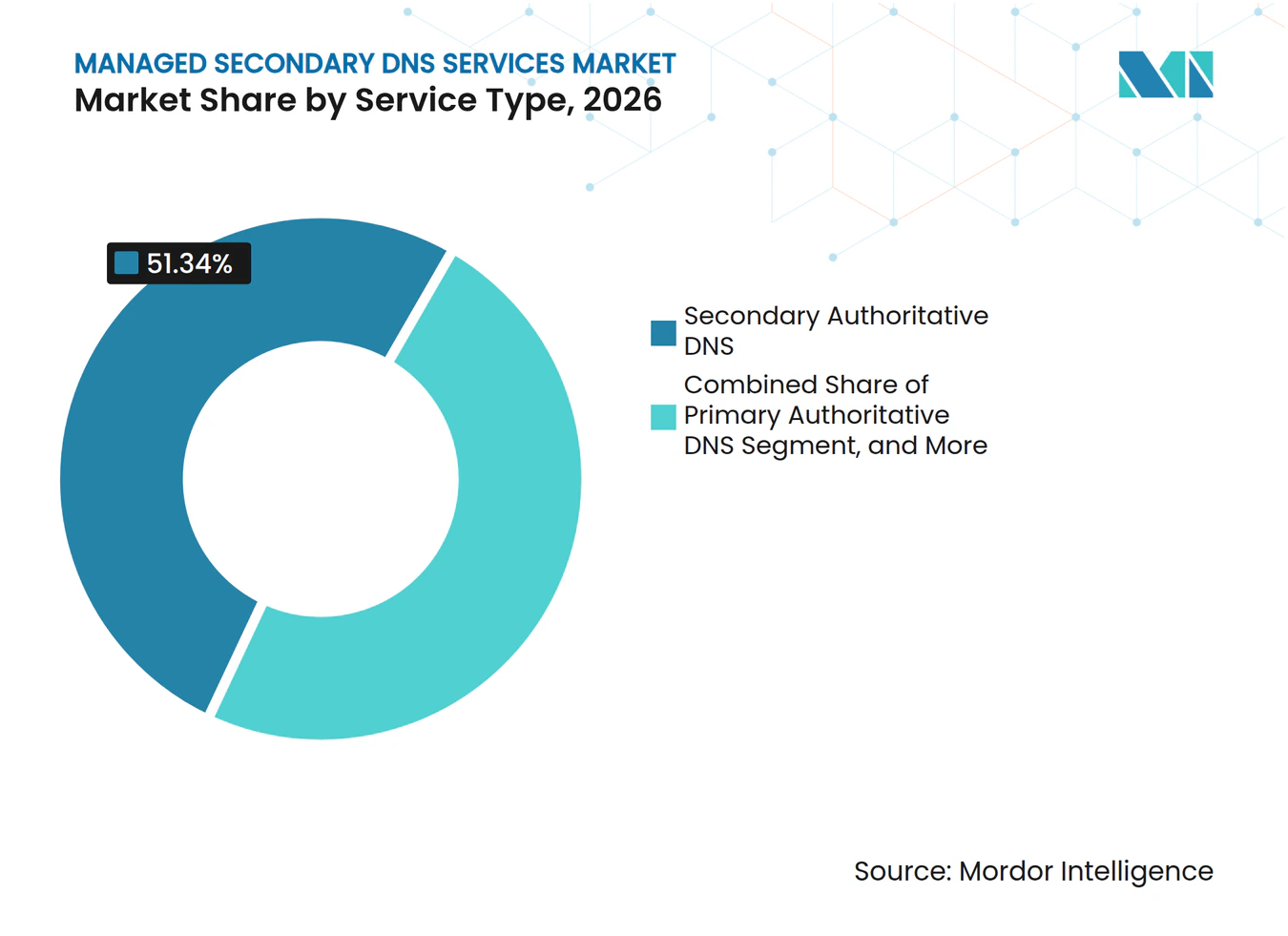
- By service type, Secondary Authoritative DNS held 51.34% of the managed secondary DNS services market share in 2026, while Dynamic DNS is projected to expand at a 9.08% CAGR through 2032.
- By deployment mode, Cloud-Based managed secondary DNS held 74.08% of revenue in 2026 and remained the fastest-growing deployment mode through 2032.
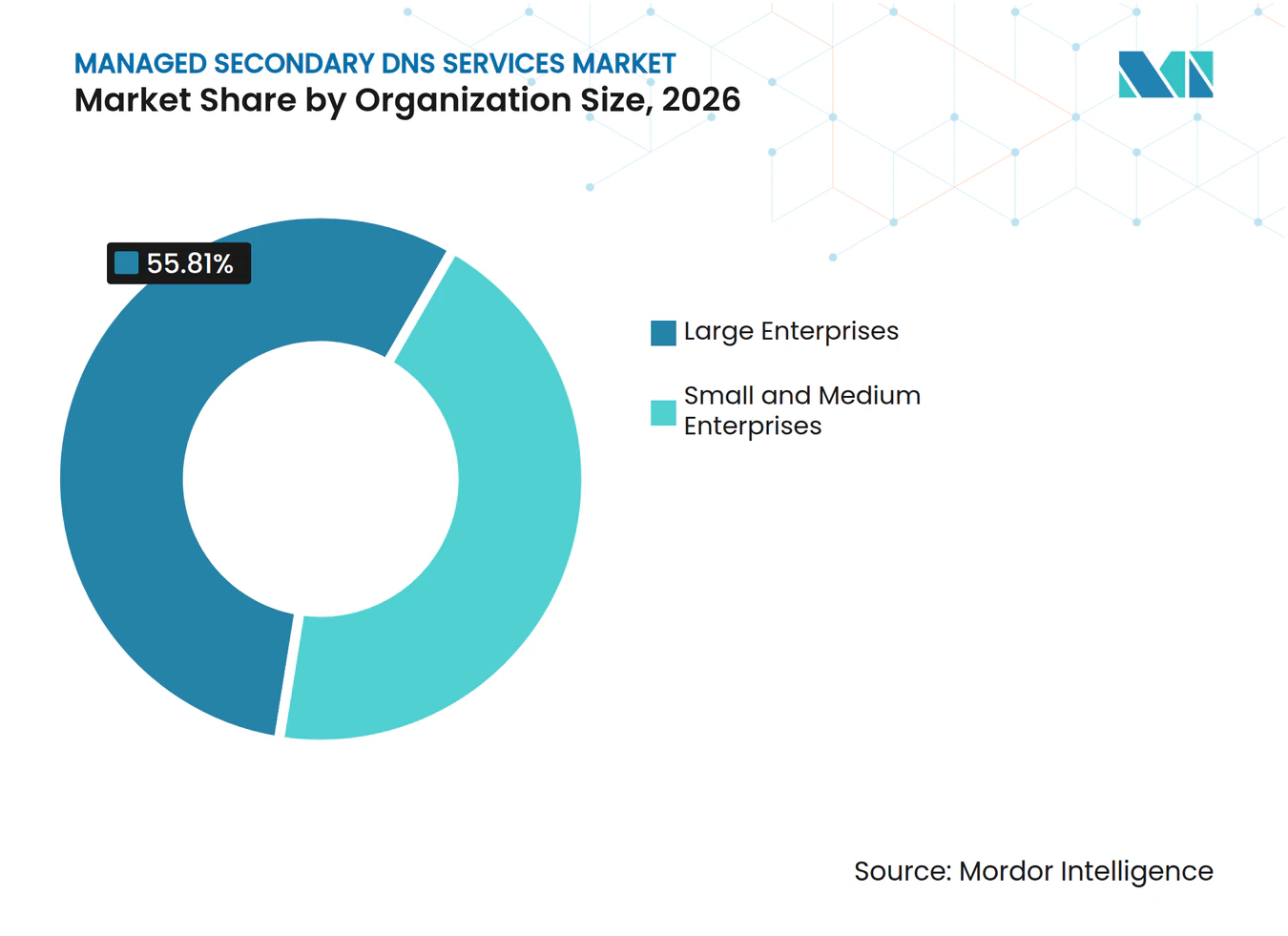
- By organization size, large enterprises held 55.81% of revenue in 2026, while small and medium enterprises are projected to expand at a 9.43% CAGR through 2032.
- By end-user industry, IT and Telecommunications held 26.88% of revenue in 2026, while Energy, Utilities, and Smart Infrastructure are projected to expand at a 9.32% CAGR through 2032.
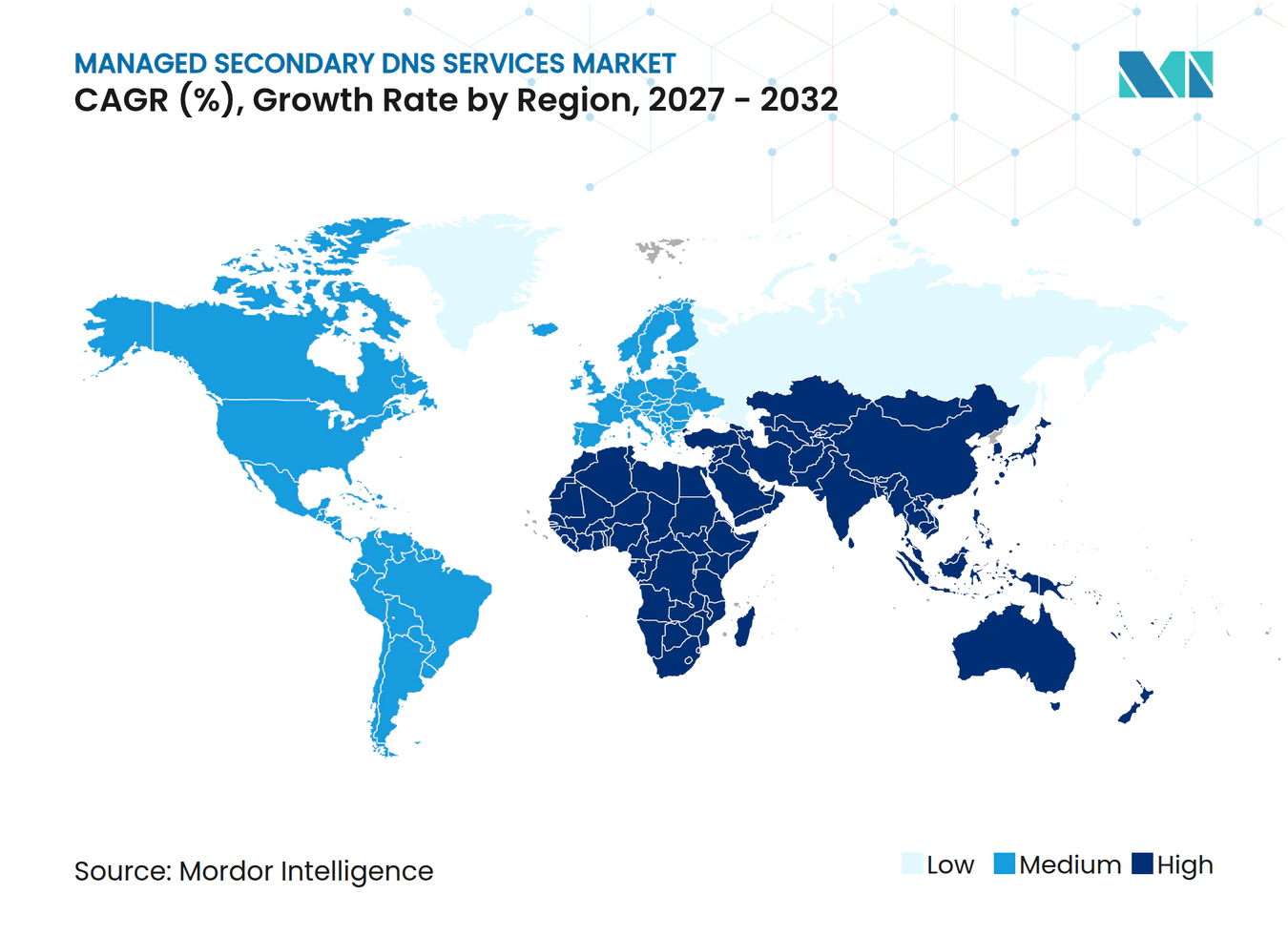
- By geography, North America held 37.83% of revenue in 2026, while the Middle East is projected to expand at a 9.84% CAGR through 2032.
Note: Market numbers in this report are based on Mordor Intelligence's proprietary estimation framework, which combines nine months of actuals with Q4 projections for base year 2026.
Market Trends and Insights
Drivers Impact Analysis of Managed Secondary DNS Services Market*
| Driver | (~) % Impact on CAGR Forecast | Geographic Relevance | Impact Timeline |
|---|---|---|---|
| Cloud Migration and Multi-Cloud Adoption | +2.3% | Global, with a concentration in North America and Europe | Short term (≤ 2 years) |
| Escalating DNS-Based Cyberattacks and Availability Requirements | +1.9% | Global, particularly North America and the Asia-Pacific | Short term (≤ 2 years) |
| Expansion of Edge Computing, CDN, and IoT Endpoints | +1.5% | Asia-Pacific core, with spillover to North America and Europe | Long term (≥ 4 years) |
| Data Residency and Digital Resilience Requirements | +1.1% | Europe, with emerging requirements in the Middle East and Asia-Pacific | Medium term (2-4 years) |
| Secondary DNS Automation for Infrastructure as Code | +0.7% | North America and Europe, with early-mover advantages in Asia-Pacific | Medium term (2-4 years) |
| Hidden Primary and Independent Provider Architectures | +0.5% | Global, enterprise-led adoption | Long term (≥ 4 years) |
| Source: Mordor Intelligence | |||
Cloud Migration and Multi-Cloud Adoption
Multi-cloud environments are making the managed secondary DNS services market more relevant to organizations that need an independent fallback path. A primary DNS service inside 1 cloud does not provide authoritative visibility or recovery for zones managed by another provider. A secondary provider can maintain a neutral copy of the zone and continue to answer requests when the primary environment is unavailable. This design reduces the dependence on a single cloud operator and helps organizations separate DNS resilience from the rest of their cloud stack. It also reduces governance gaps when different teams manage DNS through different cloud interfaces. The managed secondary DNS services market, therefore, gains from the growing need to apply common controls across distributed infrastructure.
Escalating DNS-Based Cyberattacks and Availability Requirements
DNS attacks are increasing the value of an independent authoritative service that can remain available during an incident. Cloudflare reported that DNS-based attacks accounted for 34.3% of network-layer DDoS activity in the first half of 2026. Its report also showed DNS Floods rising from 25.7% of network-layer attacks in the first quarter to 40.0% in the second quarter of 2026. EfficientIP reported a 24% increase in DNS threat signals from the second half of 2025 and described malware as the largest DNS-based threat category in 2026. These events encourage buyers to consider secondary DNS as part of a security service, not only as a failover tool. They also favor providers that combine authoritative services with detection, intelligence, and automated response capabilities.
Expansion of Edge Computing, CDN, and IoT Endpoints
Edge computing and connected devices increase DNS traffic and widen the impact of a resolution failure. In industrial settings, DNS requests support authentication, telemetry, firmware updates, and service discovery, in addition to website access. A failure can therefore interrupt communications with equipment, remote monitoring systems, and grid assets. A 2025 ACM Internet Measurement Conference paper found that many deployed IoT devices use hard-coded DNS resolvers and do not consistently follow TTL values. This behavior makes resilient DNS infrastructure more useful than reliance on device-level configuration alone. The managed secondary DNS services market is likely to benefit as distributed device estates require reliable anycast delivery and independent recovery options.
Data Residency and Digital Resilience Requirements
European resilience rules are shifting DNS design from a technical preference to a governance issue for in-scope organizations. The NIS2 framework establishes cybersecurity requirements for critical and important entities and places DNS service providers within the broader policy focus. Commission Implementing Regulation 2024/2690 sets out the technical and methodological requirements for cybersecurity risk management measures applicable to DNS service providers. The Digital Operational Resilience Act has applied to European financial entities since January 2025, strengthening the importance of ICT risk management in financial services. Buyers also seek in-region points of presence where local data and operational requirements limit centralized designs. These conditions make managed secondary DNS services market offerings with regional coverage, DNSSEC, and audit-ready controls more relevant.
Restraints Impact Analysis of Managed Secondary DNS Services Market*
| Restraint | (~) % Impact on CAGR Forecast | Geographic Relevance | Impact Timeline |
|---|---|---|---|
| Low Buyer Awareness Until a DNS Incident Occurs | -0.8% | Global, more acute among SMEs and emerging markets | Short term (≤ 2 years) |
| Migration Complexity and Zone-Transfer Governance | -0.6% | North America and Europe, complex multi-tenant enterprises | Medium term (2-4 years) |
| Split-Brain Risk Across Multi-Provider DNS Architectures | -0.5% | Global, multi-cloud enterprise environments | Medium term (2-4 years) |
| Pricing Pressure from Bundled Cloud DNS | -0.4% | Global, cloud-first organizations | Medium term (2-4 years) |
| Source: Mordor Intelligence | |||
Low Buyer Awareness Until a DNS Incident Occurs
Demand often begins after an outage, rather than through routine planning. DNS remains difficult for business stakeholders to see until an application or website is unavailable. Organizations without a prior DNS incident can view their primary service as adequate and delay spending on redundant infrastructure. The problem is compounded when incidents are recorded as application failures rather than DNS failures. This weakens the evidence available to a vendor during a sales discussion. The managed secondary DNS services market must therefore translate availability, security, and recovery risk into clear business terms before an incident occurs.
Migration Complexity and Zone-Transfer Governance
Moving from 1 DNS provider to a managed secondary arrangement requires detailed configuration work. Full and incremental zone transfers require agreement on access controls, TSIG keys, and update intervals. A poor configuration can leave stale records on the secondary service during a failover event. DNSSEC adds further coordination because providers must exchange and honor signing keys in a multi-signer setup. Akamai made multi-signer DNSSEC generally available in Edge DNS in March 2026, showing that implementation capability is improving but remains specialized.[1] Hidden-primary designs can reduce exposure but need disciplined update processes to avoid outdated public records.
*Our forecasts treat driver/restraint impacts as directional, not additive. The impact forecasts reflect baseline growth, mix effects, and variable interactions.
Managed Secondary DNS Services Market Segment Analysis
By Service Type:
Redundancy Supports Authoritative DNS AdoptionSecondary Authoritative DNS held 51.34% market share in the managed secondary DNS services market in 2026. The service receives zone data from the primary provider and answers authoritative queries when the primary becomes unavailable. This model is important for organizations with availability commitments above 99.9%, where a single authoritative provider creates an avoidable point of failure. Buyers increasingly assess whether the secondary network is independent from the primary network. A separate routing path reduces the chance that a primary-side network event also limits secondary reachability.
Dynamic DNS is projected to record a 9.08% CAGR through 2032, the highest rate among service types. Its use now extends beyond residential connectivity because enterprise and industrial devices can change addresses across networks and cloud regions. API-driven record updates allow DNS changes to follow provisioning events with less manual effort. Primary Authoritative DNS remains relevant where organizations outsource complete zone management to a specialist. Reverse DNS has a smaller revenue base, but email teams continue to need accurate PTR records for outbound mail delivery. Together, these services allow the managed secondary DNS services market to address both resilience and day-to-day DNS operations.



By Deployment Mode:
Cloud Delivery Extends Anycast ReachCloud-Based delivery accounted for 74.08% of the managed secondary DNS services market size in 2026. Geographically distributed anycast nodes enable providers to respond to authoritative requests from multiple locations simultaneously. This can reduce latency and maintain service during a regional disruption. Cloud delivery also fits API-led consumption models that are difficult to replicate with on-premises appliances. The model supports integration with CI/CD processes and infrastructure-as-code tools, making DNS changes easier to incorporate into standard deployment workflows.
Cloud-Based delivery is also the fastest-growing deployment approach, reflecting the preference for scalable and automated services. On-Premises secondary DNS continues to serve organizations that cannot route query traffic through public cloud environments. These buyers include defense contractors, government agencies, and critical infrastructure operators with air-gapped requirements. Hybrid deployment combines public anycast delivery for external domains with local resolvers for internal split-horizon zones. Infoblox expanded visibility for secondary zones on Microsoft DNS servers in March 2026, which supports organizations operating across legacy and cloud-based environments.[2] The deployment choice depends on operational controls, traffic location, and regulatory constraints.
By Organization Size:
Large Enterprises Lead, SMEs Gain AccessLarge enterprises accounted for 55.81% of the managed secondary DNS services market size in 2026. Their DNS environments often span multiple business units, cloud platforms, regions, and service-level commitments. This complexity makes a single-provider configuration harder to justify. Large organizations also face greater exposure to cyber resilience requirements in financial services and essential sectors. Platform engineering teams are increasingly involved in vendor selection and prioritize API quality, GitOps compatibility, intelligence feeds, and query performance.
Small and medium enterprises are projected to expand at a 9.43% CAGR through 2032. Cloud-native businesses can face the same DNS point of failure as much larger organizations, even with less internal expertise. Independent DNS can help them keep public services reachable during a primary-side disruption, without requiring a large in-house DNS team. Fixed-price and simpler managed offerings reduce the cost of adopting an independent service. This lowers the practical barrier to adding redundancy before a disruption occurs. Providers that offer clear setup guidance, documentation, and managed zone-transfer support can make the service more accessible to this group. This assistance is important because access controls, TSIG keys, and update intervals must be configured carefully to avoid stale records during a recovery event. The managed secondary DNS services market can widen as these buyers replace registrar-level DNS with more resilient configurations.

By End-User Industry:
Critical Operations Increase DemandIT and Telecommunications held 26.88% of the managed secondary DNS services market share in 2026. These organizations were early adopters of managed DNS practices and often set the design standards used by other sectors. Their complex, high-volume networks require dependable authoritative service across multiple environments. Financial services is also an important buyer group because formal resilience obligations encourage documented service levels and recovery procedures. Healthcare and life sciences organizations need continued access to electronic health records and telehealth platforms. Retail and e-commerce operators face direct revenue exposure when DNS resolution fails during peak demand.
Energy, Utilities and Smart Infrastructure is projected to expand at a 9.32% CAGR through 2032. DNS-dependent communications are becoming more common in grid management, pipeline monitoring, smart meters, and other operational technology settings. A DNS failure in these environments can disrupt SCADA communications and delay real-time telemetry from remote assets. This outcome is more serious than a typical web application interruption. Manufacturing, media and entertainment, education, and government organizations also add demand as cloud use rises. Their buying decisions often depend on data-residency needs, budget cycles, and the availability of providers with local operating coverage. Public-sector deployments may also require the provider to support internal and external DNS zones without moving protected traffic through a public cloud environment.
Geography Analysis
North America Managed Secondary DNS Services Market
North America held 37.83% of the managed secondary DNS services market share in 2026. The region benefits from a large concentration of major enterprises, cloud providers, and mature multi-cloud deployments. Buyers commonly need a provider-independent layer between cloud DNS services and on-premises primary configurations. Canada’s financial services and public-sector organizations drive demand for cybersecurity and resilience solutions. Mexico is an emerging contributor as nearshore manufacturing investment raises enterprise technology standards.
Europe and APAC Managed Secondary DNS Services Market
Europe remains important because resilience and cybersecurity requirements are shaping DNS procurement. Germany, the United Kingdom, and France are the largest European markets in the draft, with banking, manufacturing, and telecommunications among the active buyer groups. NIS2 makes the availability of DNS services more relevant to compliance planning for essential entities.[3] DORA introduces an additional operational resilience consideration for financial entities. Asia-Pacific has a broader mix of demand drivers across China, India, Japan, and South Korea. India gains from expanding digital public infrastructure and cloud use, while South Korea’s advanced 5G and connected manufacturing base adds IoT-driven DNS demand.
MEA and South America Managed Secondary DNS Services Market
The Middle East is projected to record the highest regional CAGR at 9.84% through 2032. GCC digital infrastructure programs are increasing the need for local, resilient DNS capacity alongside primary cloud adoption. Saudi Arabia and the United Arab Emirates are particularly relevant because sovereign-cloud projects and local hosting requirements support in-region service delivery. South America is led by Brazil and Argentina, where e-commerce and financial technology increase the need for dependable DNS. Africa remains earlier in its adoption cycle, with activity concentrated in South Africa, Nigeria, and Egypt. Across these regions, provider reach, local points of presence, and support for compliance requirements will shape opportunities in the managed secondary DNS services market.
Competitive Landscape
Market Concentration
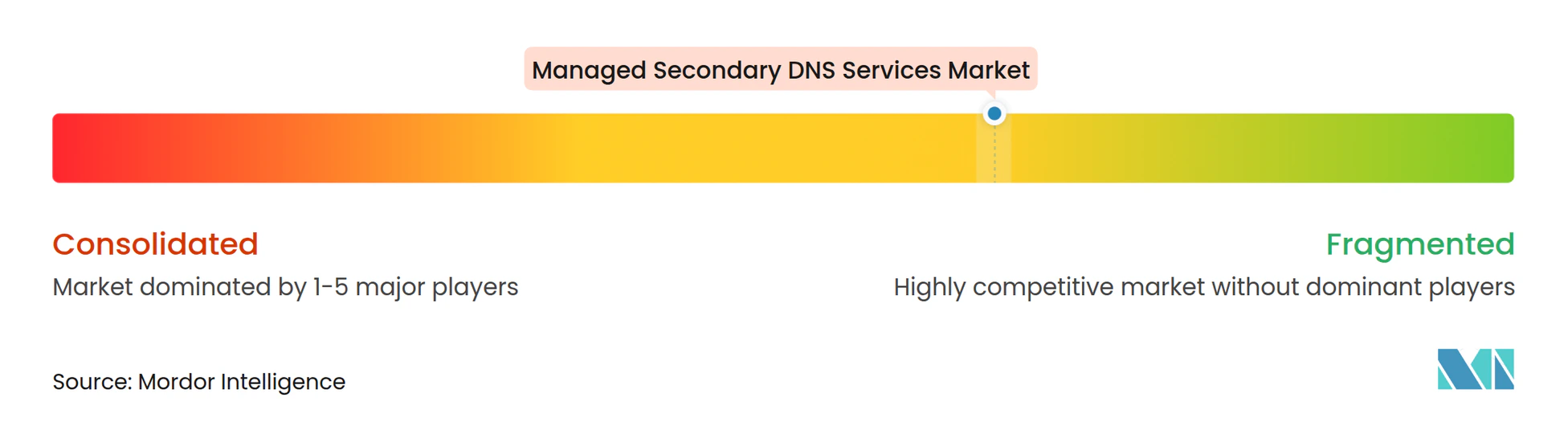
The managed secondary DNS services market is moderately fragmented. Hyperscalers and dedicated DNS specialists compete for overlapping customer groups, but they serve different technical and commercial needs. Cloudflare and Akamai focus on large enterprise accounts through global networks, security capabilities, and CDN-adjacent services. Verisign operates at the high-assurance end of the market and reported processing nearly 600 billion authoritative name server queries per day in its 2025 filing. Tiggee, BuddyNS, Hurricane Electric, and ClouDNS compete through price, network independence, and hidden-primary support.
The DDI providers Infoblox, EfficientIP, and Cisco position secondary DNS as part of a broader network management and security platform. This approach can support cross-selling, in which an organization first adopts DDI tools and then adds DNS resilience services. Cloudflare made Internal DNS generally available in July 2026, bringing authoritative and recursive DNS for private networks onto the same control plane as its public DNS and security services. Akamai introduced DNS Posture Management in June 2025 to provide multicloud visibility, monitoring, and remediation across DNS environments. These moves show that buyers are increasingly offered DNS as part of a wider security and operational platform.
Infoblox completed the acquisition of Axur in May 2026 and Kentik in August 2026, adding external threat discovery and network intelligence to its DNS-centered offering. EfficientIP changed ownership in June 2026, with Francisco Partners stating that the transaction would support the company’s growth and geographic expansion. Mid-market organizations with 500 to 5,000 employees remain a potential opening because they may have moved beyond registrar DNS without adopting a full DDI platform. Pricing pressure from bundled cloud DNS remains a constraint for standalone providers. A bundled offering can reduce the apparent cost of DNS, but it may not meet a buyer’s requirement for an independent network path, separate operational control, or regional service coverage. However, in-region coverage, multi-signer DNSSEC, incident reporting functions, and independent network paths can preserve differentiation where resilience and compliance are central to the purchase decision.
Managed Secondary DNS Services Industry Leaders
-
Amazon Web Services, Inc.
-
Cloudflare, Inc.
-
Akamai Technologies, Inc.
-
Microsoft Corporation
-
Google LLC
- *Disclaimer: Major Players sorted in no particular order
Managed Secondary DNS Services Market Companies Covered in this Report
- Amazon Web Services, Inc.
- Cloudflare, Inc.
- Akamai Technologies, Inc.
- Microsoft Corporation
- Google LLC
- International Business Machines Corporation
- Verisign, Inc.
- Neustar Security Services, LLC
- Oracle America, Inc.
- Tiggee LLC
- Infoblox Inc.
- Cisco Systems, Inc.
- Vercara, LLC
- ClouDNS Ltd.
- DNSimple Corporation
- No-IP, Inc.
- EuroDNS S.A.
- AB Name ISP
- Hurricane Electric LLC
- BuddyNS B.V.
- easyDNS Technologies Inc.
- EfficientIP SAS
- Alibaba Cloud Computing Ltd.
Recent Industry Developments in Managed Secondary DNS Services Market
- August 2026: Infoblox completed its acquisition of Kentik, a leading network intelligence and observability company, integrating real-time network flow, routing, path, and performance intelligence into its critical network services and preemptive security offering. The combination builds a DNS-anchored observability control plane that materially differentiates Infoblox from pure-play secondary DNS competitors.
- July 2026: Verisign announced the delegation of the web top-level domain into the global DNS, expanding its critical internet infrastructure portfolio and adding a new TLD generating ongoing authoritative DNS traffic.
- June 2026: Francisco Partners completed its acquisition of EfficientIP, a global leader in DDI and DNS security solutions based in Paris, from its founders and minority investors TempoCap and Jolt Capital. The investment is intended to accelerate EfficientIP's growth and geographic expansion in the DDI and DNS security markets.
- May 2026: Infoblox completed its acquisition of Axur, a global provider of AI-powered external threat discovery and digital risk protection, enabling DNS-layer blocking of malicious destinations while takedowns are in progress and scanning over 40 million URLs daily.
Global Managed Secondary DNS Services Market Report Scope
The managed secondary DNS services market includes outsourced secondary Domain Name System (DNS) solutions that provide redundant, reliable, and secure DNS infrastructure for organizations. The report covers market trends, growth drivers, challenges, competitive landscape, and demand for managed secondary DNS services across end-user industries and geographic regions.
The Managed Secondary DNS Services Market Report is Segmented by Service Type (Secondary Authoritative DNS, Primary Authoritative DNS, Dynamic DNS, and Reverse DNS), Deployment Mode (Cloud-Based, On-Premises, and Hybrid), Organization Size (Large Enterprises and Small and Medium Enterprises), End-User Industry (IT and Telecommunications, BFSI, Healthcare and Life Sciences, Retail and E-Commerce, Manufacturing and Industrial IoT, Media and Entertainment, Government and Public Sector, and Other End-User Industries), and Geography (North America, South America, Europe, Asia-Pacific, Middle East, and Africa). The Market Forecasts are Provided in Terms of Value (USD).
Segmentation Overview
| Secondary Authoritative DNS |
| Primary Authoritative DNS |
| Dynamic DNS |
| Reverse DNS |
| Cloud-Based |
| On-Premises |
| Hybrid |
| Large Enterprises |
| Small and Medium Enterprises |
| IT and Telecommunications |
| BFSI |
| Healthcare and Life Sciences |
| Retail and E-Commerce |
| Manufacturing and Industrial IoT |
| Media and Entertainment |
| Government and Public Sector |
| Other End-User Industries |
| North America | United States |
| Canada | |
| Mexico | |
| South America | Brazil |
| Argentina | |
| Rest of South America | |
| Europe | Germany |
| United Kingdom | |
| France | |
| Italy | |
| Spain | |
| Russia | |
| Rest of Europe | |
| Asia-Pacific | China |
| India | |
| Japan | |
| South Korea | |
| Australia | |
| Rest of Asia-Pacific | |
| Middle East | Saudi Arabia |
| United Arab Emirates | |
| Turkey | |
| Rest of Middle East | |
| Africa | South Africa |
| Egypt | |
| Nigeria | |
| Rest of Africa |
| By Service Type | Secondary Authoritative DNS | |
| Primary Authoritative DNS | ||
| Dynamic DNS | ||
| Reverse DNS | ||
| By Deployment Mode | Cloud-Based | |
| On-Premises | ||
| Hybrid | ||
| By Organization Size | Large Enterprises | |
| Small and Medium Enterprises | ||
| By End-User Industry | IT and Telecommunications | |
| BFSI | ||
| Healthcare and Life Sciences | ||
| Retail and E-Commerce | ||
| Manufacturing and Industrial IoT | ||
| Media and Entertainment | ||
| Government and Public Sector | ||
| Other End-User Industries | ||
| By Geography | North America | United States |
| Canada | ||
| Mexico | ||
| South America | Brazil | |
| Argentina | ||
| Rest of South America | ||
| Europe | Germany | |
| United Kingdom | ||
| France | ||
| Italy | ||
| Spain | ||
| Russia | ||
| Rest of Europe | ||
| Asia-Pacific | China | |
| India | ||
| Japan | ||
| South Korea | ||
| Australia | ||
| Rest of Asia-Pacific | ||
| Middle East | Saudi Arabia | |
| United Arab Emirates | ||
| Turkey | ||
| Rest of Middle East | ||
| Africa | South Africa | |
| Egypt | ||
| Nigeria | ||
| Rest of Africa | ||
Key Questions Answered in the Report
What is the managed secondary DNS services market size?
The managed secondary DNS services market is projected to grow from USD 421.69 million in 2026 and USD 457.32 million in 2027 to USD 694.07 million by 2032, at an 8.45% CAGR.
What is managed secondary DNS used for?
It keeps authoritative DNS available when a primary provider, cloud region, or network path becomes unavailable, using an independent copy of DNS zone data. The managed secondary DNS services market supports this model by separating recovery capability from the primary provider.
Which service type leads managed secondary DNS services?
Secondary Authoritative DNS leads with 51.34% of revenue in 2026. It maintains a zone copy and can answer authoritative requests when the primary provider is unavailable.
Why are organizations adopting secondary DNS services?
Multi-cloud operations, DNS-based attacks, edge computing, and resilience rules increase the need for independent DNS availability and governance. These needs are central to demand in the managed secondary DNS services market.
Which deployment model is most common for secondary DNS services?
Cloud-Based deployment leads with 74.08% of revenue in 2026 because it supports geographically distributed anycast delivery and API-led operations. The managed secondary DNS services market uses this model to give teams a scalable alternative to appliance-led delivery.