
Managed DNS Traffic Management and Failover Services Market Size and Share
Market Overview
| Study Period | 2021 - 2032 |
|---|---|
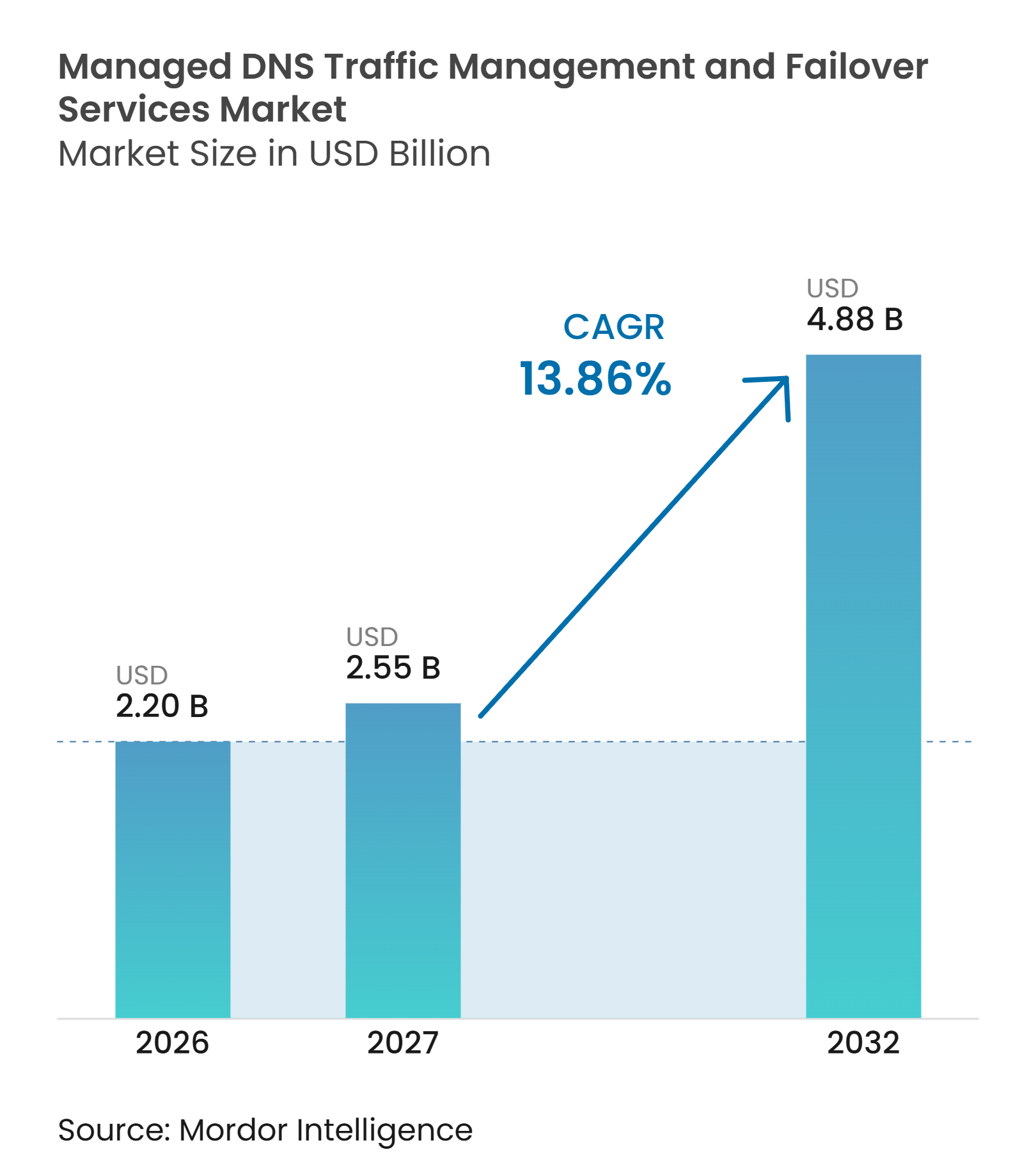
| Market Size (2027) | USD 2.55 Billion |
| Market Size (2032) | USD 4.88 Billion |
| Growth Rate (2027 - 2032) | 13.86 % |
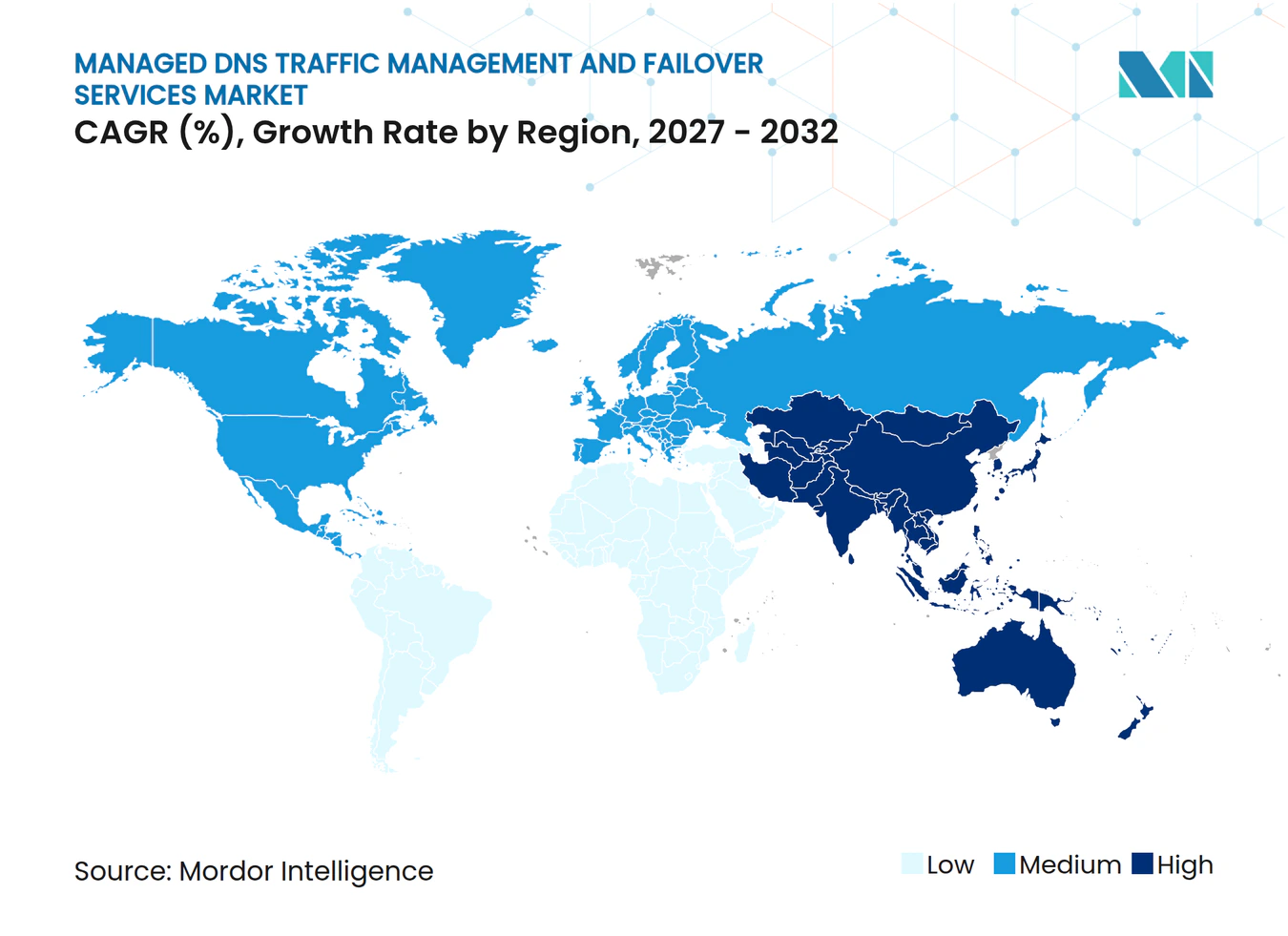
| Fastest Growing Market | Asia-Pacific |
| Largest Market | North America |
| Market Concentration | Medium |
Major Players *Disclaimer: Major Players sorted in no particular order Image © Mordor Intelligence. Reuse requires attribution under CC BY 4.0. | |
Managed DNS Traffic Management and Failover Services Market Analysis by Mordor Intelligence
The managed DNS traffic management and failover services market size is projected to expand from USD 2.20 billion in 2026 and USD 2.55 billion in 2027 to USD 4.88 billion by 2032, registering a CAGR of 13.86% between 2027 and 2032. Cloud-native production environments make DNS resolution a core operating dependency because distributed applications require reliable routing between services, regions, and cloud platforms. Higher volumes of connected devices and edge workloads increase the frequency and time sensitivity of DNS queries. Attacks that target DNS availability are encouraging organizations to procure automated routing, failover, and protective capabilities rather than basic authoritative DNS alone. Government protective DNS programs in the United States and the United Kingdom also raise the importance of auditable and resilient DNS operations. The managed DNS traffic management and failover services market, therefore, favors providers that combine global infrastructure, security controls, multi-cloud support, and clear operational accountability.
Key Report Takeaways
- By service type, DNS Traffic Management and Global Server Load Balancing held 32.67% of the managed DNS traffic management and failover services market in 2026, while Dynamic DNS and Specialized DNS Services are projected to expand at a 14.98% CAGR through 2032.
- By deployment model, cloud-based deployment held 69.27% of revenue in 2026 and is projected to expand at a 15.30% CAGR through 2032.
- By organization size, large enterprises held 73.81% of the managed DNS traffic management and failover services market in 2026, while small and medium-sized enterprises are projected to expand at a 15.53% CAGR through 2032.
- By application, cloud and SaaS applications held 33.41% of revenue in 2026, while mobile applications are projected to expand at a 15.24% CAGR through 2032.
- By end-user industry, IT and telecommunications held 28.63% of the managed DNS traffic management and failover services market in 2026, while healthcare and life sciences are projected to expand at a 15.80% CAGR through 2032.
- By geography, North America held 38.91% of revenue in 2026, while Asia-Pacific is projected to expand at a 16.28% CAGR through 2032.
Note: Market numbers in this report are based on Mordor Intelligence's proprietary estimation framework, which combines nine months of actuals with Q4 projections for base year 2026.
Market Trends and Insights
Drivers Impact Analysis of Managed DNS Traffic Management and Failover Services Market*
| Driver | (~) % Impact on CAGR Forecast | Geographic Relevance | Impact Timeline |
|---|---|---|---|
| Cloud-Native Application Proliferation | +4.5% | Global, strongest in North America and Western Europe | Short term (≤ 2 years) |
| Rising DNS Query Volumes From IoT and Edge Computing | +3.2% | Asia-Pacific core, spillover to North America and Middle East and Africa | Medium term (2-4 years) |
| Expansion of Multi-CDN and Multi-Cloud Architectures | +2.8% | Global | Short term (≤ 2 years) |
| Escalating DNS-Focused DDoS and Availability Threats | +2.1% | Global, highest in North America, Europe, and Asia-Pacific | Short term (≤ 2 years) |
| Government Adoption of Protective DNS Programs | +1.2% | North America and United Kingdom | Medium term (2-4 years) |
| API-First DNS Automation and Infrastructure-as-Code Adoption | +0.9% | North America and Europe | Long term (≥ 4 years) |
| Source: Mordor Intelligence | |||
Cloud-Native Application Proliferation
Cloud-native deployment is making DNS a service dependency inside production applications, not only a perimeter network function. The Cloud Native Computing Foundation reported that 98% of surveyed organizations use cloud-native techniques, with container use in production at 56% and Kubernetes use in 82% of containerized environments. CoreDNS was in production in 76% of those environments, which places DNS directly in the operating path of containerized workloads and supports service discovery, workload communication, and access to distributed application components.[1] A routing error can affect the service path even when computing resources remain available. The managed DNS traffic management and failover services market benefits when enterprises need policy-based routing, cross-region failover, service-level commitments, and a common view of traffic rules beyond in-cluster DNS. The same shift increases the value of reporting and governance features for organizations that must document security controls for containerized software.
Rising DNS Query Volumes From IoT and Edge Computing
Internet of Things devices place a different load on the DNS infrastructure than conventional enterprise endpoints. Research presented through the ACM DNS workshop found that individual smart devices generate repeated DNS requests and that many devices show gaps in recommended DNS security practices. Some devices do not follow expected time-to-live behavior or retain fixed resolver settings, which can make standard enterprise DNS operating practices less effective for large fleets of connected equipment. Edge computing adds more locations where applications resolve names and leaves less time for a failed lookup to be corrected. The conditions favor anycast networks that can answer requests closer to the endpoint and support adaptive time-to-live settings with routing policies designed for different device classes. The managed DNS traffic management and failover services market gains relevance as connected equipment requires reliable name resolution outside centralized data centers, while providers can differentiate by identifying unusual device behavior before it results in service disruption.
Expansion of Multi-CDN and Multi-Cloud Architectures
Organizations that distribute applications across multiple clouds and content delivery networks require a neutral mechanism to direct users to the right destination. DNS traffic management can apply latency rules, weighted routing, health checks, and failover without requiring all workloads to sit on one provider. This is important when applications use separate providers for computing, storage, security, content delivery, resilience, cost management, or regional operating requirements. The managed DNS traffic management and failover services market addresses the coordination gap between these platforms. Time-to-live configuration becomes especially important because inconsistent settings can keep users on an outdated destination after an outage. Providers that can manage routing changes in real time can reduce this risk, support consistent recovery procedures, and help teams maintain a common policy when application ownership is distributed among several internal groups.
Escalating DNS-Focused DDoS and Availability Threats
DNS-focused attacks are increasing the cost of treating authoritative DNS as a basic utility. Cloudflare reported that DNS attacks represented 34.3% of network-layer DDoS activity in the first half of 2026, while DNS flood attacks increased from 25.7% to 40.0% quarter over quarter, and 935 attacks exceeded 1 Tbps. Cloudflare also reported 5,343 attack events per hour, while 90.60% of attacks lasted fewer than 10 minutes. An attack on an authoritative server can prevent users from reaching several dependent services even when the applications remain healthy. The managed DNS traffic management and failover services market is supported by the need for automated protection because short attacks can end before manual intervention begins. Always-on mitigation, health-based routing, resilient resolution, policy control, and audit records are becoming connected purchasing requirements.
Restraints Impact Analysis of Managed DNS Traffic Management and Failover Services Market*
| Restraint | (~) % Impact on CAGR Forecast | Geographic Relevance | Impact Timeline |
|---|---|---|---|
| Legacy On-Premises DNS Sunk Costs | -3.2% | North America and Europe, large-enterprise-heavy markets | Short term (≤ 2 years) |
| IPv6, DNSSEC, and Hybrid DNS Operational Complexity | -2.5% | Global | Medium term (2-4 years) |
| Price Commoditization of Basic Authoritative DNS | -1.8% | Global, strongest in small and medium-sized enterprise-heavy markets | Long term (≥ 4 years) |
| Third-Party Control-Plane Concentration and Sovereignty Conflicts | -1.3% | Europe, Middle East, and Asia-Pacific | Long term (≥ 4 years) |
| Source: Mordor Intelligence | |||
Legacy On-Premises DNS Sunk Costs
Large enterprises can delay migration because they have already invested in BIND server clusters, proprietary DNS appliances, and on-premises DDI platforms. A transition also requires parallel operations, staff training, change management, testing, and a detailed map of existing zones, internal dependencies, access rights, and recovery procedures. Teams must decide which records can move first and which systems need to remain under local control. Internal depreciation schedules can extend migration decisions by 2-4 years in capital-intensive organizations, particularly in North America and Western Europe, where established enterprises often operate large installed bases. The managed DNS traffic management and failover services market faces a slower early adoption cycle among these buyers. Demand can shift toward the later years of the forecast period as assets are retired and providers support phased migration and hybrid operation.
IPv6, DNSSEC, and Hybrid DNS Operational Complexity
Hybrid deployments may require traditional DNS, DNSSEC-signed zones, DNS-over-HTTPS, and DNS-over-TLS to run alongside each other. Each protocol and environment has distinct configuration, monitoring, and troubleshooting needs, and a small configuration gap can affect resolution behavior across a mix of on-premises and cloud assets. CISA stated that coordinating DNSSEC, encrypted DNS, and protective DNS across mobile, roaming, on-premises, and cloud endpoints can create significant implementation overhead.[2] The ACM research also described device-level DNS security gaps that can complicate integration work for Internet of Things deployments. The managed DNS traffic management and failover services market must provide practical migration support, policy visibility, and reliable controls that network, security, and application teams can use. Complexity can discourage rapid adoption even when organizations recognize the value of more resilient DNS operations.
*Our forecasts treat driver/restraint impacts as directional, not additive. The impact forecasts reflect baseline growth, mix effects, and variable interactions.
Managed DNS Traffic Management and Failover Services Market Segment Analysis
By Service Type:
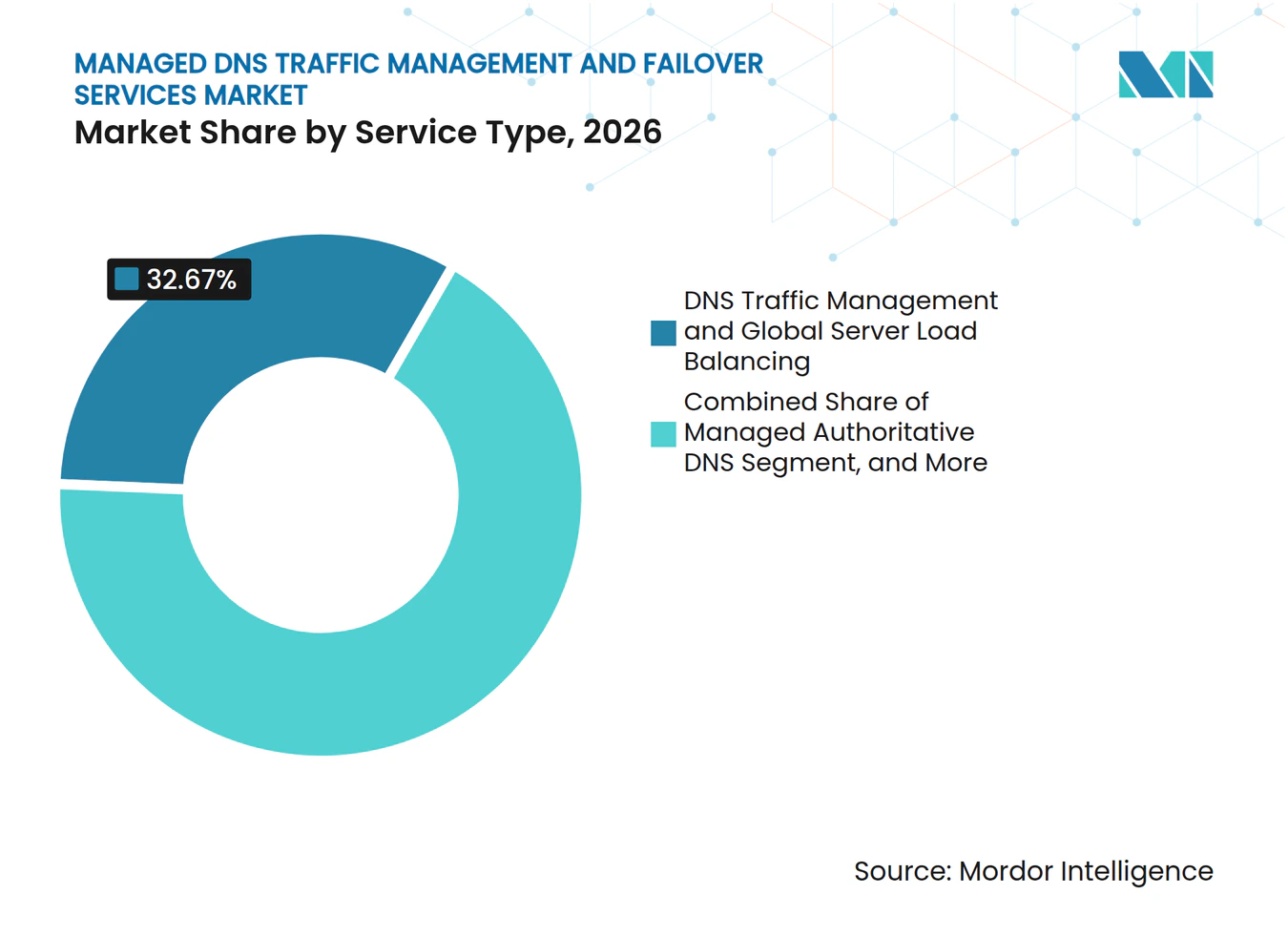
Traffic Management Anchors Revenue, Dynamic DNS AcceleratesDNS Traffic Management and Global Server Load Balancing held 32.67% of the managed DNS traffic management and failover services market share in 2026. The segment serves enterprises that need a single authoritative response to direct traffic among several active destinations. This requirement is common in multi-CDN and multi-cloud environments, where applications must distribute traffic according to geography, latency, capacity, or service health. Buyers pay for these capabilities because they link DNS operations directly to availability and performance outcomes. Managed Authoritative DNS, Managed Secondary DNS, and DNS Failover and Disaster Recovery remain important adjacent services. Failover is increasingly procured with traffic management because organizations need the same provider to detect health issues and change routing quickly.
Dynamic DNS and Specialized DNS Services is projected to expand at a 14.98% CAGR from 2027 to 2032. The service is relevant for edge deployments, connected devices, and workloads that create or move resources faster than static zone management can accommodate. The ACM research on Internet of Things DNS behavior supports the need for services that can handle recurring requests and device-specific DNS conditions. Providers are adapting dynamic DNS through time-to-live policies and routing rules that reflect device behavior. Within the managed DNS traffic management and failover services industry, dynamic DNS can increasingly be sold as part of a premium traffic management capability rather than as a separate basic function. That approach can raise service value without requiring a similar increase in the number of managed domains.



By Deployment Model:
Cloud Centralization Redefines DNS ArchitectureCloud-based deployment accounted for 69.27% of the managed DNS traffic management and failover services market size in 2026. Distributed anycast infrastructure gives cloud services the geographic reach required for low-latency resolution and resilient traffic steering. Building a comparable on-premises footprint requires substantial investment in colocation, network capacity, operations staff, and security controls. Cloud delivery also aligns DNS management with application workloads that are already moving across cloud platforms. Cloud-based deployment is projected to expand at a 15.30% CAGR through 2032. API-first architectures support this movement because they allow DNS changes to be integrated into infrastructure-as-code workflows.
On-premises deployment remains relevant for defense contractors, central banks, and critical infrastructure operators that cannot route DNS requests through third-party systems. These organizations can have security, sovereignty, or regulatory requirements that limit the use of externally managed resolvers. Hybrid deployment offers a transitional path by extending cloud-based traffic management to on-premises authoritative DNS. Amazon Route 53 Global Resolver reached general availability in March 2026 with unified public and private DNS resolution and support for DNS-over-HTTPS and DNS-over-TLS.[3] The product shows how large providers are combining public and private DNS functions within one operating model. This can reduce the operational case for maintaining separate on-premises DNS estates over time.
By Organization Size:
Enterprise Scale Anchors Demand, Small and Medium-Sized Enterprises AccelerateLarge enterprises held 73.81% of revenue in 2026 because they operate the most complex multi-region DNS estates. These organizations often require DNSSEC signing, Global Server Load Balancing policy management, security information and event management integration, and detailed query logging. They also have a larger number of applications, locations, and cloud accounts to coordinate. Infoblox stated that more than 200 enterprises adopted its Universal DDI platform within 1 year of launch. Its integration of Cloudflare and Akamai external DNS into a unified dashboard demonstrates the value placed on centralized operational control.
Small and medium-sized enterprises are projected to expand at a 15.53% CAGR through 2032. Subscription plans from providers such as Cloudflare, Constellix, and DNSimple have made advanced traffic management more accessible to organizations with fewer domains. These buyers still face direct revenue exposure when their authoritative DNS becomes unavailable. Cloudflare's first-half 2026 findings show why DNS protection is relevant beyond the largest enterprises, with frequent network-layer attack activity and DNS floods forming a larger share of attacks. The managed DNS traffic management and failover services market gains small and medium-sized enterprise demand when automated protection is offered through predictable monthly pricing. The segment also benefits when providers simplify setup and reduce the need for specialist DNS engineering teams.
By Application:
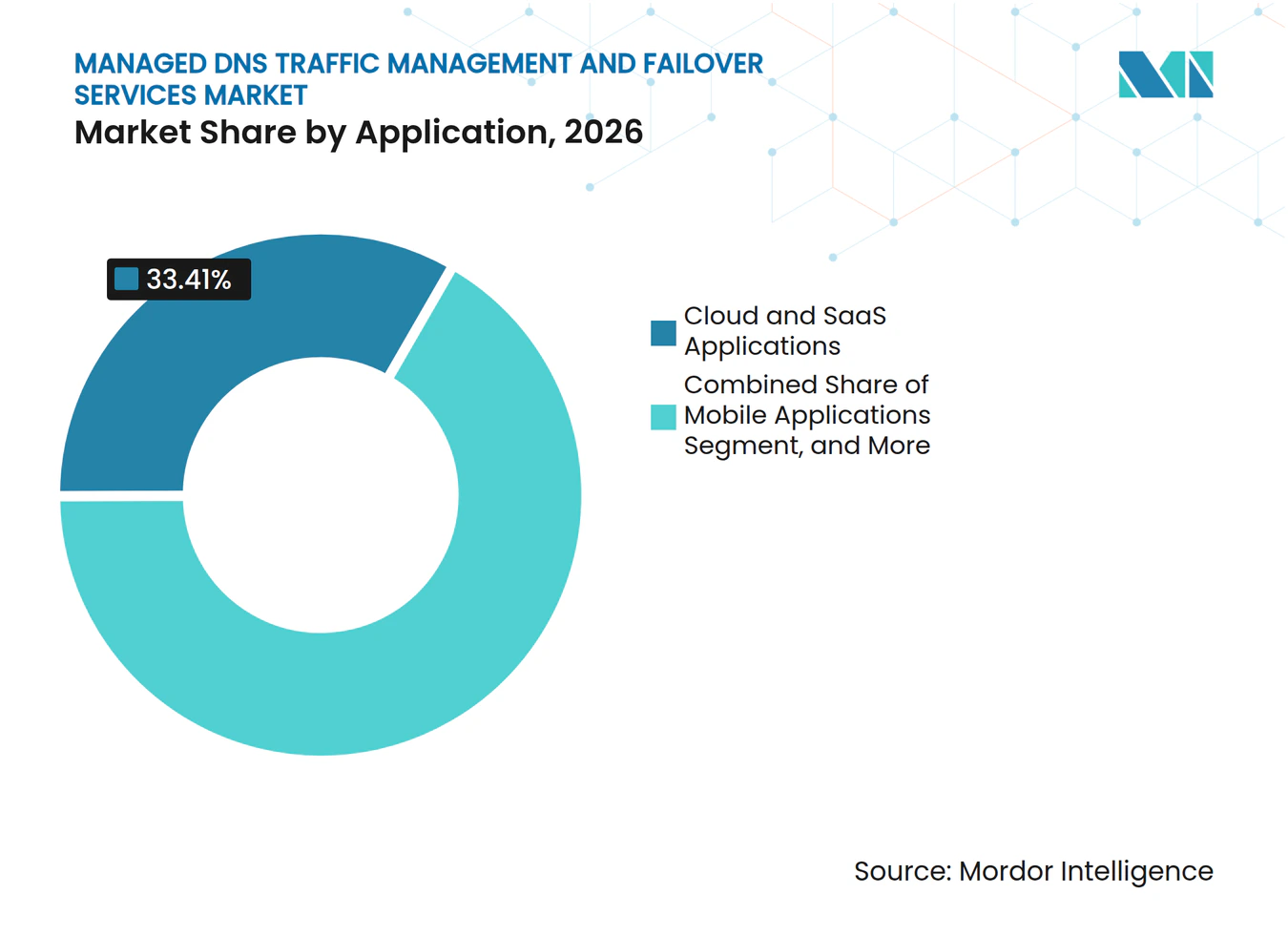
SaaS Defines Core Demand, Mobile Is the High-Growth LayerCloud and SaaS applications held 33.41% of revenue in 2026, the largest application share in the managed DNS traffic management and failover services market. Multi-tenant applications route large volumes of simultaneous user sessions through geographically distributed infrastructure. DNS traffic management supports tenant routing, regional distribution, and failover between application instances. E-commerce and digital platforms also require consistent resolution because service disruption can interrupt transactions. Content delivery networks both use Global Server Load Balancing and offer DNS-integrated traffic capabilities to customers. Enterprise networks and hybrid IT represent an important workload base as organizations migrate legacy DNS functions toward cloud-managed operations.
Mobile applications are projected to expand at a 15.24% CAGR from 2027 to 2032. Mobile users move between networks, which causes frequent IP address changes and makes faster failover more important. Network latency can also make an inefficient DNS resolution path more visible to the user. Managed DNS providers need to resolve requests efficiently for large populations of mobile endpoints. They also need routing policies that can react to changes in service health without requiring manual updates. The managed DNS traffic management and failover services market is positioned to serve this application group through low-latency infrastructure, adaptive routing, and automated response to service health changes.

By End-User Industry:
IT and Telecommunications Anchors Revenue, Healthcare Sets the Growth PaceIT and telecommunications held 28.63% of revenue in 2026. Telecom operators manage some of the largest authoritative DNS environments and use managed secondary DNS to add redundancy. BFSI is another major buyer because financial platforms require business continuity and dependable access to online services. Retail and e-commerce organizations purchase Global Server Load Balancing to support peak transactions and customers across multiple locations. Media and entertainment companies need reliable routing when content consumption rises sharply around live events. The managed DNS traffic management and failover services industry is relevant to all of these users because a DNS disruption can make otherwise functioning digital services unreachable.
Healthcare and life sciences are projected to expand at a 15.80% CAGR through 2032. Telehealth platforms, electronic health record systems, and medical Internet of Things devices need dependable DNS resolution across distributed environments. Availability failures can affect clinical operations, which raises the importance of failover and traffic management. The ACM research identifies recurring DNS behavior and security limitations in connected devices that can add risk to medical Internet of Things environments. CISA reported that its Protective DNS Resolver Service supported more than 104 federal civilian executive branch agencies and handled an average of 1.6 billion queries each day at 99.999% resolver uptime. This public-sector program illustrates the role of resilient DNS services for government users that need secure and continuous operations.
Geography Analysis
The Americas Managed DNS Traffic Management and Failover Services Market
North America held 38.91% of the managed DNS traffic management and failover services market share in 2026. The region benefits from high cloud provider density, mature enterprise technology spending, and public-sector demand for protective DNS. CISA's Protective DNS Resolver Service supported more than 104 federal civilian executive branch agencies and processed an average of 1.6 billion queries each day. This scale reinforces the importance of resilient, monitored DNS for government services. Amazon also made Route 53 public authoritative DNS generally available in AWS GovCloud regions during April 2025, giving government customers a DNSSEC-enabled public DNS service within that environment. AWS. South America has a smaller base, with Brazil and Argentina acting as key enterprise buyers. Infrastructure gaps and uneven regulatory conditions can limit the region's pace compared with more mature markets.
Europe and Middle East Managed DNS Traffic Management and Failover Services Market
Europe is shaped by data residency expectations and security requirements for critical infrastructure. The United Kingdom's National Cyber Security Center entered a new Protective DNS delivery partnership with Cloudflare in 2024.[4] The NCSC also published guidance on protective DNS for the private sector in August 2026. These measures support commercial interest in protective DNS capabilities that can meet public-sector and private-sector security needs. Germany, the United Kingdom, and France remain the largest European buyers. The Middle East is also adding demand through sovereign cloud and data center investment tied to Saudi Vision 2030 and the UAE Digital Economy Strategy.
APAC and Africa Managed DNS Traffic Management and Failover Services Market
Asia-Pacific is projected to expand at a 16.28% CAGR between 2027 and 2032. China requires authoritative DNS services that can support enterprise Internet of Things networks and digital payment platforms within sovereign boundaries. India's digital payments ecosystem and Digital India cloud mandates also support demand for managed DNS at scale. Japan and South Korea require low-latency resolution for advanced manufacturing digitization and edge AI deployments. The managed DNS traffic management and failover services market has a strong regional opportunity where government digital programs and private platforms both need reliable national and cross-border operations. Africa remains at an earlier stage, with South Africa and Nigeria forming initial demand centers. Data center investment can support wider adoption after 2028 as enterprise digital infrastructure becomes more established.
Competitive Landscape
Market Concentration
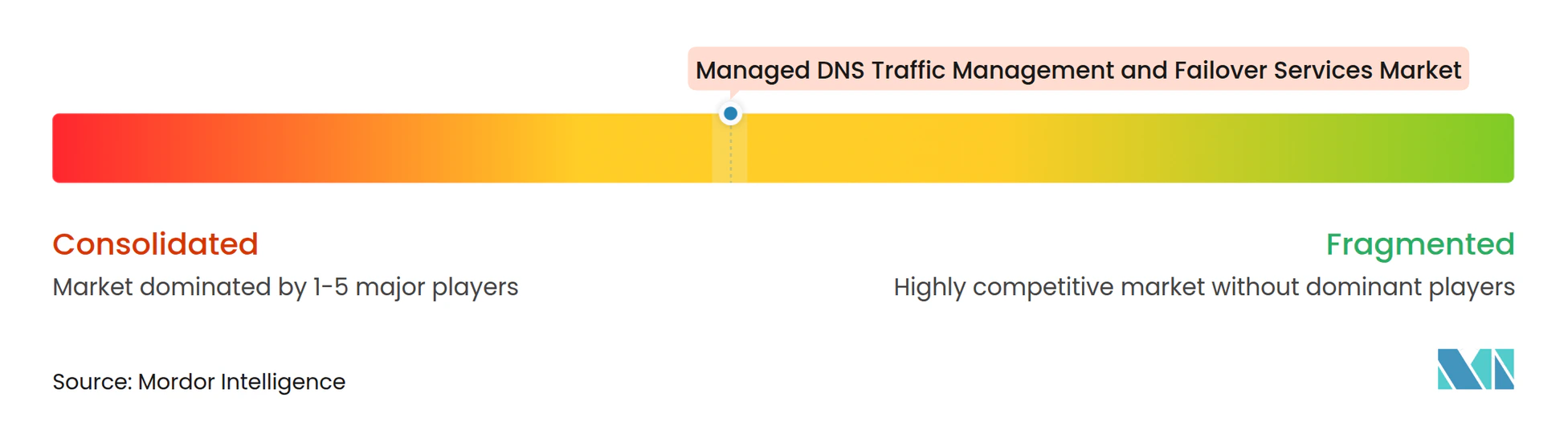
The managed DNS traffic management and failover services market is moderately consolidated among tier-1 providers and fragmented across specialist and mid-market suppliers. AWS, Cloudflare, Microsoft, Google, and Akamai benefit from integration with their broader cloud, content delivery, and security platforms. Enterprises that already run compute and storage on those platforms can adopt DNS traffic management as a control-plane service rather than make a separate purchase. This creates switching costs for pure-play vendors. Cloudflare reported fiscal year 2025 revenue of USD 2,167.9 million, up 30% from the prior year. Its scale and network footprint support its position in cloud-based managed DNS.
Specialists, including Infoblox, Vercara, Constellix, and EfficientIP, compete through multi-cloud neutrality, service-level precision, and DNSSEC management. These capabilities matter when buyers view dependence on one hyperscale DNS control plane as a governance risk. Akamai launched DNS Posture Management in June 2025 to provide agentless, multicloud visibility and real-time monitoring of DNS assets. The release shifted competitive attention toward DNS security posture and configuration risk, not only resolution speed. Infoblox integrated Cloudflare and Akamai external DNS into its management platform during November 2025, supporting centralized control of a distributed DNS estate. These product moves show how interoperability can help specialists retain relevance in mixed-vendor environments.
Competition is also shaped by the shift from perpetual on-premises licensing toward subscription-managed delivery. Providers must show that they can combine routing, failover, observability, and protective controls without making a customer dependent on one public cloud. Verisign expanded its registry infrastructure in July 2026 through the delegation of the .web generic top-level domain, with a staged commercial launch planned through registrar partners. This development reflects the continued importance of registry-scale infrastructure within the wider DNS ecosystem. AI-native DNS orchestration and agentic workload routing remain areas of competitive interest because autonomous software can require more adaptive time-to-live policies and routing decisions. Providers that can meet these operational needs while preserving visibility and policy control may strengthen their position in the managed DNS traffic management and failover services market.
Managed DNS Traffic Management and Failover Services Industry Leaders
-
Amazon Web Services, Inc.
-
Cloudflare, Inc.
-
Akamai Technologies, Inc.
-
Oracle Corporation
-
Verisign, Inc.
- *Disclaimer: Major Players sorted in no particular order
Managed DNS Traffic Management and Failover Services Market Companies Covered in this Report
- Amazon Web Services, Inc.
- Cloudflare, Inc.
- Akamai Technologies, Inc.
- Microsoft Corporation
- Google LLC
- Oracle Corporation
- International Business Machines Corporation
- GoDaddy Inc.
- Verisign, Inc.
- Vercara, LLC
- Neustar Security Services, LLC
- Tiggee LLC
- Constellix LLC
- Infoblox Inc.
- DNSimple Corporation
- No-IP, Inc.
- CDNetworks Co., Ltd.
- EfficientIP SAS
- BlueCat Networks (USA) Inc.
- Alibaba Cloud Computing Ltd.
Recent Industry Developments in Managed DNS Traffic Management and Failover Services Market
- October 2026: Cloudflare announced its 1.1.1.1 and Gateway DNS resolvers already trust the new DNSSEC root KSK-2024 ahead of the planned October 2026 rollover. The company is publishing diagnostics and configuration tools aimed at helping DNS operators confirm support for KSK-2024 across resolvers and validators. Cloudflare reports its own DNS infrastructure, including managed DNS for customers, has been tested for continuity through the October 2026 key change event.
- July 2026: Verisign announced the delegation of the .web generic top-level domain into the global DNS root zone with Verisign as designated registry operator, with staged commercial launch through registrar partners planned for 2026, extending Verisign's registry infrastructure, with over 29 years of 100% DNS uptime for .com and .net, to a new high-traffic namespace.
- July 2026: FlashStart, a leading cloud-based DNS filtering provider, has officially launched FlashStart 2026, its next-generation DNS security platform. The upgraded platform introduces real-time AI scanning to instantly block malware and enforce browsing policies across distributed enterprise devices. This launch marks a critical industry shift from simple routing uptime to secure traffic management.
- March 2026: AWS announced general availability of Amazon Route 53 Global Resolver, an anycast-based service providing unified public and private DNS resolution with DNS-over-HTTPS and DNS-over-TLS support, designed to decouple DNS from regional cloud failures following the October 2025 US East outage.
Global Managed DNS Traffic Management and Failover Services Market Report Scope
Managed DNS Traffic Management and Failover Services are outsourced, high-availability IT routing solutions where a specialized third-party provider assumes operational responsibility for configuring, optimizing, and securing an organization’s Domain Name System (DNS) infrastructure. These services dynamically route incoming user requests across globally distributed server environments based on real-time health telemetry, network latency, and geographical proximity.
The Managed DNS Traffic Management and Failover Services Market Report is Segmented by Service Type (Managed Authoritative DNS, Managed Secondary DNS, DNS Traffic Management and Global Server Load Balancing, DNS Failover and Disaster Recovery, Dynamic DNS and Specialized DNS Services, and Other Service Types), Deployment Model (Cloud-Based, On-Premises, and Hybrid), Organization Size (Large Enterprises and Small and Medium-Sized Enterprises), Application (Cloud and SaaS Applications, E-Commerce and Digital Platforms, Content Delivery Networks, Enterprise Networks and Hybrid IT, Mobile Applications, and Other Applications), End-User Industry (IT and Telecommunications, BFSI, Retail and E-Commerce, Media and Entertainment, Healthcare and Life Sciences, Government and Public Sector, and Other End-User Industries), and Geography (North America, South America, Europe, Asia-Pacific, Middle East, and Africa). The Market Forecasts are Provided in Terms of Value (USD).
Segmentation Overview
| Managed Authoritative DNS |
| Managed Secondary DNS |
| DNS Traffic Management and Global Server Load Balancing |
| DNS Failover and Disaster Recovery |
| Dynamic DNS and Specialized DNS Services |
| Other Service Types |
| Cloud-Based |
| On-Premises |
| Hybrid |
| Large Enterprises |
| Small and Medium-Sized Enterprises |
| Cloud and SaaS Applications |
| E-Commerce and Digital Platforms |
| Content Delivery Networks |
| Enterprise Networks and Hybrid IT |
| Mobile Applications |
| Other Applications |
| IT and Telecommunications |
| BFSI |
| Retail and E-Commerce |
| Media and Entertainment |
| Healthcare and Life Sciences |
| Government and Public Sector |
| Other End-User Industries |
| North America | United States |
| Canada | |
| Mexico | |
| South America | Brazil |
| Argentina | |
| Rest of South America | |
| Europe | Germany |
| United Kingdom | |
| France | |
| Italy | |
| Rest of Europe | |
| Asia-Pacific | China |
| Japan | |
| India | |
| South Korea | |
| Rest of Asia-Pacific | |
| Middle East | United Arab Emirates |
| Saudi Arabia | |
| Rest of Middle East | |
| Africa | South Africa |
| Nigeria | |
| Rest of Africa |
| By Service Type | Managed Authoritative DNS | |
| Managed Secondary DNS | ||
| DNS Traffic Management and Global Server Load Balancing | ||
| DNS Failover and Disaster Recovery | ||
| Dynamic DNS and Specialized DNS Services | ||
| Other Service Types | ||
| By Deployment Model | Cloud-Based | |
| On-Premises | ||
| Hybrid | ||
| By Organization Size | Large Enterprises | |
| Small and Medium-Sized Enterprises | ||
| By Application | Cloud and SaaS Applications | |
| E-Commerce and Digital Platforms | ||
| Content Delivery Networks | ||
| Enterprise Networks and Hybrid IT | ||
| Mobile Applications | ||
| Other Applications | ||
| By End-User Industry | IT and Telecommunications | |
| BFSI | ||
| Retail and E-Commerce | ||
| Media and Entertainment | ||
| Healthcare and Life Sciences | ||
| Government and Public Sector | ||
| Other End-User Industries | ||
| By Geography | North America | United States |
| Canada | ||
| Mexico | ||
| South America | Brazil | |
| Argentina | ||
| Rest of South America | ||
| Europe | Germany | |
| United Kingdom | ||
| France | ||
| Italy | ||
| Rest of Europe | ||
| Asia-Pacific | China | |
| Japan | ||
| India | ||
| South Korea | ||
| Rest of Asia-Pacific | ||
| Middle East | United Arab Emirates | |
| Saudi Arabia | ||
| Rest of Middle East | ||
| Africa | South Africa | |
| Nigeria | ||
| Rest of Africa | ||
Key Questions Answered in the Report
What is the size of the managed DNS traffic management and failover services market?
The managed DNS traffic management and failover services market size is USD 2.20 billion in 2026 and is projected to reach USD 4.88 billion by 2032 at a 13.86% CAGR. The outlook reflects greater use of cloud-native systems, connected devices, multi-cloud deployments, and automated DNS protection. Enterprises are also placing more weight on transparent operating records, a tested recovery process, and traffic policies that can be updated without disrupting services when they select a provider. These considerations are particularly important where DNS supports customer-facing applications, internal services, and third-party platform connections at the same time. These needs support continued demand for managed traffic control and failover services.
Which service type leads managed DNS traffic management and failover services?
DNS Traffic Management and Global Server Load Balancing leads with 32.67% revenue share in 2026 because enterprises need intelligent routing across active destinations. The service directs users by location, performance, capacity, and application health, while failover helps maintain access if a destination becomes unavailable. In the managed DNS traffic management and failover services market, these functions are often purchased together because effective routing depends on prompt detection of unhealthy service locations. The service also helps teams maintain a consistent approach when applications operate in several regions. It gives network and application teams a shared method for setting traffic priorities and testing recovery actions. This reduces coordination gaps during a service incident and improves readiness.
Why are cloud-based DNS services expanding?
Cloud-based deployment held 69.27% of revenue in 2026 and is projected to expand at a 15.30% CAGR as organizations use distributed anycast infrastructure and cloud control planes. The managed DNS traffic management and failover services market supports this shift with routing, public and private resolution, and policy controls that are better aligned with cloud-hosted application environments. Cloud deployment can also reduce the cost and effort of building distributed infrastructure for each enterprise location, while helping operations teams apply the same DNS policy across locations. This matters when smaller operations teams must support applications that serve users across several countries. It also supports a faster response to regional availability issues.
Which end-user segment is expected to expand fastest?
Healthcare and life sciences is projected to expand at a 15.80% CAGR through 2032, supported by telehealth, electronic health records, and medical Internet of Things deployments. These users need dependable resolution across sites and devices because an availability issue can affect clinical operations as well as routine technology workflows. Managed DNS suppliers must therefore support careful policy control, service continuity, and a clear operating record for availability-related decisions. This requirement makes reliable routing and recovery capabilities relevant across hospitals, clinical platforms, and connected care systems. It can support continuity planning for diverse care delivery environments. Buyers may also need visibility into DNS policy changes because those changes can affect access to important digital services.
Which region is projected to expand fastest?
Asia-Pacific is projected to expand at a 16.28% CAGR through 2032, supported by digital payments, national cloud programs, advanced manufacturing, and edge AI deployments. The managed DNS traffic management and failover services market is relevant where organizations need low-latency resolution while meeting national infrastructure and data sovereignty requirements. The regional opportunity reflects both large digital platforms and public programs that are expanding cloud and connectivity capacity. This adds demand for providers that can combine regional infrastructure with consistent operational controls. Providers must balance local requirements with dependable global service practices. Service design must account for the differing performance, security, and operating requirements of national digital ecosystems.
How do DNS attacks affect procurement decisions?
Frequent DNS flood activity increases demand for always-on mitigation, health-based routing, automated failover, and resilient authoritative DNS operations. Organizations increasingly treat DNS as a continuity requirement because a disruption can prevent users from reaching otherwise available applications, transaction systems, digital platforms, and public services. The managed DNS traffic management and failover services market responds to this concern by combining security controls with traffic steering and service restoration functions. The result is a stronger preference for services that automate protective actions and preserve operational visibility during an incident. Providers are assessed on their ability to detect an event, maintain service access, and give teams evidence for post-incident review. This helps organizations assess readiness before a disruption affects users.