
Managed Reverse DNS Services Market Size and Share
Market Overview
| Study Period | 2021 - 2032 |
|---|---|
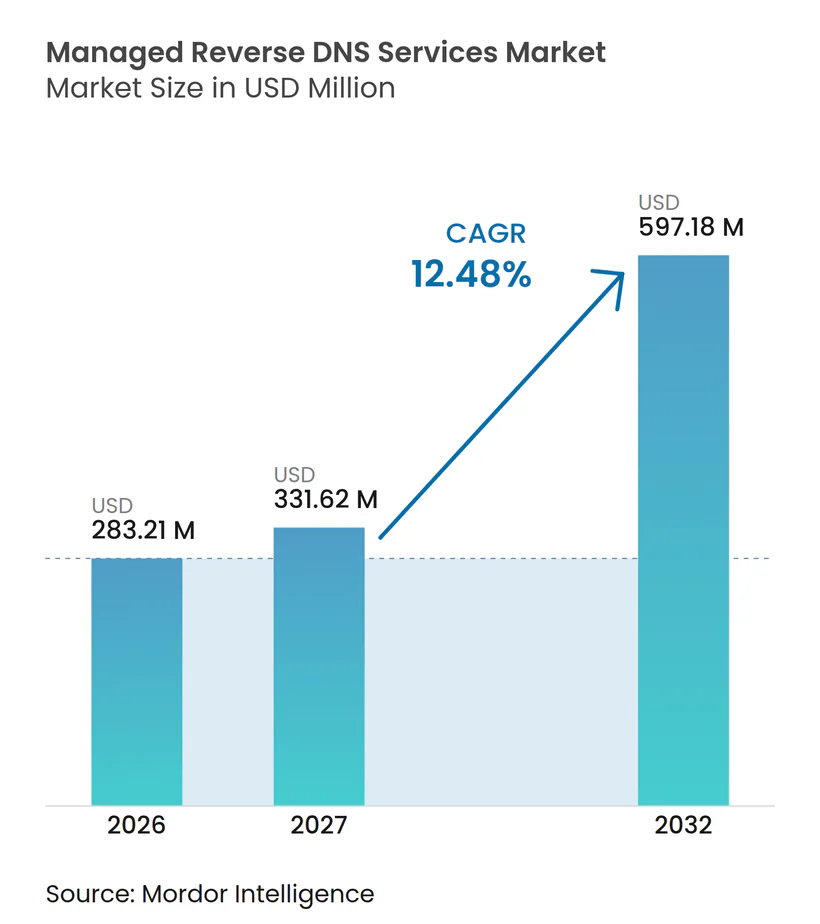
| Market Size (2027) | USD 331.62 Million |
| Market Size (2032) | USD 597.18 Million |
| Growth Rate (2027 - 2032) | 12.48 % |
| Fastest Growing Market | Asia-Pacific |
| Largest Market | North America |
| Market Concentration | Medium |
Major Players *Disclaimer: Major Players sorted in no particular order Image © Mordor Intelligence. Reuse requires attribution under CC BY 4.0. | |
Managed Reverse DNS Services Market Analysis by Mordor Intelligence
The managed reverse DNS services market size is projected to expand from USD 283.21 million in 2026 to USD 331.62 million in 2027, and to USD 597.18 million by 2032, registering a CAGR of 12.48% between 2027 and 2032. The Managed Reverse DNS Services Market is supported by cloud adoption, tighter email sender controls, and the operational burden of maintaining reverse records across changing IP address inventories. Organizations increasingly need consistent PTR records for outbound email, incident analysis, and accountable use of public address space. IPv6 deployment adds a further layer of work because reverse zones are more detailed and harder to manage at scale. Providers can differentiate through automation, API integrations, monitoring, and services that join reverse DNS management with IP reputation controls. The Managed Reverse DNS Services Market also benefits when enterprises and service providers seek a single operating model across cloud and on-premises networks.
Key Report Takeaways
- By service type, Managed PTR Record Provisioning and Administration held 26.73% of the managed reverse DNS services market share in 2026, while Managed FCrDNS Validation and Continuous Monitoring is projected to expand at a 13.91% CAGR through 2032.
- By address family, IPv4 Reverse DNS accounted for 72.51% of revenue in 2026, while IPv6 Reverse DNS is projected to expand at a 14.63% CAGR through 2032.
- By customer type, IP Network Owners and Internet Service Providers held 29.77% of the managed reverse DNS services market revenue in 2026, while Cloud and Hosting Providers are projected to expand at a 14.86% CAGR through 2032.
- By deployment model, cloud-based delivery accounted for 69.48% of revenue in 2026 and is projected to grow at a 15.63% CAGR through 2032.
- By organization size, large enterprises held 71.54% of revenue in 2026, while SMEs are projected to expand at a 16.24% CAGR through 2032.
- By end-user industry, IT and Telecommunications held 31.66% of revenue in 2026, while the healthcare and life sciences industry is projected to expand at a 14.37% CAGR through 2032.
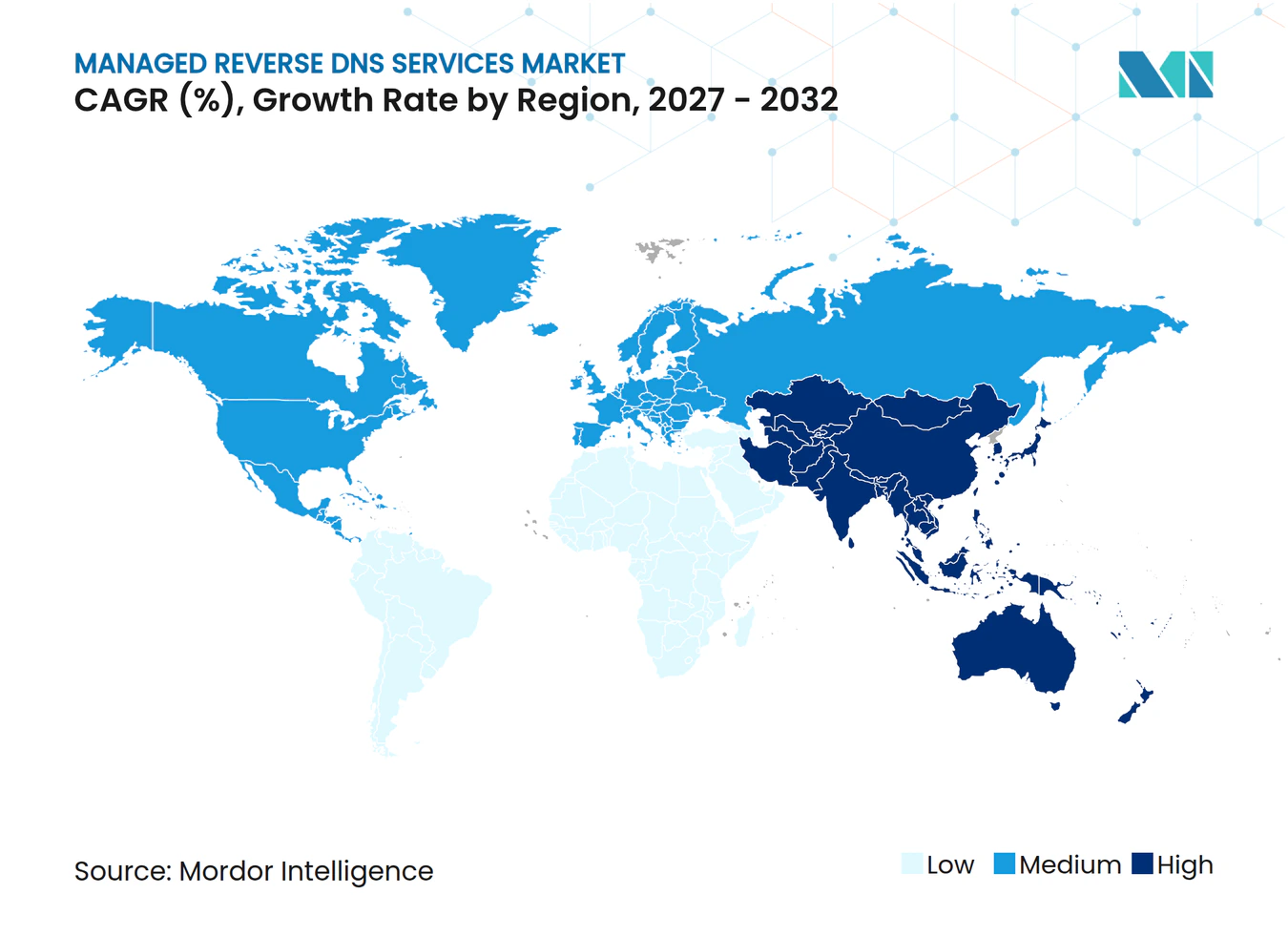
- By geography, North America held 38.64% of the managed reverse DNS services market revenue in 2026, while Asia-Pacific is projected to expand at a 15.82% CAGR through 2032.
Note: Market numbers in this report are based on Mordor Intelligence's proprietary estimation framework, which combines nine months of actuals with Q4 projections for base year 2026.
Market Trends and Insights
Drivers Impact Analysis of Managed Reverse DNS Services Market*
| Driver | (~) % Impact on CAGR Forecast | Geographic Relevance | Impact Timeline |
|---|---|---|---|
| Cloud and Multi-Cloud Adoption Expanding Managed IP Address Operations | +3.2% | Global | Medium term (2-4 years) |
| Email Deliverability Requirements Increasing PTR Record Compliance | +2.8% | Global, led by North America and Europe | Short term (≤ 2 years) |
| IPv6 Address-Space Expansion Increasing Reverse-Zone Complexity | +2.2% | Asia-Pacific core, spill-over to Europe, Middle East, and Africa and North America | Medium term (2-4 years) |
| Security Operations and Human-Readable Network Attribution | +1.8% | North America and Europe | Medium term (2-4 years) |
| Automated rDNS Delegation for Leased and Brokered IP Blocks | +1.4% | North America and Asia-Pacific | Short term (≤ 2 years) |
| PTR-Based Reputation Signals in High-Volume Messaging and Abuse Monitoring | +1.0% | Global | Long term (≥ 4 years) |
| Source: Mordor Intelligence | |||
Cloud and Multi-Cloud Adoption Expanding Managed IP Address Operations
Cloud migration is a central demand factor for the Managed Reverse DNS Services Market. Enterprises using multiple cloud environments must coordinate IP assignments and reverse records across platforms with different administrative tools. This work becomes harder when addresses are created and removed through automated deployment processes. Managed providers can use API-based workflows to keep PTR records aligned with infrastructure-as-code changes. Their role becomes more relevant when cloud teams and network teams use separate operating processes. This creates demand for services that reduce manual handoffs and provide one view of reverse-zone activity.
Email Deliverability Requirements Increasing PTR Record Compliance
Email operations make correct PTR records an immediate business requirement for many organizations. Major mailbox providers apply forward and reverse DNS checks as part of sender controls, which can prevent delivery when records do not align. A failed forward-confirmed reverse DNS check can lead to SMTP rejection and interrupt communications with customers, suppliers, and employees. The Managed Reverse DNS Services Market, therefore, has a direct link to organizations that operate high-volume mail systems. DNS administration services can identify mismatches before sending systems are affected. This need is especially material for enterprises that manage their own mail transfer agents and public IP addresses.
IPv6 Address-Space Expansion Increasing Reverse-Zone Complexity
IPv6 adoption is widening the reverse DNS administration workload. APNIC reported that the Asia-Pacific region reached 50% IPv6 capability in April 2025, while India reached 78.16%, and Japan reached 58.2%.[1] A standard /48 IPv6 allocation can contain up to 65,536 /64 subnets, which makes reverse-zone planning more involved than for a typical IPv4 allocation. The longer ip6.arpa naming structure also raises the risk of configuration mistakes when records are created manually. A 2025 study found that only 12.6% of the top 100,000 websites were fully IPv6-ready. That gap leaves a substantial pool of organizations that will need structured IPv6 DNS operations as deployments mature.
Security Operations and Human-Readable Network Attribution
Reverse DNS gives security teams readable names that help them interpret IP addresses in logs and alerts. This supports faster investigation, more useful threat correlation, and clearer communications during abuse response. AWS network-scanning guidance published in 2025 requires compliant scanners to support reverse DNS lookups for public DNS zones.[2] DNSSEC governance also raises attention on the accuracy and reliability of DNS management practices. APNIC reported in 2026 that DNSSEC validation was near 36% globally. Managed reverse DNS services can support security teams by making host attribution and record review more consistent.
Restraints Impact Analysis of Managed Reverse DNS Services Market*
| Restraint | (~) % Impact on CAGR Forecast | Geographic Relevance | Impact Timeline |
|---|---|---|---|
| Reverse DNS Control Remaining With IP-Address Owners | -1.5% | Global | Long term (≥ 4 years) |
| Limited Awareness Outside Mail and Network Operations Teams | -1.0% | Global, more acute in South America, Middle East, and Africa | Medium term (2-4 years) |
| Propagation Delays and Multi-Registry Delegation Friction | -0.8% | Global, concentrated in multi-RIR environments | Medium term (2-4 years) |
| Shared-IP and Cloud-Abstraction Constraints Limiting Customer Control | -0.7% | Global, concentrated among cloud-native SMEs | Short term (≤ 2 years) |
| Source: Mordor Intelligence | |||
Reverse DNS Control Remaining With IP-Address Owners
Control of a reverse DNS zone remains tied to the holder of the relevant IP address block. A managed provider cannot independently change or delegate that zone without the block holder's involvement. This limits the degree of control that an external service can provide and can slow down onboarding. It also becomes difficult for organizations with allocations spread across several regional registries. An NSF-supported study published in 2025 found that leased IPv4 prefixes were 2.89 times more likely to appear on blocklists than non-leased prefixes.[3] The ownership model makes cooperation among address holders, service providers, and registries necessary.
Limited Awareness Outside Mail and Network Operations Teams
PTR records and forward-confirmed reverse DNS remain specialized subjects within many organizations. Mail administrators and network engineers usually understand the operational risk, while purchasing and security leaders may focus on other infrastructure priorities. This gap can extend the time required to explain the service and secure a purchase decision. Providers may need to position reverse DNS within email resilience, public IP governance, and incident response programs. The effect is most evident where organizations have limited dedicated network operations resources. Education and managed-service bundles can reduce this barrier by making reverse DNS part of a wider IP management service.
*Our forecasts treat driver/restraint impacts as directional, not additive. The impact forecasts reflect baseline growth, mix effects, and variable interactions.
Managed Reverse DNS Services Market Segment Analysis
By Service Type:
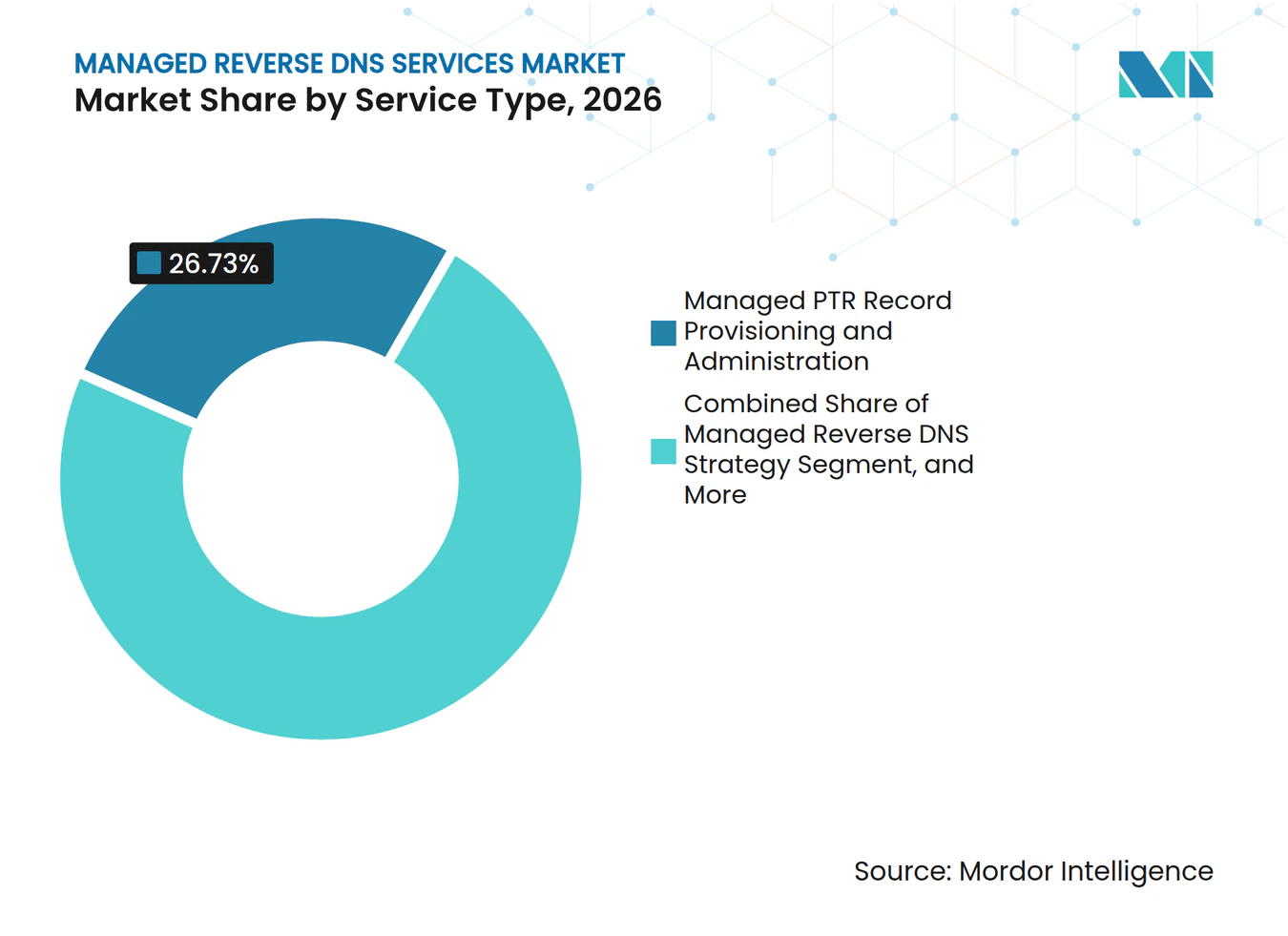
PTR Administration Anchors Revenue While FCrDNS Monitoring AcceleratesManaged PTR Record Provisioning and Administration held 26.73% of the Managed Reverse DNS Services Market revenue in 2026. The service covers creation, updates, and maintenance of PTR records for public IP addresses. Its broad use reflects the need for accurate records in email delivery, network logging, and external service operations. Organizations use it when they lack the staff or processes to manage reverse records across many address ranges. PTR administration also supports recurring service contracts because addresses and hostnames change over time. The category is relevant across enterprises, hosting firms, and Internet service providers. It provides a practical entry point for vendors seeking to offer broader DNS management. The Managed Reverse DNS Services Market can benefit when this essential task leads customers to adopt monitoring and delegation support.
Managed FCrDNS Validation and Continuous Monitoring is projected to expand at a 13.91% CAGR through 2032. This service checks whether a PTR record resolves back to the intended forward DNS record. It is useful for teams that need early warning of configuration errors before mail systems face delivery problems. Continuous monitoring shifts the service from occasional record creation to an ongoing operational control. Managed IPv6 Reverse DNS Services add support for organizations handling complex ip6.arpa zones. Reverse DNS Security and DNSSEC Services, zone design and delegation, email deliverability support, and strategy services extend the range of service options. Together, these services allow providers to tailor support to the maturity and scale of each customer's DNS environment. The Managed Reverse DNS Services Market supports providers that combine routine provisioning with ongoing validation.



By Address Family:
IPv4 Foundations Sustain Demand While IPv6 Complexity Drives GrowthIPv4 Reverse DNS accounted for 72.51% of 2026 revenue, giving it the largest Managed Reverse DNS Services Market share by address family. The installed base of IPv4 infrastructure remains extensive in enterprise networks, email systems, and internet service operations. Many security and delivery processes still depend on IPv4 address reputation and reliable host identification. This maintains demand for PTR management even as newer addressing systems are deployed. IPXO reported that its leased IPv4 volume doubled in 2025 compared with 2024.[4] Leasing activity can increase the need for clear address attribution and disciplined PTR provisioning. IPv4 services, therefore, remain a core source of recurring work for providers. The Managed Reverse DNS Services Market retains this base of demand while customers plan their IPv6 transition.
IPv6 Reverse DNS is projected to expand at a 14.63% CAGR through 2032. Its advance reflects the operational complexity created by long reverse-zone labels and large address allocations. Automated generation of nibble-reversed ip6.arpa records can reduce time spent on repetitive configuration. Providers that connect this automation to prefix management systems can make administration more predictable. The Managed Reverse DNS Services Market benefits because IPv6 readiness requires more than allocating addresses. Teams also need documented reverse-zone structures, delegated authority, and checks that records resolve as expected. The Managed Reverse DNS Services Market can serve this need with tools that show ownership, status, and record history. The low level of full IPv6 website readiness reported by the 2025 study indicates that modernization work remains incomplete.
By Customer Type:
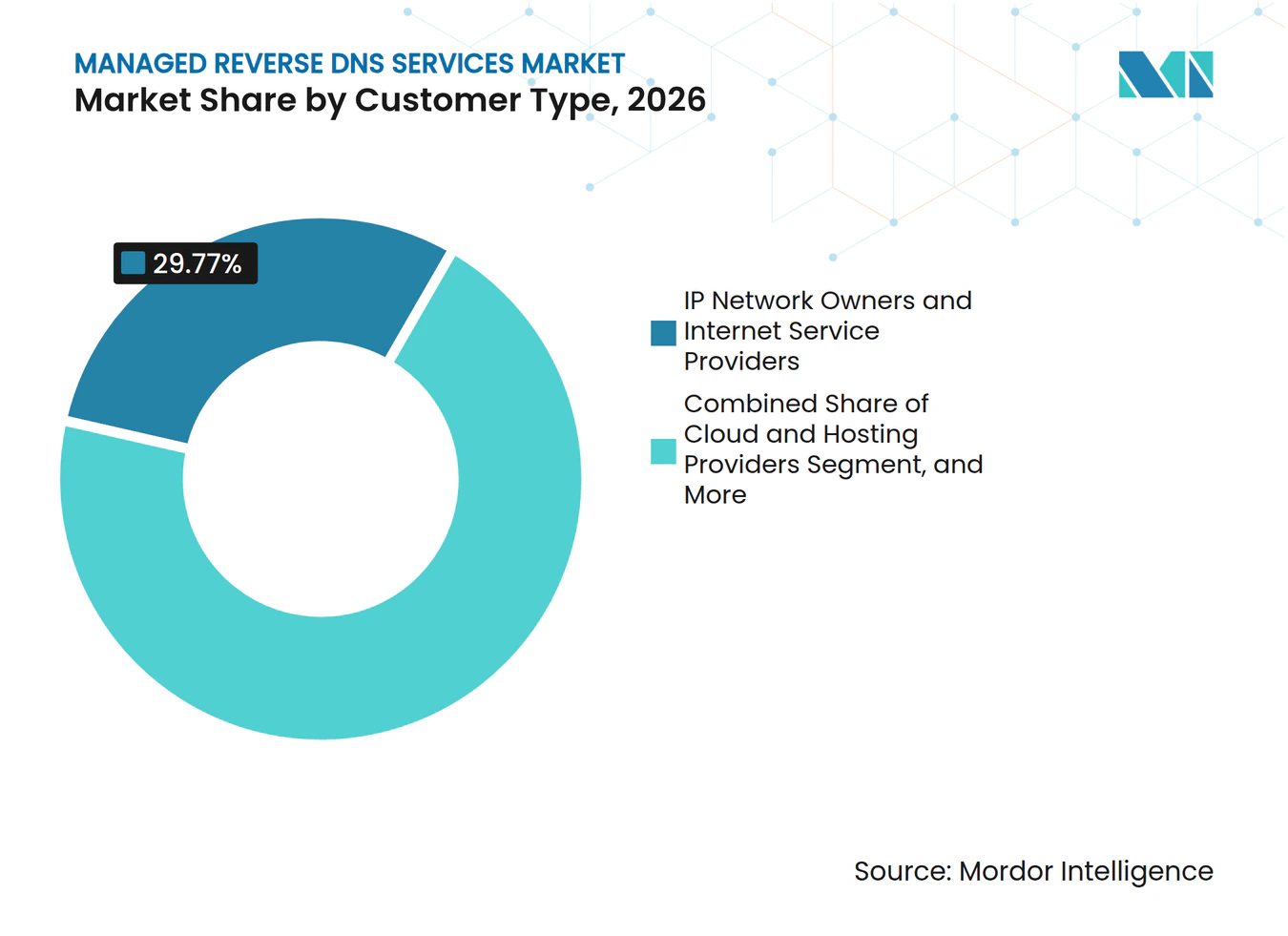
ISP Leadership Endures While Cloud Providers Drive the Fastest GrowthIP Network Owners and Internet Service Providers held 29.77% of revenue in 2026. They are foundational buyers because they hold address blocks and often manage reverse DNS for downstream customers. Their position gives them a direct role in delegation, record updates, and support for subscribers. Internet service providers may deliver reverse DNS as part of a larger connectivity or managed infrastructure package. They also handle public address portfolios that require repeatable management processes. This creates a stable demand base for platforms that centralize policy, provisioning, and audit records. The segment's role is structural because address holders remain central to reverse-zone control. The Managed Reverse DNS Services Market relies on their participation to make delegation services effective.
Cloud and Hosting Providers are projected to expand at a 14.86% CAGR through 2032. These organizations provision and reassign addresses at a scale that is difficult to support through manual requests. Their customers also expect timely reverse DNS controls for hosted applications and mail workloads. Automation is important because large cloud and hosting platforms manage both IPv4 and IPv6 inventories. IP address leasing platforms are another emerging customer group, particularly where address reputation needs careful oversight. The NSF-supported research on blocklist exposure in leased IPv4 prefixes reinforces the need for stronger controls in this area. Enterprises with dedicated public address space and managed service providers complete the customer base. The Managed Reverse DNS Services Market offers each of these groups a different route to use automated support.

By Deployment Model:
Cloud Delivery Consolidates Its Dominant PositionCloud-based deployment accounted for 69.48% of 2026 revenue and is projected to grow at a 15.63% CAGR through 2032. This model delivers reverse DNS administration through hosted portals, APIs, and shared policy layers. It suits customers who want a rapid setup without the need to maintain specialized DNS management infrastructure. Centralized interfaces are valuable when IP addresses are distributed across different locations and cloud environments. Cloud delivery also fits automated workflows that create workloads and network resources on demand. The combination of the largest share and fastest projected expansion shows that this model is important to the Managed Reverse DNS Services Market size. It gives providers a scalable route to support customers with changing IP inventories.
Cloudflare made Internal DNS generally available in July 2026 with a unified control plane for public and private DNS, a shared API, audit trails, and policy controls. This development shows how DNS platforms are combining separate administrative environments. On-premises deployment remains relevant for government agencies, defense contractors, and healthcare organizations with strict data-residency needs. Hybrid deployment links legacy infrastructure with cloud-based services and needs careful coordination to avoid record conflicts. Infoblox released an integration with Amazon VPC IPAM in November 2025 to synchronize address allocations between on-premises and AWS environments. Such integrations can reduce the reconciliation work that leads to reverse record errors.
By Organization Size:
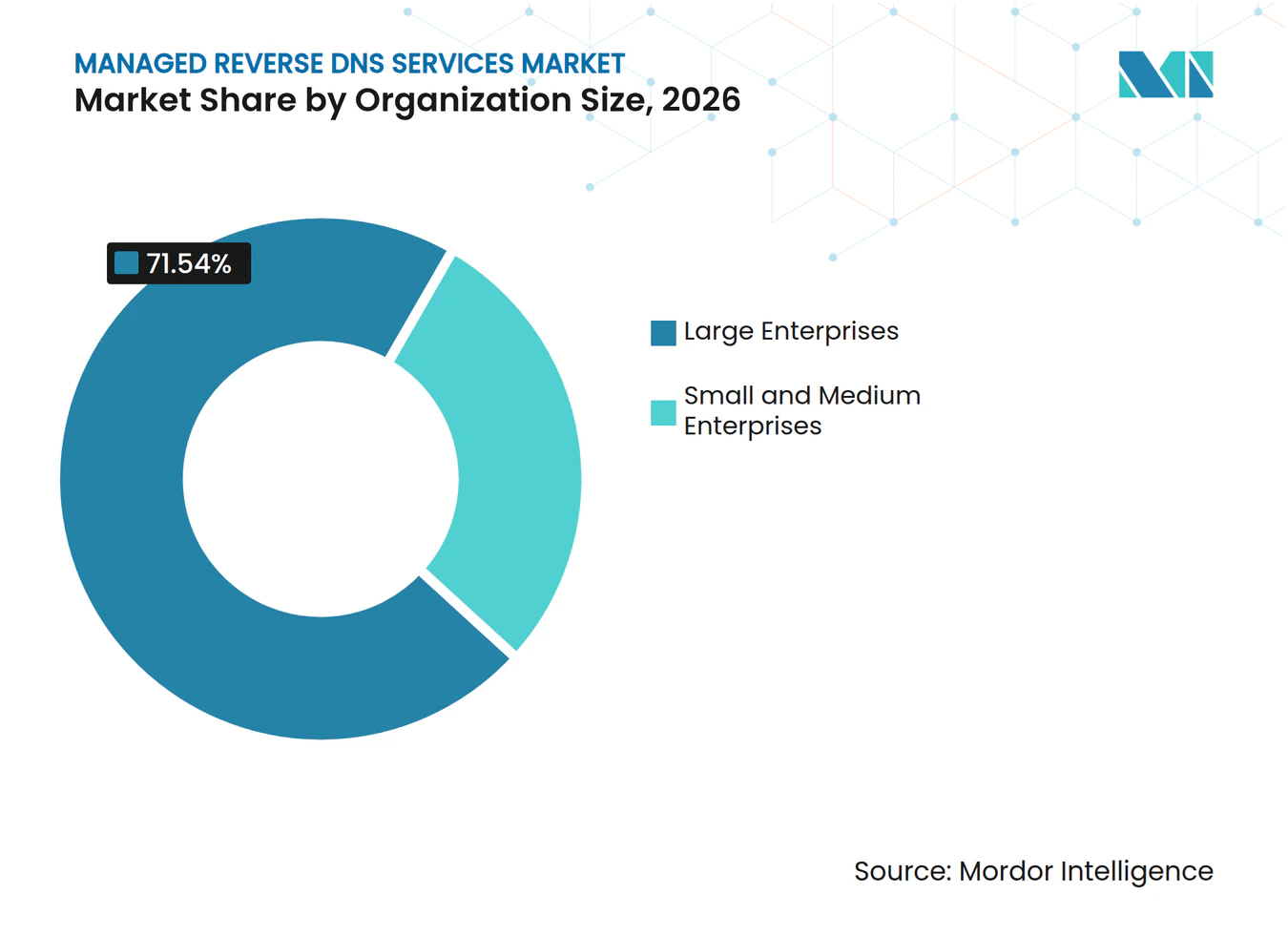
Enterprise Scale Dominates While SMEs Post the Fastest GrowthLarge enterprises held 71.54% of revenue in 2026. Their public address portfolios, distributed infrastructure, and high-volume email activity create a clear need for controlled reverse DNS operations. Many have formal security, network, and compliance functions that require documented administration. These organizations can also use advanced integrations with IP address management and security monitoring platforms. Their scale supports recurring contracts for monitoring, delegation, and remediation services. The Managed Reverse DNS Services Market is therefore anchored by larger customers that manage numerous business units and network environments. Service quality, auditability, and integration depth are important purchase factors for this group. The managed reverse DNS services market, therefore, favors vendors that can fit established enterprise control processes.
SMEs are projected to expand at a 16.24% CAGR through 2032. Cloud-first operating models expose smaller organizations to public IP workloads even when they lack specialist DNS engineers. Managed service providers can package reverse DNS alongside hosting, connectivity, security, and email support. This can make the service accessible without requiring an SME to operate a separate DNS administration function. Clear guidance and self-service features are important because reverse DNS is not always familiar to nontechnical buyers. The faster projected pace reflects a widening need for operational support as smaller firms use more cloud applications. Providers that simplify setup and monitoring are well placed to address this group.
By End-User Industry:
Telecom Leads While Healthcare Compliance Urgency RisesIT and Telecommunications held 31.66% of 2026 revenue. Telecom operators and Internet service providers purchase reverse DNS capabilities for address ranges that serve large subscriber and customer populations. Enterprise IT teams also need the service across cloud resources, data centers, and external-facing applications. Transactional email and abuse monitoring reinforce demand for reliable forward and reverse DNS alignment. The segment benefits from established network operations teams that understand PTR configuration and delegation. It also has a direct operational link to the ownership of public address space. This makes IT and Telecommunications a lasting source of demand for managed services.
The healthcare and life sciences industry is projected to expand at a 14.37% CAGR through 2032. The sector manages clinical, administrative, and patient communications that require secure, reliable email operations. Organizations also handle systems with strict privacy and operational requirements. Managed reverse DNS can support stronger control of sending infrastructure and clearer attribution in security operations. BFSI requires similar attention because frequent customer communications and anti-phishing measures raise the importance of reliable sender configuration. Government and Public Sector, Retail and E-Commerce, and Industrial Manufacturing also contribute demand as they centralize IP address management. These sectors can adopt managed services when fragmented site-level practices become difficult to maintain. The Managed Reverse DNS Services Market can support this change by centralizing routine tasks without removing local accountability.
Geography Analysis
North America Managed Reverse DNS Services Market
North America held 38.64% of 2026 revenue and remains the largest regional contributor to the Managed Reverse DNS Services Market. The region has a large concentration of ARIN-registered address holders, enterprise email operations, and managed infrastructure providers. Its technical base supports early adoption of centralized IP and DNS controls. APNIC reported that ARIN economies reached 52% IPv6 capability in April 2025, above the 40% global figure. The United States benefits from large cloud, hosting, and cybersecurity ecosystems. Canada and Mexico offer additional demand as cloud investments widen the need for coordinated IP operations.
APAC Managed Reverse DNS Services Market
Asia-Pacific is projected to expand at a 15.82% CAGR through 2032 and has the fastest regional outlook. India and Japan had IPv6 capability rates of 78.16% and 58.2%, respectively, in April 2025. This gives the region a growing need for reverse-zone planning across large IPv6 deployments. Cloud expansion, cross-border e-commerce, and digital banking also increase the volume of customer communications that depend on dependable sending infrastructure. The Managed Reverse DNS Services Market size in the region is supported by organizations that need to coordinate public IP resources across fast-changing environments. Managed platforms can address this need through automated delegation, monitoring, and shared controls.
EMEA and South America Managed Reverse DNS Services Market
Europe is a mature region where DNS governance and data-residency needs support continued investment in managed operations. The European Commission Joint Research Centre recorded a 49.4% average DNSSEC validation rate across EU member states in Q3 2025. Germany, the United Kingdom, and France lead regional demand because of their large enterprise and digital services bases. South America is developing as regional ISPs formalize IPv6 and PTR provisioning processes. The Middle East is gaining momentum through digital transformation programs in Saudi Arabia and the United Arab Emirates. Africa remains the smallest region, with demand concentrated in South Africa, Egypt, and urban telecommunications corridors.
Competitive Landscape
Market Concentration
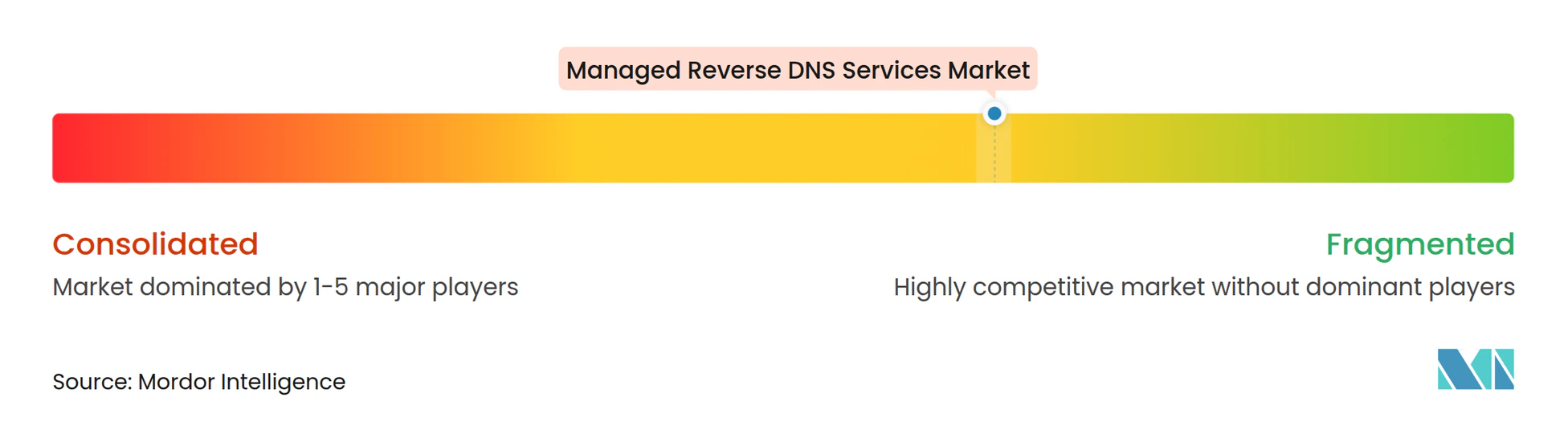
The Managed Reverse DNS Services Market is moderately fragmented because broad cloud and security providers compete with DNS and IP management specialists. Cloudflare, Amazon Web Services, Microsoft, and Akamai include DNS capabilities within wider infrastructure and security portfolios. Infoblox, IPXO, and Tiggee address buyers seeking more focused DNS, IP address management, or reverse DNS functions. Integrated portfolios can appeal to enterprise customers who prefer fewer administrative systems. Specialists can compete through focused automation, more flexible service models, and support for specific use cases. The ownership of reverse DNS authority by IP address holders and regional registries limits complete consolidation. Providers must still work with the parties that control address blocks and delegation rights.
Akamai launched DNS Posture Management in June 2025 with multicloud visibility, real-time monitoring, and integrations with Splunk, Google Security Operations, and Microsoft Sentinel. The launch shows a move toward DNS governance services that connect operational and security teams. Infoblox reported in November 2025 that it had surpassed 200 Universal DDI customers and announced cloud integrations to support network transformation. Its AWS IPAM integration also illustrates the value of synchronized address data in hybrid operations. Cloudflare's Internal DNS release in July 2026 similarly brought public and private DNS into one control environment. These moves place reverse DNS management within a larger platform strategy.
Commercial openings remain in automated IPv6 reverse-zone provisioning, IP leasing reputation management, and compliance-oriented services for regulated customers. Telecom providers need scalable tools as IPv6 deployments expand. Leasing platforms need stronger PTR and reputation processes where address histories can affect trust. Healthcare and financial-sector customers can seek better controls for public-facing mail and network infrastructure. Smaller providers, including ClouDNS, DNSimple, EuroDNS, No-IP, and Netriplex, serve customers that need simpler portals and self-service pricing. Standards knowledge remains important because ICANN policies and RFC-based delegation practices shape the operating environment. The competitive picture supports a moderate concentration profile rather than dominance by a small group of providers.
Managed Reverse DNS Services Industry Leaders
-
Akamai Technologies, Inc.
-
Cloudflare, Inc.
-
Neustar Security Services, LLC
-
Amazon Web Services, Inc.
-
Microsoft Corporation
- *Disclaimer: Major Players sorted in no particular order
Managed Reverse DNS Services Market Companies Covered in this Report
- Akamai Technologies, Inc.
- Cloudflare, Inc.
- Neustar Security Services, LLC
- Amazon Web Services, Inc.
- Microsoft Corporation
- International Business Machines Corporation
- Google LLC
- Oracle America, Inc.
- Tiggee LLC
- DigiCert, Inc.
- Vercara, LLC
- GoDaddy Inc.
- Infoblox Inc.
- ClouDNS Ltd.
- DNSimple Corporation
- No-IP, Inc.
- IPXO UAB
- Netriplex, LLC
- EuroDNS S.A.
- Corporation Service Company
- Open-Xchange AG
Recent Industry Developments in Managed Reverse DNS Services Market
- August 2026: IPXO consolidated IP leasing, management, monitoring, and monetization into a single connected platform with new subscription plans and a token-based usage model, repositioning from a leasing marketplace to an integrated IP management platform with built-in PTR provisioning and reputation management.
- July 2026: Cloudflare launched Internal DNS as generally available, unifying public and private DNS on a single control plane with a shared API, audit trail, and policy layer, eliminating the separate infrastructure previously required for managing internal and external DNS.
- June 2026: Amazon Route 53 Global Resolver added DNS View sharing between AWS accounts via AWS Resource Access Manager, enabling organizations to centralize PTR and DNS record management across distributed account structures without transferring zone ownership.
- April 2026: Cloudflare and GoDaddy announced a strategic partnership supporting Agent Name Service and Web Bot Auth standards, integrating AI crawler identity verification with DNS infrastructure and signaling a new use case requiring PTR and FCrDNS provisioning for AI agent-operating IP addresses.
Global Managed Reverse DNS Services Market Report Scope
Managed reverse DNS services market, outsourced offerings in which a provider hosts, configures, monitors, and maintains reverse DNS (PTR) records that map IP addresses back to domain names. These services support email deliverability, spam and spoofing prevention, network diagnostics, and proper IP-address reputation management across IPv4 and IPv6 environments.
The Managed Reverse DNS Services Market Report is Segmented by Service Type (Managed Reverse DNS Strategy and Assessment, Managed Reverse DNS Zone Design and Delegation, Managed PTR Record Provisioning and Administration, Managed FCrDNS Validation and Continuous Monitoring, Managed Email Deliverability and IP Reputation Services, Managed IPv6 Reverse DNS Services, Managed Reverse DNS Security and DNSSEC Services, and Other Service Types), Address Family (IPv4 Reverse DNS, and IPv6 Reverse DNS), Customer Type (IP Network Owners and Internet Service Providers, Cloud and Hosting Providers, IP Address Leasing Platforms, Enterprises With Dedicated Public IP Space, and Managed Service Providers), Deployment Model (Cloud-Based, On-Premises, and Hybrid), Organization Size (Large Enterprises, and Small and Medium-Sized Enterprises), End-User Industry (Banking, Financial Services and Insurance (BFSI), IT and Telecommunications, Healthcare and Life Sciences, Government and Public Sector, Industrial Manufacturing, Retail and E-Commerce, and Other End-User Industries), and Geography (North America, South America, Europe, Asia-Pacific, Middle East, and Africa). The Market Forecasts are Provided in Terms of Value (USD).
Segmentation Overview
| Managed Reverse DNS Strategy and Assessment |
| Managed Reverse DNS Zone Design and Delegation |
| Managed PTR Record Provisioning and Administration |
| Managed FCrDNS Validation and Continuous Monitoring |
| Managed Email Deliverability and IP Reputation Services |
| Managed IPv6 Reverse DNS Services |
| Managed Reverse DNS Security and DNSSEC Services |
| Other Service Types |
| IPv4 Reverse DNS |
| IPv6 Reverse DNS |
| IP Network Owners and Internet Service Providers |
| Cloud and Hosting Providers |
| IP Address Leasing Platforms |
| Enterprises With Dedicated Public IP Space |
| Managed Service Providers |
| Cloud-Based |
| On-Premises |
| Hybrid |
| Large Enterprises |
| Small and Medium Enterprises |
| Banking, Financial Services and Insurance (BFSI) |
| IT and Telecommunications |
| Healthcare and Life Sciences |
| Government and Public Sector |
| Industrial Manufacturing |
| Retail and E-Commerce |
| Other End-User Industries |
| North America | United States |
| Canada | |
| Mexico | |
| South America | Brazil |
| Argentina | |
| Rest of South America | |
| Europe | Germany |
| United Kingdom | |
| France | |
| Italy | |
| Rest of Europe | |
| Asia-Pacific | China |
| Japan | |
| India | |
| South Korea | |
| Rest of Asia-Pacific | |
| Middle East | Saudi Arabia |
| United Arab Emirates | |
| Rest of Middle East | |
| Africa | South Africa |
| Egypt | |
| Rest of Africa |
| By Service Type | Managed Reverse DNS Strategy and Assessment | |
| Managed Reverse DNS Zone Design and Delegation | ||
| Managed PTR Record Provisioning and Administration | ||
| Managed FCrDNS Validation and Continuous Monitoring | ||
| Managed Email Deliverability and IP Reputation Services | ||
| Managed IPv6 Reverse DNS Services | ||
| Managed Reverse DNS Security and DNSSEC Services | ||
| Other Service Types | ||
| By Address Family | IPv4 Reverse DNS | |
| IPv6 Reverse DNS | ||
| By Customer Type | IP Network Owners and Internet Service Providers | |
| Cloud and Hosting Providers | ||
| IP Address Leasing Platforms | ||
| Enterprises With Dedicated Public IP Space | ||
| Managed Service Providers | ||
| By Deployment Model | Cloud-Based | |
| On-Premises | ||
| Hybrid | ||
| By Organization Size | Large Enterprises | |
| Small and Medium Enterprises | ||
| By End-User Industry | Banking, Financial Services and Insurance (BFSI) | |
| IT and Telecommunications | ||
| Healthcare and Life Sciences | ||
| Government and Public Sector | ||
| Industrial Manufacturing | ||
| Retail and E-Commerce | ||
| Other End-User Industries | ||
| By Geography | North America | United States |
| Canada | ||
| Mexico | ||
| South America | Brazil | |
| Argentina | ||
| Rest of South America | ||
| Europe | Germany | |
| United Kingdom | ||
| France | ||
| Italy | ||
| Rest of Europe | ||
| Asia-Pacific | China | |
| Japan | ||
| India | ||
| South Korea | ||
| Rest of Asia-Pacific | ||
| Middle East | Saudi Arabia | |
| United Arab Emirates | ||
| Rest of Middle East | ||
| Africa | South Africa | |
| Egypt | ||
| Rest of Africa | ||
Key Questions Answered in the Report
What is the size of the managed reverse DNS services market?
The managed reverse DNS services market size is projected to expand from USD 283.21 million in 2026 to USD 331.62 million in 2027, and to USD 597.18 million by 2032, registering a CAGR of 12.48% between 2027 and 2032.
What is driving demand for managed reverse DNS services?
Demand is supported by cloud adoption, email deliverability controls, IPv6 deployment, and the need for reliable IP address attribution in security operations.
Which service type has the largest share of managed reverse DNS revenue?
Managed PTR Record Provisioning and Administration held 26.73% of revenue in 2026.
Which deployment model leads managed reverse DNS adoption?
Cloud-based deployment held 69.48% of revenue in 2026 and is projected to expand at a 15.63% CAGR through 2032.
Which region has the fastest outlook for managed reverse DNS services?
Asia-Pacific is projected to expand at a 15.82% CAGR through 2032, supported by IPv6 adoption and cloud infrastructure expansion.
Which end-user sector has the fastest projected expansion?
Healthcare and Life Sciences is projected to expand at a 14.37% CAGR through 2032 as organizations seek dependable controls for communications and network operations.