
Ransomware Response Retainer Services Market Size and Share
Market Overview
| Study Period | 2021 - 2032 |
|---|---|
| Market Size (2027) | USD 9.70 Billion |
| Market Size (2032) | USD 20.44 Billion |
| Growth Rate (2027 - 2032) | 16.08 % |
| Fastest Growing Market | Asia-Pacific |
| Largest Market | North America |
| Market Concentration | Medium |
Major Players *Disclaimer: Major Players sorted in no particular order Image © Mordor Intelligence. Reuse requires attribution under CC BY 4.0. | |
Ransomware Response Retainer Services Market Analysis by Mordor Intelligence
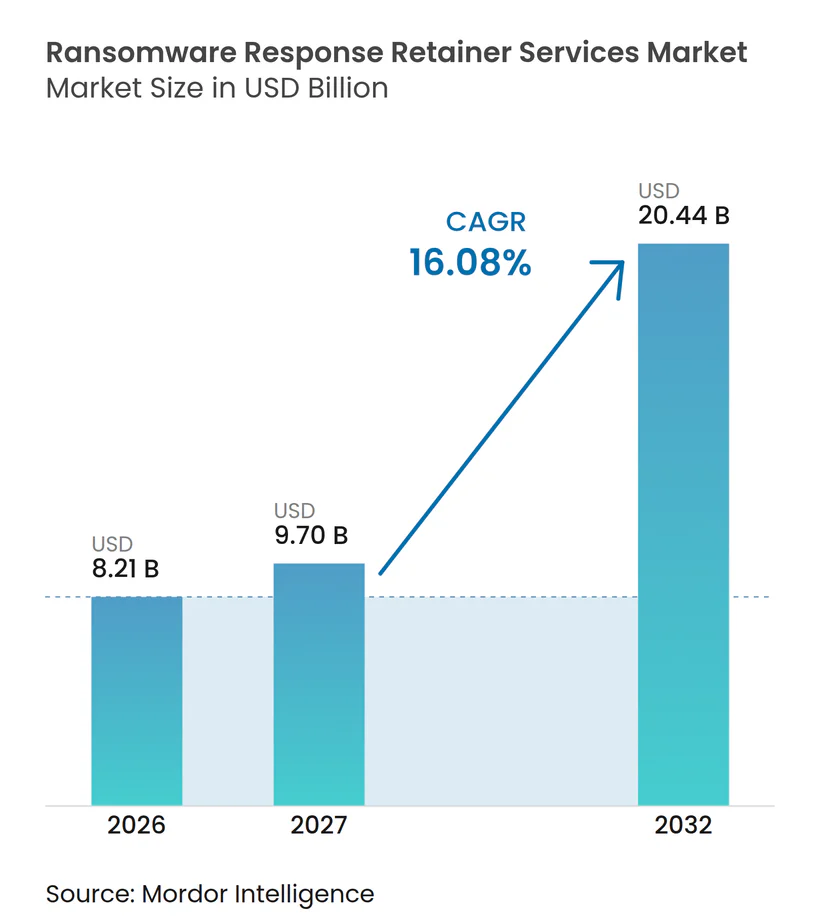
The ransomware response retainer services market size is projected to expand from USD 8.21 billion in 2026 and USD 9.70 billion in 2027 to USD 20.44 billion by 2032, registering a CAGR of 16.08% between 2027 and 2032. The ransomware response retainer services market is supported by the shift toward dual-extortion attacks, where attackers encrypt systems and remove data, increasing the value of a prepared legal and technical response. Short notification windows are making pre-contracted forensic capacity more important for regulated organizations. Insurance renewal processes also support demand because carriers increasingly expect approved response pathways and established providers. Platform-integrated providers are strengthening their position by combining threat intelligence, endpoint data, cloud investigation, and response services under one agreement. Flexible credit arrangements create an opportunity for the ransomware response retainer services market to serve buyers that need readiness work and emergency support without maintaining separate contracts.
Key Report Takeaways
- By service model, proactive retainer services held 26.39% of the Ransomware Response Retainer Services Market revenue share in 2026, while hybrid proactive and reactive arrangements are projected to expand at a 17.44% CAGR through 2032.
- By deployment mode, remote-first delivery held 56.97% share in 2026 and is projected to expand at a 17.12% CAGR through 2032.
- By organization size, large enterprises held 70.53% share of the Ransomware Response Retainer Services Market in 2026, while small and medium enterprises are projected to expand at an 18.29% CAGR through 2032.
- By end user, BFSI held 25.18% revenue share in 2026, while healthcare and life sciences are projected to expand at a 19.17% CAGR through 2032.
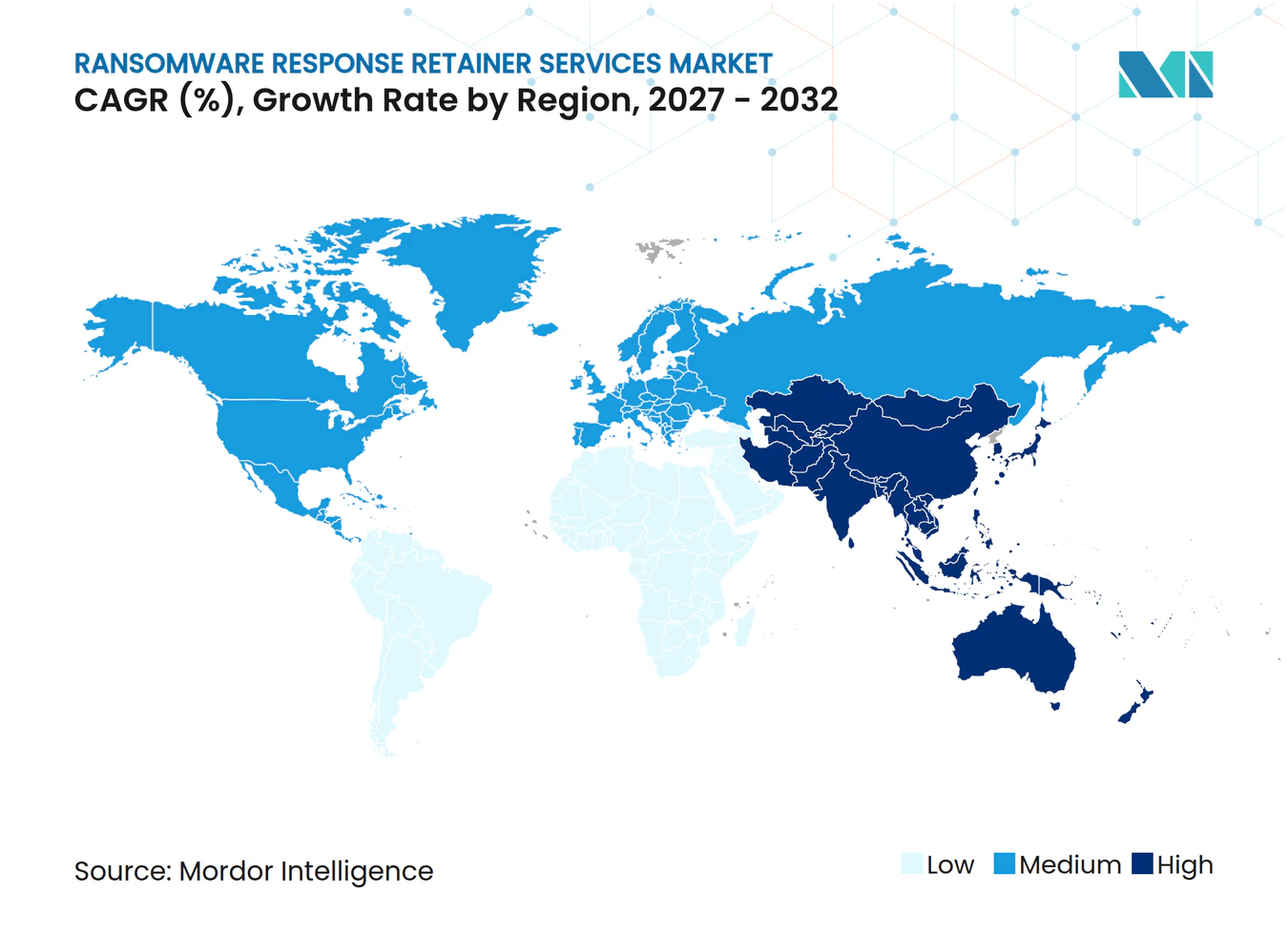
- By geography, North America held 39.21% share of the Ransomware Response Retainer Services Market in 2026, while Asia-Pacific is projected to expand at a 19.42% CAGR through 2032.
Note: Market numbers in this report are based on Mordor Intelligence's proprietary estimation framework, which combines nine months of actuals with Q4 projections for base year 2026.
Market Trends and Insights
Drivers Impact Analysis of Ransomware Response Retainer Services Market*
| Driver | (~) % Impact on CAGR Forecast | Geographic Relevance | Impact Timeline |
|---|---|---|---|
| Ransomware and Double-Extortion Escalation | +5.1% | Global, peak intensity in North America and Europe | Short term (≤ 2 years) |
| Mandatory Incident Disclosure and Notification Deadlines | +3.7% | North America and Europe core, spillover to Asia-Pacific and Middle East and Africa | Medium term (2-4 years) |
| Cyber Insurance Retainer and Panel Provider Requirements | +3.0% | North America and Europe, Asia-Pacific emerging | Medium term (2-4 years) |
| Shortage of In-House Digital Forensics and Incident Response Talent | +2.3% | Global | Long term (≥ 4 years) |
| Threat Actor Use of AI-Accelerated Social Engineering and Extortion | +1.7% | Global, highest in North America and Western Europe | Short term (≤ 2 years) |
| Retainer Economics for Cloud, Identity, and Third-Party Attack Paths | +1.4% | North America and Asia-Pacific core | Medium term (2-4 years) |
| Source: Mordor Intelligence | |||
Ransomware and Double-Extortion Escalation
The ransomware response retainer services market is being shaped by attacks that combine system encryption with data theft and threats of public release. Zscaler reported a 145.9% year-over-year rise in blocked ransomware attacks from April 2024 to April 2025. Its research also recorded 238.5 TB of data exfiltration across 10 major ransomware families and a 70.1% increase in public extortion disclosures. Coalition reported that dual-extortion cases represented 70% of ransomware claims in 2025, while initial ransom demands increased 47% year over year. The same report placed average ransomware claim cost at USD 1.18 million in 2025, compared with USD 705,000 in 2024. These costs make a pre-agreed investigation, legal coordination, and response process more valuable than waiting to identify suppliers after an incident begins.
Mandatory Incident Disclosure and Notification Deadlines
The ransomware response retainer services market benefits from notification rules that leave little time to select a forensic provider. The NIS2 guidance requires an early warning within 24 hours of awareness and an incident notification within 72 hours. DORA requires financial entities to classify and report major information and communication technology incidents within 4 hours of classification in the circumstances set out by the regulation. The U.S. Securities and Exchange Commission requires a registrant to disclose a material cybersecurity incident within 4 business days after determining that the incident is material.[1] These timelines make it difficult to complete supplier contracting, technical scoping, and disclosure preparation only after an attack. The ransomware response retainer services market, therefore, gains support where boards must align investigation findings with investor, regulator, and customer communications.
Cyber Insurance Retainer and Panel Provider Requirements
Cyber insurance is linking policy renewal more closely to planned incident response. Chubb describes cyber services for loss mitigation through approved arrangements, illustrating how insurer-led processes can guide policyholders toward established response resources. LevelBlue launched its Resilience Retainer in March 2026 with more than 50 carrier approvals and representation on more than 50 insurance panels. This approach gives buyers a clearer route to providers that can work with carrier requirements during a live event. It also makes a retainer less dependent on discretionary information technology spending because it can become part of insurance renewal planning. The ransomware response retainer services market can benefit when insurers assess pre-negotiated response, breach counsel, and crisis communications arrangements as part of readiness.
Shortage of In-House Digital Forensics and Incident Response Talent
Organizations face persistent difficulty in building their own digital forensics and incident response teams. ISC2 found that 30% of organizations could not find people with the needed skills, while 29% did not have the budget to hire enough people. Its study also found that 25% of respondents viewed digital forensics and incident response expertise gaps as an organizational vulnerability. A retainer reserves access to specialist investigators before a major incident increases competition for available capacity. This is important when several organizations need help during a wide ransomware campaign. The ransomware response retainer services market consequently serves as a capacity option for buyers who cannot justify a permanent specialist team.
Restraints Impact Analysis of Ransomware Response Retainer Services Market*
| Restraint | (~) % Impact on CAGR Forecast | Geographic Relevance | Impact Timeline |
|---|---|---|---|
| High Cost of Specialized DFIR Capacity and Evidence Tooling | -0.8% | Global, most acute in Asia-Pacific and South America | Long term (≥ 4 years) |
| Procurement and Budget Friction for Prepaid Retainer Commitments | -0.6% | Global, highest in small and medium enterprise segments | Medium term (2-4 years) |
| Cross-Border Evidence, Data Residency, and Legal Privilege Constraints | -0.5% | Europe, Asia-Pacific, Middle East and Africa | Long term (≥ 4 years) |
| Concurrent Incident Capacity Shortfalls During Major Campaigns | -0.4% | Global | Short term (≤ 2 years) |
| Source: Mordor Intelligence | |||
High Cost of Specialized DFIR Capacity and Evidence Tooling
The cost of specialist people and evidence tools can limit adoption, especially among mid-market buyers. Published annual retainers from U.S. providers range from USD 37,000 to USD 105,000 for certain offerings. A provider also needs cloud evidence collection, endpoint telemetry, memory forensics, and credentials that meet client and insurer expectations. These requirements are reflected in the price paid for experienced investigators and in the cost of maintaining an active practice. Buyers with limited security budgets must weigh prepaid response capacity against operational security controls that require immediate funding. This constraint can slow adoption in the ransomware response retainer services market where service fees are viewed as a standby cost rather than an operating expense.
Procurement and Budget Friction for Prepaid Retainer Commitments
Prepaid agreements can be difficult to approve when incidents do not happen on a predictable schedule. Finance teams may focus on utilization rates rather than the value of reserved response capacity. CrowdStrike introduced Flex for Services in March 2026 and offered eligible new customers 200 hours of services through its Zero Dollar Flex Fund, including 160 hours of incident response and 40 hours of proactive services. LevelBlue introduced a funds-based model with 100% rollover, which addresses unused-balance concerns.[2] These commercial models reduce a key objection, but they do not remove the need for buyers to assess provider value and allocate an annual budget. The ransomware response retainer services market must therefore show a clear link between readiness work and financial resilience.
*Our forecasts treat driver/restraint impacts as directional, not additive. The impact forecasts reflect baseline growth, mix effects, and variable interactions.
Ransomware Response Retainer Services Market Segment Analysis
By Service Model:
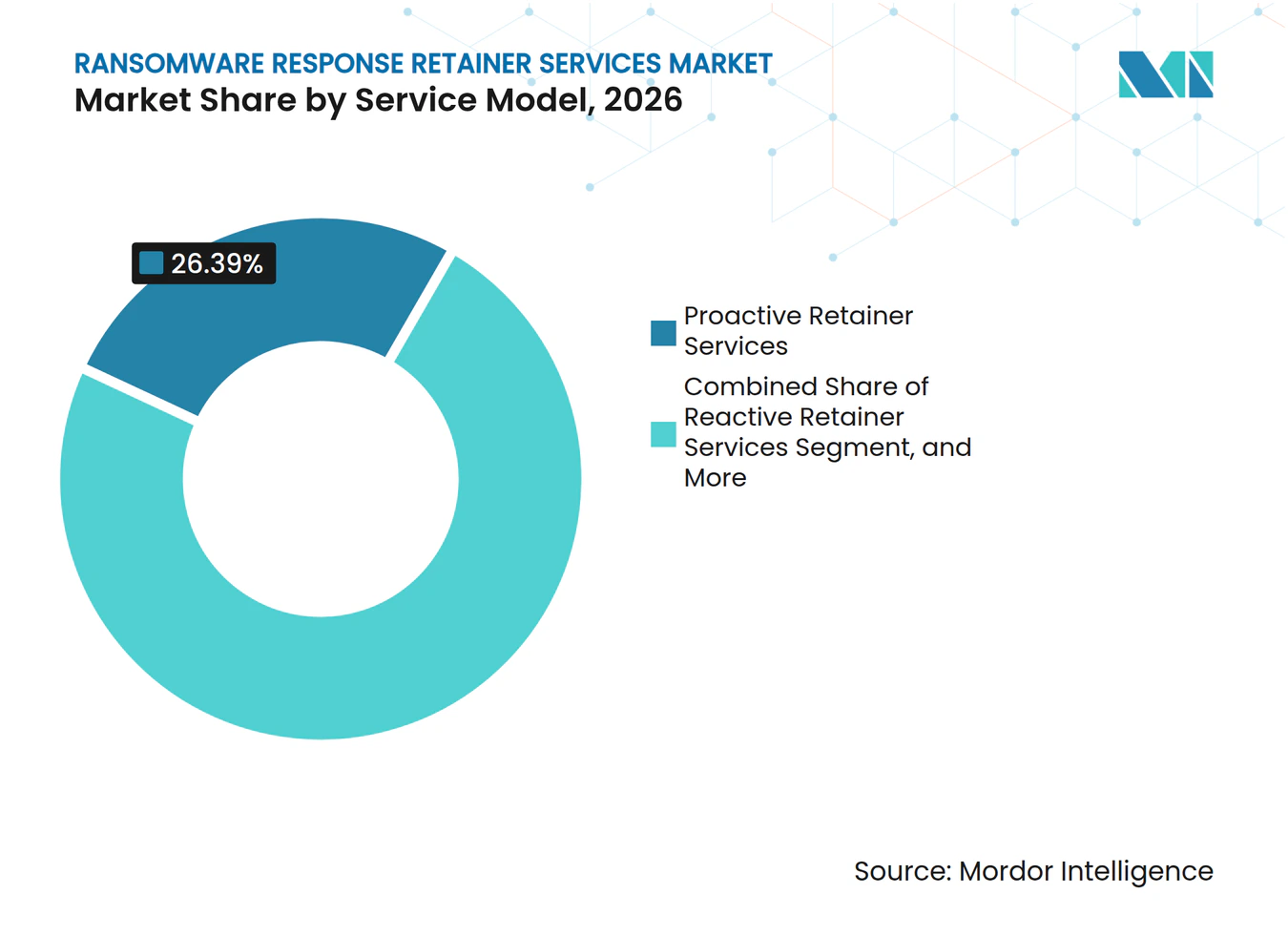
Hybrid Arrangements Are Expanding Alongside Proactive RetainersProactive retainer services held 26.39% of ransomware response retainer services market share in 2026, making them the largest service model. These arrangements support planning exercises, threat hunting, and readiness work before a disruptive event. They also create a more regular relationship between the provider and the client, which can improve knowledge of systems, contacts, and decision rights. Hybrid proactive and reactive agreements are projected to expand at a 17.44% CAGR through 2032. The ransomware response retainer services market size for hybrid arrangements benefits from a single credit pool that can fund readiness activities and emergency response.
Hybrid structures reduce the concern that a reactive agreement will remain unused in a calm year. They can also prevent a client from discovering during an incident that its retained hours are insufficient for legal, technical, and recovery work. CrowdStrike launched Flex for Services in March 2026 to let customers use one consumption model across incident response, threat hunting, and artificial intelligence advisory services. LevelBlue’s Resilience Retainer similarly combined a funds-based arrangement with rollover provisions. These approaches support continuing demand in the ransomware response retainer services market, although reactive agreements remain relevant for specialist providers focused on urgent negotiation and restoration.



By Deployment Mode:
Remote-First Delivery Has Scale While On-Site Work Remains ImportantRemote-first delivery accounted for 56.97% of ransomware response retainer services market share in 2026 and is projected to expand at a 17.12% CAGR through 2032. It allows a provider to begin evidence collection and triage without waiting for travel. Palo Alto Networks Unit 42 reported that software-as-a-service application data appeared in 23% of investigated cases in 2025, compared with 6% in 2022. This shift means relevant evidence often resides in cloud services where physical arrival provides little additional value. Remote delivery also supports cross-border clients where immediate access to endpoint and identity data is available.
Unit 42 reported that the fastest group of attackers reached data exfiltration within 72 minutes in 2025, compared with 285 minutes in 2024. This timing favors remote activation because the first investigative decisions may be needed within minutes. On-site delivery continues to matter in operational technology settings, physical evidence cases, and locations that require local-language investigators or data-residency-compliant tools. Hybrid delivery gives multinational companies an initial remote review followed by a site visit where the investigation extends into legacy systems or industrial environments. This service model supports the ransomware response retainer services market because the correct delivery method depends on the affected systems and the legal location of evidence.
By Organization Size:
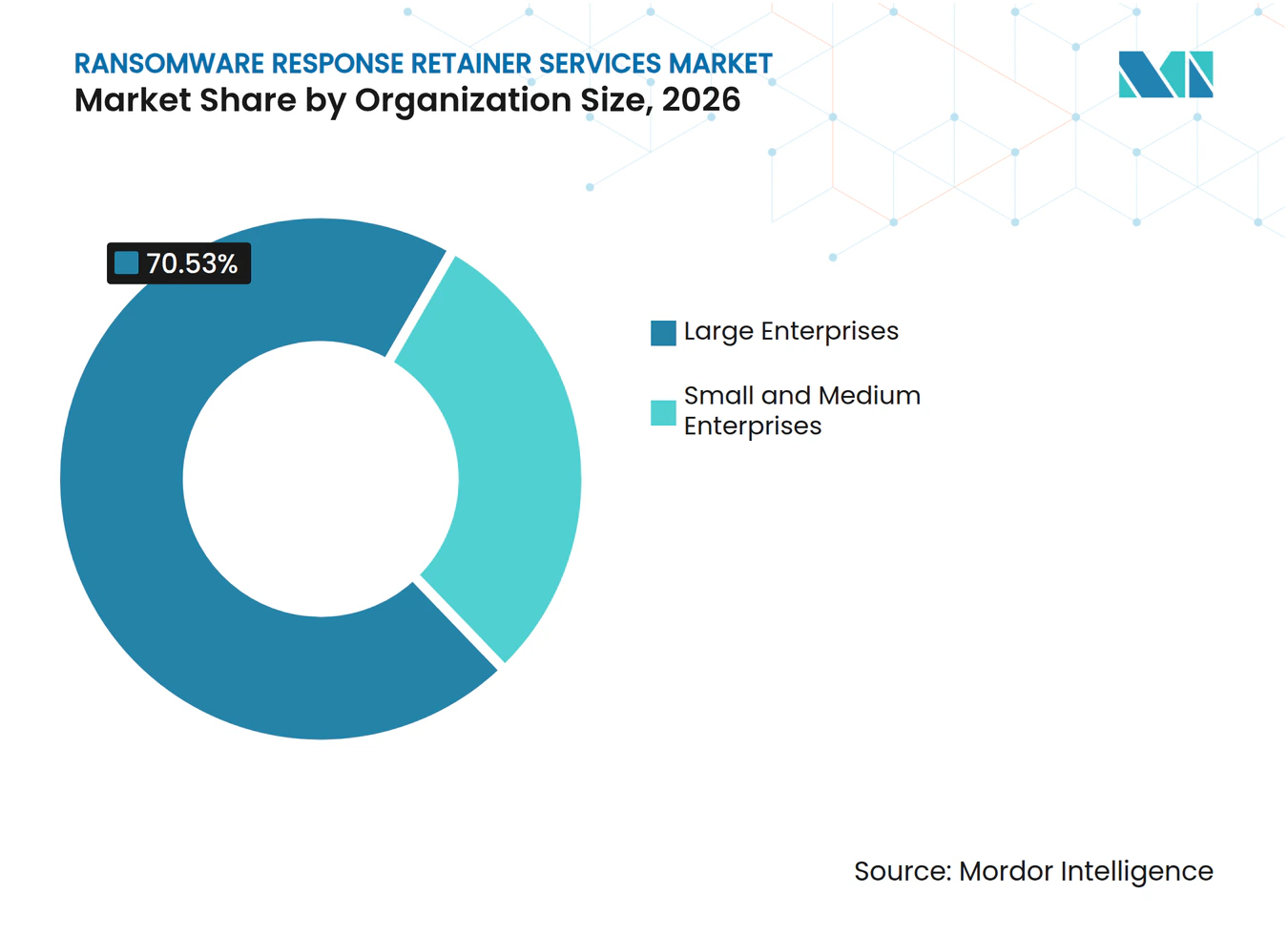
Large Enterprises Lead While Small and Medium Enterprises Gain AccessLarge enterprises held 70.53% of the ransomware response retainer services market in 2026. Their scale brings greater regulatory exposure, more complex technology environments, and a higher need to coordinate legal, technical, insurance, and communications work. Coalition found that organizations with revenue above USD 100 million faced claim frequency 5 times higher than smaller peers in 2025. These enterprises can also use a retainer to reserve support across multiple business units and countries. Their procurement teams tend to have the resources to assess detailed service levels and carrier compatibility.
Small and medium enterprises are projected to expand at an 18.29% CAGR through 2032. Flexible packages are lowering the commitment barrier for organizations that previously lacked a formal procurement process for specialist incident response. Arctic Wolf introduced Incident360 Retainer in May 2025 with proactive readiness and full-scope response coverage for 1 major incident during the contract period.[3] S&J and CyLeague Holdings introduced a pre-contracted response package in Japan for organizations with 300 or more employees from JPY 1 million (USD 6,800) per year. In the ransomware response retainer services market, clear coverage, defined response times, and credit flexibility can simplify purchasing for this group.

By End User:
BFSI Supports Revenue While Healthcare and Life Sciences Advance FasterBFSI held 25.18% of the ransomware response retainer services market in 2026. Financial institutions operate under a demanding group of reporting obligations, including U.S. Securities and Exchange Commission rules, New York Department of Financial Services expectations, and European digital operational resilience requirements. A pre-contracted provider helps this group coordinate technical findings with regulatory and investor communications. The requirement is particularly strong when an event affects payment systems, trading, personal data, or third-party service providers.
Healthcare and life sciences are projected to expand at a 19.17% CAGR through 2032. Zscaler identified healthcare among the 3 most targeted sectors in its 2025 ransomware research, while its data also showed a 935% year-over-year rise in ransomware attacks against oil and gas. Healthcare needs rapid recovery because operational disruption can affect patient services and sensitive information. Information technology and telecommunications providers also require retained capacity because software-as-a-service integrations, OAuth grants, and managed service provider relationships can create third-party attack paths. Manufacturing, energy and utilities, retail and e-commerce, and other end users broaden the ransomware response retainer services market across several operational settings.
Geography Analysis
North America Ransomware Response Retainer Services Market
North America held 39.21% regional revenue in 2026. The region has a dense set of notification rules, including the U.S. Securities and Exchange Commission’s 4-business-day disclosure period after a materiality determination. New York Department of Financial Services rules require covered entities to notify the department within 72 hours of a reportable cybersecurity event.[4] U.S. banking organizations must notify their primary federal regulator within 36 hours after determining that a qualifying computer-security incident has occurred. These requirements make contracted forensic support a practical compliance resource for financial and other regulated businesses.
Europe Ransomware Response Retainer Services Market
Europe is the second-largest region and is shaped by NIS2, which extends cyber-risk responsibilities across critical sectors, and DORA, which sets stringent reporting processes for financial entities. The ransomware response retainer services market size in Europe is also influenced by evidence handling, privacy, and jurisdictional requirements. These factors favor providers that can support local language needs and maintain data-residency-compliant workflows. European buyers may select providers with regional delivery capacity even when a global platform offers the same core technical tools.
APAC and MEA Ransomware Response Retainer Services Market
Asia-Pacific is projected to expand at a 19.42% CAGR through 2032. India’s insurance regulator issued a March 2025 direction requiring regulated insurers to empanel cyber incident response and digital forensics experts in advance. India also requires reportable cyber incidents to be reported to CERT-In within 6 hours. Japan, China, the Middle East, and Africa represent important areas of future demand as digital infrastructure expands and local specialist capacity remains limited. Regional buyers will need service models that address language, data location, and the availability of investigators during cross-border incidents.
Competitive Landscape
Market Concentration
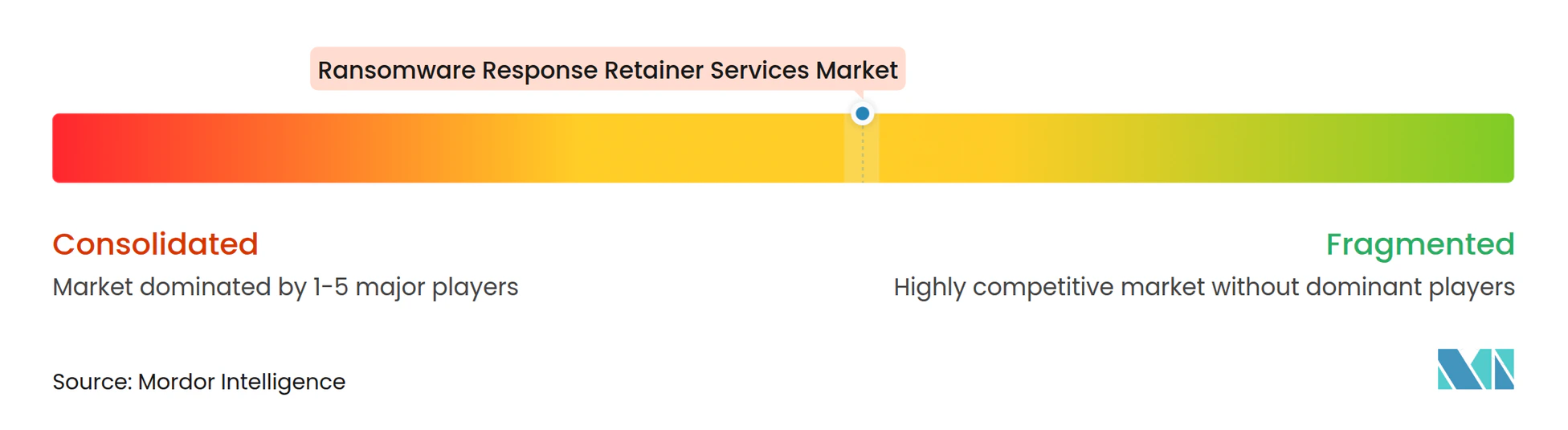
The ransomware response retainer services market is moderately fragmented below the leading platform-integrated providers. CrowdStrike, Kroll, Palo Alto Networks Unit 42, IBM X-Force, and Mandiant hold strong enterprise visibility through their technology platforms, recognized incident response practices, and insurer relationships. Specialists such as Coveware, Arete, and Sygnia compete through ransomware negotiation experience and rapid deployment networks. Buyers increasingly prefer a provider that can link threat intelligence, endpoint information, cloud forensics, legal coordination, and emergency response. This preference supports consolidation and places pressure on smaller providers that offer only one part of the response process.
CrowdStrike launched Flex for Services in March 2026, extending its consumption model across expert-led services that include incident response, threat hunting, and artificial intelligence advisory work. CrowdStrike also signed an agreement to acquire Pangea in September 2025 for USD 260 million, adding artificial intelligence detection and response capabilities to the Falcon platform. Sophos completed its USD 859 million acquisition of Secureworks in February 2025. It then launched Sophos Emergency Incident Response in June 2025 as a converged service combining capabilities from both businesses.
Kroll and CrowdStrike developed Project QuiltWorks to connect artificial intelligence-based vulnerability discovery with active incident remediation. Kroll stated in May 2026 that clients migrating more than 500,000 endpoints to the partnership achieved restoration times measured in hours and total cost of ownership reductions of as much as 30%. The ransomware response retainer services market also has space for lower-priced offers for small and medium enterprises, operational technology forensics, and multilingual service that meets regional evidence rules. Blackpanda, S&J, CyLeague Holdings, and SCSK Security illustrate the rise of regional offers targeted at Japanese or broader Asia-Pacific buyers. SCSK Security introduced a basic response, vulnerability assessment, and threat intelligence plan in February 2025 at JPY 990,000 (USD 6,700) per year.
Ransomware Response Retainer Services Industry Leaders
-
Accenture plc
-
Arctic Wolf Networks, Inc.
-
Arete Incident Response, Inc.
-
BAE Systems plc
-
Booz Allen Hamilton Holding Corporation
- *Disclaimer: Major Players sorted in no particular order
Ransomware Response Retainer Services Market Companies Covered in this Report
- Accenture plc
- Arctic Wolf Networks, Inc.
- Arete Incident Response, Inc.
- BAE Systems plc
- Booz Allen Hamilton Holding Corporation
- Cisco Systems, Inc.
- GuidePoint Security
- Coveware, Inc.
- CrowdStrike Holdings, Inc.
- Google LLC
- IBM Corporation
- Kroll, LLC
- NCC Group plc
- Palo Alto Networks, Inc.
- Rapid7, Inc.
- Secureworks Corp.
- Sophos Limited
- Sygnia Inc.
- WithSecure Corporation
Recent Industry Developments in Ransomware Response Retainer Services Market
- July 2026: Beazley Security and Halcyon introduced the Cyber Resilience Retainer, a first-of-its-kind retainer to help organizations prepare for, withstand, and recover from cyberattacks through a coordinated approach to incident management, incident response, and ransomware resilience.
- May 2026: Kroll announced the first 150-day milestones of its CrowdStrike partnership, including co-founding Project QuiltWorks alongside CrowdStrike to link AI-powered vulnerability discovery to active incident remediation. Kroll was named CrowdStrike's 2026 Americas MSSP Partner of the Year, client restoration times fell to hours, and total cost of ownership declined by as much as 30% in migrated accounts.
- March 2026: CrowdStrike launched Flex for Services, extending its consumption-based model to its full portfolio of expert-led security services, including incident response, threat hunting, and AI advisory. The companion Zero Dollar Flex Fund provided qualifying new customers with 200 hours of services, 160 hours of incident response and 40 hours of proactive services, at no upfront initiation cost, removing the prepaid-commitment barrier for first-time retainer buyers.
- March 2026: LevelBlue launched the Resilience Retainer, a funds-based model with 100% rollover and service-level agreements as low as 1 hour. It integrated capabilities from Cybereason, Stroz Friedberg, and Trustwave, and was approved by more than 50 cyber insurance carriers and listed on more than 50 insurance panels.
Global Ransomware Response Retainer Services Market Report Scope
Ransomware Response Retainer Services are specialized, subscription-based corporate cybersecurity agreements that guarantee an organization immediate, priority access to expert Digital Forensics and Incident Response (DFIR) specialists in the event of a ransomware attack.
The Ransomware Response Retainer Services Market Report is Segmented by Service Model (Proactive Retainer Services, Reactive Retainer Services, and Hybrid Proactive and Reactive Retainer Services), Deployment Model (Remote-First Delivery, On-Site Delivery, and Hybrid Remote and On-Site Delivery) Organization Size (Large Enterprises and Small and Medium-Sized Enterprises), End-User (BFSI, IT and Telecommunications, Healthcare and Life Sciences, Manufacturing, Energy and Utilities, Retail and E-Commerce, and Other End-User Industries), and Geography (North America, South America, Europe, Asia-Pacific, Middle East, and Africa). The Market Forecasts are Provided in Terms of Value (USD).
Segmentation Overview
| Proactive Retainer Services |
| Reactive Retainer Services |
| Hybrid Proactive and Reactive Retainer Services |
| Remote-First Delivery |
| On-Site Delivery |
| Hybrid Remote and On-Site Delivery |
| Large Enterprises |
| Small and Medium Enterprises |
| BFSI |
| IT and Telecommunications |
| Healthcare and Life Sciences |
| Manufacturing |
| Energy and Utilities |
| Retail and E-Commerce |
| Other End-Users |
| North America | United States |
| Canada | |
| Mexico | |
| South America | Brazil |
| Argentina | |
| Rest of South America | |
| Europe | Germany |
| United Kingdom | |
| France | |
| Italy | |
| Rest of Europe | |
| Asia-Pacific | China |
| Japan | |
| India | |
| South Korea | |
| Rest of Asia-Pacific | |
| Middle East | Saudi Arabia |
| United Arab Emirates | |
| Rest of Middle East | |
| Africa | South Africa |
| Nigeria | |
| Rest of South Africa |
| By Service Model | Proactive Retainer Services | |
| Reactive Retainer Services | ||
| Hybrid Proactive and Reactive Retainer Services | ||
| By Deployment Mode | Remote-First Delivery | |
| On-Site Delivery | ||
| Hybrid Remote and On-Site Delivery | ||
| By Organization Size | Large Enterprises | |
| Small and Medium Enterprises | ||
| By End-User | BFSI | |
| IT and Telecommunications | ||
| Healthcare and Life Sciences | ||
| Manufacturing | ||
| Energy and Utilities | ||
| Retail and E-Commerce | ||
| Other End-Users | ||
| By Geography | North America | United States |
| Canada | ||
| Mexico | ||
| South America | Brazil | |
| Argentina | ||
| Rest of South America | ||
| Europe | Germany | |
| United Kingdom | ||
| France | ||
| Italy | ||
| Rest of Europe | ||
| Asia-Pacific | China | |
| Japan | ||
| India | ||
| South Korea | ||
| Rest of Asia-Pacific | ||
| Middle East | Saudi Arabia | |
| United Arab Emirates | ||
| Rest of Middle East | ||
| Africa | South Africa | |
| Nigeria | ||
| Rest of South Africa | ||
Key Questions Answered in the Report
What is the ransomware response retainer services market size?
The ransomware response retainer services market is projected to reach USD 20.44 billion by 2032 from USD 9.70 billion in 2027, at a 16.08% CAGR.
What is a ransomware response retainer?
It is a pre-contracted agreement that gives an organization access to incident response support, often including investigation, recovery, legal coordination, and readiness work.
Why are organizations purchasing ransomware response retainers?
Dual-extortion attacks, short notification requirements, and insurer expectations increase the value of having a response provider arranged before an incident.
Which service model is expanding fastest?
Hybrid proactive and reactive arrangements are projected to expand at a 17.44% CAGR through 2032 because they can cover readiness and emergency work from one credit pool.
Which organizations are the largest users of these services?
Large enterprises held 70.53% share in 2026, reflecting their regulatory exposure, complex systems, and need to coordinate multiple stakeholders.
Which region is expanding fastest?
Asia-Pacific is projected to expand at a 19.42% CAGR through 2032, supported by developing regulatory requirements and expanding digital infrastructure.