
Managed Protective DNS Services Market Size and Share
Market Overview
| Study Period | 2021 - 2032 |
|---|---|
| Market Size (2027) | USD 1.36 Billion |
| Market Size (2032) | USD 2.61 Billion |
| Growth Rate (2027 - 2032) | 13.93 % |
| Fastest Growing Market | Asia-Pacific |
| Largest Market | North America |
| Market Concentration | Medium |
Major Players *Disclaimer: Major Players sorted in no particular order Image © Mordor Intelligence. Reuse requires attribution under CC BY 4.0. | |
Managed Protective DNS Services Market Analysis by Mordor Intelligence
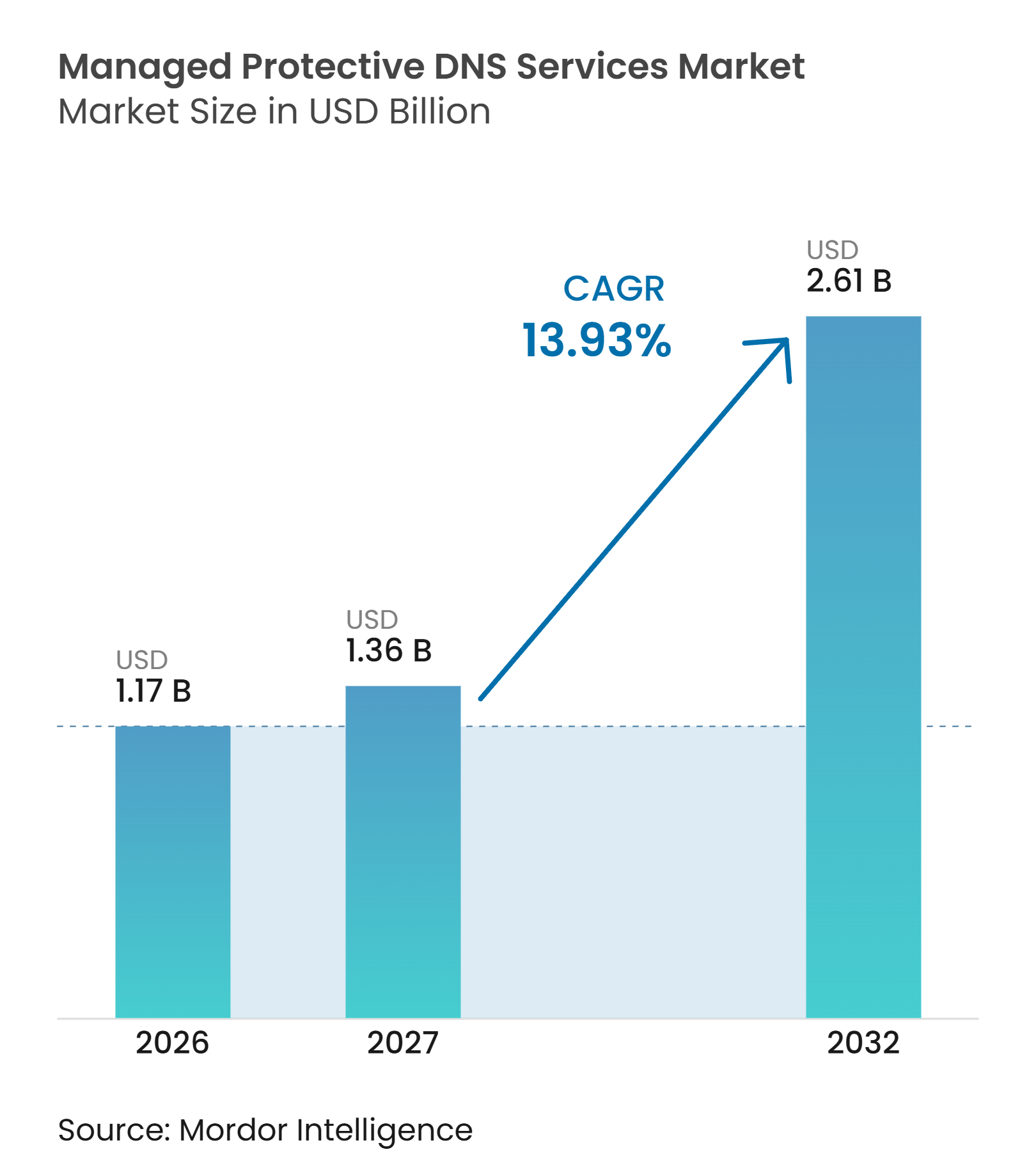
The managed protective DNS services market size is projected to expand from USD 1.17 billion in 2026 to USD 2.61 billion by 2032, registering a CAGR of 13.93% between 2027 and 2032. Demand is increasing as enterprises treat DNS as an early security control that can identify malicious activity before connections reach other layers of the network. Threat activity is also becoming more varied, which makes managed coverage useful for organizations that cannot maintain specialized DNS intelligence and response capabilities in-house. Cloud delivery supports a consistent policy for remote users, distributed sites, and workloads running across several cloud environments. Government programs and compliance requirements are making encrypted and protective DNS part of baseline security planning in several regulated settings. Vendors are responding by combining resolver protection with DNS, DHCP, and IP address management tools, which makes the managed protective DNS services market more embedded in customer security and network operations.
Key Report Takeaways
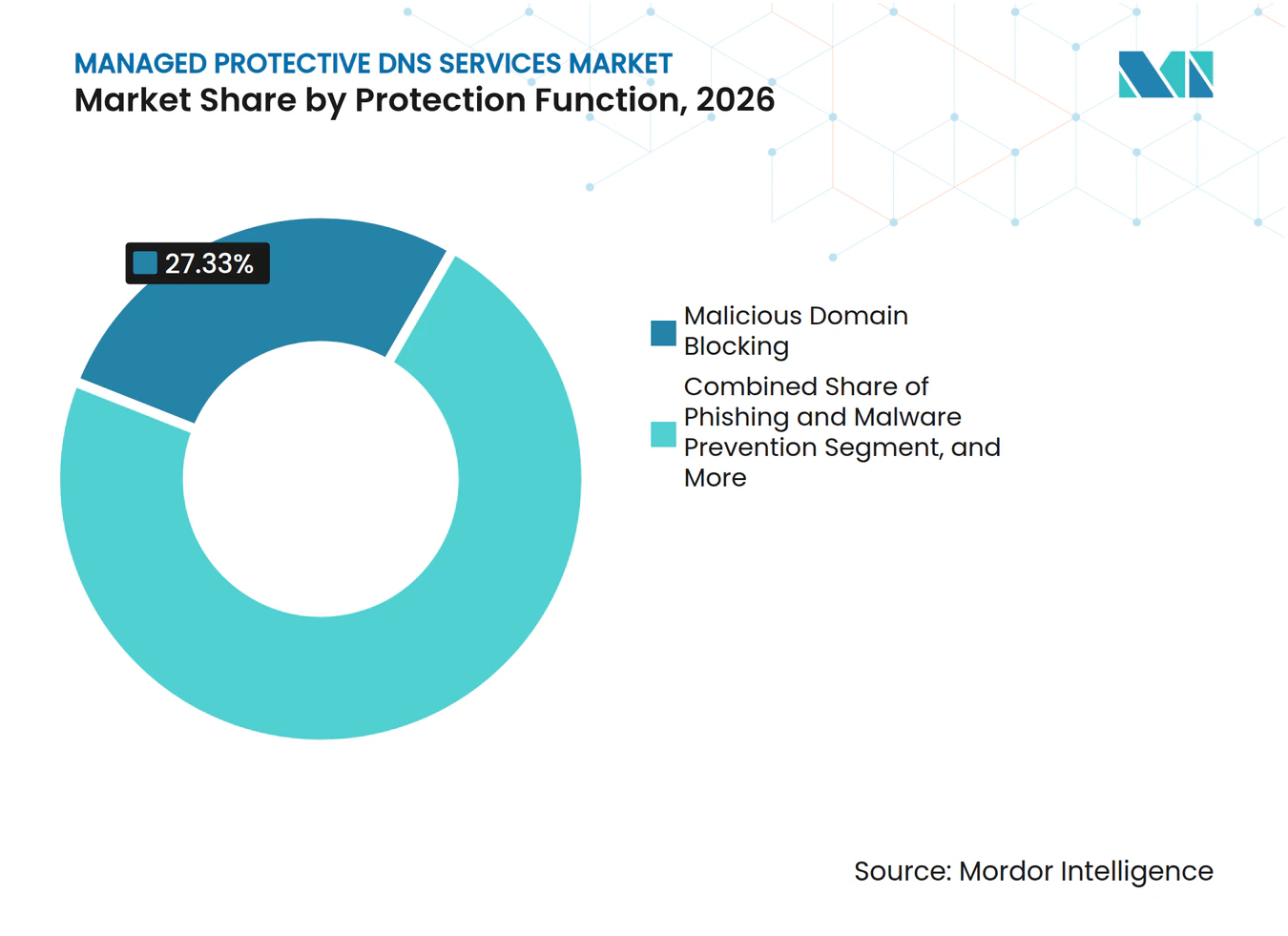
- By protection function, Malicious Domain Blocking held 27.33% of the managed protective DNS services market share in 2026, while Fast-Flux and Newly Registered Domain Detection are projected to expand at a 14.16% CAGR through 2032.
- By deployment model, Cloud-Based deployment accounted for 65.44% of revenue in 2026, while Hybrid deployment is projected to expand at a 14.22% CAGR through 2032.
- By organization size, Large Enterprises accounted for 43.88% of revenue in 2026, while Small and Medium Enterprises are projected to expand at a 14.11% CAGR through 2032.
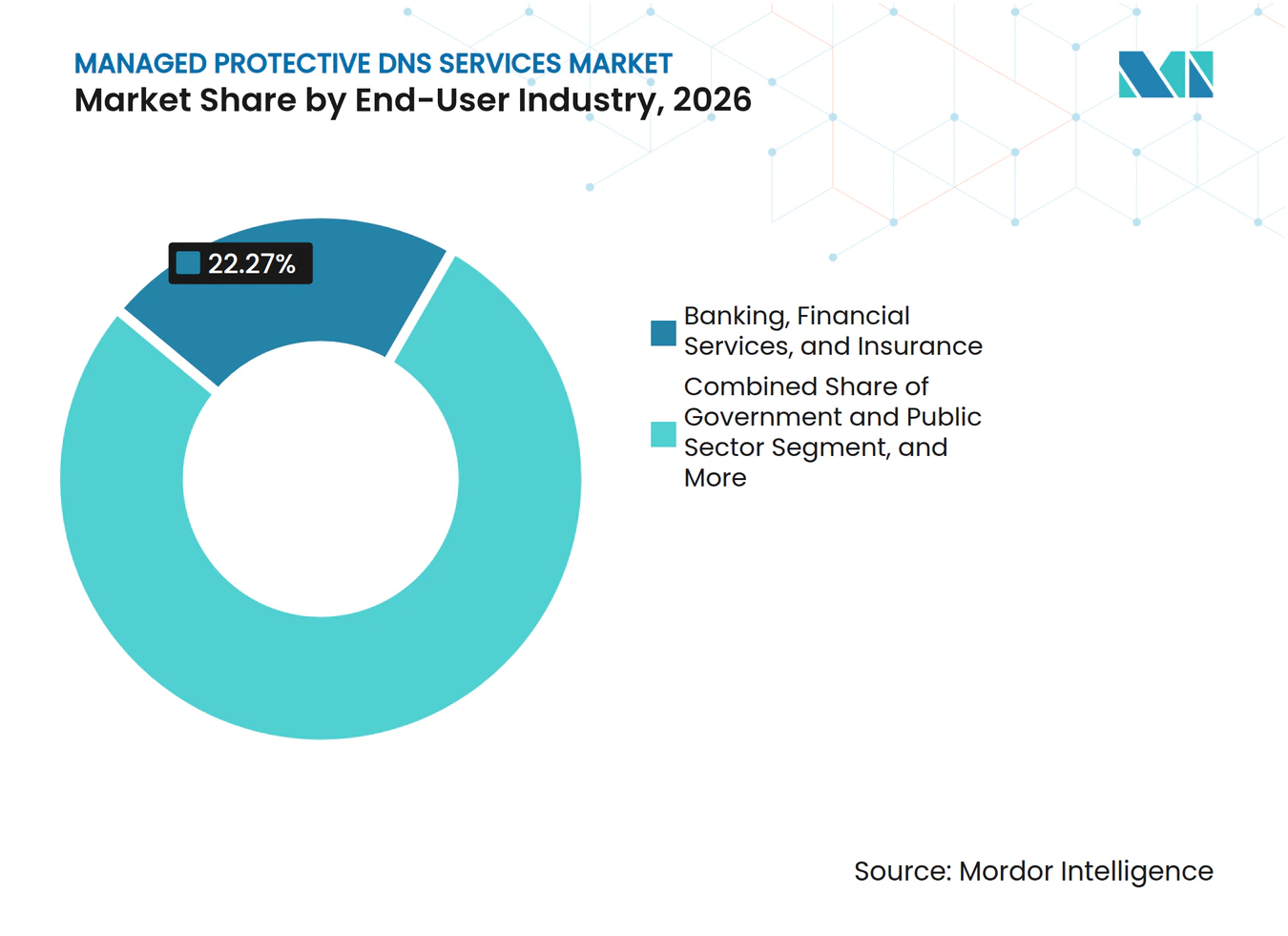
- By end-user industry, Banking, Financial Services, and Insurance held 22.27% of revenue in 2026, while Government and Public Sector are projected to expand at a 14.28% CAGR through 2032.
- By delivery and access point, Network Resolver and Forwarder held 33.21% of revenue in 2026, while Cloud Workload and VPC Resolver are projected to expand at a 14.33% CAGR through 2032.
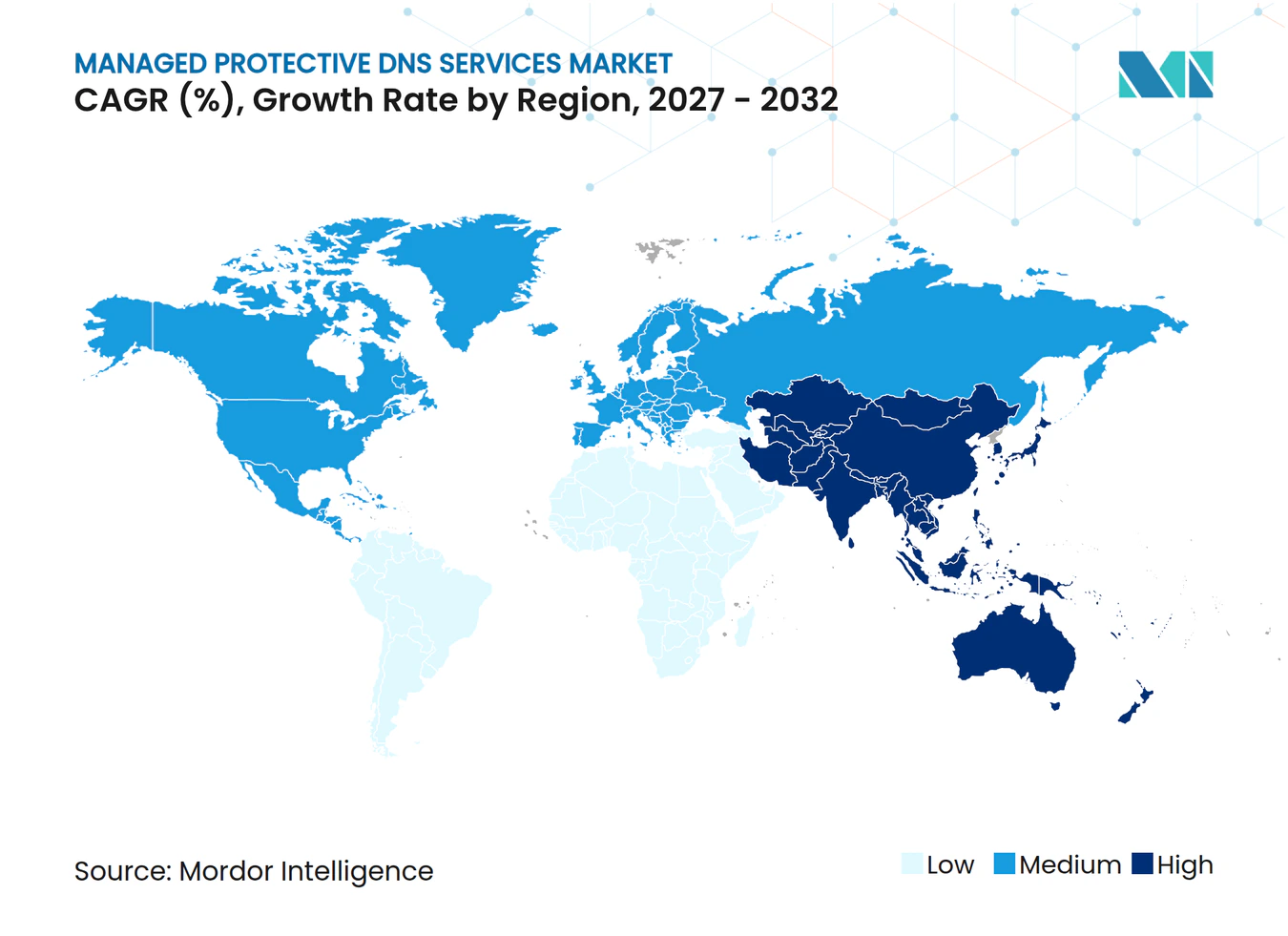
- By geography, North America held 35.44% of revenue in 2026, while Asia-Pacific is projected to expand at a 14.57% CAGR through 2032.
Note: Market numbers in this report are based on Mordor Intelligence's proprietary estimation framework, which combines nine months of actuals with Q4 projections for base year 2026.
Global Managed Protective DNS Services Market Trends and Insights
Drivers Impact Analysis*
| Driver | (~) % Impact on CAGR Forecast | Geographic Relevance | Impact Timeline |
|---|---|---|---|
| Escalation of DNS-Based Phishing, Malware, and C2 Activity | +3.5% | Global | Short term (≤ 2 years) |
| Government-Led Protective DNS Mandates and Shared Services | +2.9% | North America and Europe | Medium term (2-4 years) |
| Cloud, Hybrid Work, and Roaming-Device Expansion | +2.5% | Global | Medium term (2-4 years) |
| AI-Enabled Detection of Newly Registered and Fast-Flux Domains | +2.2% | Global, with early gains in North America and Asia-Pacific | Medium term (2-4 years) |
| DNS Telemetry as a Low-Friction SOC and Zero-Trust Control Point | +1.9% | North America and Europe | Medium term (2-4 years) |
| Protective DNS Requirements for IoT, Operational Technology, and Unmanaged Devices | +1.6% | Global, with early deployment in manufacturing-intensive Asia-Pacific and energy sectors | Long term (≥ 4 years) |
| Source: Mordor Intelligence | |||
Escalation of DNS-Based Phishing, Malware, and C2 Activity
DNS accounted for 83.8% of observed non-web threats in Zscaler ThreatLabz analysis. EfficientIP reported 13.85 billion DNS threat signals in the first half of 2026, 24% above the second half of 2025.[1] The report stated that malware became the leading DNS threat category, while daily activity increased from 8.0 million hits in January to 32.6 million in April 2026. It also recorded a 24.2% month-over-month rise in DGA activity in February and a 56.8% increase in newly observed domains in March before both signals peaked in April. That sequence gives security teams a window to investigate domains and related behavior before later-stage connections become more widespread. Infoblox found that 25.1% of 100.8 million newly observed domains were malicious or suspicious, while 95% of threat-related domains appeared in only 1 customer environment.
Government-Led Protective DNS Mandates and Shared Services
Government programs are moving protective DNS from pilot projects into routine civilian security infrastructure. A January 2025 executive order directed Federal Civilian Executive Branch agencies to enable encrypted DNS within 180 days and required federal DNS resolvers to support encrypted protocols.[2] The Department of Homeland Security reported that 92% of Federal Civilian Executive Branch agencies had joined CISA’s Protective DNS Resolver by 2025.[3] Those agencies represented more than 99% of federal external DNS traffic. The United Kingdom’s National Cyber Security Centre also provides protective DNS guidance for private-sector organizations. These programs establish procurement expectations that can carry into regulated commercial buyers as encrypted DNS and resolver security become standard requirements.
Cloud, Hybrid Work, and Roaming-Device Expansion
Hybrid work leaves a DNS security gap when endpoint devices query from home or public networks instead of through on-premises resolvers. Cloud-delivered protective DNS applies policy at the resolver level, allowing protection to follow the user without relying on physical location. Eurostat reported that a growing share of European Union enterprises use paid cloud computing services. Multiple cloud environments can create separate namespaces and inconsistent resolution paths, increasing the value of centralized DNS policy. The managed protective DNS services market is therefore supported by organizations that need a unified security control across remote work, branch locations, and cloud workloads. Cloud-native services also reduce the need to operate and update separate DNS security appliances at individual sites.
AI-Enabled Detection of Newly Registered and Fast-Flux Domains
Static threat intelligence feeds can lag attacker infrastructure that changes domain registrations or DNS records faster than blocklists are updated. CISA, NSA, FBI, and international partners identified fast flux as a national security threat in a recent advisory. The advisory described how rapid DNS record changes obscure malicious server locations and exploit gaps in network defense. Infoblox stated that its Threat Defense product blocks high-risk domains significantly earlier than traditional threat intelligence feeds, while maintaining an exceptionally low false positive rate. Palo Alto Networks said its Precision AI system analyzes a vast volume of new DNS events each day. These capabilities move vendor competition toward continuous classification of domain behavior rather than scheduled feed updates.
Restraints Impact Analysis*
| Restraint | (~) % Impact on CAGR Forecast | Geographic Relevance | Impact Timeline |
|---|---|---|---|
| Bypass Through Direct-IP Connections and Alternative Resolvers | -1.2% | Global | Short term (≤ 2 years) |
| Privacy, Data Residency, and DNS-Query Governance Concerns | -0.9% | Europe and Asia-Pacific | Medium term (2-4 years) |
| False Positives From CDN, Fast-Flux, and Newly Registered Domain Behavior | -0.6% | Global | Medium term (2-4 years) |
| Limited Buyer Awareness and Alert-Response Capacity | -0.4% | South America, Africa, and parts of Asia-Pacific | Long term (≥ 4 years) |
| Source: Mordor Intelligence | |||
Bypass Through Direct-IP Connections and Alternative Resolvers
Direct-IP communication allows malware to contact a command-and-control server through a raw IP address rather than a domain name. This method bypasses DNS-layer controls and is available in commodity malware kits without changes to attacker infrastructure. Applications, browsers, or IoT devices can also send DNS-over-HTTPS requests to public resolvers, including 1.1.1.1 and 8.8.8.8, outside an enterprise protective DNS perimeter. Research by UCL and Inria with Infoblox found that several consumer IoT devices had hardcoded resolver settings that overrode DHCP-assigned DNS settings. Effective coverage therefore requires aligned DNS policy, next-generation firewalls, and endpoint management. That cross-team implementation need can delay coverage and reduce the immediate value obtained from a managed service.
Privacy, Data Residency, and DNS-Query Governance Concerns
DNS query logs can contain IP addresses and timestamps that support profiling and location inference. ENISA has described privacy and data-protection considerations as central issues for public DNS resolver services. The DNS4EU program limits retention of IP-based query logs to 6 months and requires DNS data processing within the European Union infrastructure. These requirements affect how managed providers design log retention, data access, and regional hosting arrangements. Multinational buyers may need separate resolver deployments by jurisdiction, which adds operational work and can fragment centralized policy. The managed protective DNS services market must therefore address security outcomes alongside legal and data-handling requirements.
*Our forecasts treat driver/restraint impacts as directional, not additive. The impact forecasts reflect baseline growth, mix effects, and variable interactions.
Segment Analysis
By Protection Function: Threat Blocking Moves Beyond Known-Bad Domains
Malicious Domain Blocking held 27.33% of the managed protective DNS services market share in 2026, reflecting established threat intelligence infrastructure and widespread familiarity with blocklist-based controls. The function gives organizations a direct way to stop known malicious destinations before endpoint connections are completed. Phishing and Malware Prevention and Command-and-Control and Botnet Disruption are also substantial functions because they address channels used during ransomware staging and lateral movement. DNS Tunneling and Data-Exfiltration Prevention serves a narrower but serious use case involving concealed traffic. Infoblox records daily detections of tunneling and command-and-control activity from tools including Cobalt Strike and custom exfiltration frameworks. In the managed protective DNS services market, that need favors functions that inspect behavior and traffic patterns instead of relying only on a list of previously identified domains.
Fast-Flux and Newly Registered Domain Detection is projected to expand at a 14.16% CAGR from 2027 to 2032. This function responds to attacker infrastructure that is unfamiliar at the time of its first appearance and may change rapidly. The April 2025 fast-flux advisory raised the priority of coverage for rapidly rotating DNS records among government and critical-infrastructure operators. Providers are using predictive intelligence and behavioral models to assess registration patterns, DNS changes, and domain relationships. These methods are needed when signatures and shared lists do not yet have enough evidence to block a domain. The managed protective DNS services industry is shifting toward detection that can identify evolving infrastructure rather than only recognize known bad destinations. The managed protective DNS services market benefits when this protection can be delivered without forcing customers to replace their existing recursive DNS infrastructure.



By Deployment Model: Cloud Leads as Hybrid Architectures Expand
Cloud-Based deployment accounted for 65.44% of revenue in 2026, giving it the largest deployment model position in the managed protective DNS services market. Cloud-native services can apply the same resolver policy across data centers, remote workforces, and multiple cloud regions. They also reduce hardware maintenance at individual locations and fit naturally into SASE and security service edge deployments. On-Premises deployment remains relevant for air-gapped, classified, and certain financial services environments where DNS data must remain within internal perimeters. The model continues to serve buyers with strict control requirements and an established internal resolver infrastructure. Within the managed protective DNS services market, these use cases preserve a role for locally controlled deployments even as cloud delivery remains the leading option.
Hybrid deployment is projected to expand at a 14.22% CAGR from 2027 to 2032. It allows organizations to retain on-premises investments while extending cloud-sourced intelligence and policy to internal resolvers. Infoblox stated that its Universal DDI platform had surpassed 200 enterprise customers by November 2025, including Fortune 500 customers in financial services, healthcare, and retail. Universal DDI combines DNS, DHCP, and IP address management across on-premises, cloud, and hybrid settings. Cisco added Infoblox as a native target in Cisco Workflows in May 2026, enabling orchestration of Universal DDI and Threat Defense workflows. This type of integration can make DNS policy changes easier to propagate across several deployment layers. It also reflects how the managed protective DNS services market can connect network policy, threat response, and asset visibility across mixed environments.
By Organization Size: Large Enterprises Lead While SMEs Increase Adoption
Large Enterprises accounted for 43.88% of revenue in 2026. Their DNS traffic volumes, multi-cloud environments, and capacity to manage threat intelligence integrations support broader protective DNS deployments. Healthcare, financial services, and critical-infrastructure organizations are important large-enterprise buyers because they often need several protection functions under multi-year managed service contracts. These organizations also have more complex remote access, branch, and application environments to protect. Their purchasing decisions often prioritize centralized control and integration with existing network and security operations. This preference supports managed protective DNS services market offerings that combine broad policy coverage with service management suitable for complex organizations.
Small and Medium Enterprises are projected to expand at a 14.11% CAGR through 2032. Managed service providers can package protective DNS into per-seat security offerings that reduce the need for internal security specialists. DNSFilter reported that it processed 180 billion DNS queries daily in 2025 and served more than 43,000 organizations, primarily through managed service provider intermediaries. Its April 2025 acquisition of Zorus added endpoint web filtering and user behavior analytics to its DNS threat detection offer. Cloud delivery also removes per-site hardware costs, which can make advanced DNS intelligence more accessible for organizations with IT teams of 2 to 5 staff. The managed protective DNS services market can reach this group when managed service providers package DNS security with familiar endpoint and web controls.
By End-User Industry: Financial Services and Government Support Critical Deployments
Banking, Financial Services, and Insurance held 22.27% of revenue in 2026, the largest end-user position in the managed protective DNS services market. Financial services firms are exposed to high volumes of phishing, fraudulent domains, and attacks against customer-facing services. EfficientIP found that financial services domains represented 10.9% of targeted phishing sectors in its 2025 analysis. Cryptocurrency platforms were the second-most targeted sector, representing 18.1% of DNS phishing traffic. PCI DSS and DORA compliance frameworks support DNS-layer security as part of a broader network-defense approach, which can contribute to multi-year deployments and contract renewals. The managed protective DNS services market is consequently relevant where organizations need to demonstrate a consistent security policy across high-value customer and payment systems.
The government and public sector are projected to expand at a 14.28% CAGR through 2032. CISA’s program is extending from Federal Civilian Executive Branch coverage to a pilot involving critical infrastructure, including power grids, water utilities, and transportation operators. Healthcare and Life Sciences also contribute to demand because ransomware operations can use command-and-control and staging traffic that DNS controls can observe. Energy, Utilities, and Critical Infrastructure are increasing adoption in connection with operational technology network segmentation needs. IT and Telecommunications remains a major user group because carriers and DNS infrastructure operators require protection at scale. Retail and E-Commerce demand can increase during seasonal phishing activity, with logistics and courier-themed DNS phishing rising 3.4x in the first half of 2026. These patterns make the managed protective DNS services market relevant to organizations that need to adjust monitoring as campaigns and customer-facing activity change.

By Delivery and Access Point: Network Resolvers Anchor Coverage While Cloud Workloads Accelerate
Network Resolver and Forwarder held 33.21% of revenue in 2026. This access path integrates with existing enterprise DNS infrastructure without requiring agents on individual devices. It provides a low-disruption entry route for organizations that already operate recursive resolver fleets. It also supports internet service provider deployments that apply controls upstream of all endpoints. Endpoint and Roaming Client delivery extends protection to remote workers who query DNS away from corporate networks. This delivery method complements the managed protective DNS services market by maintaining policy coverage when the traditional corporate network is no longer the route for DNS requests.
Cloud Workload and VPC Resolver is projected to expand at a 14.33% CAGR from 2027 to 2032. Multi-cloud applications need DNS filtering for east-west and outbound workload traffic within virtual private cloud environments. Palo Alto Networks integrated Advanced DNS Security with Amazon Route 53 Resolver DNS Firewall in August 2026 through AWS Marketplace. The integration applies threat intelligence across 9 categories without requiring changes to VPC network architecture. Secure Web Gateway and Zero-Trust Platform integrations position protective DNS within SASE environments, while ISP, Carrier, and Public-Sector Resolver deployments support programs operated by CISA and the NCSC. This range of delivery options allows the managed protective DNS services market to serve both centralized infrastructure and remote endpoint requirements.
Geography Analysis
North America held 35.44% of global revenue in 2026, the largest geographic position in the managed protective DNS services market. The United States federal protective DNS mandate supports an established deployment base. The Department of Homeland Security confirmed that 92% of Federal Civilian Executive Branch agencies had joined CISA’s service by 2025, representing more than 99% of federal external DNS traffic. This scale has supported a mature vendor ecosystem and more familiar commercial procurement practices. Canada’s critical-infrastructure sectors are aligning with the Canadian Center for Cyber Security, which joined the April 2025 fast-flux advisory. Mexico’s financial sector is extending DNS security controls under national banking regulator frameworks.
Asia-Pacific is projected to expand at a 14.57% CAGR from 2027 to 2032, the fastest regional rate in the managed protective DNS services market. Cloud adoption in India, South Korea, China, and Australia is broadening the need for scalable security controls. Akamai identified AI-driven threats and distributed AI workloads as important elements of the regional cloud and security risk environment. That environment favors cloud-delivered DNS protection over appliance-based approaches that require refresh cycles. Europe has different operating requirements because DNS4EU uses European Union-based data centers to address data-residency needs. Commercial providers must address those requirements when serving European enterprise clients.
South America has steady uptake led by Brazil’s financial sector and Argentina’s technology industry. Limited awareness among small and medium enterprises remains a constraint in the region. The Middle East is developing demand through smart-city and critical-infrastructure programs in Saudi Arabia and the United Arab Emirates. Those programs increase IoT and operational technology DNS traffic that needs network-level protection. Palo Alto Networks added points of presence in Spain, Italy, and Switzerland in August 2026 to reduce DNS resolution latency for European and Middle Eastern enterprise customers. Africa held the smallest regional position in 2026, though South Africa, Nigeria, and Egypt show continued demand from mobile-first internet use and expanding fintech ecosystems.
Competitive Landscape
Market Concentration
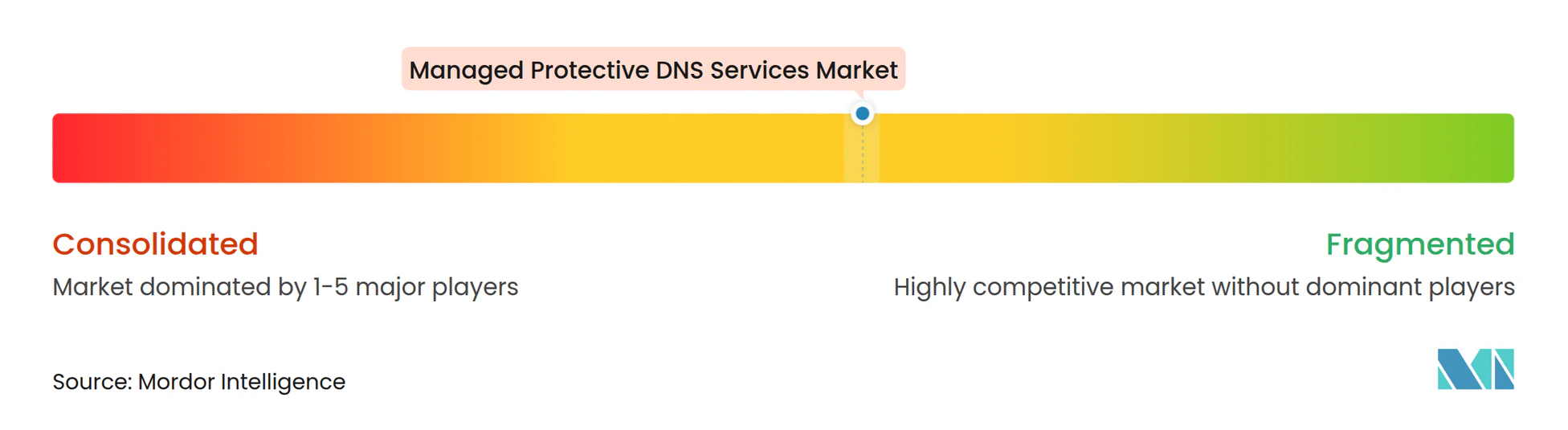
The managed protective DNS services market is moderately concentrated, with dedicated DNS security vendors and larger cybersecurity platforms competing across enterprise and managed-service-provider channels. Cisco, Cloudflare, and Infoblox are visible competitive anchors, while DNSFilter, TitanHQ, SafeDNS, DNSSense, and Heimdal Security compete for mid-market and managed service provider accounts. Provider selection in the managed service provider channel depends on per-seat economics and the breadth of API integrations. Vendors are increasingly bundling protective DNS with DDI management and SASE frameworks. This approach links DNS protection with customer network operations and can raise switching costs. The competitive field also includes cloud-adjacent offerings that place protective DNS within broader cloud security portfolios.
Infoblox completed its acquisition of Axur in May 2026 and introduced Digital Risk Protection Services and Continuous Threat Exposure Management capabilities. The acquisition expanded its position into external threat discovery, brand-abuse monitoring, and credential exposure. Cisco’s May 2026 workflow integration with Infoblox provides another example of protective DNS being connected to security orchestration and network provisioning. Palo Alto Networks’ August 2026 Amazon Route 53 Resolver DNS Firewall integration shows the importance of cloud-native partnerships. Vendor differentiation is increasingly based on classification speed, behavioral analysis, and threat intelligence depth rather than resolver performance alone. Providers are also applying graph-based and natural-language methods to identify malicious infrastructure through registration behavior and domain relationships.
Unaddressed opportunity remains in IoT and operational technology environments, where hardcoded resolvers and non-agent devices require protection at the network layer. UCL and Inria research with Infoblox found that none of 30 tested consumer IoT devices supported encrypted DNS. Managed protective DNS services market providers can also address managed-service-provider demand in South America, Africa, and Southeast Asia, where security service adoption remains below the level of threat exposure. Sovereign cloud deployment is another opening in the Middle East and Europe, where local resolver infrastructure can address data residency needs. Hyperscaler-linked integrations add pressure on independent vendors because protective DNS can be purchased as part of broader cloud security. Newer providers are targeting the IoT and operational technology gap with agentless network-level services that classify DNS queries from printers, cameras, and industrial controllers in real time.
Managed Protective DNS Services Industry Leaders
-
Cisco Systems, Inc.
-
Cloudflare, Inc.
-
Infoblox Inc.
-
Zscaler, Inc.
-
Akamai Technologies, Inc.
- *Disclaimer: Major Players sorted in no particular order
Recent Industry Developments
- October 2026: EfficientIP released its H1 2026 DNS Threat Intelligence Report, documenting a 24% increase in total DNS threat signals to 13.85 billion hits and reporting that malware overtook phishing as the leading DNS threat category for the first time, with daily malware activity rising 4x from a January low to an April peak of 32.6 million hits per day.
- October 2026: Palo Alto Networks updated its Advanced DNS Security Resolver to support Prisma Browser as a connection source, enabling DNS-over-HTTPS for all browser-based DNS activity without requiring traffic decryption, extending zero-trust DNS policy enforcement to browser sessions across managed and unmanaged devices.
- September 2026: Palo Alto Networks added DNS-over-TLS support to its Advanced DNS Security Resolver via TCP port 853, providing an additional encrypted DNS transport option alongside existing DNS-over-HTTPS infrastructure, with full IPv4 and IPv6 compatibility.
- August 2026: Palo Alto Networks Advanced DNS Security integrated with Amazon Route 53 Resolver DNS Firewall, bringing DNS threat intelligence covering 9 threat categories to AWS VPC environments via AWS Marketplace without requiring changes to VPC networking architecture.
Global Managed Protective DNS Services Market Report Scope
The Managed Protective DNS (DNS) Services Market comprises outsourced, 24/7 security services in which a third-party provider operates a policy-enforcing, recursive DNS resolver that inspects and filters DNS queries in real time, blocking resolution to known or suspected malicious domains, phishing sites, malware command-and-control (C2) infrastructure, and domain generation algorithm (DGA) domains before a connection is ever established.
The Managed Protective DNS Services Market Report is Segmented by Protection Function (Malicious Domain Blocking, Phishing and Malware Prevention, Command-and-Control and Botnet Disruption, DNS Tunneling and Data-Exfiltration Prevention, Content and Acceptable-Use Filtering, and Fast-Flux and Newly Registered Domain Detection), Deployment Model (Cloud-Based, On-Premises, and Hybrid), Organization Size (Large Enterprises and Small and Medium Enterprises), End-User Industry (Banking, Financial Services, and Insurance, IT and Telecommunications, Government and Public Sector, Healthcare and Life Sciences, Energy, Utilities, and Critical Infrastructure, Retail and E-Commerce, and Other End-User Industries), Delivery and Access Point (Network Resolver and Forwarder, Endpoint and Roaming Client, Secure Web Gateway and Zero-Trust Platform, Cloud Workload and VPC Resolver, and ISP, Carrier, and Public-Sector Resolver), and Geography (North America, South America, Europe, Asia-Pacific, and Middle East and Africa). The Market Forecasts Are Provided in Terms of Value (USD).
| Malicious Domain Blocking |
| Phishing and Malware Prevention |
| Command-and-Control and Botnet Disruption |
| DNS Tunneling and Data-Exfiltration Prevention |
| Content and Acceptable-Use Filtering |
| Fast-Flux and Newly Registered Domain Detection |
| Cloud-Based |
| On-Premises |
| Hybrid |
| Large Enterprises |
| Small and Medium Enterprises |
| Banking, Financial Services, and Insurance |
| IT and Telecommunications |
| Government and Public Sector |
| Healthcare and Life Sciences |
| Energy, Utilities, and Critical Infrastructure |
| Retail and E-Commerce |
| Other End-User Industries |
| Network Resolver and Forwarder |
| Endpoint and Roaming Client |
| Secure Web Gateway and Zero-Trust Platform |
| Cloud Workload and VPC Resolver |
| ISP, Carrier, and Public-Sector Resolver |
| North America | United States |
| Canada | |
| Mexico | |
| South America | Brazil |
| Argentina | |
| Rest of South America | |
| Europe | Germany |
| United Kingdom | |
| France | |
| Italy | |
| Spain | |
| Rest of Europe | |
| Asia-Pacific | China |
| Japan | |
| India | |
| South Korea | |
| Rest of Asia-Pacific | |
| Middle East and Africa | Saudi Arabia |
| United Arab Emirates | |
| South Africa | |
| Egypt | |
| Rest of Middle East and Africa |
| By Protection Function | Malicious Domain Blocking | |
| Phishing and Malware Prevention | ||
| Command-and-Control and Botnet Disruption | ||
| DNS Tunneling and Data-Exfiltration Prevention | ||
| Content and Acceptable-Use Filtering | ||
| Fast-Flux and Newly Registered Domain Detection | ||
| By Deployment Model | Cloud-Based | |
| On-Premises | ||
| Hybrid | ||
| By Organization Size | Large Enterprises | |
| Small and Medium Enterprises | ||
| By End-User Industry | Banking, Financial Services, and Insurance | |
| IT and Telecommunications | ||
| Government and Public Sector | ||
| Healthcare and Life Sciences | ||
| Energy, Utilities, and Critical Infrastructure | ||
| Retail and E-Commerce | ||
| Other End-User Industries | ||
| By Delivery and Access Point | Network Resolver and Forwarder | |
| Endpoint and Roaming Client | ||
| Secure Web Gateway and Zero-Trust Platform | ||
| Cloud Workload and VPC Resolver | ||
| ISP, Carrier, and Public-Sector Resolver | ||
| By Geography | North America | United States |
| Canada | ||
| Mexico | ||
| South America | Brazil | |
| Argentina | ||
| Rest of South America | ||
| Europe | Germany | |
| United Kingdom | ||
| France | ||
| Italy | ||
| Spain | ||
| Rest of Europe | ||
| Asia-Pacific | China | |
| Japan | ||
| India | ||
| South Korea | ||
| Rest of Asia-Pacific | ||
| Middle East and Africa | Saudi Arabia | |
| United Arab Emirates | ||
| South Africa | ||
| Egypt | ||
| Rest of Middle East and Africa | ||
Key Questions Answered in the Report
What is the size of the managed protective DNS services market?
The managed protective DNS services market is projected to increase from USD 1.17 billion in 2026 to USD 2.61 billion by 2032 at a 13.93% CAGR from 2027 to 2032.
What is driving demand for managed protective DNS services?
Rising DNS-based malware, phishing, command-and-control activity, cloud adoption, hybrid work, and public-sector protective DNS programs are supporting demand.
Which protection function is expanding fastest?
Fast-Flux and Newly Registered Domain Detection is projected to expand at a 14.16% CAGR through 2032 because attackers can rotate DNS records and domains quickly.
Which deployment model leads protective DNS adoption?
Cloud-Based deployment accounted for 65.44% of revenue in 2026 because it can apply common policy across remote users, distributed sites, and cloud environments.
Which end-user group has the largest protective DNS requirement?
Banking, Financial Services, and Insurance held 22.27% of revenue in 2026, reflecting its exposure to phishing and fraudulent domains.
Which region is expanding fastest for managed protective DNS services?
Asia-Pacific is projected to expand at a 14.57% CAGR through 2032 as cloud security demand increases across India, South Korea, China, and Australia.