
Managed DNS Security Services Market Size and Share
Market Overview
| Study Period | 2021 - 2032 |
|---|---|
| Market Size (2027) | USD 4.39 Billion |
| Market Size (2032) | USD 8.76 Billion |
| Growth Rate (2027 - 2032) | 14.82 % |
| Fastest Growing Market | Asia-Pacific |
| Largest Market | North America |
| Market Concentration | Medium |
Major Players *Disclaimer: Major Players sorted in no particular order Image © Mordor Intelligence. Reuse requires attribution under CC BY 4.0. | |
Managed DNS Security Services Market Analysis by Mordor Intelligence
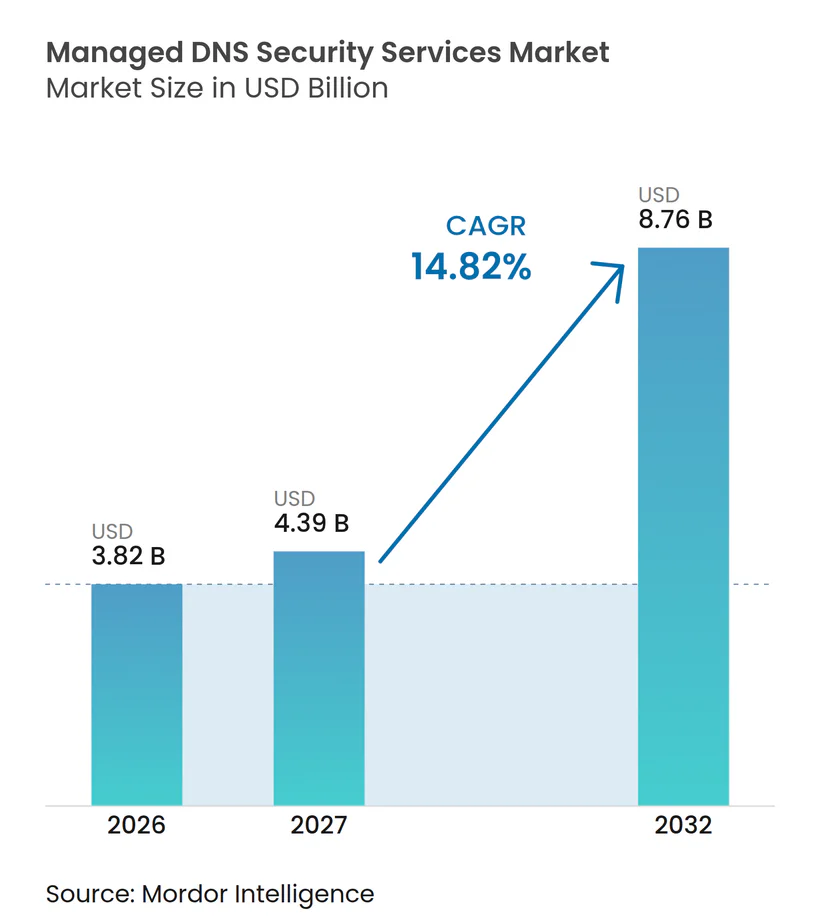
The managed DNS security services market size is projected to expand from USD 3.82 billion in 2026 and USD 4.39 billion in 2027 to USD 8.76 billion by 2032, registering a CAGR of 14.82% between 2027 to 2032. The managed DNS security services market is moving beyond routine name resolution because organizations increasingly use DNS for security controls, traffic management, and regulatory compliance. Cloud and hybrid deployments widen the attack surface, while DNS incidents can interrupt applications, transactions, and customer access. The financial impact of DNS-related incidents and the need to meet data-residency obligations are making managed services more relevant to enterprise risk planning. Providers are responding by combining DNS protection with cloud platforms, content delivery networks, threat intelligence, and automated policy tools. This creates an opportunity for providers that can support resilient global coverage while meeting local data and compliance requirements.
Key Report Takeaways
- By deployment model, cloud-based services held 64.72% of the managed DNS security services market share in 2026 and are projected to expand at a 15.24% CAGR through 2032.
- By DNS service type, primary DNS accounted for 34.66% of revenue in 2026, while secondary DNS is projected to expand at a 15.16% CAGR through 2032.
- By organization size, large enterprises held 74.33% of revenue in 2026, while SMEs are projected to expand at a 15.18% CAGR through 2032.
- By end-user industry, IT and telecommunications held 22.46% of revenue in 2026, while BFSI is projected to expand at a 15.29% CAGR through 2032.
- By application, cloud and SaaS applications held 28.71% of revenue in 2026, while IoT applications are projected to expand at a 15.22% CAGR through 2032.
- By geography, North America held 41.88% of revenue in 2026, while Asia-Pacific is projected to expand at a 15.49% CAGR through 2032.
Note: Market numbers in this report are based on Mordor Intelligence's proprietary estimation framework, which combines nine months of actuals with Q4 projections for base year 2026.
Market Trends and Insights
Drivers Impact Analysis of Managed DNS Security Services Market*
| Driver | (~) % Impact on CAGR Forecast | Geographic Relevance | Impact Timeline |
|---|---|---|---|
| Escalating DNS-Based Cyberattacks and DDoS Exposure | +4.2% | Global, concentrated in North America and Europe | Short term (≤ 2 years) |
| Cloud-Native Application Proliferation | +3.5% | North America and Asia-Pacific core, spill-over to Europe | Short term (≤ 2 years) |
| IoT and 5G Query Expansion | +2.8% | Asia-Pacific core, China, India, and South Korea, spill-over to North America | Medium term (2-4 years) |
| CDN and Multi-CDN Adoption | +1.9% | Global, strongest in North America and Europe | Medium term (2-4 years) |
| DNS Policy Automation Through Infrastructure as Code | +1.4% | North America and Europe | Medium term (2-4 years) |
| Data-Residency Requirements and Localized DNS Nodes | +0.8% | EU, China, India, and South America | Long term (≥ 4 years) |
| Source: Mordor Intelligence | |||
Escalating DNS-Based Cyberattacks and DDoS Exposure
DNS infrastructure was involved in 95% of organizational security incidents during the prior 12 months in a survey of 218 senior security decision-makers in North America and Europe. EfficientIP reported that total threat signals increased 24% between H2 2025 and H1 2026 after analyzing more than 150 billion daily DNS transactions. Malware became the leading category as daily malicious activity quadrupled between January and April 2026. Domain-generation algorithm activity can appear weeks before malware activity increases, which gives organizations with managed DNS visibility time to identify campaign infrastructure. Financial institutions faced a 272% increase in DNS query flood attacks during 2025, and the average incident cost was USD 1.1 million, which makes DNS security a procurement issue for senior management.[1]
Cloud-Native Application Proliferation
Containerized and microservice applications increase dependence on DNS because service-to-service calls require name resolution. Infoblox found that 25.1% of 100.8 million newly observed domains were malicious or suspicious in its 2025 analysis of more than 70 billion daily queries. Frequent deployment cycles can also leave dangling CNAME records after services change or are removed. Infoblox identified dangling records at 31 of nearly 40 early-access organizations, and nearly one-third were easy or trivial to exploit for phishing and credential theft.[2] Guidance from the NSA and CISA favors enterprise resolvers that support DNS over HTTPS or DNS over TLS, increasing the relevance of providers with encrypted resolver infrastructure. ISO/IEC 27001 requirements further place DNS controls within cloud governance programs. These conditions move managed DNS security services market decisions from network operations toward enterprise security leadership.
IoT and 5G Query Expansion
IoT devices can place high demand on DNS resolvers because some devices repeatedly request the same domains instead of following time-to-live values. 5G massive machine-type communications also need fast DNS resolution, which supports demand for edge-based nodes and distributed anycast networks. Research presented at RIPE 90 in 2025 found that none of the tested IoT devices used DNSSEC or encrypted DNS. This leaves IoT fleets exposed to cache poisoning and manipulation, which managed DNS security layers can help detect or block. China has more than 500 designated smart-city pilot cities, while India’s digital payments infrastructure needs reliable national services and data handling. The combined effect makes DNS protection increasingly relevant to manufacturing, logistics, and utilities operations in the managed DNS security services market.
CDN and Multi-CDN Adoption
DNS guides the routing decision in a multi-CDN design because it determines which edge network receives a request. CDN use reached 71% among the top 1,000 websites in 2025, and CDN-delivered DNS responses were 2.5 times faster than origin-server responses on desktop connections.[3] Organizations using several CDN providers need traffic policies, real-user measurement, health checks, and failover processes that basic DNS offerings do not provide. Multi-CDN environments therefore raise the value of managed DNS services that bring routing and monitoring into one policy layer. Streaming services and financial transaction platforms have strong reasons to keep applications available during network failures. Providers that combine traffic steering with threat intelligence can serve a broader role than a standalone CDN contract.
Restraints Impact Analysis of Managed DNS Security Services Market*
| Restraint | (~) % Impact on CAGR Forecast | Geographic Relevance | Impact Timeline |
|---|---|---|---|
| Legacy On-Premises DNS Persistence | -1.8% | Global, strongest in government and BFSI sectors | Long term (≥ 4 years) |
| SME Cost Sensitivity in Emerging Markets | -1.2% | South America, Middle East and Africa, and Southeast Asia | Medium term (2-4 years) |
| IPv6 and Dual-Stack Operational Complexity | -0.7% | Asia-Pacific core, spill-over to Europe | Medium term (2-4 years) |
| Concentration Risk Among Global DNS Providers | -0.4% | Global | Long term (≥ 4 years) |
| Source: Mordor Intelligence | |||
Legacy On-Premises DNS Persistence
BIND, Unbound, and PowerDNS installations remain embedded in regulated sectors, where DNS migration is considered a high-risk infrastructure change. Security decision-makers often face challenges in managing parallel on-premises and cloud DNS environments. Hardware investments and integrations with firewall rules, Active Directory zones, and ticketing workflows increase the cost of replacing these systems. EU government and critical infrastructure operators must balance sovereignty requirements that favor local control with resilience requirements that support managed anycast capacity. This dynamic sustains hybrid environments and may delay full adoption of managed services. The impact is most pronounced where procurement and budget cycles span multiple years.
SME Cost Sensitivity in Emerging Markets
Small and medium-sized enterprises in South America, sub-Saharan Africa, and Southeast Asia often operate with limited IT budgets, which can constrain the adoption of managed DNS security services. An EfficientIP survey indicates that security leaders face challenges in accessing DNS threat-detection expertise, with this gap often more pronounced in emerging economies. Affordable DDoS-as-a-service subscriptions have lowered the barrier for attacks against smaller organizations. Local IT partners may also lack managed DNS security offerings in their service portfolios. Managed service provider channels can help address this gap, but require multi-tenant tools and pricing models suited to smaller customers. Without subsidized or freemium protective DNS options, SME adoption may remain limited in high-growth regions.
*Our forecasts treat driver/restraint impacts as directional, not additive. The impact forecasts reflect baseline growth, mix effects, and variable interactions.
Managed DNS Security Services Market Segment Analysis
By Deployment Model:
Cloud Architecture Leads Revenue and GrowthCloud-based managed DNS held 64.72% of the managed DNS security services market share in 2026 and is projected to expand at a 15.24% CAGR through 2032. Anycast delivery gives cloud providers the ability to distribute traffic, switch workloads during failures, and mitigate large DDoS events. Cloudflare operates in more than 335 cities across 120+ countries, which illustrates the geographic scale available from a distributed network in the managed DNS security services market. Enterprise cloud migration also favors DNS services that connect with Infrastructure as Code workflows. Infoblox released a Terraform provider plugin in April 2025 to automate DNS record provisioning across on-premises and multi-cloud systems from one workflow.
AWS strengthened the cloud model in November 2025 with Route 53 Global Resolver and Accelerated Recovery, adding automated failover, centralized logging, and cross-cloud traffic management. On-premises deployments remain important where resolver traffic cannot cross national borders, especially in China and EU critical-infrastructure settings. Hybrid systems continue to support large organizations that manage legacy BIND infrastructure alongside cloud-native workloads. Infoblox reported that its Universal DDI Management platform surpassed 200 enterprise customers in 2026 and extended unified management to Cloudflare, Akamai, AWS, Azure, and Google Cloud. This approach lets organizations apply consistent policies while moving workloads in stages, so the managed DNS security services market includes cloud conversion as well as long-running hybrid administration needs.



By DNS Service Type:
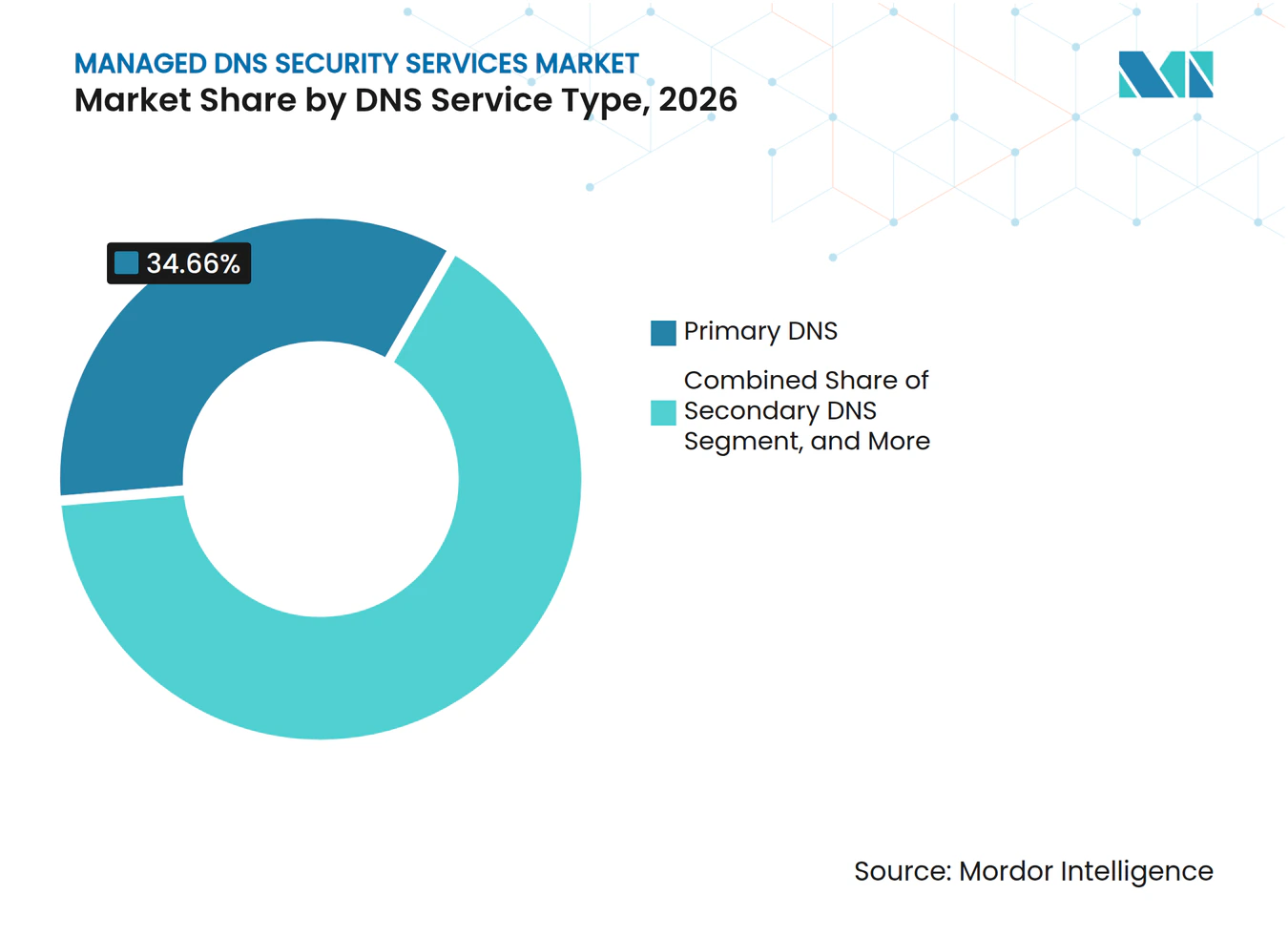
Secondary DNS Supports Resilience DesignsPrimary DNS held 34.66% of revenue in 2026, while secondary DNS is projected to expand at a 15.16% CAGR through 2032. Primary DNS remains the foundational service for authoritative records and supports the core DNS infrastructure of most enterprises. Secondary DNS is gaining attention in the managed DNS security services market as organizations seek redundancy after availability incidents and volumetric attacks. The 24% increase in DNS threat signals between H2 2025 and H1 2026 reinforces the need to spread authoritative services across providers. Multi-provider designs can distribute attack traffic and reduce reliance on a single authoritative service.
Akamai added multi-signer DNSSEC support to Edge DNS in March 2026, enabling multiple providers to co-sign zones under RFC 8901 Model 2. This can reduce an operational barrier to secondary DNS adoption. Dynamic DNS is also relevant to cloud workloads that need frequent record changes during container orchestration cycles. Reverse DNS supports email authentication through DMARC and SPF configurations in regulated settings, while zero-trust programs add another reason for resilient authoritative DNS because microsegmentation depends on stable service discovery. These needs make secondary DNS a resilience and compliance purchase rather than only a technical backup.
By Organization Size:
Enterprise Revenue Remains Concentrated While SMEs ExpandLarge enterprises held 74.33% of revenue in 2026, while SMEs are projected to expand at a 15.18% CAGR through 2032. Large organizations have the resources to manage large DNS query volumes and are frequent targets for phishing and command-and-control activity. Their investments also reflect the cost of downtime for customer-facing applications and global operations. The CISA-led April 2025 advisory on fast-flux DNS noted that rapid IP rotation can evade blocklists when organizations lack effective DNS filtering. This threat can encourage smaller organizations to use protective DNS services instead of managing complex filtering on their own.
SME adoption in the managed DNS security services market will depend heavily on managed service provider channels and tools that support multiple customers from one platform. Infoblox introduced enhanced multi-tenancy for Threat Defense in September 2026 to support scalable client deployment through these channels. NEC also introduced integrated DNS security for SME VPN routers in Japan in March 2026. DNSFilter and TitanHQ use MSP distribution to reach sub-enterprise customers in North America and Europe. Lower-cost bundles can widen access while reducing the need for dedicated security appliances, giving SMEs a practical path to adopt managed DNS security as their exposure increases.
By End-User Industry:
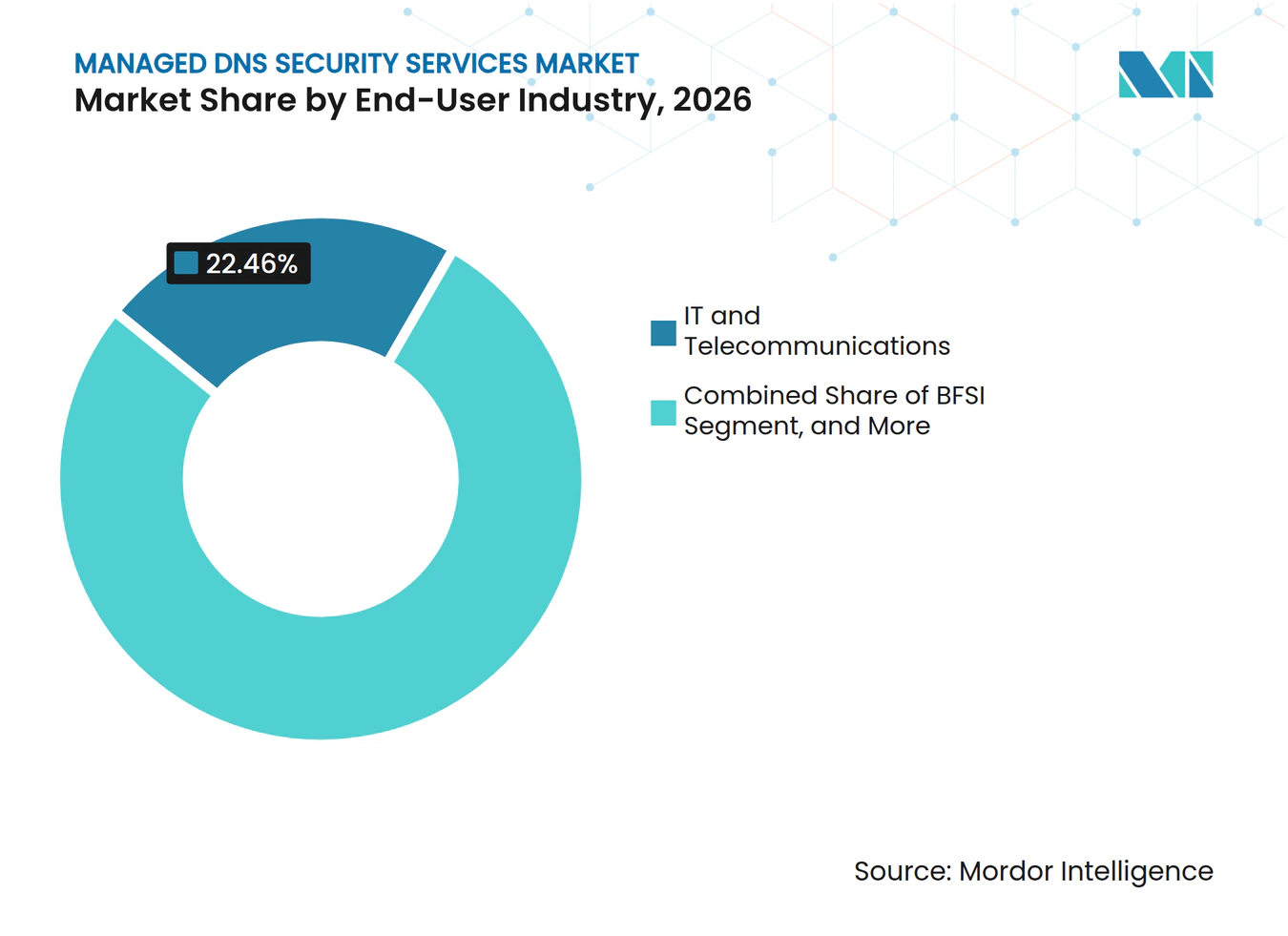
BFSI Threat Exposure Drives DemandIT and telecommunications held 22.46% of revenue in 2026, while BFSI is projected to expand at a 15.29% CAGR through 2032. The IT and telecommunications sector generates large DNS traffic volumes and supplies connectivity for other sectors within the managed DNS security services market. Financial institutions face direct exposure to DNS query floods, phishing, and other threats that can interrupt digital services. Radware reported a 272% global rise in DNS query flood attacks against financial institutions during 2025. This raises the importance of DNS monitoring and filtering at senior risk-management levels.
The Digital Operational Resilience Act requires financial entities to demonstrate ICT resilience, including incident detection and reporting relevant to DNS operations. Threat intelligence programs also use DNS signals to identify malicious infrastructure before a broader attack starts. Healthcare and life sciences, government and public-sector organizations, and retail and e-commerce companies have similar compliance and service-availability needs. HIPAA, FISMA, and PCI-DSS shape DNS data governance and transaction protection requirements in their respective settings. Manufacturing and utilities are becoming relevant as operational technology and IT networks become more connected, broadening the managed DNS security services market beyond traditional technology buyers.

By Application:
Cloud and SaaS Lead While IoT AcceleratesCloud and SaaS applications held 28.71% of revenue in 2026, while IoT applications are projected to expand at a 15.22% CAGR through 2032. Distributed workforces can generate high query volumes when users repeatedly access SaaS domains. This supports the leading position of cloud and SaaS applications in the managed DNS security services market size. IoT growth reflects device proliferation that is outpacing the use of DNSSEC and encrypted DNS. Research presented at RIPE 90 in 2025 found no tested IoT device implemented DNSSEC or encrypted DNS, leaving many device fleets exposed to DNS-layer manipulation.
DNS relationships also remain central to enterprise cloud procurement in the managed DNS security services market. Edge Footprint’s October 2026 data showed that AWS Route 53, Akamai Edge DNS, and Cloudflare managed much of the authoritative DNS used by Fortune 500 companies. CDN services and enterprise networks need intelligent routing based on latency, health checks, and geographic compliance rules. E-commerce platforms need reliable DNS during high-value transaction periods, while website hosting remains an entry-level application where ClouDNS, Constellix, and DNSimple serve SMEs and developers at lower contract values. This mix supports both high-volume enterprise contracts and a wider base of smaller users.
Geography Analysis
The Americas Managed DNS Security Services Market
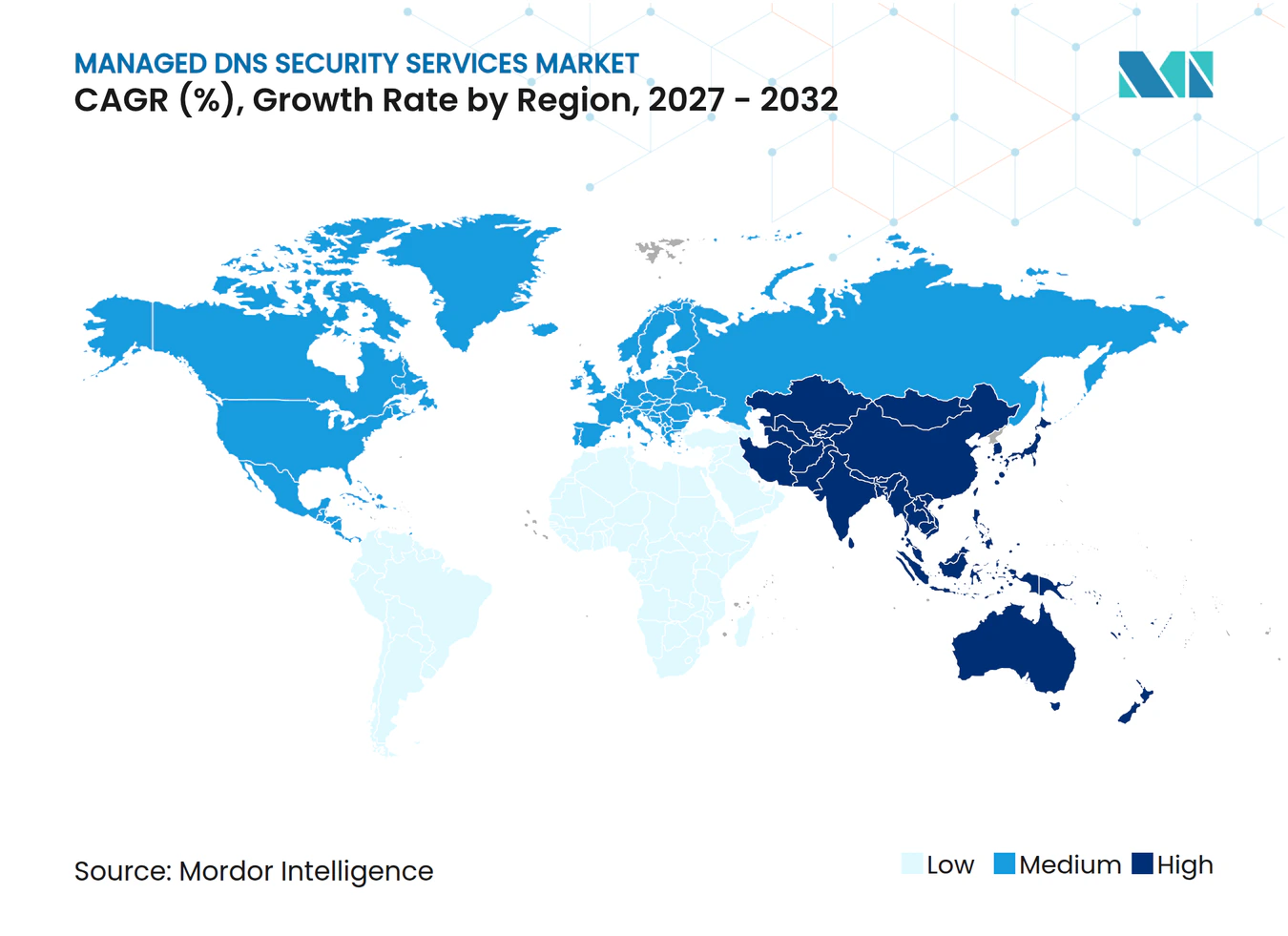
North America held 41.88% of the managed DNS security services market share in 2026. Hyperscale cloud density, mature regulation, and high enterprise attack exposure support the region’s leading position. The United States accounts for much of this demand through federal procurement and large financial, healthcare, and technology organizations, while CISA’s Protective DNS initiative and NSA encrypted-DNS guidance support the use of protected resolver services. South America is developing in the managed DNS security services market through cloud migration and telecommunications modernization, with Brazil supported by data-protection and financial-sector cybersecurity requirements.
Europe Managed DNS Security Services Market
Europe has a distinct profile because the NIS 2 Directive requires critical-infrastructure operators to audit, document, and secure DNS traffic within ICT risk management. Germany leads regional spending, with BSI IT-Grundschutz NET.1.1 requiring DNS-layer controls for organizations seeking federal cybersecurity certification. The United Kingdom’s Protective DNS program covers more than 1,400 central government, local government, and NHS organizations. GDPR data-processing agreements require providers to document how EU-resident query logs are handled, which favors providers with in-region anycast nodes and documented data boundaries.
APAC and MEA Managed DNS Security Services Market
Asia-Pacific is projected to expand at a 15.49% CAGR through 2032, the fastest geographic rate in the managed DNS security services market. 5G deployment, smart-city spending, and the region’s role in IPv6 adoption support this outlook. APNIC reported that Asia-Pacific accounted for more than 64% of global IPv6 users in 2025. China’s domestic providers operate under local security and personal-information rules, while India’s digital payments and government digitalization increase demand from financial institutions and platforms. The Middle East and Africa remain earlier-stage markets, although Saudi Arabia’s Vision 2030 and UAE telecommunications investment support regional demand.
Competitive Landscape
Market Concentration
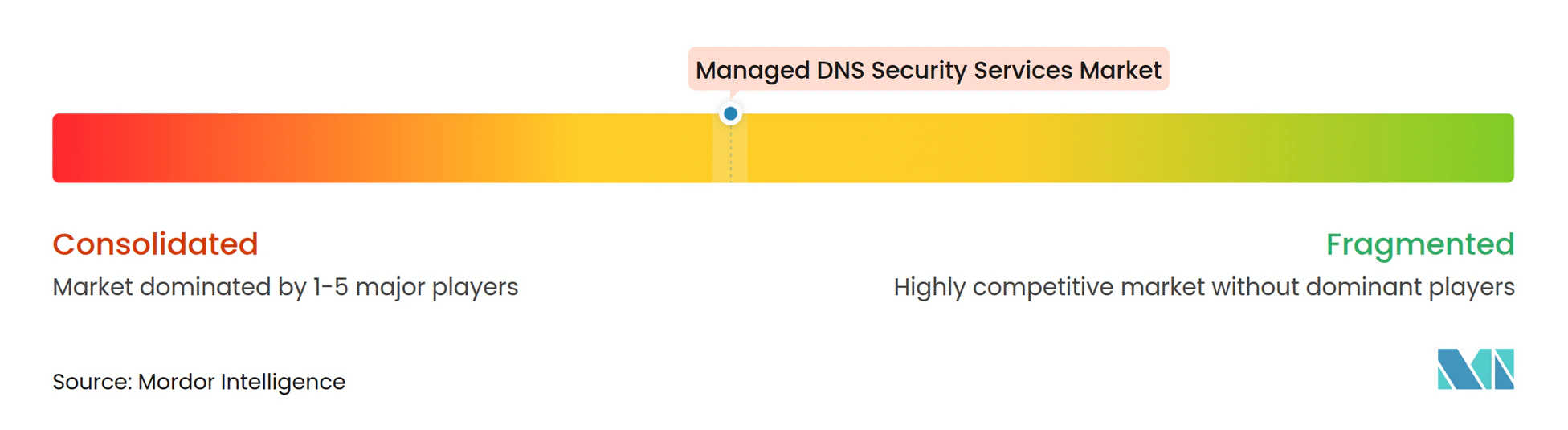
The managed DNS security services market is moderately concentrated at the platform tier, where AWS, Cloudflare, Akamai Technologies, Microsoft, and Google serve large enterprises through cloud, CDN, and security integrations. AWS Route 53 has a significant hyperscale workload position because it is closely integrated with AWS services, and Palo Alto Networks' Advanced DNS Security became generally available on Route 53 Resolver DNS Firewall in October 2026. The service adds fast-flux protection, domain-generation algorithm detection, and DNS tunneling controls within Route 53 policies. This lets AWS customers use these protections without separate VPC-level appliances.
Akamai competes in the managed DNS security services market through its authoritative DNS footprint and DNS security features. Its March 2026 update added multi-signer DNSSEC, Infrastructure Security Analytics, and dangling CNAME detection to Edge DNS. Cloudflare released Internal DNS for general availability in July 2026 to combine public and private DNS on one control plane. This addresses split-horizon DNS complexity in zero-trust architectures. These moves show how leading providers are extending DNS from a separate network service into a wider security and cloud operating model.
DDI-focused providers are also extending their positions in the managed DNS security services market into external threat intelligence and attack-surface management. Infoblox completed its Axur acquisition in May 2026, adding external threat discovery, digital-risk protection, scanning of more than 40 million URLs daily, a 98.9% takedown success rate, and average threat blocking 68.4 days earlier than traditional tools. BlueCat Networks and EfficientIP remain relevant in regulated hybrid deployments where DORA, GDPR, and data-residency requirements are material. The Linux Foundation launched DNS-AID in May 2026 with Cloudflare, GoDaddy, Infoblox, ISC, Equinix, and other members to advance decentralized AI agent discovery through DNS. The project can raise the strategic role of DNS in trusted AI agent transactions and create additional opportunities for providers with global anycast networks.
Managed DNS Security Services Industry Leaders
-
Amazon Web Services, Inc.
-
Cloudflare, Inc.
-
Akamai Technologies, Inc.
-
Microsoft Corporation
-
Google LLC
- *Disclaimer: Major Players sorted in no particular order
Managed DNS Security Services Market Companies Covered in this Report
- Amazon Web Services, Inc.
- Cloudflare, Inc.
- Akamai Technologies, Inc.
- Microsoft Corporation
- Google LLC
- International Business Machines Corporation
- Oracle Corporation
- Infoblox Inc.
- GoDaddy Inc.
- VeriSign, Inc.
- Vercara, LLC
- DigiCert, Inc.
- Cisco Systems, Inc.
- BlueCat Networks Inc.
- EfficientIP SAS
- DNSFilter, Inc.
- TitanHQ
- DNS Made Easy
- Tiggee LLC
- No-IP, Inc.
- Open-Xchange AG
- Constellix LLC
- ClouDNS Ltd.
- DNSimple Corporation
Recent Industry Developments in Managed DNS Security Services Market
- October 2026: Palo Alto Networks Advanced DNS Security reached general availability on Amazon Route 53 Resolver DNS Firewall, delivering fast-flux protection, DGA detection, and DNS tunneling blocking natively within Route 53 policies across AWS and hybrid-cloud environments, eliminating the need for separate VPC-level appliance deployments.
- October 2026: GoDaddy, Infoblox, Google, and Cloudflare demonstrated a "Chain of Trust" reference architecture for secure AI agent transactions at GovWare 2026 during Singapore International Cyber Week, developed with Singapore’s IMDA. The architecture uses DNS as the agent discovery and identity verification layer, positioning DNS operators as foundational trust infrastructure for agentic commerce networks McKinsey estimates could facilitate USD 3 trillion to USD 5 trillion in consumer purchases by 2030.
- October 2026: AWS released DNS analytics and insights for Route 53 Global Resolver and DNS Firewall through native Amazon CloudWatch integration, providing security teams with query-pattern observability, anomaly detection, and automated alarm capabilities across hybrid-cloud DNS environments.
- October 2026: VeriSign launched the limited beta for Verisign Informed, a high-assurance certificate status service delivering at-time-of-use validation through high-availability DNS infrastructure, with general availability targeted for the first half of 2027.
Global Managed DNS Security Services Market Report Scope
The Managed DNS Security Services Market comprises outsourced, 24/7 security services that protect an organization’s DNS infrastructure and DNS traffic from cyber threats, including DDoS attacks, DNS hijacking, cache poisoning, DNS tunneling, and malware command-and-control (C2) communications.
The Managed DNS Security Services Market Report is Segmented by Deployment Model (Cloud-Based, On-Premises, and Hybrid), DNS Service Type (Primary DNS, Secondary DNS, Dynamic DNS, and Reverse DNS), Organization Size (Large Enterprises and Small and Medium Enterprises), End-User Industry (IT and Telecommunications, Banking, Financial Services and Insurance, Media and Entertainment, Retail and E-Commerce, Healthcare and Life Sciences, Government and Public Sector, and Other End-User Industries), Application (Website Hosting, Cloud and SaaS Applications, E-Commerce Platforms, CDN Services, Enterprise Networks, Mobile Applications, and IoT Applications), and Geography (North America, South America, Europe, Asia-Pacific, and Middle East and Africa). The Market Forecasts Are Provided in Terms of Value (USD).
Segmentation Overview
| Cloud-Based |
| On-Premises |
| Hybrid |
| Primary DNS |
| Secondary DNS |
| Dynamic DNS |
| Reverse DNS |
| Large Enterprises |
| Small and Medium Enterprises |
| IT and Telecommunications |
| Banking, Financial Services and Insurance |
| Media and Entertainment |
| Retail and E-Commerce |
| Healthcare and Life Sciences |
| Government and Public Sector |
| Other End-User Industries |
| Website Hosting |
| Cloud and SaaS Applications |
| E-Commerce Platforms |
| CDN Services |
| Enterprise Networks |
| Mobile Applications |
| IoT Applications |
| North America | United States |
| Canada | |
| Mexico | |
| South America | Brazil |
| Argentina | |
| Rest of South America | |
| Europe | Germany |
| United Kingdom | |
| France | |
| Italy | |
| Rest of Europe | |
| Asia-Pacific | China |
| Japan | |
| India | |
| South Korea | |
| Rest of Asia-Pacific | |
| Middle East and Africa | Saudi Arabia |
| United Arab Emirates | |
| South Africa | |
| Egypt | |
| Rest of Middle East and Africa |
| By Deployment Model | Cloud-Based | |
| On-Premises | ||
| Hybrid | ||
| By DNS Service Type | Primary DNS | |
| Secondary DNS | ||
| Dynamic DNS | ||
| Reverse DNS | ||
| By Organization Size | Large Enterprises | |
| Small and Medium Enterprises | ||
| By End-User Industry | IT and Telecommunications | |
| Banking, Financial Services and Insurance | ||
| Media and Entertainment | ||
| Retail and E-Commerce | ||
| Healthcare and Life Sciences | ||
| Government and Public Sector | ||
| Other End-User Industries | ||
| By Application | Website Hosting | |
| Cloud and SaaS Applications | ||
| E-Commerce Platforms | ||
| CDN Services | ||
| Enterprise Networks | ||
| Mobile Applications | ||
| IoT Applications | ||
| By Geography | North America | United States |
| Canada | ||
| Mexico | ||
| South America | Brazil | |
| Argentina | ||
| Rest of South America | ||
| Europe | Germany | |
| United Kingdom | ||
| France | ||
| Italy | ||
| Rest of Europe | ||
| Asia-Pacific | China | |
| Japan | ||
| India | ||
| South Korea | ||
| Rest of Asia-Pacific | ||
| Middle East and Africa | Saudi Arabia | |
| United Arab Emirates | ||
| South Africa | ||
| Egypt | ||
| Rest of Middle East and Africa | ||
Key Questions Answered in the Report
What is the managed DNS security services market size?
The managed DNS security services market size is projected to expand from USD 3.82 billion in 2026 and USD 4.39 billion in 2027 to USD 8.76 billion by 2032, at a 14.82% CAGR. The outlook reflects higher demand for protective DNS, traffic management, and compliance support across cloud and hybrid environments.
What is driving demand for managed DNS security services?
Rising DNS-based attacks, cloud-native application deployment, IoT and 5G expansion, multi-CDN use, and data-residency requirements are supporting demand. Organizations also need visibility into malicious domains, redundant services during attacks, and more consistent policies across cloud and local infrastructure.
Which deployment model leads managed DNS security services?
Cloud-based deployment led with a 64.72% share in 2026 and is projected to expand at a 15.24% CAGR through 2032. Distributed anycast infrastructure, automated failover, and integration with cloud deployment tools support its position, although hybrid systems remain important in regulated settings.
Which end-user sector is expected to expand fastest?
BFSI is projected to expand at a 15.29% CAGR through 2032, supported by financial-sector threat exposure and operational resilience requirements. The sector uses DNS controls to help protect transaction services, identify malicious infrastructure, and support documented incident detection and reporting processes.
Which region is expected to record the fastest expansion?
Asia-Pacific is projected to expand at a 15.49% CAGR through 2032, supported by 5G deployment, smart-city investment, and IPv6 adoption. Demand also reflects domestic DNS needs in China and the growth of Indias digital payments and public digitalization infrastructure.
How are enterprises using secondary DNS services?
Enterprises are adopting secondary DNS for redundancy, multi-provider resilience, DNSSEC support, and improved continuity during DNS-layer attacks. It can distribute authoritative workloads across providers, reduce the impact of an outage, and support architectures where DNS security has become part of broader resilience planning.