
Managed Enterprise App Store Services Market Size and Share
Market Overview
| Study Period | 2021 - 2032 |
|---|---|
| Market Size (2027) | USD 2.47 Billion |
| Market Size (2032) | USD 4.89 Billion |
| Growth Rate (2027 - 2032) | 14.62 % |
| Fastest Growing Market | Asia-Pacific |
| Largest Market | North America |
| Market Concentration | Medium |
Major Players *Disclaimer: Major Players sorted in no particular order Image © Mordor Intelligence. Reuse requires attribution under CC BY 4.0. | |
Managed Enterprise App Store Services Market Analysis by Mordor Intelligence
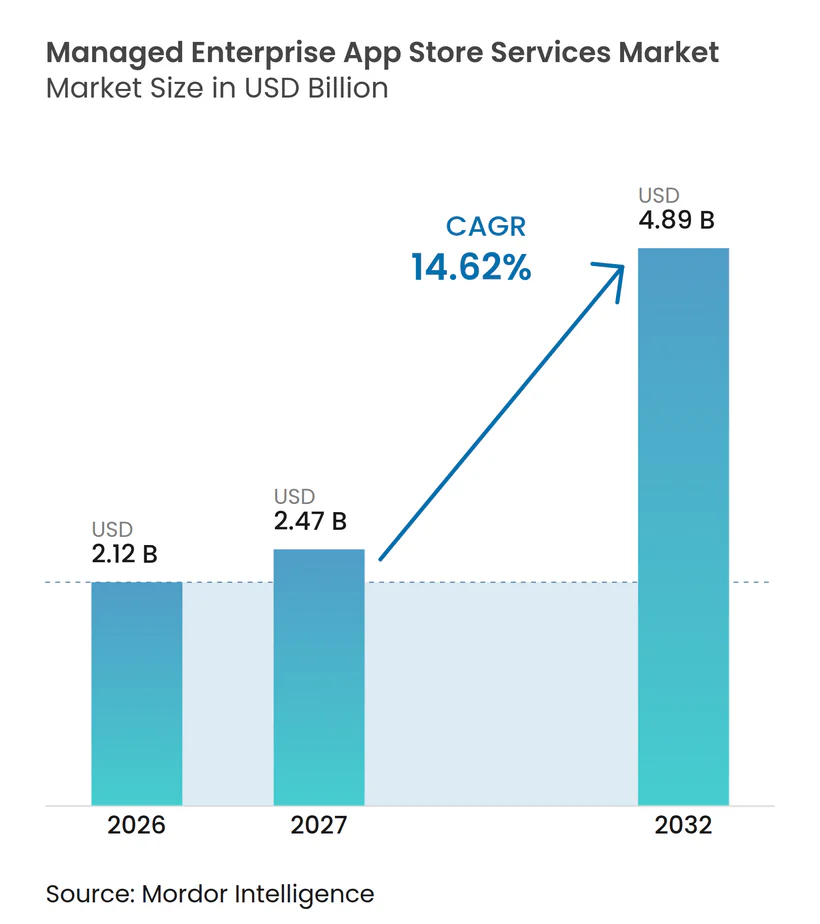
The managed enterprise app store services market size is projected to expand from USD 2.12 billion in 2026 to USD 2.47 billion in 2027, and to USD 4.89 billion by 2032, registering a CAGR of 14.62% between 2027 and 2032. The managed enterprise app store services market is supported by enterprises that are replacing informal deployment scripts and user-led sideloading with centrally governed application catalogs. This change shifts management away from devices alone and toward application entitlements, identity controls, compliance rules, and lifecycle policies. Cloud-based delivery, hybrid work, software asset management, and frontline mobility programs are driving demand for controlled distribution. Providers are responding with automated packaging, risk signals, integration tools, and support for mixed operating-system fleets. Data residency requirements and difficult integration across endpoint, identity, and service management systems remain material constraints on deployment choices.
Key Report Takeaways
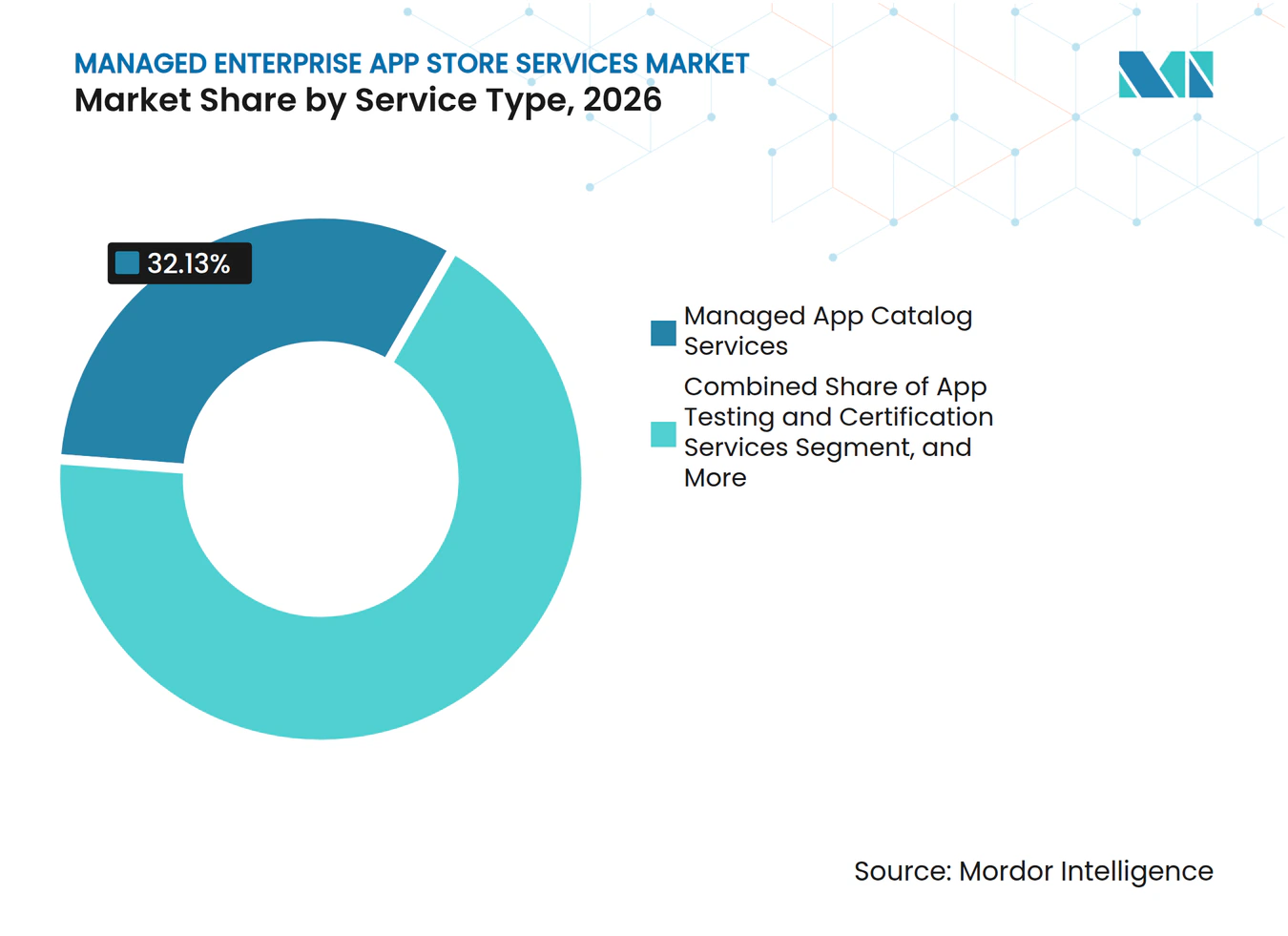
- By service type, Managed App Catalog Services held 32.13% of revenue in 2026 and are projected to expand at a 15.61% CAGR through 2032.
- By deployment model, cloud-based delivery accounted for 68.49% of the managed enterprise app store services market share in 2026 and is projected to expand at a 15.24% CAGR through 2032.
- By enterprise size, large enterprises held 74.08% of revenue in 2026, while small and medium enterprises are projected to expand at a 15.03% CAGR through 2032.
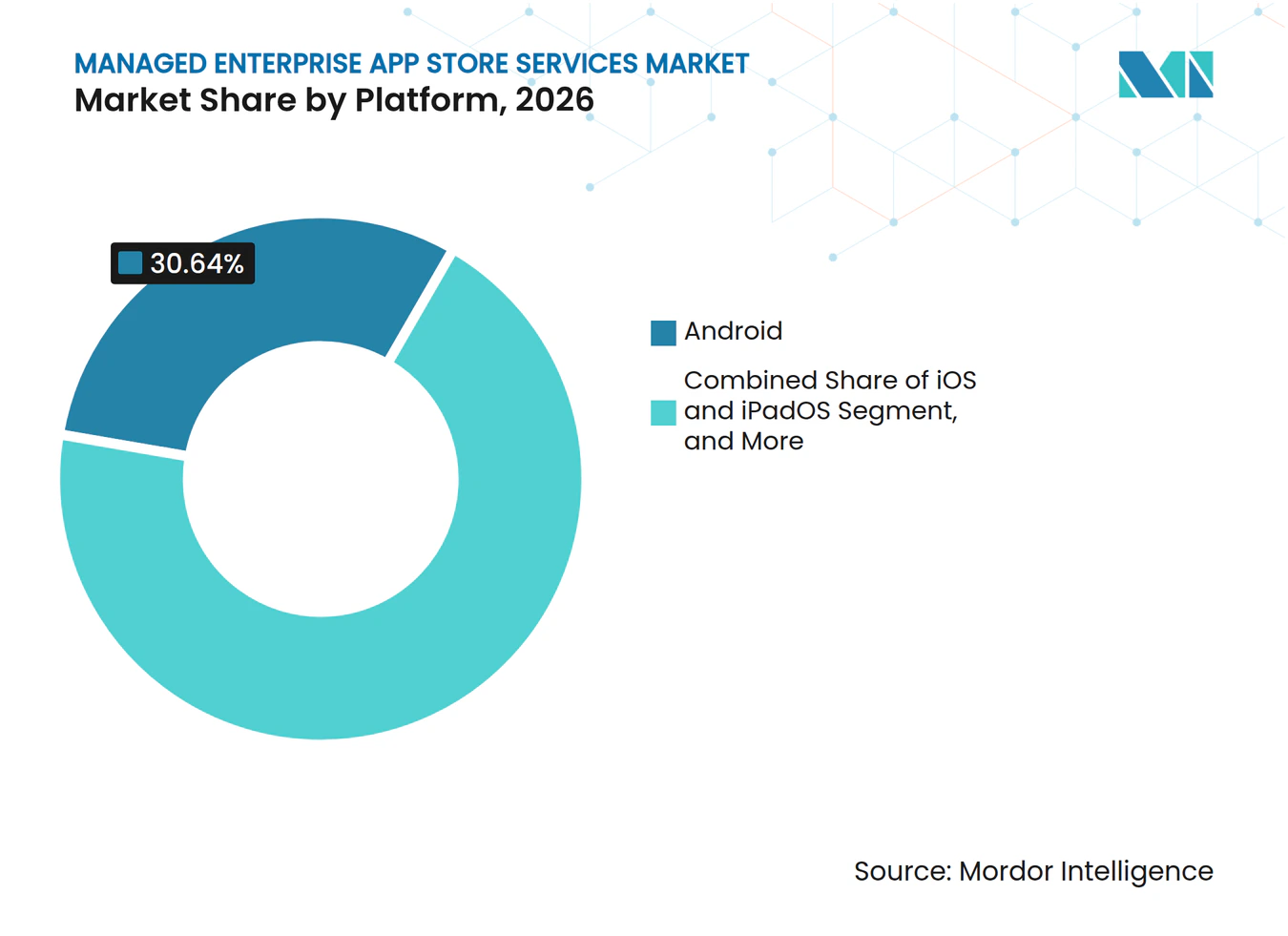
- By platform, Android held 30.64% of revenue in 2026, while iOS and iPadOS are projected to expand at a 16.18% CAGR through 2032.
- By end user, IT and Technology Departments held 34.73% of revenue in 2026, while Software Development and DevOps Teams are projected to expand at a 16.12% CAGR through 2032.
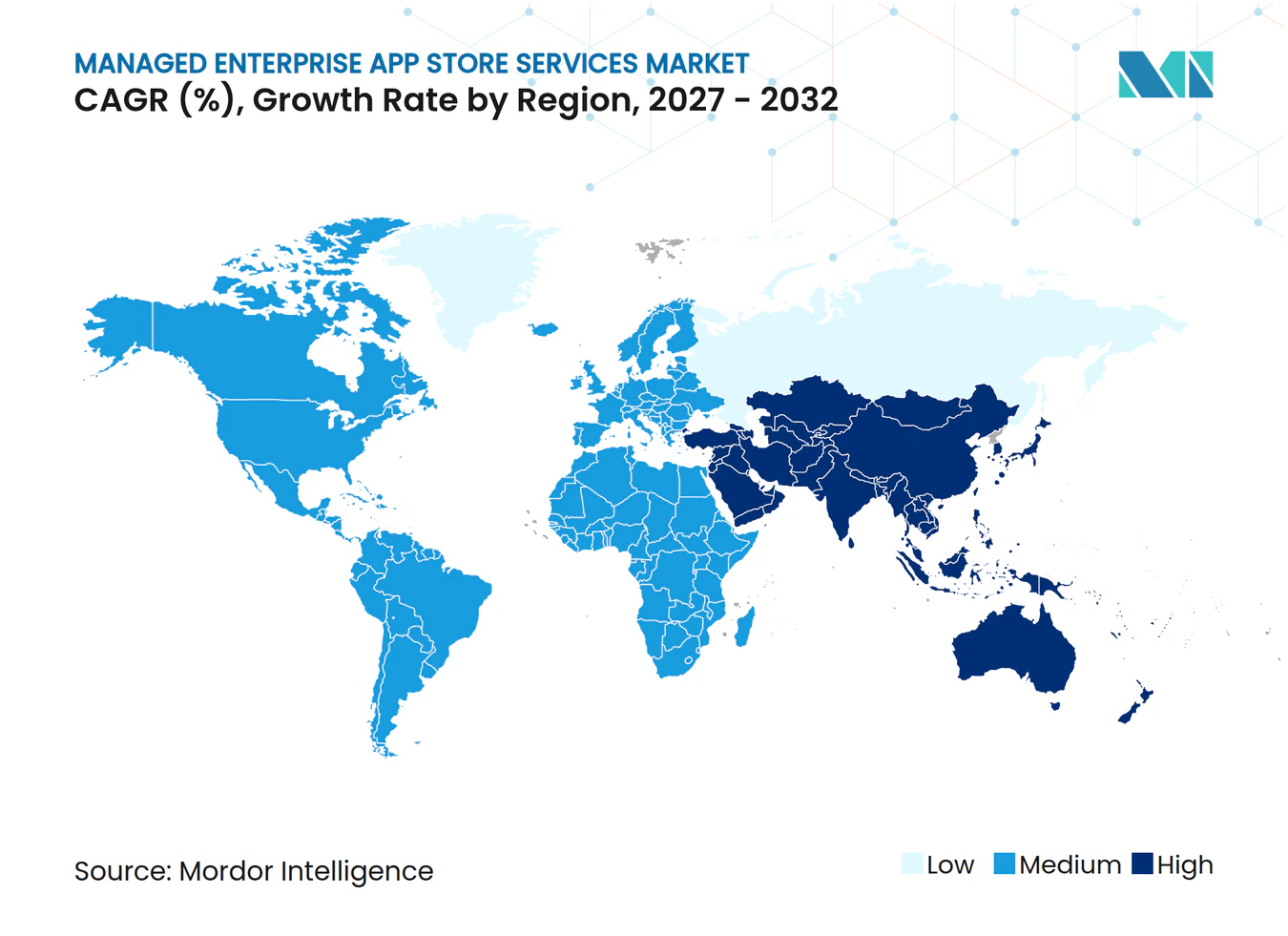
- By geography, North America held 40.86% of revenue in 2026, while Asia-Pacific is projected to expand at a 15.58% CAGR through 2032.
Note: Market numbers in this report are based on Mordor Intelligence's proprietary estimation framework, which combines nine months of actuals with Q4 projections for base year 2026.
Market Trends and Insights
Drivers Impact Analysis of Managed Enterprise App Store Services Market*
| Driver | (~) % Impact on CAGR Forecast | Geographic Relevance | Impact Timeline |
|---|---|---|---|
| Cloud-Native Enterprise Application Delivery | +3.8% | Global, concentrated in North America and Western Europe | Short term (≤ 2 years) |
| Hybrid Work and Distributed Endpoints | +3.2% | Global, highest in North America, Europe, and Asia-Pacific urban markets | Short term (≤ 2 years) |
| Software Asset Management and License Compliance | +2.4% | Global, acute in North America and Europe | Medium term (2-4 years) |
| BYOD and Frontline Mobility Programs | +2.0% | Asia-Pacific, South America, Middle East and Africa, with secondary gains in North America | Medium term (2-4 years) |
| Identity-Driven App Entitlement | +1.4% | North America and Europe, with spillover into Asia-Pacific financial services | Long term (≥ 4 years) |
| App Store Control Planes for AI Agents and Low-Code Applications | +1.2% | North America and Western Europe, with early global adoption | Long term (≥ 4 years) |
| Source: Mordor Intelligence | |||
Cloud-Native Enterprise Application Delivery
The shift to cloud-native application stacks is making the application catalog a required distribution control point within the managed enterprise app store services market. Organizations using microservices and containerized workloads need consistent versioning, provenance checks, and policy-based entitlement across distributed environments. Legacy script-led deployment cannot provide the same centralized control at scale. Omnissa reported that customers using its on-demand Windows application delivery reduced app-management time by 76% and accelerated deployment by 90% on average. On-demand delivery also gives IT teams per-application usage information that can support license reclamation and rightsizing decisions. This added software-asset-management benefit strengthens the case for managed catalog services.
Growth of Hybrid Work and Distributed Endpoints
The managed enterprise app store services market is responding to endpoint diversity that exceeds the practical reach of traditional mobile device management policies. The managed enterprise app store services market gives organizations a common governance layer across corporate, virtual, and personally owned devices. Frontline work adds further pressure because device problems can interrupt time-sensitive services. SOTI reported that 92% of emergency services first responders experienced device issues each week, with a 21-minute average resolution time for an incident.[1] These conditions make application lifecycle control relevant to operational leaders as well as IT teams. Providers that reduce resolution time can address productivity losses that are visible to finance and operations functions.
Software Asset Management and License Compliance Requirements
The managed enterprise app store services market is supported by software license compliance needs, and controlled catalogs provide a practical point for managing installation rights. A 2025 survey by ITAM Forum and Azul found that 27% of organizations spent more than USD 500,000 annually resolving software license noncompliance. The same survey found that 81% conducted licensing audits at least twice each year. Catalog-based entitlement allows procurement and IT teams to connect approved software, user access, and audit evidence. ISO 19770 and sector-specific controls are also directing attention to verifiable software asset management practices. The managed enterprise app store services market therefore benefits when application entitlement is treated as an auditable control rather than a routine IT task.
Expansion of BYOD and Frontline Mobility Programs
The managed enterprise app store services market benefits as BYOD programs move beyond cost management to support frontline and field-service work. Shared-device environments need role-based application delivery that changes as users move between tasks and devices. Microsoft described this requirement in its 2025 Intune update for frontline service delivery. Private application stores and zero-trust access are becoming more relevant as these programs expand. A managed catalog must separate personal and corporate information, apply privacy-aware compliance checks, and support selective wipe functions. These requirements make a simple device policy insufficient for many distributed workforces.
Restraints Impact Analysis of Managed Enterprise App Store Services Market*
| Restraint | (~) % Impact on CAGR Forecast | Geographic Relevance | Impact Timeline |
|---|---|---|---|
| Data Sovereignty and Cross-Border Hosting Complexity | -2.0% | European Union, Middle East, India, and Southeast Asia | Medium term (2-4 years) |
| Integration Friction Across Management Systems | -1.6% | Global, most acute in large enterprises with mixed IT stacks | Short term (≤ 2 years) |
| Apple and Android Enterprise Distribution Policy Dependence | -1.0% | Global, highest in Apple-first enterprise environments | Medium term (2-4 years) |
| App Provenance Gaps for Private and Repackaged Applications | -0.7% | Global, concentrated in finance and healthcare | Long term (≥ 4 years) |
| Source: Mordor Intelligence | |||
Data Sovereignty and Cross-Border Hosting Complexity
The managed enterprise app store services market faces data residency rules that can divide a unified deployment into multiple jurisdiction-specific configurations. This raises cost and makes centralized architectures harder to operate across borders. Saudi Arabia enforces requirements that affect the storage and handling of sensitive and personally identifiable information.[2] The EU Data Act became effective in September 2025 and added portability and switching requirements to existing GDPR and NIS2 obligations. Managed enterprise app store services market providers must therefore offer configurations that match local hosting, entitlement records, and transfer requirements. These rules can reduce the operational flexibility of multi-tenant cloud platforms.
Integration Friction Across Management Systems
Managed enterprise app store services can be easier to deploy than the integrations around them. MDM, UEM, ITSM, IAM, and distribution tools can use different device identifiers and update records at different intervals. Scalefusion reported that 42% of IT organizations experienced difficulty when switching systems, 16% managed IT risk in silos, and 33% reported collaboration gaps across endpoint management teams. These conditions can delay rollout and complicate governance after deployment. NIST guidance on zero-trust architecture emphasizes coordinated policy enforcement across identity and endpoint-management functions. Service providers must absorb this integration work and set realistic implementation schedules.
*Our forecasts treat driver/restraint impacts as directional, not additive. The impact forecasts reflect baseline growth, mix effects, and variable interactions.
Managed Enterprise App Store Services Market Segment Analysis
By Service Type:
Catalog Management Leads While Lifecycle Services AccelerateManaged App Catalog Services held 32.13% of service-type revenue in 2026 and are projected to expand at a 15.61% CAGR through 2032. Catalog governance is the first capability needed before packaging, testing, deployment, and lifecycle services can be coordinated. The managed enterprise app store services market size for this service line is supported by demand for catalog curation, application discovery, and per-application risk assessment. Jamf introduced App Insights in September 2026 to identify outdated versions, potential data leakage, and side-loaded code. These features turn the catalog from a static list of approved applications into a working security control for technology and compliance teams.
App Packaging and Repackaging Services remain important because internal application-factory teams cannot always prepare vendor installers for silent deployment at scale. App Deployment and Distribution Services remain in demand when organizations support multiple operating systems, virtual desktops, and various application sources. App Lifecycle and Update Management Services receive greater attention when unpatched applications are treated as a compliance concern separate from device patching. Addigy launched its Prebuilt App Catalog in July 2025, with 30-minute update checks and automated macOS fleet patching without scripts. App Testing and Certification Services support internal and repackaged applications that must meet vendor-audit, ISO 27001, and provenance requirements before release.



By Deployment Model:
Cloud Leads as Hybrid Architectures Address Residency ConstraintsCloud-based delivery held 68.49% of revenue in 2026 and is projected to expand at a 15.24% CAGR through 2032. Centralized provisioning, automated update processes, and integration with cloud identity platforms support its leading position. Subscription pricing can scale with device counts and lower the infrastructure burden of on-premises server operations. The model suits enterprises that are moving away from legacy on-premises MDM platforms and need consistent updates across locations. Cloud delivery remains the standard starting point for many managed enterprise app store services market implementations.
On-premises delivery retains a role for government agencies, healthcare organizations, and financial-services firms that face strict localization rules. These organizations may need legal exemptions or specialized architecture before cloud-hosted distribution can be used. Hybrid models retain sensitive entitlement data on-premises while using cloud catalog intelligence and update-management functions. NIST zero-trust guidance treats policy enforcement as a logical function rather than a hosting-location requirement. This gives hybrid architectures a credible way to address data sovereignty requirements without giving up central service capabilities.
By Enterprise Size:
Large Enterprises Anchor Spending While SMEs Accelerate FastestLarge enterprises accounted for 74.08% of revenue in 2026, reflecting their global workforces, multi-platform fleets, and extensive compliance obligations. They can manage thousands of applications across Android, iOS, Windows, and macOS environments in multiple jurisdictions. Their device and application programs often require different controls for data, identity, and software licensing. Recast Software described a Fortune 50 bank using Application Workspace to unify catalog and deployment workflows across Intune, Configuration Manager, and virtual desktop infrastructure. This complexity favors dedicated service contracts over self-managed device-management deployments, keeping large enterprises central to the managed enterprise app store services market.
Small and medium enterprises are projected to expand at a 15.03% CAGR through 2032. Cloud delivery has reduced per-device costs and made managed tools accessible to organizations with fewer than 500 employees. Mosyle and Addigy offer product lines that address resource constraints, simpler operational needs, and the need for predictable administration. Mosyle launched AccessMule in June 2025 as a subsidiary focused on access management for SMB workflows. ISO 27001 and sector-specific certification requirements also make managed governance an alternative to building internal application-control programs.
By Platform:
iOS and iPadOS Accelerate While Android Holds the Largest ShareAndroid held 30.64% of platform revenue in 2026, supported by frontline devices, rugged hardware, and mixed fleets across Asia-Pacific, South America, the Middle East, and Africa. The Android Management API enables declarative management and can reduce reliance on older enterprise mobility management profiles. These capabilities help UEM providers manage delivery across fleets that include field equipment and employee devices. Android remains relevant where device cost, durability, and operating-system choice influence purchasing decisions. The Android market share in the managed enterprise app store services market reflects this wide operating context.
iOS and iPadOS are projected to expand at a 16.18% CAGR through 2032 as Apple deployments extend across healthcare, financial services, and field-service work. These buyers place value on device reliability and security, especially where application access affects frontline activity. Jamf expanded Self Service+ to iOS and iPadOS following its JNUC 2025 announcement, combining catalog delivery, security notifications, and device management into a single application. Windows benefits from its Microsoft 365 and Entra integrations, while macOS and ChromeOS are expanding their fleet presence, and Esper added Linux support in September 2025. This broader platform coverage expands the addressable market for managed enterprise app store services.

By End User:
IT Departments Lead While DevOps Teams Drive the Next Growth WaveIT and Technology Departments held 34.73% of end-user revenue in 2026 because they buy, deploy, and govern enterprise app store infrastructure. Their priorities include fewer help desk tickets, consistent application versions, and auditable software asset management records. They also coordinate the device, security, and identity policies that shape user-entitlement decisions. As app stores connect to zero-trust architectures, IT leaders increasingly work with security and identity teams as co-sponsors. This department remains the main point of operational ownership for the managed enterprise app store services market.
Software Development and DevOps Teams are projected to expand at a 16.12% CAGR through 2032. Their demand reflects the need to distribute private and internally developed applications through controlled channels rather than informal build sharing. Applivery added Build Retention Management and Build Lifecycle Control in November 2025 for CI/CD artifact storage and compliance-aligned archiving. Security and Compliance Teams are becoming meaningful buyers as provenance verification and runtime signals move closer to the catalog layer. Healthcare and Life Sciences, Retail, Logistics, and Transportation also need governed distribution for frontline use and regulated information handling.
Geography Analysis
North America Managed Enterprise App Store Services Market
The managed enterprise app store services market in North America accounted for 40.86% of revenue in 2026, supported by a high concentration of large enterprises, mature MDM and UEM ecosystems, and active software audit practices. The United States accounts for most regional demand due to Apple-first enterprise deployments and a vendor base concentrated in technology hubs. Canada is a secondary source of demand as financial services and healthcare organizations address provincial data-governance requirements. Microsoft stated that its Entra Suite delivered a documented 131% ROI from unified identity and network access.[3] Integrated entitlement architectures can use catalog services as a downstream enforcement function.
Europe Managed Enterprise App Store Services Market
The managed enterprise app store services market in Europe is the second-largest regional segment, and its requirements are shaped by GDPR, NIS2, and the EU Data Act. These frameworks limit architectural options and encourage buyers to consider providers with EU data-residency capabilities. Germany and the United Kingdom are the main demand centers, while France, Italy, Spain, the Nordic countries, and Central European markets support broader demand. The EU Data Act introduced switching-rights obligations that affect vendor selection and strengthen interest in multi-cloud-compatible designs.
APAC, MEA and South America Managed Enterprise App Store Services Market
The managed enterprise app store services market in Asia-Pacific is projected to expand at a 15.58% CAGR through 2032, supported by China, India, Japan, South Korea, and Singapore. These countries combine enterprise BYOD adoption, mobility digitization, and mobile-first workforce programs. India’s Digital Personal Data Protection Act increases the value of controlled entitlement and data-segmentation policies. Advantech partnered with SOTI in August 2025 to extend MobiControl and XSight across IoT and industrial-device portfolios in smart retail, logistics, and healthcare. The Middle East, Africa, and South America add further demand through digital transformation, PDPL enforcement, and Brazil’s LGPD compliance requirements for financial services and retail buyers.
Competitive Landscape
Market Concentration
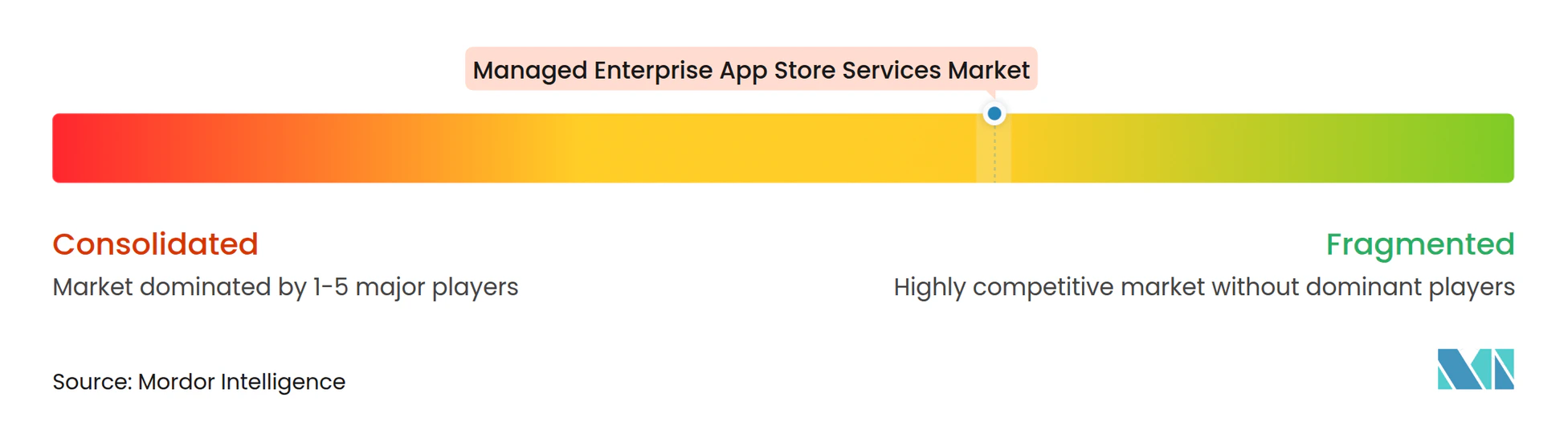
The managed enterprise app store services market is moderately fragmented, with no vendor leading across all platforms, deployment model, and end-user categories. Jamf and Mosyle focus on Apple environments and compete through integration with Apple management APIs and application catalogs. SOTI, 42Gears, Esper, and ProMobi Technologies, operating as Scalefusion, cover multiple platforms and compete through operating-system breadth, frontline support, and mixed-fleet pricing. Addigy is positioned around continuously connected macOS management, while Recast Software focuses on Windows catalog governance. These focused positions support premium offerings in defined buyer groups.
The managed enterprise app store services market has openings in sovereign-cloud-compatible distribution for regulated industries and government buyers. It also has scope for catalog governance of AI agents and cross-platform lifecycle management for SMEs that cannot operate multiple MDM suppliers. Jamf announced a Platform API Gateway at JNUC 2026 that puts its APIs behind one authentication model to support third-party integration and automation. This development increases platform stickiness for organizations that want a single integration approach.
Applivery launched Applivery Intelligence in September 2026 with Autonomous Endpoint Management and an MCP layer that exposes more than 200 platform actions to the agentic AI ecosystem. SOTI integrated XSight with ServiceNow at SOTI SYNC 25 in October 2025, placing diagnostics within established IT service-management workflows. These moves show a focus on automation and workflow integration, rather than only more device connections. The competitive structure remains consistent with specialists serving defined platform and workflow needs.
Managed Enterprise App Store Services Industry Leaders
-
Jamf Software, LLC
-
SOTI Inc.
-
42Gears Mobility Systems Private Limited
-
Mitsogo Inc.
-
Recast Software, Inc.
- *Disclaimer: Major Players sorted in no particular order
Managed Enterprise App Store Services Market Companies Covered in this Report
- OB2J
- 42Gears Mobility Systems Private Limited
- APPCIRCLE INC.
- Applivery
- Codeproof Technologies Inc.
- ENTGRA (PRIVATE) LIMITED
- Eracent
- Esper.io, Inc.
- FLECS Technologies GmbH
- Iru, Inc.
- Jamf Software, LLC
- Mitsogo Inc.
- Mosyle Corporation
- ProMobi Technologies Pvt. Ltd.
- Recast Software, Inc.
- Relution GmbH
- SOTI Inc.
- FileWave (USA), Inc.
- Addigy, Inc.
- Fleet Device Management, Inc.
Recent Industry Developments in Managed Enterprise App Store Services Market
- September 2026: Jamf announced App Insights at JNUC 2026, a per-app risk scoring capability that assesses outdated versions, potential data leakage, and side-loaded code for every application in an enterprise deployment. The feature marks a significant evolution of the managed app catalog from static library to active security enforcement surface.
- September 2026: Applivery launched Applivery Intelligence with Autonomous Endpoint Management (AEM) and the Applivery MCP, exposing more than 200 platform management actions to the agentic AI ecosystem. The launch repositions Applivery as an AI-native endpoint and app distribution platform capable of operating within broader agent orchestration architectures.
- September 2026: Addigy launched the Addigy Intelligence Suite for Apple devices, providing IT teams with AI-driven governance over how AI tools are used across managed Apple fleets, including automated deployment and compliance controls for AI-class applications.
- September 2026: FileWave released version 16.4.1, introducing enhanced client upgrade reliability, improved infrastructure maintenance tooling, and smarter deployment visibility for enterprise-scale endpoint and application management operations.
Global Managed Enterprise App Store Services Market Report Scope
The managed enterprise app store services market refers to the industry providing centralized solutions for managing the selection, packaging, testing, distribution, deployment, updating, and lifecycle management of applications used within organizations. These services enable enterprises to establish and maintain secure, controlled application catalogs, streamline software deployment, enforce organizational IT policies, and ensure application compatibility, security, and compliance across corporate devices and operating systems.
The Managed Enterprise App Store Services Market Report is Segmented by Service Type (Managed App Catalog Services, App Packaging and Repackaging, App Testing and Certification, App Deployment and Distribution, and App Lifecycle and Update Management), Deployment Model (Cloud-Based, On-Premises, and Hybrid), Enterprise Size (Large Enterprises, and Small and Medium Enterprises), Platform (Android, iOS and iPadOS, Windows, macOS, ChromeOS, and Linux), End User (IT and Technology Departments, Software Development and DevOps Teams, Security and Compliance Teams, Healthcare and Life Sciences, Retail, Logistics, and Transportation, Other End-Users), and Geography (North America, South America, Europe, Asia-Pacific, Middle East, and Africa). The Market Forecasts are Provided in Terms of Value (USD).
Segmentation Overview
| Managed App Catalog |
| App Packaging and Repackaging |
| App Testing and Certification |
| App Deployment and Distribution |
| App Lifecycle and Update Management |
| Cloud-Based |
| On-Premises |
| Hybrid |
| Large Enterprises |
| Small and Medium Enterprises |
| Android |
| iOS and iPadOS |
| Windows |
| macOS |
| ChromeOS |
| Linux |
| IT and Technology Departments |
| Software Development and DevOps Teams |
| Security and Compliance Teams |
| Healthcare and Life Sciences |
| Retail, Logistics, and Transportation |
| Other End Users |
| North America | United States |
| Canada | |
| Mexico | |
| South America | Brazil |
| Argentina | |
| Chile | |
| Rest of South America | |
| Europe | Germany |
| United Kingdom | |
| France | |
| Italy | |
| Spain | |
| Russia | |
| Rest of Europe | |
| Asia-Pacific | China |
| Japan | |
| India | |
| South Korea | |
| Australia | |
| Singapore | |
| Rest of Asia-Pacific | |
| Middle East | United Arab Emirates |
| Saudi Arabia | |
| Qatar | |
| Turkey | |
| Rest of Middle East | |
| Africa | South Africa |
| Egypt | |
| Nigeria | |
| Kenya | |
| Rest of Africa |
| By Service Type | Managed App Catalog | |
| App Packaging and Repackaging | ||
| App Testing and Certification | ||
| App Deployment and Distribution | ||
| App Lifecycle and Update Management | ||
| By Deployment Model | Cloud-Based | |
| On-Premises | ||
| Hybrid | ||
| By Enterprise Size | Large Enterprises | |
| Small and Medium Enterprises | ||
| By Platform | Android | |
| iOS and iPadOS | ||
| Windows | ||
| macOS | ||
| ChromeOS | ||
| Linux | ||
| By End User | IT and Technology Departments | |
| Software Development and DevOps Teams | ||
| Security and Compliance Teams | ||
| Healthcare and Life Sciences | ||
| Retail, Logistics, and Transportation | ||
| Other End Users | ||
| By Geography | North America | United States |
| Canada | ||
| Mexico | ||
| South America | Brazil | |
| Argentina | ||
| Chile | ||
| Rest of South America | ||
| Europe | Germany | |
| United Kingdom | ||
| France | ||
| Italy | ||
| Spain | ||
| Russia | ||
| Rest of Europe | ||
| Asia-Pacific | China | |
| Japan | ||
| India | ||
| South Korea | ||
| Australia | ||
| Singapore | ||
| Rest of Asia-Pacific | ||
| Middle East | United Arab Emirates | |
| Saudi Arabia | ||
| Qatar | ||
| Turkey | ||
| Rest of Middle East | ||
| Africa | South Africa | |
| Egypt | ||
| Nigeria | ||
| Kenya | ||
| Rest of Africa | ||
Key Questions Answered in the Report
What is the managed enterprise app store services market size?
The market is projected to expand from USD 2.12 billion in 2026 and USD 2.47 billion in 2027 to USD 4.89 billion by 2032, at a 14.62% CAGR.
Which service type leads enterprise app store services?
Managed App Catalog Services held 32.13% of service-type revenue in 2026 and are projected to expand at a 15.61% CAGR through 2032.
Why are cloud-based app store services widely adopted?
Cloud-based delivery held 68.49% of revenue in 2026 because it supports centralized provisioning, automated updates, and cloud identity integration.
Which operating system is expanding fastest for managed app distribution?
IOS and iPadOS are projected to expand at a 16.18% CAGR through 2032 as use increases in healthcare, financial services, and field-service work.
Which region is expanding fastest for enterprise application catalogs?
Asia-Pacific is projected to expand at a 15.58% CAGR through 2032, supported by BYOD adoption, mobility programs, and compliance requirements.
What limits adoption of managed enterprise app store services?
Data-residency obligations and difficult integration across MDM, UEM, ITSM, IAM, and software-distribution systems can slow implementation.