
Mobile Application Management (MAM) Software Market Size and Share
Market Overview
| Study Period | 2020 - 2031 |
|---|---|
| Market Size (2026) | USD 3.53 Billion |
| Market Size (2031) | USD 6.84 Billion |
| Growth Rate (2026 - 2031) | 14.14 % |
| Fastest Growing Market | Asia-Pacific |
| Largest Market | North America |
| Market Concentration | Medium |
Major Players *Disclaimer: Major Players sorted in no particular order Image © Mordor Intelligence. Reuse requires attribution under CC BY 4.0. | |
Mobile Application Management (MAM) Software Market Analysis by Mordor Intelligence
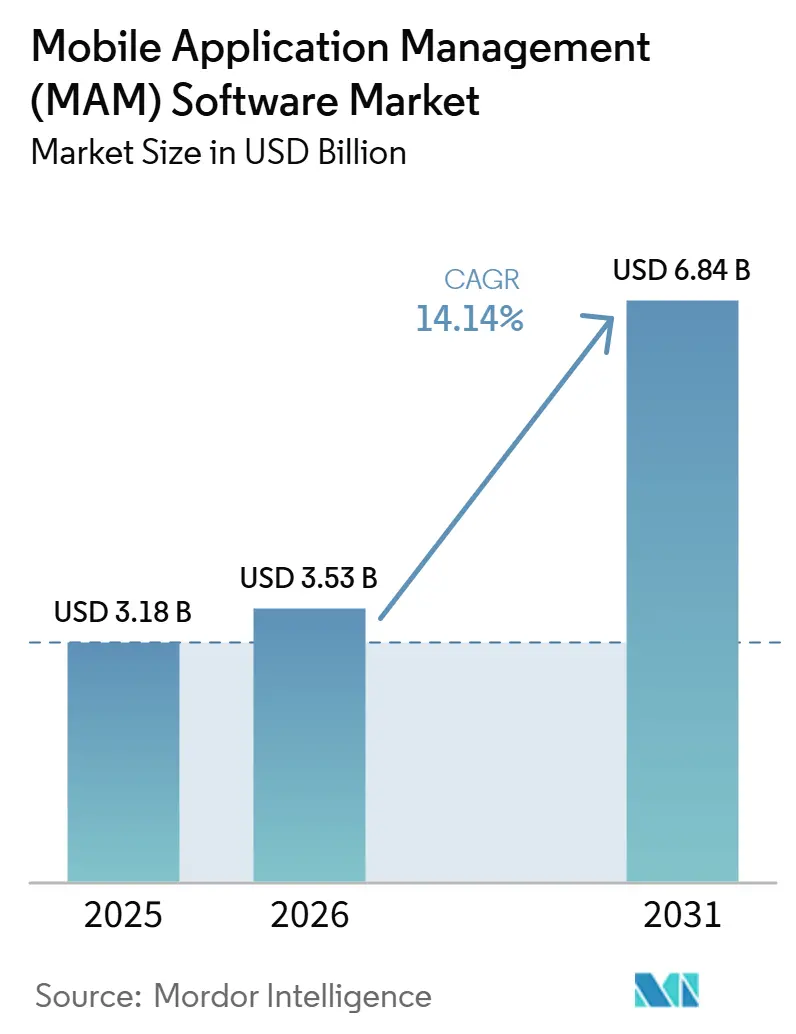
The Mobile Application Management (MAM) Software Market size was USD 3.18 billion in 2025 and is forecast to reach USD 6.84 billion by 2031, growing at a CAGR of 14.14% from 2026 to 2031. Demand is rising because many enterprises now want to protect company data at the application level rather than control the entire personal device, making mobile governance easier to implement in bring-your-own-device settings. Hybrid work models, wider use of personal smartphones for business applications, and tighter cybersecurity obligations are keeping mobile app protection high on technology spending plans. The market is also benefiting from the move toward cloud delivery, as cloud-based tools enable faster policy updates, greater visibility, and easier integration with identity systems across distributed workforces. Growth opportunities are widening in small and mid-sized companies and in regulated sectors that need stronger controls for sensitive business or patient information. At the same time, the pace of rollout is still held back in some organizations by legacy enterprise mobility stacks, fragmented identity environments, and policy gaps that can appear when operating system versions differ across device fleets.
Key Report Takeaways
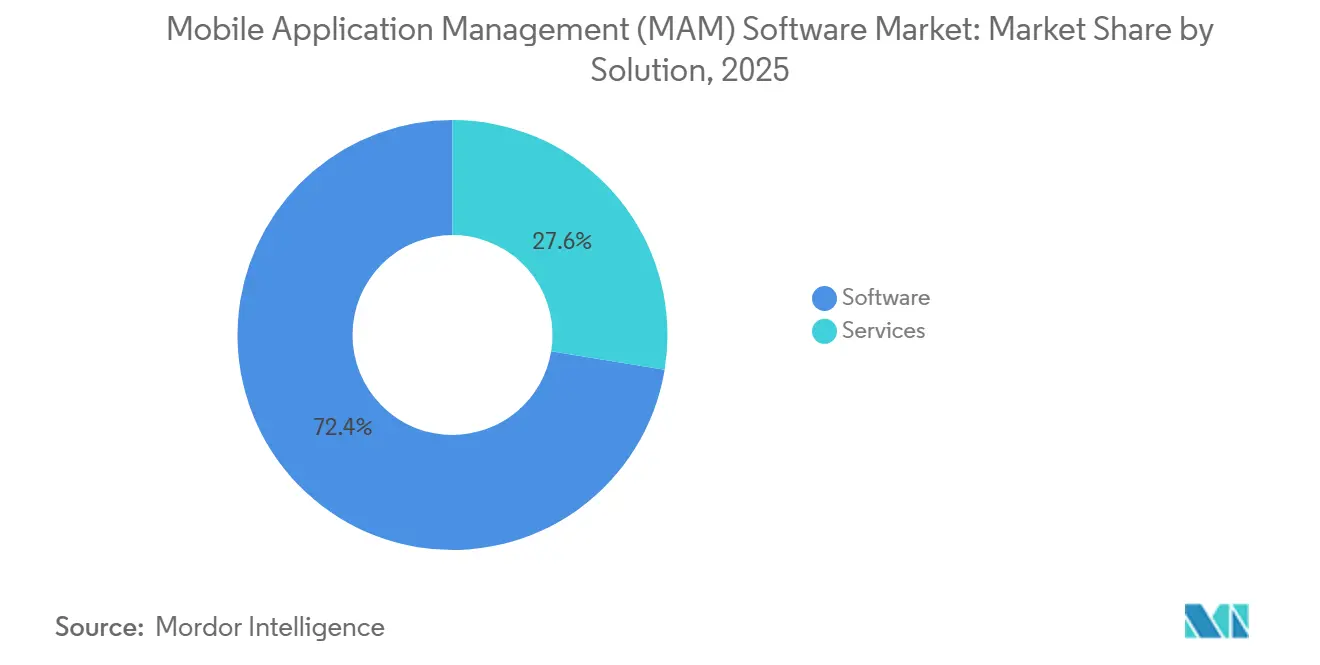
- By solution, software led with 72.41% revenue share in the Mobile Application Management (MAM) Software Market 2025, while services are projected to expand at a 16.82% CAGR through 2031.
- By deployment, cloud-based deployment held 68.19% share in 2025, while hybrid deployment is expected to record the highest CAGR at 15.43% through 2031.
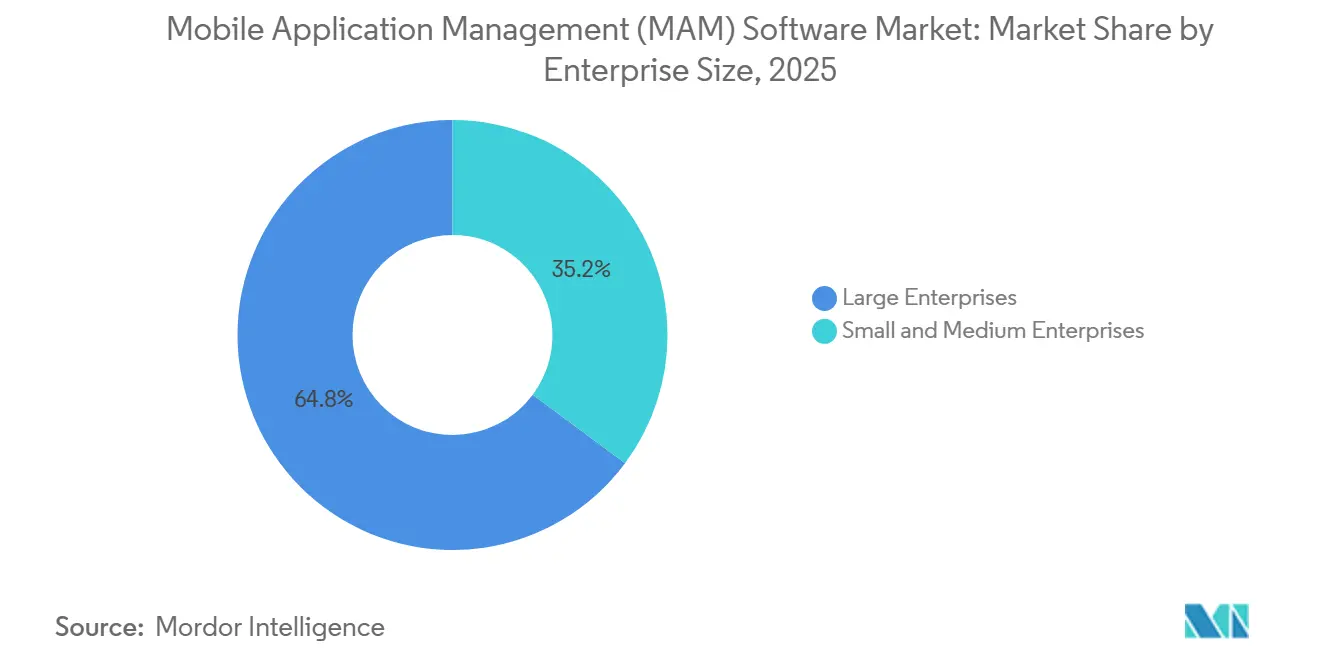
- By enterprise size, large enterprises accounted for 64.83% of the Mobile Application Management (MAM) Software Market in 2025, while SMEs are projected to grow fastest at a 17.24% CAGR through 2031.
- By end user, IT and Telecommunication held 22.36% share in 2025, while Healthcare and Life Sciences are expected to expand at a 16.91% CAGR through 2031.
- By geography, North America captured 34.62% share in the Mobile Application Management (MAM) Software Market 2025, while Asia-Pacific is projected to register the highest regional CAGR at 17.83% through 2031.
Note: Market size and forecast figures in this report are generated using Mordor Intelligence’s proprietary estimation framework, updated with the latest available data and insights as of January 2026.
Market Trends and Insights
Drivers Impact Analysis of Mobile Application Management (MAM) Software Market*
| Driver | (~) % Impact on CAGR Forecast | Geographic Relevance | Impact Timeline |
|---|---|---|---|
| Cloud-First Rollout Demand Across Hybrid Workforces | +2.8% | Global, with deployment acceleration concentrated in North America, Western Europe, and Asia-Pacific enterprise corridors | Short term (≤ 2 years) |
| App-Level Data Loss Prevention Requirements | +2.3% | Global, with regulatory intensity highest in North America and Europe | Short term (≤ 2 years) |
| Zero Trust Policy Enforcement for Managed Apps | +1.8% | North America and Europe primary, with spillover to Asia-Pacific government and BFSI sectors | Medium term (2-4 years) |
| App Containerization and Sandboxing Adoption | +1.5% | Global, with frontline industries such as retail, logistics, and healthcare driving near-term volume | Medium term (2-4 years) |
| FinOps Pressure to Consolidate Endpoint and App Control Stacks | +1.1% | North America and Europe, with early adoption in technology-intensive Asia-Pacific markets | Medium term (2-4 years) |
| Mobile Privilege Segregation for Contractor and Frontline Access | +0.8% | Global, with strongest relevance in construction, energy, and government contracting | Long term (≥ 4 years) |
| Source: Mordor Intelligence | |||
Cloud-First Rollout Demand Across Hybrid Workforces
Cloud-managed endpoint environments became more common as enterprises tried to support workers across homes, offices, and shared workspaces. In that setting, the Mobile Application Management (MAM) Software Market is gaining because app policies can be updated quickly without depending on full device enrollment or local infrastructure changes. Microsoft states that MAM for unenrolled devices is commonly used for personal or BYOD devices and can protect organizational data inside applications without enrolling the full device.[1]Microsoft Learn, “Mobile Application Management (MAM) for Unenrolled Devices in Microsoft Intune,” Microsoft Learn, learn.microsoft.com This model reduces friction for employers and employees by protecting email, files, and collaboration apps while leaving personal device control outside the enterprise boundary. It is also noted that mobile devices have become a permanent part of enterprise environments and need centralized management and protection across both corporate-owned and personally owned scenarios. As a result, the Mobile Application Management (MAM) Software Market continues to benefit from cloud-first programs that treat the application layer as the most practical control point for distributed workforces.
App-Level Data Loss Prevention Requirements
Application-level data loss prevention moved closer to a core requirement as business data began flowing through messaging apps, cloud drives, and AI tools on personal devices. This shift is supporting the Mobile Application Management (MAM) Software Market because app controls can block copying, forwarding, or moving sensitive information outside approved channels. It is explained that app protection policies can allow or block specific in-app actions, including copy-and-paste controls, on unenrolled personal devices. One vendor expanded its endpoint platform in July 2026 with native DLP, AI usage visibility, and centralized policy controls for data exchanged with AI applications, web applications, and cloud services.[2]Fortinet, “FortiEndpoint Expands Security for the AI Era,” Fortinet Blog, fortinet.com In Europe, the NIS2 framework widened cybersecurity obligations across critical sectors and kept reporting and risk management duties high on enterprise agendas. That combination of data exposure risk and compliance pressure is giving the Mobile Application Management (MAM) Software Market a stronger role in enterprise security planning.[3]European Commission, “NIS2 Directive: Securing Network and Information Systems,” Shaping Europe’s Digital Future, digital-strategy.ec.europa.eu
Zero Trust Policy Enforcement for Managed Apps
Zero-trust programs are pushing mobile governance beyond static policy storage toward continuous access evaluation. That change is helping the Mobile Application Management (MAM) Software Market because managed apps now carry signals that can support decisions on whether access should continue, be limited, or be blocked. An endpoint platform continuously evaluates endpoint health and uses dynamic risk and compliance scores to enforce adaptive access policies via native zero-trust network access. Mobile security is also placed within broader enterprise protection practices, including access control, continuous monitoring, and configuration management.[4]Gema Howell, Joshua Franklin, Vincent Sritapan, Murugiah Souppaya, and Karen Scarfone, “SP 800-124 Rev. 2, Guidelines for Managing the Security of Mobile Devices in the Enterprise,” National Institute of Standards and Technology, csrc.nist.gov In practice, this means the app is no longer just a delivery point for work tools; it is becoming an active checkpoint for trust decisions. That evolution is strengthening the Mobile Application Management (MAM) Software Market in sectors where remote access, contractor access, and sensitive data handling now need continuous verification.
App Containerization and Sandboxing Adoption
App containerization is becoming more attractive because it lets employers isolate work data on personal smartphones without having to manage the entire device. This supports the Mobile Application Management (MAM) Software Market by reducing employee resistance and easing privacy concerns in BYOD environments. MAM for unenrolled devices is described as a way to secure organizational data within the app itself, which aligns with the same app-centric control model behind sandboxed mobile workspaces. A 2026.0 release unified app policy workflows for Google Play apps, custom in-house apps, and proprietary apps from a single Android console, reducing the administrative burden in containerized app environments. That matters in retail, logistics, healthcare, and field service settings where shared or frontline mobility has to be secured with limited IT resources. As app isolation becomes easier to manage, the Mobile Application Management (MAM) Software Market is gaining a wider base across organizations that previously saw full-device management as too intrusive or too difficult to scale.
Restraints Impact Analysis of Mobile Application Management (MAM) Software Market*
| Restraint | (~) % Impact on CAGR Forecast | Geographic Relevance | Impact Timeline |
|---|---|---|---|
| Integration Friction With Legacy EMM and Identity Stacks | -1.8% | Global, most acute in North America and Europe where legacy MDM deployments are deepest | Medium term (2-4 years) |
| Policy Drift Across Multiple Mobile Operating System Versions | -1.4% | Global, with concentrated impact in Asia-Pacific and Middle East and Africa markets with high device heterogeneity | Short term (≤ 2 years) |
| Limited Security Budget Ownership Outside Central IT | -1.1% | Global, most pronounced in the SME segment and in emerging markets | Long term (≥ 4 years) |
| App Wrapping and SDK Maintenance Overhead for In-House Apps | -0.8% | North America and Europe, where in-house enterprise app portfolios are largest | Medium term (2-4 years) |
| Source: Mordor Intelligence | |||
Integration Friction with Legacy EMM and Identity Stacks
Many enterprises still use older enterprise mobility management environments, legacy certificate setups, and overlapping identity directories, which complicate new rollouts. This slows the Mobile Application Management (MAM) Software Market because companies often buy modern tools faster than they can clean up the systems that those tools must connect with. A March 2026 Apple migration feature was highlighted that lets organizations move devices between MDM platforms without wiping the device, while retaining data and configurations. That reduces part of the switching burden, but it does not fully solve conflicts across older policy structures, app wrappers, and mixed user records. Where on-premises directories and cloud identity tools still overlap, security teams often delay full app policy rollout until those dependencies are sorted. This integration drag remains one of the clearest restraints on faster expansion in the Mobile Application Management (MAM) Software Market.
Policy Drift Across Multiple Mobile Operating System Versions
Policy consistency becomes harder when device fleets span multiple versions of iOS and Android simultaneously. That issue constrains the Mobile Application Management (MAM) Software Market because app controls may not work with the same depth or reliability across all devices in use. It was documented that Android 16 Desktop Mode did not fully support EMM-managed app allowlisting, managed settings restrictions, or custom launcher experiences in Workspace ONE Launcher environments. This kind of mismatch creates real compliance gaps, especially when employees use lower-cost hardware that receives updates slowly or when organizations depend on kiosk and frontline deployments. It was also noted that staying on the correct OS version is critical for security, compliance, and operational stability, underscoring how much platform change can affect daily operational outcomes. Until version fragmentation becomes easier to handle, the Mobile Application Management (MAM) Software Market will continue to face delays in full-fleet standardization.
*Our forecasts treat driver/restraint impacts as directional, not additive. The impact forecasts reflect baseline growth, mix effects, and variable interactions.
Mobile Application Management (MAM) Software Market Segment Analysis
By Solution:
Services Momentum Reshapes A Software-Dominated MarketSoftware held 72.41% of the Mobile Application Management (MAM) Software Market share in 2025, underscoring the centrality of policy engines, compliance dashboards, and SDK libraries to every deployment. The largest share remained with software because enterprises usually buy a platform first, then add workflows, controls, and reporting around it over time. In most contracts, the software layer remains the primary spending center because it handles app distribution, protection rules, access controls, and administrative visibility through a single interface. That position also reflects buyer preference for broad platforms that can sit inside larger endpoint and workspace programs rather than operate as narrow standalone tools. As the Mobile Application Management (MAM) Software Market matures, software continues to anchor the installed base even when buyers later expand into outside consulting or managed support.
Services are projected to grow at a 16.82% CAGR through 2031, making them the fastest-growing part of this segment. Growth is picking up because many organizations still lack the in-house staff needed to configure app policies, integrate identity systems, and maintain compliance rules across mixed mobile fleets. The rising technical depth of app governance is pushing more buyers toward managed deployment, policy tuning, and ongoing advisory support. This shift is also widening the role of service partners in regulated sectors, where mobile controls must align with formal security programs and audit expectations. Over time, the Mobile Application Management (MAM) Software Market is likely to maintain its software-heavy structure, but the revenue mix should continue to shift toward services as organizations seek more hands-on implementation and management support.


By Deployment:
Hybrid Architecture Bridges Cloud Economics And Data SovereigntyCloud-based deployment accounted for 68.19% of the Mobile Application Management (MAM) Software Market size in 2025, supported by the operational ease of SaaS delivery and the need for faster response across distributed users. Cloud deployment is favored because policy changes can be pushed quickly, application visibility is easier to maintain, and integration with cloud identity environments is more straightforward. It also aligns well with personal-device access models, where organizations want to manage the app and data without taking control of the whole phone. It is stated that app protection on unenrolled devices is used across Android, iOS, and Windows for organizational access on personal devices. These advantages have helped the cloud model become the default starting point in much of the Mobile Application Management (MAM) Software Market.
Hybrid deployment is projected to grow at a 15.43% CAGR through 2031 and remains the fastest-expanding deployment model. The appeal is strongest in sectors that want cloud-based policy administration but still need on-premises control points for data residency or internal compliance reasons. It was noted that an endpoint offering supports both cloud-managed deployments and on-premises control to meet data sovereignty and regulatory needs. That same balance is driving hybrid demand across enterprises that cannot move every security decision into a third-party cloud environment. Fully on-premises models still matter in isolated or highly restricted settings, but their slower operating model makes them less attractive for many distributed teams. As a result, the Mobile Application Management (MAM) Software Market is seeing hybrid become the practical bridge between cloud efficiency and control requirements.
By Enterprise Size:
SME Adoption Broadens The Market's Structural BaseLarge enterprises held 64.83% share in 2025, reflecting their bigger application estates, stronger compliance obligations, and larger endpoint budgets. Their lead also stems from the fact that mobile application controls are often purchased as part of broader unified endpoint or digital workspace agreements, which increases contract size and extends vendor relationships. In the Mobile Application Management (MAM) Software Market, large companies usually move first because they face more complex governance needs across offices, contractors, and global operations. They are also more likely to need formal reporting, approval structures, and layered access controls for business-critical mobile apps. That made large enterprises the clear revenue anchor for this segment in 2025.
SMEs are projected to grow at a 17.24% CAGR through 2031, which makes them the fastest-growing enterprise size group. This acceleration matters because it comes from new adoption rather than from large-scale replacement cycles. Cloud pricing, simpler rollout models, and channel-led service packages are making app-level security far more accessible to smaller businesses than it was a few years ago. A March 2026 expansion into Android Enterprise via Managed Google Accounts enables organizations with limited IT depth to manage mixed Apple and Android fleets from a single platform. That kind of simplified cross-platform management fits smaller companies that want consistent controls without running several separate tools. As SME entry rises, the Mobile Application Management (MAM) Software Market is building a broader, long-term customer base rather than relying solely on large enterprises.
By End User:
Healthcare Growth Challenges IT And Telecom's LeadIT and Telecommunication held the largest end-user share at 22.36% in 2025, which matched the sector's mobile-heavy operating model and early adoption of app-level controls. These organizations use a wide range of internal collaboration, service delivery, and field productivity apps, making them early reference buyers for new mobile governance tools. BFSI remained another large user group because mobile banking, transaction security, and internal compliance programs require tighter control of application behavior and data movement. Retail and e-commerce, government and administration, industrial manufacturing, education and research institutions, media and entertainment, and energy and utilities also contribute demand, though for different reasons tied to payment, field service, public access, learning, or mobile operations. Together, these patterns show that the Mobile Application Management (MAM) Software Market is supported by both compliance-heavy sectors and operationally mobile sectors.
Healthcare and Life Sciences are projected to expand at a 16.91% CAGR through 2031, making them the fastest-growing end-user segment. Growth is being driven by clinician BYOD use, wider telemedicine adoption, and rising use of remote patient and clinical applications that move sensitive information across personal devices. The HIPAA Security Rule establishes national standards for protecting electronic protected health information and requires administrative, physical, and technical safeguards. That requirement is pushing healthcare organizations to secure data inside the application layer, not only on the network or the device. App containerization also helps providers distribute clinical tools with less friction, giving the spending case both a compliance and a workflow side. This is why the Mobile Application Management (MAM) Software Market is seeing some of its strongest forward movement from healthcare environments.
Geography Analysis
North America Mobile Application Management (MAM) Software Market
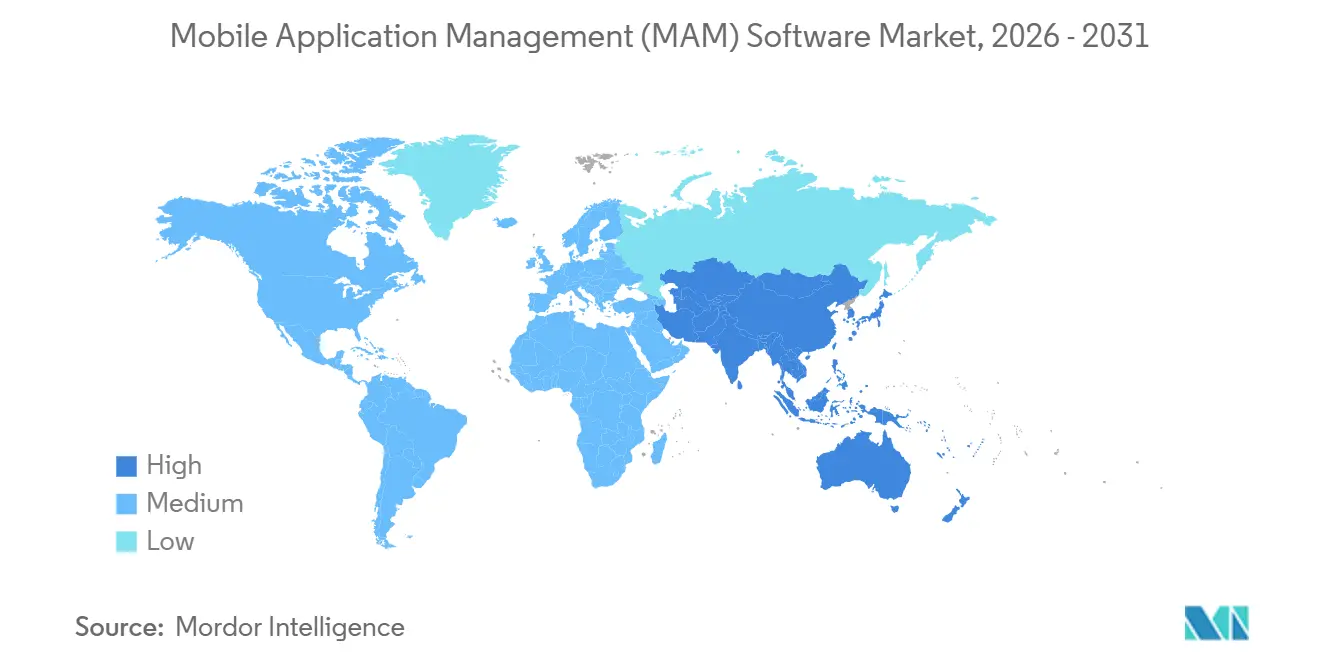
North America held 34.62% of the Mobile Application Management (MAM) Software Market share in 2025, maintaining its leading regional position. The region benefits from a dense base of enterprise software buyers, stronger adoption of zero-trust security models, and higher spending on endpoint and identity management. The United States remains the largest national contributor because large enterprises in finance, healthcare, and technology continue to treat mobile app governance as a necessary part of digital security. Canada is also contributing to regional demand as financial institutions and other regulated organizations tighten mobile risk oversight and strengthen controls around work applications. This combination of mature buyers and steady compliance pressure kept North America ahead in the Mobile Application Management (MAM) Software Market.
APAC Mobile Application Management (MAM) Software Market
Asia-Pacific is projected to grow at a 17.83% CAGR through 2031, which makes it the fastest-growing regional segment. India is a major growth engine because enterprise smartphone use and BYOD programs are expanding across technology services firms and banks. South Korea is seeing demand from large conglomerates that need consistent mobile app policies across globally distributed workforces. Southeast Asia is opening new room for adoption as cloud delivery costs ease, 5G coverage expands, and government digitization programs improve the case for business mobility in Indonesia, Vietnam, and Thailand. China follows a different path because data localization rules favor local hosting and hybrid deployment models, while Japan is seeing stronger demand for more flexible work arrangements and a preference for local data-handling practices.
EMEA and South America Mobile Application Management (MAM) Software Market
Europe held the second-largest regional share in 2025 and remains driven by compliance-led adoption. The NIS2 Directive widened cybersecurity obligations across 18 critical sectors and required member states to transpose the framework into national law by October 2024. Germany, the United Kingdom, and France are the region's largest country markets, with stronger activity in financial services, manufacturing, and the public sector. South America, the Middle East, and Africa remain early-stage regions, but demand is improving as privacy laws and broader digital initiatives heighten the need for application-layer controls on mobile devices.

Competitive Landscape
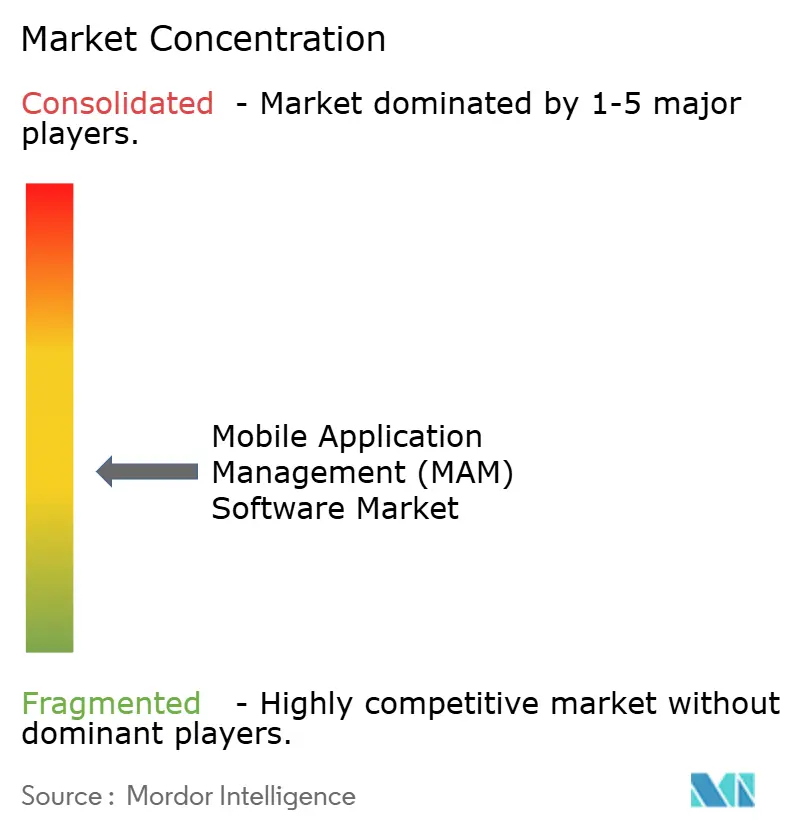
The Mobile Application Management (MAM) Software Market is moderately concentrated, with a few broad platform vendors holding strong installed bases and several specialists competing through vertical focus or pricing flexibility. Microsoft, Omnissa, and IBM MaaS360 remain central platform names, while Jamf, SOTI, Hexnode, Ivanti, and ManageEngine compete through device specialization, simpler deployment models, or frontline use cases. Microsoft benefits from its reach into organizations that already use Microsoft productivity and identity environments, which continues to position MAM for unenrolled devices as a practical BYOD access model across multiple operating systems. That installed-base advantage makes it easier for Microsoft to expand app protection without always requiring a separate device-management decision. At the same time, the Mobile Application Management (MAM) Software Market still leaves room for vendors that can solve narrower operating challenges better than the broad suites.
Specialist vendors are using product depth and easier administration to create differentiation. Jamf expanded into Android Enterprise management via Managed Google Accounts in March 2026, improving its position in mixed Apple and Android environments and expanding its reach beyond Apple-first accounts. SOTI's MobiControl 2026.0 release unified app policy workflows across Google Play apps, custom in-house apps, and SOTI ONE apps, which is useful for organizations with heavy Android and frontline mobility needs. IBM MaaS360 also gained a competitive talking point through Apple migration support, which lets organizations shift devices between MDM platforms without wiping them, lowering a common barrier to vendor switching. These moves show that product usability, migration ease, and mixed-platform management remain important competitive levers in the Mobile Application Management (MAM) Software Market.
Another pressure point is coming from endpoint security vendors that are adding app-level governance into broader security suites. Fortinet expanded FortiEndpoint in July 2026 with native DLP, AI usage visibility, endpoint risk scoring, and adaptive zero-trust access in a single platform. That type of consolidation can challenge standalone mobile app tools when buyers want fewer agents, fewer consoles, and tighter policy coordination. Vendors in the Mobile Application Management (MAM) Software Market, therefore, need to show clear value in app-level governance, regulated workflows, and mobile-specific control depth if they want to defend their positions against broader endpoint platforms.
Mobile Application Management (MAM) Software Industry Leaders
Microsoft Corporation
IBM Corporation
VMware, Inc.
BlackBerry Limited
Cisco Systems, Inc.
- *Disclaimer: Major Players sorted in no particular order
Mobile Application Management (MAM) Software Market Companies Covered in this Report
- Microsoft Corporation
- VMware, Inc.
- Cisco Systems, Inc.
- Cloud Software Group
- Ivanti Neurons for MDM
- ManageEngine
- 42Gears SureMDM
- Amazon Web Services, Inc.
- Oracle Corporation
- SAP SE
- IBM Corporation
- ProMobi Technologies
- BlackBerry Limited
- Tangoe
- NinjaOne
- Jamf Pro
- Codeproof Technologies
- SOTI MobiControl
- Anysphere, Inc.
- Jamf Pro

Recent Industry Developments in Mobile Application Management (MAM) Software Market
- July 2026: Fortinet announced a major expansion of its FortiEndpoint unified platform, integrating AI usage visibility and governance, native DLP via FortiDLP, endpoint risk scoring, adaptive Zero Trust Network Access, and FortiAI-assisted security operations through a single agent, console, and license. The release directly challenges multi-vendor MAM-plus-DLP stacks by consolidating endpoint and data governance functions, previewing a broader endpoint consolidation trend across enterprise security architectures.
- March 2026: Jamf launched Android enterprise management via Managed Google Accounts integration, enabling organizations to configure and deploy sideloaded apps, support multiple APK versions for heterogeneous device fleets, and control work-profile app widgets from within the Jamf platform. The release repositions Jamf, previously an Apple-specialist, as a viable cross-platform MAM and UEM provider for organizations managing mixed Apple and Android environments.
- March 2026: IBM MaaS360 and Apple introduced MDM migration capabilities via iOS 26 and Apple Business Manager that allow organizations to shift device management from one MDM platform to another without factory resets, retaining data and configurations. The capability materially lowers the switching cost associated with changing MAM or MDM vendors, expected to accelerate competitive displacement of legacy EMM deployments across the mid-enterprise segment.
- February 2026: SOTI released its ONE 2026.0 platform with unified app policy management across Google Play, custom in-house apps, and SOTI's mobility suite from a single Android console, alongside centralized eSIM provisioning, a redesigned unified UI across all platform modules, and AI integration aligned with Microsoft and Samsung platform technologies.


Global Mobile Application Management (MAM) Software Market Report Scope
The mobile application management (MAM) software market refers to the ecosystem of software solutions and associated services designed to secure, manage, and control mobile applications deployed across enterprise environments without necessarily requiring management of the underlying mobile device hardware. This includes capabilities such as enterprise app cataloging, application provisioning, software updates and patching, license management, and app-level security policies (such as app wrapping, containerization, and data encryption). Deployed via cloud-based, hybrid, or on-premises models, these solutions cater to organizations of all sizes across industries such as BFSI, healthcare, IT, and government. By isolating and securing corporate data at the application level, MAM software enables organizations to safeguard sensitive information, ensure regulatory compliance, and maintain employee productivity by allowing secure access to business-critical applications on both corporate-owned and personally owned (BYOD) smartphones and tablets.
The Mobile Application Management (MAM) Software Market Report is Segmented by Solution (Software and Services), Deployment (Cloud-Based, Hybrid, and On-Premises), Enterprise Size (Large Enterprises, and Small and Medium Enterprises), End User (IT and Telecommunication, BFSI, Healthcare and Life Sciences, Retail and E-Commerce, Industrial Manufacturing, Education and Research Institutions, Media and Entertainment, Government and Administration, Energy and Utilities, and Other End-User Industries), and Geography (North America, South America, Europe, Asia-Pacific, and Middle East and Africa). The Market Forecasts are Provided in Terms of Value (USD).
| Software |
| Services |
| Cloud-Based |
| Hybrid |
| On-Premises |
| Large Enterprises |
| Small and Medium Enterprises |
| IT and Telecommunication |
| BFSI |
| Healthcare and Life Sciences |
| Retail and E-Commerce |
| Industrial Manufacturing |
| Education and Research Institutions |
| Media and Entertainment |
| Government and administration |
| Energy and Utilities |
| Other end-user industries |
| North America | United States | |
| Canada | ||
| Mexico | ||
| South America | Brazil | |
| Argentina | ||
| Rest of South America | ||
| Europe | Germany | |
| United Kingdom | ||
| France | ||
| Russia | ||
| Spain | ||
| Rest of Europe | ||
| Asia-Pacific | China | |
| Japan | ||
| India | ||
| South Korea | ||
| Southeast Asia | ||
| Rest of Asia-Pacific | ||
| Middle East and Africa | Middle East | Saudi Arabia |
| United Arab Emirates | ||
| Turkey | ||
| Rest of Middle East | ||
| Africa | South Africa | |
| Nigeria | ||
| Egypt | ||
| Rest of Africa | ||
| By Solution | Software | ||
| Services | |||
| By Deployment | Cloud-Based | ||
| Hybrid | |||
| On-Premises | |||
| By Enterprise Size | Large Enterprises | ||
| Small and Medium Enterprises | |||
| By End User | IT and Telecommunication | ||
| BFSI | |||
| Healthcare and Life Sciences | |||
| Retail and E-Commerce | |||
| Industrial Manufacturing | |||
| Education and Research Institutions | |||
| Media and Entertainment | |||
| Government and administration | |||
| Energy and Utilities | |||
| Other end-user industries | |||
| By Geography | North America | United States | |
| Canada | |||
| Mexico | |||
| South America | Brazil | ||
| Argentina | |||
| Rest of South America | |||
| Europe | Germany | ||
| United Kingdom | |||
| France | |||
| Russia | |||
| Spain | |||
| Rest of Europe | |||
| Asia-Pacific | China | ||
| Japan | |||
| India | |||
| South Korea | |||
| Southeast Asia | |||
| Rest of Asia-Pacific | |||
| Middle East and Africa | Middle East | Saudi Arabia | |
| United Arab Emirates | |||
| Turkey | |||
| Rest of Middle East | |||
| Africa | South Africa | ||
| Nigeria | |||
| Egypt | |||
| Rest of Africa | |||


Key Questions Answered in the Report
What is the current and projected size of the Mobile Application Management (MAM) Software Market?
The Mobile Application Management (MAM) Software Market was valued at USD 3.18 billion in 2025 and is forecast to reach USD 6.84 billion by 2031, growing at a 14.14% CAGR from 2026 to 2031.
Which solution category leads mobile application management software demand?
Software led with 72.41% revenue share in 2025 because policy engines, compliance dashboards, and SDK libraries remain the core of most deployments.
Which deployment model is growing fastest in mobile app governance?
Hybrid deployment is projected to grow fastest at a 15.43% CAGR through 2031 because many regulated organizations want cloud flexibility with added control over sensitive environments.
Why are smaller businesses adopting mobile application management tools faster now?
SMEs are projected to expand at a 17.24% CAGR through 2031 as cloud pricing, managed service bundles, and simpler cross-platform tools reduce rollout cost and complexity.
Which end-user group is expected to expand the fastest through 2031?
Healthcare and Life Sciences are projected to grow at a 16.91% CAGR because clinician BYOD use, telemedicine applications, and patient data protection needs are all increasing.
Which region offers the strongest growth outlook for this space?
Asia-Pacific has the fastest regional outlook with a projected 17.83% CAGR through 2031, supported by rising enterprise smartphone use, BYOD expansion, and broader digital adoption across emerging economies.
Page last updated on:


 Your data is secure and never sold or shared.


