
Managed SASE Services Market Size and Share
Market Overview
| Study Period | 2021 - 2032 |
|---|---|
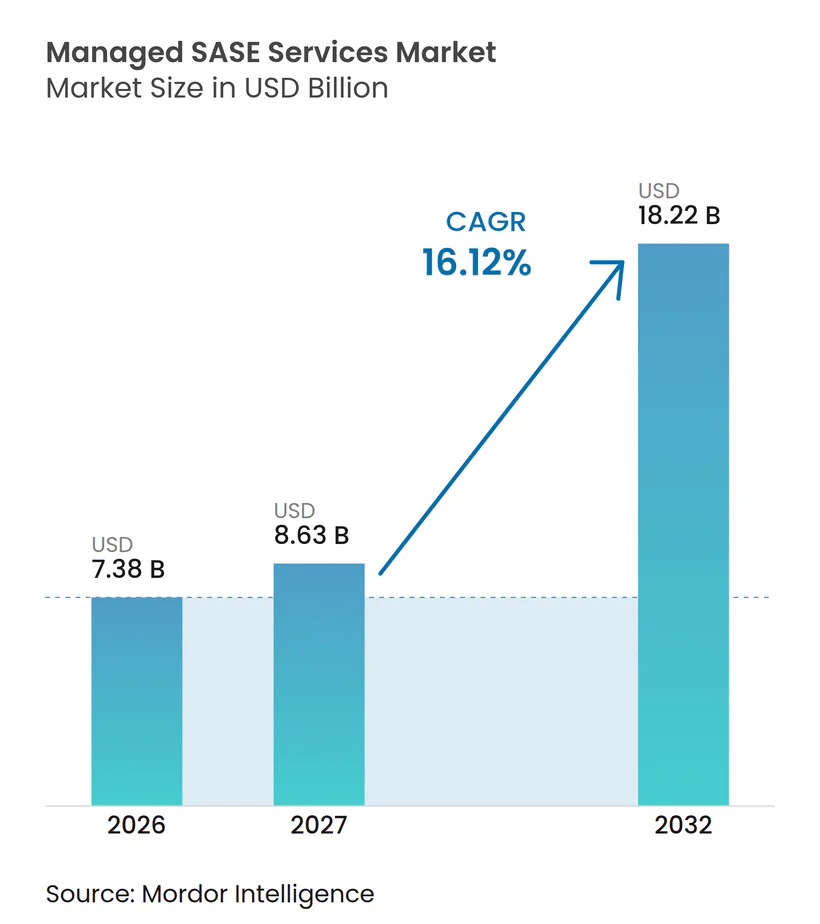
| Market Size (2027) | USD 8.63 Billion |
| Market Size (2032) | USD 18.22 Billion |
| Growth Rate (2027 - 2032) | 16.12 % |
| Fastest Growing Market | Asia-Pacific |
| Largest Market | North America |
| Market Concentration | Medium |
Major Players *Disclaimer: Major Players sorted in no particular order Image © Mordor Intelligence. Reuse requires attribution under CC BY 4.0. | |
Managed SASE Services Market Analysis by Mordor Intelligence
The managed SASE services market size is USD 7.38 billion in 2026 and is forecast to reach USD 18.22 billion by 2032, growing at a CAGR of 16.12% from 2027 to 2032. Growth follows the shift of enterprise workloads toward cloud-delivered applications, which reduces the usefulness of data-center-centered security designs. Providers are combining network connectivity, secure access, and operations into subscription agreements that can replace separate hardware refresh cycles. This approach gives carriers a way to turn network renewal risk into recurring security revenue and deeper customer relationships. Data sovereignty requirements are also increasing the value of providers that can operate inspection points within the countries where customers process data. Migration from MPLS, firewalls, and VPNs remains difficult, while inspection latency and cloud egress costs can increase the total deployment cost.
Key Report Takeaways
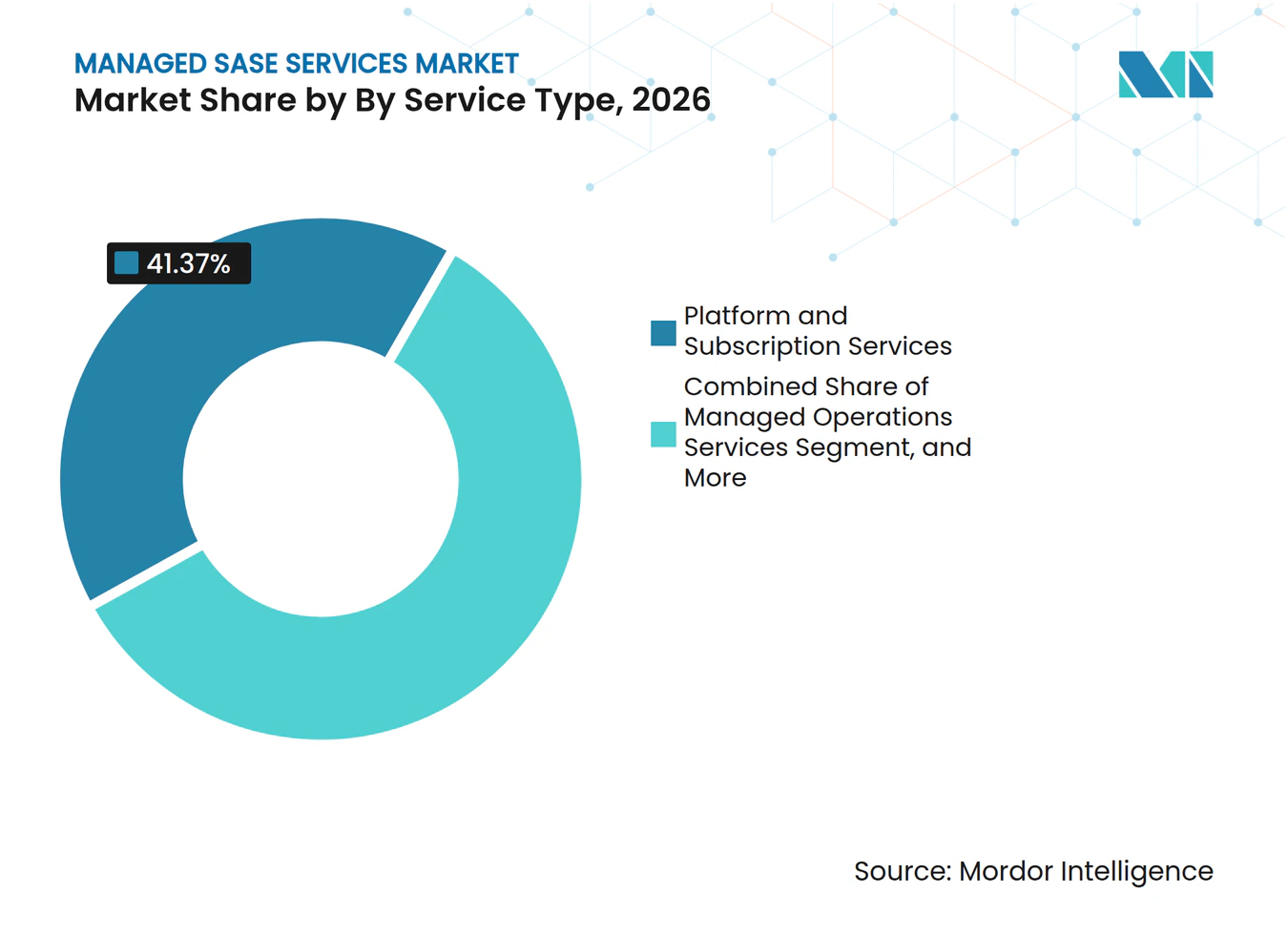
- By service type, Platform and Subscription Services held 41.37% of the managed SASE services market share in 2026, while Managed Operations Services is projected to expand at a 16.93% CAGR through 2032.
- By management model, Fully Managed Service held 43.83% share in 2026, while Co-Managed and Assisted Service is projected to expand at a 16.52% CAGR through 2032.
- By vendor type, Single-Vendor SASE held 58.27% share in 2026, while Multi-Vendor SASE is projected to expand at a 16.62% CAGR through 2032.
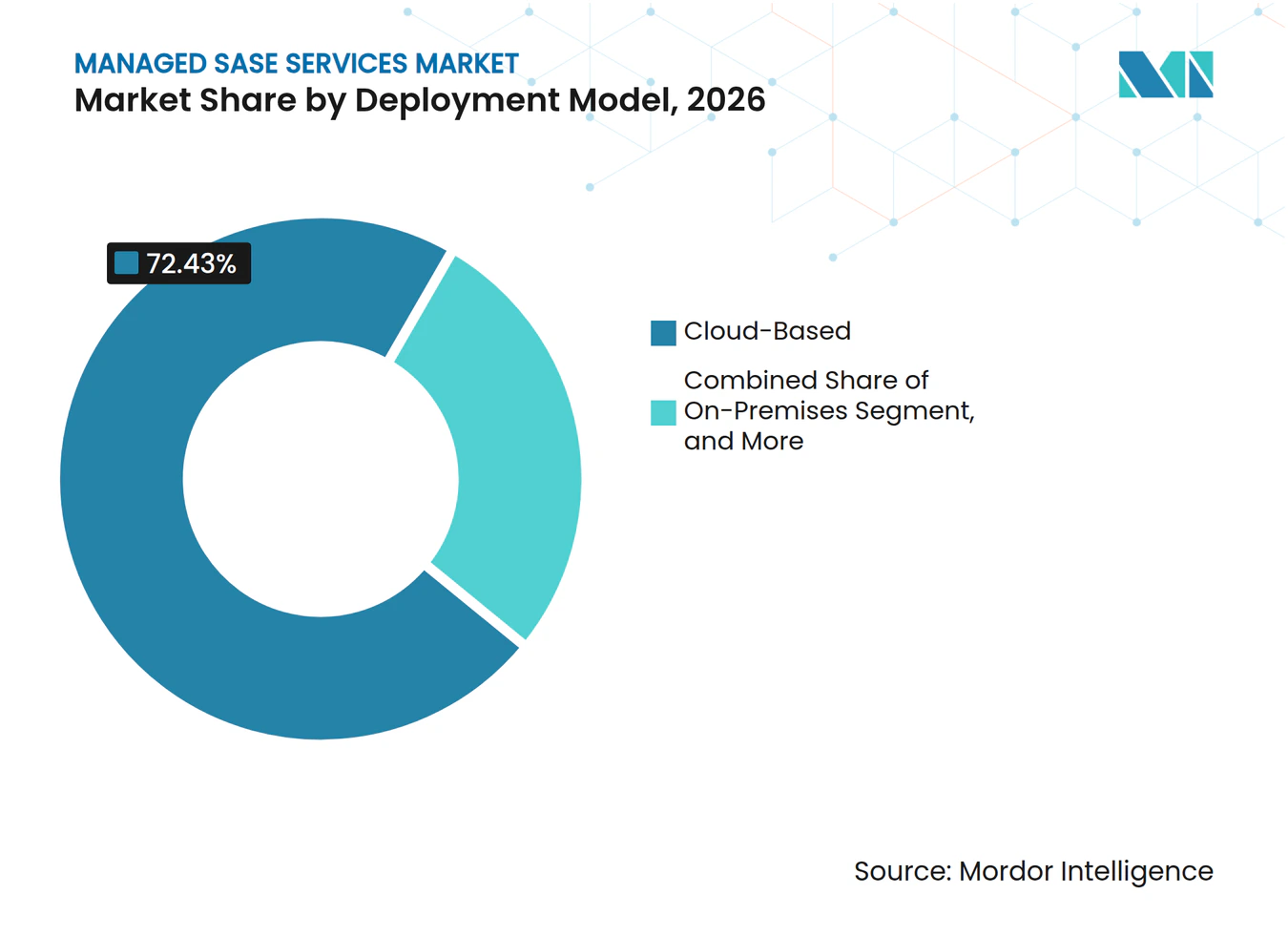
- By deployment model, Cloud-Based deployment held 72.43% share in 2026, while Hybrid deployment is projected to expand at a 16.83% CAGR through 2032.
- By end-user industry, BFSI held 23.87% share in 2026, while Healthcare is projected to expand at a 16.37% CAGR through 2032.
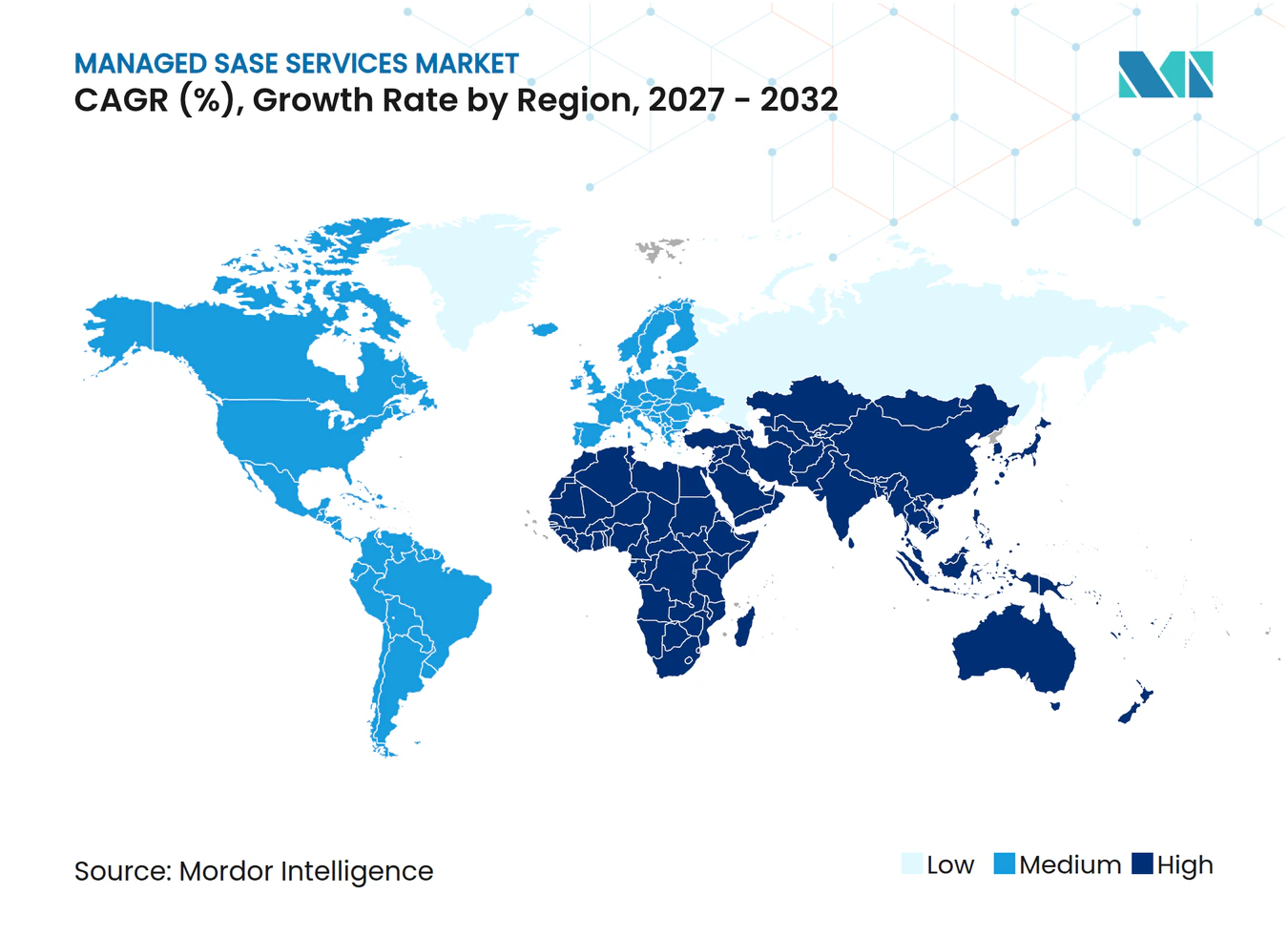
- By geography, North America held 38.73% share in 2026, while Asia-Pacific is projected to expand at a 16.48% CAGR through 2032.
Note: Market numbers in this report are based on Mordor Intelligence's proprietary estimation framework, which combines nine months of actuals with Q4 projections for base year 2026.
Global Managed SASE Services Market Trends and Insights
Drivers Impact Analysis*
| Driver | (~) % Impact on CAGR Forecast | Geographic Relevance | Impact Timeline |
|---|---|---|---|
| Cloud and SaaS Migration | +3.0% | Global | Short term (≤ 2 years) |
| Hybrid Work and Distributed Access Requirements | +2.5% | Global | Short term (≤ 2 years) |
| Escalating Cybersecurity Threats and Zero Trust Adoption | +2.0% | Global, concentrated in North America and Europe | Medium term (2-4 years) |
| Enterprise Demand for Managed Security Expertise | +1.5% | Global | Medium term (2-4 years) |
| Sovereign Inspection Points and Local Key Custody Requirements | +0.8% | Europe, Asia-Pacific, Middle East and Africa | Long term (≥ 4 years) |
| eSIM-Native Zero Trust for Cellular IoT Fleets | +0.4% | Global, early traction in North America and Asia-Pacific | Long term (≥ 4 years) |
| Source: Mordor Intelligence | |||
Cloud and SaaS Migration
Enterprise cloud migration is weakening the economic case for MPLS and on-premises perimeter security. Enterprise applications increasingly run in the cloud, so more traffic begins outside the corporate data center. The managed SASE services market benefits when providers inspect this traffic at distributed points of presence instead of routing it back through legacy headends. This can improve traffic handling for major software-as-a-service platforms such as Microsoft 365, Salesforce, and Workday. Providers can also use direct SaaS peering to manage latency and egress exposure. Many buyers begin with security service edge functions before adding SD-WAN, which favors modular contracts over a full platform commitment.
Hybrid Work and Distributed Access Requirements
Hybrid operations require organizations to secure remote staff, software-as-a-service applications, data centers, cloud workloads, branches, and third-party access simultaneously. Hybrid work is now a common operating model across organizations. This makes continuous policy enforcement difficult for internal teams that manage separate networks and security tools. The managed SASE services market responds to this need through monitoring, policy administration, and incident response. Larger enterprises tend to fund platform consolidation and automation, while mid-sized organizations rely more heavily on providers for daily operations.
Escalating Cybersecurity Threats and Zero Trust Adoption
Ransomware, AI-enabled phishing, and supply-chain malware are making security spending harder to defer. The difference between adoption and full operation creates demand for managed and co-managed delivery models. The managed SASE services market can integrate identity verification, policy enforcement, and threat intelligence into a single operating model. Buyers increasingly expect real-time prevention and automated controls as standard features.
Enterprise Demand for Managed Security Expertise
A shortage of cybersecurity skills is raising the value of external operations teams. Nearly half of the surveyed organizations described the parallel use of VPN and ZTNA as a major operational burden. Managed providers can maintain network operations, security engineering, and threat intelligence capabilities that are costly to build internally. The managed SASE services market has an opening among enterprises with 500 to 5,000 users, as many offerings remain designed for global corporations. Standardized delivery and automation can reduce service costs for this group. Channel partners remain important to reaching these buyers, while routine task automation is essential for sustainable service delivery.
Restraints Impact Analysis*
| Restraint | (~) % Impact on CAGR Forecast | Geographic Relevance | Impact Timeline |
|---|---|---|---|
| Legacy MPLS, Firewall and VPN Migration Complexity | -1.8% | Global | Short term (≤ 2 years) |
| High Implementation and Transition Costs | -1.2% | Global, pronounced in SME segments | Medium term (2-4 years) |
| Inline Security Inspection Latency for Real-Time Applications | -0.6% | Global, concentrated in financial services and media | Medium term (2-4 years) |
| Hyperscale SaaS Egress Fees for Inspection Workloads | -0.4% | Global | Long term (≥ 4 years) |
| Source: Mordor Intelligence | |||
Legacy MPLS, Firewall, and VPN Migration Complexity
Moving from MPLS circuits, hardware firewalls, and VPN concentrators to cloud-delivered SASE can disrupt both technology and internal ownership structures. Organizations often operate legacy and SASE systems together for 12 to 24 months while they address policy conflicts, customer-premises equipment compatibility, and branch cutovers. Migration difficulty is a persistent obstacle for multinational organizations with varied branch hardware. Network and security teams can also have separate governance structures, which delays decisions beyond vendor deployment timelines. The managed SASE services market depends on providers that can reduce this burden through migration engineering, zero-touch provisioning, and co-managed transition services. Providers that offer structured migration plans can build buyer confidence during procurement.
High Implementation and Transition Costs
Implementation spending includes migration engineering, identity integration, concurrent infrastructure, staff training, and cloud egress charges. AWS lists base internet egress at USD 0.09 per gigabyte for the first 10 terabytes, while Azure lists USD 0.087 per gigabyte for Zone 1, and Google Cloud lists USD 0.12 per gigabyte as a baseline.[1] High-volume inspection traffic, including video conferencing, data replication, and AI inference, can therefore become a material part of cloud spending. Hybrid designs can retain some local enforcement on-premises and send only essential traffic for cloud inspection. The managed SASE services market remains more accessible when providers show the full cost of ownership to finance teams. Smaller organizations are more exposed because fixed engineering costs and parallel operations extend payback periods.
*Our forecasts treat driver/restraint impacts as directional, not additive. The impact forecasts reflect baseline growth, mix effects, and variable interactions.
Segment Analysis
By Service Type: Platform Services Lead While Managed Operations Expand
Platform and Subscription Services accounted for 41.37% of service type revenue in 2026. Unified contracts combine SD-WAN, security service edge functions, and network orchestration under a single agreement. This structure can support multi-year relationships and provide providers with a foundation for adding managed capabilities. Platform services also simplify commercial accountability for customers who want fewer supplier relationships. Professional Services remains important because many organizations need help integrating legacy security portfolios with cloud-delivered architectures. Consulting can help customers establish policy, deployment, and operating plans before they introduce managed services.
Managed Operations Services is projected to grow at a 16.93% CAGR from 2027 to 2032. The segment benefits from the need to enforce Zero Trust policies continuously across distributed networks. Many organizations do not want to staff network security operations around the clock or recruit specialists for every security domain. Providers can supply continuous monitoring, incident response, policy testing, and operational optimization within the same service relationship. AI-based anomaly detection and automated incident workflows add value beyond baseline network administration because they help teams prioritize issues that need attention. These capabilities matter when customers need better performance as well as better security. The managed SASE services market is therefore moving toward services that combine technology delivery with daily operating responsibility.



By Management Model: Fully Managed Delivery Holds the Largest Share
Fully Managed Service held 43.83% of revenue in 2026. The model appeals to security teams that want to transfer day-to-day responsibility to a provider while retaining clear service-level commitments. Full operational control gives providers a clearer view of clients' environments and can support discussions on renewal and service expansion. BT Business offers a tiered structure that ranges from self-service to fully outsourced delivery across 180 countries. The managed SASE services market uses this range of service levels to address organizations with very different internal operating capacities.
Co-Managed and Assisted Service is forecast to grow at a 16.52% CAGR from 2027 to 2032. It suits large organizations that want to retain governance while needing external support for continuous operations. These customers may already own security platforms but lack enough personnel to run them continuously. The managed SASE services market supports this model because providers can handle operational execution while internal teams set policy and oversee risk. This arrangement can ease adoption for organizations that are unwilling to fully outsource security operations.
By Vendor Type: Single-Vendor Platforms Lead While Multi-Vendor Models Gain Ground
Single-Vendor SASE held 58.27% of vendor-type revenue in 2026. Buyers value a single management console, clear accountability, and less integration work across network and security functions. Many buyers want to reduce integration complexity, consolidate services, and lower capital and operating costs. Unified architectures can also make audit trails and data governance easier to manage. ISO 27001 and SOC 2 Type II requirements reinforce this preference for some organizations. A single-vendor model can be useful when enterprises prioritize operating simplicity over component selection.
Multi-Vendor SASE is projected to advance at a 16.62% CAGR from 2027 to 2032. It meets the needs of global enterprises that face varied compliance requirements and have existing vendor commitments. No single platform always meets every local operational or regulatory requirement. The managed SASE services market also includes providers that combine best-of-breed security service edge capabilities with their own SD-WAN underlay. Orange Business uses Cisco, Fortinet, Palo Alto Networks, HPE Aruba, Netskope, and Zscaler components as virtual network functions in its Super POPs. This approach gives customers more flexibility, but it also increases the need for integration and operating expertise.
By Deployment Model: Cloud Delivery Dominates While Hybrid Needs Rise
Cloud-Based deployment accounted for 72.43% of revenue in 2026. It gives customers globally distributed security capacity without branch hardware refresh cycles or a large upfront appliance investment. Cloud-native delivery can support AI-based policy automation, anomaly detection, and digital experience monitoring across users and locations. It can also scale as traffic demand changes across distributed users and sites. The managed SASE services market size for cloud-based services reflects the broad preference for scalable, centrally administered security. The managed SASE services market also relies on cloud delivery to extend protection quickly to new branches and remote workers.
Hybrid deployment is forecast to grow at a 16.83% CAGR from 2027 to 2032. Sovereign processing rules, air-gapped operational technology systems, and low-latency industrial workloads support this demand. Fortinet describes FortiSASE Outpost as a design that keeps inspection and logging in customer-controlled infrastructure when local processing is required.[2] Hybrid models allow customers to use cloud-delivered security while retaining inspection nodes where they need local control and predictable traffic handling. On-premises systems remain relevant for critical infrastructure and classified government settings. The selection of deployment model increasingly depends on regulatory requirements and traffic characteristics, not only on cloud preference. The managed SASE services market benefits when providers can operate across both cloud and customer-controlled environments.

By End-User Industry: BFSI Leads While Healthcare Grows Fastest
BFSI accounted for 23.87% of end-user revenue in 2026. Financial institutions face high threat exposure, detailed compliance requirements, and connectivity needs across branches and remote advisory teams. Financial services organizations are adopting both hybrid SASE designs and cloud-native security technologies. IT and Telecommunications is also a meaningful user group because its networks are often cloud-native and early in SASE adoption. Manufacturing, Government and Defense, Energy and Utilities, and Retail and E-Commerce are gaining demand as connected operations extend the enterprise perimeter. Industrial IoT and digital transformation increase the number of users, locations, and systems that require secure access.
Healthcare is projected to expand at a 16.37% CAGR from 2027 to 2032. Telemedicine, remote patient monitoring, and ransomware exposure are increasing the need for consistent access controls. Clinical networks now cover hospitals, remote clinician devices, third-party suppliers, and patient applications, so access decisions must work across multiple settings. The managed SASE services market can apply identity-based policies and encrypted inspection across this distributed environment. HIPAA requirements for electronic protected health information make access controls and audit trails important. Healthcare organizations often need managed support because they do not maintain large internal network security teams. Transportation and Logistics, Education, and Hospitality and Travel also need secure connectivity for distributed operations and hybrid workforces. This creates opportunities for providers that can combine centralized policy administration with service delivery tailored to operational requirements.
Geography Analysis
North America held 38.73% of regional revenue in 2026. The managed SASE services market benefits from mature cloud infrastructure and a carrier-managed services base in the region, including AT&T, Verizon, Comcast Business, and Lumen Technologies. CISA issued guidance in July 2026 that directs federal civilian agencies toward SASE architectures aligned with TIC 3.0.[3] The guidance shifts demand away from commercial enterprises and toward federal agencies. Canada and Mexico are developing through multinational subsidiaries that need consistent security policies across their operations. South America is smaller, but Brazil has demand from digital financial services, while Argentina and other countries remain at earlier stages.
Europe is shaped by GDPR data residency rules, the NIS2 Directive, and the Digital Operational Resilience Act for financial services. These requirements make the location of security decisions and infrastructure a practical buying issue. The managed SASE services market in Europe values sovereign designs that place data processing, access control, management, and legal jurisdiction under EU law. Versa Networks activated a fully sovereign SASE deployment in Germany in 2026. Germany leads adoption because large enterprises face detailed security and data governance requirements. The United Kingdom, France, and Benelux are significant markets, while Italy, Spain, Russia, and the rest of Europe are developing in line with cloud modernization and regulatory enforcement.
Asia-Pacific is projected to grow at a 16.48% CAGR from 2027 to 2032. India’s Digital Personal Data Protection Act, China’s cybersecurity law amendments, and 5G-related connectivity upgrades are increasing the need for localized inspection capacity. The managed SASE services market in Asia-Pacific favors providers with credentialed regional infrastructure that can support specified in-country processing. Providers in the region are expanding automation-led delivery to meet this need. Saudi Arabia and the United Arab Emirates are also increasing cloud investment through national programs, while sovereign services address local data custody expectations. Africa remains early-stage, with South Africa, Egypt, and Nigeria supported by multinational companies that extend global security policies into regional operations.
Competitive Landscape
Market Concentration
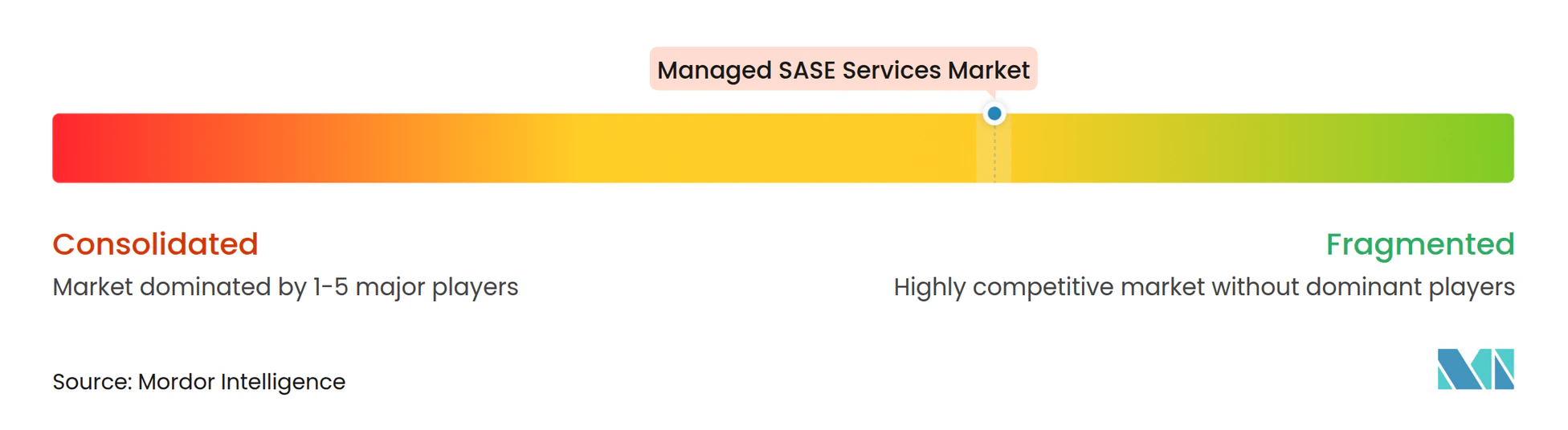
The managed SASE services market is moderately fragmented because no provider leads every geography and customer group. Global carriers, including AT&T, Verizon, Orange Business, BT Group, Vodafone, Telefónica, Deutsche Telekom, and NTT DOCOMO BUSINESS, use network reach and existing enterprise contracts as their main advantages. Cloud-native vendors and managed security specialists compete through architecture and product development speed. Cato Networks raised USD 359 million in June 2025 at a valuation above USD 4.8 billion, illustrating continued funding for cloud-native platforms. Competition increasingly centers on policy automation, data loss prevention, and the ability to deliver operations at scale.
The main opportunity areas are mid-sized enterprises, operational technology settings in manufacturing and energy, and governments that need sovereign services. Traditional networking vendors can face pressure from security-first providers that move faster in platform development. Providers are using AI for anomaly detection, incident response automation, and ticket classification to improve service delivery. Wipro launched its CISO Command Center with CrowdStrike in September 2026 to combine advisory support with security operations.[4] The offering uses the CrowdStrike Falcon platform across endpoint, cloud, exposure, and AI security. This shows how system integrators are extending managed operations beyond connectivity and access security.
AT&T Business and Palo Alto Networks delivered a Quantum-Resilient SASE Fabric in July 2026 using IETF hybrid key exchange standards in the Prisma SASE architecture. The managed SASE services market is also responding to data sovereignty needs through broader local coverage. Vodafone Business and Fortinet expanded their partnership in April 2025 across Europe, Asia, and the United States, including co-managed service options and professional support. These moves show that coverage, local processing, and managed delivery are becoming central competitive factors. The managed SASE services market increasingly rewards providers that can combine these capabilities in a consistent cross-border operating model.
Managed SASE Services Industry Leaders
-
AT&T Inc.
-
Verizon Communications Inc.
-
BT Group plc
-
Tata Communications Limited
-
Wipro Limited
- *Disclaimer: Major Players sorted in no particular order
Recent Industry Developments
- September 2026: Wipro Limited and CrowdStrike launched the CISO Command Center, an advisory and security operations offering powered by the CrowdStrike Falcon® platform. The initiative delivers integrated protection across endpoint security, cloud security, exposure management, and AI security through Wipro's CyberTransform and CyberShield managed service suite, operationalizing a risk-led security model for enterprises facing frontier AI-accelerated threats.
- July 2026: AT&T Business and Palo Alto Networks delivered a Quantum-Resilient SASE Fabric, embedding post-quantum cryptography natively into the Prisma SASE architecture using IETF hybrid key exchange standards RFC 9370, RFC 9242, and RFC 8784. The fabric provides crypto-agility across AT&T's 5G, fiber, and legacy underlays, protecting against harvest-now-decrypt-later threats and aligning with CNSA 2.0 and NIS2/DORA compliance requirements.
- May 2026: Netskope expanded its NewEdge Network to cover all four components of data sovereignty, network transport, data processing, domestic storage, and metadata governance, across 24 countries through more than 120 data centers and 80 regions, with recent additions in Indonesia and Turkey. The expansion includes third-party validation and auditable environments to support compliance with GDPR, India's DPDPA, Saudi Arabia's PDPL, and sector-specific localization mandates.
- May 2026: Netskope and Deloitte expanded their global managed SASE partnership, launching first in EMEA to deliver managed SASE integrating Netskope's SSE, SD-WAN, ZTNA, CASB, Secure Web Gateway, and Firewall-as-a-Service within Deloitte's managed security and advisory framework. The service targets enterprises navigating cloud adoption, AI data flows, and multi-regional regulatory requirements, with additional regions to follow the EMEA launch.
Global Managed SASE Services Market Report Scope
The managed secure access service edge (SASE) services market covers third-party-managed cloud-based networking and security solutions that integrate wide-area networking (WAN) capabilities with security services, including secure web gateways, cloud access security brokers, firewall-as-a-service, and zero-trust network access.
The Managed SASE Services Market Report is Segmented by Service Type (Platform and Subscription Services, Professional Services, Managed Operations Services, and Monitoring, Incident Response, and Optimization Services), Management Model (Fully Managed Service, Co-Managed and Assisted Service, and Self-Managed Service), Vendor Type (Single-Vendor SASE and Multi-Vendor SASE), Deployment Model (On-Premises, Cloud-Based, and Hybrid), End-User Industry (Information Technology and Telecommunications, BFSI, Healthcare, Retail and E-Commerce, Manufacturing, Government and Defense, Education, Energy and Utilities, Transportation and Logistics, Hospitality and Travel, and Other End-User Industries), and Geography (North America, South America, Europe, Asia-Pacific, Middle East, and Africa). The Market Forecasts are Provided in Terms of Value (USD).
| Platform and Subscription Services |
| Professional Services |
| Managed Operations Services |
| Monitoring, Incident Response and Optimization Services |
| Fully Managed Service |
| Co-Managed and Assisted Service |
| Self-Managed Service |
| Single-Vendor SASE |
| Multi-Vendor SASE |
| On-Premises |
| Cloud-Based |
| Hybrid |
| Information Technology and Telecommunications |
| BFSI |
| Healthcare |
| Retail and E-Commerce |
| Manufacturing |
| Government and Defense |
| Other End-User Industries |
| North America | United States |
| Canada | |
| Mexico | |
| South America | Brazil |
| Argentina | |
| Rest of South America | |
| Europe | Germany |
| United Kingdom | |
| France | |
| Italy | |
| Spain | |
| Russia | |
| Rest of Europe | |
| Asia-Pacific | China |
| India | |
| Japan | |
| South Korea | |
| Australia | |
| Rest of Asia-Pacific | |
| Middle East | Saudi Arabia |
| United Arab Emirates | |
| Turkey | |
| Rest of Middle East | |
| Africa | South Africa |
| Egypt | |
| Nigeria | |
| Rest of Africa |
| By Service Type | Platform and Subscription Services | |
| Professional Services | ||
| Managed Operations Services | ||
| Monitoring, Incident Response and Optimization Services | ||
| By Management Model | Fully Managed Service | |
| Co-Managed and Assisted Service | ||
| Self-Managed Service | ||
| By Vendor Type | Single-Vendor SASE | |
| Multi-Vendor SASE | ||
| By Deployment Model | On-Premises | |
| Cloud-Based | ||
| Hybrid | ||
| By End-User Industry | Information Technology and Telecommunications | |
| BFSI | ||
| Healthcare | ||
| Retail and E-Commerce | ||
| Manufacturing | ||
| Government and Defense | ||
| Other End-User Industries | ||
| By Geography | North America | United States |
| Canada | ||
| Mexico | ||
| South America | Brazil | |
| Argentina | ||
| Rest of South America | ||
| Europe | Germany | |
| United Kingdom | ||
| France | ||
| Italy | ||
| Spain | ||
| Russia | ||
| Rest of Europe | ||
| Asia-Pacific | China | |
| India | ||
| Japan | ||
| South Korea | ||
| Australia | ||
| Rest of Asia-Pacific | ||
| Middle East | Saudi Arabia | |
| United Arab Emirates | ||
| Turkey | ||
| Rest of Middle East | ||
| Africa | South Africa | |
| Egypt | ||
| Nigeria | ||
| Rest of Africa | ||
Key Questions Answered in the Report
What is the managed SASE services market size?
The managed SASE services market size is USD 7.38 billion in 2026 and is forecast to reach USD 18.22 billion by 2032 at a CAGR of 16.12% from 2027 to 2032.
What is driving demand for managed SASE services?
Cloud migration, hybrid work, cybersecurity threats, and limited security operations capacity are supporting demand for managed delivery.
Which service type leads managed SASE services?
Platform and Subscription Services leads with 41.37% share in 2026, while Managed Operations Services has the highest forecast CAGR at 16.93%.
Which deployment model is growing fastest?
Hybrid deployment is projected to grow at a 16.83% CAGR through 2032 because customers need local processing, lower latency, and greater control over regulated data.
Which end-user sector is growing fastest?
Healthcare is projected to grow at a 16.37% CAGR through 2032, supported by telemedicine, remote patient monitoring, and the need to protect clinical information.
Which region is expanding fastest?
Asia-Pacific is projected to grow at a 16.48% CAGR through 2032, supported by data protection rules and enterprise connectivity upgrades.