
Managed CWPP Services Market Size and Share
Market Overview
| Study Period | 2021 - 2032 |
|---|---|
| Market Size (2027) | USD 1.05 Billion |
| Market Size (2032) | USD 2.86 Billion |
| Growth Rate (2027 - 2032) | 22.25 % |
| Fastest Growing Market | Asia-Pacific |
| Largest Market | North America |
| Market Concentration | Medium |
Major Players *Disclaimer: Major Players sorted in no particular order Image © Mordor Intelligence. Reuse requires attribution under CC BY 4.0. | |
Managed CWPP Services Market Analysis by Mordor Intelligence
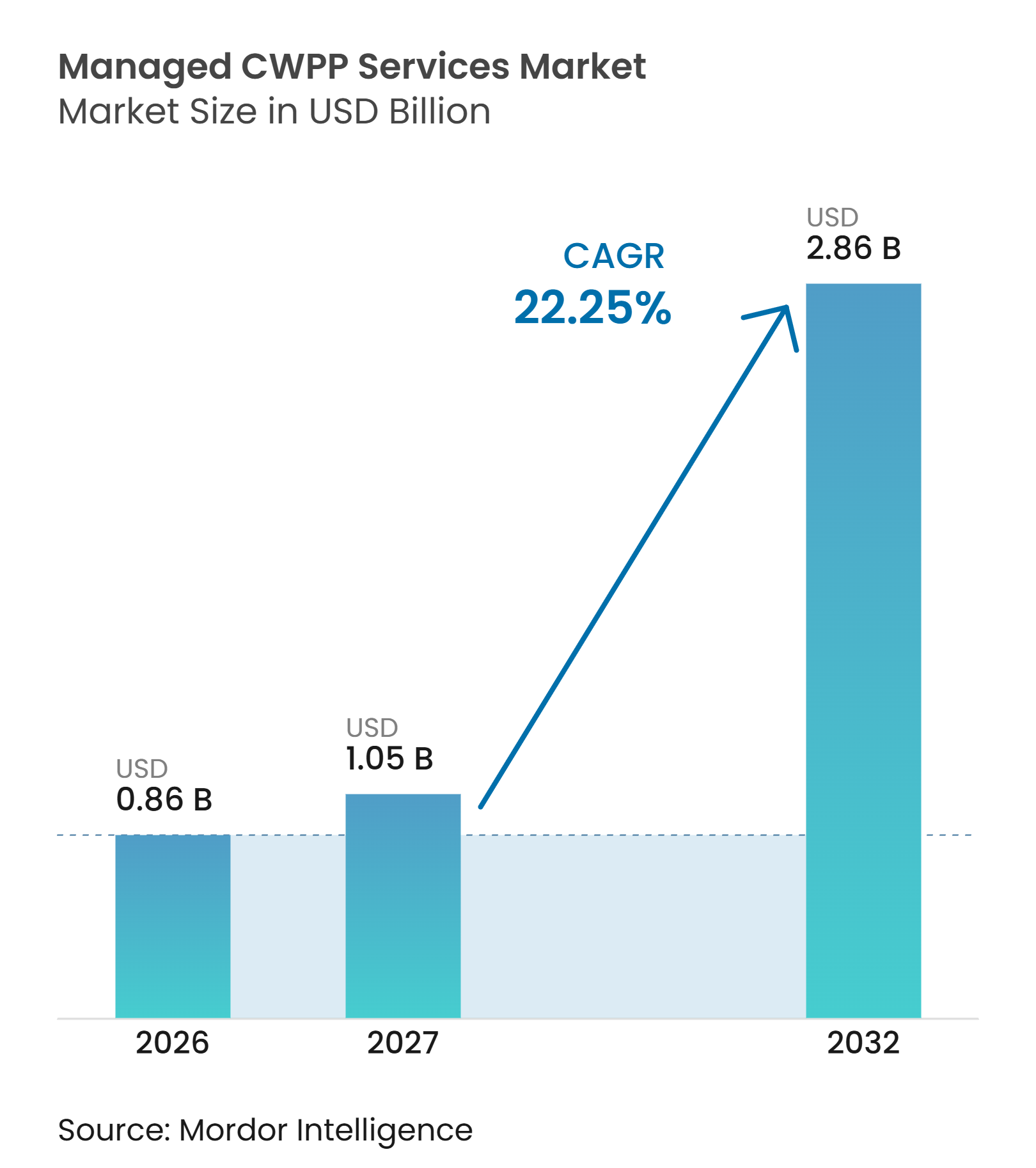
The Managed CWPP Services Market size is projected to expand from USD 0.86 billion in 2026 to USD 1.05 billion in 2027, and to USD 2.86 billion by 2032, registering a CAGR of 22.25% between 2027 and 2032. The Managed CWPP Services Market is expanding as enterprises protect workloads that run across public and private cloud environments. Runtime controls have become more important because perimeter-focused security cannot fully monitor containerized and serverless workloads. Demand also reflects the movement from separate cloud security tools toward integrated cloud-native application protection platforms. Ransomware, credential misuse, and compliance requirements are increasing the value of continuous workload monitoring. Providers that combine platform integration, response services, and local delivery capacity are better positioned to serve regulated customers.
Key Report Takeaways
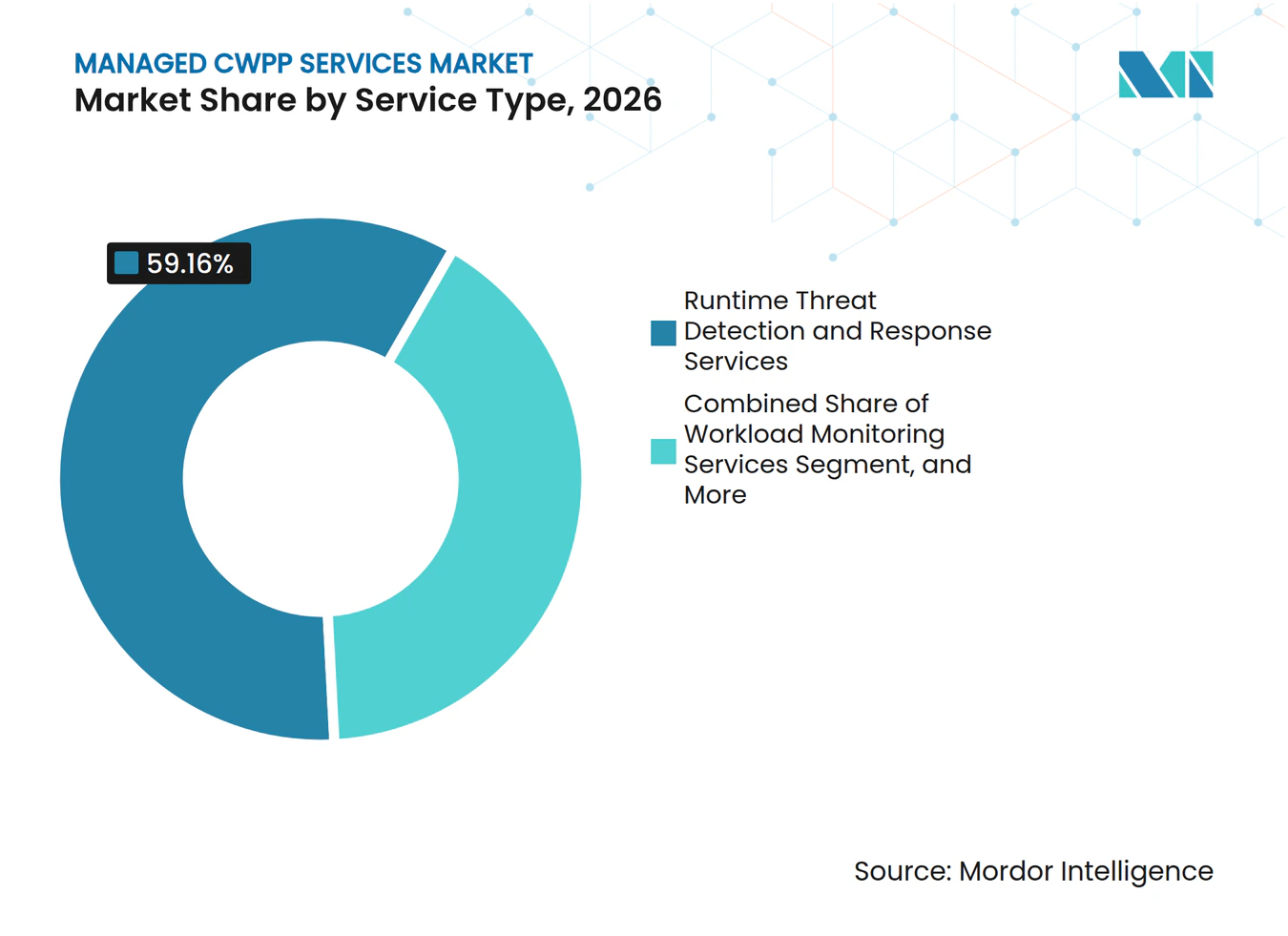
- By service type, Runtime Threat Detection and Response Services held 59.16% of the Managed CWPP Services Market share in 2026, while Container and Kubernetes Security Management Services are projected to expand at a 23.36% CAGR through 2032.
- By deployment model, Public Cloud accounted for 66.45% of the Managed CWPP Services Market share in 2026, while Hybrid Cloud is projected to grow at a 23.78% CAGR through 2032.
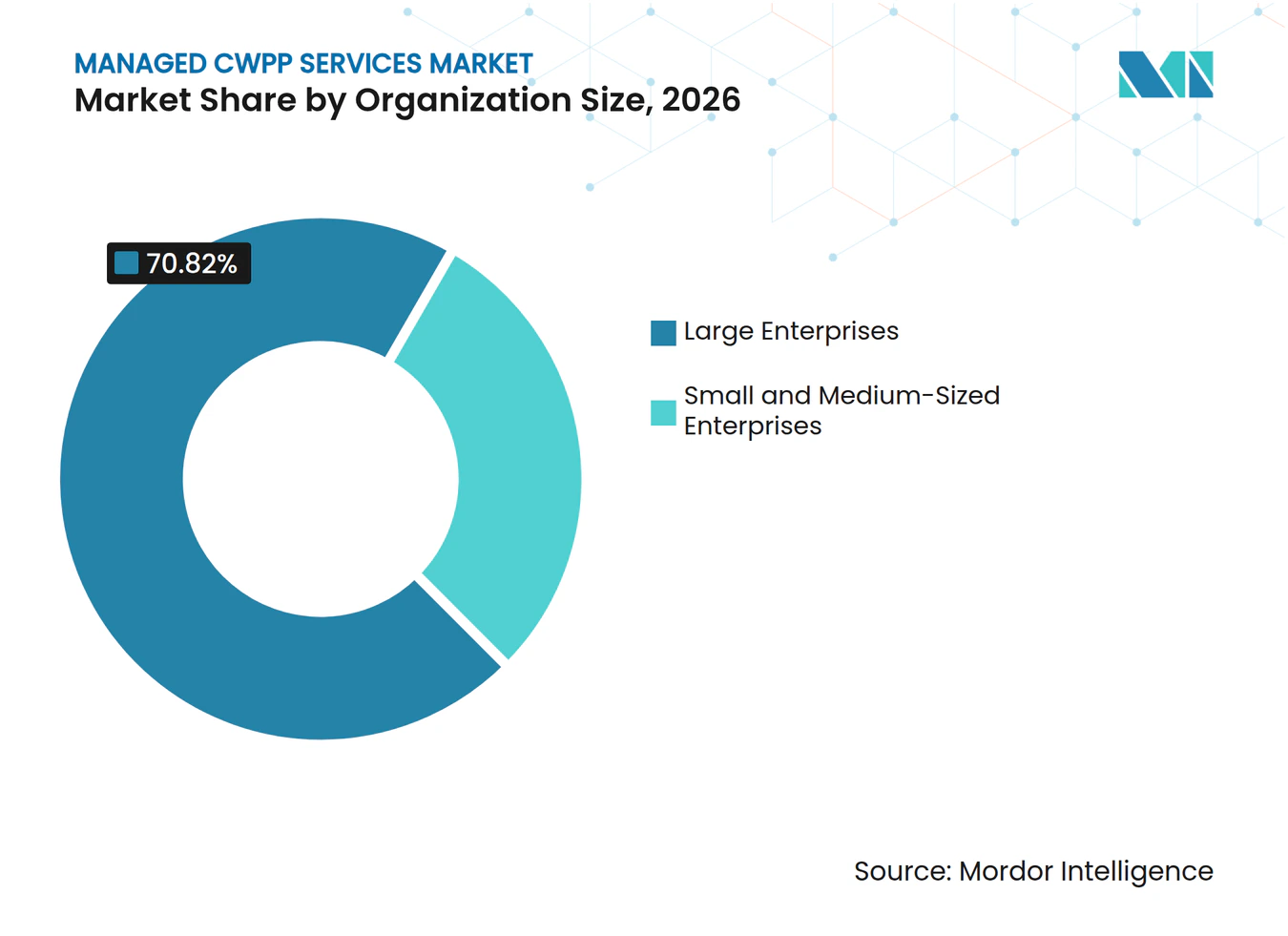
- By organization size, Large Enterprises held 70.82% of the Managed CWPP Services Market revenue share in 2026, while Small and Medium-Sized Enterprises are projected to expand at a 24.08% CAGR through 2032.
- By end-user industry, BFSI accounted for 29.11% of the Managed CWPP Services Market revenue share in 2026, while Healthcare and Life Sciences are projected to advance at a 22.76% CAGR through 2032.
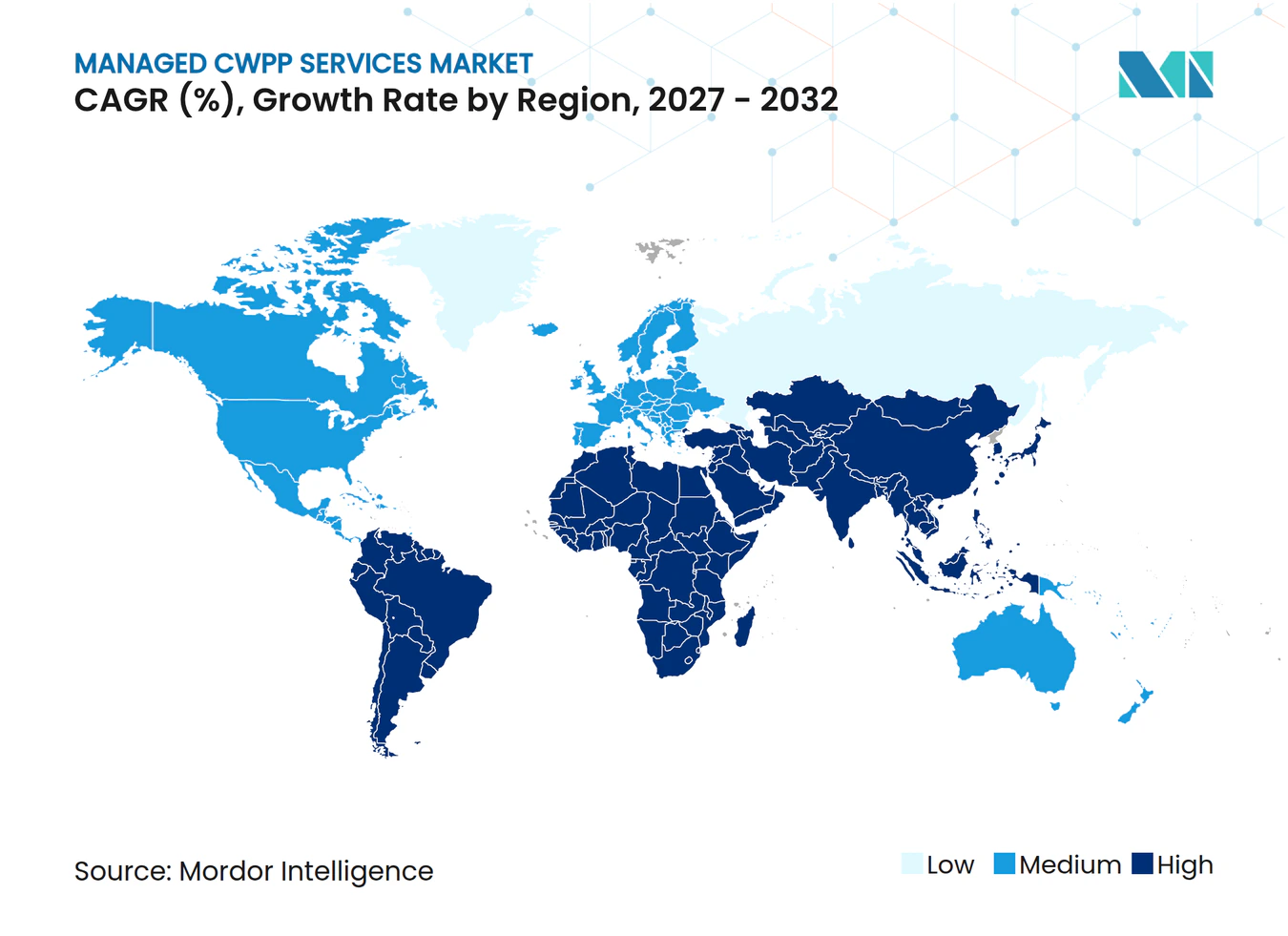
- By geography, North America held 36.51% of the Managed CWPP Services Market revenue share in 2026, while Asia-Pacific is projected to grow at a 23.05% CAGR through 2032.
Note: Market numbers in this report are based on Mordor Intelligence's proprietary estimation framework, which combines nine months of actuals with Q4 projections for base year 2026.
Market Trends and Insights
Drivers Impact Analysis of Managed CWPP Services Market*
| Driver | (~) % Impact on CAGR Forecast | Geographic Relevance | Impact Timeline |
|---|---|---|---|
| Multi-Cloud and Hybrid-Cloud Adoption | +4.8% | Global | Short term (≤ 2 years) |
| DevSecOps Integration and CNAPP Consolidation | +4.2% | North America and Europe | Medium term (2-4 years) |
| Cloud-Native Ransomware and Compliance Exposure | +3.5% | Global | Short term (≤ 2 years) |
| Cloud-Insurance Control Requirements | +2.8% | North America and Europe | Short term (≤ 2 years) |
| eBPF-Based Runtime Telemetry | +2.3% | North America, Europe, and Asia-Pacific | Medium term (2-4 years) |
| Managed Expertise for Distributed Workloads | +1.9% | Global, with early gains in Asia-Pacific and Middle East and Africa | Long term (≥ 4 years) |
| Source: Mordor Intelligence | |||
Multi-Cloud and Hybrid-Cloud Adoption Widens the Managed CWPP Demand Base
Multi-cloud and hybrid-cloud designs are broadening the customer base for the Managed CWPP Services Market. Thales reported that enterprises used an average of 2.1 public cloud providers in 2025. It also found that 55% of respondents considered multi-cloud security more difficult than on-premises security. This was 4 percentage points higher than the prior year. Separate cloud environments create gaps in how workload telemetry is collected and assessed. Managed providers can centralize this work for organizations without a dedicated cloud security operations center. Rackspace reported that 48% of IT decision-makers considered hybrid-cloud deployment critical to operations over the next 12 to 24 months. DevSecOps programs increase the need for runtime controls in the Managed CWPP Services Market. Security checks in development pipelines cannot identify every execution-time threat in containerized environments.
DevSecOps Integration and CNAPP Consolidation Accelerate Managed Service Consumption
DevSecOps programs increase the need for runtime controls in the Managed CWPP Services Market. Security checks in development pipelines cannot identify every threat that appears when a workload runs. This limitation is important for containers that operate across changing cloud environments. Palo Alto Networks introduced Cortex Cloud 2.0 in October 2025 with autonomous AI agents trained on 1.2 billion security incident responses. The update also included a Cloud Command Center for unified multi-cloud asset, risk, and active-threat visibility. Integrated offerings can reduce reliance on separate CWPP, CSPM, and CIEM tools. This makes managed delivery more appealing to buyers who lack an internal security operations center.
Cloud-Native Ransomware and Compliance Exposure Elevate Runtime Monitoring
Cloud-native ransomware increases the value of continuous monitoring in the Managed CWPP Services Market. Containerized microservices can create lateral movement paths that traditional endpoint tools may not identify. IBM reported that data theft represented 18% of security incidents in its 2025 threat intelligence findings. This exposure makes workload-level monitoring relevant to both security teams and executive leadership. Healthcare requirements under consideration include encryption for electronic protected health information, written incident response plans, and restoration of critical systems within 72 hours. European financial institutions must also document workload security posture and report incidents under DORA and related cloud outsourcing guidance.[1] Cyber insurance is supporting recurring demand for managed workload protection. Delinea found that 99.5% of survey respondents needed at least some security controls to obtain cyber coverage in 2025. Threat detection and incident response were among the most frequently required controls.
Cloud-Insurance Control Requirements Create Recurring Demand
Cyber insurance is supporting recurring demand for managed workload protection. Delinea found that 99.5% of survey respondents needed at least some security controls to obtain cyber coverage in 2025. Threat detection and incident response were among the most frequently required controls. Insurers increasingly review external vulnerabilities and cloud security posture before issuing policies. Organizations without documented controls can face coverage restrictions or higher premiums. The UK National Cyber Security Center included workload-level runtime monitoring in cyber hygiene guidance for insurance evaluation in September 2026. The Managed CWPP Services Market can therefore benefit when smaller firms seek protection to meet coverage conditions.
Restraints Impact Analysis of Managed CWPP Services Market*
| Restraint | (~) % Impact on CAGR Forecast | Geographic Relevance | Impact Timeline |
|---|---|---|---|
| Data-Residency and Sovereign-Telemetry Constraints | -2.4% | Europe, Asia-Pacific, and Middle East and Africa | Short term (≤ 2 years) |
| Cloud-Security Skills Shortage | -1.8% | Global | Long term (≥ 4 years) |
| Agent Fatigue and Tool-Sprawl Costs | -1.4% | North America and Europe | Medium term (2-4 years) |
| ARM and Serverless Coverage Gaps | -0.9% | North America and Asia-Pacific | Medium term (2-4 years) |
| Source: Mordor Intelligence | |||
Data-Residency and Sovereign-Telemetry Constraints Fragment Service Delivery
Data residency requirements can restrict how managed providers deliver the Managed CWPP Services Market offering. The EU Data Act entered enforcement in September 2025 and added obligations for non-personal data and cross-border data flows. NIS2 and DORA also require timely incident reporting and influence where data can be processed. These requirements can require regional data planes and jurisdiction-specific compliance tools. The European Cloud Certification Scheme includes a highest-tier path that calls for EU-headquartered providers and in-region processing. Providers may need several regional security operations centers, which can raise delivery costs and reduce margins for mid-tier firms.
Cloud-Security Skills Shortage Limits Adoption and Delivery Capacity
The shortage of cloud security talent limits the Managed CWPP Services Market. Organizations can buy a platform, but may not have staff to configure policies or respond to alerts. This challenge can encourage the use of managed services while also limiting providers' capacity to onboard new clients. Complex incidents still require human judgment for escalation, investigation, and policy tuning. Automated triage and remediation can reduce the burden of routine work. However, automation does not yet eliminate the need for cloud-native security specialists.
*Our forecasts treat driver/restraint impacts as directional, not additive. The impact forecasts reflect baseline growth, mix effects, and variable interactions.
Managed CWPP Services Market Segment Analysis
By Service Type:
Runtime Demand Leads While Container Security Gains MomentumRuntime Threat Detection and Response Services held 59.16% of the Managed CWPP Services Market in 2026. The segment benefits from demand for continuous behavioral monitoring rather than periodic vulnerability scans. BFSI, healthcare, and critical infrastructure buyers need active detection evidence for audits. Runtime services record workload behavior and response activity. This supports organizations that need to show continuous security oversight in the Managed CWPP Services Market.
Container and Kubernetes Security Management Services are projected to grow at a 23.36% CAGR through 2032. Larger enterprises are expanding Kubernetes workloads across multiple clusters and regions. Many internal teams lack experience with eBPF sensors, Falco detection tuning, and multi-cluster policy management. The Managed CWPP Services Market creates opportunities for providers in advisory, investigation, and response services that leverage platform-native telemetry.[2] AWS expanded GuardDuty runtime monitoring for Amazon EKS in June 2025 using a fully managed eBPF agent that customers do not deploy or maintain.



By Deployment Model:
Hybrid Use Changes Service Delivery RequirementsPublic Cloud accounted for 66.45% of the Managed CWPP Services Market in 2026. Production workloads are concentrated on AWS, Microsoft Azure, and Google Cloud. These environments support close integrations and lower agent deployment requirements. Public cloud customers in the Managed CWPP Services Market can use managed security services with established platform connectors. This supports efficient deployment for providers with hyperscaler expertise.
Hybrid Cloud is projected to grow at a 23.78% CAGR through 2032. Enterprises use hybrid designs to meet sovereignty needs and maintain control over selected workloads. Private cloud remains important for defense, central banking, and critical utilities. These deployments can require on-premises sensors and dedicated security operations resources. In July 2025, Orca Security expanded its runtime platform to hybrid and private cloud environments, adding container escape detection, privilege escalation monitoring, Windows protection, and natural-language investigations.
By Organization Size:
SME Demand Rises With Insurance RequirementsLarge Enterprises accounted for 70.82% of the Managed CWPP Services Market in 2026. They operate more cloud workloads, larger Kubernetes environments, and broader threat surfaces. These conditions make managed runtime protection operationally and financially relevant. Regulated enterprises also need evidence that controls are working. Large organizations, therefore, remain the main revenue base for managed providers.
Small and Medium-Sized Enterprises are projected to grow at a 24.08% CAGR through 2032. Managed delivery reduces the operational burden for firms with limited security teams. Cyber insurance requirements can encourage buyers in the Managed CWPP Services Market to implement documented workload protection. Providers can make their offerings more relevant by providing compliance evidence, audit-ready reports, and framework mapping. Sysdig introduced its Model Context Protocol server in October 2025 and reported a 76% reduction in mean time to respond with filtering of more than 98% of low-risk vulnerability noise.

By End-User Industry:
BFSI Supports Revenue While Healthcare Grows FasterBFSI held 29.11% of the Managed CWPP Services Market in 2026. Financial institutions manage high-value cloud workloads and face strict security requirements. DORA and revised cloud outsourcing guidance require documented security posture and incident timelines. Managed providers can supply continuous monitoring and evidence for compliance programs. These requirements support the sector's role as the main revenue base.
Healthcare and Life Sciences are projected to grow at a 22.76% CAGR through 2032. The sector is responding to proposed requirements for incident response plans, system restoration, and ePHI encryption. These obligations increase the value of continuous workload visibility in the Managed CWPP Services Market. Government and Public Administration, IT and Telecommunication, Industrial Manufacturing, Retail and E-commerce, and Energy and Utilities represent the remaining demand base. Qualys TotalCloud received FedRAMP High authorization in May 2026 for workload protection, posture management, entitlement management, container security, and cloud detection and response.
Geography Analysis
North America Managed CWPP Services Market
North America held 36.51% of the Managed CWPP Services Market in 2026. The region has a high concentration of cloud-native enterprises and managed security providers. Security disclosure rules and sector requirements make documented runtime protection important for many buyers. The United States drives regional demand through extensive use of AWS and Azure.
Europe Managed CWPP Services Market
Europe has a regulatory-driven growth profile and significant delivery constraints for the Managed CWPP Services Market. NIS2, DORA, the EU Data Act, and the European Cloud Certification Scheme influence telemetry portability and data processing choices. Providers may need regional infrastructure or local partners to serve regulated customers. Germany, the United Kingdom, and France are the largest national demand centers.[3] Growing adoption of hybrid and multi-cloud architectures across regulated industries is further increasing demand for managed cloud workload protection services throughout the region.
South America, APAC and MEA Managed CWPP Services Market
Asia-Pacific is projected to expand at a 23.05% CAGR through 2032 in the Managed CWPP Services Market. Japan is moving toward managed security procurement through public digital transformation activities and comparative cloud threat-detection testing, published in July 2025 by the Information-technology Promotion Agency. India is adding demand as enterprises move more workloads to cloud environments. South Korea has exposure from manufacturing and semiconductor workloads that can contain valuable intellectual property. Cybereason launched a CNAPP solution in Japan in May 2025 with eBPF-based workload protection and runtime incident logging. South America, the Middle East, and Africa remain smaller in absolute terms, although Brazil and the United Arab Emirates are developing as hubs for financial-sector cloud adoption and government digitization.
Competitive Landscape
Market Concentration
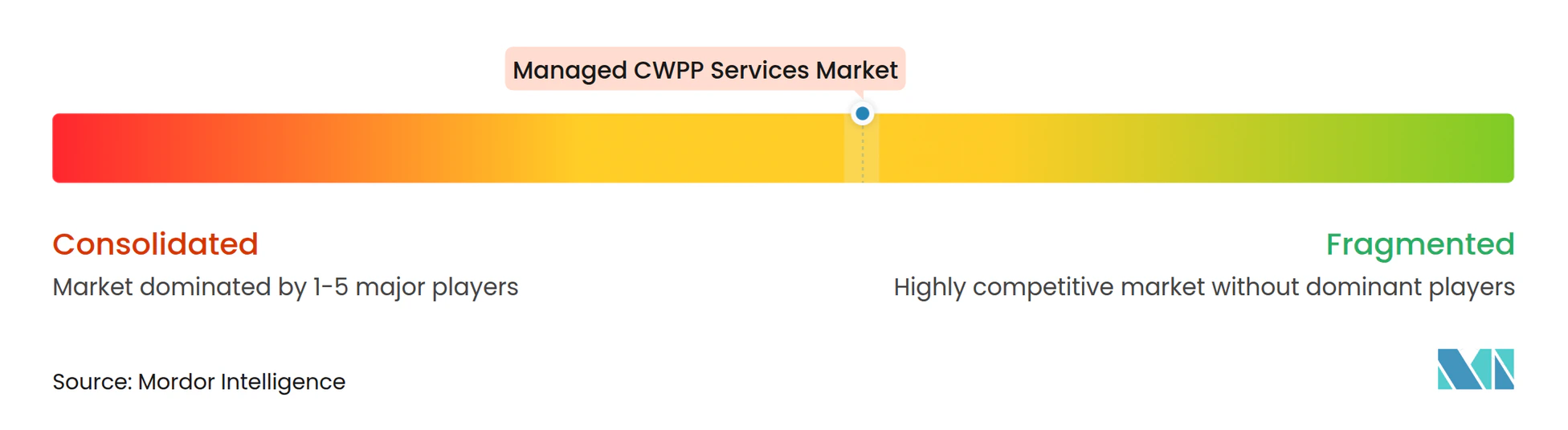
The Managed CWPP Services Market has moderate concentration among leading platform providers. Palo Alto Networks, CrowdStrike, and Wiz have broad footprints in the Managed CWPP Services Market and adjacent CNAPP capabilities. Google signed an agreement to acquire Wiz for USD 32 billion in March 2025. Wiz products were expected to remain available on AWS, Azure, and Oracle Cloud after closing, subject to regulatory approval.
Palo Alto Networks launched Cortex Cloud 2.0 in October 2025 with autonomous AI agents and unified multi-cloud visibility. CrowdStrike announced AI Model Scanning and eBPF-powered runtime data protection at the RSA Conference 2025. These moves expand protection from alerting toward investigation and remediation. Sysdig introduced its Model Context Protocol server in October 2025 to connect runtime telemetry with AI platforms. These functions can reduce the delivery burden for providers serving clients with small security teams.[4] As AI-driven automation capabilities mature, managed service providers are expected to improve operational efficiency, reduce analyst workload, and deliver faster threat detection and response outcomes across complex cloud environments.
The Managed CWPP Services Market has opportunities in hybrid and private cloud runtime coverage. ARM architecture and serverless protection remain areas where coverage can be incomplete. The eBPF Foundation awarded USD 228,200 in 2025 for upstream ARM64 security work. SME packages that combine monitoring with evidence of compliance are another opportunity. Third-party providers must differentiate through cross-cloud intelligence, response support, and advisory services as hyperscalers add detection capabilities.
Managed CWPP Services Industry Leaders
-
Palo Alto Networks, Inc.
-
Trend Micro Incorporated
-
Fortinet, Inc.
-
Sophos Limited
-
Check Point Software Technologies Ltd.
- *Disclaimer: Major Players sorted in no particular order
Managed CWPP Services Market Companies Covered in this Report
- Palo Alto Networks, Inc.
- CrowdStrike Holdings, Inc.
- Wiz, Inc.
- Trend Micro Incorporated
- Orca Security Ltd.
- Aqua Security Software Ltd.
- Sysdig, Inc.
- Uptycs, Inc.
- Upwind Security, Inc.
- SentinelOne, Inc.
- Qualys, Inc.
- Tenable Holdings, Inc.
- Rapid7, Inc.
- Illumio, Inc.
- Check Point Software Technologies Ltd.
- Fortinet, Inc.
- Sophos Limited
- Trellix, Inc.
- Cyscale, Inc.
- CloudDefense.AI, Inc.
Recent Industry Developments in Managed CWPP Services Market
- September 2026: SentinelOne expanded its Wayfinder Threat Hunting service to cover AWS, Azure, and Google Cloud control-plane activity, combining Singularity Platform telemetry with expert human-led hunting for IAM privilege escalation, unauthorized data access, and cloud infrastructure abuse mapped to MITRE ATT&CK techniques. The expansion extended continuous cloud workload protection to all major hyperscaler environments and was immediately available to existing Wayfinder customers.
- August 2026: SentinelOne and AWS expanded their collaboration to deliver unified AI governance for customers, building on Amazon Bedrock, integrating SentinelOne's AI runtime security with Amazon Bedrock AgentCore to give security teams a single enforcement and remediation layer for AI agent risk, targeting the growing gap between AI deployment velocity and security team capacity to govern AI workloads.
- May 2026: Qualys TotalCloud achieved FedRAMP High authorization, positioning it as a government-grade CNAPP covering cloud workload protection, CSPM, CIEM, Kubernetes, and container security, and cloud detection and response for US federal agencies, addressing a previously underserved segment of the Managed CWPP Services Market where compliance requirements exceeded available certified offerings.
- October 2025: Palo Alto Networks unveiled Cortex Cloud 2.0, integrating autonomous AI agents trained on 1.2 billion real-world security responses, a reimagined Cloud Command Center for unified, multi-cloud risk visibility, and a CDR agent that delivers real-time protection with up to 50% lower resource consumption. Automated upgrades were scheduled for all global customers in H1 2026, marking the platform's transition to an autonomous cloud security operations engine.
Global Managed CWPP Services Market Report Scope
The Managed CWPP Services Market comprises outsourced cybersecurity services that monitor, protect, manage, validate, and respond to threats affecting cloud workloads across public, private, and hybrid cloud environments. These services encompass workload monitoring, runtime threat detection and response, container and Kubernetes security management, compliance and configuration management, and ongoing security operations designed to protect virtual machines, containers, serverless workloads, and cloud-native applications. The market includes managed services, implementation, consulting, support, maintenance, and continuous security operations associated with cloud workload protection.
The Managed CWPP Services Market Report is Segmented by Service Type (Workload Monitoring Services, Runtime Threat Detection and Response Services, Container and Kubernetes Security Management Services, Compliance and Configuration Management Services, and Other Service Types), Deployment Model (Public Cloud, Private Cloud, and Hybrid Cloud), Organization Size (Large Enterprises, and Small and Medium-Sized Enterprises), End-User Industry (Banking, Financial Services, and Insurance [BFSI], Government and Public Administration, Healthcare and Life Sciences, IT and Telecommunication, Industrial Manufacturing, Retail and E-commerce, Energy and Utilities, and Other End-User Industries), and Geography (North America, South America, Europe, Asia-Pacific, Middle East, and Africa). The Market Forecasts are Provided in Terms of Value (USD).
Segmentation Overview
| Workload Monitoring Services |
| Runtime Threat Detection and Response Services |
| Container and Kubernetes Security Management Services |
| Compliance and Configuration Management Services |
| Other Service Types |
| Public Cloud |
| Private Cloud |
| Hybrid Cloud |
| Large Enterprises |
| Small and Medium-Sized Enterprises |
| Banking, Financial Services, and Insurance (BFSI) |
| Government and Public Administration |
| Healthcare and Life Sciences |
| IT and Telecommunication |
| Industrial Manufacturing |
| Retail and E-commerce |
| Energy and Utilities |
| Other End-User Industries |
| North America | United States |
| Canada | |
| Mexico | |
| South America | Brazil |
| Argentina | |
| Rest of South America | |
| Europe | Germany |
| United Kingdom | |
| France | |
| Italy | |
| Russia | |
| Rest of Europe | |
| Asia-Pacific | China |
| Japan | |
| India | |
| South Korea | |
| Rest of Asia-Pacific | |
| Middle East | Saudi Arabia |
| United Arab Emirates | |
| Rest of Middle East | |
| Africa | South Africa |
| Nigeria | |
| Rest of Africa |
| By Service Type | Workload Monitoring Services | |
| Runtime Threat Detection and Response Services | ||
| Container and Kubernetes Security Management Services | ||
| Compliance and Configuration Management Services | ||
| Other Service Types | ||
| By Deployment Model | Public Cloud | |
| Private Cloud | ||
| Hybrid Cloud | ||
| By Organization Size | Large Enterprises | |
| Small and Medium-Sized Enterprises | ||
| By End-User Industry | Banking, Financial Services, and Insurance (BFSI) | |
| Government and Public Administration | ||
| Healthcare and Life Sciences | ||
| IT and Telecommunication | ||
| Industrial Manufacturing | ||
| Retail and E-commerce | ||
| Energy and Utilities | ||
| Other End-User Industries | ||
| By Geography | North America | United States |
| Canada | ||
| Mexico | ||
| South America | Brazil | |
| Argentina | ||
| Rest of South America | ||
| Europe | Germany | |
| United Kingdom | ||
| France | ||
| Italy | ||
| Russia | ||
| Rest of Europe | ||
| Asia-Pacific | China | |
| Japan | ||
| India | ||
| South Korea | ||
| Rest of Asia-Pacific | ||
| Middle East | Saudi Arabia | |
| United Arab Emirates | ||
| Rest of Middle East | ||
| Africa | South Africa | |
| Nigeria | ||
| Rest of Africa | ||
Key Questions Answered in the Report
What is the Managed CWPP Services Market size?
The Managed CWPP Services Market is projected to expand from USD 0.86 billion in 2026 and USD 1.05 billion in 2027 to USD 2.86 billion by 2032, at a 22.25% CAGR.
What is driving demand for managed cloud workload protection services?
Multi-cloud operations, runtime threat exposure, compliance requirements, and cyber insurance controls are increasing demand for continuous workload monitoring.
Which managed CWPP service is the largest?
Runtime Threat Detection and Response Services held 59.16% revenue share in 2026.
Which deployment model is growing fastest?
Hybrid Cloud is projected to grow at a 23.78% CAGR through 2032 as firms balance cloud use, control, and data residency requirements.
Which customer group is growing fastest for managed CWPP services?
Small and Medium-Sized Enterprises are projected to expand at a 24.08% CAGR through 2032, supported by managed delivery and cyber insurance requirements.
Which region is projected to grow fastest?
Asia-Pacific is projected to grow at a 23.05% CAGR through 2032, supported by cloud adoption in Japan, India, and South Korea.