
Managed AI-SOC Operations Services Market Size and Share
Market Overview
| Study Period | 2021 - 2032 |
|---|---|
| Market Size (2027) | USD 10.44 Billion |
| Market Size (2032) | USD 26.38 Billion |
| Growth Rate (2027 - 2032) | 20.37 % |
| Fastest Growing Market | Asia-Pacific |
| Largest Market | North America |
| Market Concentration | Medium |
Major Players *Disclaimer: Major Players sorted in no particular order Image © Mordor Intelligence. Reuse requires attribution under CC BY 4.0. | |
Managed AI-SOC Operations Services Market Analysis by Mordor Intelligence
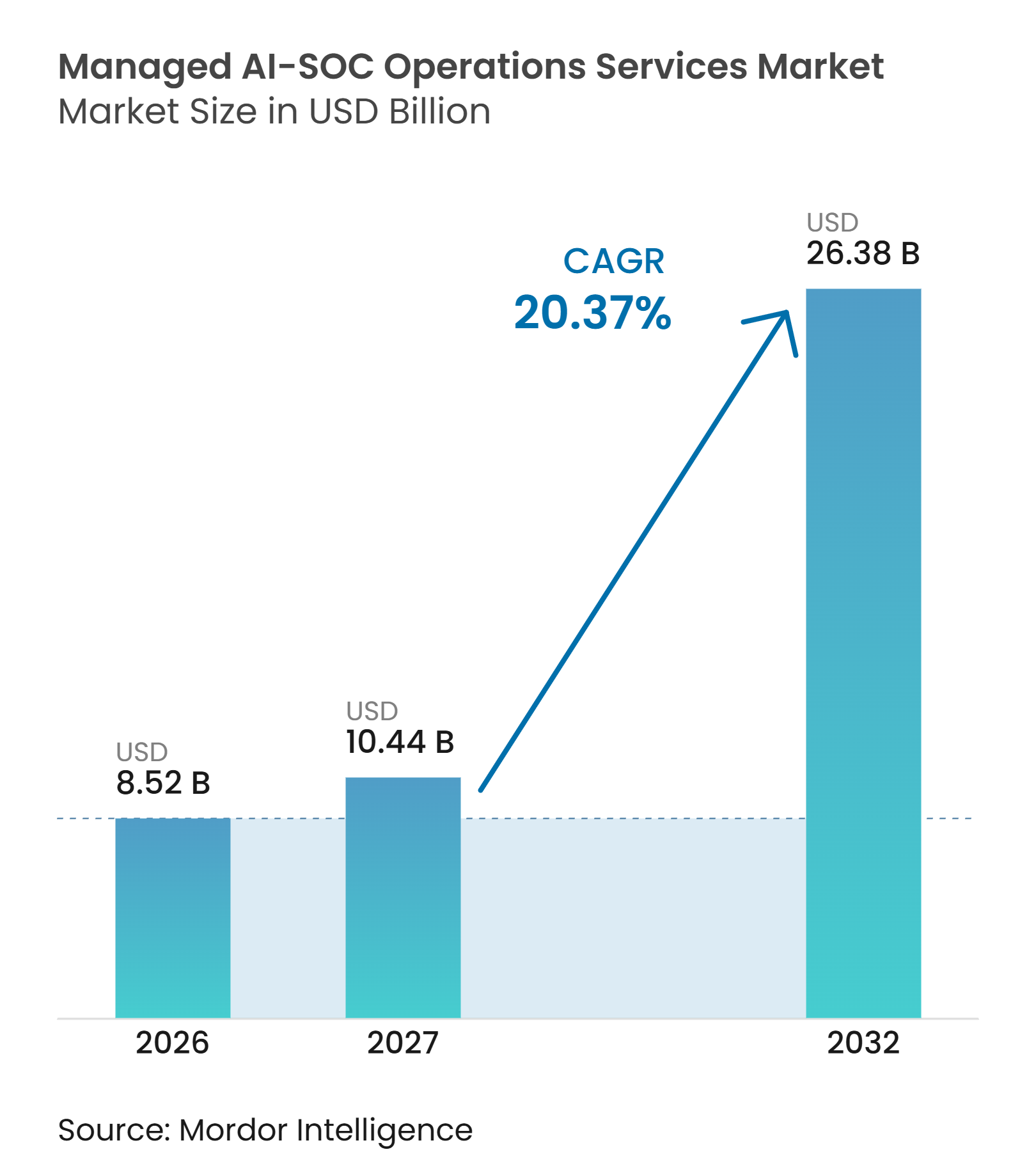
The managed AI-SOC operations services market size is projected to expand from USD 8.52 billion in 2026 and USD 10.44 billion in 2027 to USD 26.38 billion by 2032, registering a CAGR of 20.37% between 2027 and 2032. The managed AI-SOC operations services market is moving from point security tools toward managed outcomes that link detection, investigation, and containment. Faster attacker activity leaves security teams with less time to review alerts manually. Buyers are placing more weight on continuous monitoring, documented response processes, and integrations across endpoint, identity, cloud, and on-premises environments. This favors providers that combine AI-supported workflows with skilled analysts and accountable operating procedures. Data residency and sector-specific compliance requirements also shape which delivery models providers can offer in each country.
Key Report Takeaways
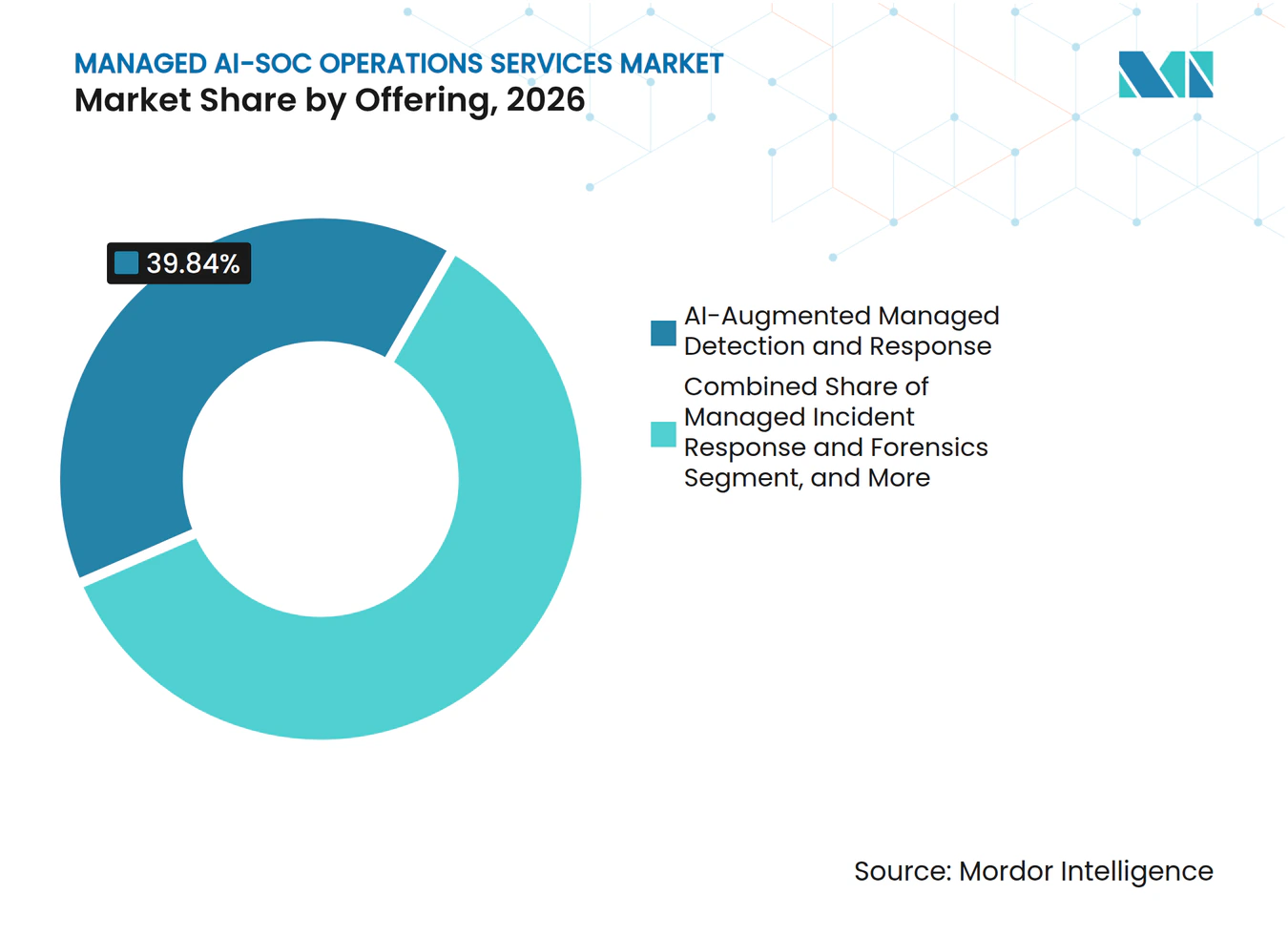
- By offering, AI-Augmented Managed Detection and Response led with 39.84% revenue share in 2026, while AI SOC-as-a-Service is projected to expand at a 22.43% CAGR through 2032.
- By SOC function, Threat Detection and Monitoring held 29.71% of revenue in 2026, while Incident Investigation and Analysis is expected to expand at a 21.91% CAGR through 2032.
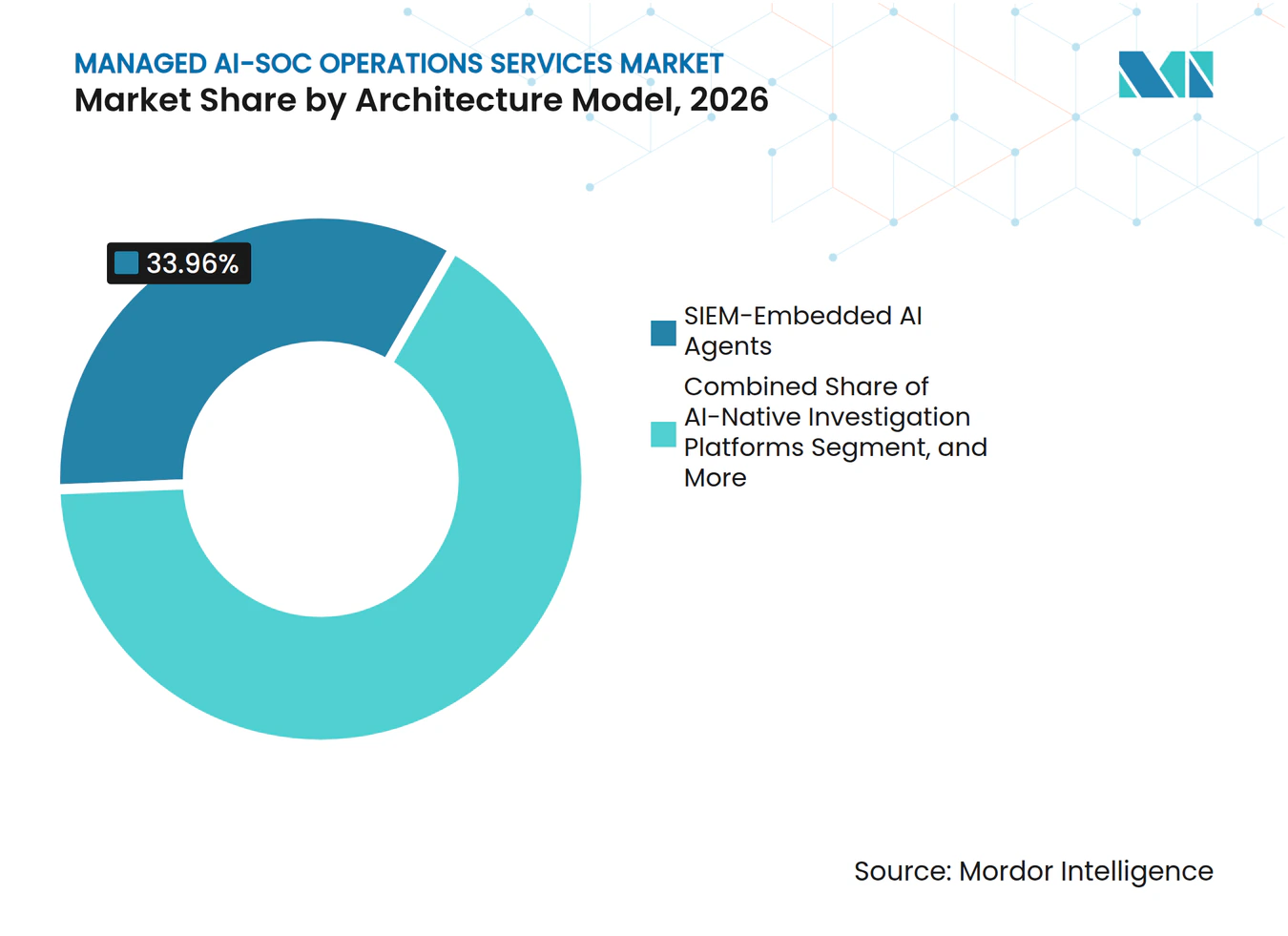
- By architecture model, SIEM-Embedded AI Agents accounted for 33.96% of revenue in 2026, while AI-Native Investigation Platforms are projected to expand at a 21.86% CAGR through 2032.
- By deployment model, Hybrid Cloud held 49.88% of revenue in 2026, while On-Premises and Air-Gapped deployments are projected to expand at a 22.68% CAGR through 2032.
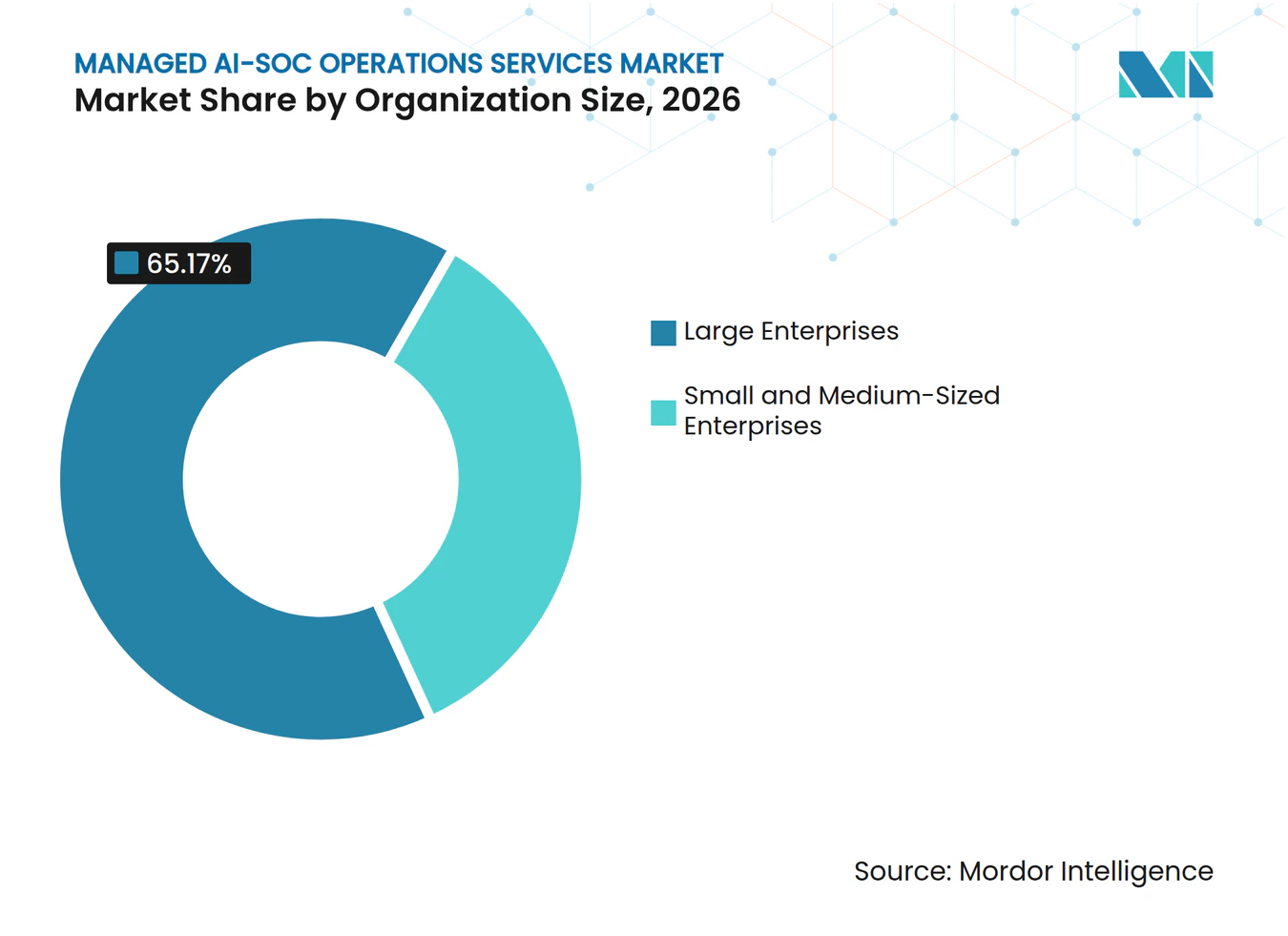
- By organization size, Large Enterprises held 65.17% of revenue in 2026, while Small and Medium-Sized Enterprises are expected to expand at a 22.17% CAGR through 2032.
- By end-user industry, BFSI accounted for 28.62% of revenue in 2026, while Healthcare and Life Sciences are projected to expand at a 21.98% CAGR through 2032.
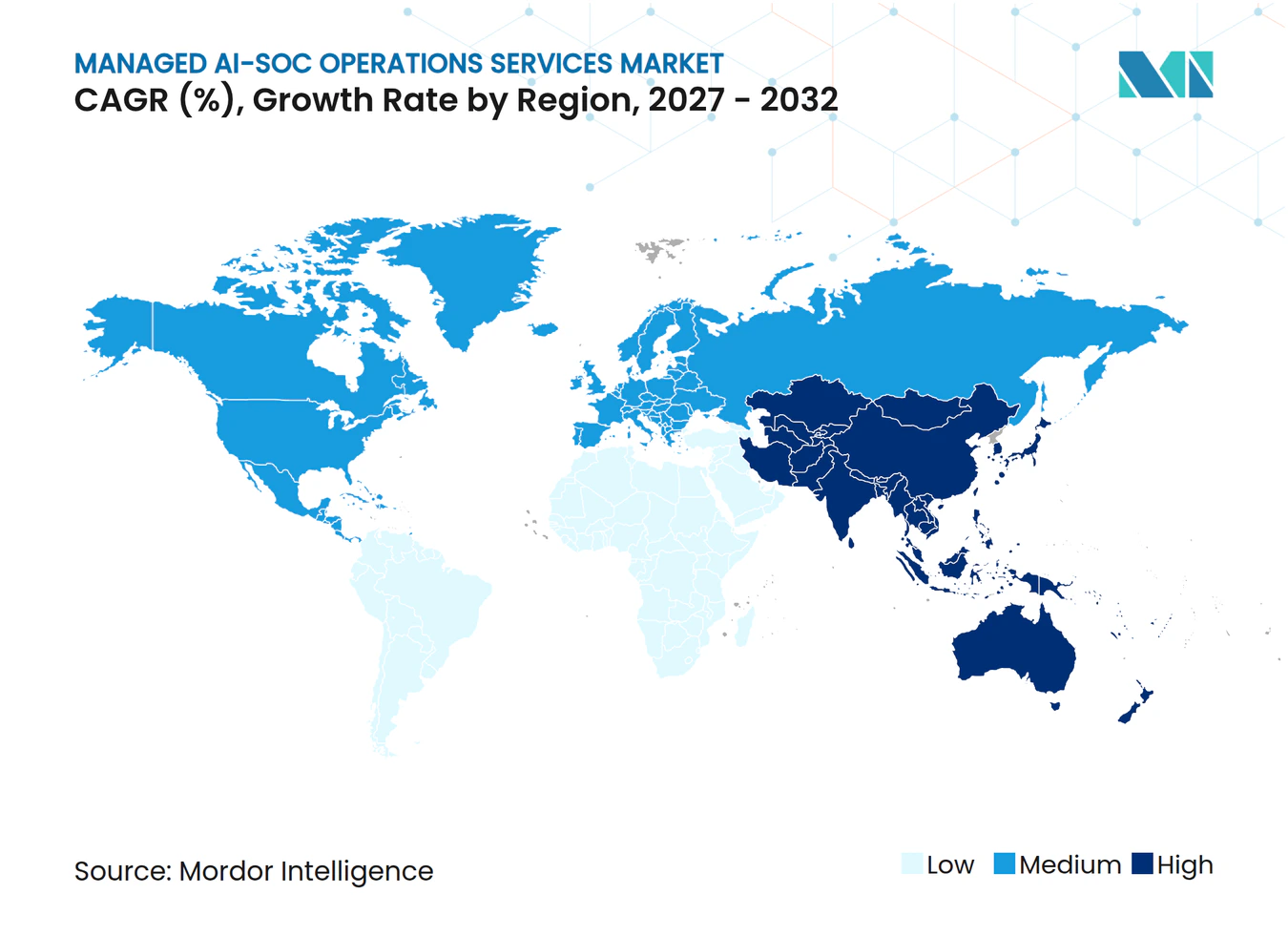
- By geography, North America held 39.77% of managed AI-SOC operations services market revenue in 2026, while Asia-Pacific is projected to expand at a 21.09% CAGR through 2032.
Note: Market numbers in this report are based on Mordor Intelligence's proprietary estimation framework, which combines nine months of actuals with Q4 projections for base year 2026.
Market Trends and Insights
Drivers Impact Analysis of Managed AI-SOC Operations Services Market*
| Driver | (~) % Impact on CAGR Forecast | Geographic Relevance | Impact Timeline |
|---|---|---|---|
| Escalating Multi-Vector Cyberattacks | +4.2% | Global, with peak intensity in North America, Western Europe, and Northeast Asia | Short term (≤ 2 years) |
| Cybersecurity Workforce Shortage | +3.8% | Global, most severe in Asia-Pacific and Middle East and Africa | Medium term (2-4 years) |
| Expanding Cloud and Hybrid Attack Surface | +3.5% | Global, highest in North America and Europe where hybrid infrastructure adoption is mature | Short term (≤ 2 years) |
| Mandatory Incident Reporting and Cyber-Insurance Controls | +2.9% | North America and EU core, with spillover to Asia-Pacific and Middle East and Africa | Medium term (2-4 years) |
| AI-Assisted Alert-Context Compression | +2.2% | Global, with early concentration in cloud-native deployments across North America and Asia-Pacific | Medium term (2-4 years) |
| Data-Residency-Driven Local SOC Demand | +1.8% | Asia-Pacific core, Middle East and Africa, and national markets with data localization mandates | Long term (≥ 4 years) |
| Source: Mordor Intelligence | |||
Escalating Multi-Vector Cyberattacks Widen the Detection-Response Gap
The managed AI-SOC operations services market benefits from attacks that cross several security surfaces in the same incident. Palo Alto Networks reported that 87% of incidents involved 2 or more attack surfaces, while 43% spanned 4 or more surfaces[1]. This increases the value of service models that combine telemetry from cloud, identity, endpoint, network, and application sources. The same report indicates that security teams need a broader context before they can contain an incident safely. CrowdStrike reported an average eCrime breakout time of 29 minutes and a fastest observed breakout time of 27 seconds. The managed AI-SOC operations services market, therefore, depends less on isolated alert handling and more on coordinated detection and response.
Cybersecurity Workforce Shortage Restructures the Build-Versus-Buy Decision
The shortage is increasingly a skills problem rather than a simple hiring problem. SANS found that 60% of surveyed organizations identified skills gaps as their leading workforce concern. SANS also found that 79% of SOCs used AI or machine learning tools, but only 36% had incorporated them into a defined workflow [2]. This creates a role for managed providers that can tune models, govern playbooks, and validate workflows before the service reaches the client. A 2025 study found that AI copilots could reduce triage time by up to 68% in short-staffed SOCs[3]. ISACA reported that 61% of cybersecurity teams considered themselves understaffed, supporting demand for operating models that add capacity without a full internal SOC build-out.
Expanding Cloud and Hybrid Attack Surface Forces SOC and Cloud Security Convergence
Cloud and hybrid environments require the SOC to analyze activity across systems that use different tools and data formats. Palo Alto Networks reported that API attacks increased by 41% as agentic AI expanded its use of APIs. In the same survey, 89% of respondents said cloud and application security must be fully integrated with the SOC to be effective. Organizations managed an average of 17 cloud security tools from 5 vendors, and 30% needed more than 1 day to resolve a cloud incident. Providers that bring this telemetry together can reduce the handoffs that slow investigation. This gives the managed AI-SOC operations services market a stronger role in clients that lack a unified view across cloud, edge, and on-premises systems.
Mandatory Incident Reporting and Cyber-Insurance Controls Elevate Compliance as a Procurement Driver
Shorter reporting windows make automated evidence collection more important for regulated organizations. DORA has been applied since January 17, 2025, and requires financial entities to provide an initial incident notification within 4 hours of classification and an intermediate report within 72 hours. NIS2 requires essential entities to provide an early warning within 24 hours and a notification within 72 hours of a significant incident. These obligations favor services that maintain incident records, classifications, and clear ownership of responses. The SEC also requires public companies to disclose material cybersecurity incidents within 4 business days after determining materiality. Cyber-insurance controls add demand for documented 24/7 monitoring and forensic capability, which managed AI-SOC providers can package with operational reporting.
Restraints Impact Analysis of Managed AI-SOC Operations Services Market*
| Restraint | (~) % Impact on CAGR Forecast | Geographic Relevance | Impact Timeline |
|---|---|---|---|
| Legacy Integration and Data Normalization Complexity | -2.80% | Global, most pronounced in large enterprises with heterogeneous SIEM estates in North America and Europe | Medium term (2-4 years) |
| Trust and Liability Concerns Around Autonomous Response | -1.90% | Global, highest in regulated sectors across North America and the EU | Long term (≥ 4 years) |
| Model Poisoning and Prompt-Injection Exposure in SOC Workflows | -1.40% | Global, concentrated in organizations using LLM-augmented triage pipelines | Medium term (2-4 years) |
| Evidence-Chain Fragmentation Across Multi-Tenant Environments | -0.90% | Global, most acute in MSSPs operating multi-tenant cloud architectures in Europe and Asia-Pacific | Long term (≥ 4 years) |
| Source: Mordor Intelligence | |||
Legacy Integration and Data Normalization Complexity Extends Deployment Cycles
The main obstacle in many engagements is data readiness rather than the availability of AI tools. A 2025 survey found that 72% of organizations operated more than 1 SIEM and 41% operated more than 2. Different data structures can make threat correlation unreliable until logs and detection rules are normalized. CardinalOps reported that hybrid and multi-cloud environments can overwhelm legacy SIEM systems during deployment and create detection gaps during migration. For multi-client providers, the extra normalization work extends onboarding and raises delivery costs. Providers with automated normalization and detection-rule translation can reduce this friction. The managed AI-SOC operations services market will therefore favor vendors that can make integration repeatable without weakening client-specific controls.
Trust and Liability Concerns Around Autonomous Response Create Governance Ceilings
Organizations remain cautious when AI can take high-impact containment actions without an analyst's approval. A 2026 legal study found that existing liability approaches do not fully settle accountability for autonomous cyber operations. This makes buyers more willing to use AI for triage, evidence gathering, and recommendations than for direct network isolation or credential revocation. Human approval remains important in regulated sectors and high-risk environments. Detailed audit trails and decision logs help service providers show why an action was proposed or taken. Clear override thresholds also support the gradual adoption of more autonomous workflows. These controls can improve trust, although they may limit the speed advantage of a fully autonomous response.
*Our forecasts treat driver/restraint impacts as directional, not additive. The impact forecasts reflect baseline growth, mix effects, and variable interactions.
Managed AI-SOC Operations Services Market Segment Analysis
By Offering:
AI-Augmented MDR Anchors Revenue While SOC-as-a-Service Captures GrowthAI-Augmented Managed Detection and Response held 39.84% of the managed AI-SOC operations services market share in 2026. It suits enterprises that already use endpoint detection, extended detection, or established security data platforms and need a managed overlay instead of a replacement program. The model adds AI-supported detection, prioritization, and expert review to technology that the client has already validated. AI SOC-as-a-Service is projected to expand at a 22.43% CAGR through 2032. It appeals to mid-market buyers who prefer a cloud-delivered subscription to building and staffing an internal SOC. Per-endpoint pricing also makes it easier to connect costs to the scope of the protected environment.
Managed Incident Response and Forensics continues to serve clients that have high breach exposure but limited internal investigation capacity. These services remain relevant when a client needs structured evidence gathering, scoping, and support after an event. Managed Threat Intelligence and Advisory Services address the planning layer above routine detection and provide context for threat priorities. Managed SIEM and Managed SOAR support buyers who want log management, detection engineering, and playbook automation without a full platform migration. The managed AI-SOC operations services market is moving toward bundled contracts that define outcomes, service levels, and documentation requirements. DORA and NIS2 make audit-ready evidence and measurable detection performance more important in these contracts.



By SOC Function:
Threat Detection Leads While Investigation Accelerates Most RapidlyThreat Detection and Monitoring held 29.71% of the managed AI-SOC operations services market share in 2026. It remains the foundation for downstream triage, investigation, remediation, cloud monitoring, and identity monitoring. Enterprises continue to rely on these services because they provide persistent oversight of broad telemetry sets. Incident Investigation and Analysis is projected to expand at a 21.91% CAGR through 2032. AI-supported investigation tools can gather evidence from several sources, correlate indicators over time, and prepare case narratives. This reduces repetitive work that previously depended on senior analyst time.
Alert Triage and prioritization remain important because high alert volumes can obscure events that require rapid escalation. Threat Hunting provides a proactive layer for buyers seeking activity that routine detection rules may miss. Incident Response and Remediation connects detection to containment and recovery, where controlled human approvals remain important. Cloud Security Monitoring gains relevance as clients distribute workloads across public cloud, private cloud, and on-premises systems. Identity and Access Monitoring responds to the central role of identity misuse in many cloud intrusions. The managed AI-SOC operations services market increasingly differentiates providers by investigation depth and containment discipline rather than by the volume of alerts processed.
By Architecture Model:
SIEM-Embedded AI Agents Dominate, but Native Platforms Gain Ground FastSIEM-Embedded AI Agents accounted for 33.96% of managed AI-SOC operations services market revenue in 2026. This approach lets enterprises add AI capabilities to existing security data lakes while preserving tested detection rules. It reduces the disruption, cost, and migration risk associated with a full platform change. AI-Native Investigation Platforms are projected to expand at a 21.86% CAGR through 2032. They are suited to greenfield deployments and broader SOC modernization programs. These platforms structure investigation workflows around AI reasoning instead of adding automation to legacy rule-based processes.
Multi-Agent Mesh and Hyperautomation Platforms represent a more advanced model in which specialized agents operate across detection, investigation, and response tasks. The approach is still moving from research settings into production deployments. It appears more often in requests for proposals from enterprises seeking coordinated action across complex environments. Hybrid Human-AI SOC Models remain important in regulated settings where people must approve containment actions. Architecture selection depends on the depth of existing infrastructure, the sensitivity of the data, and the client's regulatory obligations. The direction of travel is toward greater automation, but within action boundaries defined by the client and service provider.

By Deployment Model:
Hybrid Cloud Leads, While On-Premises and Air-Gapped Deployments AccelerateHybrid Cloud held 49.88% of managed AI-SOC operations services market revenue in 2026. This reflects the mix of public cloud, private cloud, and on-premises systems used by many enterprises. A hybrid delivery model allows providers to collect and analyze telemetry across those locations without forcing every workload into a common environment. On-Premises and Air-Gapped deployments are projected to expand at a 22.68% CAGR through 2032. The expansion reflects sovereignty and security requirements rather than a reversal in cloud adoption. Financial entities, defense contractors, and critical infrastructure operators may require locally deployed monitoring because shared infrastructure cannot meet their security or data location rules.
Public Cloud deployments serve organizations that prioritize centralized access, faster service activation, and scalable processing capacity. Private Cloud deployments appeal to healthcare and financial organizations that need separation of sensitive data without a full air gap. DORA adds weight to resilience and oversight requirements for financial entities. Providers that can operate dedicated on-premises AI-SOC systems as a managed service address buyers that do not fit standard shared-service models. This capability is important where national rules limit cross-border telemetry sharing. The managed AI-SOC operations services market will need a broader range of delivery options as data localization requirements become more common.
By Organization Size:
Large Enterprises Anchor Revenue While SMEs AccelerateLarge Enterprises held 65.17% of managed AI-SOC operations services market revenue in 2026. Their complex environments, larger security budgets, and long-standing relationships with managed security providers support this position. Many large buyers are shifting from analyst-intensive services toward AI orchestration across endpoint, identity, and cloud systems. CrowdStrike and IBM expanded their collaboration in March 2026 to combine Charlotte AI with IBM's Autonomous Threat Operations Machine for coordinated investigation and containment. This reflects enterprise demand for connected operations rather than separate security tools. Large organizations also require strong governance for any service that can affect critical systems.
Small and Medium-Sized Enterprises are projected to expand at a 22.17% CAGR through 2032. Lower costs for AI-supported triage and per-endpoint subscriptions make managed coverage more accessible to organizations that cannot employ a full internal team. SentinelOne launched Managed AI Defense through the Pax8 marketplace in September 2025, combining endpoint protection, AI analyst capability, managed threat hunting, and vulnerability management for smaller businesses. Kyndryl, DNA, and Google also launched a 24/7 AI-enhanced security operations service for SMEs in Finland in April 2026. These offerings show that the provider model can be adapted beyond North American channel ecosystems. The managed AI-SOC operations services market has room for providers that can keep services simple while offering continuous monitoring.
By End-User Industry:
BFSI Leads Revenue While Healthcare and Life Sciences Capture GrowthBFSI held 28.62% of managed AI-SOC operations services market share in 2026. Ransomware exposure and obligations under PCI DSS 4.0, DORA, and SOX create a strong need for monitored, documented security operations. Financial institutions also face tight reporting timelines and close scrutiny of their technology suppliers. DORA requires an initial incident notification within 4 hours after classification for covered financial entities. These requirements raise the value of services that can collect evidence and support controlled response at all hours. Legacy SIEM environments create an additional need for upgrades for institutions seeking better automation.
Healthcare and Life Sciences are projected to expand at a 21.98% CAGR through 2032. The sector needs faster monitoring as health systems, connected devices, and digital care services create more security events to manage. Government and Defense require deployment patterns that can satisfy air-gap, classified-network, and sovereignty rules. Information Technology and Telecommunications buyers need monitoring across a complex, distributed infrastructure. Manufacturing, retail, and e-commerce face added exposure from operational technology connections and payment fraud. The managed AI-SOC operations services market can address these industries when providers tailor telemetry, workflows, and escalation rules to each operating environment.
Geography Analysis
North America Managed AI-SOC Operations Services Market
North America held 39.77% of the managed AI-SOC operations services market share in 2026. The region has dense regulatory requirements, mature security budgets, and a broad managed security ecosystem. The United States is shaped by the SEC's incident disclosure rule and a range of sector-specific expectations for continuous monitoring. ISACA found that 61% of cybersecurity teams considered themselves understaffed, which reinforces demand for external operational capacity. Canada and Mexico extend adoption beyond the United States, although their service penetration is lower.
Europe Managed AI-SOC Operations Services Market
Europe is strongly shaped by compliance requirements. NIS2 has expanded reporting expectations for essential entities, including an early warning within 24 hours and notification within 72 hours for significant incidents. DORA adds further operational resilience obligations for financial entities. Germany, the United Kingdom, and France are leading national markets with a mix of global managed service relationships and demand for sovereign delivery. AV-TEST reported that Western European countries face complex, multi-vector threat activity, with Germany managing substantial DDoS and ransomware attacks simultaneously. Southern and Eastern Europe also benefit as newly covered entities put formal SOC arrangements in place.
APAC, South America and MEA Managed AI-SOC Operations Services Market
Asia-Pacific is projected to expand at a 21.09% CAGR through 2032. Data localization requirements in China, India, Indonesia, and South Korea increase the need for locally delivered monitoring while limiting cross-border telemetry sharing. Google Cloud launched Google Security Operations in the Seoul Region in June 2026 to provide local data residency for Korean financial services and public-sector organizations. South America is developing as financial sector digitalization and regulation encourage wider adoption beyond large enterprises. The Middle East and Africa is also gaining structured managed security ecosystems, with data sovereignty becoming a central procurement requirement. Together, these regions reward providers that can combine global capability with local delivery and governance.
Competitive Landscape
Market Concentration
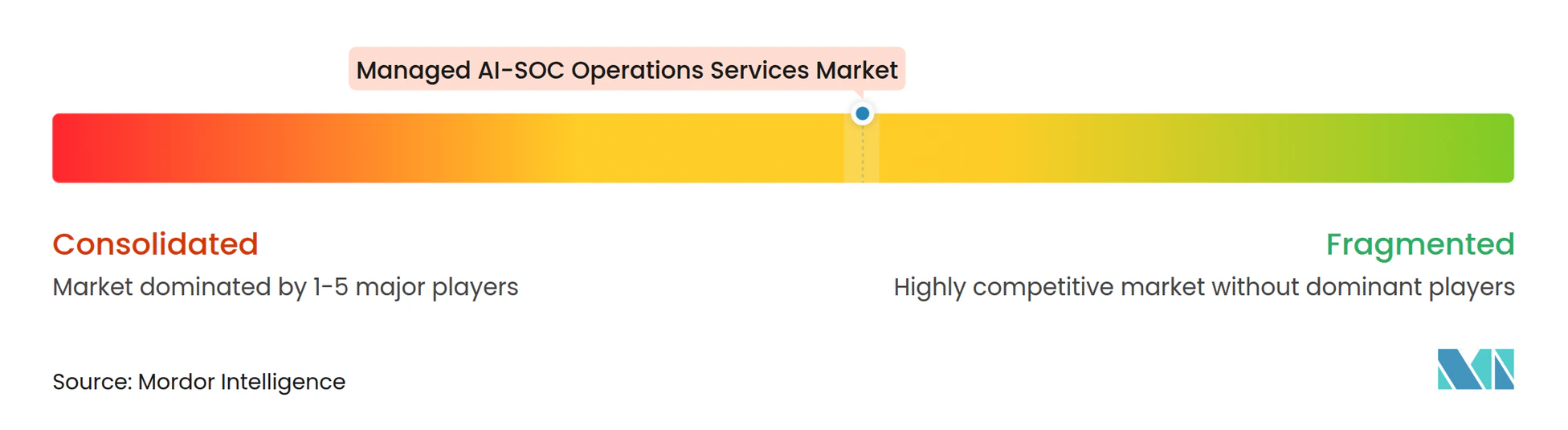
The managed AI-SOC operations services market is moderately concentrated in its upper tier. Hyperscale technology vendors, global consulting groups, and specialist managed detection and response providers compete for large enterprise contracts. A wider group of regional managed security service providers and AI-native entrants serves mid-market and SME buyers. Platform consolidation is a key strategy because clients increasingly expect integrated detection, investigation, response, and governance capabilities. Providers must also demonstrate that their service can operate across endpoint, identity, cloud, and on-premises environments.
CrowdStrike and IBM expanded their collaboration in March 2026 to integrate Charlotte AI with IBM's Autonomous Threat Operations Machine for machine-speed investigation and containment. Palo Alto Networks launched Cortex AgentiX in October 2025 as an AI orchestration platform with prebuilt agents for security workflows. CrowdStrike also signed an agreement to acquire Pangea in September 2025 to add security for enterprise AI data, models, agents, identities, and interactions. These moves show how leading providers are broadening their platforms rather than selling standalone tools. The competitive baseline is shifting toward AI-supported operations with clear safeguards, rather than AI features in isolation.
Opportunities remain in SME subscription delivery, on-premises services for sovereignty-constrained buyers, and vertical workflows for healthcare and operational technology settings. Smaller providers can compete by offering greater integration flexibility and sector expertise where larger platforms do not offer sufficient customization. Compliance with DORA, NIS2, and FedRAMP can raise barriers to entry in regulated national markets. Local legal presence, data residency capabilities, and documented operating controls become part of the service offer in those markets. This narrows the supplier field for high-regulation contracts while leaving room for new providers in the broader global market. The managed AI-SOC operations services market therefore combines a concentrated enterprise tier with a more fragmented set of regional and specialized providers.
Managed AI-SOC Operations Services Industry Leaders
-
IBM Corporation
-
Microsoft Corporation
-
Palo Alto Networks, Inc.
-
CrowdStrike Holdings, Inc.
-
NTT DATA Group
- *Disclaimer: Major Players sorted in no particular order
Managed AI-SOC Operations Services Market Companies Covered in this Report
- IBM Corporation
- Microsoft Corporation
- Palo Alto Networks, Inc.
- CrowdStrike Holdings, Inc.
- NTT DATA Group Corporation
- Accenture plc
- Cisco Systems, Inc.
- Google LLC
- International Business Machines Corporation
- Fortinet, Inc.
- Broadcom Inc.
- SentinelOne, Inc.
- Arctic Wolf Networks, Inc.
- Rapid7, Inc.
- Sophos Limited
- eSentire, Inc.
- Secureworks Corp.
- Trustwave Holdings, Inc.
- Orange Cyberdefense
- Capgemini SE
Recent Industry Developments in Managed AI-SOC Operations Services Market
- June 2026: Google LLC launched Google Security Operations in the Google Cloud Seoul Region, providing Korean enterprises in financial services and the public sector with local data residency and AI-powered threat detection aligned with Korea's Financial Services Commission compliance guidelines.
- April 2026: Kyndryl partnered with Finnish telecom provider DNA and Google to launch an AI-enhanced, 24/7 security operations service targeting SMEs. Built on Google Security Operations, the service combines AI-driven detection, automation, and threat intelligence in a managed SOC model designed for small and mid-market organizations.
- March 2026: CrowdStrike Holdings, Inc. and IBM announced an expanded strategic collaboration at RSA 2026 to advance agentic SOC transformation. The collaboration integrates CrowdStrike Charlotte AI with IBM's Autonomous Threat Operations Machine for coordinated, machine-speed investigation and containment across endpoint, identity, and cloud environments, extending the Falcon platform into IBM Consulting's managed Threat Detection and Response services and X-Force Cyber Range crisis simulation experiences.
- February 2026: Arctic Wolf Networks, Inc. launched Aurora Managed Endpoint Defense for MSPs, extending its AI-powered Aurora Platform to managed service providers with a channel-native delivery model that adds managed endpoint detection and response to the Aurora ecosystem.
Global Managed AI-SOC Operations Services Market Report Scope
The Managed AI-SOC Operations Services Market comprises outsourced, AI-augmented security operations services in which a provider delivers 24/7 threat monitoring, detection, alert triage, incident investigation, and response using AI/ML, generative AI, SOAR, and agentic AI capabilities.
The Managed AI-SOC Operations Services Market Report is Segmented by Offering (AI-Augmented MDR, AI SOC-as-a-Service, Managed Incident Response, Managed Threat Intelligence, Managed SIEM, and Managed SOAR), SOC Function (Threat Detection and Monitoring, Alert Triage and Prioritization, Incident Investigation and Analysis, Threat Hunting, Incident Response and Remediation, Cloud Security Monitoring, and Identity and Access Monitoring), Architecture Model (SIEM-Embedded AI Agents, AI-Native Investigation Platforms, Multi-Agent Mesh and Hyperautomation Platforms, and Hybrid Human-AI SOC Models), Deployment Model (Public Cloud, Private Cloud, Hybrid Cloud, and On-Premises and Air-Gapped), Organization Size (SME, and Large Enterprise), End-User Industry (BFSI, Government, Healthcare, IT and Telecom, Manufacturing, and Retail), and Geography (North America, South America, Europe, Asia-Pacific, and Middle East and Africa). The Market Forecasts are Provided in Terms of Value (USD).
Segmentation Overview
| AI-Augmented Managed Detection and Response |
| AI SOC-as-a-Service |
| Managed Incident Response and Forensics |
| Managed Threat Intelligence and Advisory Services |
| Managed Security Information and Event Management |
| Managed Security Orchestration, Automation, and Response |
| Threat Detection and Monitoring |
| Alert Triage and Prioritization |
| Incident Investigation and Analysis |
| Threat Hunting |
| Incident Response and Remediation |
| Cloud Security Monitoring |
| Identity and Access Monitoring |
| SIEM-Embedded AI Agents |
| AI-Native Investigation Platforms |
| Multi-Agent Mesh and Hyperautomation Platforms |
| Hybrid Human-AI SOC Models |
| Public Cloud |
| Private Cloud |
| Hybrid Cloud |
| On-Premises and Air-Gapped |
| Small and Medium-Sized Enterprises |
| Large Enterprises |
| Banking, Financial Services, and Insurance |
| Government and Defense |
| Healthcare and Life Sciences |
| Information Technology and Telecommunications |
| Manufacturing |
| Retail and E-Commerce |
| Other End-User Industries |
| North America | United States |
| Canada | |
| Mexico | |
| South America | Brazil |
| Argentina | |
| Rest of South America | |
| Europe | United Kingdom |
| Germany | |
| France | |
| Italy | |
| Spain | |
| Rest of Europe | |
| Asia-Pacific | China |
| Japan | |
| India | |
| South Korea | |
| Rest of Asia-Pacific | |
| Middle East and Africa | Saudi Arabia |
| United Arab Emirates | |
| South Africa | |
| Egypt | |
| Rest of Middle East and Africa |
| By Offering | AI-Augmented Managed Detection and Response | |
| AI SOC-as-a-Service | ||
| Managed Incident Response and Forensics | ||
| Managed Threat Intelligence and Advisory Services | ||
| Managed Security Information and Event Management | ||
| Managed Security Orchestration, Automation, and Response | ||
| By SOC Function | Threat Detection and Monitoring | |
| Alert Triage and Prioritization | ||
| Incident Investigation and Analysis | ||
| Threat Hunting | ||
| Incident Response and Remediation | ||
| Cloud Security Monitoring | ||
| Identity and Access Monitoring | ||
| By Architecture Model | SIEM-Embedded AI Agents | |
| AI-Native Investigation Platforms | ||
| Multi-Agent Mesh and Hyperautomation Platforms | ||
| Hybrid Human-AI SOC Models | ||
| By Deployment Model | Public Cloud | |
| Private Cloud | ||
| Hybrid Cloud | ||
| On-Premises and Air-Gapped | ||
| By Organization Size | Small and Medium-Sized Enterprises | |
| Large Enterprises | ||
| By End-User Industry | Banking, Financial Services, and Insurance | |
| Government and Defense | ||
| Healthcare and Life Sciences | ||
| Information Technology and Telecommunications | ||
| Manufacturing | ||
| Retail and E-Commerce | ||
| Other End-User Industries | ||
| By Geography | North America | United States |
| Canada | ||
| Mexico | ||
| South America | Brazil | |
| Argentina | ||
| Rest of South America | ||
| Europe | United Kingdom | |
| Germany | ||
| France | ||
| Italy | ||
| Spain | ||
| Rest of Europe | ||
| Asia-Pacific | China | |
| Japan | ||
| India | ||
| South Korea | ||
| Rest of Asia-Pacific | ||
| Middle East and Africa | Saudi Arabia | |
| United Arab Emirates | ||
| South Africa | ||
| Egypt | ||
| Rest of Middle East and Africa | ||
Key Questions Answered in the Report
What is the managed AI-SOC operations services market size?
The managed AI-SOC operations services market is projected to rise from USD 8.52 billion in 2026 and USD 10.44 billion in 2027 to USD 26.38 billion by 2032, at a 20.37% CAGR.
What is driving adoption of managed AI-SOC services?
Multi-vector attacks, cybersecurity skills shortages, cloud complexity, and shorter incident reporting windows are supporting adoption.
Which offering leads managed AI-SOC operations services?
AI-Augmented Managed Detection and Response leads with a 39.84% revenue share in 2026.
Which deployment model has the highest share?
Hybrid Cloud leads with 49.88% of revenue in 2026, reflecting the mix of cloud and on-premises systems used by enterprises.
Which end-user sector has the fastest projected expansion?
Healthcare and Life Sciences is projected to expand at a 21.98% CAGR through 2032.
Which region is expanding fastest?
Asia-Pacific is projected to expand at a 21.09% CAGR through 2032, supported by digitalization and local data residency requirements.