
Managed Industrial SOC Services Market Size and Share
Market Overview
| Study Period | 2021 - 2032 |
|---|---|
| Market Size (2027) | USD 3.34 Billion |
| Market Size (2032) | USD 7.03 Billion |
| Growth Rate (2027 - 2032) | 16.25 % |
| Fastest Growing Market | Asia-Pacific |
| Largest Market | North America |
| Market Concentration | Medium |
Major Players *Disclaimer: Major Players sorted in no particular order Image © Mordor Intelligence. Reuse requires attribution under CC BY 4.0. | |
Managed Industrial SOC Services Market Analysis by Mordor Intelligence
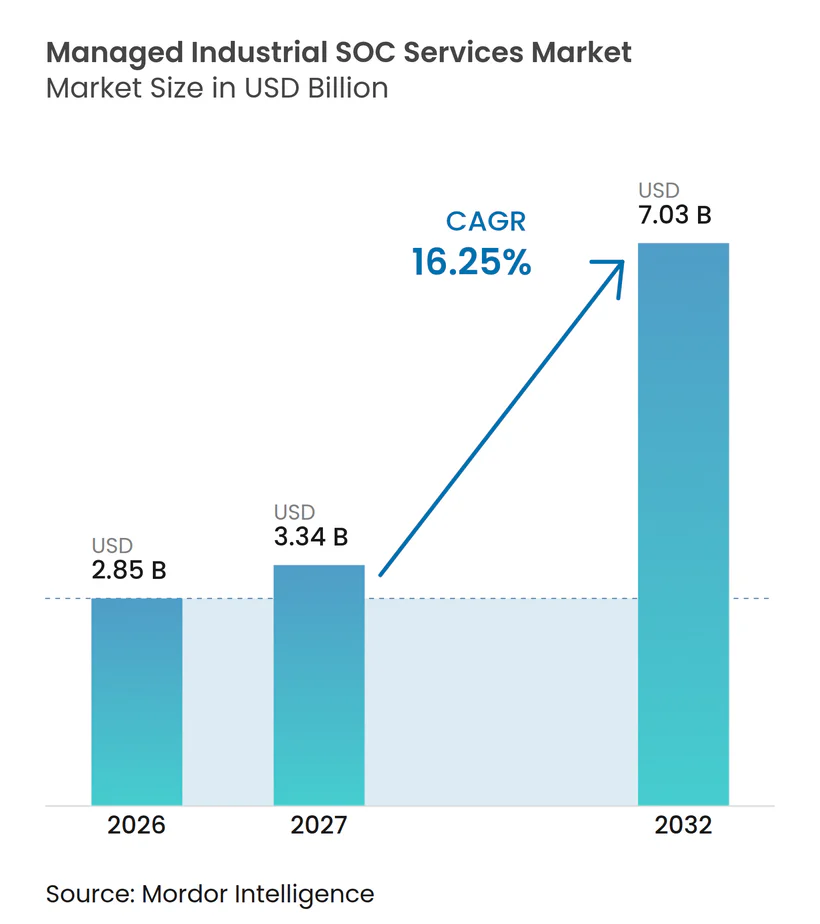
The managed industrial SOC services market size stood at USD 2.85 billion in 2026 and is expected to reach USD 7.03 billion by 2032 at a CAGR of 16.25% during 2027-2032. The managed industrial SOC services market is benefiting from the connection of corporate networks with operational systems, which has increased the need for continuous visibility across plants, utilities, and transport networks. Ransomware activity and longer attack dwell times are moving security decisions beyond corporate IT teams and toward plant leaders and boards. Regulatory obligations are also making documented monitoring and incident response necessary for many operators. Providers that combine OT-aware technology with managed response services can address both compliance needs and operational risk. The managed industrial SOC services market also has room to expand as industrial operators connect more assets through IIoT and cloud platforms.
Key Report Takeaways
- By service type, Managed Security Monitoring held 27.37% of the managed industrial SOC services market share in 2026, while Managed Detection and Response is projected to expand at a 17.34% CAGR through 2032.
- By offering, Service-Only Offering held 33.53% of the 2026 market, while Platform-Enabled Managed Service is projected to expand at a 17.64% CAGR through 2032.
- By industry vertical, Energy and Utilities accounted for 24.56% of the managed industrial SOC services market share in 2026, while Transportation and Logistics is projected to expand at a 17.87% CAGR through 2032.
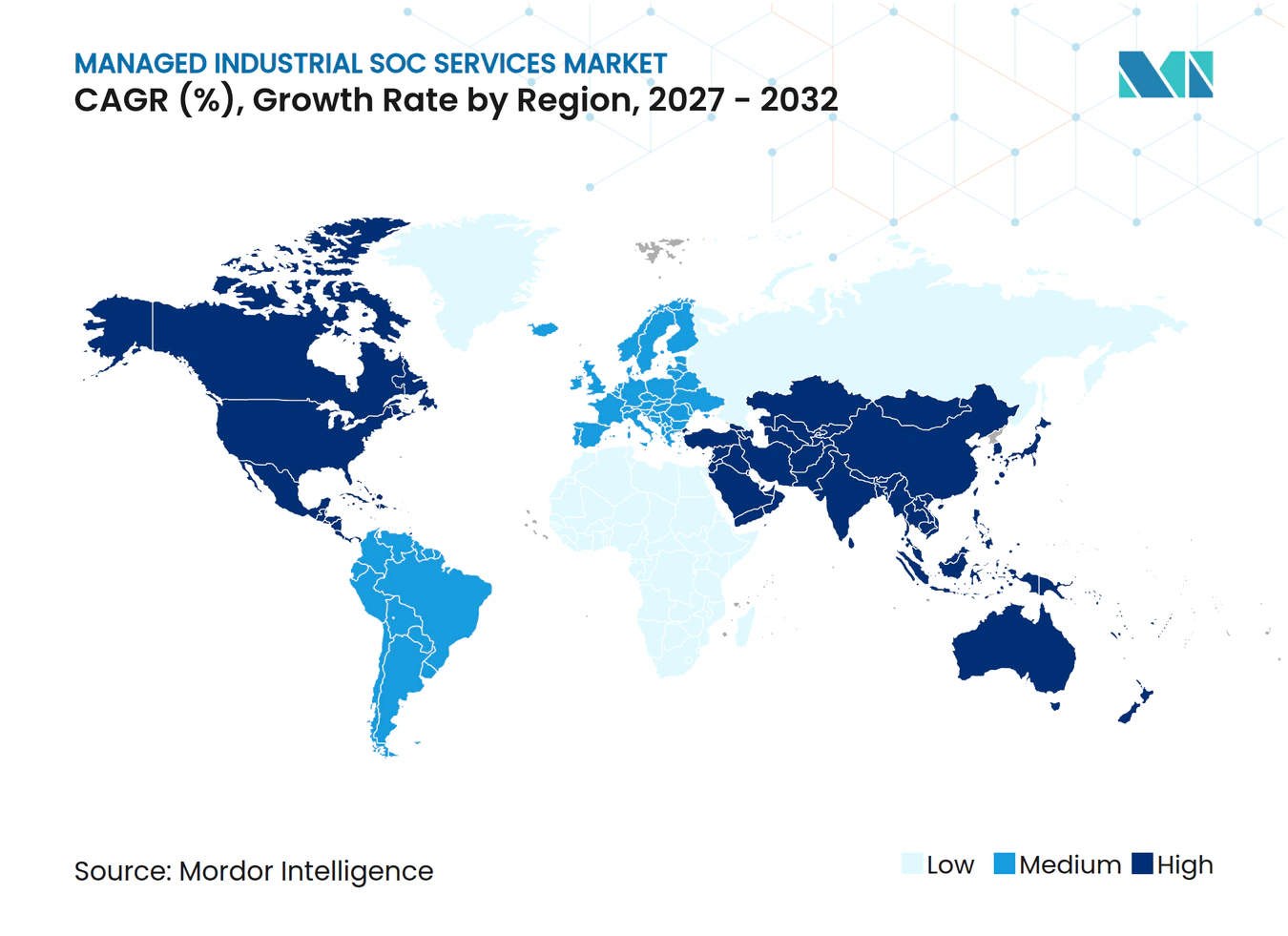
- By geography, North America held 37.89% of the 2026 market, while Asia-Pacific is projected to expand at a 17.73% CAGR through 2032.
Note: Market numbers in this report are based on Mordor Intelligence's proprietary estimation framework, which combines nine months of actuals with Q4 projections for base year 2026.
Market Trends and Insights
Drivers Impact Analysis of Managed Industrial SOC Services Market*
| Driver | (~) % Impact on CAGR Forecast | Geographic Relevance | Impact Timeline |
|---|---|---|---|
| IT/OT Convergence Expanding Attack Surfaces | +3.2% | Global, concentrated in North America, Germany, and Japan | Long term (≥ 4 years) |
| Escalating Ransomware Against Critical Infrastructure | +2.8% | Global, North America and Europe most affected | Short term (≤ 2 years) |
| Tightening OT Cybersecurity Regulation | +2.4% | North America and Europe core, with spillover to Asia-Pacific and the Middle East | Medium term (2-4 years) |
| Industrial Digitalization and IIoT Adoption | +2.0% | Asia-Pacific core, with spillover to South America and Africa | Long term (≥ 4 years) |
| Safety-Critical Change Windows Driving Always-On External Monitoring | +1.2% | Global, concentrated in Energy and Utilities, Oil and Gas, and Process Manufacturing | Medium term (2-4 years) |
| Insurer and Lender Evidence Requirements for Plant-Level Controls | +0.9% | North America and Europe, with early uptake in Australia and Singapore | Short term (≤ 2 years) |
| Source: Mordor Intelligence | |||
IT/OT Convergence Expanding Attack Surfaces
The integration of enterprise networks with plant systems is changing industrial cyber exposure. A 2025 academic study described IT and OT integration as a major shift in manufacturing and identified cybersecurity as one of the connected challenges that operators must manage. Marlink reported that 60% of assessed industrial sites used shared IT and OT infrastructure in 2025. More than 70% had undocumented or weakly secured connections between these environments, while 30-40% of OT assets were initially unknown or unmanaged. The same assessment found that compromised user credentials accounted for 69% of observed risks, so network anomaly monitoring alone can miss a major entry route. The managed industrial SOC services market can address this gap by combining asset visibility, identity monitoring, and protocol-aware detection across connected industrial environments.
Escalating Ransomware Against Critical Infrastructure
Ransomware is increasing the operational urgency of industrial cyber monitoring. Dragos recorded 1,140 ransomware incidents affecting industrial organizations in the second quarter of 2026, up 12% from the first quarter, and manufacturing accounted for 65% of victims. Transportation and logistics ranked third in the same analysis with 95 incidents. Dragos also reported a 42-day average dwell time for OT ransomware, which shows why alerting without investigation and response can leave industrial sites exposed. IBM found that OT-impacting cyber incidents averaged USD 4.56 million in cost and that 49% of OT-relevant vulnerabilities disclosed in the first half of 2025 had critical or high severity ratings. These conditions support demand in the managed industrial SOC services market for services that can link enterprise and plant telemetry and guide containment.
Tightening OT Cybersecurity Regulation
Industrial cybersecurity rules are moving from guidance toward enforceable obligations. ENISA published technical implementation guidance for the EU NIS2 Directive in June 2025, covering continuous monitoring, documented incident response, and reporting timelines of 24-72 hours. These requirements can be difficult for mid-sized industrial operators to meet with internal teams alone. The managed industrial SOC services market is therefore supported by the need for continuous coverage and documented evidence that can stand up to regulatory review. SANS reported that regulated industrial sites experienced 50% fewer financial and safety impacts from OT incidents than unregulated peers. ISA/IEC 62443 is also becoming more important in third-party service assessments, which raises the value of providers that can demonstrate alignment with established industrial security practices.
Industrial Digitalization and IIoT Adoption
Industrial IoT sensors, edge devices, and cloud-connected control systems are increasing the number of assets that require monitoring. CISA updated an advisory in July 2026 on Iranian-affiliated actors exploiting internet-connected programmable logic controllers from Rockwell Automation, Schneider Electric, and Siemens.[1]The advisory shows that newly connected OT equipment can create exposure across energy, water, and government facilities. The managed industrial SOC services market benefits because every new connected asset expands the scope of monitoring and response that operators require. Providers can improve service delivery by automatically identifying OT devices as they connect instead of relying on periodic manual asset surveys. This approach can increase coverage while reducing the operational burden placed on plant engineering teams.
Restraints Impact Analysis of Managed Industrial SOC Services Market*
| Restraint | (~) % Impact on CAGR Forecast | Geographic Relevance | Impact Timeline |
|---|---|---|---|
| Shortage of OT-Savvy Cybersecurity Talent | -2.1% | Global, most acute in North America and Europe | Long term (≥ 4 years) |
| Legacy Protocols and Unpatchable Assets | -1.5% | Global, concentrated in Energy, Oil and Gas, Process Manufacturing, and Mining | Long term (≥ 4 years) |
| Passive-Only Monitoring Limits Active Containment | -0.9% | Global | Medium term (2-4 years) |
| Procurement Ownership Split Between Plant Engineering and Corporate Security | -0.7% | North America and Europe, less pronounced in Asia-Pacific | Medium term (2-4 years) |
| Source: Mordor Intelligence | |||
Shortage of OT-Savvy Cybersecurity Talent
The shortage of personnel with both cybersecurity and industrial control knowledge constrains service capacity. CREST found that 85% of respondents saw skills shortages as limiting service quality and consistency, while 76% cited specialist personnel as the largest barrier to entering OT and ICS cybersecurity services.[2] EPRI reported that OT cybersecurity vacancies can take 4-9 months to fill even when budgets are available. SANS also found in 2026 that 60% of organizations lacked skills needed to address current threats, and 27% reported breaches tied to capability gaps. The issue affects operators that want to build internal teams and providers that need to add experienced analysts. The managed industrial SOC services market is responding through platform-enabled delivery, where automated correlation and focused workflows can help skilled personnel support more clients.
Legacy Protocols and Unpatchable Assets
Many industrial control systems rely on protocols that were not designed with modern security controls. Modbus, DNP3, PROFIBUS, and IEC 61850 may lack native authentication, encryption, or integrity verification. Plant operators often cannot patch or upgrade these systems without creating operational and safety concerns. IBM found that 1 in 5 critical OT vulnerabilities disclosed in the first half of 2025 had publicly available exploit code.[3] This creates a gap between the urgency of disclosed risk and the ability to remediate it quickly. The managed industrial SOC services market can provide compensating controls, including segmentation, unidirectional gateways, zone-based access control, and monitoring designs aligned with ISA/IEC 62443.
*Our forecasts treat driver/restraint impacts as directional, not additive. The impact forecasts reflect baseline growth, mix effects, and variable interactions.
Managed Industrial SOC Services Market Segment Analysis
By Service Type:
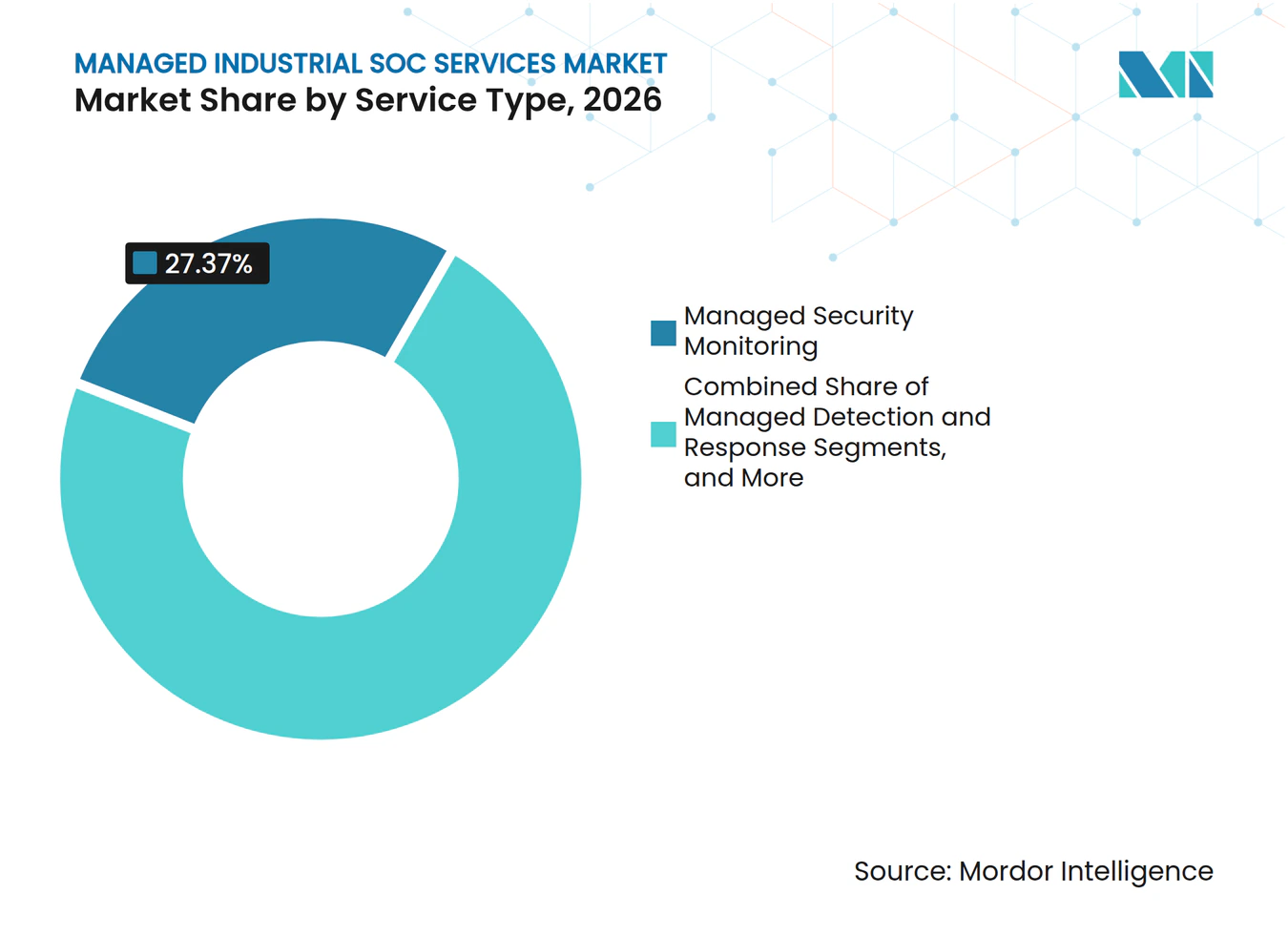
Managed Detection and Response Gains Importance Alongside MonitoringManaged Security Monitoring accounted for 27.37% of the market in 2026, making it the leading service type and the usual starting point for industrial operators. It provides the continuous visibility needed to identify unusual activity across operational networks. Managed Detection and Response is projected to record a 17.34% CAGR through 2032. This service brings together detection, investigation, triage, and coordinated response for clients that need more than alert logs. Dragos reported a 42-day average OT ransomware dwell time, which reinforces the need for a structured response process alongside monitoring.
Threat hunting and threat intelligence services are relevant for energy, oil and gas, and defense-linked industrial users that face persistent state-linked threats. Dragos identified 3 new OT threat groups in its 2026 report, supporting the case for proactive adversary tracking. Compliance monitoring and reporting are gaining importance in North America and Europe as operators need records for regulatory review. In the managed industrial SOC services market, vulnerability and exposure management is becoming more relevant as IIoT adoption increases OT asset inventories. Incident response and recovery support is commonly retained by organizations that need tested readiness and faster containment after a major event.



By Offering:
Platform-Enabled Services Address Delivery Capacity ConstraintsService-Only Offering held 33.53% of the market in 2026, reflecting its accessibility for operators beginning OT security outsourcing. Platform-Enabled Managed Service is projected to record a 17.64% CAGR through 2032. This model brings purpose-built technology into the managed service delivery process. Platforms that read Modbus, DNP3, and IEC 61850 can provide better industrial context than IT tools that only ingest OT syslog data. Automated correlation also helps reduce the analyst effort required for each alert.
Darktrace launched a unified OT security platform in September 2025 with OT engineer dashboards, segmentation-aware risk modeling, and NEXT-generation endpoint telemetry for industrial teams. The announcement illustrates why platform capability is becoming an important basis for competition in the managed industrial SOC services market. Integrated solution and service offerings appeal to buyers that prefer a single provider for technology and operations. Incident-response retainers help organizations document readiness for audit and response planning. Staff augmentation and OT analyst support remain relevant for operators with internal security programs that need specialist expertise during specific threats or audit cycles.
By Industry Vertical:
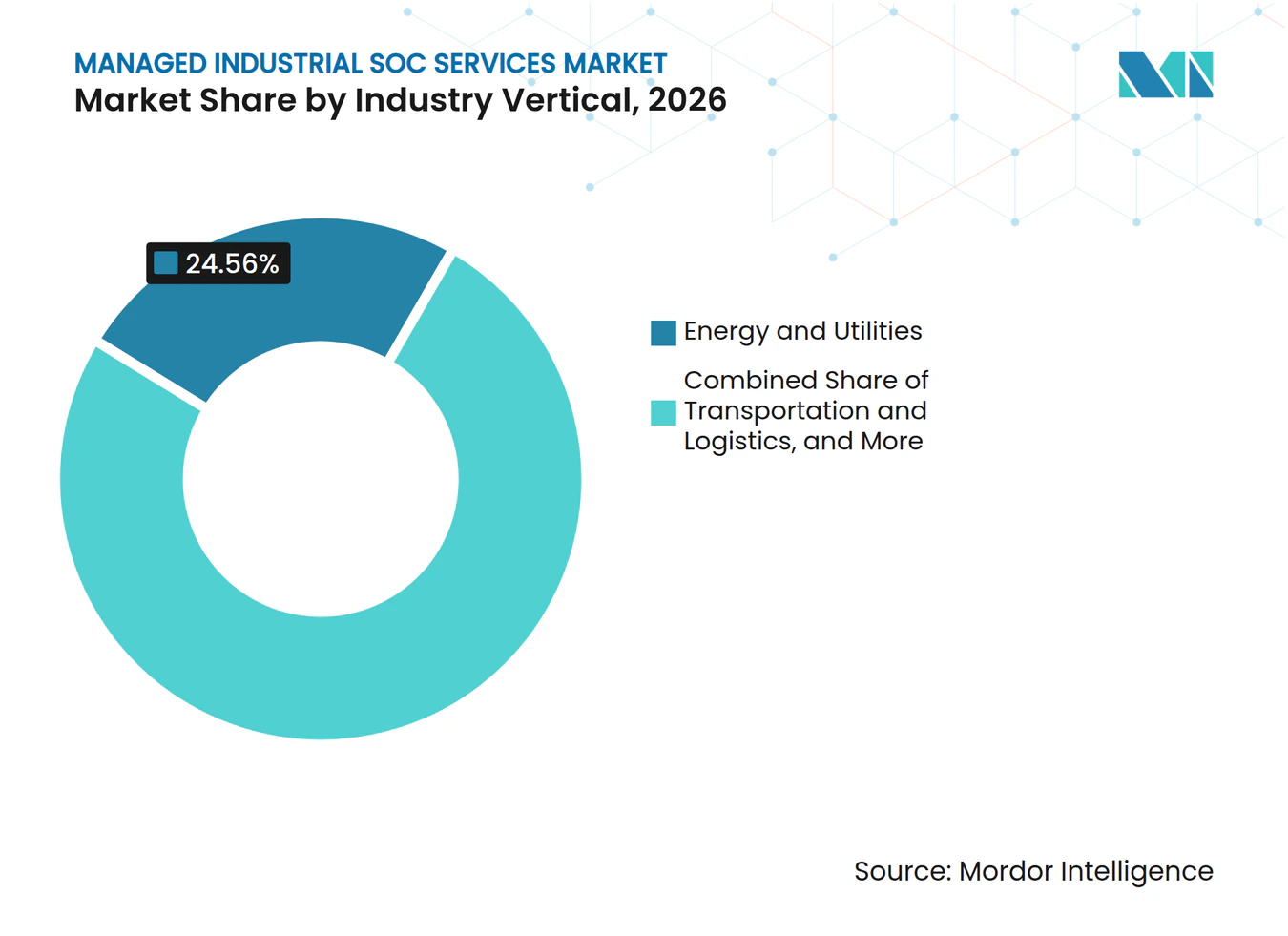
Transportation and Logistics Presents the Fastest Expansion OpportunityEnergy and Utilities commanded 24.56% of the market in 2026, supported by its critical-asset concentration and long-standing regulatory obligations. Transportation and Logistics is projected to record a 17.87% CAGR through 2032. Cyber incidents targeting logistics operators rose 61% in 2025 and were projected to double in 2026, raising concern across ports, rail systems, and fleet telematics networks. A Kaspersky and VDC Research study found that more than two-thirds of transportation and logistics organizations planned to achieve full digital operations within 2 years. The same study identified cybersecurity concerns as the leading barrier to those digital plans.
Energy and Utilities remains a large buyer group because grid disruption can have significant physical consequences and continuous monitoring is an established control. Oil and Gas demand is supported by pipeline cybersecurity requirements. In the managed industrial SOC services market, Discrete Manufacturing, Process Manufacturing, Mining and Metals, and Pharmaceuticals and Life Sciences are also important user groups as ransomware risks and ISA/IEC 62443 requirements encourage initial procurement. Connected manufacturing systems in pharmaceuticals create compliance-led demand that resembles the earlier regulatory path in energy. These verticals give providers opportunities to tailor monitoring, evidence reporting, and response services to specific operational settings.

Geography Analysis
North America Managed Industrial SOC Services Market
North America held 37.89% of the market in 2026, making it the largest regional market. Sector-specific requirements for pipelines, electric power, and transportation have created a need for continuous monitoring that many operators cannot staff internally. Dragos reported that the United States accounted for 38% of global industrial ransomware incidents in the second quarter of 2026, while SANS found that 58% of North American respondents identified IT-to-OT lateral compromise as the leading initial attack vector. Canada adds demand from energy and mining operators, while Mexico is entering a more formal phase of OT security procurement in automotive and electronics manufacturing.
Europe and South America Managed Industrial SOC Services Market
Europe is the second-largest regional market in 2026, with Germany and the United Kingdom serving as major industrial demand centers. Dragos recorded the sharpest quarter-to-quarter incident increase in Germany, from 37 incidents in the first quarter of 2026 to 68 in the second quarter. In the managed industrial SOC services market, NIS2 is supporting demand because it requires continuous monitoring, incident documentation, and reporting timelines. ENISA guidance places responsibility at the board level, and France, Italy, and Spain are seeing greater procurement urgency as national implementation progresses. Brazil is the main South American demand center, especially in electricity and oil and gas, although budget sensitivity and less mature regulation constrain adoption.
APAC and MEA Managed Industrial SOC Services Market
Asia-Pacific is projected to record a 17.73% CAGR through 2032, making it the fastest-expanding geography in the managed industrial SOC services market. China, South Korea, and India combine manufacturing scale, growing connectivity, and increasing exposure to cyber threats. Mitsubishi Electric agreed to acquire Nozomi Networks for USD 883 million in September 2025, signaling confidence in industrial cyber demand across the region. Singapore and Australia act as regulatory anchors for neighboring markets. The Middle East maintains demand from oil and gas operators in Saudi Arabia and the UAE, while African adoption remains earlier stage in mining, oil and gas, and utilities.
Competitive Landscape
Market Concentration
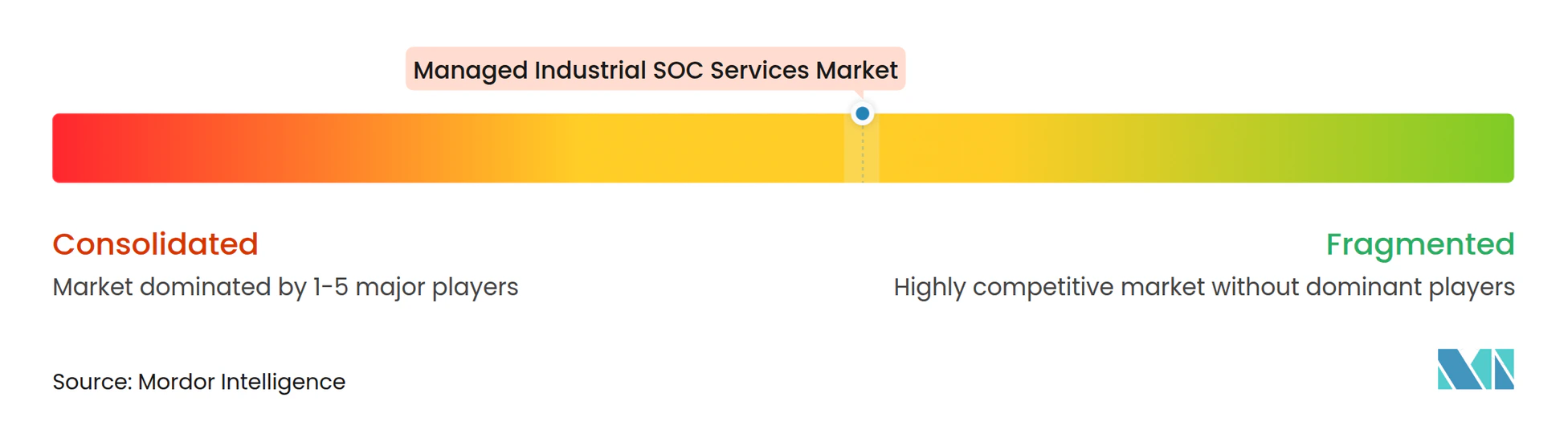
The managed industrial SOC services market is moderately concentrated, with OT-focused providers holding important platform recognition and diversified security companies supplying managed layers around OT-capable tools. Accenture agreed in June 2026 to acquire a majority stake in Dragos and all of runZero and NetRise for a combined enterprise value of USD 4.175 billion. The transaction shows that larger services firms view industrial managed security as an important area for expansion and brings together threat detection, attack-surface intelligence, and firmware-level supply-chain visibility. Independent OT specialists face a narrower window to establish durable positions before larger technology and services groups expand through acquisitions or partnerships.
Claroty secured USD 150 million in Series F funding in January 2026, and the financing raised its valuation by 80% from March 2024. Its funding supports the view that pure-play cyber-physical systems platforms remain strategically valuable. Mitsubishi Electric's planned Nozomi acquisition is another example of industrial technology companies adding OT security capability through transactions. TXOne Networks introduced vEdgeIPS Pro in September 2026, using closed-loop AI automation that it said reduces OT policy deployment effort by more than 90%. These moves show competition in the managed industrial SOC services market is focusing on automation, asset intelligence, and technology that can work in industrial settings.
The mid-market has meaningful unmet demand in Discrete Manufacturing, Process Manufacturing, and Mining and Metals. Providers that package services around ISA/IEC 62443 evidence and insurer control requirements can shorten approval processes by addressing both plant and corporate security needs. The managed industrial SOC services market rewards providers that can produce audit-ready outputs without extensive manual work. This capability can support higher pricing and increase switching costs after the initial compliance cycle. Service providers also need to balance technology automation with OT expertise because plant assets and safety processes limit the use of fully automated containment.
Managed Industrial SOC Services Industry Leaders
-
Dragos, Inc.
-
Claroty Ltd.
-
Nozomi Networks Inc.
-
TXOne Networks Inc.
-
Forescout Technologies, Inc.
- *Disclaimer: Major Players sorted in no particular order
Managed Industrial SOC Services Market Companies Covered in this Report
- Dragos, Inc.
- Claroty Ltd.
- Nozomi Networks Inc.
- TXOne Networks Inc.
- Radiflow Ltd.
- Waterfall Security Solutions Ltd.
- Mission Secure, Inc.
- Verve Industrial Protection, Inc.
- Industrial Defender, Inc.
- Armexa, Inc.
- Applied Risk B.V.
- Xage Security, Inc.
- Owl Cyber Defense Solutions, LLC
- Cyberbit Ltd.
- Stellar Cyber, Inc.
- Forescout Technologies, Inc.
- Tenable Holdings, Inc.
- Armis, Inc.
- Darktrace Holdings plc
- OPSWAT, Inc.
Recent Industry Developments in Managed Industrial SOC Services Market
- October 2026: CISA, the FBI, the U.S. Secret Service, and international partners issued a joint Cybersecurity Advisory warning that SafePay ransomware actors have impacted approximately 600 victims across the Americas, Europe, and Australia in 2026, targeting internet-facing devices with credential-based access pathways. The advisory highlights sustained criminal ransomware pressure on industrial operators and reinforces the business case for managed monitoring with around-the-clock alert triage.
- September 2026: TXOne Networks launched its next-generation Edge release at SEMICON Taiwan, introducing vEdgeIPS Pro virtual appliances and closed-loop AI automation that reduces OT policy deployment effort by more than 90%. The release extends TXOne's inline, fail-safe protection from physical hardware to virtualized OT infrastructure, enabling managed service providers to deploy protection in software-defined industrial environments without hardware refresh cycles.
- July 2026: CISA updated its April 2026 advisory on Iranian-affiliated cyber actors exploiting internet-connected PLCs across U.S. critical infrastructure sectors, expanding scope to include Schneider Electric and Siemens devices alongside Rockwell Automation products and adding new guidance on detecting malicious changes in reusable PLC code modules. The expanded advisory escalates the multi-vendor supply-base risk profile for managed SOC providers serving energy, water, and government facility operators.
- June 2026: Accenture announced agreements to acquire a majority stake in Dragos and 100% of runZero and NetRise for a combined enterprise value of USD 4.175 billion. The deal, expected to close in August or September 2026, creates an integrated OT security software-plus-services platform combining Dragos's threat detection with attack-surface intelligence and firmware-level supply-chain visibility, and establishes a new competitive benchmark for scale in the managed industrial SOC services market.
Global Managed Industrial SOC Services Market Report Scope
The Managed Industrial SOC (Security Operations Center) Services Market refers to the specialized cybersecurity services sector that delivers outsourced, continuous monitoring, detection, investigation, threat hunting, incident response, and security management for industrial environments, including operational technology (OT), industrial control systems (ICS), SCADA networks, manufacturing facilities, energy plants, utilities, transportation infrastructure, and other critical industrial assets.
The Managed Industrial SOC Services Market Report is Segmented by Service Type (Managed Security Monitoring, Managed Detection and Response, Threat Hunting and Threat Intelligence, Incident Response and Recovery Support, Compliance Monitoring and Reporting, and Vulnerability and Exposure Management), Offering (Service-Only Offering, Platform-Enabled Managed Service, Integrated Solution and Service Offering, Incident-Response Retainer, and Staff Augmentation and OT Analyst Support), Industry Vertical (Energy and Utilities, Oil and Gas, Discrete Manufacturing, Process Manufacturing, Mining and Metals, Transportation and Logistics, Pharmaceuticals and Life Sciences, and Other Industry Verticals), and Geography (North America [United States, Canada, and Mexico], South America [Brazil, Argentina, Chile, and Rest of South America], Europe [Germany, United Kingdom, France, Italy, Spain, and Rest of Europe], Asia-Pacific [China, Japan, India, South Korea, Australia, Singapore, Malaysia, and Rest of Asia-Pacific], Middle East [Saudi Arabia, United Arab Emirates, Israel, Turkey, and Rest of Middle East], and Africa [South Africa, Nigeria, Egypt, and Rest of Africa]). The Market Forecasts are Provided in Terms of Value (USD).
Segmentation Overview
| Managed Security Monitoring |
| Managed Detection and Response |
| Threat Hunting and Threat Intelligence |
| Incident Response and Recovery Support |
| Compliance Monitoring and Reporting |
| Vulnerability and Exposure Management |
| Service-Only Offering |
| Platform-Enabled Managed Service |
| Integrated Solution and Service Offering |
| Incident-Response Retainer |
| Staff Augmentation and OT Analyst Support |
| Energy and Utilities |
| Oil and Gas |
| Discrete Manufacturing |
| Process Manufacturing |
| Mining and Metals |
| Transportation and Logistics |
| Pharmaceuticals and Life Sciences |
| Other Industry Verticals |
| North America | United States |
| Canada | |
| Mexico | |
| South America | Brazil |
| Argentina | |
| Chile | |
| Rest of South America | |
| Europe | Germany |
| United Kingdom | |
| France | |
| Italy | |
| Spain | |
| Rest of Europe | |
| Asia-Pacific | China |
| Japan | |
| India | |
| South Korea | |
| Australia | |
| Singapore | |
| Malaysia | |
| Rest of Asia-Pacific | |
| Middle East | Saudi Arabia |
| United Arab Emirates | |
| Israel | |
| Turkey | |
| Rest of Middle East | |
| Africa | South Africa |
| Nigeria | |
| Egypt | |
| Rest of Africa |
| By Service Type | Managed Security Monitoring | |
| Managed Detection and Response | ||
| Threat Hunting and Threat Intelligence | ||
| Incident Response and Recovery Support | ||
| Compliance Monitoring and Reporting | ||
| Vulnerability and Exposure Management | ||
| By Offering | Service-Only Offering | |
| Platform-Enabled Managed Service | ||
| Integrated Solution and Service Offering | ||
| Incident-Response Retainer | ||
| Staff Augmentation and OT Analyst Support | ||
| By Industry Vertical | Energy and Utilities | |
| Oil and Gas | ||
| Discrete Manufacturing | ||
| Process Manufacturing | ||
| Mining and Metals | ||
| Transportation and Logistics | ||
| Pharmaceuticals and Life Sciences | ||
| Other Industry Verticals | ||
| By Geography | North America | United States |
| Canada | ||
| Mexico | ||
| South America | Brazil | |
| Argentina | ||
| Chile | ||
| Rest of South America | ||
| Europe | Germany | |
| United Kingdom | ||
| France | ||
| Italy | ||
| Spain | ||
| Rest of Europe | ||
| Asia-Pacific | China | |
| Japan | ||
| India | ||
| South Korea | ||
| Australia | ||
| Singapore | ||
| Malaysia | ||
| Rest of Asia-Pacific | ||
| Middle East | Saudi Arabia | |
| United Arab Emirates | ||
| Israel | ||
| Turkey | ||
| Rest of Middle East | ||
| Africa | South Africa | |
| Nigeria | ||
| Egypt | ||
| Rest of Africa | ||
Key Questions Answered in the Report
What is the size of the managed industrial SOC services market?
The managed industrial SOC services market size was USD 2.85 billion in 2026 and is expected to reach USD 7.03 billion by 2032, at a 16.25% CAGR during 2027-2032.
What is driving demand for managed industrial SOC services?
IT and OT convergence, ransomware, industrial connectivity, and stricter monitoring and incident-reporting requirements are increasing demand for external OT security operations.
Which service type is expanding fastest?
Managed Detection and Response is projected to expand at a 17.34% CAGR through 2032 as users require investigation and coordinated response alongside monitoring.
Which end-user sector leads managed industrial SOC service adoption?
Energy and Utilities held 24.56% of the market in 2026 because critical assets, regulatory requirements, and operational consequences support continuous monitoring.
Which region has the fastest projected expansion?
Asia-Pacific is projected to expand at a 17.73% CAGR through 2032, supported by industrial digitalization, connected assets, and evolving security requirements.