
Malaysia Box Truck Market Size and Share
Market Overview
| Study Period | 2020 - 2031 |
|---|---|
| Forecast Data Period | 2026 - 2031 |
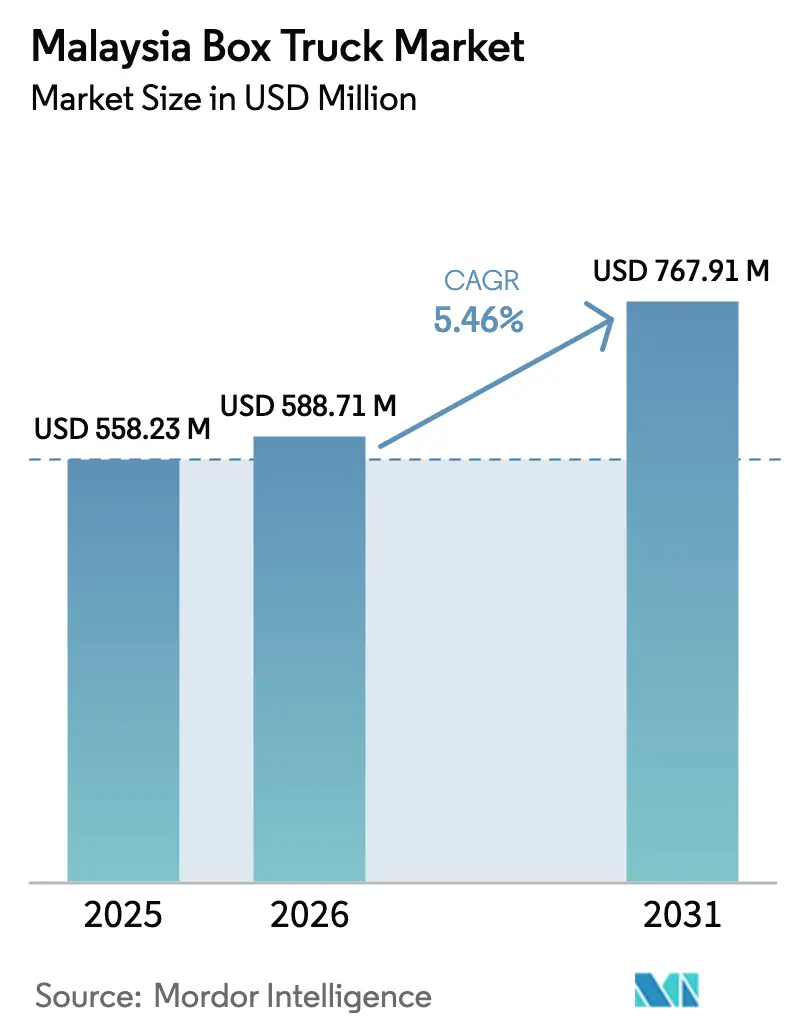
| Base Year Market Size (2025) | USD 558.23 Million |
| Market Size (2026) | USD 588.71 Million |
| Market Size (2031) | USD 767.91 Million |
| Growth Rate (2026 - 2031) | 5.46 % |
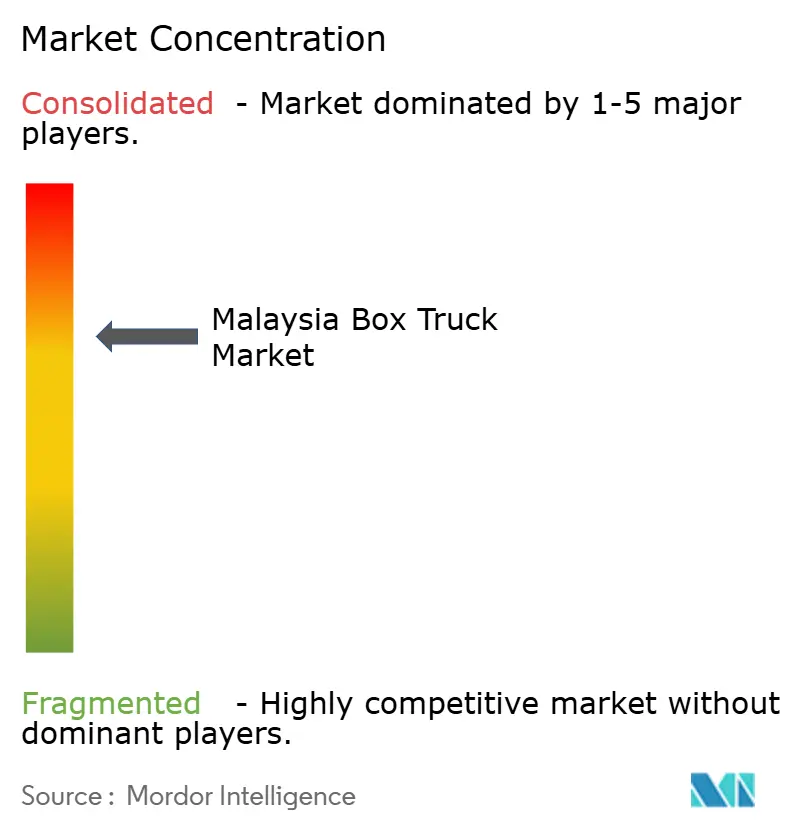
| Market Concentration | Medium |
Major Players *Disclaimer: Major Players sorted in no particular order Image © Mordor Intelligence. Reuse requires attribution under CC BY 4.0. | |
Malaysia Box Truck Market Analysis by Mordor Intelligence
Malaysia box truck market size in 2026 is estimated at USD 588.71 million, growing from 2025 value of USD 558.23 million with 2031 projections showing USD 767.91 million, growing at 5.46% CAGR over 2026-2031. Resilient demand stems from e-commerce growth, infrastructure upgrades, and stricter emissions regulations, which collectively offset near-term headwinds from the removal of diesel subsidies, higher financing costs, and foreign exchange volatility. Light-duty vehicles designed for last-mile delivery are driving new registrations, while refrigerated bodies are gaining traction as cold-chain standards become increasingly stringent. Fleet operators are also refreshing assets to meet Euro VI timelines and to hedge against volatile diesel prices by piloting electric variants. At the same time, the market benefits from federal grants that subsidize automation and telematics, allowing logistics firms to enhance route planning and improve fuel efficiency.
Key Report Takeaways
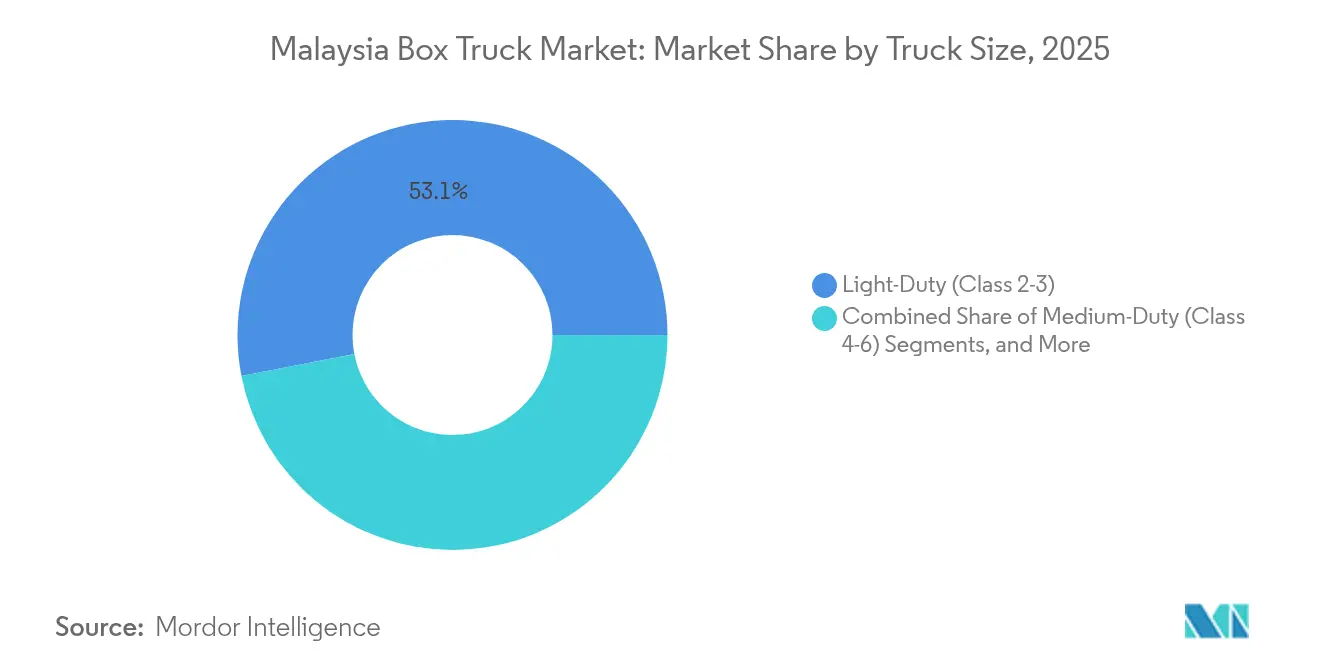
- By truck size, light-duty units captured 53.05% of Malaysia's box truck market share in 2025 and posted the fastest growth, at a 5.78% CAGR, through 2031.
- By fuel type, diesel accounted for 85.62% of Malaysia's box truck market share in 2025, while electric variants led expansion at a 6.04% CAGR through 2031.
- By body type, dry freight boxes held a 58.55% of Malaysia's box truck market share in 2025, and refrigerated boxes are expected to advance at a 5.59% CAGR through 2031.
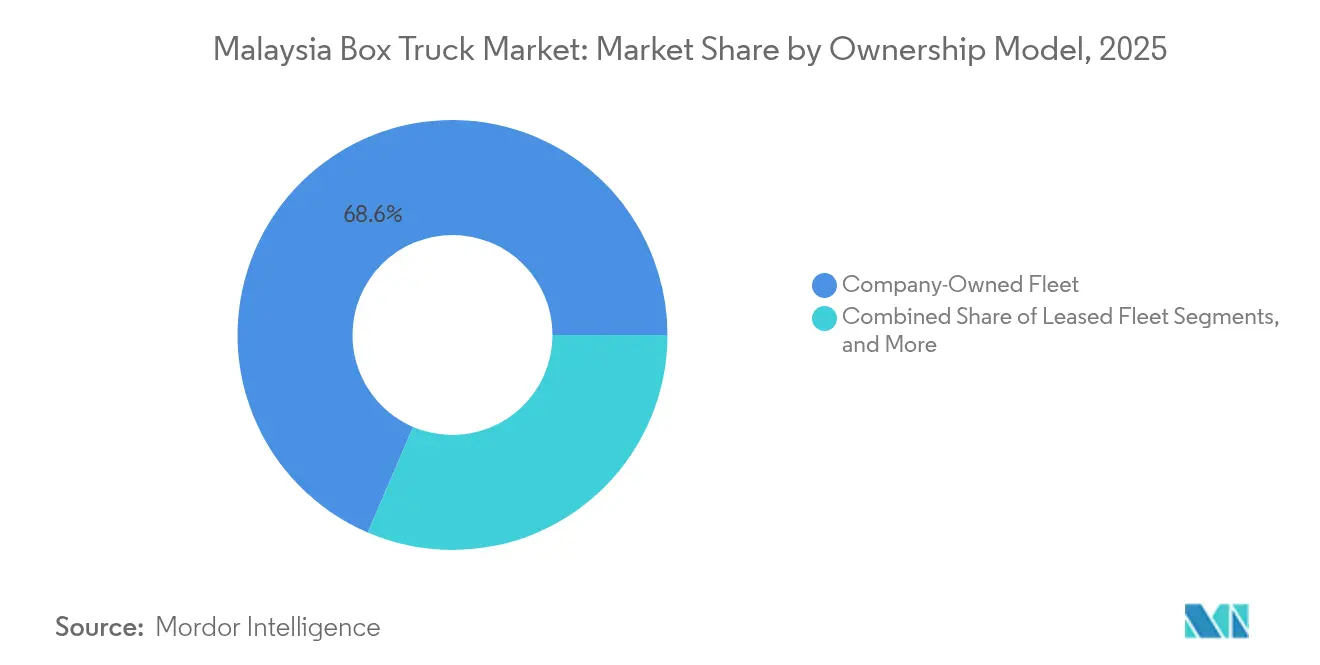
- By ownership model, company fleets controlled 68.55% of Malaysia's box truck market share in 2025, whereas rental fleets are expected to show the highest 5.31% CAGR through 2031.
- By end user, transportation companies led with a 37.85% of Malaysia's box truck market share in 2025, while courier & parcel services drove growth at a 5.71% CAGR through 2031.
Note: Market size and forecast figures in this report are generated using Mordor Intelligence’s proprietary estimation framework, updated with the latest available data and insights as of 2026.
Malaysia Box Truck Market Trends and Insights
Drivers Impact Analysis*
| Driver | (~) % Impact on CAGR Forecast | Geographic Relevance | Impact Timeline |
|---|---|---|---|
| Last-Mile Delivery Surge | +1.2% | Global, concentrated in Klang Valley, Penang, Johor | Short term (≤ 2 years) |
| Road Infra Upgrades | +0.9% | National, with early gains in Peninsular Malaysia, Sabah, Sarawak | Medium term (2-4 years) |
| Cold-Chain Expansion | +0.8% | Global, spill-over to regional hubs | Medium term (2-4 years) |
| Fleet Renewal via Euro VI | +0.7% | National compliance requirement | Short term (≤ 2 years) |
| Halal Logistics Drive Box Trucks | +0.4% | Global, with concentration in Muslim-majority regions | Long term (≥ 4 years) |
| Weight-Efficient Designs Favored | +0.3% | National, phased implementation | Medium term (2-4 years) |
| Source: Mordor Intelligence | |||
E-Commerce Boom and Last-Mile Delivery Surge
The Malaysia box truck market continues to benefit from a sharp rise in online retail volumes that require frequent, small-parcel dispatches. Investments such as DHL’s RM300 million Kuala Lumpur Gateway facility and the introduction of automated sortation hubs around Klang Valley confirm sustained parcel throughput growth [1]. Urban consolidation centers favor light-duty box trucks able to navigate narrow streets and execute multiple daily stops with minimal dwell time. Telematics platforms, including 5G-enabled solutions offered by Yes Fleet, now deliver real-time diagnostics and route optimization that lower monthly fuel use by more than 4,000 liters for high-utilization vehicles. Cross-border parcels flowing under the ASEAN Customs Transit System’s 24-hour clearance window boost demand for sealed, customs-compliant bodies. Collectively, these shifts embed e-commerce logistics as a structural, not cyclical, catalyst for additional vehicle purchases and fleet digitalization.
Government-Led Road Infrastructure Upgrades
Ongoing highway widening and new corridor projects shorten intra-Malaysia transit times, reduce vehicle wear and tear, and spur incremental freight demand. Key initiatives include the Johor–Singapore Causeway overhaul, KL–Karak capacity expansion, and the Pan Borneo Highway rollout, each of which involves adding lanes, reinforcing pavements, and introducing weigh-in-motion enforcement [2]. Improved road quality reduces maintenance downtimes, which raises asset utilization and encourages medium-duty fleet additions that can now complete longer hauls in a single shift. Real-time traffic platforms linked to smart sensors also enable carriers to trim fuel costs by rerouting around congestion.
Cold-Chain Expansion for Perishables and Pharma
Malaysia’s ambition to serve as a regional pharmaceutical and halal-food logistics hub is accelerating demand for temperature-controlled transport. Refrigerated box trucks compliant with Good Distribution Practice and Medical Device Authority standards now form a critical link in supply chains that move vaccines, biologics, and fresh produce [3]. DHL and DKSH have expanded their pharma-grade storage, which requires precise last-mile temperature integrity, while local agribusinesses, such as FGV, invest in multi-zone reefers for fresh produce distribution. IoT sensors that monitor temperature, humidity, and shock are becoming a standard fitment, and redundant power units mitigate spoilage risk during grid or vehicle outages. Consequently, refrigerated bodies show the strongest incremental unit growth within the Malaysia box truck market.
Corporate Fleet Renewal Driven by Euro VI Standards
Stricter emission norms are shortening replacement cycles as operators retire Euro II and Euro III assets. The Road Transport Department enforces enhanced smoke-opacity checks, and non-compliant vehicles face immediate grounding[4]. Isuzu, Hino, and Mitsubishi Fuso have launched Euro IV-ready chassis ahead of the Euro VI transition. Fleet owners who adopt compliant trucks benefit from lower road tax brackets and improved fuel economy, which partially offset the higher capital outlays. This regulatory push is therefore a demand accelerator for modern, cleaner vehicles across all weight classes in Malaysia.
Restraints Impact Analysis*
| Restraint | (~) % Impact on CAGR Forecast | Geographic Relevance | Impact Timeline |
|---|---|---|---|
| High EV Truck Costs | -0.8% | National, with urban concentration | Short term (≤ 2 years) |
| Diesel Price Volatility | -0.6% | National impact on diesel fleet operations | Short term (≤ 2 years) |
| Limited EV Charging for Industry | -0.5% | National, with rural gaps more pronounced | Medium term (2-4 years) |
| Axle Rules Cut Payloads | -0.3% | National enforcement with highway focus | Medium term (2-4 years) |
| Source: Mordor Intelligence | |||
High Upfront Cost of Electric Box Trucks
Battery-electric models carry price tags 70% higher than comparable diesel units, even after import-duty exemptions, which constrains adoption among small carriers. Finance houses also discount residual values due to technological uncertainty, pushing monthly installments higher than those for diesel alternatives. Depot charging requires electrical upgrades that cost up to RM100,000 per site. Meanwhile, the charging network density outside major corridors remains sparse, with fewer than 1,000 operational points nationwide. Although the total cost of ownership becomes favorable after five years under high mileage, cash-flow constraints deter many operators from early transition, tempering the short-term lift that electrification could otherwise provide to the market.
Volatile Diesel Prices Compressing Freight Margins
The June 2024 elimination of blanket diesel subsidies resulted in a 56% overnight increase in pump prices, eroding operating margins for carriers locked into annual freight contracts. While some shippers accepted spot-rate surcharges, smaller hauliers lacked the bargaining power to do so and deferred truck purchases. The planned RON95 subsidy rationalization in mid-2025 reinforces investor caution across the Malaysia box truck industry. Operators are countering cost volatility via telematics-driven driver training, aerodynamic retrofits, and route optimization, but these measures offset only a portion of fuel inflation. Persistent uncertainty, therefore, weighs on near-term replacement intentions, while simultaneously nudging fleet managers toward lighter chassis and alternative fuels, thereby reshaping long-run demand patterns.
*Our forecasts treat driver/restraint impacts as directional, not additive. The impact forecasts reflect baseline growth, mix effects, and variable interactions.
Segment Analysis
By Truck Size/Class: Light-Duty Vehicles Anchor Urban Growth
Light-duty vehicles hold 53.05% of Malaysia's box truck market share in 2025, representing a 5.78% CAGR outlook through 2031. These compact trucks maneuver through congested lanes, reach residential doorsteps, and minimize driver license requirements, making them the default choice of courier and retail distributors as urban warehousing adopts hub-and-spoke designs. As trip frequency rises, demand for nimble chassis with walk-through cabs and tail-lift options also increases.
Medium-duty trucks service inter-city cold-chain and construction supply runs that require greater payload but not the full capacity of heavy rigs. Meanwhile, heavy-duty classes cater to high-volume corridors linking Port Klang, Penang Port, and Johor Port, but they face payload caps under stricter axle-weight enforcement. Technology features such as advanced driver assistance systems, collision avoidance, and real-time load monitoring are spreading from heavy to lighter segments, creating cross-segment convergence that lifts average selling prices and deepens aftermarket demand within the Malaysia box truck market.

By Fuel Type: Diesel Dominates as Electric Scales Gradually
Diesel engines powered 85.62% of Malaysia's box truck market share in 2025. The segment benefits from established refueling infrastructure, attractive torque curves, and robust residual values. Nonetheless, subsidy removal magnifies operating-cost exposure and accelerates interest in efficiency upgrades, such as start-stop systems, low-rolling-resistance tires, and high-pressure fuel injection.
Electric box trucks, supported by duty exemptions and a 38% national EV penetration target by 2040, are projected to grow at the fastest rate, with a 6.04% CAGR through 2031. Fleet pilots led by swift-parcel and food-delivery operators demonstrate that depot-return schedules match battery ranges of 200-300 kilometers. Hybrid and CNG/LPG platforms fill transitional niches but lack the policy impetus offered to zero-emission drivetrains. Long-term, declining battery costs and federal tax credits are forecast to lift the electric share above 10.00% by 2031, thereby diversifying energy exposure for the Malaysian box truck market.
By Body Type: Dry Freight Prevails, Refrigerated Bodies Outpace
Dry freight boxes accounted for 58.55% of Malaysia's box truck market share in 2025, serving as the primary mode of transportation for general cargo, e-commerce parcels, and light construction materials. Their standardized dimensions ease dock integration and maximize cubic utilization, traits critical in high-turn warehouses. The Malaysia box truck market share of refrigerated boxes stands lower today, but its 5.59% CAGR underscores how temperature accountability reshapes logistics requirements.
Pharmaceutical companies, fresh produce exporters, and halal food distributors specify multi-zone reefers fitted with IoT sensors that transmit temperature and humidity data to cloud-based dashboards. Curtain-side variants remain popular among building materials suppliers for the side loading of irregular pallets, while tail-lift boxes gain ground for last-mile furniture and appliance delivery. Demand for specialized interiors, such as antimicrobial linings and aluminum flooring, further segments the market and boosts value-added fabrication activity within local body-builder clusters.
By Ownership Model: Capital-Light Demand Lifts Rentals
Company-owned vehicles still dominate at 68.55% of Malaysia's box truck market share in 2025 because large 3PLs and retailers place a premium on in-house control, brand graphics, and predictable total cost of ownership. They also leverage in-house workshops that minimize downtime and stretch asset life. Yet the rental fleet’s 5.31% CAGR through 2031 signals a shift toward capital agility, particularly among SMEs that confront margin compression from fuel volatility and interest-rate hikes.
Full-service leasing packages bundle insurance, maintenance, and telematics into a single monthly fee, freeing up cash for core business expansion. Subscription models introduced by major conglomerates allow term flexibility as short as three months, appealing to businesses with seasonal peaks such as electronics launches and harvest periods. Electrification accelerates this pivot because rental providers absorb battery risk and invest in shared charging depots. Consequently, the rental channel adds resilience to overall vehicle demand and broadens participation in the Malaysia box truck market.
By End User: Transportation Companies Lead, Couriers Accelerate
Transportation companies accounted for 37.85% of Malaysia's box truck market share in 2025, leveraging economies of scale to serve a diverse range of sectors, including FMCG and industrial inputs. Their fleet renewal cycles track regulatory mandates and client service-level agreements, undergirding baseline demand for newer trucks with advanced safety tech.
Courier and parcel operators, propelled by double-digit e-commerce parcel volumes, register a 5.71% CAGR to 2031. They specify tight wheelbases, sliding doors, and telematics that integrate with customer apps. Retailers and wholesalers continue to right-size their private fleets, favoring medium-duty units equipped with tail lifts for store-direct deliveries. Construction companies increase orders when infrastructure capital expenditures rise, while public agencies maintain modest replacement of utility and emergency support vehicles. The Malaysia box truck market thus mirrors the structural interplay between consumer behavior, manufacturing shifts, and public-sector budgets.
Geography Analysis
Peninsular Malaysia contributes a significant share of current revenue due to its dense highway grid, proximity to major seaports, and cross-border trade with Singapore. The Klang Valley alone houses fulfillment centers that dispatch more than 1 million parcels daily, underpinning continuous demand for light-duty trucks with rapid-loading configurations. Johor’s Iskandar region benefits from causeway upgrades that cut clearance times, drawing electronics assemblers that depend on time-critical trucking links. Penang’s industrial cluster similarly sustains medium-duty refrigerated flows for medical devices and semiconductor supply chains.
East Malaysia, historically hindered by fragmented road networks, now represents the fastest-growing regional node within the Malaysian box truck market. The Pan Borneo Highway reduces Kuching-Kota Kinabalu transit by six hours, enabling same-day freight that previously required overnight stops. Agribusiness exporters in Sabah deploy heavy-duty rigs outfitted with lighter chassis to comply with stricter axle weight rules while maximizing palm oil and seafood payloads. Sarawak’s resource projects, encompassing timber and gas, require specialized body orders that can withstand rugged terrain and high humidity.
Cross-border dynamics extend market reach beyond national boundaries. The ASEAN Customs Transit System enables 24-hour through-runs at Bukit Kayu Hitam and Johor Bahru, stimulating demand for trucks equipped with electronic cargo sealing and satellite tracking that meet the Singapore Land Transport Authority's requirements. Proposed Malaysia-Singapore Special Economic Zone incentives could increase point-to-point vehicle movements by up to 15% by 2030, potentially driving sustained chassis demand for operators serving integrated supply chains. Collectively, regional investments ensure that the Malaysia box truck market delivers balanced growth across mature and emerging corridors.
Regulatory Landscape
Malaysia box truck manufacturing, registration, and operation fall under the Road Transport Act 1987 framework, with the Road Transport Department (JPJ) acting as the main compliance gatekeeper. Commercial vehicles and their variants require Vehicle Type Approval (VTA), and JPJ also governs private and commercial vehicle modifications, including cargo body structure changes that affect load capacity and safety compliance. Emissions tightening referenced through Euro standards in industry product positioning and safety requirements anchored to recognized standards, including MS and ECE regulations, also influence OEM chassis specification and fleet replacement decisions.
On the operating side, the Land Public Transport Agency (APAD) regulates goods vehicle operator licensing through circulars that set out licensing terms and cargo structure categories, which affects eligibility to run rigid box trucks and semi-trailer configurations. These rules intersect with enforcement themes already highlighted in the market context, including stricter smoke-opacity checks and the need to keep vehicles road-legal under JPJ oversight. As a result, fleets place more weight on compliant chassis, documented body builds, and auditable modification processes.
Value Chain Analysis
The Malaysia box truck value chain begins with upstream inputs such as steel, aluminum, composites, refrigeration units, and electronics for telematics and sensors, followed by chassis manufacturing or import and then local assembly. CKD operations help OEMs align with local policy incentives and manage total landed cost. Local assembly is anchored by Isuzu Hicom Malaysia in Pekan, Pahang and Hino Motors manufacturing in Malaysia (linked to its local LCV output), supported by tier suppliers and logistics providers that feed parts into assembly lines and dealer networks. A scale marker for the ecosystem is Isuzu Hicom Malaysia reaching a milestone of over 100,000 CKD trucks by Q2 2025, supporting the importance of localized production for chassis availability and parts continuity.
Downstream, domestic bodybuilders and upfitters convert chassis into dry boxes, curtain-siders, tail-lift configurations, and refrigerated bodies. Body modifications also introduce additional compliance touchpoints where prior JPJ approval is required. Distribution moves through OEM dealers and fleet sales teams, while financing and leasing firms support both company-owned and rental models highlighted in the report. The aftermarket completes the chain through parts, service workshops, and inspection-related maintenance, which becomes more important as fleets move to newer emission-compliant platforms and add electronics-heavy features such as telematics and temperature monitoring that increase service complexity.
Competitive Landscape
Japanese OEMs maintain their primacy through localized assembly, extensive dealer networks, and proven durability in tropical climates. Isuzu’s ten-year reign reflects a consistent lead-time advantage for chassis, spares, and after-sales support. Hino and Mitsubishi Fuso follow with complementary product ladders that span light to heavy segments. The trio leverages Euro-IV readiness to secure fleet conversions ahead of looming Euro-VI cut-offs, thereby reinforcing brand loyalty among institutional buyers.
Strategic collaborations intensify. DRB-HICOM’s end-to-end ecosystem covers CKD assembly, parts distribution, and fleet management services, delivering bundled offers that lower lifecycle cost for fleet operators. Global forwarders, such as GEODIS, procure Mercedes-Benz Actros tractors equipped with geofencing and driver-fatigue sensors, signaling technology-led differentiation. Domestic bodybuilders step up by integrating composite panels and refrigerated liners that meet GDP and halal standards, capturing margins beyond the bare chassis value and anchoring local supply chains for the Malaysian box truck market.
Electric entrants spur fresh competition. Chinese OEMs JAC and BAIC have secured CKD agreements that circumvent import duties and commit to localizing battery assembly, a prerequisite for tender participation by government entities aiming for zero-emission fleets. Meanwhile, telematics vendors partner with insurers to launch pay-how-you-drive premiums that reward safer behavior, carving out ancillary revenue streams. Altogether, the competitive field balances entrenched scale advantages with innovation-driven disruption, maintaining moderate rivalry that favors customers through wider choice and faster technology diffusion.
Malaysia Box Truck Industry Leaders
-
Isuzu Motors Limited
-
Hino Motors Sales (Malaysia) Sdn Bhd
-
Mitsubishi Fuso Truck and Bus Corporation
-
Tata Motors Limited
-
Scania (Malaysia) Sdn Bhd
- *Disclaimer: Major Players sorted in no particular order
Market Opportunities and Future Outlook
Fleet modernization under tighter compliance requirements creates room for OEMs and bodybuilders that can supply VTA-ready variants and approval-friendly body designs. This is most visible for refrigerated and specialized halal logistics configurations where documented integrity is needed across the cold chain. With JPJ control over vehicle modifications alongside APAD licensing structures for operators, demand tends to shift toward standardized, compliant body programs rather than ad hoc fabrication. Suppliers that can offer repeatable designs, documentation, and service support are positioned to win with multi-site fleets.
Electrification and connected-fleet adoption create a second opportunity lane, particularly for last-mile box trucks with predictable duty cycles. Charging ecosystem build-out is tied to named infrastructure players such as Gentari, ChargEV, and TNB Electron, while the market narrative already points to active fleet piloting and telematics-driven efficiency programs. On the supply side, local assembly players including Isuzu Hicom Malaysia in Pekan are building capability and localization efforts aimed at improving emissions compliance and preparing for EV component localization, which increases the number of procurement pathways for fleets beyond fully imported options.
Recent Industry Developments
- March 2026: Isuzu Motors Limited and Isuzu Malaysia launch the 2026 Isuzu D-Max featuring a new 2.2L turbodiesel MaxForce engine and an 8-speed automatic transmission. The release expands Isuzu's light-duty pickup presence in Malaysia and could influence fleet purchase decisions as well as aftersales demand.
- February 2026: Isuzu Motors Limited and Isuzu Malaysia confirm that the Elf remains the top truck model in Malaysia with a 92.5% share in 2025. The market leadership reinforces Isuzu's dominance in Malaysia fleet consideration and may affect competitor pricing and model mix planning.
- February 2026: Hino Motors Sales (Malaysia) Sdn Bhd reports graduation of the second batch of ten trainees from its HTIP program. The capability development strengthens the local technician base and service readiness, supporting fleet maintenance and customer support.
Research Methodology Framework and Report Scope
Market Definition and Coverage
For this study, the market value refers to box trucks sold and registered in Malaysia over the study period, calculated using vehicle selling prices and mapped to year-specific demand.
Scope exclusions: we exclude road freight services revenue, standalone cargo body retrofits without a truck sale, and used vehicle resale transactions.
Segmentation Overview
- By Truck Size/Class
- Light-Duty (Class 2-3)
- Medium-Duty (Class 4-6)
- Heavy-Duty (Class 7-8)
- By Fuel Type
- Diesel
- Gasoline
- Electric
- Hybrid
- CNG/LPG
- By Body Type
- Dry Freight Box
- Refrigerated Box
- Curtain Side Box
- Tail-Lift Box
- By Ownership Model
- Company-Owned Fleet
- Leased Fleet
- Rental Fleet
- By End User
- Transportation Companies
- Retailers and Wholesalers
- Courier and Parcel Services
- Construction Firms
- Government Agencies
Data Sources, Market Sizing, and Validation
Desk Research
Desk research started with a clean view of Malaysia commercial vehicle demand and replacement cycles, then narrowed to box-truck relevant signals. We relied on public statistics and regulatory materials to anchor demand direction, and then used industry disclosures to understand where pricing and specifications were moving.
Common sources included government and official datasets and publications such as Malaysia transport and registration statistics, Royal Malaysian Customs trade series for commercial vehicles and parts, Bank Negara Malaysia and Department of Statistics Malaysia macro series, and policy notes from the Ministry of Transport and the Road Transport Department. We also reviewed product brochures, price lists, and press releases, and checked company filings and investor presentations when they helped validate model assumptions. For cross checks, we used paid subscriptions that compile company financials and news, patent databases for technology direction, and an import or export shipment level database to infer equipment flow timing. This desk list is illustrative, and additional sources were used to collect data, validate it, and resolve open questions.
Primary Interviews and Surveys
Primary work focused on validating what is actually being bought in Malaysia, how buyers choose payload and body specifications, and how pricing is negotiated at the transaction level. We spoke with stakeholders across fleet operators, logistics users, dealers, body builders, and service partners so our assumptions on unit mix and replacement timing could be stress tested against buying behavior. Respondent input was also used to sanity check desk estimates around lead times, financing sensitivity, and the pace of adoption for refrigerated and specialty bodies.
Distribution of primary research fieldwork respondents
| Company type | Respondent position |
|---|---|
| Top tier: 34% | CXOs: 19% |
| Mid tier: 47% | Functional/Unit leaders: 24% |
| Smaller Players: 19% | Managers: 57% |
Market-Sizing & Forecasting
The core sizing logic used a top-down build where Malaysia commercial vehicle activity, registration trends, and fleet replacement patterns were reconstructed into an addressable demand pool for box trucks, then filtered by the observed box-truck share. After the pool was built, we corroborated results with selective bottom-up approximations, such as sampled model-level price points multiplied by indicative unit volumes from channel checks, then adjusted where the two views diverged.
Key inputs included new registration momentum in light and medium commercial vehicles, the share of urban delivery and cold chain loads that typically require enclosed bodies, road freight and e-commerce activity indicators that affect last mile fleet additions, and the direction of financing and interest rates that influences purchase timing. We also tracked the diesel versus newer powertrain mix shift, since it changes average selling prices. To translate units into value, average selling prices were updated using recent quote ranges, configuration mix (payload class and body specification), and typical discounting behavior reported in interviews, then carried forward in line with expected inflation and feature uptake.
For forecasting, scenario analysis was used because demand can shift with subsidy changes, fuel costs, and fleet capex cycles, and the final curve was selected after aligning it with expert views on replacement timing and backlog normalization. Where direct indicators were limited for smaller fleets, we handled gaps using proportional allocation from observed end user mix and dealer-level demand patterns, and rechecked these allocations against what stakeholders reported.
Data Validation & Update Cycle
Outputs were checked in multiple steps before sign-off, starting with consistency tests such as year-to-year growth behavior, pricing reasonableness, and mix stability across truck classes. We compared the model against independent signals, including commercial vehicle registration direction, trade inflows for relevant vehicle categories, and macro indicators tied to logistics activity, and then investigated any large variances before finalizing.
A second analyst review was conducted to challenge assumptions, and re-contacting was triggered when a key input moved beyond an expected band, for example a sharp price reset or a demand dip tied to policy. Reports are refreshed annually, with interim updates when material events occur. Before delivery, an analyst performs a final pass to ensure the latest available information is reflected in the final numbers.
Mordor Intelligence's Malaysia Box Truck Market Size Compared With Other Published Estimates
It is normal to see different market size values for Malaysia box trucks, even when publishers focus on the same country and similar time window. Differences typically come from how a box truck is defined, how vehicle prices are treated across years, and whether the model is kept current when exchange rates and discounting patterns change.
In this report, the refresh cycle and currency timing are handled at the year level, so price and mix updates are not carried forward using an older FX assumption. The ASP logic is also revalidated using fresh channel quotes and buyer feedback, a practice maintained by Mordor Intelligence.
Benchmark comparison
| Source | Market Size | Gaps in Research Methodology |
|---|---|---|
| Mordor Intelligence | USD 558.23 M (2025) | |
| Trade Journal A | USD 520.00 M (2025) | Often uses a narrower definition that leans toward light duty urban delivery units, and may apply list prices or older quote sets without rechecking discount levels and body cost add-ons. |
| Regional Consultancy B | USD 610.00 M (2026) | May include adjacent enclosed commercial vehicles and specialty body builds more broadly, and sometimes carries forward a single price escalation assumption without resetting the currency basis each year. |
Overall, the spread in published values is mainly explained by scope boundaries around what qualifies as a box truck and by how pricing is updated over time. Our approach keeps totals traceable to a clear demand pool, a transparent ASP build, and repeatable checks against observable vehicle activity signals, which helps decision makers compare like with like.
Key Questions Answered in the Report
What is the current value of the Malaysia box truck market?
The Malaysia box truck market size stood at USD 588.71 million in 2026 and is projected to reach USD 767.91 million by 2031.
Which truck class is growing fastest in Malaysia?
Light-duty units used for last-mile delivery are expected to post the highest 5.78% CAGR through 2031.
How big is diesel’s share in Malaysian box trucks?
Diesel engines powered 85.62% of units sold in 2025, although that share will gradually decline as electric adoption increases.
How is infrastructure spending affecting demand?
Highway upgrades such as the Pan Borneo project shorten transit times, which lifts truck utilization and supports new vehicle purchases across regions.