
Magnetic Separation In Mining Market Size and Share
Market Overview
| Study Period | 2021 - 2031 |
|---|---|
| Market Size (2026) | USD 50.61 Billion |
| Market Size (2031) | USD 67.15 Billion |
| Growth Rate (2026 - 2031) | 5.82 % |
| Fastest Growing Market | North America |
| Largest Market | Asia-Pacific |
| Market Concentration | Low |
Major Players *Disclaimer: Major Players sorted in no particular order Image © Mordor Intelligence. Reuse requires attribution under CC BY 4.0. | |
Magnetic Separation In Mining Market Analysis by Mordor Intelligence
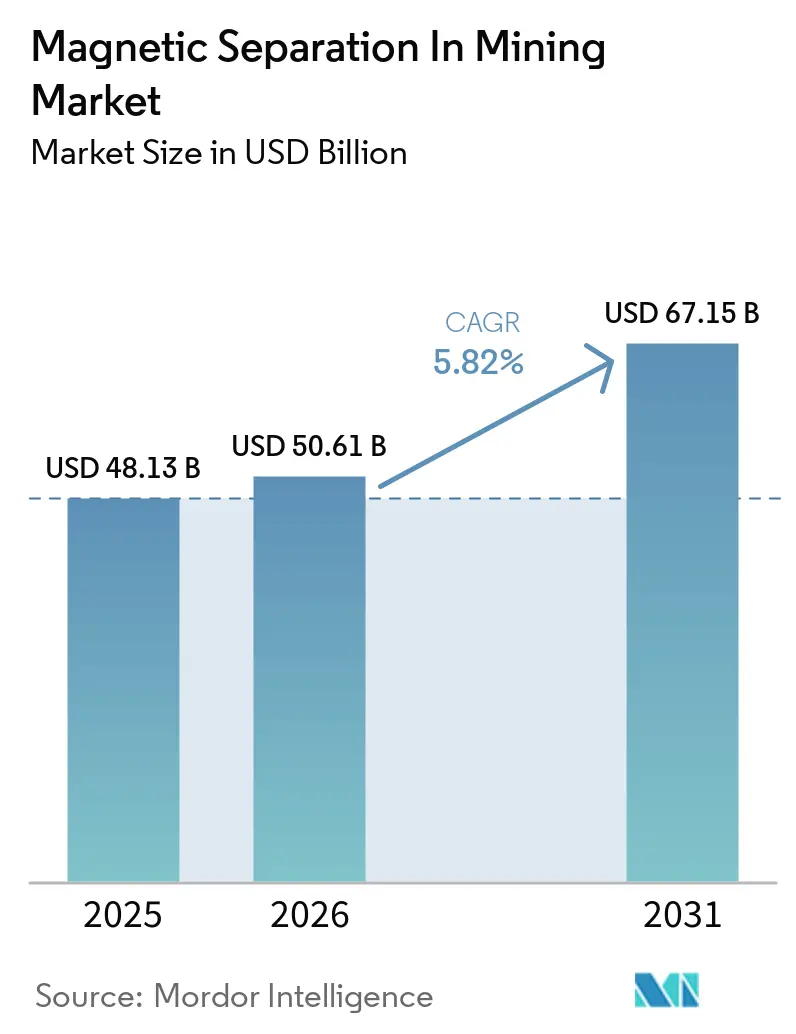
The magnetic separation in mining market size was valued at USD 48.13 billion in 2025 and is estimated to grow from USD 50.61 billion in 2026 to USD 67.15 billion by 2031, at a CAGR of 5.82% during the forecast period (2026-2031). Declining ore grades are increasing the need for beneficiation before mined material enters downstream processing routes, particularly where feedstocks must meet iron-content and impurity specifications. This requirement applies to iron ore, lithium, rare earth elements, and other minerals that require control of iron-bearing impurities. Equipment suppliers offer high-intensity systems, modular designs, and digital maintenance services to support recovery across established and emerging processing circuits. Market growth depends on investments in critical-mineral supply chains, circular mining projects, and low-water processing routes, which can generate demand beyond greenfield iron ore operations. Supply risks associated with rare earth magnets and the cost of advanced equipment remain constraints for the magnetic separation in mining market across mining environments.
Key Report Takeaways
- By product type, wet magnetic separators held 34.73% of the magnetic separation in mining market share in 2025, while dry magnetic separators are forecast to grow at a 6.32% CAGR through 2031.
- By technology, permanent magnetic separation held 36.51% of the magnetic separation in mining market share in 2025, while electromagnetic separation is forecast to grow at a 6.71% CAGR through 2031.
- By application, iron ore beneficiation accounted for 39.11% in 2025, while industrial mineral processing is forecast to grow at a 6.85% CAGR through 2031.
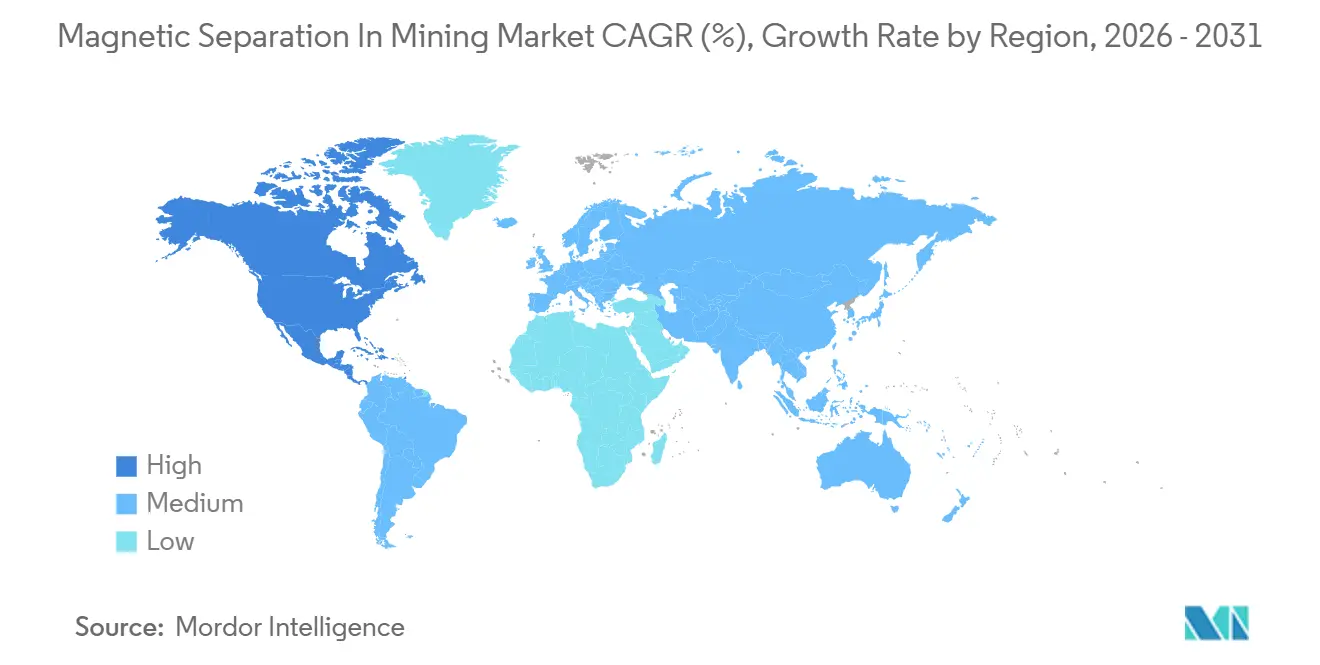
- By geography, Asia-Pacific held a 43.27% share in 2025, while North America is forecast to grow at a 6.67% CAGR through 2031.
Note: Market size and forecast figures in this report are generated using Mordor Intelligence’s proprietary estimation framework, updated with the latest available data and insights as of January 2026.
Global Magnetic Separation In Mining Market Trends and Insights
Drivers Impact Analysis*
| Drivers | (~) % Impact on CAGR Forecast | Geographic Relevance | Impact Timeline |
|---|---|---|---|
| Declining Ore Grades and Beneficiation Requirements | +1.4% | Global, the highest intensity in APAC and South America | Long term (≥ 4 years) |
| Critical Mineral and Battery-Material Supply-Chain Expansion | +1.2% | North America, APAC, and Europe | Medium term (2-4 years) |
| Tailings Reprocessing and Circular-Mining Investments | +0.7% | APAC, South America, and MEA | Medium term (2-4 years) |
| Automation, Sensor-Based Sorting, and Predictive Maintenance | +0.9% | Global, concentrated in APAC and North America | Short term (≤ 2 years) |
| Water Scarcity and Dry Magnetic Separation Adoption | +0.6% | APAC, MEA, and South America | Long term (≥ 4 years) |
| Source: Mordor Intelligence | |||
Declining Ore Grades and Increasing Beneficiation Requirements
Declining ore grades are increasing mining investment in beneficiation equipment. Major Australian producers process hematite-goethite blends from certain deposits with iron content below 58% Fe. These materials do not meet the feedstock requirements of higher-grade steelmaking routes without additional upgrading. As a result, magnetic separation is becoming an integral component of mining flowsheets. The magnetic separation in mining market benefits as operators seek to make lower-grade feedstock suitable for downstream processing.
The requirement extends beyond maximizing material recovery from each deposit. Mines that improve concentrate quality can serve premium iron ore demand. The Chinese Academy of Sciences reported stable output from a magnetization-roasting project that processes iron ore tailings containing 11% Fe. The project’s three production lines have a combined capacity of 5.56 million tons per year and produce concentrate containing more than 65% Fe. The project also reported 35% lower energy consumption than comparable technologies, demonstrating the potential to process materials previously considered waste.
Critical Mineral and Battery Material Supply Chain Expansion
Battery materials are expanding the role of magnetic separation beyond conventional iron ore circuits. High-gradient systems can recover more than 98% of lithium iron phosphate (LFP) particles from spent lithium-ion batteries. They can also achieve 96%-99% iron removal during spodumene beneficiation, producing battery-grade lithium concentrates. These applications link equipment demand to both mineral processing and battery recycling. Consequently, the magnetic separation in mining market serves distinct customer requirements across the upstream and downstream battery value chain.
The supply chain context highlights the role of this equipment. The International Energy Agency identified LFP supply chains as a critical mineral bottleneck in 2025. China accounted for 75% of purified phosphoric acid production and 95% of high-purity manganese sulfate production. Iron removal and purification remain key steps in these supply chains. Suppliers that can demonstrate battery-grade purity at commercial throughput can address applications beyond those served by conventional iron ore equipment[1]International Energy Agency, “Global Critical Minerals Outlook 2025,” International Energy Agency, iea.org.
Tailings Reprocessing and Circular Mining Investments
Tailings reprocessing is generating equipment orders from projects that previously focused on storage and closure. Vale is developing a tailings reprocessing plant at the suspended Gongo Soco mine. The facility is designed to produce 2 million tons of iron ore annually through magnetic concentration. The project supports Vale’s broader circular production strategy, which exceeded 26.3 million tons in 2025. The magnetic separation in mining market benefits from projects that treat legacy materials as recoverable resources rather than disposal obligations.
This shift also has a regulatory dimension. Mining companies increasingly need to demonstrate how they will manage and reduce stored tailings. Material drawdown plans can support mine closure planning and the recovery of saleable mineral content. Sibanye-Stillwater approved its Phase 1 chrome and Platinum Group Metals (PGM) surface retreatment project in mid-2026, with commissioning targeted for the end of 2027. This timeline positions magnetic recovery as a core component of a new surface retreatment project. Such projects are expanding demand beyond greenfield mines and conventional ore-processing operations.
Automation, Sensor-Based Sorting, and Predictive Maintenance
Digital tools are changing how mine operators evaluate separator purchases. Predictive maintenance systems can identify emerging equipment issues before they result in extended shutdowns. Metso launched its data-driven analytics service in September 2025 and expanded its connected machine base from fewer than 400 to more than 800 machines within approximately 12 months. The company stated that the service detected 80% to 90% of emerging equipment issues. These systems increase the relevance of data access, service coverage, and equipment reliability in the magnetic separation in mining market.
Connected equipment can also influence supplier selection. Operators can assess a separator’s ability to support remote condition monitoring, which may favor suppliers that offer integrated service contracts and digital platforms. Research published in 2025 indicated that AI-driven predictive maintenance would see broader adoption between 2026 and 2028. Sensor deployment, edge computing, and anomaly detection support this trend. Lower-cost suppliers may face challenges where mines require connected support as part of the equipment package.
Restraints Impact Analysis*
| Restraints | (~) % Impact on CAGR Forecast | Geographic Relevance | Impact Timeline |
|---|---|---|---|
| High Capital and Installation Costs for Advanced Separators | -0.8% | Global, most acute in emerging markets and smaller mining operations | Long term (≥ 4 years) |
| Volatility in Mining Output and Critical-Mineral Prices | -0.7% | Global | Short term (≤ 2 years) |
| Neodymium-Iron-Boron (NdFeB) Magnet Supply Concentration and Export-Control Exposure | -0.5% | North America, Europe, and non-China APAC | Medium term (2-4 years) |
| Source: Mordor Intelligence | |||
High Capital and Installation Costs for Advanced Separators
Advanced high-gradient magnetic separators require capital investment and complex installation. Smaller operators and projects with limited financing flexibility face higher cost requirements. Wet separation also requires water, pumping, and dewatering infrastructure. An Australian greenfield magnetite project required 10 gigaliters of water annually to process 5 million tons per annum. These requirements can delay the adoption of advanced systems in the magnetic separation in mining market.
Permitting also affects the early investment cycle. Environmental approvals for new processing plants and tailings ponds can add 12 to 36 months to project schedules, requiring operators to commit capital before generating revenue. Modular separator designs can reduce installation barriers for larger projects. However, legacy equipment creates switching costs at established operations. Replacement decisions may remain limited outside major expansions and greenfield developments.
NdFeB Magnet Supply Concentration and Export-Control Exposure
Permanent-magnet separator suppliers outside China face procurement risks. China introduced export controls on seven heavy rare earth elements in April 2025. On October 9, 2025, China’s Ministry of Commerce (MOFCOM) issued Announcements Nos. 61 and 62 covering NdFeB magnets containing dysprosium or terbium. The controls also extended to foreign-produced magnets containing 0.1% Chinese-origin heavy rare earth content. These rules affect equipment manufacturers that rely on permanent magnets for field strength in the magnetic separation in mining market.
The export licensing rules applied to internationally traded products from December 1, 2025. The International Energy Agency reported that China accounted for 94% of global sintered permanent-magnet production. It also reported that European permanent-magnet prices reached up to six times Chinese domestic prices after the April controls. Higher procurement costs can increase equipment prices and extend supplier lead times. This risk applies as critical-mineral projects move toward construction and commissioning.
*Our forecasts treat driver/restraint impacts as directional, not additive. The impact forecasts reflect baseline growth, mix effects, and variable interactions.
Segment Analysis
By Product Type: Wet Dominance Challenged by Waterless Circuit Gains
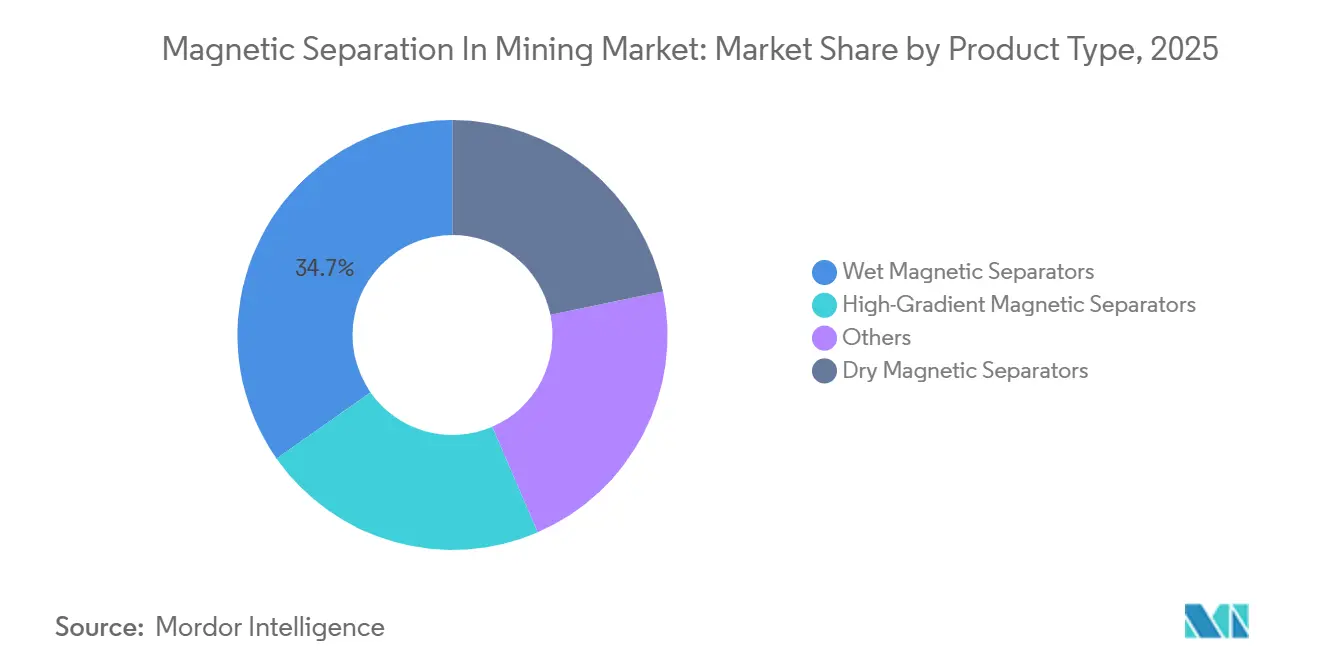
Wet magnetic separators accounted for 34.73% of global product demand in 2025. Their position reflects long-term use in iron ore, base-metal, and coal processing flowsheets, where slurry handling infrastructure is already established. Wet equipment also supports fine-particle recovery, including magnetite concentrations below 40 microns. These factors support continued use in high-grade iron ore circuits with narrow product specifications. High-gradient magnetic separators represent the high-intensity segment of the product range. SLon introduced the SLon-8000 vertical-ring pulsating high-gradient magnetic separator (HGMS) in June 2025. The equipment is rated at 2,500 tons per hour and consumes 0.12 kWh per ton. SLon stated that the model reduced energy consumption by 70% compared with the earlier SLon-4000 model. The dry magnetic separators segment of the magnetic separation in mining market is projected to grow at a CAGR of 6.32% through 2031, as water-constrained regions adopt lower-water processing circuits.
Dry magnetic separators are used in regions where limited water availability restricts wet processing. Their flowsheets can remove coarse waste before subsequent processing stages without using water, reducing water consumption and tailings pond requirements. The equipment is relevant in Australia, APAC, MEA, and other mining regions facing water constraints. The magnetic separation in mining industry also uses magnetic pulleys and belt separators for tramp-iron removal. These ancillary systems track overall mining activity more closely than the dry separator category. They provide protection for downstream equipment. Product selection depends on mineral properties, particle size, water availability, and required throughput. Wet systems will remain relevant where fine recovery requirements and existing slurry circuits support their use, while dry systems will gain adoption where operating conditions favor waterless processing and lower infrastructure requirements.



By Technology: Permanent Magnets for Broad Applications, Electromagnets for High-Purity Applications
Permanent magnetic separation accounted for 36.51% of the technology segment in 2025. This technology offers zero standby power consumption, low maintenance requirements, and performance in high-throughput recovery circuits. Permanent systems are used for magnetite and ferrosilicon recovery and in dense-media separation plants for coal and base metals. Their stable performance over extended operating periods supports continued adoption. STEINERT reported that its WDH drums can deliver 15% operational expenditure (OPEX) savings in magnetite recovery at dense-media separation plants by reducing maintenance frequency. Electromagnetic separation is projected to be the fastest-growing technology category, expanding at a CAGR of 6.71% through 2031. Processing fine and weakly magnetic minerals requires greater field intensity and control than permanent systems can provide. This capability is relevant for lithium, manganese, rare earth, and industrial mineral applications. Digital controls can adjust electromagnetic field intensity as ore-feed conditions change.
Hybrid systems combine permanent and electromagnetic stages within a single equipment footprint. Shenyang Longi introduced a coupled-magnetic-field modular high-intensity separator in August 2026. The company stated that its multi-ring parallel architecture increased coil-center field strength by 30% while reducing energy consumption by 15% to 20%. The design targets weakly magnetic minerals, including lithium and rare earth ores. This development supports the magnetic separation in mining market as operators seek higher performance without a proportional increase in equipment footprint. Superconducting magnetic separators remain a smaller technology category. They operate at field intensities above 5 tesla and serve applications that require ultra-fine mineral liberation. Although the technology has a narrower application base than permanent and electromagnetic systems, it is relevant where mineral characteristics require very high-intensity separation. It provides the magnetic separation in mining market with an option for specialized recovery requirements.
By Application: Iron Ore Anchors Share, Industrial Minerals Accelerate
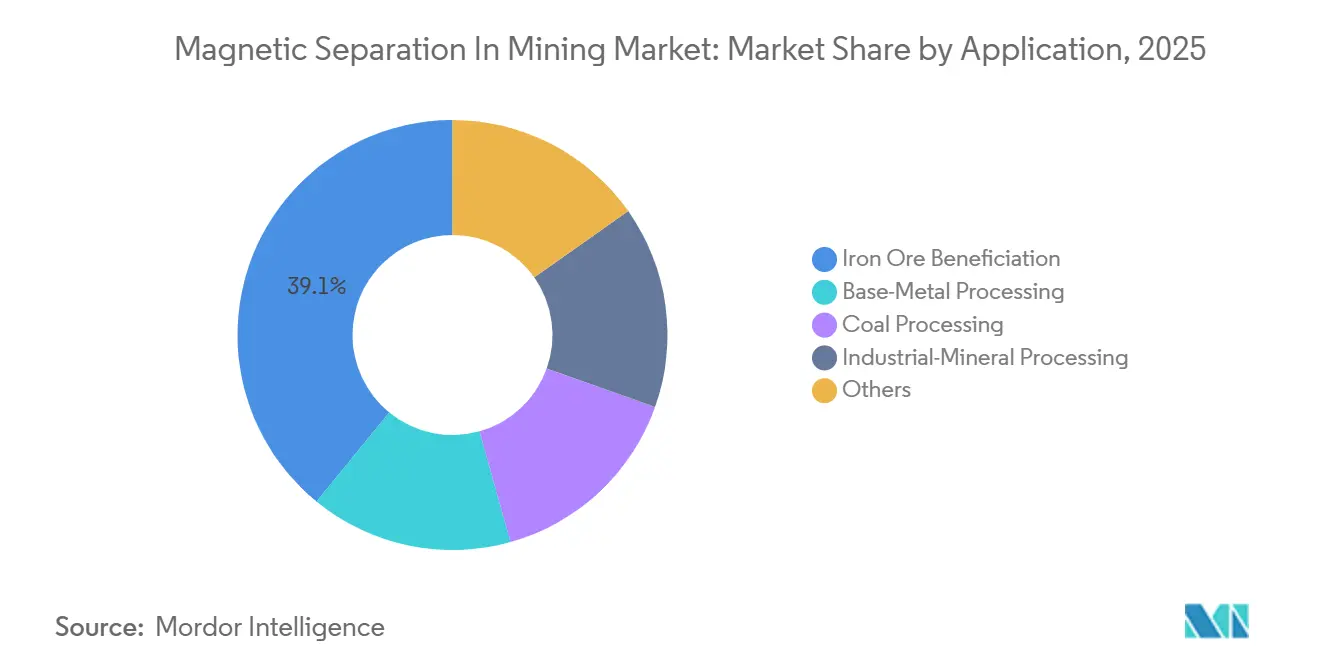
Iron ore beneficiation accounted for 39.11% of the magnetic separation in mining market size in 2025. This share reflects the scale of global magnetite and hematite production. Magnetic separation is integrated into many iron ore processing flowsheets. Declining ore grades increase the number of processing passes and the degree of liberation required to meet concentrate specifications, increasing equipment requirements per ton of final product. The Chinese Academy of Sciences reported a commercial magnetization-roasting project that produces a concentrate containing more than 65% Fe from tailings containing 11% Fe. The project has a capacity of 5.56 million tons per year and demonstrates how beneficiation can recover material that was previously discarded. Base-metal and coal processing remain mature applications, with equipment demand tracking their respective commodity cycles more closely.
Industrial-mineral processing is projected to grow at a CAGR of 6.85% through 2031. Lithium, rare earth, manganese, quartz, feldspar, and kaolin processing circuits require the removal of iron impurities to meet product specifications. In many cases, impurity levels must be reduced to below 100 ppm. Magnetic separation, therefore, serves as a product-quality requirement rather than solely a recovery step. The magnetic separation in mining market can benefit as battery and specialty-mineral producers implement stricter purity requirements. A 2025 review of hard-rock lithium processing identified magnetic separation as a standard step between dense-media separation and froth flotation. The process removes iron-bearing gangue and protects downstream flotation selectivity. The other applications category includes precious stone sorting and industrial waste processing, where sensor-magnetic hybrid systems are expanding potential use cases. ISO 9001 product consistency requirements may also encourage equipment upgrades across battery-material supply chains. These applications provide the magnetic separation in mining market with a broader demand base beyond iron ore processing.
Geography Analysis
Asia-Pacific accounted for 43.27% of global demand in 2025. China remains central to regional demand due to its large iron ore processing base. India is also expanding beneficiation activities, as 66.5% of its remaining iron ore resources are medium- or low-grade. These resources require upgrading before they can support modern steelmaking routes. LONGi Magnet supplied more than 100 CTB-1230 and LCTJ-1230 separators, along with 48 automated magnetic suspension concentrators, to the CITIC Pacific Sino Iron project in Australia.
LONGi reported that the project achieved concentrate grades exceeding 65.5%. Chinese manufacturers maintain domestic market presence through integrated supply networks, while Japan’s KANETEC and Nippon Magnetics serve specialized industrial separation applications. Indonesia and the Philippines are generating demand through nickel laterite processing. These operations use magnetic separation to remove tramp iron before hydrometallurgical processing, contributing to regional demand for magnetic separation in the mining market.
North America is forecast to expand at a CAGR of 6.67% through 2031. Over a six-month period, the U.S. government mobilized more than USD 30 billion in letters of interest, investments, and loans for critical mineral supply chains[2]U.S. Department of State, “2026 Critical Minerals Ministerial,” Office of the Spokesperson, state.gov. Canada announced more than CAD 3.6 billion in program commitments at the Prospectors & Developers Association of Canada (PDAC) 2026, including the CAD 2 billion Critical Minerals Sovereign Fund. Glencore’s CAD 2 billion Onaping Depth nickel project in Sudbury achieved first ore access in August 2026.
Europe has a presence in industrial mineral processing and recycling applications. The region’s circular economy policies support investments in battery material recycling and impurity removal systems. STEINERT expanded its Near-Infrared (NIR) technology center in Zittau, Germany, to 9,000 square meters, representing a fourfold increase in space. This expansion supports regional demand for integrated sensor-based and magnetic sorting systems and creates opportunities in the magnetic separation market in mining. South America and the Middle East and Africa (MEA) represent smaller regions within the magnetic separation in mining market. Brazil drives demand for wet magnetic concentration through tailings reprocessing and hematite-rich iron ore operations. Chile and Argentina offer applications for high-gradient magnetic separation systems in lithium extraction and spodumene impurity removal. South Africa is developing demand through chrome and Platinum Group Metals (PGM) surface retreatment projects. Kazakhstan is also attracting suppliers focused on complex, weakly magnetic mineral deposits. SLon exhibited its High Gradient Magnetic Separation (HGMS) portfolio at the Almaty mining exhibition in September 2026.

Competitive Landscape
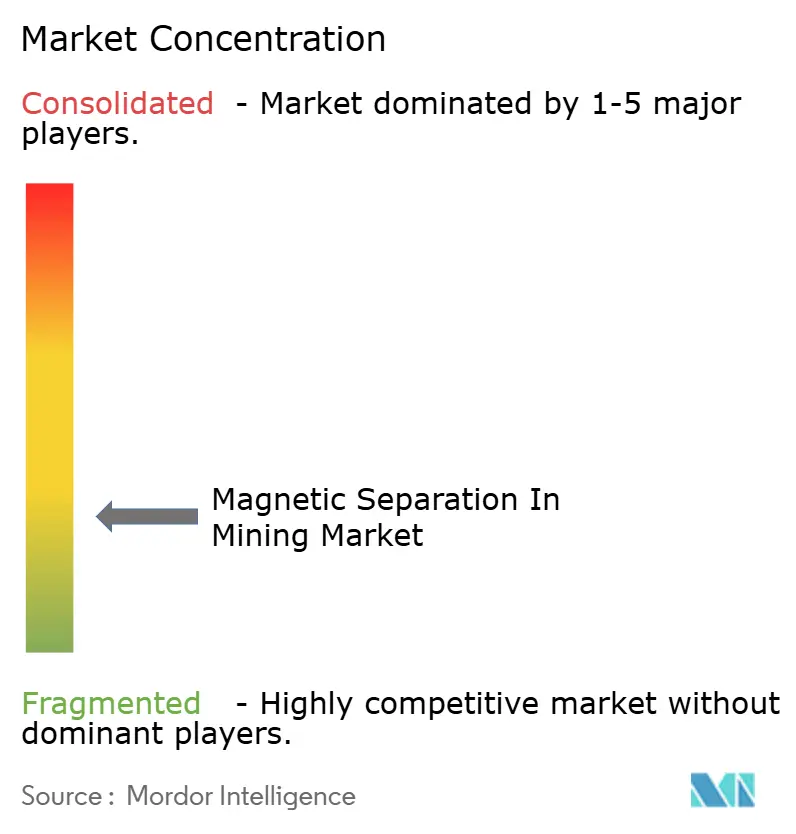
The magnetic separation in mining market is fragmented, with no company holding a dominant global position across all product categories. Chinese equipment manufacturers, including LONGi Magnet, SLon Magnetic Separator, and Shandong Huate Magnet Technology, primarily serve the cost-sensitive iron ore processing market, which has high equipment demand. They compete on throughput, energy efficiency, and domestic supply-chain reach. Western suppliers, such as Eriez, STEINERT, and Metso, focus on integrated sorting solutions, predictive maintenance, and aftermarket support.
The market separates equipment demand for large-scale operations from specialized, purity-focused applications. This distinction limits direct price competition among suppliers that serve different operational requirements. Goudsmit Magnetics launched its DeepReach range in July 2026 for recycling and mining streams with processing rates of up to 650 m³ per hour. The range combines deep-field permanent overband magnets and drum separators, enabling specialized European suppliers to address specific high-throughput applications.
Suppliers are also investing in technologies that integrate sensing, control, and separation. Metso’s expansion of connected machines reflects the integration of service-based models into supplier offerings. LONGi launched a modular separator in August 2026 to improve field intensity and energy efficiency for weakly magnetic minerals. SLon’s vertical-ring pulsating high-gradient technology received recognition in a January 2026 patent competition, reflecting the industry focus on system architecture. These strategies enable suppliers to target lithium, rare earth elements, tailings, and remote mining projects.
Battery-material recycling, tailings reprocessing, and remote, water-constrained operations are key competitive application areas. These applications require impurity removal, water management, and operational flexibility. Suppliers that lack established quality, environmental, and service capabilities may have a narrower addressable customer base. ISO 9001 and ISO 14001 certifications are increasingly relevant in procurement decisions at major mine sites. Therefore, technical fit and service capabilities, in addition to equipment cost, shape the magnetic separation in mining market.
Magnetic Separation In Mining Industry Leaders
Metso
Eriez Manufacturing Co.
STEINERT GmbH
SLon Magnetic Separator Co., Ltd.
Bunting Magnetics Inc.
- *Disclaimer: Major Players sorted in no particular order

Recent Industry Developments
- September 2026: Metso launched the Sampo Cell, a coarse-particle flotation technology, at the Metso Summit on September 10, 2026. The technology improves ore recovery per ton processed without affecting fine-particle recovery. It expands Metso's mineral processing portfolio into coarser separation, which can reduce grinding energy requirements before magnetic concentration stages.
- August 2026: Shenyang LONGi unveiled a coupled-magnetic-field modular high-intensity magnetic separator. The separator features a multi-ring parallel architecture that increases coil-center field strength by 30% and reduces energy consumption by 15-20%. It is designed to separate weakly magnetic minerals, including lithium and rare earth ores.


Global Magnetic Separation In Mining Market Report Scope
Magnetic separation is a physical process that uses a magnetic field to separate magnetic materials from mixed material streams, enabling the recovery of magnetic constituents while retaining non-magnetic materials.
The magnetic separation market is segmented by product type, technology, application, and geography. By product type, the market is segmented into Wet Magnetic Separators, Dry Magnetic Separators, High-Gradient Magnetic Separators, and Others. By technology, the market is segmented into Permanent Magnetic Separation, Electromagnetic Separation, and Others. By application, the market is segmented into Iron Ore Beneficiation, Base-Metal Processing, Coal Processing, Industrial-Mineral Processing, and Others. The report also covers market size and forecasts for magnetic separation across 15 countries in major regions. The market sizes and forecasts are provided in terms of value (USD).
| Wet Magnetic Separators |
| Dry Magnetic Separators |
| High-Gradient Magnetic Separators |
| Others |
| Permanent Magnetic Separation |
| Electromagnetic Separation |
| Others |
| Iron Ore Beneficiation |
| Base-Metal Processing |
| Coal Processing |
| Industrial-Mineral Processing |
| Others |
| Asia-Pacific | China |
| India | |
| Japan | |
| South Korea | |
| ASEAN Countries | |
| Rest of Asia-Pacific | |
| North America | United States |
| Canada | |
| Mexico | |
| Europe | Germany |
| United Kingdom | |
| France | |
| Italy | |
| NORDIC Countries | |
| Rest of Europe | |
| South America | Brazil |
| Argentina | |
| Rest of South America | |
| Middle East and Africa | Saudi Arabia |
| South Africa | |
| Rest of Middle East and Africa |
| By Product Type | Wet Magnetic Separators | |
| Dry Magnetic Separators | ||
| High-Gradient Magnetic Separators | ||
| Others | ||
| By Technology | Permanent Magnetic Separation | |
| Electromagnetic Separation | ||
| Others | ||
| By Application | Iron Ore Beneficiation | |
| Base-Metal Processing | ||
| Coal Processing | ||
| Industrial-Mineral Processing | ||
| Others | ||
| By Geography | Asia-Pacific | China |
| India | ||
| Japan | ||
| South Korea | ||
| ASEAN Countries | ||
| Rest of Asia-Pacific | ||
| North America | United States | |
| Canada | ||
| Mexico | ||
| Europe | Germany | |
| United Kingdom | ||
| France | ||
| Italy | ||
| NORDIC Countries | ||
| Rest of Europe | ||
| South America | Brazil | |
| Argentina | ||
| Rest of South America | ||
| Middle East and Africa | Saudi Arabia | |
| South Africa | ||
| Rest of Middle East and Africa | ||


Key Questions Answered in the Report
What is current market size of Magnetic Separation in Mining Market?
The magnetic separation in mining market size was valued at USD 48.13 billion in 2025 and is estimated to grow from USD 50.61 billion in 2026 to USD 67.15 billion by 2031, at a CAGR of 5.82% during the forecast period (2026-2031).
Which product type leads to the demand for magnetic separation equipment?
Wet magnetic separators led product demand with a 34.73% share in 2025, supported by their use in established slurry-based processing circuits.
Which magnetic separation technology is growing fastest?
Electromagnetic separation is projected to grow at a 6.71% CAGR through 2031 because applications involving weakly magnetic and fine minerals require greater control over field intensity.
Why are dry magnetic separators becoming more important?
Dry systems support mines in water-constrained regions by reducing water use, tailings requirements, and related infrastructure needs.
Page last updated on:


 Your data is secure and never sold or shared.


