
Machine Tending Vision Systems Market Size and Share
Market Overview
| Study Period | 2020 - 2031 |
|---|---|
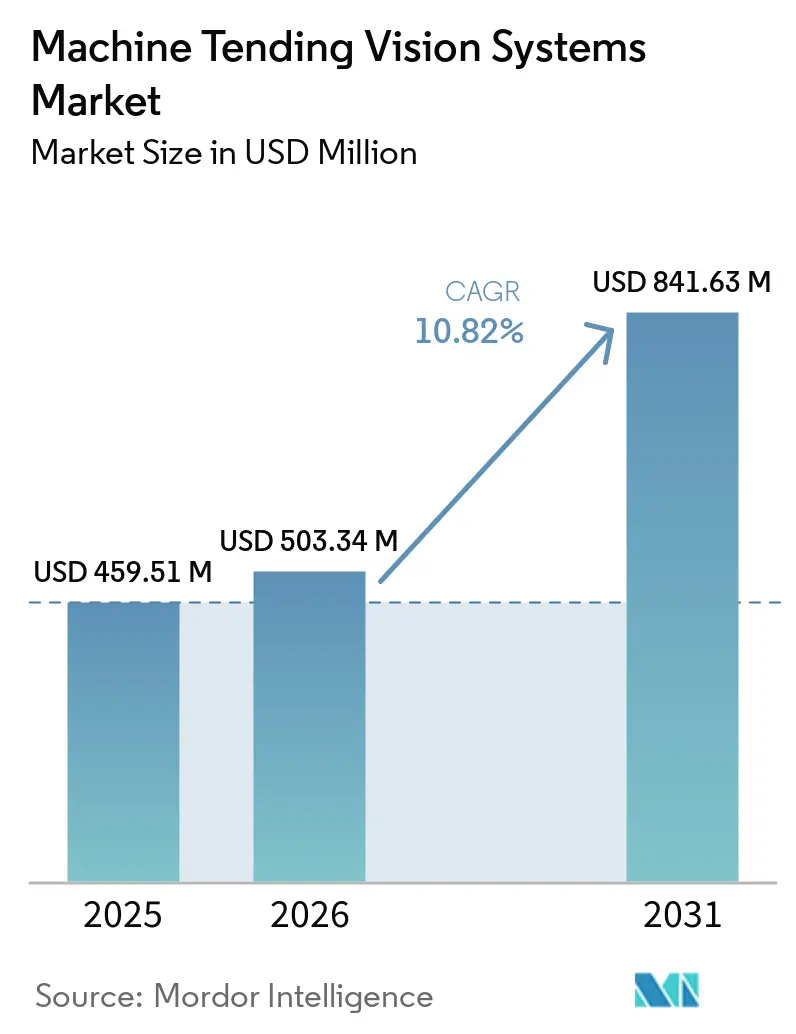
| Market Size (2026) | USD 503.34 Million |
| Market Size (2031) | USD 841.63 Million |
| Growth Rate (2026 - 2031) | 10.82 % |
| Fastest Growing Market | Middle East and Africa |
| Largest Market | Asia-Pacific |
| Market Concentration | Medium |
Major Players *Disclaimer: Major Players sorted in no particular order Image © Mordor Intelligence. Reuse requires attribution under CC BY 4.0. | |
Machine Tending Vision Systems Market Analysis by Mordor Intelligence
The Machine tending vision systems market size was USD 459.51 million in 2025 and is projected to reach USD 841.63 million by 2031, registering a CAGR of 10.82% between 2026 and 2031. Vision-guided automation is becoming more central to precision manufacturing because it supports unattended and multi-shift machine operation. This change is widening adoption beyond large original equipment manufacturers to contract machine shops and mid-sized assemblers. Buyers increasingly consider vision capability when they specify new automation cells, rather than adding it after installation. Suppliers are responding with integrated hardware, software, and service packages that reduce deployment complexity. High brownfield costs and a limited pool of specialists remain material barriers, especially for smaller manufacturers.
Key Report Takeaways
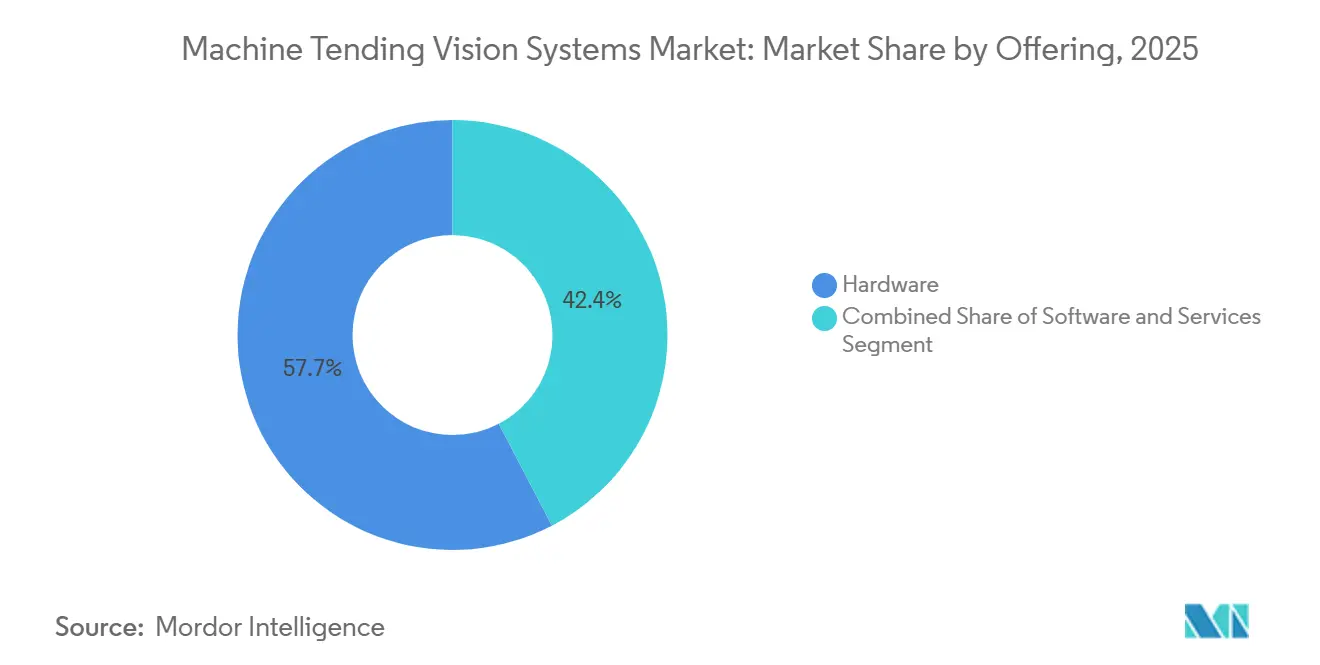
- By offering, hardware held 57.65% of revenue in 2025 of the machine-tending vision systems market, while software is projected to expand at an 11.21% CAGR through 2031.
- By vision technology, 2D area-scan vision held 37.65% of revenue in 2025, while time-of-flight vision is projected to expand at an 11.32% CAGR through 2031.
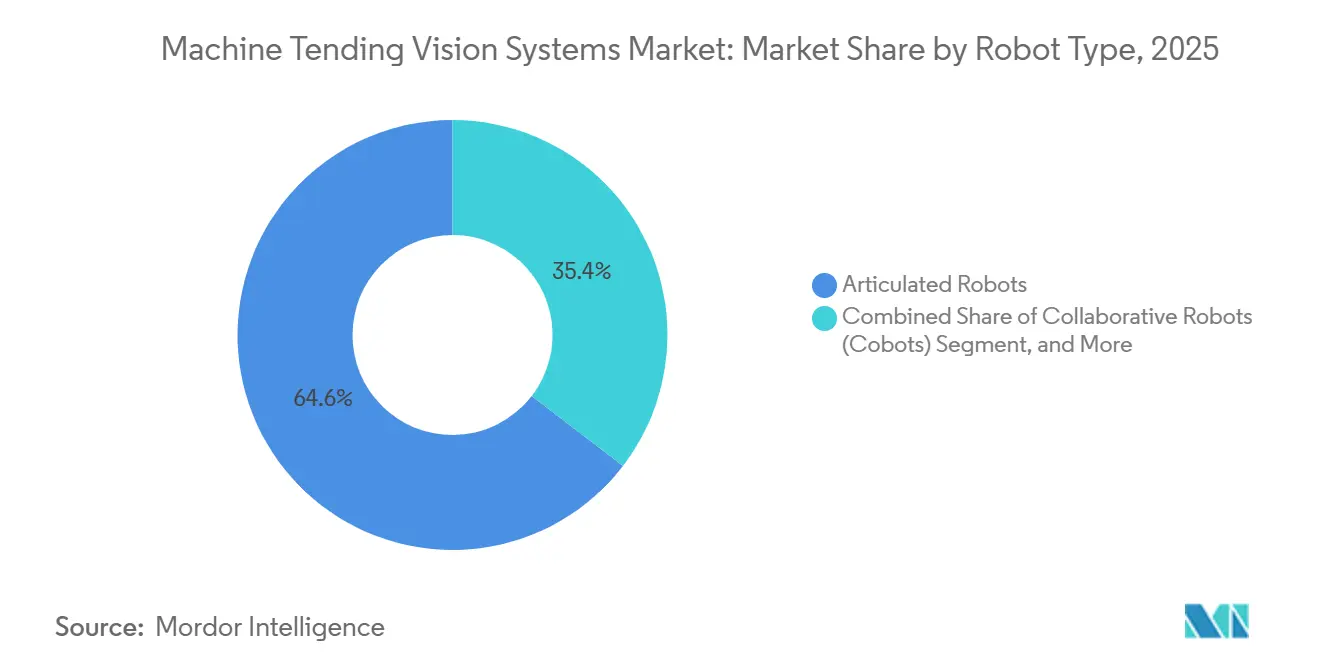
- By robot type, articulated robots accounted for 64.51% of revenue in 2025, while collaborative robots are projected to grow at an 11.78% CAGR through 2031.
- By deployment, new machine-tending cells held 63.21% of revenue in 2025 and are projected to expand at an 11.51% CAGR through 2031.
- By application, bin picking and random part feeding held 29.91% of revenue in 2025 and are projected to expand at an 11.81% CAGR through 2031.
- By end-user industry, automotive and automotive components held 32.22% of revenue in 2025, while electronics and semiconductors are projected to expand at an 11.87% CAGR through 2031.
- By geography, Asia-Pacific held 39.78% of the machine tending vision systems market revenue in 2025, while the Middle East and Africa are projected to record the fastest geographic expansion at 11.13% through 2031.
Note: Market size and forecast figures in this report are generated using Mordor Intelligence’s proprietary estimation framework, updated with the latest available data and insights as of January 2026.
Global Machine Tending Vision Systems Market Trends and Insights
Drivers Impact Analysis*
| Driver | (~) % Impact on CAGR Forecast | Geographic Relevance | Impact Timeline |
|---|---|---|---|
| Expansion of Lights-Out and Low-Staffed CNC Operations | +3.2% | Global, concentrated in North America, Germany, Japan, and South Korea | Short term (≤ 2 years) |
| Vision-Guided Robotics for High-Mix Production | +2.8% | Global, strongest in Asia-Pacific and North America | Short term (≤ 2 years) |
| 3D Vision and AI-Based Part Localization | +2.1% | Global, with early adoption in Japan, South Korea, and North America | Medium term (2-4 years) |
| Reduced Spindle Idle Time and Higher Equipment Utilization | +1.5% | North America, Europe, and Japan | Short term (≤ 2 years) |
| Standardized Vision Kits for Small and Mid-Sized Manufacturers | +1.0% | North America, Europe, and ASEAN | Medium term (2-4 years) |
| Vision-Based Recipe Transfer Across Mixed Robot Fleets | +0.7% | Global, particularly automotive and contract machining hubs | Long term (≥ 4 years) |
| Source: Mordor Intelligence | |||
Expansion of Lights-Out and Low-Staffed CNC Operations
The shortage of skilled CNC labor is making lights-out operation more relevant for many manufacturers. A configured lights-out cell can sustain up to 168 productive hours each week, compared with 40 hours in a single-shift arrangement. Vision systems identify, orient, and verify parts before a robot completes the tending task. This capability allows unattended operation across multiple shifts where process conditions are stable. New cells are therefore more likely to include vision during the original specification process.
Adoption of Vision-Guided Robotics for High-Mix Production
High-mix and low-volume production creates a strong use case for vision-guided robotics. Vision recognition reduces dependence on dedicated fixtures that can be difficult to justify for short production runs. North American robot orders increased 4.3% in units and 21.3% in value during the second quarter of 2026.[1] Semiconductor and electronics applications represented 36.5% of collaborative robot orders in the first half of 2026. Vision-guided cobots help smaller contract shops respond to varied order profiles without extensive mechanical retooling. This approach can improve lead-time performance where larger production facilities have traditionally held an advantage.
Rising Integration of 3D Vision and AI-Based Part Localization
The Machine tending vision systems market is shifting from 2D imaging toward depth-aware perception and AI-based localization. A 2026 study reported a 99% grasping success rate and 0.38 mm translation error for a 3D stereo vision system using dimensionality reduction.[2] This level of performance helps integrators support more demanding uptime commitments for complex picking tasks. AI inference within the vision controller also increases the importance of software and integration capability. Cognex introduced the In-Sight 6900 controller with NVIDIA Jetson processing in April 2026. The company introduced the In-Sight 3900 system with Qualcomm Dragonwing processing in May 2026.
Demand for Reduced Spindle Idle Time and Higher Equipment Utilization
Spindle utilization remains an important measure of machine tool productivity. Part search and orientation delays leave costly equipment idle between machining cycles. Structured-light 3D systems can reduce part-search time from several minutes to less than 1 second in suitable applications. For a EUR 200,000 (USD 220,000) five-axis machining center at the 2025 average rate, a 10-point utilization gain can support payback within 12 to 18 months. FANUC's Robot division generated JPY 378,610 million (USD 2.51 billion, and revenue increased 14.9%.[3] This performance reflects the increasing importance of coordinated robotics, motion control, and vision in capital equipment decisions.
Restraints Impact Analysis*
| Restraint | (~) % Impact on CAGR Forecast | Geographic Relevance | Impact Timeline |
|---|---|---|---|
| High Brownfield Integration and Retrofitting Costs | -1.8% | Global, most acute in North America and Europe | Short term (≤ 2 years) |
| Shortage of Vision, Robotics, and Controls Integration Specialists | -1.2% | Global, with highest severity in Europe, North America, and Japan | Medium term (2-4 years) |
| Sensitivity to Metal Glare, Coolant, Chips, and Variable Lighting | -0.7% | Global, particularly metalworking and CNC-intensive settings | Short term (≤ 2 years) |
| Cybersecurity and Data-Ownership Concerns in Connected Vision Cells | -0.5% | North America, Europe, and Asia-Pacific technology hubs | Medium term (2-4 years) |
| Source: Mordor Intelligence | |||
High Brownfield Integration and Retrofitting Costs
Many installations take place in operating facilities with equipment from different generations. Existing CNC lines often have varied PLC configurations, safety systems, and communication protocols. Integration can require signal compatibility work and new safety validation under ISO 13849. Plant downtime can add costs comparable with the hardware expense. A 2026 study found that limited protocol standardization remains a serious obstacle for small and medium-sized manufacturers. Uncertain integration costs make predictable commercial models more difficult and can delay retrofit decisions.
Shortage of Vision, Robotics, and Controls Integration Specialists
Machine tending projects require expertise across vision algorithms, robot motion, and CNC controls. Deployment schedules can therefore depend more on integrator capacity than on equipment availability. ABB reported that OmniCore EyeMotion can reduce commissioning time by up to 90% compared with custom integrations. Simplified tools are useful for standard applications and can lower the burden on technical teams. They cannot fully replace specialists in brownfield sites with legacy safety architecture or unusual part geometry. Training activity by industrial organizations may expand the talent pool, but the shortage is likely to remain relevant during the medium term.
*Our forecasts treat driver/restraint impacts as directional, not additive. The impact forecasts reflect baseline growth, mix effects, and variable interactions.
Segment Analysis
By Offering: Hardware Provides the Revenue Base, While Software Gains Importance
Hardware held 57.65% of the Machine tending vision systems market share in 2025. Within the Machine tending vision systems market, cameras, sensors, lighting, and processors form the core equipment installed in articulated-arm tending cells. Cameras and vision sensors represent the highest-volume hardware category across many factory settings. Structured-light projectors and frame grabbers gain relevance as 3D deployments increase. Optics and lenses serve specialized measurement needs, including telecentric imaging applications. Polarized and coaxial lighting arrangements help address metallic surfaces and inconsistent reflections. These systems require application knowledge because lighting performance affects image quality and detection reliability. Hardware remains necessary even as software becomes a larger source of differentiation. Service activity also rises with the installed base through maintenance and support work. The Machine tending vision systems industry continues to depend on hardware reliability in high-throughput production cells.
Software is projected to expand at an 11.21% CAGR through 2031. Deep learning and AI vision software can manage high-mix applications where rule-based tools struggle with new part variations. CAD-based matching is less effective when part appearance or orientation changes frequently. Cognex stated that more than 100 customers moved from single-line AI pilots to multi-site rollouts after OneVision became generally available in May 2026. Within the Machine tending vision systems market, centralized model development with local execution can support more consistent deployment across production sites. Robot guidance and part-localization software represent an important area for future investment. Suppliers with effective software platforms can create stronger customer retention. Hardware-only providers face greater pressure to integrate analytics and AI functionality. System integration services remain necessary where manufacturing conditions differ between plants. The Machine tending vision systems market is therefore shifting some value toward software capability without reducing the need for physical equipment.

By Vision Technology: 2D Area-Scan Retains Scale, While ToF Supports Depth-Aware Tasks
2D area-scan vision held 37.65% of revenue in 2025. It remains widely used for flat-part inspection and tray-based loading because it is proven and cost-effective. Within the Machine tending vision systems market, installed cells often retain these systems when current performance meets production requirements. The upgrade case for 3D technology can be weaker in structured applications with consistent part presentation. 2D line-scan systems serve continuous web inspection and high-speed conveyor operations. Structured-light 3D and stereo vision support more demanding bin-picking tasks. Polarized illumination can improve localization accuracy on reflective metal surfaces. Hyperspectral and calibrated multi-camera arrays serve specialized needs in medical devices and aerospace. These technologies address narrow applications with specific inspection requirements. The Machine tending vision systems market retains a broad technology mix because application conditions vary substantially.
Time-of-flight vision is projected to expand at an 11.32% CAGR through 2031. Within the Machine tending vision systems market, its compact form factor supports installations where available space is limited. It can also perform well where ambient light conditions affect other approaches. Scan-cycle latency can be more important than peak spatial resolution in safety monitoring tasks. STMicroelectronics introduced the VL53L9 direct ToF 3D LiDAR module in June 2026, with 2.3K resolution at 100 fps. High-frame-rate ToF systems can support speed adjustment when people approach collaborative work zones. Structured-light vision remains better suited to certain precision localization tasks. Both technologies can operate in the same cell for different functions. The Machine tending vision systems industry uses this combination to balance accuracy, speed, and safety requirements. Technology choice will remain tied to the material, cycle time, and handling conditions of each application.
By Robot Type: Articulated Robots Lead, While Cobots Increase Flexibility
Articulated robots held 64.51% of revenue in 2025. Within the Machine tending vision systems market, they are widely used in high-payload and high-throughput CNC tending applications. Automotive body component lines depend on six-axis motion and extended reach for repetitive handling tasks. Aerospace structural machining cells also use articulated robots where workpieces require complex positioning. Heavy metalworking applications favor robust systems that can operate around large parts and machining equipment. SCARA robots serve high-speed planar tasks, including circuit board loading and small precision parts. Cartesian and gantry systems are relevant for large-format aerospace manufacturing. Overhead rail-mounted vision systems can inspect workpieces before transfer in these installations. Established robot types remain appropriate where volume and part consistency justify purpose-built cells. The Machine tending vision systems market continues to rely on articulated robots for demanding production environments.
Collaborative robots are projected to expand at an 11.78% CAGR through 2031. Within the Machine tending vision systems market, they address lower-payload tending needs in electronics assembly, medical devices, and contract manufacturing. Semiconductor and electronics applications represented 36.5% of cobot orders in the first half of 2026. Cobots can reduce the capital commitment required for smaller facilities to adopt vision-guided automation. Their flexibility is useful where part changeovers occur more frequently. Universal Robots and Flex expanded their partnership in April 2026. Flex is deploying Universal Robots cobots in its facilities while manufacturing key components. This arrangement links production experience to product development work. The Machine tending vision systems market can benefit as cobot platforms adapt to practical tending requirements. The Machine tending vision systems industry is using these deployments to improve tools for flexible automation.
By Deployment: New Cells Lead, While Retrofits Extend the Opportunity
New machine-tending cells held 63.21% of revenue in 2025 and are projected to expand at an 11.51% CAGR through 2031. Within the Machine tending vision systems market, greenfield semiconductor plants, North American EV battery facilities, and European modernization projects support demand. Vision systems can be specified during the design stage in these projects. This allows camera placement, lighting design, and software architecture to be considered from the outset. New-cell contracts often include integration, commissioning, and warranty services. These bundled packages can have higher values than standalone equipment purchases. Reshoring-related construction activity supports a pipeline of new tending cell projects. OEM channels play an important role in delivering turnkey solutions. The Machine tending vision systems market size for new cells benefits from investments in purpose-built production capacity. New installations also avoid many of the technical complications associated with legacy equipment.
Retrofit and upgraded cells remain strategically important despite their lower current share. The CNC installed base includes hundreds of thousands of units in North America and Europe. This installed base creates a substantial opportunity for vision upgrades. Existing equipment may need new safety validation, communication integration, and tailored mechanical design. FANUC reported shipments of more than 1,000 physical AI robots since the December 2025 IREX debut. The company positioned these systems for intelligence upgrades in operating factories. Standardized vision kits and no-code tools can have a strong commercial effect in retrofit applications. Certified upgrades with clearer cost parameters can improve buyer confidence. Suppliers that simplify brownfield conversion can strengthen their position in the Machine tending vision systems market. Retrofit demand broadens the addressable base beyond new capital projects.
By Application: Bin Picking Leads, While Structured Loading Remains Important
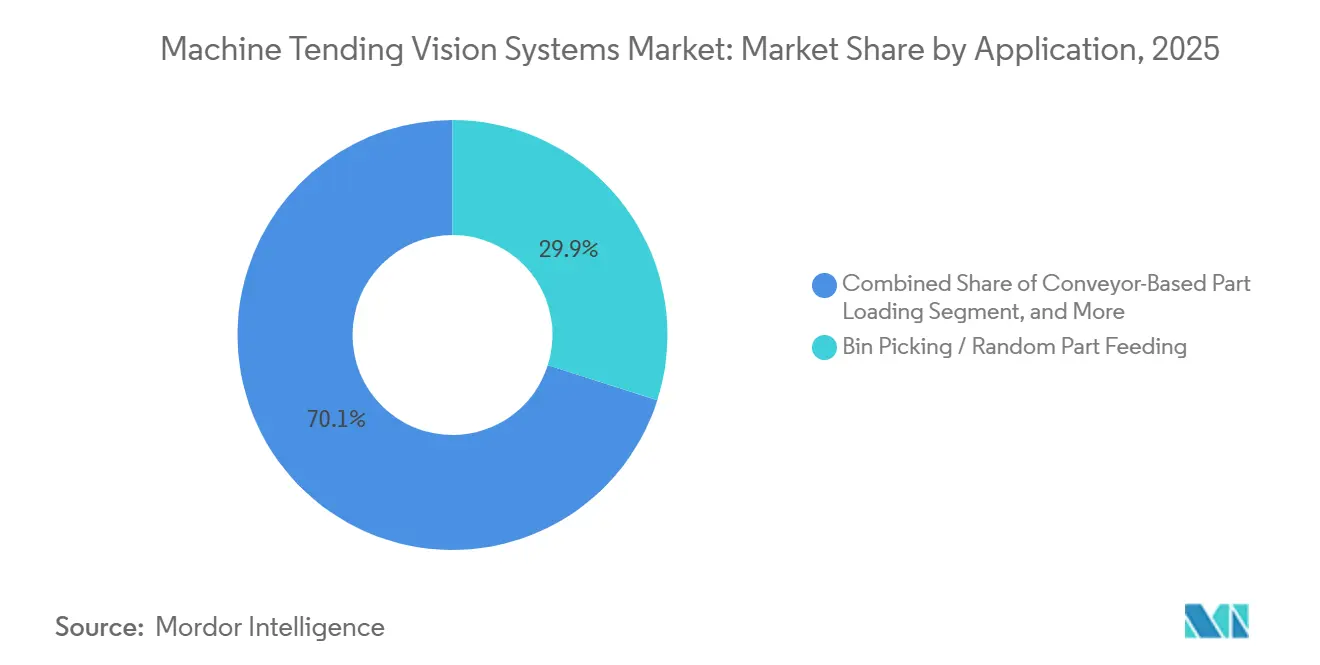
Bin picking and random part feeding held 29.91% of revenue in 2025 and are projected to expand at an 11.81% CAGR through 2031. These applications require the system to identify parts that arrive in variable orientations. A 2026 study reported sub-millimeter localization on metal parts at a 520 ms cycle time. This performance supports the use of AI-based bin picking in CNC tending workflows. Vention introduced Rapid Operator AI at NVIDIA GTC 2026 and reported up to 99% first-pick success rates for containers up to 60.9 cm deep. Apera AI introduced VuePod at Automate 2026 as a self-configuring bin-picking cell. Productized systems can reduce the need for extensive on-site expertise. These developments can lower deployment costs in suitable use cases. The Machine tending vision systems market share held by bin picking reflects its broad relevance for unstructured part presentation. The application also remains closely tied to advances in 3D perception and AI software.
Tray-based and pallet-based loading use structured input layouts that simplify automation design. Vision remains useful for confirming pocket occupancy and component orientation. Conveyor-based loading requires fast imaging that stays synchronized with moving material. This supports demand for 2D line-scan cameras in automotive and consumer electronics production. Direct machine-to-machine transfer uses vision to check handoff geometry and identify part slippage. These functions can reduce scrap across linked machining operations. Structured loading applications provide a dependable base of hardware demand through the forecast period. Tray-based loading is gaining interest in medical device assembly. Fragile components and sterile environments can support higher-value deployments in this setting. The Machine tending vision systems market remains diverse because structured and unstructured handling require different technical approaches.
By End-User Industry: Automotive Anchors Demand, While Electronics Leads Growth
Automotive and automotive components held 32.22% of revenue in 2025. High volumes of housings, shafts, brackets, and EV battery casings move through CNC tending cells. EV battery enclosures and electric motor housings create additional handling requirements. These components can support dedicated cells where output volumes justify the investment. Aerospace and defense is smaller by volume but carries higher value requirements. Tight tolerances, exotic alloys, and formal oversight support demand for calibrated and traceable vision systems. Metal fabrication and metalworking accounts for many cells but involves difficult surface conditions. Glare, coolant, and swarf can increase engineering work and affect system cost. Machinery and industrial equipment also uses flexible tending for varied machined subassemblies. The Machine tending vision systems market serves a range of end users because each requires reliable part handling and verification.
Electronics and semiconductors are projected to expand at an 11.87% CAGR through 2031. Semiconductor capacity additions and high-mix assembly profiles support this outlook. Rule-based automation can be difficult to maintain when product configurations change frequently. Collaborative robots represented 36.5% of semiconductor and electronics robot orders in the first half of 2026. Medical device applications are also emerging for vision-guided tending. FDA 21 CFR Part 11 and EU MDR requirements support monitoring systems that help with both guidance and documentation. Machinery producers require adaptable systems for varied parts and smaller batches. Fixture-based setups can be uneconomic when product variety is high. The Machine tending vision systems market benefits from this need for adaptable automation across specialized manufacturing settings. These end users value repeatable handling, traceability, and shorter changeover times.
Geography Analysis
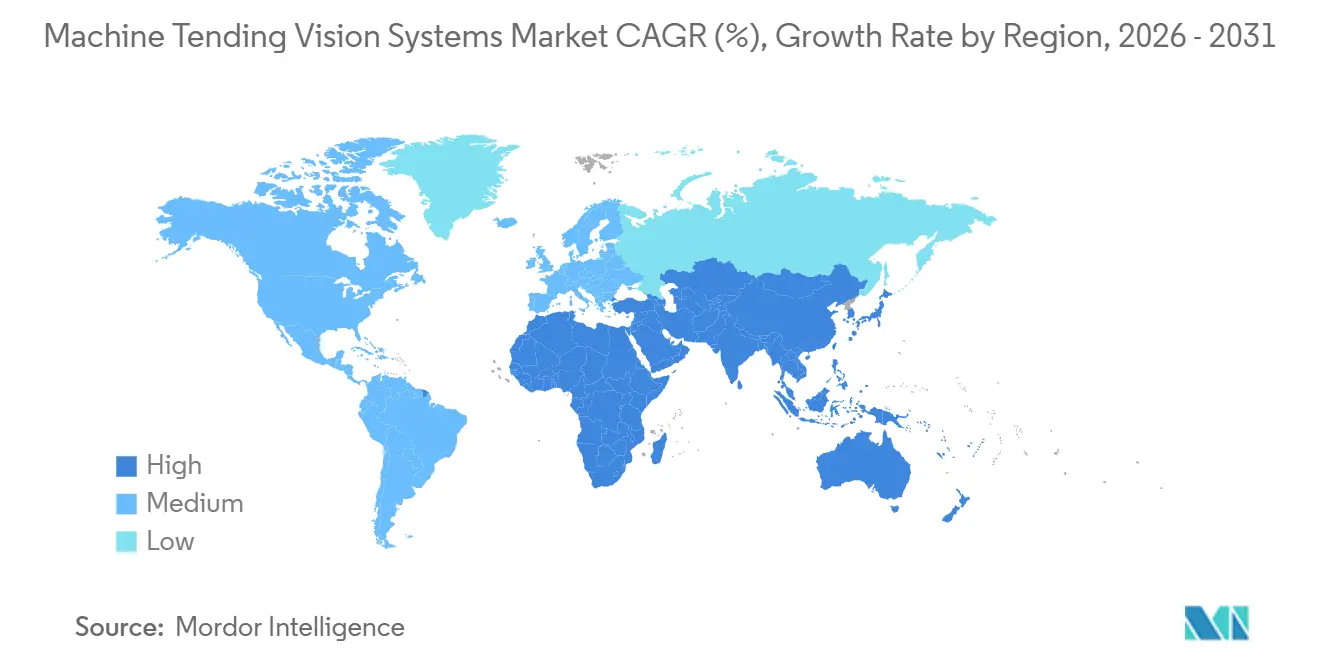
Asia-Pacific held 39.78% of global revenue in 2025. China, Japan, South Korea, and Taiwan provide a dense base of CNC machine tools and electronics production. China's electronics export activity, domestic machine tool sector, and manufacturing expansion in Vietnam and Thailand support regional demand. FANUC's Robot division generated JPY 378,610 million (USD 2.51 billion) at the fiscal year 2026 average rate, and revenue increased 14.9%, while Yaskawa introduced the MOTOMAN NEXT Agentic Robot System in July 2026.
North America and Europe are the second and third-largest regional markets. Reshoring, labor costs, manufacturing incentives, and new semiconductor and EV battery projects support automation investment in North America. Cognex reported USD 268 million in first-quarter 2026 revenue, up 24% year over year. Germany's automotive and mechanical engineering sectors remain important in Europe. SICK introduced AI-powered 3D inspection on its Nova platform in August 2026, while EU Machinery Regulation EU 2023/1230 and ISO 13849 make certification important for full-cell solutions.
Middle East and Africa is projected to record the fastest regional expansion through 2031. Saudi Arabian and United Arab Emirates manufacturing programs support automation-equipped industrial facilities. Rockwell Automation reported that 98% of Middle East manufacturers view digital transformation as essential and allocate close to 30% of operating budgets to advanced technology. Saudi Arabia's Alat is establishing domestic robot manufacturing with SoftBank Group, and the UAE's MIITE 2026 program includes an AED 1 billion industrial resilience fund. South America adds incremental demand through Brazil's automotive and metalworking clusters and Argentina's aerospace components base.
Competitive Landscape
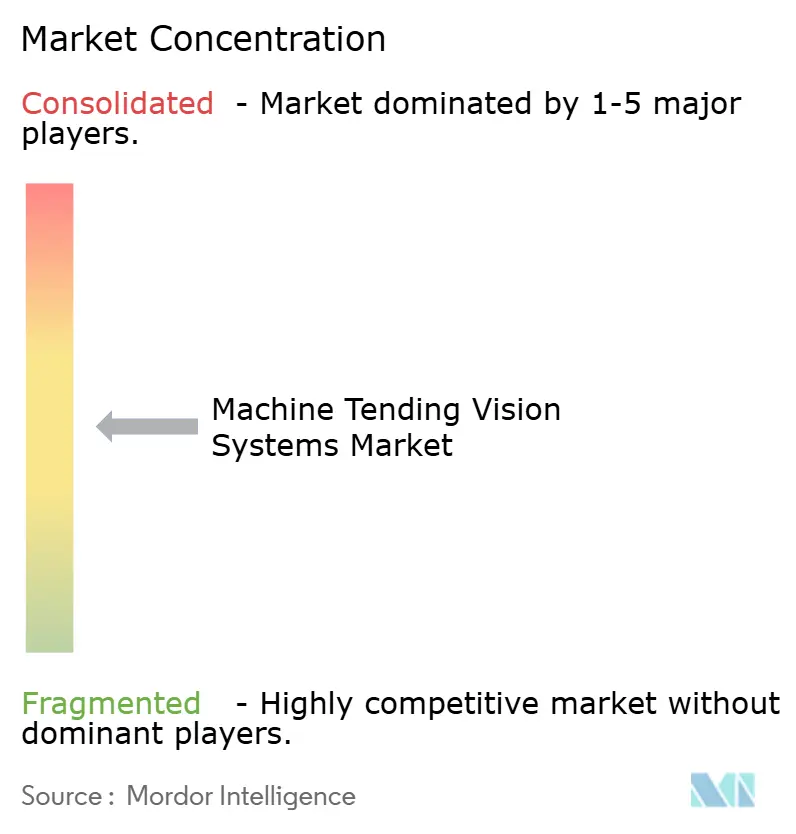
The Machine tending vision systems market is moderately fragmented across integrated platform providers, vision specialists, and AI-focused entrants. ABB, FANUC, Yaskawa, KUKA, and Mitsubishi Electric compete through motion and vision integration. Cognex, Keyence, SICK, Basler, and Allied Vision Technologies compete through imaging performance, software capabilities, and global service networks. Cognex stated that OneVision had more than 100 enterprise customers after its May 2026 general availability, and its platform centralizes AI model training while supporting local execution. Suppliers also seek opportunities in metallic-surface applications involving coolant and swarf.
Photoneo's Bin Picking Studio 1.12 supports more than 275 robot models across more than 11 brands. This capability provides a multi-brand option for 3D bin-picking deployments. Doosan Robotics received 2 CES 2026 Innovation Awards for its Scan and Go solution, which uses laser-based 3D vision to create optimized tool paths from point-cloud data. AI-focused entrants are increasing pressure in parts of the Machine tending vision systems market. Certified products and established support networks retain an advantage in regulated factory environments.EU Machinery Regulation EU 2023/1230 and ISO 13849 reinforce the position of larger suppliers with validation and service resources. Buyers may prefer vendors that can manage safety validation, vision systems, and robotics integration. Smaller specialists can remain competitive through focused imaging, AI capabilities, and multi-brand partnerships. The Machine tending vision systems market includes both integrated providers and specialist technology companies.
Machine Tending Vision Systems Industry Leaders
-
FANUC Corporation
-
ABB Ltd.
-
Cognex Corporation
-
Keyence Corporation
-
OMRON Corporation
- *Disclaimer: Major Players sorted in no particular order
Recent Industry Developments
- September 2026: SICK AG launched AI-powered 3D quality inspection on its Nova platform, combining deep learning with height data analysis for machined part anomaly detection. The release marks SICK's first AI deployment across its high-precision 3D vision range and enables configurable intelligent inspection without specialized machine vision expertise.
- July 2026: Yaskawa Electric Corporation announced the MOTOMAN NEXT Agentic Robot System, integrating Google DeepMind's Gemini Robotics ER 1.6 embodied reasoning model. The system enables robots to autonomously assess conditions and devise work procedures without pre-programmed instructions.
- July 2026: Photoneo released Bin Picking Studio 1.12 and Locator Studio 1.5, introducing direct 3D localization model creation from sensor scans, AI-based object classification, and Estun robot support. Compatible robot models now span 275+ across 11+ leading brands.
- June 2026: Apera AI unveiled VuePod at Automate 2026, a self-configuring bin-picking cell built on 4D Vision that autonomously plans picking strategies, reorientation, and path planning from initial deployment. The product eliminates on-site integration expertise requirements for bin-picking automation.
Global Machine Tending Vision Systems Market Report Scope
The machine tending vision systems market comprises the sale, integration, and servicing of hardware, software, and related solutions that use 2D or 3D machine vision to guide and monitor robots or collaborative robots during the automated loading, unloading, positioning, identification, and inspection of workpieces in CNC machines, lathes, milling centers, presses, injection-molding machines, and other industrial equipment.
The Machine Tending Vision Systems Market Report is Segmented by Offering (Hardware [Cameras and Vision Sensors, Optics and Lenses, Lighting Systems, Processors and Frame Grabbers, and Other Hardware Components], Software [Rule-Based Vision Software, Deep Learning and AI Vision Software, Calibration and Measurement Software, and Robot Guidance and Part-Localization Software], and Services [System Integration Services and Maintenance and Support Services]), by Vision Technology (2D Area-Scan Vision, 2D Line-Scan Vision, 3D Stereo Vision, Structured-Light 3D Vision, Time-of-Flight [ToF], and Other Vision Technologies), by Robot Type (Articulated Robots, Collaborative Robots [Cobots], SCARA Robots, Cartesian/Gantry Robots, and Other Robot Types), by Deployment (New Machine-Tending Cells and Retrofit/Upgraded Machine-Tending Cells), by Application (Bin Picking/Random Part Feeding, Tray-Based Part Loading, Conveyor-Based Part Loading, Pallet-Based Part Loading, Direct Machine-to-Machine Transfer, and Other Applications), by End-User Industry (Automotive and Automotive Components, Aerospace and Defense, Electronics and Semiconductors, Machinery and Industrial Equipment, Metal Fabrication and Metalworking, Medical Devices, and Other End-User Industries), and by Geography (North America [United States, Canada, and Mexico], South America [Brazil, Argentina, and Rest of South America], Europe [Germany, United Kingdom, France, Italy, Spain, and Rest of Europe], Asia-Pacific [China, Japan, India, South Korea, ASEAN, and Rest of Asia-Pacific], and Middle East and Africa [Middle East (Saudi Arabia, United Arab Emirates, and Rest of the Middle East) and Africa (South Africa and Rest of Africa)]). The Market Forecasts are Provided in Terms of Value (USD).
| Hardware | Cameras and Vision Sensors |
| Optics and Lenses | |
| Lighting Systems | |
| Processors and Frame Grabbers | |
| Other Hardware Components | |
| Software | Rule-Based Vision Software |
| Deep Learning and AI Vision Software | |
| Calibration and Measurement Software | |
| Robot Guidance and Part-Localization Software | |
| Services | System Integration Services |
| Maintenance and Support Services |
| 2D Area-Scan Vision |
| 2D Line-Scan Vision |
| 3D Stereo Vision |
| Structured-Light 3D Vision |
| Time-of-Flight (ToF) |
| Other Vision Technologies |
| Articulated Robots |
| Collaborative Robots (Cobots) |
| SCARA Robots |
| Cartesian / Gantry Robots |
| Other Robot Types |
| New Machine-Tending Cells |
| Retrofit / Upgraded Machine-Tending Cells |
| Bin Picking / Random Part Feeding |
| Tray-Based Part Loading |
| Conveyor-Based Part Loading |
| Pallet-Based Part Loading |
| Direct Machine-to-Machine Transfer |
| Other Applications |
| Automotive and Automotive Components |
| Aerospace and Defense |
| Electronics and Semiconductors |
| Machinery and Industrial Equipment |
| Metal Fabrication and Metalworking |
| Medical Devices |
| Other End-User Industries |
| North America | United States | |
| Canada | ||
| Mexico | ||
| South America | Brazil | |
| Argentina | ||
| Rest of South America | ||
| Europe | Germany | |
| United Kingdom | ||
| France | ||
| Italy | ||
| Spain | ||
| Rest of Europe | ||
| Asia-Pacific | China | |
| Japan | ||
| India | ||
| South Korea | ||
| ASEAN | ||
| Rest of Asia-Pacific | ||
| Middle East and Africa | Middle East | Saudi Arabia |
| United Arab Emirates | ||
| Rest of the Middle East | ||
| Africa | South Africa | |
| Rest of Africa | ||
| By Offering | Hardware | Cameras and Vision Sensors | |
| Optics and Lenses | |||
| Lighting Systems | |||
| Processors and Frame Grabbers | |||
| Other Hardware Components | |||
| Software | Rule-Based Vision Software | ||
| Deep Learning and AI Vision Software | |||
| Calibration and Measurement Software | |||
| Robot Guidance and Part-Localization Software | |||
| Services | System Integration Services | ||
| Maintenance and Support Services | |||
| By Vision Technology | 2D Area-Scan Vision | ||
| 2D Line-Scan Vision | |||
| 3D Stereo Vision | |||
| Structured-Light 3D Vision | |||
| Time-of-Flight (ToF) | |||
| Other Vision Technologies | |||
| By Robot Type | Articulated Robots | ||
| Collaborative Robots (Cobots) | |||
| SCARA Robots | |||
| Cartesian / Gantry Robots | |||
| Other Robot Types | |||
| By Deployment | New Machine-Tending Cells | ||
| Retrofit / Upgraded Machine-Tending Cells | |||
| By Application | Bin Picking / Random Part Feeding | ||
| Tray-Based Part Loading | |||
| Conveyor-Based Part Loading | |||
| Pallet-Based Part Loading | |||
| Direct Machine-to-Machine Transfer | |||
| Other Applications | |||
| By End-User Industry | Automotive and Automotive Components | ||
| Aerospace and Defense | |||
| Electronics and Semiconductors | |||
| Machinery and Industrial Equipment | |||
| Metal Fabrication and Metalworking | |||
| Medical Devices | |||
| Other End-User Industries | |||
| By Geography | North America | United States | |
| Canada | |||
| Mexico | |||
| South America | Brazil | ||
| Argentina | |||
| Rest of South America | |||
| Europe | Germany | ||
| United Kingdom | |||
| France | |||
| Italy | |||
| Spain | |||
| Rest of Europe | |||
| Asia-Pacific | China | ||
| Japan | |||
| India | |||
| South Korea | |||
| ASEAN | |||
| Rest of Asia-Pacific | |||
| Middle East and Africa | Middle East | Saudi Arabia | |
| United Arab Emirates | |||
| Rest of the Middle East | |||
| Africa | South Africa | ||
| Rest of Africa | |||
Key Questions Answered in the Report
What is the size of the machine tending vision systems market?
The market was valued at USD 459.51 million in 2025 and is projected to reach USD 841.63 million by 2031 at a CAGR of 10.82%.
Which offering category leads machine tending vision systems?
Hardware led with 57.65% of revenue in 2025 because cameras, sensors, lighting, and processors are required in automated tending cells.
What technology is expanding fastest in machine tending vision systems?
Time-of-flight vision is projected to expand at an 11.32% CAGR through 2031, supported by depth-aware localization and safety monitoring needs.
Why are collaborative robots important for machine tending?
Collaborative robots are projected to expand at an 11.78% CAGR through 2031 because they support flexible, lower-payload tasks in high-mix operations.
Which application holds the largest share in machine tending vision systems?
Bin picking and random part feeding held 29.91% of revenue in 2025 and are projected to expand at an 11.81% CAGR through 2031.
Which region leads demand for machine tending vision systems?
Asia-Pacific held 39.78% of revenue in 2025, supported by its CNC machine tool, electronics, and semiconductor production base.