
Modular Machine Vision Systems Market Size and Share
Market Overview
| Study Period | 2020 - 2031 |
|---|---|
| Market Size (2026) | USD 5.32 Billion |
| Market Size (2031) | USD 7.78 Billion |
| Fastest Growing Market | Asia-Pacific |
| Largest Market | Asia-Pacific |
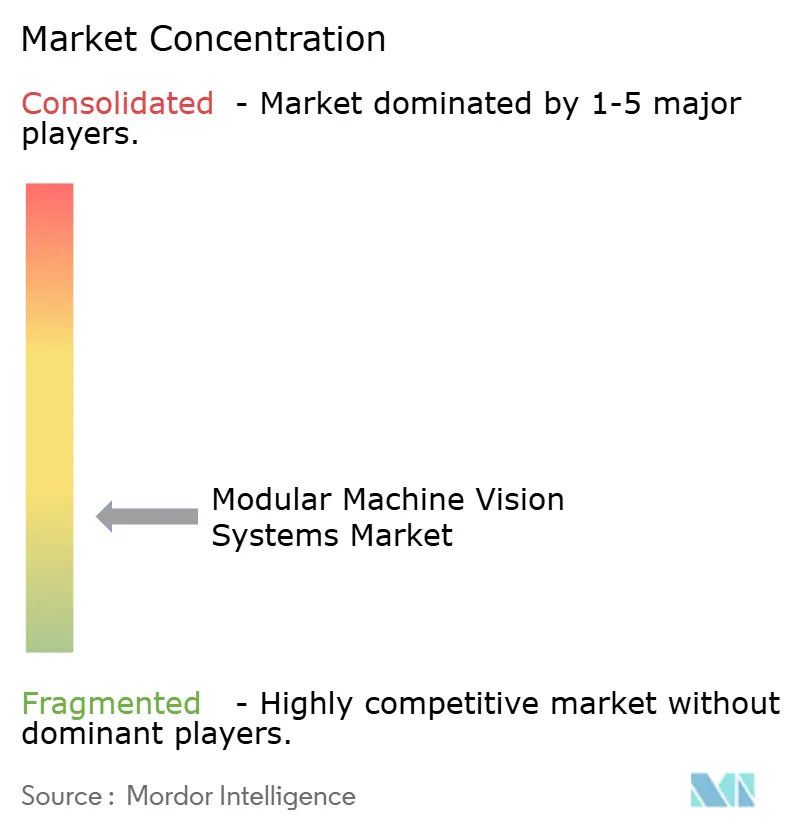
| Market Concentration | Low |
Major Players *Disclaimer: Major Players sorted in no particular order Image © Mordor Intelligence. Reuse requires attribution under CC BY 4.0. | |
Modular Machine Vision Systems Market Analysis by Mordor Intelligence
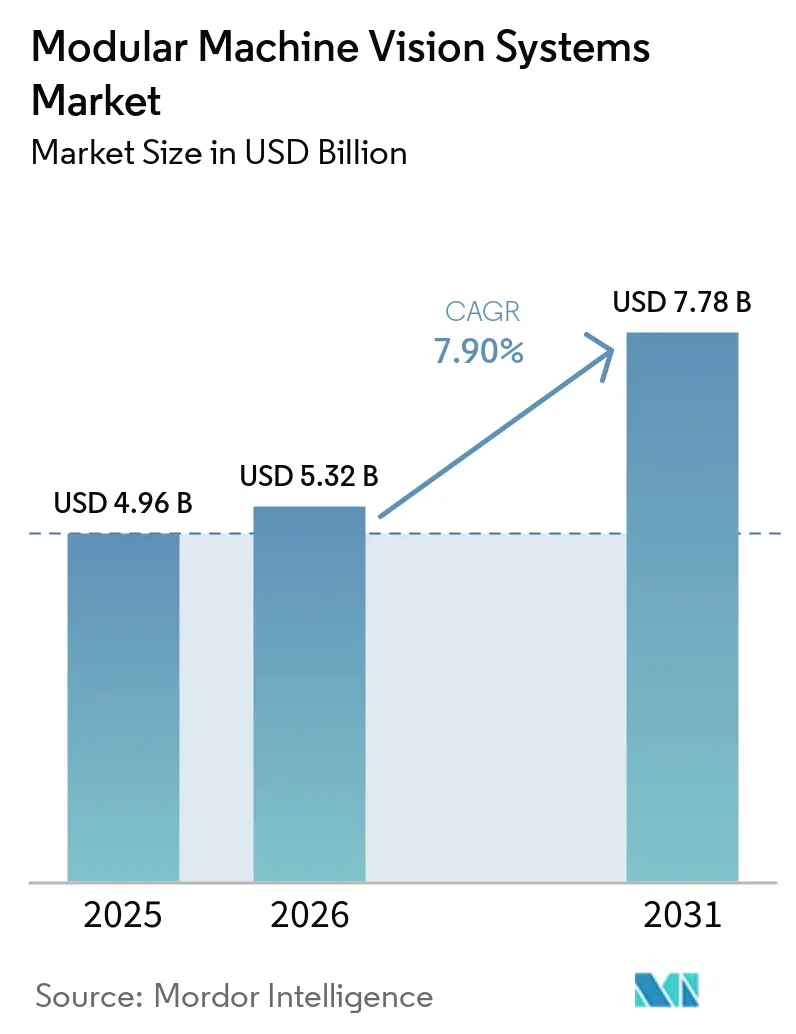
The Modular Machine Vision Systems Market size was valued at USD 4.96 billion in 2025 and is estimated to grow from USD 5.32 billion in 2026 to reach USD 7.78 billion by 2031, at a CAGR of 7.90% during the forecast period (2026-2031).
Factory automation programs are moving buyers away from fixed systems because modular equipment can be adjusted when product lines change. Edge AI is also increasing demand for separate processing and computing modules instead of closed hardware bundles. Suppliers are using software platforms to connect hardware sales with subscription income and multi-site deployments. This approach favors vendors that can combine training tools, cameras, optics, and controls in a usable system. Integration costs, limited specialist skills, and cybersecurity requirements remain important barriers, particularly for smaller manufacturers and emerging economies.
Key Report Takeaways
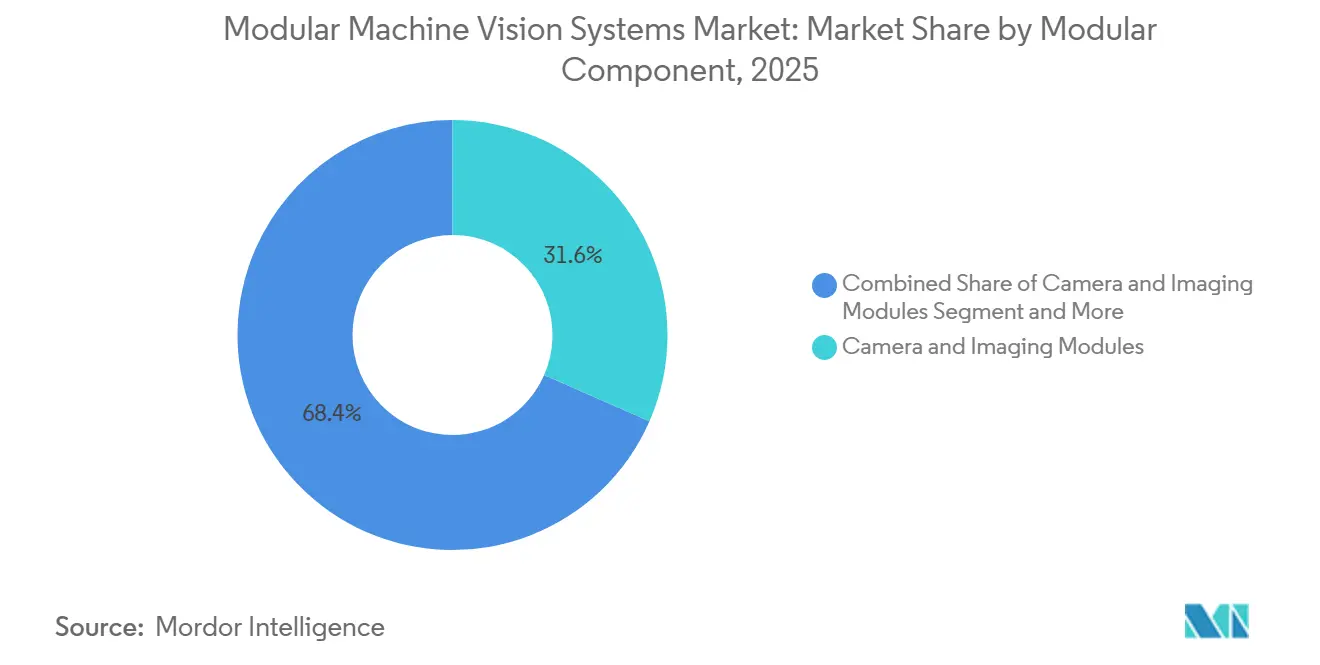
- By modular component, Camera and Imaging Modules held 31.56% of the modular machine vision systems market share in 2025, while Vision Software and AI Modules are projected to expand at a 9.11% CAGR through 2031.
- By imaging type, 2D Vision Systems accounted for 68.76% of the modular machine vision systems market size in 2025, while Hyperspectral and Multispectral Imaging Systems are expected to expand at a 9.88% CAGR through 2031.
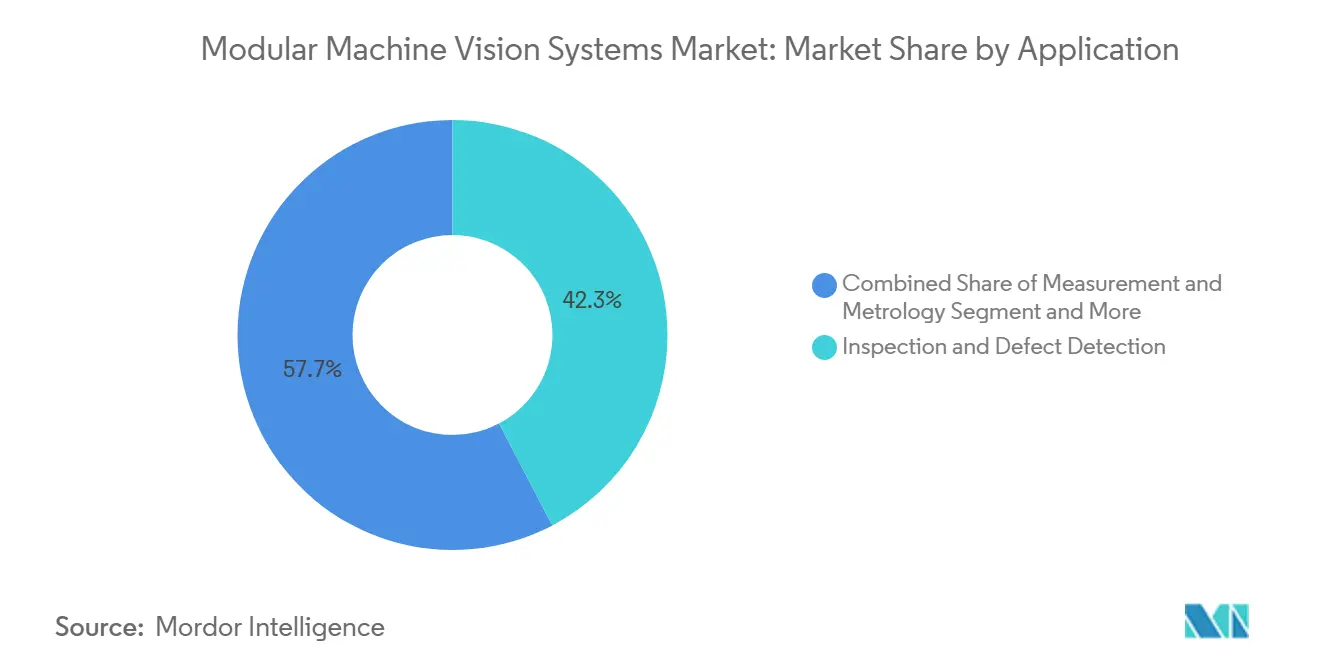
- By application, Inspection and Defect Detection held 42.31% of revenue in 2025, while Guidance and Positioning is projected to advance at an 8.66% CAGR through 2031.
- By end-user industry, Automotive accounted for 25.12% of revenue in 2025, while Healthcare and Pharmaceuticals is expected to expand at an 8.78% CAGR through 2031.
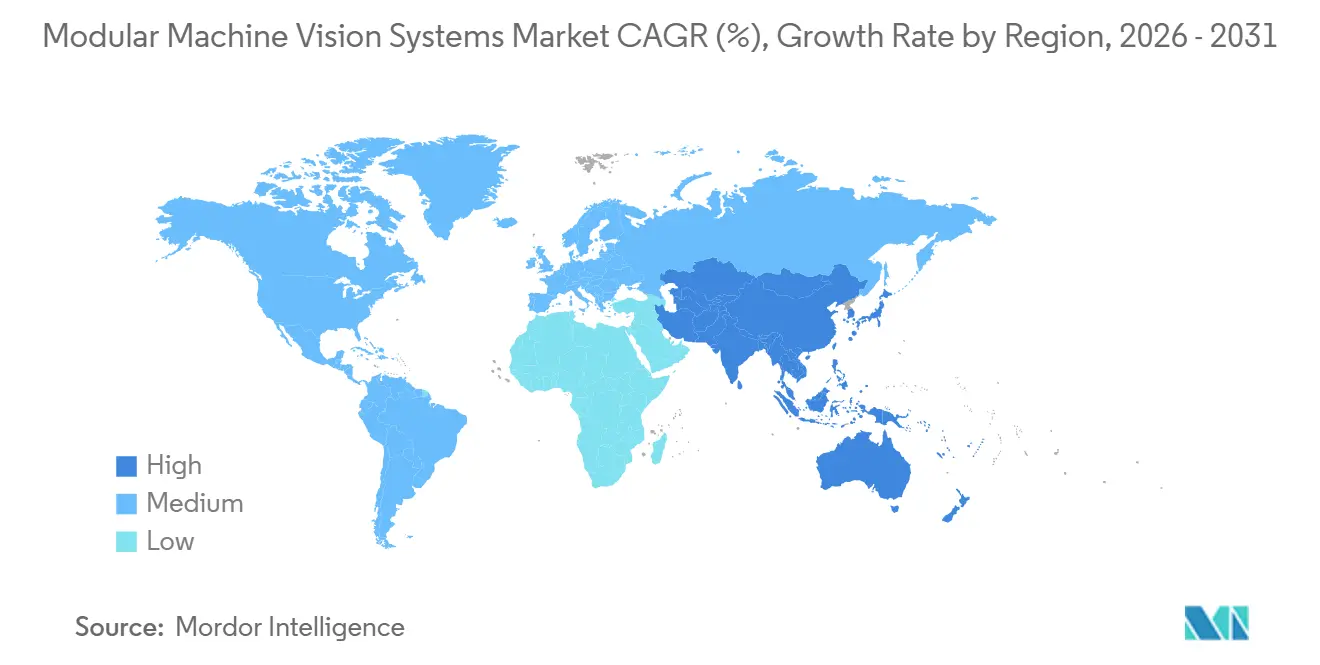
- By geography, Asia-Pacific held 38.76% of the modular machine vision systems market share in 2025 and is projected to advance at an 8.32% CAGR through 2031.
Note: Market size and forecast figures in this report are generated using Mordor Intelligence’s proprietary estimation framework, updated with the latest available data and insights as of January 2026.
Market Trends and Insights
Drivers Impact Analysis of Modular Machine Vision Systems Market*
| Driver | (~) % Impact on CAGR Forecast | Geographic Relevance | Impact Timeline |
|---|---|---|---|
| Factory Automation and Industry 4.0 Adoption | +2.1% | Global | Long term (≥ 4 years) |
| AI-Enabled Defect Detection and Process Optimization | +1.7% | Global, concentrated in North America, Europe, and Asia-Pacific | Medium term (2-4 years) |
| Electronics, Semiconductor, and Battery Inspection Complexity | +1.2% | Asia-Pacific core, with spillover to North America | Long term (≥ 4 years) |
| Vision-Guided Robotics and Autonomous Material Handling | +1.0% | North America, Asia-Pacific, and Europe | Medium term (2-4 years) |
| Edge AI Inference in Space-Constrained Machines | +0.7% | Global | Short term (≤ 2 years) |
| Machine-Readable Product Identity Requirements | +0.4% | Global | Short term (≤ 2 years) |
| Source: Mordor Intelligence | |||
Factory Automation and Industry 4.0 Adoption
Smart manufacturing investment is a major force behind the modular machine vision systems market. Manufacturers need inspection systems that can be adjusted as product designs and production volumes change. Open communication standards make it easier to link cameras, lighting, processors, and plant controls. This requirement supports modular systems with compatible input and output modules. Japan, Germany, and China are important manufacturing centers where modernization programs are influencing procurement decisions. In these locations, compliance requirements can affect the timing of upgrades as much as the expected financial return.
AI-Enabled Defect Detection and Process Optimization
AI-based defect detection is moving from pilot projects into production use across the modular machine vision systems market. NVIDIA reported 98.51% accuracy for die-level semiconductor defect classification using a vision foundation model and self-supervised learning. The approach also reduced the labeled data needed for specialized inspection tasks.[1]NVIDIA Corporation, “Optimizing Semiconductor Defect Classification with Generative AI and Vision Foundation Models,” NVIDIA Developer Blog, developer.nvidia.com. This matters where defects occur rarely and labeled images are limited. A 2025 review found that deep learning outperformed classical machine learning in several industrial inspection settings when datasets included more than 10,000 samples. Processing modules that support these models can reduce annotation and retraining work over the system life cycle.
Electronics, Semiconductor, and Battery Inspection Complexity
Semiconductor nodes are becoming smaller, and advanced packaging requires more demanding inspection methods. Chiplet, chip-on-wafer-on-substrate, and fan-out wafer-level packaging can exceed the capability of older optical systems. Battery manufacturing adds separate needs for electrode-coating uniformity and separator defect detection. These tasks require fine spatial resolution and, in some cases, multispectral sensing. Interchangeable optics and lighting can help manufacturers update a system as process requirements change. This reduces the risk of replacing a complete inspection platform during a typical 5-7-year capital equipment cycle.
Vision-Guided Robotics and Autonomous Material Handling
Vision-guided robots are expanding the addressable use cases for the modular machine vision systems market. Fulfillment centers need systems that can identify varied stock-keeping units and guide picking equipment in real time. A modular camera and lighting configuration lets operators modify pick zones or add product types without rebuilding a full robotic cell. Industrial AI deployments also use automated guided vehicles and autonomous mobile robots for material movement. Humanoid robot trials in 2025 and 2026 create added demand for lightweight, body-mounted camera and processing combinations. These designs must operate reliably under six-degrees-of-freedom motion.
Restraints Impact Analysis of Modular Machine Vision Systems Market*
| Restraint | (~) % Impact on CAGR Forecast | Geographic Relevance | Impact Timeline |
|---|---|---|---|
| High System Integration and Lifecycle Costs | -1.4% | Global, most pronounced in emerging markets | Long term (≥ 4 years) |
| Shortage of Machine Vision Integration Skills | -1.0% | Global | Medium term (2-4 years) |
| Dataset Drift Across Product and Lighting Variants | -0.7% | Global | Medium term (2-4 years) |
| Industrial Cybersecurity and Data-Ownership Concerns | -0.4% | North America, Europe, and Asia-Pacific | Short term (≤ 2 years) |
| Source: Mordor Intelligence | |||
High System Integration and Lifecycle Costs
Total ownership costs can be higher than buyers expect in the modular machine vision systems market. Hardware can represent 40-60% of a project cost, while integration engineering, licenses, calibration, and lighting design make up the balance. Multi-vendor configurations can need custom middleware to ensure compatibility between component layers. Lens and lighting modules also have different replacement schedules. This makes maintenance more complicated than it is for a monolithic smart camera. Standard interfaces and certification programs can reduce this burden, but adoption remains uneven across the vendor base.
Shortage of Machine Vision Integration Skills
Machine vision integration requires knowledge of optics, industrial networks, programmable logic controllers, supervisory control systems, and AI model management. This combination is difficult to find in a single engineer. Longer hiring periods for certified vision specialists can delay commissioning and raise contractor costs. Automated setup tools can reduce the amount of specialist work needed for each deployment. Cognex stated that more than 100 enterprise customers used OneVision during its beta phase and reduced AI expansion costs by up to 50%. Model drift monitoring and retraining add another skill requirement that was less relevant to rule-based systems.
*Our forecasts treat driver/restraint impacts as directional, not additive. The impact forecasts reflect baseline growth, mix effects, and variable interactions.
Modular Machine Vision Systems Market Segment Analysis
By Modular Component:
Camera Modules Lead as AI Software Supports Faster ExpansionCamera and Imaging Modules held 31.56% of the modular machine vision systems market share in 2025. Camera selection drives choices for resolution, sensor format, shutter type, and interface protocol. It therefore affects many later decisions within a modular system. Optics and Lens Modules, Lighting Modules, and Image Acquisition and Interface Modules make up the next group of hardware spending. Tunable LED lighting is gaining attention where surface texture or material composition must be distinguished. Processing and Computing Modules have also changed as edge-capable AI accelerators become part of higher-performance systems.
Cognex introduced its In-Sight 6900 Vision Controller in April 2026 with NVIDIA Jetson technology and up to 157 TOPS of AI performance.[2]Cognex Corporation, “Cognex Launches In-Sight Vision Controller Powered by NVIDIA,” Cognex, investor.cognex.com. Vision Software and AI Modules are projected to record the fastest component CAGR at 9.11% through 2031. Software creates a closer customer relationship because it can support training, refinement, and deployment across several sites. Cognex made OneVision generally available in May 2026 after a beta involving more than 100 enterprise customers. I/O and Communication Modules remain relatively standardized, but demand for OPC-UA-ready interfaces is improving where digital manufacturing programs specify compatible data connections.



By Imaging Type:
2D Systems Retain Scale While Hyperspectral Use Broadens2D Vision Systems accounted for 68.76% of the modular machine vision systems market size in 2025. Their large installed base reflects familiar integration methods, established software support, and a lower cost per inspection point. Packaging, electronics assembly, and logistics code-reading commonly use high-speed global-shutter cameras. LMI Technologies launched Gocator 2D Smart Cameras in January 2026 with edge-native AI, IP67 enclosures, and support for up to 84 frames per second. These capabilities can extend 2D deployment into settings that previously needed a more costly 3D configuration.
3D Vision Systems are used in bin picking, solder-joint inspection, and automotive body-gap measurement, where depth information is necessary. Basler and Orbbec announced an industrial 3D vision partnership in March 2026, including the Basler Stereo mini for autonomous mobile robot and automated guided vehicle navigation.[3]Basler AG, “Basler AG and Orbbec Partner for Industrial 3D Vision Solutions,” Basler, baslerweb.com. Hyperspectral and Multispectral Imaging Systems are projected to expand at a 9.88% CAGR through 2031. Lower detector costs and on-chip neural networks have reduced inference latency to less than 10 milliseconds on snapshot cameras. Food sorting, pharmaceutical inspection, battery-cathode verification, and incoming material authentication need spectral information that RGB systems cannot provide.
By Application:
Inspection Holds Revenue While Guidance and Positioning ExpandsInspection and Defect Detection held 42.31% of application revenue in 2025. Zero-defect requirements support demand in automotive supply chains, battery manufacturing, and pharmaceutical packaging. The IMDD-1M project presented at CVPR 2026 included 1.24 million annotated defect images across 421 defect types and 63 industrial domains. This work supports the training data needed for AI inspection in specialized applications. Measurement and Metrology is also important where semiconductor packaging and smaller electronic components require tighter geometric tolerances.
Identification and Code Reading is receiving added attention in 2026 because GS1 Sunrise 2027 requires point-of-sale systems to read 2D barcodes by the end of 2027. This change requires brands to validate inline print-and-verify stations for QR codes and DataMatrix formats. Guidance and Positioning is expected to record the fastest application CAGR at 8.66% through 2031. Collaborative robotics in manufacturing and logistics needs real-time spatial awareness throughout each operating cycle. Print and label inspection and agricultural produce sorting remain smaller applications, but they are gaining use among smaller manufacturers that previously relied on manual inspection.
By End-User Industry:
Automotive Anchors Demand While Healthcare and Pharmaceuticals AcceleratesAutomotive held the largest end-user share at 25.12% in 2025. Production scale and high inspection density across vehicle lines support this position. Battery packs and electric powertrains add inspection needs for electrode coating, tab welding, and electrolyte fill levels. Modular systems can serve these separate inspection stations more cost-effectively than fixed purpose-built equipment. Electronics and semiconductors are the second-largest end-user segment. Display panel inspection in South Korea and semiconductor automated optical inspection in Taiwan support demand for high-speed line-scan and area-scan modules.
Food and Beverage, Logistics and Retail, and Packaging use AI vision to manage variable product appearances. Irregular produce shapes and varied labels are more difficult for rule-based systems that need a separate recipe for each variant. Healthcare and Pharmaceuticals is projected to record the fastest end-user CAGR at 8.78% through 2031. Electronic records and medicine serialization requirements make verified packaging inspection a necessary compliance activity. OMRON released the VHV5-SRV Barcode Verification System in June 2026 for calibrated inline verification under IEC 15415 and IEC 15416 requirements.[4]OMRON Automation, “OMRON Introduces VHV5-SRV Barcode Verification System for 100% Inline Inspection,” OMRON Automation, automation.omron.com. The system supports secondary packaging inspection, label checks, serialization verification, fill-level inspection, and container integrity assessment.
Geography Analysis
APAC Modular Machine Vision Systems Market
Asia-Pacific held 38.76% of the modular machine vision systems market share in 2025 and is projected to expand at an 8.32% CAGR through 2031. China has the largest national demand in the region, with semiconductor automated optical inspection, AI-enabled vision systems, and robot vision attracting investment. Japan is upgrading older inspection lines as manufacturers adopt interoperable factory systems. South Korea needs high-speed line-scan and metrology-grade sensors for semiconductor memory and display panels. Basler acquired a 76% stake in Alpha TechSys Automation in October 2025 and rebranded it as Basler India, strengthening its sales and service presence in India.
North America and Europe Modular Machine Vision Systems Market
North America and Europe together form the second-largest combined demand area in the modular machine vision systems market. The United States has a strong demand for AI vision software and semiconductor capital equipment integration. Defense and national security programs also favor on-device systems that keep inference data local. Germany anchors European demand through automotive suppliers and precision engineering companies. The United Kingdom, France, Italy, and Spain focus more on packaging machinery and food and beverage inspection. Canada and Mexico benefit from semiconductor and automotive supply-chain investment, though their volumes are lower than those of the United States.
MEA and South America Modular Machine Vision Systems Market
The Middle East and Africa are at earlier stages of adoption, but manufacturing investment is creating new opportunities. Saudi Arabia and the United Arab Emirates are building domestic manufacturing capacity, which supports vision-guided inspection in new pharmaceutical, food processing, and electronics plants. Greenfield projects can reduce integration barriers because modular standards are included in line design from the start. South Africa has the most established machine vision demand in Africa, driven by automotive assembly and food processing. Brazil leads South America, where automotive and food processing support structured investment. Argentina and other South American countries remain smaller opportunities as capital equipment becomes more affordable.

Competitive Landscape
The modular machine vision systems market is fragmented. Cognex Corporation, KEYENCE Corporation, and Teledyne Technologies together held roughly one-third of global revenue, while specialized component makers accounted for the remainder. Competition increasingly centers on software that helps customers build and manage AI inspection applications across sites. Cognex made OneVision generally available in May 2026 as a collaborative environment for developing, refining, and scaling AI vision applications. This model links hardware deployments to software use and can support recurring revenue. Vendors with capable software and hardware portfolios are better placed to win larger enterprise contracts.
KEYENCE offers the VS-G Series with a custom 32-core AI engine, built-in image storage, and support for up to 8 camera connections. Its image storage capability supports visual traceability across production processes. Teledyne agreed in August 2026 to acquire Varex Imaging in an all-cash transaction valued at USD 1.1 billion. The transaction adds X-ray tubes, digital flat-panel detectors, photon-counting detectors, and imaging software. It broadens Teledyne’s position in medical imaging and industrial nondestructive inspection. Such moves show why vendors are seeking broader imaging portfolios rather than relying on a single component category.
Potential openings remain in hyperspectral integration for mid-market users, cybersecurity-certified platforms for regulated operations, and compact 3D systems for mobile and humanoid robots. Advantech and Basler announced a GMSL-based vision and robotics computing partnership in April 2026 for physical AI, humanoid robotics, autonomous mobile robots, and intelligent logistics. Component partnerships can shorten the time needed to serve these emerging uses. Buyers still need systems that combine cameras, optics, lighting, computing, and software without creating excessive integration work. This requirement favors suppliers that can demonstrate compatibility and support throughout deployment.
Modular Machine Vision Systems Industry Leaders
Cognex Corporation
KEYENCE CORPORATION
Basler AG
Teledyne Technologies Incorporated
OMRON Corporation
- *Disclaimer: Major Players sorted in no particular order
Modular Machine Vision Systems Market Companies Covered in this Report
- Cognex Corporation
- KEYENCE CORPORATION
- Basler AG
- Teledyne Technologies Incorporated
- OMRON Corporation
- Allied Vision Technologies GmbH
- IDS Imaging Development Systems GmbH
- MVTec Software GmbH
- LMI Technologies Inc.
- Matrox Imaging Inc.
- Euresys S.A.
- Chromasens GmbH
- JAI A/S
- Vieworks Co., Ltd.
- Tordivel AS
- Opto Engineering S.p.A.
- A&B Software LLC
- Advanced Illumination, Inc.
- CCS Inc.
- Smart Vision Lights, Inc.
- Edmund Optics Inc.

Recent Industry Developments in Modular Machine Vision Systems Market
- August 2026: Teledyne Technologies announced a definitive agreement to acquire Varex Imaging Corporation in an all-cash transaction valued at USD 1.1 billion. The consideration is USD 18.90 per share, representing a 52.3% premium to Varex's last closing price. The deal adds X-ray tubes, digital flat-panel detectors, photon-counting detectors, and imaging software to Teledyne's portfolio. It extends the company’s modular imaging reach into medical diagnostic imaging and industrial nondestructive inspection. Closing is anticipated in early 2027, subject to regulatory approvals and Varex shareholder consent.
- July 2026: Mitsubishi Electric and Sony Semiconductor Solutions announced a strategic joint venture agreement, including the establishment of Advanced Vision Solutions in Yokohama, Japan. Mitsubishi Electric holds 60% and Sony Semiconductor Solutions holds 40%. The venture will develop AI vision sensor solutions for factory automation. It combines Mitsubishi’s factory automation control expertise with Sony Semiconductor’s image sensor and edge AI technology. Business operations are scheduled to begin in October 2026.
- April 2026: Advantech and Basler AG announced a strategic partnership to deliver a GMSL-based vision and robotics computing platform. The platform combines Basler's ace 2 GMSL industrial cameras with Advantech's robotic controllers powered by NVIDIA Jetson. It targets physical AI, humanoid robotics, autonomous mobile robots, and intelligent logistics applications.
- March 2026: Onto Innovation launched the Dragonfly G5 inspection system for sub-micron 2D and 3D macro defect inspection in high-volume semiconductor manufacturing. It incorporates multi-mode illumination, advanced optics, and AI-powered defect classification. The system received orders displacing the previous tool-of-record for 2D inspection at multiple customer fabrication plants. 3Di shipments also began alongside Dragonfly G5 placements.


Global Modular Machine Vision Systems Market Report Scope
The modular machine vision systems refer to the customizable industrial inspection setups built by selecting and combining separate, compatible hardware and software components, such as cameras, lenses, lighting, frame grabbers, and processors, rather than using a single pre-packaged unit.
The Modular Machine Vision Systems Market Report is Segmented by Modular Component (Camera and Imaging Modules, Optics and Lens Modules, Lighting Modules, Image Acquisition and Interface Modules, Processing and Computing Modules, Vision Software and AI Modules, and I/O and Communication Modules), Imaging Type (2D Vision Systems, 3D Vision Systems, and Hyperspectral and Multispectral Imaging Systems), Applications (Inspection and Defect Detection, Measurement and Metrology, Identification and Code Reading, Guidance and Positioning, and Other Applications), End-User Industry (Automotive, Electronics and Semiconductors, Food and Beverage, Healthcare and Pharmaceuticals, Logistics and Retail, Packaging, and Other End-User Industries), and Geography (North America, Europe, Asia-Pacific, Middle East, and Africa). The Market Forecasts are Provided in Terms of Value (USD).
| Camera and Imaging Modules |
| Optics and Lens Modules |
| Lighting Modules |
| Image Acquisition and Interface Modules |
| Processing and Computing Modules |
| Vision Software and AI Modules |
| I/O and Communication Modules |
| 2D Vision Systems |
| 3D Vision Systems |
| Hyperspectral and Multispectral Imaging Systems |
| Inspection and Defect Detection |
| Measurement and Metrology |
| Identification and Code Reading |
| Guidance and Positioning |
| Other Applications |
| Automotive |
| Electronics and Semiconductors |
| Food and Beverage |
| Healthcare and Pharmaceuticals |
| Logistics and Retail |
| Packaging |
| Other End-User Industries |
| North America | United States |
| Canada | |
| Mexico | |
| South America | Brazil |
| Argentina | |
| Rest of South America | |
| Europe | Germany |
| United Kingdom | |
| France | |
| Italy | |
| Spain | |
| Rest of Europe | |
| Asia-Pacific | China |
| Japan | |
| India | |
| South Korea | |
| ASEAN | |
| Rest of Asia-Pacific | |
| Middle East | Saudi Arabia |
| United Arab Emirates | |
| Rest of the Middle East | |
| Africa | South Africa |
| Rest of Africa |
| By Modular Component | Camera and Imaging Modules | |
| Optics and Lens Modules | ||
| Lighting Modules | ||
| Image Acquisition and Interface Modules | ||
| Processing and Computing Modules | ||
| Vision Software and AI Modules | ||
| I/O and Communication Modules | ||
| By Imaging Type | 2D Vision Systems | |
| 3D Vision Systems | ||
| Hyperspectral and Multispectral Imaging Systems | ||
| By Application | Inspection and Defect Detection | |
| Measurement and Metrology | ||
| Identification and Code Reading | ||
| Guidance and Positioning | ||
| Other Applications | ||
| By End-User Industry | Automotive | |
| Electronics and Semiconductors | ||
| Food and Beverage | ||
| Healthcare and Pharmaceuticals | ||
| Logistics and Retail | ||
| Packaging | ||
| Other End-User Industries | ||
| By Geography | North America | United States |
| Canada | ||
| Mexico | ||
| South America | Brazil | |
| Argentina | ||
| Rest of South America | ||
| Europe | Germany | |
| United Kingdom | ||
| France | ||
| Italy | ||
| Spain | ||
| Rest of Europe | ||
| Asia-Pacific | China | |
| Japan | ||
| India | ||
| South Korea | ||
| ASEAN | ||
| Rest of Asia-Pacific | ||
| Middle East | Saudi Arabia | |
| United Arab Emirates | ||
| Rest of the Middle East | ||
| Africa | South Africa | |
| Rest of Africa | ||


Key Questions Answered in the Report
What is the modular machine vision systems market size?
The modular machine vision systems market size was USD 5.3 billion in 2026 and is estimated to reach USD 7.8 billion by 2031 at a 7.90% CAGR.
Which component holds the largest share of modular machine vision systems?
Camera and Imaging Modules held 31.56% of revenue in 2025 because camera specifications shape later optics and processing choices.
Which imaging technology is expected to expand fastest?
Hyperspectral and Multispectral Imaging Systems are projected to expand at a 9.88% CAGR through 2031, supported by food, pharmaceutical, and battery inspection uses.
Why are companies adopting modular machine vision systems?
Manufacturers use modular systems to adjust cameras, lighting, and computing as product lines, inspection needs, and automation programs change.
Which end-user sector is expected to expand fastest?
Healthcare and Pharmaceuticals is expected to expand at an 8.78% CAGR through 2031 due to packaging inspection and serialization requirements.
Which region leads demand for modular machine vision systems?
Asia-Pacific held 38.76% of revenue in 2025 and is projected to expand at an 8.32% CAGR through 2031.
Page last updated on:





