
Compact Machine Vision Systems Market Size and Share
Market Overview
| Study Period | 2020 - 2031 |
|---|---|
| Market Size (2026) | USD 4.5 Billion |
| Market Size (2031) | USD 6.66 Billion |
| Growth Rate (2026 - 2031) | 8.16 % |
| Fastest Growing Market | Asia-Pacific |
| Largest Market | Asia-Pacific |
| Market Concentration | Medium |
Major Players *Disclaimer: Major Players sorted in no particular order Image © Mordor Intelligence. Reuse requires attribution under CC BY 4.0. | |
Compact Machine Vision Systems Market Analysis by Mordor Intelligence
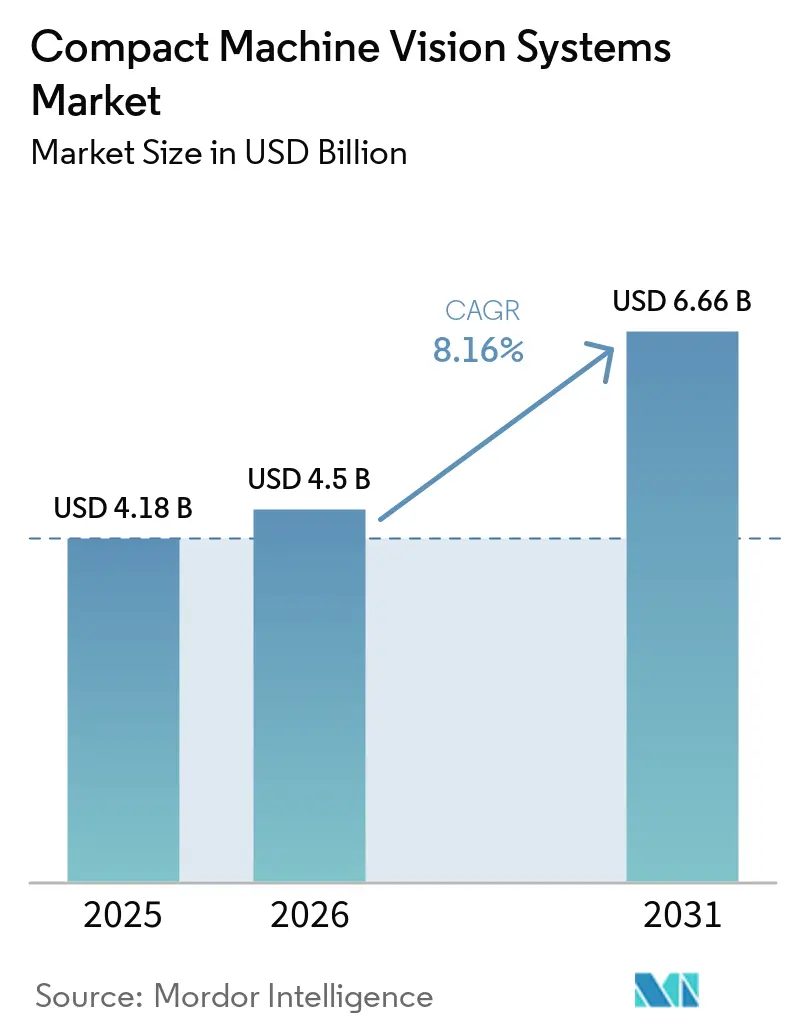
The Compact Machine Vision Systems Market size is projected to expand from USD 4.18 billion in 2025 and USD 4.50 billion in 2026 to USD 6.66 billion by 2031, registering a CAGR of 8.16% between 2026 and 2031.
Demand is supported by factory automation programs, zero-defect requirements, and a persistent shortage of trained quality-inspection workers. Manufacturers are also seeking smaller systems that can fit into high-mix production lines without separate PC infrastructure. Embedded AI is shifting more image processing onto cameras and sensors, which supports faster local inspection and reduces reliance on network connections. Vendors are responding with integrated software, connectivity, and lifecycle support because these services can reduce deployment complexity and strengthen customer retention. The compact machine vision systems market also has opportunities in regulated manufacturing, where traceable inspection records and repeatable quality controls are increasingly important.
Key Report Takeaways
- By product type, smart cameras held 38.89% share of the compact machine vision systems market size in 2025, while embedded vision systems are projected to expand at a 9.19% CAGR through 2031.
- By imaging type, 2D vision systems held 69.19% of revenue in 2025, while multispectral and hyperspectral imaging systems are projected to expand at a 10.12% CAGR through 2031.
- By application, inspection and defect detection held 40.45% share of the compact machine vision systems market demand in 2025, while guidance and positioning is projected to expand at an 8.91% CAGR through 2031.
- By end-user industry, automotive held 24.56% of revenue in 2025, while healthcare and pharmaceuticals are projected to expand at a 9.23% CAGR through 2031.
- By geography, Asia-Pacific held 39.87% share of the compact machine vision systems market size in 2025 and is projected to expand at an 8.65% CAGR through 2031.
Note: Market size and forecast figures in this report are generated using Mordor Intelligence’s proprietary estimation framework, updated with the latest available data and insights as of January 2026.
Global Compact Machine Vision Systems Market Trends and Insights
Drivers Impact Analysis*
| Driver | (~) % Impact on CAGR Forecast | Geographic Relevance | Impact Timeline |
|---|---|---|---|
| Expanding Factory Automation and Industry 4.0 Adoption | +2.5% | Global, concentrated in Asia-Pacific core markets, including China, Japan, and South Korea, and North America | Long term (≥ 4 years) |
| Rising Zero-Defect and Traceability Requirements | +1.8% | Global, with strong mandates in Europe, North America, and advanced Asia-Pacific manufacturing hubs | Medium term (2-4 years) |
| Labor Shortages in Inspection and Quality Roles | +1.5% | North America and Europe, with emerging relevance in Asia-Pacific, the Middle East, and Africa | Medium term (2-4 years) |
| Embedded AI Inference Enabling Low-Latency Inspection | +1.2% | Global, especially Asia-Pacific semiconductor and electronics clusters, North American packaging, and EV battery facilities | Medium term (2-4 years) |
| Shrinking Equipment Footprints in High-Mix Production Lines | +0.8% | Global, with high relevance in electronics and precision assembly in Germany, Japan, and South Korea | Medium term (2-4 years) |
| Edge Processing Reducing Vision-Data Bandwidth | +0.6% | Global, particularly multi-camera production cells and distributed warehouse automation in North America and Europe | Medium term (2-4 years) |
| Source: Mordor Intelligence | |||
Expanding Factory Automation and Industry 4.0 Adoption
The compact machine vision systems market benefits from factory investments that place inspection closer to production equipment. China issued an eight-ministry AI plus Manufacturing directive in January 2026 that called for machine vision and unmanned intelligent inspection across production lines. The directive also targeted 1,000 flagship AI enterprises and 500 benchmark manufacturing deployments by 2027. This policy direction embeds vision equipment in wider industrial modernization plans and supports demand beyond short-term production cycles. A 2026 systematic review identified deep-learning machine vision as a central part of Industry 4.0 quality-control workflows. The review also found that transformer-based approaches can improve the handling of complex defect shapes at production speed, supporting adoption of AI-capable compact platforms.
Rising Zero-Defect and Traceability Requirements
The compact machine vision systems market gains support as quality control becomes a supplier and compliance requirement. Automotive and medical-device suppliers increasingly need records that link inspection images, defect coordinates, and production conditions to serialized parts. A 2026 study described a compact single-camera automated optical inspection station for mixed-SKU bottling lines. The system combined defect detection, dimensional measurement, and barcode confirmation at production speed. It also generated Quality 4.0 traceability records suited to good manufacturing practice requirements. These capabilities make compact installations relevant where manufacturers need inspection, documentation, and limited floor-space use in the same production cell.
Labor Shortages in Inspection and Quality Roles
The compact machine vision systems market is supported by limited availability of workers for repetitive inspection tasks. Reshoring in North America can add inspection needs faster than employers can add trained operators. PMMI reported in 2025 that equipment makers and end users were seeking inspection tools that could operate without sustained operator training. This preference favors machine-embedded solutions that can deliver consistent checks during routine production. Labor constraints also make throughput, scrap reduction, and reduced dependence on manual review important elements of equipment selection. The resulting focus is not limited to large factories, because smaller facilities also need practical ways to maintain quality coverage with limited staffing.
Embedded AI Inference Enabling Low-Latency Inspection
Embedded inference allows image classification to operate at the production line rather than through an external PC or a cloud connection. Cognex introduced the In-Sight 3900 in May 2026 with up to 25-megapixel resolution and up to 4 times the inspection throughput of earlier systems in a PC-free design. Cognex also introduced the NVIDIA Jetson-powered In-Sight 6900 controller in April 2026 with up to 157 TOPS of AI performance.[1]Cognex Corporation, “Cognex Launches In-Sight Vision Controller Powered by NVIDIA,” PR Newswire, prnewswire.com. The controller supports transformer-based segmentation using as few as 10-20 training images. These developments can reduce infrastructure needs and help manufacturers deploy AI inspection on low-volume or space-constrained lines. They also show why the compact machine vision systems market is increasingly shaped by software and compute capability, rather than optics alone.
Restraints Impact Analysis*
| Restraint | (~) % Impact on CAGR Forecast | Geographic Relevance | Impact Timeline |
|---|---|---|---|
| Integration and Calibration Complexity | -1.8% | Global, most acute in North America and Europe where precision requirements and audit trails are demanding | Medium term (2-4 years) |
| Upfront Cost for High-Performance Compact Systems | -1.4% | Asia-Pacific small and medium-sized enterprises, South America, Africa, and the Middle East, where capital-cost sensitivity is high | Medium term (2-4 years) |
| Shortage of Machine Vision Integrators and AI Specialists | -0.9% | Global, especially North America and Europe where certified integrator capacity has not kept pace with demand | Long term (≥ 4 years) |
| Thermal and Optical Constraints in Miniaturized Housings | -0.5% | Global, with high exposure in foundry, automotive paint, and food processing lines with high ambient temperatures | Long term (≥ 4 years) |
| Source: Mordor Intelligence | |||
Integration and Calibration Complexity
Integration and calibration remain material barriers to broader deployment of compact systems. Manufacturers must manage the initial installation and the continuing maintenance of camera, lens, lighting, and software settings. The supplied evidence notes that temperature-related lens-mount movement can create positional errors above ±0.012 mm after 4 hours at 32°C ambient conditions. It also notes that some vision sensors need recalibration every 7-15 operating hours under continuous production load. Software updates can add difficulty when NPU compilers are tied closely to particular operating systems. The compact machine vision systems market consequently favors suppliers that offer documented connectivity, native manufacturing-execution-system plugins, and defined support arrangements.
Upfront Cost for High-Performance Compact Systems
High-performance compact systems can remain difficult to justify for small and medium-sized manufacturers with limited capital budgets. Standard 2D inspection can be more accessible than 3D or hyperspectral configurations because the latter require more specialized components and integration. This difference can create separate adoption paths for lower-cost smart cameras and higher-value embedded AI systems. The lower-cost category serves routine inspection tasks, while premium configurations address semiconductor, pharmaceutical, and advanced automotive requirements. Capital sensitivity is particularly relevant in South America, Africa, the Middle East, and parts of Asia-Pacific. The compact machine vision systems market therefore includes both volume-led demand for standard systems and smaller, higher-value demand for advanced configurations. This cost divide affects how suppliers position systems for different buyer groups.
*Our forecasts treat driver/restraint impacts as directional, not additive. The impact forecasts reflect baseline growth, mix effects, and variable interactions.
Segment Analysis
By Product Type: Smart Cameras Lead While Embedded AI Reshapes the Category
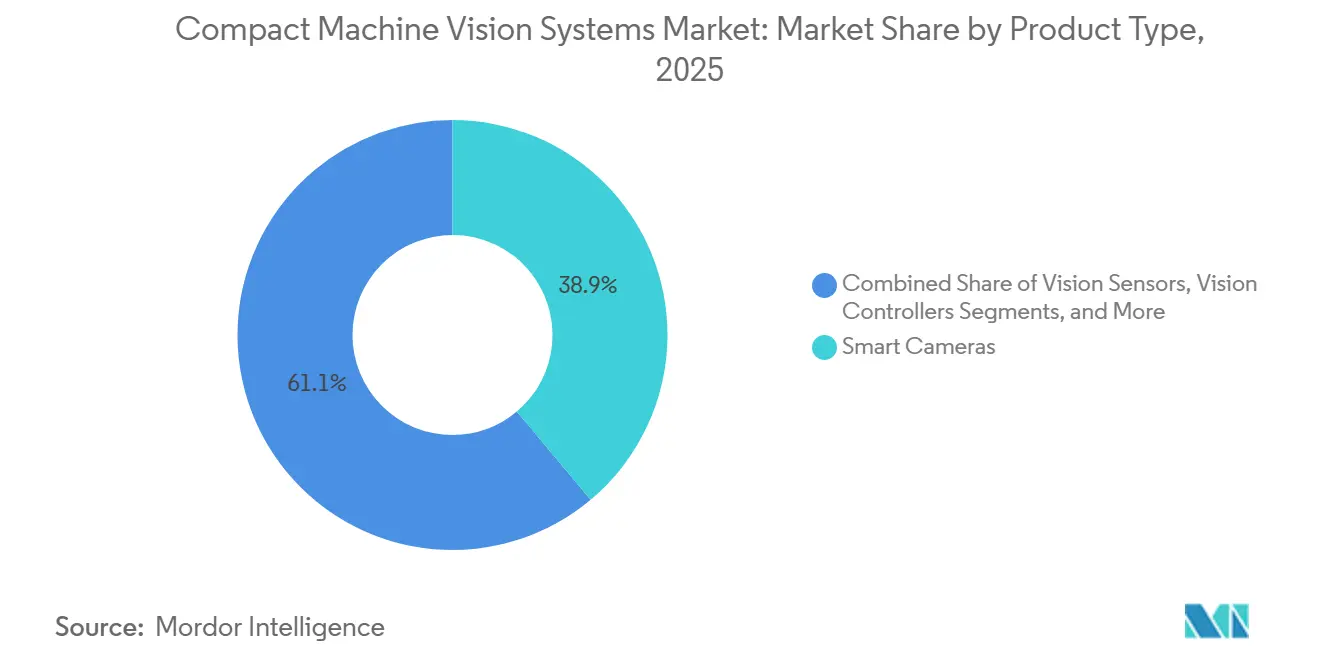
Smart cameras held 38.89% of the compact machine vision systems market share in 2025. Their position reflects the combination of optics, an image sensor, processing, and communication interfaces in one device. This structure removes the need for separate computing equipment in many routine applications. Smart cameras are widely used for defect detection and code reading on stable production lines. Their installed base is also supported by compatibility with established industrial software environments. Vision sensors serve simpler pass-fail tasks at lower price points. Vision controllers support more demanding applications that require high AI throughput, modular cameras, or flexible lighting arrangements. Cognex positioned its In-Sight 6900 controller for this need with NVIDIA Jetson technology, up to 157 TOPS, and modular camera and lighting support.
Embedded vision systems are projected to expand at a 9.19% CAGR through 2031. Their development is linked to AI inference moving onto application-specific modules that can be placed in robotic cells and conveyor-integrated positions. The compact machine vision systems market size for this category is supported by production settings where space is restricted and local processing is needed. Mitsubishi Electric and Sony Semiconductor Solutions announced Advanced Vision Solutions in July 2026 to develop AI analysis directly on the image sensor. The planned venture combines Sony image-sensor and edge-AI capabilities with Mitsubishi Electric factory-automation expertise. On-sensor processing can reduce communication between the sensor and processor. IEC 62061 safety requirements also influence embedded system design because deterministic fault responses are important in machinery applications. Line-scan cameras and 3D time-of-flight cameras retain specialized roles in web inspection and bin-picking.



By Imaging Type: 2D Vision Anchors Volume While Spectral Imaging Commands the Growth Premium
2D vision systems held 69.19% of revenue in 2025, making them the core imaging format for the compact machine vision systems market. Their technical maturity, lower cost, and broad integrator familiarity support use in surface inspection, code reading, and dimensional gauging. Edge-learning software is expanding the range of variable-appearance and texture-discrimination tasks that 2D systems can address. Cognex included ViDi Edge Learning capabilities in the In-Sight 3900 for these types of inspection needs. 3D systems serve automotive body-in-white assembly, robotic bin-picking, and electronics placement where depth information is important. Structured-light and time-of-flight systems support this work as component costs fall. The category remains relevant where a production task needs spatial information that a 2D image cannot provide.
Multispectral and hyperspectral imaging systems are projected to expand at a 10.12% CAGR through 2031. Their role is based on the ability to identify material characteristics rather than surface appearance alone. Specim described its SpecimONE system as an inline hyperspectral platform for industrial sorting and quality control. Its line-scan approach captures many spectral bands at speeds suited to conveyor operations.[2]Specim, “SpecimONE: Inline Hyperspectral Imaging for Industrial Sorting and Quality Control,” Specim, specim.com. This allows real-time chemical identification in food, pharmaceutical, and recycling operations. A 2025 scientific study found that hyperspectral imaging combined with chemometrics can serve as a process analytical technology tool for online pharmaceutical monitoring. Such monitoring aligns with the FDA’s process analytical technology guidance described in the supplied material. The compact machine vision systems market can therefore support inspection tasks that require material-level information.
By Application: Inspection Commands Share While Guidance Use Cases Gain Velocity
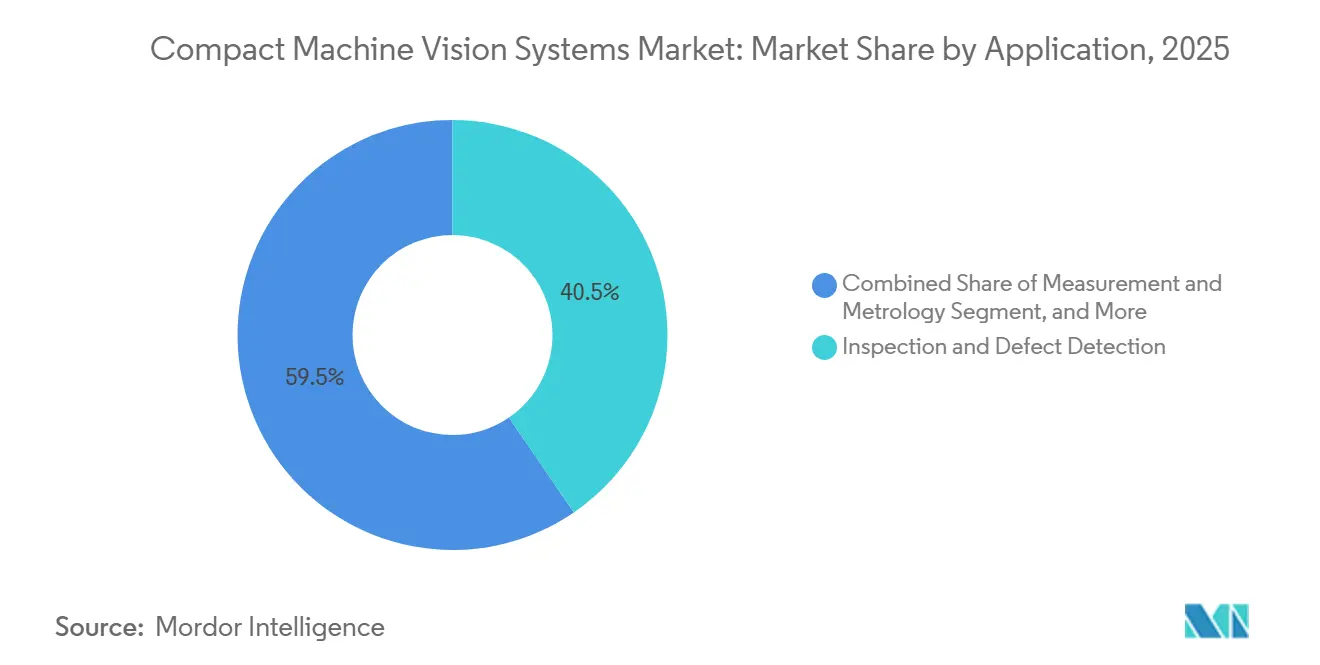
Inspection and defect detection held 40.45% of the demand in 2025. The application spans surface-flaw checks on automotive stampings, particulate inspection in injectables, label verification in beverages, and solder-joint quality checks on printed circuit boards. Its leading role reflects the availability of proven AI training data and close links with manufacturing-execution-system records. These relationships can make replacement more difficult once a plant has embedded an inspection platform in its quality process. A 2026 study demonstrated a compact single-camera automated optical inspection station that completed defect detection, dimensional gauging, and barcode confirmation in one pass. This design reduces the need for separate inspection stations and supports multifunction installations. The compact machine vision systems market continues to depend on this application because quality inspection remains a direct operational requirement across manufacturing sectors.
Guidance and positioning is projected to expand at an 8.91% CAGR through 2031. Growth is connected to collaborative robots and autonomous mobile robots that need real-time spatial awareness when parts arrive in varying positions. General Motors used its BVSeal system with cobots, gas-imaging cameras, and edge AI to identify EV battery-tray leaks at line speed. The example shows how machine vision can support guidance functions that were previously dependent on manual verification. These applications increase demand for compact systems that can operate close to robotic equipment. They also favor 3D-capable configurations when robotic arms need six-degree-of-freedom spatial information. The compact machine vision systems market has a role in this shift because compact hardware can be fitted into constrained assembly environments.
By End-User Industry: Automotive Leads While Healthcare Accelerates
Automotive held 24.56% of end-user revenue in 2025. The sector uses compact vision for body-in-white inspection and for newer EV battery production requirements. Electrode coating and stacking require close alignment control, which raises the importance of reliable inspection equipment. Automotive producers also use vision systems for surface checks, component presence confirmation, and final-assembly verification. Electronics and semiconductor manufacturing require particularly high-resolution configurations for small defects and complex packaging structures. Onto Innovation introduced the Dragonfly G5 in March 2026 for submicron 2D and 3D macro-defect inspection in advanced semiconductor packaging. The company reported that the system provided more than 3 times the throughput of the prior approach and received double-digit order commitments from a high-bandwidth-memory manufacturer.
Healthcare and pharmaceuticals are projected to expand at a 9.23% CAGR through 2031. Its demand is tied to inline inspection for injectables, blister packs, biologics containers, and other regulated products. Syntegon introduced OpaqView in 2025 for the inspection of opaque products, including dark liquids, milky products, and heavy suspensions. The system uses advanced cameras and illumination to address product types that are difficult to inspect with conventional methods. Traceability expectations also increase the value of automated records in pharmaceutical production. Food and beverage, logistics and retail, and packaging make up the remaining end-user landscape. Food processors can use 3D and hyperspectral systems where foreign-body detection and portion-control requirements call for more detailed inspection. The compact machine vision systems market serves these end-user needs through systems matched to line conditions and quality requirements.
Geography Analysis
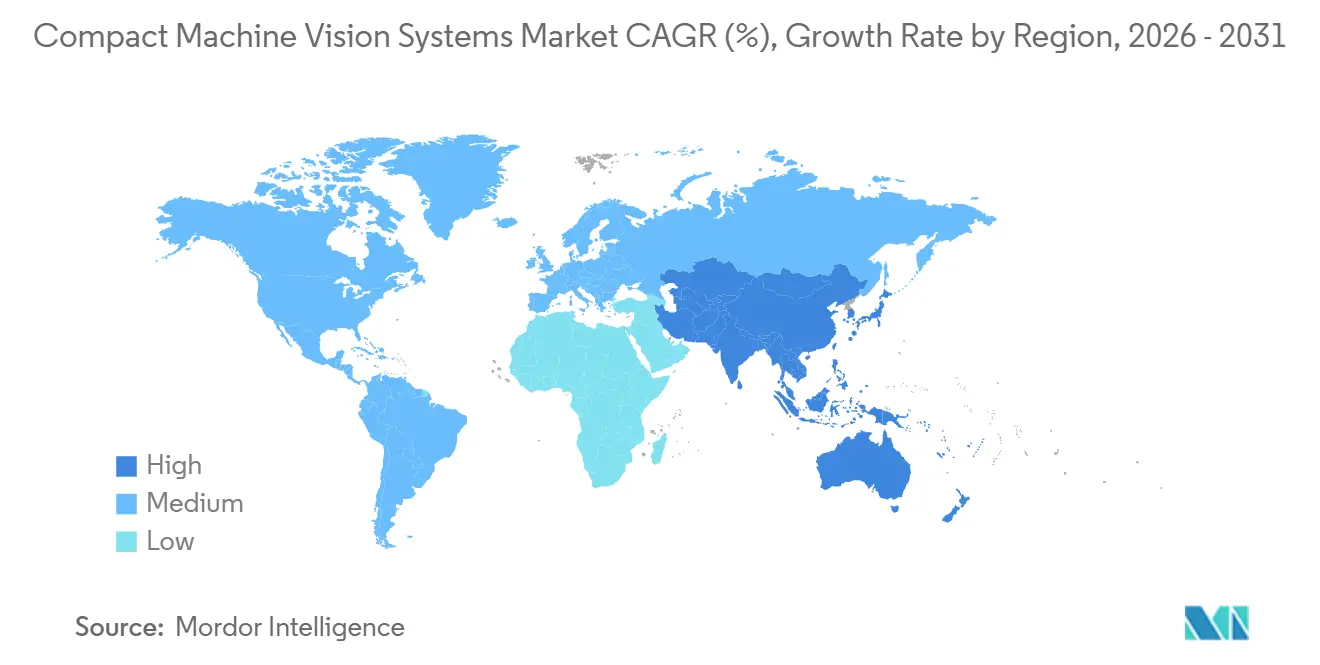
Asia-Pacific held 39.87% of the compact machine vision systems market share in 2025 and is projected to expand at an 8.65% CAGR through 2031. China’s concentration of consumer electronics, new-energy vehicles, and semiconductor production supports regional demand. The January 2026 AI plus Manufacturing policy direction called for machine vision and unmanned intelligent inspection in production lines. Japan and South Korea remain important for high-specification electronics and automotive applications. The July 2026 announcement of Advanced Vision Solutions highlighted Japanese interest in on-sensor AI vision for manufacturing automation.
North America and Europe support demand for embedded AI systems and inspection platforms used in regulated production. In North America, reshoring can increase inspection requirements while the supply of skilled labor remains constrained. Germany is a leading European adopter because of its automotive, machinery, and medical-device manufacturing base. The EU Machinery Regulation influences choices for vision systems used in safety-critical machinery roles.[3]EUR-Lex, “Regulation (EU) 2023/1230 of the European Parliament and of the Council on Machinery,” Official Journal of the European Union, eur-lex.europa.eu. Basler’s ultra-compact 25 × 30 mm vision sensor reflects the need among European machine builders for components that are ready to integrate. The compact machine vision systems market benefits when equipment suppliers place these components inside original machine designs.
South America, the Middle East, and Africa remain earlier-stage adoption areas. Brazil and Argentina support demand through food, beverage, and packaging production where inspection automation is gaining attention. Saudi Arabia and the UAE are building industrial and pharmaceutical capacity under Vision 2030 programs that include automation-ready inspection infrastructure. South Africa leads regional use in automotive assembly, where international OEM plants use vision-guided quality systems. High system cost remains a key barrier across these regions. The compact machine vision systems market can broaden its presence as hardware costs decline and local system-integration capabilities develop.

Competitive Landscape
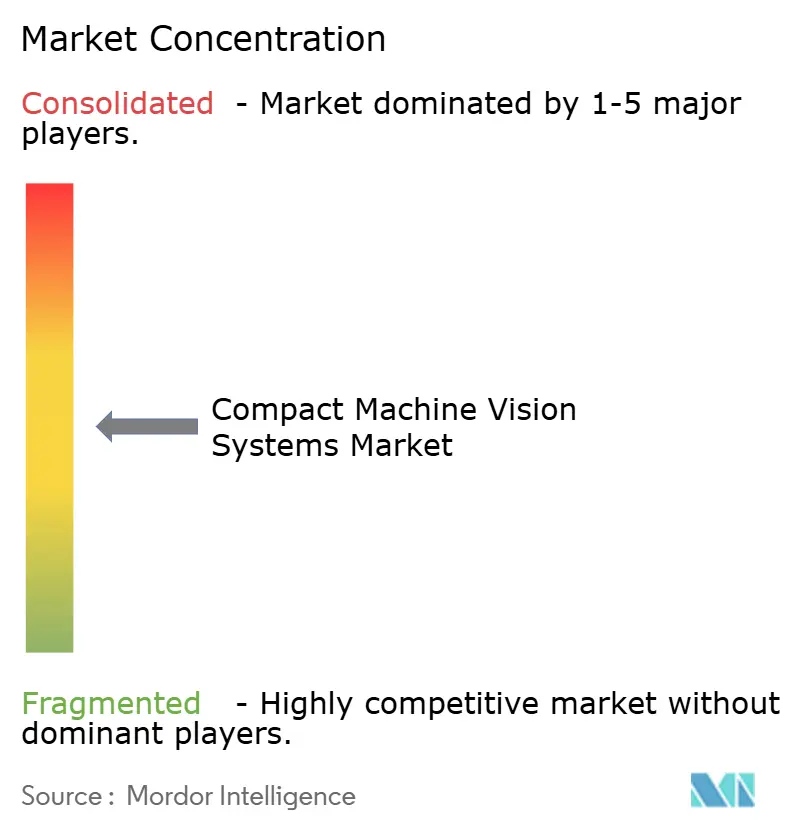
The compact machine vision systems market is moderately fragmented, with Cognex Corporation and KEYENCE Corporation holding strong brand positions. Their strengths include integrator networks, proprietary AI software, and portfolios that range from vision sensors to smart cameras and controllers. Basler AG, Teledyne DALSA, SICK AG, and Baumer Holding form a further competitive group with positions in high-resolution imaging, 3D sensing, and specialty sensor integration. Standard 2D smart cameras face price pressure, which encourages established vendors to add platforms and subscriptions. This makes software capability, connectivity, and support more important competitive factors. The compact machine vision systems market is also shaped by supplier efforts to deliver pre-integrated packages with certified PLC connections, manufacturing-execution-system plugins, and factory-support agreements.
Cognex released the In-Sight 3900 in May 2026 as a PC-free embedded AI vision system with up to 25-megapixel resolution and up to 4 times the throughput of previous systems. The company also made OneVision generally available in May 2026 as an AI vision development environment for cloud-to-edge model management. Cognex stated that more than 100 manufacturers had progressed from single-line applications to multisite rollouts since the June 2025 beta launch. It cited Essity reducing inspection setup time from more than 1 year to less than 1 day. It also cited Schneider Electric doubling yield while reducing false rejects. These moves show a strategy that combines hardware with a deployment environment that can support customer retention and broader rollout in the compact machine vision systems market.
Smaller companies compete by reducing deployment friction rather than by matching every established supplier’s portfolio. LMI Technologies, IDS Imaging Development Systems, and Vision Components use compact NVIDIA Jetson and specialized NPU chipsets for embedded 3D and 2D AI vision. Datalogic has a position in industrial code reading, while JAI A/S serves high-sensitivity multispectral imaging applications. VITRONIC focuses on transit and logistics inspection, and Chromasens specializes in high-resolution line-scan systems. Mitsubishi Electric and Sony Semiconductor Solutions announced Advanced Vision Solutions in July 2026 to pursue on-sensor AI analysis. The partnership places attention on the sensor layer and on reducing latency between image capture and processing. The compact machine vision systems market remains open to specialized suppliers that address clearly defined operational needs.
Compact Machine Vision Systems Industry Leaders
Cognex Corporation
KEYENCE CORPORATION
Teledyne DALSA, Inc.
LMI Technologies Inc.
Basler AG
- *Disclaimer: Major Players sorted in no particular order

Recent Industry Developments
- July 2026: Advantech launched the AIR-055, a compact multimodal Vision AI edge inference system powered by the Qualcomm Dragonwing IQ-9075M processor, delivering 100 TOPS of AI performance with extended-distance camera connectivity and 20+ I/O interfaces for smart manufacturing, AOI, and robotics applications.
- May 2026: Cognex launched the In-Sight 3900 Vision System, its highest-performance embedded AI vision product, powered by Qualcomm Dragonwing platforms with up to 25-megapixel resolution and 4 times the inspection throughput of prior-generation systems. The system operates without an external PC and pairs with Cognex OneVision for cloud-to-edge model management.
- May 2026: Cognex announced the general availability of OneVision, its AI vision development environment. Since its June 2025 beta launch, over 100 manufacturers worldwide used it to progress from single-line applications to multisite rollouts. Essity cut inspection-setup time from over 1 year to under 1 day, and Schneider Electric doubled yield while reducing false rejects.
- March 2026: Onto Innovation launched the Dragonfly G5 Inspection System, targeting submicron 2D and 3D macro-defect inspection for advanced semiconductor packaging with over 3 times the throughput improvement. The launch secured double-digit order commitments from a leading high-bandwidth memory manufacturer, with shipments expected in the second quarter of 2026.


Global Compact Machine Vision Systems Market Report Scope
Compact Machine Vision Systems are integrated, small-form-factor imaging solutions that combine image capture, processing, and analytics capabilities into a single, space-efficient hardware unit. Used primarily in automated manufacturing and robotics, these self-contained systems execute real-time, high-speed inspection, defect detection, and precise part alignment directly at the edge of the production line.
The Compact Machine Vision Systems Market Report is Segmented by Product Type (Vision Sensors, Smart Cameras, Embedded Vision Systems, Vision Controllers, and Other Product Types), Imaging Type (2D Vision Systems, 3D Vision Systems, and Multispectral and Hyperspectral Imaging Systems), Application (Inspection and Defect Detection, Measurement and Metrology, Identification and Code Reading, Guidance and Positioning, and Other Applications), End-User Industry (Automotive, Electronics and Semiconductors, Food and Beverage, Healthcare and Pharmaceuticals, Logistics and Retail, Packaging, and Other End-User Industries), and Geography (North America, South America, Europe, Asia-Pacific, Middle East and Africa). The Market Forecasts are Provided in Terms of Value (USD).
| Vision Sensors |
| Smart Cameras |
| Embedded Vision Systems |
| Vision Controllers |
| Other Product Types |
| 2D Vision Systems |
| 3D Vision Systems |
| Multispectral and Hyperspectral Imaging Systems |
| Inspection and Defect Detection |
| Measurement and Metrology |
| Identification and Code Reading |
| Guidance and Positioning |
| Other Applications |
| Automotive |
| Electronics and Semiconductors |
| Food and Beverage |
| Healthcare and Pharmaceuticals |
| Logistics and Retail |
| Packaging |
| Other End-User Industries |
| North America | United States |
| Canada | |
| Mexico | |
| South America | Brazil |
| Argentina | |
| Rest of South America | |
| Europe | Germany |
| United Kingdom | |
| France | |
| Italy | |
| Spain | |
| Rest of Europe | |
| Asia-Pacific | China |
| Japan | |
| India | |
| South Korea | |
| ASEAN | |
| Rest of Asia-Pacific | |
| Middle East | Saudi Arabia |
| United Arab Emirates | |
| Rest of the Middle East | |
| Africa | South Africa |
| Rest of Africa |
| By Product Type | Vision Sensors | |
| Smart Cameras | ||
| Embedded Vision Systems | ||
| Vision Controllers | ||
| Other Product Types | ||
| By Imaging Type | 2D Vision Systems | |
| 3D Vision Systems | ||
| Multispectral and Hyperspectral Imaging Systems | ||
| By Application | Inspection and Defect Detection | |
| Measurement and Metrology | ||
| Identification and Code Reading | ||
| Guidance and Positioning | ||
| Other Applications | ||
| By End-User Industry | Automotive | |
| Electronics and Semiconductors | ||
| Food and Beverage | ||
| Healthcare and Pharmaceuticals | ||
| Logistics and Retail | ||
| Packaging | ||
| Other End-User Industries | ||
| By Geography | North America | United States |
| Canada | ||
| Mexico | ||
| South America | Brazil | |
| Argentina | ||
| Rest of South America | ||
| Europe | Germany | |
| United Kingdom | ||
| France | ||
| Italy | ||
| Spain | ||
| Rest of Europe | ||
| Asia-Pacific | China | |
| Japan | ||
| India | ||
| South Korea | ||
| ASEAN | ||
| Rest of Asia-Pacific | ||
| Middle East | Saudi Arabia | |
| United Arab Emirates | ||
| Rest of the Middle East | ||
| Africa | South Africa | |
| Rest of Africa | ||


Key Questions Answered in the Report
What is the size of the compact machine vision systems market?
The sector is estimated at USD 4.50 billion in 2026 and is forecast to reach USD 6.66 billion by 2031 at an 8.16% CAGR.
Which product category led compact machine vision systems in 2025?
Smart cameras led with 38.89% of revenue in 2025 because they combine imaging, processing, and communications in one device.
Which imaging technology is projected to expand fastest through 2031?
Multispectral and hyperspectral imaging systems are projected to expand at a 10.12% CAGR through 2031.
Why are manufacturers adopting compact vision systems?
Factory automation, traceability requirements, inspection labor constraints, and local AI processing are key adoption factors.
Which end-user sector is projected to expand fastest?
Healthcare and pharmaceuticals is projected to expand at a 9.23% CAGR through 2031, supported by regulated inline inspection needs.
Which region led demand in 2025?
Asia-Pacific led with 39.87% of revenue in 2025 and is projected to expand at an 8.65% CAGR through 2031.
Page last updated on:





